Category: Reviews

  • The Inn at Little Bend by Bobbi Groover

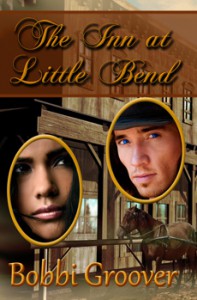
    The Inn at Little Bend by Bobbi Groover

    Hardship has followed Grayson Ridge, a motherless girl named for the orphanage that took her in, from the moment she fought for her first breath. At fifteen, fearing she’s killed the man who “adopted” her as slave labor, Grayson bolts into the wilderness, where she steals clothes and cuts her hair to become River, a homeless boy on the run. Rescued from vicious vagabonds by a kinder, gentler drifter, River attaches to taciturn Drake Somerset—temporarily, she thinks, but their history has only just begun.

    What follows is a story of false identities, gender bending, and impassioned—if at times confused—love; Shakespeare’s As You Like It served up romance-style. Grayson’s many personae end up in classic predicaments, some truly horrifying and many nearly fatal, and she and Drake spend a good amount of time patching up each other’s wounds. That is, when they’re not challenging, exasperating, tormenting, and misinterpreting each other. The author has a fine ear for natural, quick-witted dialogue, and it’s one of the pleasures gleaned from reading this well-crafted tale.

    Ms. Groover has structured her narrative against backdrops that move effortlessly from Virginia’s plantations to the West and back again, fashioning her framework with details that are as unobtrusive as they are knowledgeable. The love story is rather refreshingly old-school: this is no thin plot on which to hang a string of bedroom romps.  Instead, it is the untangling of Grayson and Drake’s many masquerades and misunderstandings that intrigue the reader, although each character’s passions are given plenty of consideration—and yes, heat.

    Despite the quintessential American settings and psyches, a whiff of “Jane Eyre” blows through: the orphanage and the search for home; the young and moral woman resurrecting the heart and soul of a man who has closed himself off in tormented guilt; the themes of forgiveness and conscience over passion. What is decidedly different: the raw, almost desperate feistiness of River, the abundant humor, and the wonderful secondary character of Aggie, whose unrequited love for Drake never stops her from being Grayson’s friend and mentor.

    The Inn at Little Bend won first place in Chanticleer Book Reviews’ Published Novels Romance Western-Mystery category.

  • NOWHERE ELSE TO GO by Judith Kirscht – Contemporary, Literary Fiction

    NOWHERE ELSE TO GO by Judith Kirscht – Contemporary, Literary Fiction

    It’s the fall of 1968 and America is in the throes of rapid social change and cultural upheaval. Martin Luther King has just been assassinated and body bags filled with 18-year-olds boys are coming back from Vietnam at an alarming rate.  Political unrest and race riots are turning cities into war zones while suburbanites try to buffer themselves against the tumultuous times.

    Nowhere Else to Go by Judith Kirscht masterfully explores these momentous national issues by humanizing them on a personal scale in the small Midwestern college town of Norton Bluffs. The intransigence of the ruling suburbanite whites along with their fears meet head on with the anxieties of the disadvantaged blacks in the halls of education—where the effects of racial polarization are most profoundly felt and magnified in small towns.

    Principal Cassie Daniels, of Red River Junior High School, relentlessly tries to carry on classes, school dances and basketball games even as she encounters the shrapnel from these social upheavals in her beloved school, in her marriage, in her relationship with her two school-aged sons, and within her professional relationships.

    Principal Daniels and the RRJH faculty have already endured the difficulties brought on by racial integration and bussing.  But just when they thought that they had made it past the worst and even came out somewhat ahead with a new wing of classrooms, the Board of Education has more in store for RRJH. It seems that with a bit of “redistricting,”  Red River Junior High, due to its location on the edge of town, can serve as a buffer zone between disadvantaged, mostly black, neighborhoods and those of the affluent white ones.

    The hoped-for, by the town’s politicians, result from this redistricting maneuver is to return a sense of “normalcy” to the town of Norton Bluffs along with the prevention of any violence like last year’s riots at the high school.  And if the redistricting isn’t enough to throw RRJH into a tailspin, The School Board is dictating to use RRJH as a social experiment laboratory for testing some educational “new-think” concepts.  Fresh new teachers have been hired by the School Board for RRJH –and this is where things start to get really interesting.  These new teachers’ tutor in ‘advanced school room theory’ is Principal Cassie Daniels’ husband.  Ben Daniels is an ivory tower burnout hoping to put a new polish on his tarnished idealistic proclivities.  He’s already selected the feisty Louisa Norton as his favorite protégé.

    Principal Daniels can’t help but worry that the escalating racial tensions in her schoolrooms will erupt into violence.  Can she keep her divided faculty members on the same page?  Will those wide-eyed kids from the Flats be able to make “the jump” from the safety of their old elementary school into the open-jawed terrors of junior high?  And just what are Ben and the confrontational Louisa really up to?

    If Cassie Daniels is the strength of the author’s energetic narrative, the teenage students are its pulse, a Greek chorus chanting under the noisy howl of the games adults play.  As expected, a great deal of this novel is devoted to these adolescents’ emotional responses. Particularly endearing are Kirscht’s portrayals of how the kids try to cope with a world that they are too young to understand. Kirscht does an excellent job telling her story from many perspectives.

    No Where Else to Go is a tenacious read that captures the grittiness of the undertow of racism and prejudice.  However, some may find the first several pages a little hard to follow as you are taken instantly into the fray of the battle, but if you hang on, you will find this dense novel to be fast-paced and hard to put down.  I heartily recommend Nowhere Else to Go as a tightly woven and insistently engaging novel about racial prejudice and the blackboard jungle of the 1960s.

  • Tree Soldier by J.L.Oakley – Historical Fiction, FDR Era Work Camp, Pacific Northwest

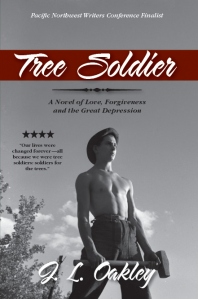
    Tree Soldier by J.L.Oakley – Historical Fiction, FDR Era Work Camp, Pacific Northwest

    In this action-packed, emotionally charged historical novel titled Tree Soldier, J.L. Oakley takes us back to the era of the Great Depression. With millions of Americans unemployed, President Franklin D. Roosevelt devised a New Deal work relief program called the Civilian Conservation Corps.

    Some three million unmarried young men went to work in CCC camps across America—building roads and bridges, establishing flood control, and replanting depleted forests. Of the men’s $30 monthly paychecks, $25 was sent to help their desperately poor families.

    Oakley skillfully weaves this history into a suspense-building story of love, forgiveness, and redemption. The story commences with the arrival in 1935 of a new squad of “Tree Soldiers” at Camp Kulshan, a CCC forestry camp in the rugged North Cascades, near the little village of Frazier, Washington.

    While most of the new recruits are sort of rough teenagers from urban New Jersey and New York, our protagonist is a college student who left school and his farm home in eastern Pennsylvania to join up.  The strong and handsome John Parker Hardesty has more than a paycheck on his mind, however. The pensive young man, who sometimes seeks solitude in the forest, is trying to escape his nightmare memories of two tragic events in his life. His fellow recruits nonetheless respect the polite, clean-cut, Park who can also hold his own in the physically competitive proving ground environment of camp life. Many of the new recruits seek out his company, especially a wiry, 18-year-old Italian kid named Mario Spinelli, who takes the upper bunk above Park. Before long Park becomes the squad’s “straw boss.”

    Camp Kulshan is no fun summer camp. The physical training is tough, camp chores are boring, and not all the Tree Soldiers are easy to get along with. The boys of “Joisey Squad” (from the Jersey accents of several) are dubbed “foreigners” and suffer some rough hazing. However, camp life is not all work and no play. The people of Frazier appreciate the camp’s contribution to the community and in friendship arrange baseball games and picnics. The Tree Soldiers reciprocate with a dance in the mess hall. Boys meet girls, sparking romance, but also jealousy. Park is drawn to the dance floor by a pretty, auburn-haired young woman, Kate Alford. He breaks in on an arrogant, self-serving camp officer, David Callister, who has his eyes possessively on Kate. As Park takes Kate in his arms, Callister stalks off the floor.

    As the story’s pace increases, so does the emotion it evokes. Suspense builds as reputations are undermined, treachery and deceit threaten lives on the verge of redemption, while storms brew and forest fires erupt. Oakley’s characters come to life as their respective roles are defined with the drama of trials and tests of wills, and determination builds. Love blossoms, but not without thorns. Friendships are solidified, and trust and support are developed in the face of duplicity and enmity. In the final pages of this compelling book, Oakley introduces one more human trait, one she saw fit to include in its title—forgiveness.

    J.L. Oakley’s Tree Soldier will draw you in and keep you turning the pages.  Tree Soldier won Chanticleer Book Reviews Blue Ribbon Award of Grand Prize in our Published Novels Contest 2012 earning it a coveted CBR star.

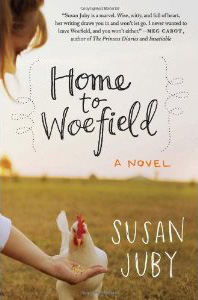
  • Home to Woefield by Susan Juby

    Home to Woefield by Susan Juby

    You might, at first glance, be doubtful about a story about poultry but don’t hesitate: This story is about way more than chickens. It will have you laughing out loud and wincing at the same time. Will the impetuous Prudence from Brooklyn, with her inheritance of worn-out Woefield Farm on Vancouver Island along with its looming foreclosure papers and its attached oddballs, ever succeed at fulfilling her dream of selling her own organic produce at the farmers’ market?

    Before long, you will soon find yourself rooting for Juby’s unpredictable characters instead of shaking your head in disbelief at their madcap antics and the ensuing mayhem. And, then, along come the chickens—who would have thought chickens could be the glue for the magic of it all?

    Juby immerses us in the endearingly hapless mayhem of her characters’ lives with their doubtful plans and out-right weaknesses: a banjo picking Earl with his crankiness and withdrawal from life, Seth with his very convoluted coming-of-age issues, a clip-board-carrying eleven-year-old girl who shows up unexpectedly on Prudence’s door step and meets challenges far beyond her years head-on, and then there is poor ol’ Bertie the depressed sheep. All of these misfits commensurate with the landscape of the barren and tattered Woefield Farm, and soon we know that they and the farm are all dependent on each other if they are to flourish.

    And, of course, there is romance! We follow Prudence again as she roars into romance in the same energetic and unpredictable ways that she faces all of her challenges with the unsuspecting, seemingly improbable, Eustace. Be ready for more laughing out loud while you are groaning  at the predicaments that Prudence keeps getting herself and everyone around her into.

    Juby’s use of the first person narrative style keeps the story immediate, enriching each character in our “mind’s eye” as each one’s perspective of the same events overlap. Her description of their thoughts and opinions is so lively and her characters such a riotous mix of people and animals that it makes you marvel you are not hearing from the chickens and the sheep, too.

    You will find yourself laughing at Juby’s wry wit and practical outlook and wishing you could look at your own life the way these characters look at each other’s lives. Her fresh humor provides lightness to their heavier issues and you will find yourself re-framing your first reactions to them as the story unfolds.

    Home to Woefield will make you think again about reaching toward the seemingly unreachable in your own life, about taking that leap of faith, and believing maybe, just maybe, some chickens will show up to make it all happen.

  • Murder One by Robert Dugoni

    Murder One by Robert Dugoni

    In Murder One, lawyer turned novelist, Robert Dugoni has conjured up an intense page-turner that deftly mixes drama, mystery and suspense that will keep you guessing until its final pages.  Dugoni’s vivid characters in his novel are marvelously believable, as are the Seattle locales that are described. (more…)

  • Big River Meadows: Eviction from Eden by W. David Jones, M.D.

    Big River Meadows: Eviction from Eden by W. David Jones, M.D.

    Big River Meadows: Eviction from Eden is a novella based on a true story written by W. David Jones, M.D.  He tells the story of his father’s boyhood—a rancher’s son growing up on a large Montana spread.  The story propounds that the vigilante law of the old West prevailed as late as 1927. (more…)

  • Borrowed Time: 75 Years & Counting by Carolyn Leeper

    Borrowed Time: 75 Years & Counting by Carolyn Leeper

    In Borrowed Time: 75 Years & Counting, A Memoir, Carolyn Leeper shares with her readers a heartwarming and uplifting memoir. Mrs. Leeper intersperses her own poetry with short prose pieces throughout her book. She recalls memorable experiences, the variety of caring relatives who raised her, and what times were like when she was young. She writes of coming of age passages and of how she continues to treasure each day—her borrowed time.

    Books and workshops abound that offer guidance to seniors and social workers in evoking life review memoirs. Mrs. Leeper’s Borrowed Time is an excellent example of a life review memoir that is well-written, succinct, and a pleasure to read.

    Leeper begins with the story of her birth, and her mother’s death just two weeks later. The tragedy is tempered by the author’s appreciation of the relatives who stepped in to raise her with love and care. Following sections focus on her early childhood memories, her grandparents, and her father, whom she did not meet until she was seven years old.

    Her pieces entitled “Money” and “More Money”—where she describes understanding the concept of money, her pride in earning it, and discovery of how to save it— would make Suze Orman’s heart sing. Leeper’s respectful attitude in regard to money reflects that of many children raised by parents who lived through the Great Depression.

    Mrs. Leeper, a freelance writer and newsletter editor in Bellingham, Washington, has a clear, conversational writing style. However, reading her memoir had me wishing that she would add more details along with expanding on her life experiences instead of the brief summaries. Clearly, she has led (and clearly, is leading) an interesting and fulfilling life. I wanted Leeper to share with me and her readers more references such as the ones about saddle shoes, the cost of candy, and how she learned to swim. These details and reference points would place her life more vividly in an historical perspective and engage the reader. And I do believe that the reader would enjoy reading more about her experiences.

    While Borrowed Time will be most appreciated by Leeper’s family and friends, it stands as an uplifting and heartfelt example of life review and life lessons lovingly rendered.

    [fusion_builder_container hundred_percent=”yes” overflow=”visible”][fusion_builder_row][fusion_builder_column type=”1_1″ background_position=”left top” background_color=”” border_size=”” border_color=”” border_style=”solid” spacing=”yes” background_image=”” background_repeat=”no-repeat” padding=”” margin_top=”0px” margin_bottom=”0px” class=”” id=”” animation_type=”” animation_speed=”0.3″ animation_direction=”left” hide_on_mobile=”no” center_content=”no” min_height=”none”][Editor’s note: Upon my first reading of Leeper’s memoir, I easily envisioned it as an illustrated children’s book that could share with young children what life was like for their elder grandparents, aunts and uncles when they were young. After my third reading, I am sure that properly “translated” it would make a cherished story for young children who are curious about how their elders dressed for prom, how much they paid to see a movie, what life was like before TV, cell phones, or computers. Her vivid description of the Seven Dancer Daughters had me imaging them in my mind’s eye. Her memoir would also impart lessons to be learned and applied in the young readers’ lives. I do hope that Mrs. Leeper will give consideration to this suggestion because I would love for my young nieces to read it if she does. ]

    [/fusion_builder_column][/fusion_builder_row][/fusion_builder_container]

  • The Winter Olympics: An Insider’s Guide to the Legends, Lore, and the Games by Ron C. Judd

    The Winter Olympics: An Insider’s Guide to the Legends, Lore, and the Games by Ron C. Judd

    Flashbacks, gruesome accounts, victories relived, analysis, and competitors’ profiles of the Winter Olympics are revealed in Ron C. Judd’s captivating compendium titled The Winter Olympics: An Insider’s Guide to the Legends, Lore, and the Games.

    Judd doesn’t just report the scores, the times, the winners and the losers. He relays the human drama that unfolds during the Games—the glorious victories and, yes, the gut-wrenching agonies—the very stuff that becomes tomorrow’s lore and legends.

    Ron C. Judd is like a Joseph Campbell of the Olympic Games. He writes of transcendent experiences, of impossible feats, and, he says, “of moments that are beyond description.”  But describing these moments is exactly what he does. Judd deftly captures and vividly relates the escalation of emotions, the split-second moments that separate the winners from the losers after decades of day-in and day-out grueling training, the sweaty reality of the Olympics along with the heady glory and magic he has witnessed and experienced first-hand.

    The guide covers the history and beginnings of the Winter Games and the athletes who compete in them. Judd, a self-professed “ring-head” has been covering the Olympics as a journalist since the Nagano Games in 1998. He has been following the Games since he was in high school, which was when the 1980 Olympics took place in Lake Placid, New York.

    Your interests about sport categories such as Curling will be piqued. Thanks to this entertaining guide, I finally understand how it is played and scored. And why it is an Olympic Winter Game. Judd also reveals tantalizing tidbits such as who are sex symbols of Curling. Yes, Curling has its idols too.

    Discover the fun facts and interesting anecdotes of the Winter Games as Judd guides you through the intricacies of rules and strategies of sports such as cross-country skiing and Nordic combined competitions. Finding out how the first biathlon races got started (Hint: It has something to do with caribou.) is just one of the reasons why this book is such a fun and entertaining guide. It goes beyond the basics of regulations and scoring.

    Judd addresses the age old debate that takes place mostly in pubs: The question of whether figure skating is a sport or an art. He describes how the Figure Skating competitions are judged or rather how they are supposedly judged.  After reading his tome, you will agree with Judd that figure skating is not for the meek or the weak.

    On that note, I was intrigued to see if he had anything to say about that Tonya Harding and Nancy Kerrigan debacle. He does. You, too, can read about the rest of the story in The Winter Olympics. 

    Judd treats his readers to the true insider’s account of “the agony of defeat” film footage.  You know—the one that was shown over and over—on the opening of ABC’s Wide World of Sports program for what must seem like an eternity to the poor guy who was filmed crashing while ski jumping. And why did we as an audience watch him crash over and over? Because as Judd writes ever so eloquently: “He is us, and we are him…” in victory and in defeat.

    The action-packed full-colored photographs that permeate The Winter Games are enough of a reason to purchase it just to have on your coffee table.  However, it is an authoritative and intelligently written reference guide about the Winter Games.  Judd continuously acknowledges that he is one fortunate guy to have witnessed firsthand history in the making. He never tires of the Games. And neither do the fans. This book is the superlative guide to the Winter Games.

    It is Judd’s insider, behind-the-scenes stories of intrigue  that entertain and educate us.  The lore and legends that he has gleaned from his years as a dedicated “ring-head” journalist, along with his effusive admiration of the dedicated athletes who compete, earns The Winter Olympics: An Insider’s Guide to the Legends, the Lore, and the Games a gold medal.


  • Blood of the Reich by William Dietrich

    Blood of the Reich by William Dietrich

    Prepare yourself for grand adventure as William Dietrich deftly blends the fruits of a fertile imagination and well-researched historical facts into a tale so well-crafted that characters and images seem to jump from the page in wide-screen 3-D. I was only 12 pages into Blood of the Reich when I became apprehensive that this hypnotic thriller would eventually come to an end.

    From the golden, autumnal splendor of present day Washington State’s Skagit River Valley to the vivid color of prayer flags waving in contrast to the stark remoteness of Tibet, you’ll be there, deeply involved, wanting more. Blood, a major player in this complex mystery, will be as red as the trees of  the Pacific Northwest are green.

    Then find yourself in 1938 when a Nazi expedition journeys to the high Himalayas to determine if there is any truth to a myth that hints  of  an ancient city located there that cradles a source of immense power—power which could accelerate their plan of world domination. Close on their heels are the Americans, bent on decoding the satanic plan. Both parties are armed and dangerous.  However, the Nazis have the advantage: a very old vial of blood.

    In a saga that spans a turbulent seventy years of action, romance and intrigue, the historian-author maintains a high level of entertainment and page turning. Dietrich’s narrative is as informative and amusing as it is boldly exciting. Be prepared to fully surrender your sense of reality to a high velocity ride that crashes head-on with a sensational blood splattered finale.

    Blood of the Reich deftly blurs the line between science and the paranormal as it exposes the veins of a twisted relationship between the human race and our own, often terrifying, technologies.  With his memorable characters, dichotomy of  modern technology and ancient Buddhist Tibetan temples,  along with non-stop action, and thrilling plot, Dietrich delivers.

  • Endangered by Pamela Beason

    Endangered drops us into immediate engagement with its story: a child goes missing, wildlife need protection right now while hunters loom, people are hurried, focused on their own lives, and fallible with their good and not-good-at-all motivations and behaviors. You will find many levels and many stories here, all combined into one.

    (more…)