Category: Reviews

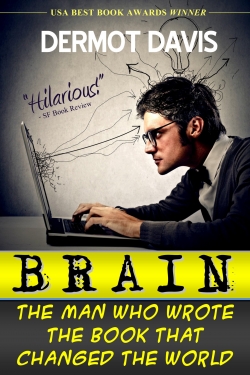
  • BRAIN by Dermot Davis, a rare species of complete entertainment

    BRAIN by Dermot Davis, a rare species of complete entertainment

    Daniel Waterstone has every intention of writing the Great American Novel, and in doing so, he is going to set the ignorant, crazy mass of modern readers straight on what constitutes great literature.  But, after two improbable, failed “masterpieces,” his publisher, the delightfully savvy Suzanne, has told him that success and recognition will best be served by his authoring a book that some of the “great-unwashed” might actually be interested in reading. Daniel likes the idea but is clueless about how to proceed.

    The product of coldly academic and overprotective parents, Daniel entered adulthood as a cynic with a dislike for people, a fear of women, and a conviction that everyone except him was crazy. He had such strong feelings of loneliness that he often thought of himself as an alien trapped on the wrong planet. Although highly-degreed in literature, the rigidly naïve Mr. Waterstone will soon learn that he is obligated to finish one final course: Life 101. And if he is willing to take his lessons, life just might have a little something up its sleeve for him.

    Daniel quickly finds a theme for the book that will liberate him from poverty and his sense of failure; he enters a bookstore where a flamboyant and somewhat other-worldly writer of self-help books is preaching his gospel to an enchanted crowd. When Daniel calls him out as an opportunistic fraud, the guru challenges him to engage in a “mind-meld” that will supposedly free Daniel from some of his hang-ups.

    Amused and seemingly unaffected, Daniel leaves the store cradling an idea for the book that will please the masses: he will write, under a pseudonym, a satire that exposes the pop-psychology industry for what he thinks it is: a total lie, an insult to crazy people done by crazy people. Ironically, his satire becomes the kind of blockbuster success that brings him riches and fame, but at a cost, as author Dermot Davis is happy to tell us all about in Brain: The Man Who Wrote the Book That Changed the World, his mystical and joyous tale of personal growth and fulfillment in the modern age.  

    “Crazy,” the word, the notion, the concept, is the spine from which flows the energy of  Davis’ often tongue-in-cheek fairy tale, its relevance grounded in the infinite variability of human  experience, and its ability to score a few points for emotion in the seemingly endless skirmish between skepticism and belief. Score more points for the stubborn and ineffective Daniel if he can revise the “me-versus-them” definition of “crazy” that has him strapped to the cheap seats of human experience.  

    And, could there be a better word than “crazy” to carry the torch of enlightenment into the shadows of our increasingly soul-less and programmed culture?  Probably not, at least in Davis’ jauntily addictive narrative, an arena in which he holds court with the majesty of an imaginative, accomplished humorist.

    I was not surprised to learn that the author is also a playwright, as his marvelously crafted characters and sets quickly acquire the kind of three-dimensional believability that one expects to encounter in a live theatrical performance or, according to my mind’s eye, a movie (complete with an endearingly haunting soundtrack and a reincarnated Jack Lemmon in the lead role!).

    Dermot Davis’ Brain is that rare species of complete entertainment that can be both deeply philosophical and buoyantly accessible. Laughs, suspense, intrigue, love, and a gentle thread of the paranormal are all there for you, gift-wrapped in a sweet mist of serendipity.  


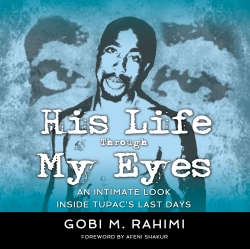
  • HIS LIFE THROUGH MY EYES by Gobi Rahimi

    HIS LIFE THROUGH MY EYES by Gobi Rahimi

    In the early ‘90s, up-and-coming artist Tupac Shakur was taking the rap industry by storm. Known for his electric energy and controversial lyrics, his music focused largely on social injustices and oppression. Equally notorious for the brilliance of his music and for his frequent problems with gang violence and the law, he accrued a large and passionate community of listeners and fans. When he was killed in a drive-by shooting at the young age of 25 in 1996, his legacy as a well-known and respected voice within the genre lived on.

    In the book His Life Through My Eyes, filmmaker Gobi Rahimi, who worked continually with Tupac in the months preceding his death, offers a unique glimpse into the artist’s day-to-day life. Sparing no detail, Rahimi takes the reader on an intimate and emotional journey through his memories of the times spent with Tupac, aided by photographs he took during the time. Rahimi tells the story of how he came to work with Tupac and become his close friend.

    This book is shamelessly personal; it is as much about Rahimi’s journey to process Tupac’s  death and honor his legacy as it is about Tupac himself. This is to Rahimi’s credit, though. What might otherwise feel like a series of empty anecdotes is bonded by Rahimi’s laudable honesty and openness with regards to his grief and admiration for Tupac.

    Rahimi touches on the sociopolitical controversy and turmoil that surrounded Tupac during his life, and does not gloss over Tupac’s struggles with racism in the music industry. However, his focus is much more on Tupac as a human being than as a public figure. Rather than recounting details of his friend’s public persona, he centers on portraying the man he knew.

    In many ways, the book reads very much like a series of diary entries. Some may find Rahimi’s accounts somewhat chaotically organized, but overall the stories provide captivating, interesting, and thought-provoking insights into Shakur’s life. Rahimi’s respect and love for his friend ultimately shine through. Engaging, personal, and deeply felt, Rahimi’s tribute to Tupac Shakur will be sure to move those interested in his legacy.

  • BAD VAMPIRES by Karl Larew, a humorous new take on vampires

    BAD VAMPIRES by Karl Larew, a humorous new take on vampires

    Karl Larew is well known for the depth and breadth of his knowledge in the field of military history, both in academic works and in historical fiction.

    Well, as you might imagine, Bad Vampires has nothing to do with world politics and war, or even reality on the home front. Rather, this versatile author has chosen to entertain us by delving into the practices of the netherworld of 19th-century vampirism, BUT, as it exists in the modern world—the difference being that, today, there are both Bad Vampires and Good Vampires. This is a modern fictional account, and one designed to make you chortle instead of scream. It is a hilarious and refreshingly fun read!

    Rather than a single locale in Transylvania, the vampires in this tale travel from New York to our nation’s capital and its Virginia suburbs, then Hollywood, and on to Hong Kong, and back and forth, in multiple trips, logging who knows how many thousands of miles.

    The 19th-century vampire’s vicious bite and suck method has evolved into a variety of means for the nourishment of vampires. Among Bad Vampires, the process can still end in, well, the end for the blood donor. Good Vampires, however, take care not to let this happen. Further, the New York Association of Good Vampires has rules regarding the infliction of mortal wounds by other means (pistols seem to be the most popular). In any case, Good Vampires are the winners, Bad Vampires are the losers. Bad Vampires have no imagination and can’t put a bullet in the side of a barn, whereas Good Vampires are ingenious in their strategies and never miss a target, even with one hand tied behind them.

    This tale is either carried along or interrupted by outrageously corny puns, double entendres, and other linguistic contrivances designed to tickle the characters and amuse the readers. Larew obviously enjoyed drawing these from old TV shows: Bad Vampire Elmer wants to make a movie about vampires in New York City—”Sucks and the City” it gets labelled by a Good Vampire; another Good Vampire calls the Head Vampire about a new idea. The CHIEF tells him, “GET SMART! I could say that 99 times and still not have said it enough!” Do any readers remember “Henry Aldrich” (Hen-reeeeeeee) on the radio? No? Never mind.

    It’s hard to develop the character of a vampire. In this story, some are good and some are bad. Protagonist Lance Blodgett is a good one and smart as well. In his day life, he’s an assistant professor of anthropology at New York University, specializing in East European folklore. He has a tender streak and loving heart, which he very soon gives to Carol Binghamton, who isn’t a vampire.

    Carol, a computer programmer, finds herself reciprocating Lance’s feelings. She even offers him breakfast, if he’ll bite her where it won’t show. Lance tells her that biting is “too painful and leaves a big bruise. We use little spring-powered lancets, like diabetics use for blood sugar tests.” She kindly offers him a rump.

    I wouldn’t want to spoil the story for you—just give you a taste that hopefully will tempt you to try it yourself. You might say, as Lance did after breakfast, “Oh, very good—[it has] a sort of tangy je ne sais quoi.”   

  • DESTINY’S SECOND CHANCE by Kate Vale, a heartwarming women’s fiction novel

    DESTINY’S SECOND CHANCE by Kate Vale, a heartwarming women’s fiction novel

    Two decades ago, librarian Isabella Campbell made the wrenching decision as a young, unwed mother to put her newborn child up for adoption. Though Bella wanted to keep her daughter, her rigid and disapproving parents insisted that a child needed both a mother and a father, not a single, inexperienced, teenage mother. Bella reluctantly agreed, but only if she was allowed to receive regular updates from the adoptive parents. The parents complied for a short period of time, but then Bella heard nothing more from them.

    Upon returning home from a business trip, Bella finds a letter from her daughter’s adoptive father, Nolan Harris, giving her permission to contact Destiny, who is now twenty-one. Bella is instantly thrown into emotional turmoil, thrilled yet very apprehensive. Would Destiny even want to meet or talk to her? Had her daughter’s adoptive mother, who had always disapproved of keeping Bella in their lives, continue to be a roadblock? And why had Nolan Harris chosen this moment in time to contact her after all these years?

    With a deft hand, author Kate Vale weaves this stressful, yet welcome complication into the daily events of Bella’s busy life—the distressing illness of a close friend who runs a local bookstore, the difficult relationship with her mother, who has never let Bella forget about her “little mistake”, and, of course, the new romantic interest in Bella’s life, Gavin, the nephew of her elderly ill friend. The result is a compelling novel rich in detail, heart-warming in its delicate yet realistic portrayal of the impact of adoption on all the lives it touches.

    Vale has a real talent for drawing characters one wants to get to know, and for understanding the emotional impact of the events that shape our lives. Destiny’s Second Chance draws the reader in from the very beginning, providing a thoughtful and satisfying story about people who feel like close friends.

    Life is messy, and life-altering decisions are never just good or bad, but rather create a mixture of emotions that run the gamut from satisfaction that one perhaps made the right decision, to guilt or despair over the toll that decision has taken in the intervening years. Vale understands this, and has described these conflicting emotions beautifully.

    This book will stay with readers long after they put it down. Highly recommended for those who enjoy women’s fiction and stories of family relationships.

  • ENEMY of EXISTENCE by Yuan Jur, a science-fiction novel

    ENEMY of EXISTENCE by Yuan Jur, a science-fiction novel

    Brimming with a fully dynamic set of characters and otherworldly energies, Enemy of Existence is the strong and inventive debut novel that introduces Juan Yur’s science-fiction space opera series Citadel 7.

    Uniss and Dogg turn literary style on its head by greeting and then involving the reader in their story. Coming to Earth from the Superverse, they home in on 1960s outback Australia to seek out and commandeer the help of young Ben Blochentackle.

    Uniss and Dogg engage and prepare Ben for the realities of the Superverse until he is able to digest the psychological and physical demands of the looming war. At the same time, Uniss and Dogg must find a way to satisfy the coercing unit of the Evercycle council, who are the creators of existence.

    Ben’s human life changes forever when he joins Uniss and Dogg, right when he’s about to disclose his feelings towards his lady friend. Dogg’s painful timing in bringing Ben out to the Superverse is made worse when both Uniss and Dogg come to realize that Ben might not be who they thought he was. The reader finishes Enemy of Existence deeply satisfied but simultaneously left with many questions about what the future holds for the characters.

    Yuan Jur utilizes his skillful craft of writing as he uses different perspectives throughout the book to open up various characters and their environments to the reader’s viewpoint. This particular development in Yuan Jur’s writing provides the reader with a well-rounded insight into the Superverse. The author is no stranger to breaking conventional norms with his quirky, unique writing style that will captivate readers.

    Enemy of Existence breaks new ground in the science-fiction universe as readers are required to actively participate in unraveling the novel’s plot.

  • TARNISHED HERO by Jim Gilliam, a military thriller

    TARNISHED HERO by Jim Gilliam, a military thriller

    Tim Kelly grew up in 1960s Galveston, Texas, a border city with a long history of being terrorized into lawlessness by drug cartels from Northern Mexico. He left home at the age of fourteen to escape the unacceptable behavior of a ne’er-do-well father. While conjuring up his street smarts, Kelly learned about the value of  choosing loyalty to friends over that of authority from a couple of highly disparate mentors: Rodolfo Guzman, a cartel leader, and Dave Holt, a local sheriff.  

    Kelly shouts the sixties mantra of “question authority” with the consequences-be-damned recklessness of a young man who will  be true to his heart, even if it lands him into chaos. Indeed, trouble will stick to him like maggots to a dismembered body in Jim Gilliam’s sweaty guns n’ ammo action thriller Tarnished Hero.

    As a Petty Officer in the United States Coast Guard, Kelly demonstrates his lack of respect for authority with extreme prejudice, enough to land him in a courts-martial. It is only with reference to his acts of bravery in Vietnam that his defenders are able to keep him out of prison.

    That will not be good enough for his accusers who, in a wink toward the military-industrial complex, decide to splice this knowledge of his grace under pressure into an offer that he cannot refuse: Kelly can walk free after completing the dangerous mission of infiltrating and destroying a drug cartel, that of Rodolfo Guzman, the man who had always been like a father to him. At the same time, Kelly’s fiancée is in a coma after becoming collateral damage in a brutal combat between the Campechee and Sineloa drug cartel.

    It is when Kelly accepts an open invitation to spend some time in Guzman’s drug palace in Northern Mexico that his code of “trusting friends first” will force him to face not only the dilemma of a loyalty to be divided between Guzman and Dave Holt, but also of being thrust into a senseless and bloody border war that has more than a few parallels to the Vietnam conflict. As such, Gilliam’s novel stands not only as a complex and intriguing “band of brothers” romp, but also as a reflection on the evils of unquestioned authority and corruption.

    Tarnished Hero is abundant with colorful heroes and villains. The author is deft at offering them various poses on his good-guy to bad-guy continuum and he paces his quick narrative with enough twists and surprises to sustain interest.  However, it is important to point out that this will be for most people a “guy” book, one that offers up the kind of violence and gore that its subject requires for credibility. Also, readers are warned that some female characters are portrayed as rather one-dimensional boy-toys, perhaps as a nod to that common stereotype of the era.

    That being said, Tarnished Hero is a thriller  that can more than holds its own as an engrossing entertainment for fans of the genre.

  • THE MAVERICK EFFECT by George Verdolaga,  a step-by-step motivational guide

    THE MAVERICK EFFECT by George Verdolaga, a step-by-step motivational guide

    Have you ever wondered what makes you different from others? Why you’ve always had the urge to “go against the herd”? Why the “popular” kids who snubbed you in school seem to go nowhere after graduation, while you still have an urge to accomplish something great, no matter what it takes? It may be the Maverick Effect, an intriguing theory conceived by entrepreneur and self-styled maverick George Verdolaga.  

    Verdolaga makes an important distinction between “mavericks” and “hipsters.” Hipsters look cool, revel in their popularity, but fade out fast—because they are really only followers, chasing the latest trends in fashion or tech. Mavericks are the ones who actually establish those trends.

    People with maverick personalities may have a hard time at first, driven by weird artistic and intellectual interests that set them uncomfortably apart. However, they are the real winners, Verdolaga asserts, once they realize their true potential, “finding their way over, around or under” the barriers that society has put in their path.

    The author gives many pertinent examples of the maverick effect among unusual people throughout history: Pythagoras, Caravaggio, even Jesus, were ahead of the curve, misunderstood and scorned by the conventional thinkers of their day. J. K. Rowling was a divorced single mom living on welfare when she conceptualized Harry Potter and his magical universe. Steve Jobs, Bill Gates, Steven Spielberg, all were considered nerds when they were young. People destined for maverick greatness never say, “I give up,” “It’s too hard,” or “I’m too busy.” They aren’t distracted by what the crowd wants, but rather, “fearlessly embrace challenges and become the catalysts that spearhead the new initiative for change.”

    This motivational guide is organized with business-like competence by someone who has “walked the walk”—Verdolaga left the family business his parents had built for him, choosing instead to carve out his own highly lucrative path through the corporate world.

    He offers sound, step-by-step advice for those willing to break out of their comfort zone every single day to promote their groundbreaking ideas. He sets forth, with numerous case studies and a lengthy bibliography, the skills needed to manifest the maverick effect: “overnight success” can take years, so persistence is essential, along with training in public speaking to convince others of the feasibility of one’s projects.
    Words of wisdom from a successful pacesetter, The Maverick Effect will inspire the hidden innovators among us to invent, initiate, and innovate.

  • BLUE: a novel by Kayce Stevens Hughlett – transcends genres with its complexity of story and psychological suspense

    BLUE: a novel by Kayce Stevens Hughlett – transcends genres with its complexity of story and psychological suspense

    This lyrically written, beautiful story of three emotionally broken yet connected women begins in present day, illustrating the current struggles each faces to simply hold it together and get through each day. The tale then slowly unravels—as these women’s lives unravel—to reveal the mystery in their past that connects them.

    We meet Izabel—a young woman who arrived on Shaw Island in Washington State without any memory of her life up to that point. Taken in and cared for by the nuns, she then trained as a doula, a birthing coach. Izabel now lives on Orcas Island and is a valued member of the community, but it soon becomes apparent that she is struggling with the re-emergence of repressed memories.

    As those memories surface, her current life begins to deteriorate: She dreams of a teenage girl, experiences birthing pains after a particularly difficult night with one of her clients, and almost melts down in a coffee shop when a name mentioned by a friend sounds horribly familiar. Izabel knows that she must deal with whatever is happening to her and turns to a close friend and mentor for help.

    Not far away in Seattle, we meet Monica, a single, clinically depressed woman with a closeted addiction. Her life is unraveling, and she has no idea how to put it back together. Through a sequence of events she meets Jack, a psychotherapist, who cares deeply about her and supports her as she grapples with overcoming her problems.

    And Daisy dreams in shades of blue about the fantastical world of Tausi in which creatures talk about philosophy and an evil master is plotting her demise. Is she having a near death experience? Or is she really dreaming? Where is she?

    Kayce Stevens Hughlett has used her extensive background in therapy and as a life coach to create a novel about the deeply rooted psychological connections between all of us. Blue is a story that is at times wonderfully whimsical, and at others, poignant, heartfelt, and even suspenseful.

    But most of all, it is an uplifting tale about how three women who have spent years only half alive and struggling, and who, with the help of a supportive network of friends, eventually deal with past traumas and are able to find their way back to each other.

    Blue transcends genres with its complexity of story and psychological suspense. It would not be a surprise if it appears on Oprah’s Book Club list. A poignant, inspiring tale of three women, emotionally damaged by the events of their lives, who ultimately find their way back to each other.

  • MURDER AT THE LEOPARD by R.M. Vassari and Lucia Olivia Lampe, a historical mystery novel

    MURDER AT THE LEOPARD by R.M. Vassari and Lucia Olivia Lampe, a historical mystery novel

    Many times, collaborative efforts by authors—especially with regard to their debut novel—suffer from fledgling attempts to master both the craft and the melding of two writing styles. Not so for this stunningly well-written, debut historical mystery.

    Murder at The Leopard, the first book in the Vespers Series set in Palermo, Italy during the thirteenth century, brings to life a fascinating time in European history. Vassari and Lampe have captured the essence of this era, providing a wonderfully complex tale of greed, past betrayals, revenge, and murder.

    With a deft hand and a talent for storytelling, the authors introduce you to a rich cast of characters, from local tavern owners to spies under the employ of a despot ruler. A simple farmer and his very pregnant wife travel to Palermo, hoping that God will grant their wish for a boy.

    A long-lost brother, an old crusader who has returned home after decades and harbors old secrets, accompanies them. A wealthy merchant sends his ne’er-do-well nephew to guide them on their journey whilst placing him under orders to spy on King Charles’ preparations for war. Local tavern and inn owners hope for good commerce during the upcoming Holy Week celebrations. Against this backdrop, an engaging and entertaining murder mystery unfolds.

    The main heroes of the Vespers Series are the tavern owners Ysabella de Rogerio and her charming husband Amodeus. In this first novel, they’ve timed the opening night of their new neighborhood tavern with Holy Week, to take advantage of the pilgrims who are flooding into Palermo. Unfortunately, the religious holiday also brings together old enemies, and the celebrations at The Leopard quickly turn serious when a wealthy merchant, Ludovico, is murdered. The sheriff arrives, and after a brief investigation, wrongfully arrests Amodeus for the crime.

    Soon after, a second murder occurs, further jeopardizing the reputation of The Leopard and the life savings Ysabella and Amodeus have poured into their tavern.

    It’s up to Ysabella to prove Amodeus is innocent, find the real killer, and save their business. As she begins to dig deeper into the lives of those involved, she uncovers past betrayals, greed, a thirst for revenge that hasn’t faded in the forty years since the Crusades, and even the dirty deeds of spies working to topple the current king.

    Vassari and Lampe have employed accurate historical detail—along with likable and complex characters that quickly become old friends—to give readers an entertaining and engaging read from the very first page. Highly recommended for those who love historical fiction or a good rousing mystery!


  • SECOND CHANCE by Linell Jeppsen, a western thriller

    SECOND CHANCE by Linell Jeppsen, a western thriller

    In the early years of the twentieth century, the northern woods of Idaho were known for their booming mining towns. Families filed and worked claims, hoping to make a decent living and create a home for themselves on the Western frontier. Unfortunately, those booming mining towns also had their fair share of crime. Claim jumping, the violent practice of stealing valuables and producing claims, was commonplace.

    In the fifth book of The Deadman series Second Chance, Linell Jeppsen uses this fascinating setting to craft a story about a trio of rich and powerful men who have made it their goal to acquire mining claims in Wallace, Idaho, using whatever means necessary. The local miners and their families who get in their way tend to end up dead.

    Matthew Wilcox, recently retired from law enforcement, has established a new detective agency with his son, Chance. He and Chance are just coming off their first case, a successful sting operation against an illegal boxing scheme. Matthew is looking forward to some relaxation and training sessions with a new stallion they’ve acquired. But the newly installed telephone rings, and the news on the other end isn’t good: Matthew’s lady friend, Annie Thurston, has been nearly beaten to death and her friend is murdered.

    This new case, Matthew quickly learns, is larger in scope than what he and Chance have handled in the past. What begins as a series of relatively simple-looking claim jumps and acts of violence  in the Northern Idaho woods ends up stretching all the way to the playgrounds of the rich and powerful in Seattle. The Wilcoxes are up against very powerful, very connected, evil villains.

    Jeppsen has written a fast-paced, entertaining historical mystery set in the Northwest in a timeframe that is unusual for the western genre—the early twentieth century.

    Using extensive research and her in-depth knowledge of the area, she provides an authentic blend of mystery and western genres, plenty of action, and even a bit of romance. Her ear for the vernacular of the time is dead-on, and her knowledge of the locales, from Idaho to Puget Sound, is clearly extensive.
    Readers will be drawn to the characters from the very beginning, and will enjoy spending time with them again as they take on a trinity of bad guys.  The Deadman series is an action-packed, engaging blend of western and mystery fiction not to be missed.