Category: Reviews

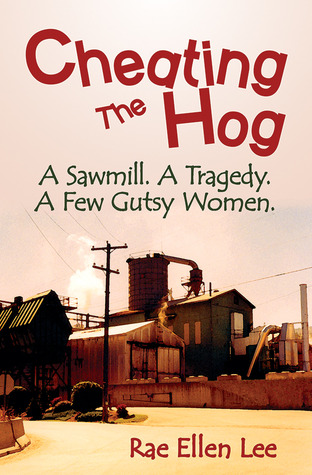
  • CHEATING THE HOG: A Sawmill. A Tragedy. A Few Gutsy Women by Rae Ellen Lee

    CHEATING THE HOG: A Sawmill. A Tragedy. A Few Gutsy Women by Rae Ellen Lee

    When her bell-ringing employment for the Christmas season ends, Echo Spangler tackles a higher paying job demanding heavy physical labor—one at the local saw mill that is known for paying above minimum wage, but is perilous to one’s limbs.

    Male bosses and a few male co-workers conspire to force her to quit, adding to the daily “business as usual” danger. But she needs this job to pay her bills, and she’s determined not to let the jerks get the best of her. Rae Ellen Lee’s novel Cheating the Hog  is full of snappy writing that conveys the groaning of Echo’s muscles, while also showing her bravado and joy of simple pleasures against her taunting male co-workers.

    Echo presents a gutsy hard crust to her bosses and the men lording over her in the sawmill, but reveals her big heart to three female co-workers, her mother, and old friends. Danger ramps up beyond the job when she tries to help the women escape domestic violence.

    Readers will be engrossed in Lee’s lively narrative style; learning along the way about the workings of the sawmill machinery the fatal chaos it may bring if things go wrong. Lee also brings us to life outside the mill. Echo’s homelife includes her gun-toting mother, but Echo still carries the hopeful sparks of romance in her heart; even if she has to deal with prissy women and thick-skulled men.

    This engaging story shows the life of gutsy women on the sharp edge of poverty–with no extra education­­ and none of the advantages of a relatively carefree upbringing. The author immerses the reader into Echo’s daily life and demonstrate how such women experience the hardships relentlessly tumbling their way, enduring a male-dominated work culture, and living through its dangers. The book’s overarching theme encompasses underprivileged women who work hard, laugh hard, love hard, fight hard, and never give up. They forgive when they can, all the while struggling to show courage against odds most readers hope they will never face.

    People busy with their own lives don’t often give much thought to the hard and dirty jobs millions of men and women do every day. The author shows how (and why) many working folks muster the ability to face danger, fear, and death daily on the job. When readers turn the last page, they’ll be glad that they read the entertaining and enlightening Cheating the Hog engagingly written by the talented Rae Ellen Lee.  


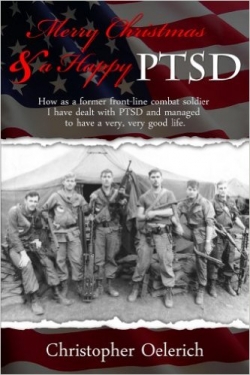
  • MERRY CHRISTMAS AND A HAPPY PTSD by Christopher Oelerich, a guide for PTSD sufferers

    MERRY CHRISTMAS AND A HAPPY PTSD by Christopher Oelerich, a guide for PTSD sufferers

    “I went away to war one person and came back another, and in my wildest dreams would never have chosen to be the one who came back.” – Christopher Oelerich

    Thus begins this heartfelt discussion of Post Traumatic Stress Disorder by a military veteran who has spent his life helping others deal with the debilitating symptoms associated with the disorder. Christopher Oelerich relates his own personal history, beginning from when he was drafted into the military during the Vietnam War, and continuing through his return to civilian life and his own rocky road to recovery.

    Oelerich eschews political correctness in favor of blunt talk mixed with detailed, empowering strategies that have worked for him, as well as for the military veterans and homeless he has helped over the years.

    PTSD is defined as an anxiety disorder that can be brought on by various types of traumatic events, such as combat in war, extreme natural disasters (hurricanes, tsunamis) or terrorist attacks, the psychological aftermath of which manifests in a range of symptoms—nightmares and flashbacks, alcoholism, drug use, and phantom pain, to name only a few.  Because of these varied symptoms, Oelerich points out that the disorder can easily be—and often is—misdiagnosed by physicians. PTSD also affects women at twice the rate of men, a fact little understood by the general public.

    Oelerich believes that the most important, brutal truth he has learned over the years is that if you are suffering from PTSD, and don’t care to help yourself, no one else will either. Once you accept that underlying truth, he advocates that you must also be willing to employ the discipline and mental toughness required to get through the long process of healing.

    He shares strategies that he has used and also ones that he has implemented in his work with vets and the homeless to deal with PTSD in the hope they will be able to  lead more  productive and meaningful lives. Mixing discipline, advice about dealing with problems one at a time, the healing power of prayer, and many of the tenets employed in drug and alcohol abuse programs, the author crafts a comprehensive program to effectively survive and deal with the disorder.

    The author has given PTSD sufferers a gift by providing an honest account of his own struggles, as well as what he did to eventually overcome them. For those who suffer from PTSD, understanding that they are not alone and that they can help themselves is a huge step toward embracing a recovery program. Oelerich, who has experienced combat and traumatic events, wrote this book as a “How To” guide for combat soldiers, like himself, who suffer from PTSD.

    Merry Christmas and a Happy PTSD by Chris Oelerich is highly recommended for those who suffer from PTSD, for the family members and friends of those who suffer, and for those who are simply interested in having a greater understanding beyond what is reported in the popular press about this debilitating disorder. Oelerich’s methods to overcome PTSD are plain-spoken and practical, with an  overall message of optimism for those with PTSD.

    This is a very personal, no-holds-barred, yet ultimately, empowering discussion of PTSD and its effects on those who suffer from it. The author hopes that Merry Christmas and a Happy PTSD will be used as a tool to reduce PTSD symptoms in others who suffer from it so that they, too, can live healthier and happier lives.

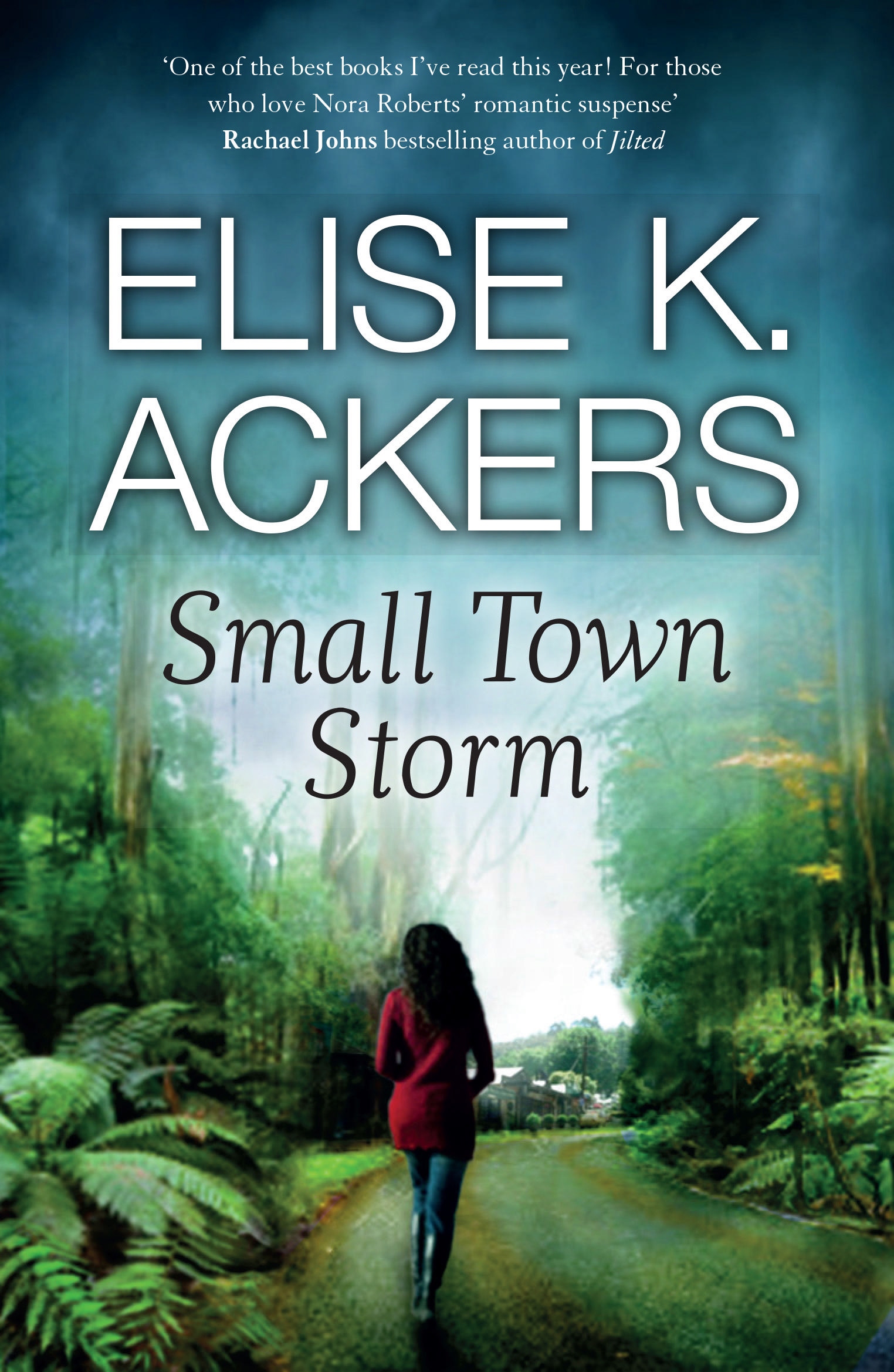
  • SMALL TOWN STORM by Elise K. Ackers – a chilling and dark contemporary thriller

    SMALL TOWN STORM by Elise K. Ackers – a chilling and dark contemporary thriller

    Aptly titled, Elise K. Ackers’s Small Town Storm is an intriguing and electric mystery set in contemporary Olinda, Australia. Jordan Hill and Erica Lawrence were inseparable childhood best friends until one fateful night when Erica’s family was torn apart and Erica disappeared without a trace.

    Jordan has always assumed she died. Nineteen years later, Jordan is the new senior constable in his hometown. He has several issues to contend with, including catching up on the small town gossip he has missed out on over the years while living in Melbourne. But when he runs into Erica, a ghost from his past, things take a turn for the worse.

    Erica, too, is newly returned to Olinda, taking a position as a veterinarian in the same town where she disappeared from all those many years ago. Jordan, who has spent years devastated by her supposed death, is shocked and angry when he encounters her—doesn’t she understand the pain she caused him? Erica, too, is saddened by Jordan’s less than warm response. To make matters worse, a murder has shaken the peaceful town and Erica is the sole suspect. Erica and Jordan must put aside their differences in order to find answers.

    Ackers takes a fascinating premise and enlivens it with sparkling dialogue, small town details, and excellent characterization. Readers will be immediately captivated by both the mystery plot and the burgeoning romance between Erica and Jordan.

    Additional layers of intrigue surrounding why Erica left town nineteen years before and what happened to her family add depth and complexity to the plot. Even secondary characters are well-drawn, lending the story an authentic voice and making the menacing plot palpable and chilling. The novel moves at a brisk pace ratcheting up the suspense level to a crescendo on all fronts. Fans of mysteries and suspense novels will be sure to be captivated by Small Town Storm, but be warned that this is a darker mystery complete with serial killers and gruesome acts.

    Fans of mysteries and suspense novels will surely be captivated by the engrossing Small Town Storm, an intriguing and well written mystery page-turner that will have you double-checking your locks and looking over your shoulder. Elise K. Ackers is certainly one to watch.


  • ANGELS OVER YELLOWSTONE by Elisabeth Ward – a richly drawn saga

    ANGELS OVER YELLOWSTONE by Elisabeth Ward – a richly drawn saga

    An atmospheric picture from American frontier history, Angels over Yellowstone explores larger societal issues through the lens of one small family’s experience as their lives are dramatically affected by the demands of a growing young nation.

    In the 1890s in Wyoming, the United States government has decided to fully claim lands in the Yellowstone region that were earlier designated as national parkland. The American Women’s Suffrage movement was in full swing, the Sierra Club was founded, the Boston subway being built, and the Wounded Knee Massacre had just taken place—these were just a few of the events that were shaping this young nation at this time.

    In poet/author Elisabeth Ward’s  paean to pioneer life, a young woman, Casey Potter, will be especially affected by this news, when soldiers arrive at her cabin one morning to announce that she, her trapper husband Lang, and their little girl Ginger, must move away so that the land around them can be viewed by tourists, untouched by human influence.

    The simple life they share will be sacrificed to the greater good, to national domain and the preservation of pristine nature.

    Living so remotely from civilization, barely able to think in terms of national agendas, Casey understands only that she and her family have to leave the cabin home they love, forced off the hunting grounds whose bounty has fed their family. But knowing that the soldiers will return soon to burn down their precious homestead, they acquiesce.

    Accepting their fate, the three vacate their hearth and home as they are forced to set out and start anew. However, Casey and Lang return to report their moving on to a fellow trapper. It is their return that brings about fatal consequences. Coming to terms with the loss of her home and then the loss of her husband is almost more than Casey can bear. Casey considers the notion of suicide until she finds solace in simple rituals, what she calls “service” or the simple rituals of everyday life.

    Ward’s characters are lyrically and powerfully drawn as are her evocative images of the time and place of this young nation at the turn of the new century. The author deftly juxtaposes Casey’s reluctant departure from her secure landscape with Lang’s earlier expedition when he met the girl with rust-colored hair: “…After seeing Casey McGregor’s hair he felt everything was dull.” The author interweaves poetry into the story, intensifying the emotional content. The pulse of her plot is unwaveringly strong, holding the reader to the page.

    To some, Ward’s concentration on one white family’s tribulations may seem somewhat skewed, since the biggest losers in the opening of the national parklands were undoubtedly the Native American peoples. Nevertheless, Ward’s tale underscores some larger truths about our twin American conflicting aspirations, to conquer and to conserve.

    Angels over Yellowstone combines a richly drawn saga of personal love and loss with some provoking philosophical questions about the American ethos.

  • FIVE THOUSAND BROTHERS-IN-LAW: LOVE IN ANGOLA PRISON: A MEMOIR Shannon Hager – A rare and authentic view inside the US penal system

    FIVE THOUSAND BROTHERS-IN-LAW: LOVE IN ANGOLA PRISON: A MEMOIR Shannon Hager – A rare and authentic view inside the US penal system

    An authentic and insightful account from behind the bars at one of America’s most storied penitentiaries. Shannon Hager, who worked more than twenty years as a nurse in the deep South’s prisons and jails, shares her inside experiences.

    After her years of connecting directly with this bizarre, labyrinthine system that strips away almost every human right, she retains genuine empathy for prisoners and their families in this award-winning memoir.

    Hager’s drama began ​in 1992 ​when she arrived at the Louisiana State Penitentiary, commonly known as Angola, a name held over from plantation days, denoting the origin of slaves who toiled there. Eighteen thousand acres are surrounded on three sides by the Mississippi River. Angola has been the last stop for thousands of criminals.

    Hager had important tasks as a health care professional, such as tuberculosis testing and investigating HIV/AIDS cases within its walls. Hager ​quickly learned ​that most of the staff were hostile toward anyone trying to help prisoners​. Above all, she was told repeatedly, prisoners were not to be trusted. This led to such paradoxical policies as refusing to allow prisoners to use condoms, because they could be utilized as weapons, or for transporting drugs, even though HIV/AIDS was widespread in the prisoner population.

    ​Though she came to know many prisoners well, and not only befriended but married one, she never got over the feeling of oppression and sorrow that festered inside the prison: “Pain seeped up from the ground like morning fog.”

    When she met Big Kidd, an older ​convict who had spent more years in prison than out, she found herself falling for with this ​charming, seemingly reformed, self-styled disc jockey/preacher. She quit her job to have a relationship with him; Hager became involved with Big Kidd’s family on the outside. She began to understand what relatives and loved ones experience when they have someone near and dear to them in prison.

    Hager poignantly describes her own love story, blooming from the jagged cracks of Angola Prison, as it tries to find enough light and humanity to survive. ​Loving Big Kidd caused her to share some of his suffering:  ​little privacy, no conjugal visits, and hard choices. It is a love that dramatically breaks all rules.

    Hager’s writing style comes from the heart and reflects her gradual immersion into Big Kidd’s reality. Using the common Louisiana practice of nicknaming, she vividly describes the characters she encountered, adopting their ​accents in conversation and sometimes even writing ​in their colorful street patois.

    Discrepancies and shortcomings of the United States penal system that encompassed more than two million people are exposed by Hager in an up close and personal way. Most of the two million prisoners come from unrelenting impoverishment, turbulent environments, and have no education or skills.

    A rare, vibrant view of a complex, dangerous, and at times, inhuman subculture of contemporary society–Five Thousand Brothers-in-Law communicates a significant and compelling message about the poor and oppressed—whoever they are, no matter what their misdeeds. ​

  • GOD’S HOUSE by John Trudel, an international thriller

    GOD’S HOUSE by John Trudel, an international thriller

    Jack Donner can’t get a break. He blames himself for the deaths of those he was close to, and even one he was hired to protect. While bringing the body home from the Middle East, he gets detained in the United States by low level agents over a missing stamp in his passport. Worse yet, he has to use his real identity this time. While his CIA connections eventually get him out of hot water, his troubles are only beginning.

    The body Jack brings home belongs to a man who had the technology that could change the world’s power balance forever. A system that produces efficient, clean energy, but could also be used as a weapon of mass destruction. The company behind it, Enertech, was attacked in Lagos where it lost most of its staff.

    A young, attractive widow, Anne, is left with the assets, but she wasn’t involved with operations. She has no idea what her husband was working on. Jack planned on retiring, but is talked into staying on as a private citizen commissioned to recover Enertech’s technology along with trying to keep Anne safe during the process.

    Anne and her late husband, Bob, were members and supporters of a local mega-church called The Sanctuary, run by a charismatic woman, Liz, with ties to nefarious foreigners. Liz speaks at the United Nations, visits the Dalai Lama frequently, and spreads the gospel of wealth, non-violence, and world peace.

    Anne turns to Liz and a few close friends for emotional support during this difficult time. She also turns over everything she knows about the company to Jack. This leaves him with a lot of data and few answers, and puts him under the scrutiny of watchful eyes at The Sanctuary.

    Things are not right around Anne’s empty estate. Jack needs help to keep her and himself safe, but there are never quite enough resources at his employer’s disposal to do so. While trained in firearms, he’s not a huge fan of them. He’s more of a technologist than a soldier.

    Enertech faces bankruptcy. The pressure to sell to a foreign investor is on, starting a race against time. Problem is, Jack can’t find the answers needed to unlock the key to the technology. One clue keeps him going: a message from Bob to his late wife that is hidden in some kind of cipher, tucked away in the pages of a cheesy novel.

    Anne and Jack start developing their own story, though Jack has reservations about getting romantically involved. Everyone he cares about ends up dead. He’s seen too much bloodshed to risk another loss. He about earns a frequent-user pass to the ER trying to protect Anne, and now he has to keep both her and her only close relative out of danger in Brazil.

    Will Jack be able to come through for Anne and Enertech? The stakes are high in both cases.

    Those Anne trusts raise doubts about Jack. He has doubts about himself, recalling many episodes revealing the horrors of non-staged, real life gunfire and bloodshed, losing friends in wartime.

    One of the character’s German accent reads so spot-on you almost hear it. Those who follow events in the Middle East will resonate with John’s novels. His novels seem more fact than fiction; they lend credence to Trudel’s tagline: “Thrillers are fiction until it happens.”

     This fast-paced thriller will have you turning pages quickly to piece together puzzles with surprising twists. You would never know that John Trudel’s God’s House is his debut novel. It reads like it was written by a seasoned author.


  • SPIRITUAL BLACKMAIL: My Journey Through a Catholic Cult by Sherri Schettler – a cautionary tale

    SPIRITUAL BLACKMAIL: My Journey Through a Catholic Cult by Sherri Schettler – a cautionary tale

    In the early 1960s, leaders of the Roman Catholic Church found themselves grappling with dynamic shifts in the expectations and needs of contemporary society. In order to accommodate these shifts Pope John XXIII called for a special gathering of religious leaders. The gathering, referred to as the Second Vatican Council, aka Vatican II, outlined new strategies to make the disciplines of the Church and the explanations of her doctrine more accessible to her members.

    Unfortunately many of the clergy, as well as the faithful, viewed these strategies as an undermining of centuries-old Catholic doctrine. Confusion and alarm within the hearts and minds of many traditionally-minded Catholics was the unfortunate result.

    Author Sherri Schettler’s family was one of the many that succumbed to a deep-rooted fear that the new church had lost the necessary wherewithal to satisfy their spiritual needs. It was this sentiment that rendered them vulnerable to the charismatic “Bishop” Francis Schukardt who, with his renegade faction of misguided fundamentalists, shepherded them into the dark territory of mind control, and ultimately, betrayal. For Sherri, a trusting, vulnerable 14 year-old, the journey became one that would severely test both her faith and her resolve.

    Informative and introspective, “Spiritual Blackmail” reveals the many facets of traumatic bonding, also known as Stockholm syndrome, in which an isolated individual identifies with and often defends her “captors.” But Sherri proved to be no ordinary follower.

    In this honest and courageous memoir, author Sherri Schettler provides the reader with a riveting account of her years of near-incarceration within the confines of the ultra-traditional Fatima Crusade. And with grace and compassion she exposes, understands, and, ultimately, forgives the cruel actions of a spiritual flock that strayed from its Christian path.

    Author Sherri Schettler’s story is a cautionary tale of the power of deception and a window into the genesis of radical fundamental religious thought.

    Reviewer’s Note: The Second Vatican Council was formally opened by Pope John Paul XXIII on 11 October 1962 and closed by Pope Paul VI on 8 December 1965.


  • The ARIADNE CONNECTION by Sara Stamey, a SciFi Thriller set in Greece

    The ARIADNE CONNECTION by Sara Stamey, a SciFi Thriller set in Greece

    The year is 2027 and planet Earth is angry. Pollution has gone viral, ravaging the global environment while corporate technocracy has invaded all aspects of the media using its sensory-loaded “NeuroLink” productions to commandeer the thoughts and will of the masses.

    Radical climate swings, drought and famine, flood and pestilence take on Biblical meaning. And deep inside its core, the bowels of the earth are being rocked by a violent shift of its geomagnetic poles – a shift paired with cataclysmic seismic activity.

    With planetary life headed for extinction, mankind reaches out to its “Gods,” both secular and non-secular, for salvation. At the same time whisperings on the NeuroLink claim that there is a savior among them. Saint Ariadne.

    With the story of a lifetime in her sghts, NeuroLink celebrity Leeza Conreid calls upon “freelance import expediter” Peter Mitchell to take her into the dark heart of the militarized Mediterranean League’s territory. She’s confident that her history with Ariadne will give her the access she needs, but Leeza has more than a hot story on her mind. Broken promises and a perceived betrayal have warped her soul, launching her on a revenge-driven mission to expose and destroy Ariadne.

    “Saint” Ariadne has her own plan. After pushing into alternative scientific frontiers using pulsed laser, electronic stimulation and a mysterious “tonic” water, she’s on the verge of finding a cure for a rapidly-progressing form of leprosy. But the ongoing electromagnetic upheaval is tapping into something primal in her DNA, and her life’s work as well as her “healing abilities” are under attack. With global salvation at stake, Ariadne must escape from the exile of her father’s house and place her trust in the talents of hard-drinking smuggler Peter Mitchell.

    Destined to be a classic in the Speculative Fiction genre, Sara Stamey’s Cygnus Award-winning novel, The Ariadne Connection, takes the reader on a visual feast through the azure waters and rugged Mediterranean landscape of the Greek Islands while tapping into the deep roots of mythological tradition. And her use of well-defined, believable characters invites us to cinch our seatbelts tight and come along for the ride of a lifetime.

    With a clever nod to movie blockbusters such as “The Fifth Element” and “Transporter,” Sara Stamey’s near-future novel The Ariadne Connection is a rocket-paced thrill ride that delivers complex, engaging characters in a laser-sharp plot.

  • VILLA of DECEIT: a Novel of Ancient Rome by Ron Singerton

    VILLA of DECEIT: a Novel of Ancient Rome by Ron Singerton

    Ron Singerton’s “Villa of Deceit” cleverly portrays the transition from the Roman Republic, which had a complex constitution with checks and balances, to the rise of the imperial dynasty of the Roman Empire, which would rule the next four hundred years with an iron hand, by using the microcosm of a Roman family to reflect the changes and undercurrents that were beginning to change the course of Western Civilization.

    The book opens with young Gaius, the hero of the story, intending to celebrate the last night of the Ludi Flores festival with his good friend Appian Dio. But that afternoon, he makes the mistake of attempting to intervene on behalf of a young slave Gaius’s tyrannical father, Toronius, is unfairly punishing. Gaius fails, earning the wrath of his father, and is also injured during the altercation. For Gaius, the incident is further proof of what he has known for some time: Toronius is a brutal man with few scruples, and in Gaius’ eyes, unfit to head the family or the family’s trade.

    However, the laws of first century B.C. Rome are of no help in deterring a man such as Toronius. And Gaius’s young mother, who escapes the suffocating rule of her husband by looking after her own interests, is no ally to her son. Not long after the incident with the young slave, Gaius falls in love with a female slave brought into the household. To save her from his father, Gaius convinces her to flee with him and is disinherited as a result. Unfortunately, tragedy strikes, leaving Gaius alone with young son.

    In Gaius, the author gives us a highly sympathetic character who, though young, is intelligent and moral enough to draw conclusions about such unfair treatment of slaves, and brave enough to make difficult decisions in order to strive to live his life by a better standard. Forced into choices that carry consequences by the limited options available in those times, Gaius leaves the infant with a relative and joins the merciless military to try his luck at becoming a Roman Legionnaire.

    Singerton has done his research, and he paints a very accurate portrait of life for young men during first century B.C. Rome. Fathers demand that they come of age early in life, measuring their manhood and stamina by the number of women they bed in one night, and the amount of fear that they are able to strike into the hearts and minds of others.

    In 70 B.C. Rome, slaves and prostitutes are to be used and then discarded when no longer needed. A slave’s life has little value and is easily replaced by more prisoners who would be taken in the next cold-blooded military conquest.  Imported to Roman households from far away lands, slave were young children, and the women who were sorted as to their best use in the eyes of their captors. Those captured who were of little use were instantly put to death. The Roman Empire would continue to conquer and expand its undisputed rule across three continents for the next four hundred years.

    “Villa of Deceit: a Novel of Ancient Rome” by Ron Singerton will keep readers turning the pages as the author vividly conveys the brutality and wanton disregard of life on and off the battlefield in this cleverly plotted historical novel that speaks to a time that would affect Western Civilization for the next millennium.

  • 17,000 Feet: A Story of Rebirth by Fox Deatry – an adventurous PNW novel

    17,000 Feet: A Story of Rebirth by Fox Deatry – an adventurous PNW novel

    What do you do after you’ve done all you can? Jo Packwood, marine biologist at the top of her professional game, decides to climb Mt. Olympia, all 17,000 feet of it, looking for clues to her blighted childhood and facing the cold mists of her future.

    The book begins on the trail up the mountain. Jo is accompanied by Solomon, nicknamed Squibb, her long-lost uncle, the person most likely to help her reconnect spiritually with her father Papi, or Nelson, who abandoned her and her mother when she was a small child. Why?—Jo has only vague memories to rely on, most of them painting a scurrilous impression of Nelson—a decorated soldier, yes, but a reckless rake and deceiver.

    Jo has recently placed her mother, increasingly isolated by Alzheimer’s, in a nursing home, evoking guilt, as well as frustration at the lack of information about the fractured family. As they ascend, Jo and Squibb spar, share, and commiserate, while he gradually, gruffly, fills in a more human, ameliorative portrait of Nelson, who disappeared, presumed dead in an avalanche, on the very mountain they are climbing.

    Squibb is a reluctant mentor whose advice will reverberate for Jo at a critical moment: “Life isn’t a sprint, sugar pie. It’s about bases: you get to each for the grand slam homerun.” Loss of radio contact with a group of hikers up ahead, hallucinations possibly brought on by oxygen deprivation, and the horrifying discovery of a cache of frozen corpses (could Nelson’s be among them?) stymie the pair, with worse to come.

    Fox Deatry, media executive and author (American Witches: An American Witch in New York City), tells Jo’s story in flashbacks as she hikes up Mt. Olympia: her discouraging visit with her deluded mother; her mentoring moment with a female cleric; an unexpected talk with one of her father’s old war buddies; and her introduction to Solomon/Squibb who will challenge her to conquer the mountain that killed her father (“Up there, you’ll experience unexpected things”).

    Deatry’s descriptive prose shows practiced sophistication, and he conveys ordinary conversation believably. The plot is well constructed, and readers may appreciate the story’s close adherence to the classic concept of the hero’s journey: reluctance at the outset, fateful guidance, life-threatening peril, all leading, as the subtitle references, to rebirth, in a most surprising, cinematic conclusion.

    17,000 Feet, an adventure combining real time, powerful memory and lush imagination, offers a heroine in crisis coming to terms with her life’s big questions by taking courage and, finally, taking charge.