Category: Reviews

  • PAYTON’S PURSUIT, The WINTERS SISTERS, BOOK TWO by Joanne Jaytanie – Paranormal/Military Romance

    PAYTON’S PURSUIT, The WINTERS SISTERS, BOOK TWO by Joanne Jaytanie – Paranormal/Military Romance

    A diabolical plot brews in the midst of a steamy romance in author Joanne Jaytanie’s second Winters’ sisters’ novel, Payton’s Pursuit.

    Continuing where book one left off, Victory and Tristan marry, and Morgan and Collin—Lawrence Braxton’s DNA guinea pigs—join forces with Tristan’s team and the Winters Corporation in Washington State for book two. Payton Winters, one in a set of triplet sisters, learns from Victory that her ability to detect and inadvertently calm Collin’s unstable emotional levels has something to do with the specially formulated fertility drug their mother used for conception.

    Concurrently, Braxton, his company Biotec, and the clandestine Kaleidoscope Group remain at large, which means that Victory (and quite possibly all of the sisters) is still a prime target because of her powerful telepathic ability to communicate with animals.

    Payton attends dog shows with the last person she would want assigned to be her bodyguard: Collin McBain, the very same man who kidnapped Victory when she was held captive at Biotec (in book one).

    During one of the dog shows, Collin finds out that his young stepsister, Emma, may be in trouble and assigns a team to keep an eye on her. After connecting the dots, he and Payton learn that the Kaleidoscope Group runs the boarding school for specialized students, and that the group has chosen Emma for more reasons than Collin and Payton realize. What’s even worse is Victory’s discovery of their mother’s fertility research, which has ties to none other than Biotec.

    Needless to say, close quarters breeds love, and Collin and Payton fall in love. Amid their burgeoning romance, Braxton relentlessly searches for Emma. Providing for Emma’s safety, however, turns out to be a more complex problem than Collin and Tristan’s crew thought.

    Many returning characters, as well as a new supporting cast, grace the pages of Jaytanie’s second book in the Winters series. Punctuated with aspects of book one, Chasing Victory, Payton’s Pursuit clearly can function as a stand-alone, yet, it is highly recommended for readers new to Jaytanie’s Winters series to start with book one to appreciate the series’ plot dynamics. One of the most important plot dynamics is in understanding how telepathy plays into the sisters’ lives. This begins with Victory who first discovers that her gift—which is heightened when she meets her future husband Tristan—goes well beyond working with animals. Of course, Jaytanie does not dwell on the details of Victory’s story—kidnapping and romantic ties to Tristan. So, first-time readers will miss out on those nerve-racking and spicy tidbits.

    Payton’s Pursuit plot tension builds slowly while throwing in a whole bunch of twisty turns that will have your engines racing until the very end. Consistent with her series is Jaytanie’s writing style, including a well-defined cast, woven together with engaging dialogue and riveting scenes.

    5 Star Best Book Chanticleer Reviews round silver sticker

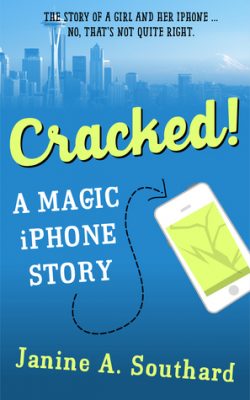
  • CRACKED! A MAGIC iPHONE STORY by Janine A. Southard – Seattle, Cyber-Punk, Fantasy

    CRACKED! A MAGIC iPHONE STORY by Janine A. Southard – Seattle, Cyber-Punk, Fantasy

    Can a middle-aged, hip statistician find the perfect boyfriend in Washington’s Emerald City? Maybe with the help of her magic iPhone!

    On this quirky journey through and around Seattle our heroine, Morena’s accompanied by two strange, but well-meaning sidekicks. Morena’s best friend/roommate, Suzyn, a twenty-something, aspiring photographer from New York, who likes to dance, get drunk, and get high; Magic Man, is an undercover, 6,000-year-old elf, who only wants to fit it with the humans around him. Also, a mysterious Green Man, who seems to be nearby wherever Morena goes, but whom she never notices, adds a note of mystery.

    After a breezy false start in which the narrator chats the reader up, like a neighbor over mid-morning coffee and Danish, the real story begins.

    One morning, Morena discovers a package on her kitchen table. Her ex-boyfriend, who “never sent her a single gift,” before their “horrid break-up,” has now sent her an iPhone—and it just so happens the phone is magic. It has only one app, designed for finding the right mate—and Morena, with her biological clock ticking, longs for love. She is searching for a soul mate—as long as it doesn’t take a lot of effort. She enjoys her current lifestyle, so, the right man would have to not only conveniently drop into her life, but also fit into her life. That iPhone may have been the perfect gift.

    The reader journeys with Morena, her magic phone in hand, on Seattle’s buses and light rail, into various neighborhoods, coffee shops, pubs, and restaurants, as well as to neighboring communities. Cracked! . . . introduces a plethora of geeks, freaks, “funky hipsters,” story gamers, “hipsters playing at being gamers  . . . ,” anonymous drug dealers, and more. Along the way, the reader may learn some street slang while being apprised of the go-to (for whatever you want) places in that urban area.

    Particularly entertaining and interesting are the forays into the story gaming world, where the gaming part counted as a respectably nerdy pursuit, and the story part counted as creative . A fun feature of the story is that it is a microcosm of Seattle life: giving its readers a chance to interact with some odd characters, but still not have to be friends with them.”

    While some may find Cracked! to be somewhat thin on plot, it’s heavy on atmosphere and setting, which is captivatingly authentic. Southard’s hip and cool characters are multi-dimensional and memorable. As a stylistic technique, the intrusive and opinionated omniscient narrator is sometimes informative and amusing, but at other times, can be distracting. However, always fun!

    Overall, Cracked! A Magic iPhone Story provides an insider view of Seattle, its denizens, and some of their various activities and belief systems, that contribute to its unique culture. It’s a fun read in a much too serious world.

  • The FLYING BURGOWSKI by Gretchen Wing – YA, Social & Family Issues, Fantasy

    The FLYING BURGOWSKI by Gretchen Wing – YA, Social & Family Issues, Fantasy

    In many ways, Gretchen K. Wing’s protagonist in The Flying Burgowski, Jocelyn Burgowski (Joss, for short) is a typical teenager.  She admires and appreciates a favorite teacher, argues with her older brother, Michael (in an awkward rebellious stage), and hangs out with her friends, the popular Savannah and the sweet social misfit, Louis. She loves to relax with a good book, usually one in the Harry Potter series. The third is her favorite.

    Then there are the atypical aspects of Joss’s life.  She lives off the coast of Washington, on Dalby Island, beautiful with its tall fir trees and surrounding water, although not a mall or a MacDonald’s in sight. Her father runs the all-purpose store and shocks his children when he abruptly marries Lorraine, the seemingly stereotypical librarian.  Joss’s mother abandoned the family nine years earlier for mainland life and has struggled with alcoholism and pill addiction.

    And then there’s Joss’s very vivid dreams, dreams in which she takes flight and soars over the island.  Unlike Harry Potter, she doesn’t need a broom.  No, she flies as freely as a bird.  On her fourteenth birthday, which occurs on the summer solstice, she discovers that the dreams were preparation for the real thing.  She instinctively takes off from The Toad, a large rock on the island, and life will never be the same.  How could it?  Even if she and Michael (in trouble again for driving his father’s truck into a ditch and smoking pot) weren’t sent to the mainland to spend time with their mother, Joss’s life is forever on a new course, one that is mapped against the sky.

    To Wing’s enormous credit, the novel never loses its convincing realism despite the main character’s spending a good portion of it in the sky, her arms outstretched, her body turning as she banks left and right, her lungs filling with the scent of lilies. The author weaves these scenes seamlessly, beautifully into the narrative.  We root for Joss as she plans her flight sessions, catch our breath when she takes a rough landing, her skin scraped, and worry with her that she’ll be sighted by someone who happens to look up at the evening sky. The realism is complemented, however, by the exhilaration of these scenes. Joss is so thrilled by the experience of flight that the reader wants to take her hand and witness what she does as a human bird, to feel that rush of air swim against our skin.

    Joss’s gift for flight, of course, is mired in old and interesting secrets that involve her mother and even her new step-mother. Her aerial talent is tested when she adjusts to a new school, unkind classmates, her mother’s substance abuse relapses, and the surprising but welcome maturation of her brother. Wing’s poignant and sensitive handling of Joss’s and Michael’s time on the mainland underscores the protective power of sibling relationships in the face of parental weakness or failure. The self-growth that they experience as a result stays with them when they return to Dalby Island and resume life as they knew it, but with far greater self-awareness.

    The Flying Burgowski isn’t your typical young adult book and that’s a very good thing.  Wing infuses realistic teen life, with all its problems, with a hefty dose of magic realism, and the result is an engaging and captivating fusion.  After reading it, don’t be surprised if you find yourself looking up at the sky, ready to sight the lucky human endowed with the gift of flight.

    5 Star Best Book Chanticleer Reviews round silver sticker

  • ASTROLOGER’S PROOF by David John Jaegers – Metaphysical Techno-Thriller Fiction

    ASTROLOGER’S PROOF by David John Jaegers – Metaphysical Techno-Thriller Fiction

    David John Jaegers’ Astrologer’s Proof is all about the steps leading to utopia, involving both ephemeral and cosmic mechanisms, balancing on the edge of an ethical paradox.

    The science fiction/fantasy author Orson Scott Card wrote a book titled “Characters & Viewpoint” in which he posited that all novels divide broadly into four different story types: Milieu, Idea, Character, and Event. He dubbed these categories the “MICE” Quotient, and each sets up specific expectations in the reader.

    Within that framework, Astrologer’s Proof qualifies as an Idea novel. It is Book 2 of the Astro-theologian Series, a metaphysical techno-thriller trilogy in which a Big Idea is explored.

    What’s the Big Idea? Simply put, it’s the search for an empirical proof that astrology is a valid science that defines and guides human nature and destiny, dovetailing with all religions into a unified cosmic truth that can positively change the world.

    That’s a lofty promise which author David John Jaegers delivers.

    Of course, proving the premise takes serious work – and a lot of illegal maneuvers to gather the necessary data. Astrologer’s Proof thus becomes an end-justifies-the-means story, where honest, moral, well-intentioned philanthropists break laws, invade privacy, deceive their loved ones, and establish front organizations, all to gather the information they need to demonstrate they’re right—in scientific, indisputable terms.

    Some series fiction forms the continuing adventures of one or more characters. Astrologer’s Proof, conversely, is the middle segment of a grand epic covering the Big Idea. Book 1 (Astrologer’s Apprentice) establishes the situation and players; Book 2 (Astrologer’s Proof) describes the process of making the Big Idea happen, and Book 3 (A Virtual Life) will reveal the repercussions. In other words, this book is the fat juicy middle of a delicious Po-boy, worth every bit of effort to digest.

    In Astrologer’s Proof, Jaegers unfolds the Big Idea and patiently tells us how it is transformed into action. Here the author demonstrates his depth of knowledge with the material and impresses the reader with the story’s thoroughness, technical veracity, rationality, and fascinating possibilities.

    In many ways, this book is an experimental novel, with the traditional elements of storytelling over-arching the trilogy, spreading across multiple characters in the telling. Jaegers brings his skill to the forefront here and invites his audience deeper, into a complex world that he skillfully weaves.

    For sophisticated readers who yearn for a multifariously inspired scenario that stretches the psychic mind and challenges beliefs, look no further. Astrologer’s Proof is your perfect match. This is a story with exceptional intelligence and visionary quality. It cleaves to the author’s heart, and those who read the book will be affected by its positive energy.

  • MY EXTRAORDINARY LIFE by Monica Sucha Vickers – Memoir, Inspirational

    MY EXTRAORDINARY LIFE by Monica Sucha Vickers – Memoir, Inspirational

    Monica Sucha Vickers was born in 1954, her parents’ first child. Their love for her overcame the shock they experienced when they saw that she was severely handicapped.

    Born without legs and missing her right arm, Vickers was probably a “thalidomide baby,” although her mother’s medical records are mysteriously lacking the proof of that speculation. Advised by doctors to institutionalize their tiny daughter, her parents took her home instead, and, without discussing their secret sorrows, they raised Monica with courage and without barriers.

    Her father pushed her to try new things—navigating stairs and participating in sports. Initially sent to a special needs school, she complained that she was out of place there, so she was transferred to typical schooling.

    In college she and a roommate took a long trip out west in the author’s hand-controlled auto, inspiring her to move from the Midwest of her birth with its icy winters to sunny California. She became an expert medical transcriptionist, typing twice as fast with one hand as most of her co-workers could with two. It was here she met and eventually married a construction engineer who designed a special office space for her home business. Together they happily entertained their large extended families.

    After her rather sheltered upbringing, the author gradually saw that the world can be cold and hurtful to people with handicaps; she speaks out boldly on that subject. She states that her grandmother, who taught her to bake, prepare fresh garden veggies, ride a tricycle, even sew and embroider, provided the impetus for this memoir. Her grandmother was, and still is, her hero.

    Vickers writes with a rare combination of gusto and aptly chosen phrasing, reflecting her own spirited but well-planned approach to life’s adversities, of which she has had more than her fair share. Her prose is plain and her observations frank, showing her creative talent along with the ability to objectify her experience in an unusually balanced manner.

    The book contains many photographs showing not only the extent of her disabilities, especially in early childhood, but also the means she has used to overcome them over the course of her tough but courageous life: the heavy but cosmetically sculpted artificial legs, the various wheelchairs, her hand-operated car, her athleticism as a swimmer, her unconventional but very effective typing method. Here, Vickers admonishes readers about what not to do and say to handicapped and wheelchair bound persons, which is enlightening and edifying.

    Avoiding any temptation towards bitterness, especially in the matter of the probable cause of her disabilities, Vickers has boldly included numerous honest appraisals penned by family members and friends about growing up with and knowing her. This willingness to see herself as others see her sometimes brings her back to the awareness of the adage, “People will see your disability before they see you,” a hard lesson that took her a long time to absorb.

    This is an important memoir that serves to bridge a gap between people of all shapes and sizes – no matter what their condition. An honest and courageous chronology of a life that truly deserves to be called “extraordinary.” Monica can be reached via her Facebook page or her website, which is listed at the top of this review.

    5 Star Best Book Chanticleer Reviews round silver sticker

  • The JøSSING AFFAIR by J. L. Oakley – Norwegian Historical Fiction, World War II, Thriller

    The JøSSING AFFAIR by J. L. Oakley – Norwegian Historical Fiction, World War II, Thriller

    At a time when true identities are carefully protected and information can get you killed, heroes emerge to fight the evils of Nazi-occupied Norway in J.L. Oakley’s highly suspenseful and beautifully penned historical fiction novel, The Jøssing Affair.

    In a quiet Norwegian fishing village during the Nazi occupation, risk lurks everywhere. Most residents are patriotic members of the resistance, “jøssings,” but there are “quislings,” too. Those who collaborate with the Germans and tout the Nazi propaganda of Nordic brotherhood between the nations. Mistaking the two is a matter of life and death.

    At the heart of the narrative is Jens Hansen who is an exceedingly mild-mannered handyman and a deaf-mute. Jens helps his friend Kjell on this fishing boat but mostly keeps to himself, communicating with paper and pencil when asked a question.

    But Jens has a secret. His real identity is that of Tore Haugland, a man who will risk his life repeatedly as a British-trained member of the resistance. He and Kjell coordinate the transport of weapons and agents via the “Shetland bus,” a fleet of small fishing boats and a few American submarine chasers, that make excursions from the coast of Norway to the Scottish Shetland Islands.

    Haugland and Kjell also assist the young Norwegian men who fled enlistment in the German army and are starving in the woods. Armed with the knowledge that war is ugly and men often break under brutal interrogation and tortured before their deaths, Haugland and Kjell share the scantest details about themselves with each other.

    There are many heart-stopping moments in this novel, deeply affecting episodes told with poignant precision and a sense of awe for the real-life counterparts Oakley’s characters portray.

    Amidst the intrigue and suspense occurring on the seas, daily life in the village may seem calmer, but Oakley deftly demonstrates the pervasiveness of suspicion and danger during wartime. Villagers snub Anna, a beautiful young widow whom they mistakenly believe to be a quisling. As the Allied Invasion progresses through Europe, liberating towns and countries alike, the residents of Fjellstad fear that the German forces will hang on until the last bitter moments in their beloved Norway. How many will die before that time comes?

    Oakley clearly did exhaustive research when writing this book.  A voluminous amount of details is provided on all aspects of the Resistance in Norway.  No stone is unturned and the reader benefits. In addition, the reader learns a great deal about Norwegian life and customs, about an exceptionally hearty people who annually experience four phases of winter and midnight sunshine during summer.  They are not a people to be subjugated, and this book showcases how they fought the German occupation with every means available to them.

    The Jøssing Affair is a highly enriching experience, a fascinating and profound work of historical fiction penned by, J.L. Oakley, one of the best in the business. A certain testimony to the underground heroes of WWII who put aside personal safety for a cause much bigger than themselves. Their courage is acknowledged in this superbly gripping novel.

    5 Star Best Book Chanticleer Reviews round silver sticker

  • The EDGE of FARALLON by Peter Skinner – Literary, Thriller/Suspense

    The EDGE of FARALLON by Peter Skinner – Literary, Thriller/Suspense

    Sam came to Jade Cove to kill someone. The question is who.

    A mountain lion refuses to leave Big Sur’s ferocious coast while a family on the brink of foreclosure clings to their land. But the real danger might not be what Lulu Willis or her uncle Angus expects. Enter Sam a man with a checkered past, a significant stint in the military, and, at present, marred with PTSD and alcoholism. Lulu suspects that Sam is there to kill her ailing uncle and she will do anything to stop him, even if it means killing Sam.  However, as the wind continues to shift along the coast, it becomes apparent that Lulu’s volatility and past issues might bring everyone, including Sam, further to Farallon’s edges.

    As a playwright, Skinner (The Bells of Moses Henry, White Buffalo) uses words and dialogue in an undoubtedly poetic way. The dialogue, in particular, is intricately varied—snappy one minute and lyrical the next. It provides each character with their own unique thumbprint, with each fighting a different set of demons. Angus’s dementia, Sam’s grapple with humanity, and Lulu’s struggle toward forgiveness all tie together in a tangled mosaic that makes any type of resolution seem improbable.

    In addition, Skinner’s skillful use of imagery and metaphor gives both his characters and setting a delicious complexity. This is especially true in the descriptions of local flora and fauna, including “wandering micro-plates,” “tide pools ripe with purpose,” “a Steller’s Jay with deep blue feathers” and even a “phalanx of rusty mailboxes.” Readers will completely immerse themselves in these textures, especially since Skinner reintroduces plot threads with just enough variance to keep readers guessing.

    From a suspense standpoint, Skinner includes just enough detail to keep readers intrigued, while not revealing too many clues at once. This sprinkling of detail ratchets up the tension and makes it impossible for the reader to put the book down. And while the language and implications can become a bit esoteric at times, the twists and turns, shifting points of view, and varying textures will keep readers engaged.

    With traces of Gothic flare, Peter Skinner’s The Edge of Farallon is a brilliantly dark and satisfying read, exposing truths about family, life, and death. A story for those looking for complex character development, unique imagery, and a breathless plot.

    Additional Note from Reviewer: Those interested in the dialogue might also think about reading the play version, available on Skinner’s website.

  • DIGGER: SIERRA and the CASE of the CHIMERA KILLER by Robert D. Calkins – YA, Mystery/Thriller, Crime Fiction

    DIGGER: SIERRA and the CASE of the CHIMERA KILLER by Robert D. Calkins – YA, Mystery/Thriller, Crime Fiction

    Artfully constructed with lightning pacing, Robert D. Calkins’ Digger: Sierra and the Case of the Chimera Killer is a must read for mystery/thriller fans and for animal lovers alike, especially those who know that a dog well-trained can be much more than just a pet

    Teenager Bryce Finn and his Golden Retriever Sierra share the spotlight as the novel’s human hero and canine heroine. As a determined duo doing SAR (search and rescue), they are just about the best in their Washington state region, time and again proving Sierra’s reliability and wholehearted enthusiasm for the often grisly “game” of locating decomposing corpses.

    There’s a serial killer on the loose in Kitsap County, targeting young female runaways, drug users, and prostitutes. Sheriff Elroy Patterson asks for some extra funds from the county council, above the objections of the hard-nosed conservative councilor, Garrison, who mockingly calls the supposed killer a “chimera”an imaginary monster.  The council overrides him and grants Patterson the money, and the press latches onto Garrison’s weird term so the hunt for the Chimera Killer is on.

    Tracking down the serial murderer becomes the new shared obsession of Bryce and Sierra, although one rescuer, Alan Granger, seems curiously determined to make the pair look bad but with no success. Whenever Bryce tells his pet to “find Digger” she’s all too willing to please, knowing that a ball game will be her reward.

    But Bryce has another obsession: he’s finally getting a chance to woo Katie, his first foray into young love. Katie is reciprocating by taking an active role in SAR, a romantic interest in Bryce, and developing a fondness for his amazing canine. Meanwhile, more bodies are being discovered, which as Bryce notes, is both a victory for law enforcement and the SAR team, but a sad day for the victim and family.

    Author Robert D. Calkins, himself a SAR dog handler in the very county where this multi-layered plot takes place, has set out to educate as well as entertain. He offers fascinating details of the canine/human relationship, even to the tone of voice (high-pitched and childlike) that is best used to reward one’s dog for success in locating the sought-after person or object. Anyone interested in effective dog training will find this book a manual of best practice, as numerous tips are cleverly embedded in dramatic scenarios that will keep you turning the pages.

    This book will interest YA readers through adults with its teen characters out-doing many of the grown-up pros in solving crimes. More seasoned readers will also find themselves charmed and intrigued by the subtleties of a mystery well-conceived and cinematic.

    Calkins’ earlier works centering around this subject are suitable for the middle-grade readers and includes Digger, Sierra Becomes a Search Dog, and Sierra the Search Dog Finds Fred. The author’s fourth book is Bryce Bumps His Head, a chapter book for beginning readers. Although Digger: Sierra and the Chimera Killer could be considered a flagship novel, the author tells us he is working on a sequel. Now that’s something to be excited about!

    5 Star Best Book Chanticleer Reviews round silver sticker

  • The SPANISH CLUB by Danielle Burnette – Y/A, Fiction

    The SPANISH CLUB by Danielle Burnette – Y/A, Fiction

    Seven Chicago teens spend one eventful week on a chaperoned field trip to Mexico. Traveling with the intention of cultural immersion, they instead learn love, forgiveness, and some serious life lessons.

    St. Francis High School Spanish Club members Brianna and her BFF Dana, along with five other friends are on a field trip that they won’t soon forget. It’s the summer before their senior year, and adulthood—with all of its attendant major decisions—looms. Flying into Mexico City accompanied by teachers Mrs. Fritz and Miss Yancy, they meet Miguel the guide, who ushers them through La Ciudad’s myriad monuments, cathedrals, and markets, as well as Teotihuacán, Guanajuato, and Guadalajara. It’s quite the whirlwind trip, with Miguel’s impassioned recounting of history adding meaning and depth for students and readers alike. Indeed, the rich imagery of the hi about astorical landmarks blossom on the page, and the descriptions of the people, the food, and the art should fire the imaginations of teen readers and instill in them a desire to travel to Mexico City and beyond.

    That said, The Spanish Club is not a travel essay, but a young adult drama, stocked with classic teen yearnings, choices, vanities, and pranks. Author Burnette does a marvelous job of imbuing the narrative with colorful angst: “At once, every blemish on Brianna’s body itched and squirmed for Enrique’s attention, and she stiffened under the weight of all her imperfections.” Her characters embody every emotional high and low – especially protagonist Brianna Garrett.

    Brianna is inseparable from her BFF, Dana Tate, until she discovers, with equal parts shock and delight, that heartthrob Enrique has shared her distant admiration since freshman year. A rift grows between the girls, and not only because of Enrique. Dana is jealous of Brianna’s growing friendship with dance team leader Stacia.

    But boys and BFFs aren’t the only things commanding Brianna’s attention.

    Before the trip, Brianna needed to acquire her passport. What she soon discovered forces a rift between the parents she always counted on for the truth. Brianna was adopted. And her parents never once disclosed the information. Now in Mexico, she rages against them and shuns their long-distance calls. But what brings eventual forgiveness is not her identity but her friend Dana.

    Throughout the story, the World Cup serves as a foreboding backdrop, with the alarming zeal of local news reports of fan-related tragedies. This culminates in a frightening confrontation that departs from the story’s general lightheartedness to make a sobering point, but also, brings Brianna and Dana back together, making The Spanish Club a very good summer read for Y/A audiences.

  • The BOY WHO WANTED WINGS by James Conroyd Martin – Medieval Historical Fiction, War/Military, European

    The BOY WHO WANTED WINGS by James Conroyd Martin – Medieval Historical Fiction, War/Military, European

    A suspenseful and often overlooked chapter in history, the siege of Vienna in the late 17th century is the subject of James Conroyd Martin’s masterful novel, The Boy Who Wanted Wings.

    Although Poland’s involvement in the protection of the city from the invading Turks is the mainstay of the book, Martin widens the breadth of his study to underscore the multinational effort undertaken to halt the spread of Islam, providing meticulously researched details about the allied forces of the Saxons, Franconians, and Bavarians uniting to halt the siege of the Ottomans and Crimean Tatars*.  Although this is a work of fiction, to the author’s credit, the wealth of historical information provided is beyond impressive.  Most helpful is the glossary of Polish cultural and military terms of the time at the outset of the book.

    The reader navigates this chapter in Europe’s past with Aleksy Gazdecki, a boy on the verge of manhood whose personal past and present circumstances present no end of identity issues.  A Tatar by birth, he was orphaned as an infant and raised by a Polish peasant family, tenants of Lord Halicki.  Aleksy’s swarthy complexion and dark, almond-shaped eyes cause him to stand out amongst the Poles and ultimately be treated with suspicion.  He longs to join the Winged Hussars, the elite branch of the Polish military whose legendary skills with seventeen-foot-long lances are announced by a uniform that includes “wings.”  Although he trains with a former soldier, currently a stablemaster, Aleksy knows how futile his dream is since only men of noble birth can become Winged Hussars.

    Amidst the military drama is, of course, personal drama.  Aleksy has a chance encounter with the beautiful Krystyna, Lord Halicki’s daughter, and the two engage in a dangerous, secretive romance, jumping the hurdles presented by her family, who are determined to see her married to a wealthy noble, as well as confronting the escalating war at hand. Krystyna’s brothers, the sweet Marek and the haughty, vengeful Roman, will cross paths with Aleksy again and again since he follows them into battle as Marek’s “retainer.”

    Just as Aleksy sought to overcome the circumstances of his birth in his romantic life, he will do so also on the battlefield. Ironically, his Tatar heritage gives him the opportunity to save a life, a very important life, and the resulting events put Krystyna within his reach. Martin takes no shortcuts and keeps the reader guessing with a long list of characters and numerous plots twists all carried out with exquisite pacing.

    Despite the triumph of the Poles, Martin deftly explores the addictive nature of bloodlust and the true consequences of war. Aleksy is exhausted and saddened by the killing and able to transcend nationalistic feelings.  He has killed men, regardless of where they’re from or what faith they practice. It’s an apt observation from a Tatar who has lived his life amongst a people other than his own, a Tatar who has tried to be the most loyal subject of Poland.

    This is a novel with staying power.  Given the geopolitical situations in the world today, the author reminds us that war has a long and bloody history, and political alliances are intricately tied to this history. James Conroyd Martin’s The Boy Who Wanted Wings will make one most glad for the opportunity to spend time in the 17th century.

    *Alternate spelling: Tartar

    This book is also available in Softcover (ISBN-13: 978-0997894509) and Hardcover (ISBN-13: 978-0997894516)

    5 Star Best Book Chanticleer Reviews round silver sticker