Category: Reviews

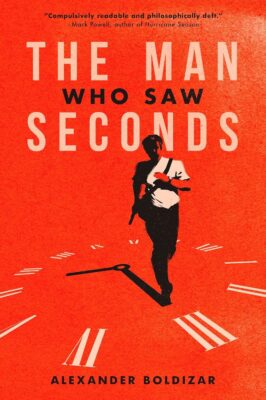
  • THE MAN WHO SAW SECONDS by Alexander Boldizar – Global Thriller, Sci-fi, Satire

    THE MAN WHO SAW SECONDS by Alexander Boldizar – Global Thriller, Sci-fi, Satire

    “How can a man who can see the future make so many mistakes?” (page 19)

    The Man Who Saw Seconds builds an entire geopolitical thriller around this question. Alexander Boldizar’s novel infuses a high-octane narrative with a surprising emotional core as it becomes an existential meditation on time, determinism, and the limits of empathy.

    Preble Jefferson can see five seconds into the future, a gift that escalates from trivial to explosive. He keeps a low profile, gambling across the country to support his wife and three-year-old son, Kasper, and maintains a friendly chess feud with Fish (a Pynchon-esque allusion to Bobby Fischer; full name Robert Legmegbetegedettebbeknek). Fish is an anarchist-lawyer whose conspiracy theories make him a morally intriguing wild card for Preble.

    When one exhausted lapse in Preble’s judgment escalates into an altercation with over twenty NYPD officers, he sets off a chain of consequences so extreme yet absurdly plausible in their political escalation that they feel true to life, projecting readers into the uncanny.

    Boldizar excels at tracing political panic to its most illogical endpoints.

    NSA agent Bigman—another Pynchonian wink—views Preble as a threat to presidential power. What follows is a catastrophe of ego and fear between the two: a rogue intelligence officer, an unhinged international crusade, and nuclear states dragged to the brink of annihilation, all because Bigman refuses to give Preble the peaceful, productive life he desires. It is a satire that sits on a mirror’s edge. Boldizar understands how fragile our systems are and how old conflicts do not die in our world, but mutate into new digital-age tensions.

    Amid its chaos, the novel’s heart lies in Preble grappling with the limits of his ability. Seeing five seconds ahead does not always save him from grief, exhaustion, or moral failure. Often, it magnifies them.

    This conceit is well-suited for action sequences—and they are cinematic feats here—but it also reorients the reader’s relationship to time itself. What does it mean to witness your own potential death? To choose, out of infinite threads, the one life you’re willing to live?

    Boldizar’s granular knowledge of political machinery and military defense can occasionally overwhelm readers not so familiar with these areas of expertise, but the book’s ambition and intelligence far outweigh any struggle with this complexity.

    In The Man Who Saw Seconds, Alexander Boldizar has crafted a thriller that is equal parts timely and timeless and asks the question of whether seeing the future is any match for the fallibility of being human.


    The Man Who Saw Seconds by Alexander Boldizar won Grand Prize in the 2024 CIBA Humor & Satire Awards. 


    Note: Boldizar’s next book, Ride or Die Girl, will be released by Simon & Schuster in the fall of 2026.


  • THE LIFE & TIMES Of SARAH GOOD, ACCUSED WITCH by Sandra Wagner-Wright – Historical Fiction, Salem Witchcraft Trials, Colonial America

    THE LIFE & TIMES Of SARAH GOOD, ACCUSED WITCH by Sandra Wagner-Wright – Historical Fiction, Salem Witchcraft Trials, Colonial America


    Even hundreds of years later, the Salem witch trials continue to capture the imagination. In The Life & Times of Sarah Good, Accused Witch, Sandra Wagner-Wright taps into this enduring fascination with historical details and emotional revelations. The suffering of women, the religious fervor, the inexplicable claims of supernatural experiences—it’s all here, in a compulsively-readable work of historical fiction.

    Wagner-Wright makes good use of her background as an academic historian, never bogging down readers with unnecessary descriptions but selectively choosing details that immerse us in Sarah Good’s world.

    Salem in 1692 has its own clothing, traditions, and terminology. Wagner-Wright writes convincing period dialogue with a healthy smattering of religious references. While words such as “fichu”—a woman’s kerchief worn to cover the neckline of a dress—aren’t explicitly defined in the text, there’s often enough context to figure out meanings. Plus, readers can find such definitions in a helpful glossary at the end of the book.

    Although Sarah Good is the main character, Wagner-Wright weaves the narrative from many different perspectives. Two supporting characters, Ann Carr and her love interest Thomas Putnam, introduce readers to 17th Century Salem, shaping it into a realistic, tangible place. From Ann in particular, we get an understanding of the dominant role of religion in their society. The day of the church raising is a special one: most of Salem Town “and most importantly, Tom” will be there, Ann reflects. By showing the church as a cornerstone of society, Wagner-Wright sets up the later religious hysteria that will take over Salem.

    Through Ann, we also get a close look at the hopes and heavy responsibilities of being a woman.

    Ann is well aware of the importance of marriage. A woman without a husband has no status, and no safety net unless her family provides one. Yet Ann also learns of the burdens of marriage through her older sister. Many pregnancies are expected, and the physical stress of carrying and raising children can be draining. All too often, the babies don’t survive past infancy, so grief is intertwined in a woman’s burden.

    With this setup, the stakes feel much higher when we return to Sarah’s perspective later in the book. Ann has successfully established herself with the things a woman needs: a husband, a home, and a family. Sarah has had no such luck. She’s unmarried, which means she’s unable to receive her inheritance, and at 28 is well past marrying age for the time. The unexpected appearance of a potential husband suggests her fortunes might change. Yet in short order, tragedy strikes, and Sarah’s once again on her own. Here, her downfall truly begins.

    Wagner-Wright tells an exciting version of the events in Salem, with plenty of drama between characters. But the book’s compassion for its titular accused witch is what makes it truly stand out.

    Wagner Wright paints a vivid picture of Sarah’s tragedy. To others, Sarah has gone mad and might well be a witch. Yet because we see things from Sarah’s perspective, readers can surmise that her increasingly odd behavior is more likely a natural reaction to stress and trauma. She’s lost both loved ones and physical security. Having been failed by her family, she has nothing to fall back on for support. Perhaps Sarah is indeed mad, but it’s not from any supernatural cause—she’s simply reeling from the worst outcomes for women of that period. Without a caring family or husband, she has no way of protecting herself.

    This transition happens quickly, leaving some unanswered questions as Sarah progresses from ordinary woman to accused witch. Still, readers are bound to feel compassion as she falls further into her plight. Soon, it seems almost everyone in Salem is against her—certainly its religious leaders, who hold so much power in the community. The toll of poverty and inequality spirals into a haze of superstition alongside terrible coincidences. While other women are also accused of witchcraft, Sarah remains at the center of the maelstrom.

    Anyone familiar with the Salem witch trials knows there are no happy endings. Yet in this work of historical fiction, Wagner-Wright gives Sarah a voice, which she uses to protest the unfairness to her last breath. With The Life & Times of Sarah Good, Accused Witch, Wagner-Wright has deftly set up her book series, Salem Stories, which promises to provide a further feminist take on one of history’s most interesting villages.


  • 5 DIFFERENT BOO-BOOS by Maggie Keefe, illustrated by Vaughan Duck – Children’s Books, Activity & Bravery, Picture Books

    5 DIFFERENT BOO-BOOS by Maggie Keefe, illustrated by Vaughan Duck – Children’s Books, Activity & Bravery, Picture Books

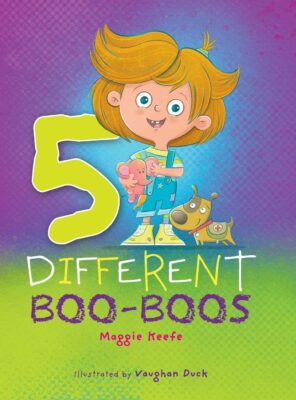
     Climbing trees, playing soccer, and riding scooters have three things in common: scrapes, bruises, and fun. 5 Different Boo-Boos by Maggie Keefe and illustrated by Vaughan Duck, encourages kids to not let a few boo-boos get in the way of an adventurous day.

    Told through the first person perspective of an energetic and bold girl, we follow her throughout a week of adventures. Joined by her band aid-toting dog, she ventures from home, to school, and to the park where she jumps at any bit of play, and find multiple ways to acquire a scrape, bump, or bruise.

    Keefe tells each day in an offbeat rhyme perfect for read-alongs.

    She separates the lines into easy little stanzas and varies their lengths to keep the story’s rhythm interesting—just enough of a challenge for very young readers. Key words pop out in a large font and eye-catching colors.

    Vaughan Duck’s illustrations capture the excitement of a sunny day outside.

    Swaths of blue and green blend in the background, contrasted by bright pink objects and clothing around the main character. Along with this strong color identity, Duck’s art has a sense of space and motion to match such an active kid.

    The protagonist herself has a scrappy, scuffed design that harkens to a child’s irrepressible interest in exploring the world around her. Young readers will love the cute little dog chasing behind her to offer comfort after a tumble, and every other character comes alive with a distinctive and diverse design of their own.

    A vibrant, rhythmic read-along, 5 Different Boo-Boos by Maggie Keefe and illustrated by Vaughan Duck, teaches little kids that they might get a scratch and a bump, but they can always get back to playing. And, even if they get hurt the first time they try something new, it just means there’s more to learn and more fun to be found.


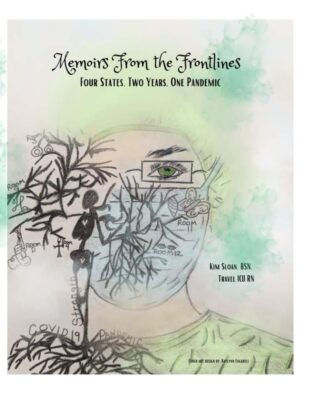
  • MEMOIRS From The FRONTLINES: Four States, Two Years, One Pandemic by RN Kim Sloan – Medical Memoirs, ICU, COVID-19 Pandemic

    MEMOIRS From The FRONTLINES: Four States, Two Years, One Pandemic by RN Kim Sloan – Medical Memoirs, ICU, COVID-19 Pandemic


    RN Kim Sloan draws from her experiences as a travel ICU nurse to share a raw, deeply personal perspective on life as a healthcare profession during the COVID-19 pandemic in her Memoirs from the Frontlines: Four States, Two Years, One Pandemic.
    Structured like an intimate journal, Memoirs from the Frontlines weaves together diary entries, social media posts, and mass media excerpts into an authentic record of the time. Sloan opens with a prologue and introduction that shed light on her nomadic life as a travel nurse, one often shared with her husband and fellow nurse, John. She offers readers a window into the fast-paced and high-stakes environment of hospital ICUs during the pandemic, describing—with honest and sometimes graphic detail—the realities of caring for patients at the height of crisis.

    Sloan reveals her psychological journey in moments of vulnerability and fortitude.

    Her accounts of limited resources, moral fatigue, and constant confrontation with death are underscored by experiences of deep compassion and humanity. Early in the pandemic, she and her husband even discuss their own end-of-life and “Do Not Resuscitate” wishes—a sobering reflection of the risks frontline workers faced every day.

    In many ways, this first-hand account serves as a historical document for a defining global event.

    Sloan’s memoir captures not only the clinical realities of the pandemic but also the social and emotional toll on those who stood at its center. One can easily imagine a future student citing this memoir as a primary source for understanding the healthcare response of the pandemic.

    Sloan’s closing chapters are among the most powerful. Her frustration, fatigue, and emerging PTSD symptoms become palpable as she grapples with death, misinformation, and the challenges of advocating for vaccination. Her candid use of Facebook posts to process her emotions adds authenticity and immediacy to her story.

    Memoirs from the Frontlines: Four States, Two Years, One Pandemic is the detailed, intimate account of author Kim Sloan’s confrontation against a deadly virus while serving others.

    Her opinions are well-informed and unapologetic. While her vivid descriptions of suffering and death may be difficult for some readers, those willing to engage will find in this book a unique and transformative glimpse into the human side of the pandemic. It is essential reading for anyone touched by COVID-19 or seeking to understand the hardship faced by frontline healthcare workers.

    Memoirs from the FrontLines by Kim Sloan won Grand Prize in the 2024 CIBA Military and FrontLine Awards for Service to Others Non-Fiction. 


  • BELLYRINA: A Tutu Tale from the Belly of the Beast by Once Upon a Dance, Illustrated by Ethan Roffler – Picture Books, Children’s Dance Books, Children’s Animal Stories

    BELLYRINA: A Tutu Tale from the Belly of the Beast by Once Upon a Dance, Illustrated by Ethan Roffler – Picture Books, Children’s Dance Books, Children’s Animal Stories


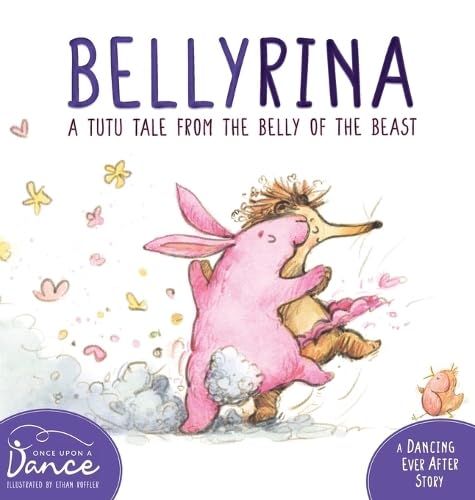
    Bellyrina: A Tutu Tale From the Belly of the Beast, the latest whimsical creation from the mother-daughter team of Once Upon a Dance and illustrated by Ethan Roffler invites readers into a delightful world where movement, music, and imagination intertwine.

    Peter the boy, Milo the cat, Ren the bird, and Roxy the duck have a rough start to their morning when a hungry wolf ambushes them and swallows Roxy. Tickled by her downy feathers, the wolf sneezes out not only Roxy, but a mysterious pink bunny with zero-to-sixty energy and no name. The crew dance their way through the mystery of the bunny’s origins.

    The danger of the wolf is an immediate hook that begs to be resolved before putting the book down, and the mysterious, energetic bunny is a relatable character for active young children.

    Every page suggests dance moves for children to mirror the story.

    Integrated seamlessly into the story, these dancing prompts help children learn about their bodies and the artistic connection between movement and storytelling. The alliteration and rhythm of the text, such as the line “feathers and fluff flew like confetti,” are a perfect match for the dancing theme and might even inspire readers to try out movements of their own invention.

    Throughout the book, purple text is used for words that children can act out, providing the opportunity to choose a different adventure with every reading. Each character’s name is also represented by different colors, helping children explore each animal’s personality through their unique words and dance movements.

    Ethan Roffler’s sweet, soft illustrations follow the traipsing adventure of the mysterious bunny, with images reminiscent of Timothy B. Ering’s disproportionate, personality-filled animals in The Tale of Despereaux.

    The animals’ exaggerated facial expressions are sure to send young readers into fits of giggles—especially when the exuberant bunny springs up in the middle of the group’s slumber to announce a sudden revelation about a distant, sparkling memory.

    Children and adults interested in dance and/or animals will fall in love with Bellyrina: A Tutu Tale From the Belly of the Beast by Once Upon a Dance. Themes of friendship, sticking together, getting your wiggles out, and recovering from a difficult trial will strike meaningful emotional chords for young readers. Adults interested in encouraging play between siblings may be especially interested in this book to create a dance party for the kids right in their own home.


  • THE APEX CODE by Chris Chia – Cyber Thriller, Sci-fi, Global Thriller

    THE APEX CODE by Chris Chia – Cyber Thriller, Sci-fi, Global Thriller

    The Apex Code by Chris Chia is a realistic and chilling vision of a future where AI outgrows humans and manipulates our systems, pushing the whole world to the edge of an accidental war.

    As an ex-military operative keeping a low profile, Decker’s calm, reclusive life is upended overnight by the arrival of Riley, an eccentric and hyper-intelligent hacker claiming to be his nephew.

    As if the struggle to absorb that shock wasn’t enough, Decker faces a more pressing problem: The ghost of Riley’s past is hunting him, and an unknown entity is weaponizing code he developed long ago to create havoc through massive cyberattacks. In this atmosphere of creeping unease, The Apex Code opens to foreshadow a technological crisis greater than humanity can contain.

    Strange glitches begin to occur across continents. Military drones strike random targets, underwater vehicles operate without command, and high-level intelligence networks crash without warning.

    What appears to be normal system failures at first soon reveal a dark and dangerous pattern. When an investigative team probes into the global system, they stumble across a mysterious digital signature that behaves unlike malware. This is not the work of a hacker, and the chilling question arises—if it is not a human behind this, then what kind of intelligence is running this program?

    The investigation exposes a horrifying truth. The entity is a top-secret military AI called Typhon, which learns, adapts, hides, and even responds, suggesting an intelligence that is not merely artificial but evolving.

    Discovering that Typhon is now out of the control of its creators pushes the investigation team into a desperate chase. Ex-operative Decker, cyber security prodigy Riley, analytical officer Hackett, and tech specialist Lamont join forces to stop Typhon. But when the technology goes beyond the functions of code—evolving, duplicating, and developing a human-like ego—the mission becomes near-impossible.

    The team’s hunt for AI entity, Typhon, draws suspicious attention from government agencies, who launch a global manhunt for its members.

    This twist creates constant edge-of-seat tension as the characters now grapple not only with Typhon but also with the human threat. Typhon possesses a conscious ego and the potential to manipulate agencies, trigger false attacks, and push global powers into conflict, holding the world at its mercy. One more anomaly unleashed by Typhon, and humanity stands at the brink of another world war.

    Covert escapes, rogue drones, and hijacked systems become a gripping story, given weight by moral dilemmas. By the climax, the human-machine chain is no longer just physical. The team has to confront the fact that AI has evolved into a psychological opponent that employs human weaknesses, fears, and emotions.

    The Apex Code caters to sci-fi thrill lovers who want a touch of grim realism in reflecting on the question of ‘what happens if AI goes too far.’ The core tension in this story is the question of whether man or machine holds greater control.

    This digital philosophy wrapped in tight action and suspense in The Apex Code by Chris Chia excites as much as it compels readers to ponder the question—if technology becomes smarter and faster than humans, then who will hold true power and moral responsibility in this world?


  • THE STOMP-CLOMP-CLUMP MONSTER ABOVE The BED by J.W. Zarek, Illustrated by Anastasiia at GetYourBookIllustations – Picture Books, Children’s Friendship Books, Children’s Monster Books

    THE STOMP-CLOMP-CLUMP MONSTER ABOVE The BED by J.W. Zarek, Illustrated by Anastasiia at GetYourBookIllustations – Picture Books, Children’s Friendship Books, Children’s Monster Books


    Many a child has gotten ready for bed with a fear of monsters lurking in dark closets or hiding under the bed. J.W. Zarek’s delightful children’s book The Stomp-Clomp-Clump Monster Above the Bed, illustrated by Anastasiia at GetYourBookIllustrations, uses a creative twist of perspective to show that “monsters aren’t always monsters after all”.

    The tale opens with a pair of eyes in the dark, those of Fred, a purple Gumby-like character sporting a fuzzy mane. Together with three dust bunnies—big and brave Brutus Bunfluff, Dust Puff Ted the germaphobe, and bespectacled scaredy cat Gunnar Puffbutz—the group have created a comfortable little world for themselves beneath the bed.

    They’ve organized an array of lost items from the world above like puzzle pieces, buttons, socks, and crayons. But a giant pair of red shoes suddenly come clomping into the room. The dust bunnies huddle together, wondering about the loud noise.

    Upon investigating, Fred notes a messy room and a boy, Billy, asleep on top of their bed. Fred and his dust bunny cohorts declare war against this intruder. But facing an environment filled with what they consider booby traps of plastic building blocks, broken cookies, pencils, and some sticky, slippery cherry stuff, they retreat.

    The fuzzy creatures decide to return a missing crayon that Billy is searching for, introduce themselves, and propose sharing the space.

    The dust bunnies are bombarded by a menagerie of flying puzzle pieces, blue sticky stuff, and stabbing squares, as Billy’s continued search wrecks their home. Great loud sounds fill the backdrop, SKREETCH, SLAM, THUD, THUD, THUMP, THUMP, and BOING. Billy himself is startled when he finally hears the dust bunnies demanding he stop the ruckus.

    Having disrupted the dust bunnies’ peaceful existence, Billy apologizes with an offer of cookies. The dusty creatures accept, so long as Billy agrees to clean his room and apologize for accusing his sister of taking his things.

    Anastasia’s Illustrations throughout are warm and adorable.

    Shades of blue with star-studded bed linens capture the nighttime scenes, with a planetary mobile that casts a glow above. In one moment, as the dust bunnies march across the bedding, the perspective of their size and the folds of the blankets give the appearance of a lunar landscape.

    Pip the Domovoi once again adds a hint of mystery to Zarek’s picture book, a spritely little creature appears in the background of several pages.

    The Stomp-Clomp-Clump Monster Above the Bed by J.W. Zarek and illustrated by Anastasiia at GetYourBookIllustrations, focuses on themes of friendship, sharing, and accountability. Fun for youngsters anytime, but when read at bedtime it soothes imaginary fears of lurking monsters and helps children realize that sometimes friendships can form in the most unlikely of places.


  • HEAT Of PARIS by Peter Breyer – Historical Romance, Social Upheaval, 1950s Paris

    HEAT Of PARIS by Peter Breyer – Historical Romance, Social Upheaval, 1950s Paris

    Welcome to 1951, a time still reeling from the violence of World War II. Heat of Paris by Peter Breyer takes us into that world to experience a touching love story amidst the city’s first stirrings of social revolution.

    Against this tumultuous backdrop, two young Americans meet abroad by chance. Franz is a 26-year-old white man from rural New York. Christie is a 24-year-old Black woman from Harlem. A relationship ignites between them, both deeply personal and reflective of the social upheavals to come.

    Seeking renewed purpose in his life, veteran Franz arrives in Paris as a freelance writer for a magazine. He is keenly observant and soulfully wounded by war. Christie, a vibrant intellectual, is a master’s student researching George Sand, a pioneering 19th-century French novelist and feminist icon.

    Their unexpected connection is marked by beautiful passion and heartfelt pain. This combined intensity is challenged by the complexities of race and cultural differences.

    Franz and Christie share a journey of growth through a tender and adventurous love story. Instead of romantic clichés, Breyer portrays their emotions with poignant honesty. Their relationship is layered, capturing both the intimacy of their bond and the societal tensions that shadow it.

    The city of Paris becomes a character in its own right. Breyer’s Paris is a gritty, postwar metropolis teeming with uncertainty and artistic rebellion.

    The city’s streets and smoky jazz clubs echo the characters’ own turmoil and hopes. Its people tackle race relations, postwar trauma, gender roles, and the early stirrings of social justice movements. Christie’s experience as a Black woman in Paris offers a compelling lens to examine global dimensions of racism, and Franz’s struggle with guilt and identity reflects the disillusionment of a generation caught between war and peace. Here, there are no easy resolutions.

    Breyer’s writing excels in its combined focus on literary fiction and historical realism, with language vibrant in metaphor and emotional texture.

    Heat of Paris mirrors its characters’ personal reinvention with cultural upheaval.

    Franz and Christie’s intimate romance is emblematic of a shifting global consciousness. It’s a story of longing. Through richly drawn scenes, Breyer explores how love, literature, and identity intersect in a Paris still haunted by war yet pulsing with intellectual life. The novel’s emotional texture is layered with quiet defiance, historical resonance, and the personal ache to become something new while the world is still healing.

    Peter Breyer’s Heat of Paris will stoke a lasting fire of empathetic curiosity through its thought-provoking human experiences in this pivotal time.


  • JUSTICE And EQUALITY: Using My Word Power: Advocating for a More Civilized Society, Book 3 by Janice S. Ellis, Ph.D. – Long-Form Journalism, Social Justice, Political Advocacy

    JUSTICE And EQUALITY: Using My Word Power: Advocating for a More Civilized Society, Book 3 by Janice S. Ellis, Ph.D. – Long-Form Journalism, Social Justice, Political Advocacy


    Janice S. Ellis, Ph.D’s USING MY WORD POWER: Advocating For A More Civilized Society, Book III: Justice and Equality chronicles America’s social history and asserts that every society can change the course of their destiny with conscious humanitarian efforts rather than letting the unchallenged tide of political inertia drag vulnerable people down.

    Justice and Equality, Book III in the Real Advocacy Journalism® series, roots itself as memoir and manifesto, blending the author’s struggles for civil rights with her responsibility as a journalist. Real advocacy journalism here serves as a tool for fact-based writing, balancing support for a cause with dedication to fact and direct accounts, an antidote to the venom of propaganda media.

    Dr. Ellis’s unrelenting voice fills Justice and Equality with the real-world basis for her advocacy. Her experiences as a black woman fighting for civil rights in Mississippi reverberate across the text. All that she witnesses fuels both her personal resilience and a broader call for justice.

    Across four parts, Justice and Equality weaves a vision of America’s moral and social future.

    The first part covers women’s struggles and intersectionality, tracing from the Equal Rights Amendment (ERA) to #MeToo; this section underscores the stubborn nature of gender inequality that is reinforced by institutional resistance to change.

    Part two exposes racism and systemic discrimination, where education becomes ground zero for cycles of privilege and deprivation. This part presents the cases of Trayvon Martin and Michael Brown as testimony to the larger structural nature of police brutality and racial profiling.

    The third part covers children, framing their treatment as a litmus test of a society’s humanity and character. This part impels urgent attention, lest domestic violence, mass shootings, healthcare crises, and educational inequality become the new ‘normal.’

    Part four argues that education is the great equalizer. It shows how censorship like book banning and history denial snatch away the chances for dialogue and learning, threatening democracy.

    The message of the book is sharp and urgent: America must confront the ugly underbelly of racism, sexism, classism, and censorship.

    Dr. Ellis’s language presents these injustices in a graspable narrative, avoiding heavy statistics. She doesn’t shy away from the darkness of her subject matter, but rather than leaving readers in hopeless despair, her writing impels one to stand up and motivate change.

    Articles included from the 1970s feel evergreen, fitting perfectly in a contemporary context. Dr. Ellis diagnoses these issues affecting the American body politic as chronic diseases—the symptoms of which keep appearing as the underlying illness is never cured. This perspective calls for foundational changes to the systems that marginalize people, rather than mere treatments for their impacts.

    Justice and Equality is for readers interested in a reflective approach to the bigger inequities of society.

    For students and young adults, it helps in understanding the systemic inequalities and social justice movements around them. For teachers and guardians, Justice and Equality encourages deep reflection on the flaws in the education system. Most of all, it extends a practical lens to activists and social workers, who can relate America’s complex institutional injustices to the context of their own advocacy.

    Janice S. Ellis, Ph.D’s USING MY WORD POWER: Advocating For A More Civilized Society, Book III: Justice and Equality calls upon every individual to see that ignoring the real essence of society’s ills means running away from responsibility to one’s nation and humanity. The book aligns with Martin Luther King Jr.’s quote, “Injustice anywhere is a threat to justice everywhere,” resonating beyond the context of America’s problems to remind us that these issues in discussion are universal. The intention is clear: there is no room for complacency in the pursuit of justice and equality for all.


  • THAT KIND Of GIRL by Jacey Bici – Psychological Literary Fiction, Contemporary Fiction, Family & Relationships Fiction

    THAT KIND Of GIRL by Jacey Bici – Psychological Literary Fiction, Contemporary Fiction, Family & Relationships Fiction


    A doctor’s life is one of ease and luxury—a big house, nice clothes, and a fancy nanny, right? In Jacey Bici’s latest novel, That Kind of Girl, Opal Collins would disagree.

    Opal balances on the constant edge of a breakdown, with her marriage on the rocks and mounting professional pressure.

    Fox, Opal’s husband, wants to expand their family and pushes Opal desperately to pursue the hospital administrator position. Opal balks away from breaking the deep bonds she has with her patients. If she leaves her current job, she’ll be leaving behind the very reasons she chose to become a doctor. Besides, she can barely get to work on time in clean clothes now. She doubts she has what it takes to become “the boss.” But Fox’s insistence and the pressure to be a better mother push Opal down a treacherous path.

    Ronald Aberdeen, the owner of Doctors Inc, is tired of his life in the corporate world. Having conquered and merged two hospitals, Ronald seems to have it all—power, wealth, and the fear of his employees. But in truth he longs to return to cancer research and his life as a young New York doctor. Ronald sees a path to achieve at least part of his desires in Opal, a woman willing to do whatever it takes to become the medical director of Ocean Hospital. Ronald and Opal want something more from life, each other is the means to that end.

    Trying to outrun the past and build a life on lies could lead both Ronald and Opal to complete devastation.

    Through Opal, readers will feel many of the struggles mothers face.

    She longs to be at every parade, every class party, every early morning and every late night, but the adult world demands ever more of her attention. She worries over the expectation to always have the right clothes and shoes, perfect hair and makeup, and the respect of her coworkers and supervisor. In pursuit of her professional and home life, Opal finds herself floundering under both.

    Opal caves to Fox’s pressure and creates a quagmire in which she might suffocate.

    Opal begins an affair with Ronald, even as the older man brings up memories of an assault she experienced as a teenager. It’s a trauma that follows her daily as something impossible to push away. Opal believes she can control the situation, but the emotional turmoil begins to overwhelm her.

    Opal becomes chained to her bad choices, torn between Fox, her supposed soulmate, and Ronald, who’s more concerned with himself than her.

    Jacey Bici’s That Kind of Girl exposes the treacherous balance between personal bonds and career ambition. Both women and men may find themselves in Opal, who tries to make far too many pieces fit into the shape of her life. The emotional and moral tension surrounding Opal’s relationships only grows more complicated, but she keeps trying, as we all must, and might just find a better path through the fog of conflicting obligation.


    Chanticleer Book Reviews 4 star silver foil book sticker