Category: Marketing

  • CALLS to ACTION – Part Two of Five Things Every Author’s Web Site Needs

    CALLS to ACTION – Part Two of Five Things Every Author’s Web Site Needs

    [fusion_builder_container hundred_percent=”no” equal_height_columns=”no” menu_anchor=”” hide_on_mobile=”small-visibility,medium-visibility,large-visibility” class=”” id=”” background_color=”” background_image=”” background_position=”center center” background_repeat=”no-repeat” fade=”no” background_parallax=”none” parallax_speed=”0.3″ video_mp4=”” video_webm=”” video_ogv=”” video_url=”” video_aspect_ratio=”16:9″ video_loop=”yes” video_mute=”yes” overlay_color=”” video_preview_image=”” border_color=”” border_style=”solid” padding_top=”” padding_bottom=”” padding_left=”” padding_right=”” type=”legacy”][fusion_builder_row][fusion_builder_column type=”1_1″ layout=”1_1″ background_position=”left top” background_color=”” border_color=”” border_style=”solid” border_position=”all” spacing=”yes” background_image=”” background_repeat=”no-repeat” padding_top=”” padding_right=”” padding_bottom=”” padding_left=”” margin_top=”0px” margin_bottom=”0px” class=”” id=”” animation_type=”” animation_speed=”0.3″ animation_direction=”left” hide_on_mobile=”small-visibility,medium-visibility,large-visibility” center_content=”no” last=”true” min_height=”” hover_type=”none” link=”” border_sizes_top=”” border_sizes_bottom=”” border_sizes_left=”” border_sizes_right=”” first=”true”][fusion_text]

    The Second Post on the Five Pillars of Effective Website Design will Focus on Calls to Action – Driving your web site visitor to take action instead of moving on. 

    Recap

    You already know the obvious elements your website needs, such as your books and where to get them, a page about yourself, a blog (if you keep it up), your contact information, and if appropriate, press page and calendar.

    But does your website have these five essential website pillars to be effective for promoting you and your work?  

    1. Your Branding Message in a Tagline
    2. Calls to Action – Driving Your Audience to Action
    3. Search Engine Optimization (SEO)
    4. Interaction with Your Visitor
    5. Usability and Readability

    Effective Author Website

    2. Drive Audience to Action

    [/fusion_text][/fusion_builder_column][/fusion_builder_row][/fusion_builder_container][fusion_builder_container hundred_percent=”yes” overflow=”visible” type=”legacy”][fusion_builder_row][fusion_builder_column type=”1_1″ layout=”1_1″ background_position=”left top” background_color=”” border_color=”” border_style=”solid” spacing=”yes” background_image=”” background_repeat=”no-repeat” padding_top=”” padding_right=”” padding_bottom=”” padding_left=”” margin_top=”0px” margin_bottom=”0px” class=”” id=”” animation_type=”” animation_speed=”0.3″ animation_direction=”left” hide_on_mobile=”no” center_content=”no” min_height=”none” align_self=”flex-start” border_sizes_undefined=”” first=”true” last=”true” hover_type=”none” link=”” border_position=”all”][fusion_button link=”#” color=”default” size=”xlarge” type=”flat” target=”_self” title=”” button_gradient_top_color=”” button_gradient_bottom_color=”” button_gradient_top_color_hover=”” button_gradient_bottom_color_hover=”” accent_color=”” accent_hover_color=”” bevel_color=”” border_width=”1px” shadow=”” icon=”fa-star” icon_divider=”yes” icon_position=”left” modal=”” animation_type=”0″ animation_direction=”down” animation_speed=”0.1″ alignment=”left” class=”” id=”” border_radius=”0″]Sign Up Here[/fusion_button][fusion_separator style_type=”none” top_margin=”10″ bottom_margin=”10″ sep_color=”” icon=”” width=”” class=”” id=”” /][fusion_button link=”#” color=”default” size=”xlarge” type=”flat” target=”_self” title=”” button_gradient_top_color=”” button_gradient_bottom_color=”” button_gradient_top_color_hover=”” button_gradient_bottom_color_hover=”” accent_color=”” accent_hover_color=”” bevel_color=”” border_width=”1px” shadow=”” icon=”fa-star” icon_divider=”yes” icon_position=”left” modal=”” animation_type=”0″ animation_direction=”down” animation_speed=”0.1″ alignment=”left” class=”” id=”” border_radius=”0″]Click Me Now![/fusion_button][fusion_separator style_type=”none” top_margin=”40″ bottom_margin=”10″ sep_color=”” icon=”” width=”” class=”” id=”” /][fusion_text]

    What is it you want your visitor to do?

    • Buy a book directly?
    • Go to Amazon?
    • Leave a review?
    • Attend your workshop?
    • Subscribe to your newsletter or blog?
    • “Like” you on Facebook or “follow” you on Twitter?
    • Contact you directly?

    What do you want visitors to your website to do first and foremost? Make that item the easiest to find on the webpage and make it easy for your website visitor to take action. It’s okay to have that action on more than one page.

    LINKS Are Your Friends!

    Always have easily accessible links that open in a NEW WINDOW. Once someone is visiting your site, you want to make sure that your site remains open in his/her browser.  Visitors should never have to leave your site to check out your book’s page on Amazon or sign up for your newsletter.

    Links should be easily recognizable as a way to access more information. Try to use highly visible and friendly “buttons” whenever possible.

    And always make triple sure that your links work! 

    How Google Analytics can help you achieve your goals.

    Using Google Analytics, you can track how many people are on your site, what time of day, from what part of the world, what device they used, where they clicked from, how much time they spent on each page before leaving, and more.

    [/fusion_text][/fusion_builder_column][fusion_builder_column type=”1_1″ layout=”1_1″ background_position=”left top” background_color=”” border_color=”” border_style=”solid” spacing=”yes” background_image=”” background_repeat=”no-repeat” padding_top=”” padding_right=”” padding_bottom=”” padding_left=”” margin_top=”0px” margin_bottom=”0px” class=”” id=”” animation_type=”” animation_speed=”0.3″ animation_direction=”left” hide_on_mobile=”no” center_content=”no” min_height=”none” align_self=”flex-start” border_sizes_undefined=”” first=”true” last=”true” hover_type=”none” link=”” border_position=”all”][fusion_text]

    google analytics
    Monitor your traffic with Google Analytics

    By tracking viewer behavior you can determine where visitors spend the most time, vs. where you would like them to spend the most time.

    If visitors are missing the biggest point of your web site, it’s time to look at your layout and site organization, and change it up to drive the traffic where you want it to go.

    You can learn more about Google Analytics here: http://www.google.com/analytics/

    Google makes it easy to set-up! And, here is an eight-minute YouTube video that will take you step by step through the setting up Google Analytics for your web site.

    Our next post will focus on SEO (Search Engine Optimization).

    We hope that this article has shed some light on areas where your website can be improved to help you reach your audience. The best part is all of these improvements are free if you know how to do it yourself. If not, Chanticleer Reviews offers website assistance and creation as part of their book marketing services targeted specifically for authors.

    Read Part Three Here!

    Rochelle Parry, Chanticleer Reviews’ Creative Director   You are welcome to email me at: RParry@ChantiReviews.com

    Rochelle Parry, webmaster[/fusion_text][/fusion_builder_column][/fusion_builder_row][/fusion_builder_container]

  • Five Things Every Author’s Web Site Needs, Part 1 of 5

    Five Things Every Author’s Web Site Needs, Part 1 of 5

    You already know the obvious elements your website needs, such as your booksand where to get them, a page about yourself, a blog (if you keep it up), your contact information, and if appropriate, press page and calendar.

    But does your website have these five essential website pillars to be effective for promoting you and your work?  

    1. Your Branding Message in a Tagline
    2. Calls to Action – Driving Your Audience to Action
    3. Search Engine Optimization (SEO)
    4. Interaction with Your Visitor
    5. Usability and Readability

    The First Post on the Five Pillars of Effective Website Design will focus on your branding message because this will make your website’s information and marketing message more effective.

    Effective Author Website

    1. Your Branding Message

    A tagline should conceptualize your branding message. Websites need to be clear and concise, and only include up front what can be easily digested within seconds. Your first impression needs to be like an ‘elevator pitch’. Your tagline, short and sweet, will appear on every page, in the header.

    Branded as Romance Author
    Branded as Romance Author

    For instance, author Laura Navarre’s tagline is Desire has never been so dangerous. From this short phrase you can gather that she writes romance novels with intrigue and risk.

    Branded as political romance
    Branded as political romance

    Laura also writes under another alias, Nikki Navarre. Although it’s part of the same website, she brands her alter-ego very differently: State secrets have never been this sexy. From this, we know we are going to read politically charged romances, and from the graphics, that they involve the Soviet Union.

    Wendy Delaney - Chanticleer
    Branded as a Cozy Mystery

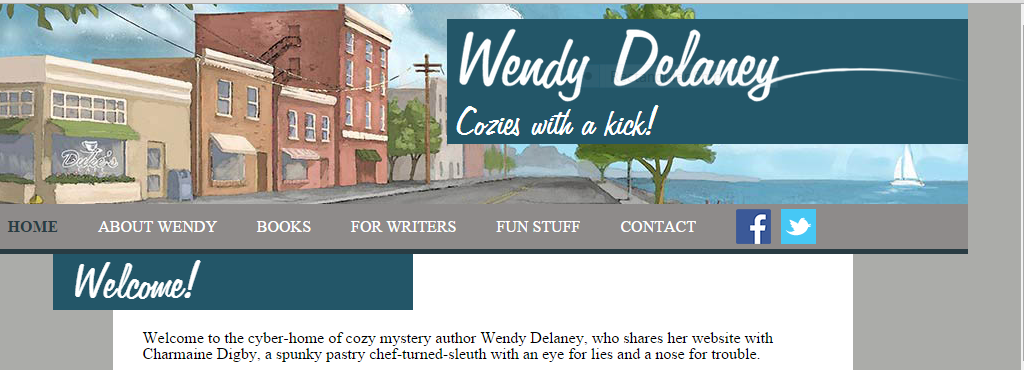
    Author Wendy Delaney uses Cozies with a Kick, implying fun mysteries with a tad of spiciness– that these are not grandma’s cozies. You could not confuse these two authors. They are both women, they both write mysteries, but you know they are reaching different audiences.

    Notice how every aspect of their websites focuses and reinforces their specific branding in their web sites visitors’ mind-space.

    See how your website compares with this handy branding checklist for your author web site’s homepage: 

    • Header – Strong Visual Image that Reinforces the Tagline
    • Menu Bar – Easy to Navigate
    • Homepage – says it all: Author, Tagline, Genre, Where to Purchase, How to Contact, Testimonials, and Visitor Engagement
    • Handy Links with Calls to Action
    • A personal note from the author at the bottom of the page to call again (visit again).

    Our next post will focus on Calls to Action.

    We hope that this article has shed some light on areas where your website can be improved to help you reach your audience. The best part is all of these improvements are free if you know how to do it yourself. If not, Chanticleer Reviews offers website assistance and creation as part of their book marketing services targeted specifically for authors.

    See the next article here!

    Rochelle Parry, Chanticleer Reviews’ Creative Director  

    Rochelle Parry, webmaster

  • Engaging Readers and Building a Fanbase Using Leadership Communication, Part 2

    Engaging Readers and Building a Fanbase Using Leadership Communication, Part 2

    Writing Craft may be the key to writing a great story, but engaging people is the key to building a readership and a fan base.

    Engaging Readers and Building a FanbasePart 2. Establishing Competence and Credibility as an Author in Today’s Digital World of Publishing: Engaging Readers and Building a Fan-base using Leadership Communication Skills


    Recap of Part 1. Creating Identity and then Communicating It

    Authors must take the leadership role in communicating with potential readers. Authors are also responsible for maintaining and nurturing the author/reader relationship. If they do not, then other authors who do will gain ‘mindshare’ of those readers.

    By leading the communication about you and your work, you will have a distinct advantage of the hundreds of thousands of authors who do not.  And with a million plus books hitting the market this year alone, every advantage helps to position your work a notch higher.

    As an author, lead the way to creating the digital paths that will help people discover your books. Today, that means communicating via the Internet. 

    We listed the four cornerstones of Leadership Communication in the previous article as:

    1) Creating Identity

    2) Establishing Credibility and Competence

    3) Creating Shared Content

    4) Committing to Action

    We also defined the Interverse as a global network that is overlaid on the Internet. The Interverse is where the virtual digital universe intersects with reality. To have an Internet presence means you must have a website that communicates your brand, your identity, as an author.

    Part 2:  Establishing Credibility and Competence

    Engaging Readers and Building a Fan-baseAuthors must recognize the need for strong credentials to demonstrate competence to potential readers, book buyers, librarians, and media professionals.

    Authors must be empathetic to readers. Why should they read your book? What will drive their decision? Where can they discover it/find it? How can you as the author gain their confidence and trust? When do readers decide what to read? Who are your readers/your audience?

    Authors need to answer these questions honestly for themselves and then begin establishing credibility, credence, and competence with their potential readers.

    Establishing Competence

    Make sure that your work is the best that it can be. Believe in your work by putting together the best team of editors, proof readers, beta readers, press formatting editors (digital and/or print), cover designers, and publishing professionals that you can to produce your book. First impressions do count as do second, third, and so on. Readers are savvy.

    Then acknowledge the team of talent that worked on making your work the best it can be in your work’s preface. Your team then has a stake in your work and they will, in all probability, broadcast your work because it broadcasts their work.

    Let the world of readers know that you did your very best for them—that you acknowledge them and that you are showing respect for them. Publishing your work as a professionally as you can conveys respect for Readers.

    Results: Book buyers for bookstores and libraries are wary about buying books from Indie authors and small presses because of quality issues they have had to deal with previously. Their selections determine their next pay raise or even keeping on the payroll. Help them do their job by making it easy for them to see that your work is of a professional level and that it reflects the time-honored traditions of publishing that their readers have come to expect and demand.

    A Reader will be more willing to tell others of your work if it reflects well on her.

     Ask Readers for their feedback & insights—not just reviews—and then reward them for their time and effort whether or not the information was positive or negative. Ask them for this information on a one- on-one basis through your website and social media messaging. (Of course, never feed the Internet trolls.)

    Results: Readers will make a connection with you and your work. Connections lead to more introductions to other readers. This is how fan bases are created. Also, you gain valuable reader perspectives about your work.

    Establish Credibility

    Highlight Quotes, Reviews, and Support from Others to Gain Credibility

    Why are reviews important?

    Book ReviewsReviews add weight to your credibility. Reviews allow for comparison and judgment thereby engaging potential readers in the mental process of decision making and discussion points. Your promotional efforts are not dissipating into the ether, but are actually getting noticed by potential readers and publishing professionals.

    • Reviews distinguish your work from the millions of other books that are in the market place.
    • Reviews support your author platform and add evidence that your work is validated by readers.
    • Reviews allow for discourse about your work.
    • Editorial reviews make available the language for readers to discuss your work and to use in their reviews. Authors have told us is that Editorial reviews give their readers the language and vocabulary to discuss their works. Editorial reviews also help to set the tone of reader interaction.
    • Reviews are critical to your work’s success in today’s digital age of publishing. Readers may never actually see your printed book, but your reviews will be easily available to read on the Internet.
    • Reviews crystallize what your book is about from its reader’s viewpoint.
    • Reviews connect your readers through a commonality and promote discussion.
    • Reviews give authors something to post, blog, and chat about with their works that someone else has said. Authors can easily re-tweet, share, like, and comment on their Editorial Reviews without sounding “self-promoting.”

    Book Reviews are consistently one of the most powerful tools available to authors.

    As much as you love your book and your family and friends think that it awesome, readers want to know what others think of your work to make their decisions. There are several types of reviews and reviewers:

    • peer reviews by other authors
    • editorial reviews by professional reviewers in the publishing industry
    • manuscript overviews – pre-publication editorial reviews
    • consumer reviews by individual readers
    • reviews by family and friends (cheerleader reviews)

    An author requires the first four to make a professional impression on potential readers because each type of review has its own targeted audience and its own aim. And since there are many shades of gray, authors will benefit from having reviews from all categories.

    For more information on reviews, please read “What is an Editorial Review? And How is It Different from just a Review?”

    Use Quotes from:

    • Editorial Reviews
    • Other authors who write in your genre and have read your book
    • Those who have inspired you
    • Writing competition awards (be sure to link to competition’s official listing of award winners)
      • Post and display digital badges from writing contests and affiliations
    • Notable personalities in fields related to book. For example, if your work is about a murder mystery that takes place in Provence, France, could you ask for quotes from a notable chef, or artist, or business owner from the area who has read your work. OR if your work is a medical thriller, try to get a quote from a medical examiner. Be creative!

    All of the above increases your sphere of potential readers and adds value to your work and your author brand. Most importantly, quotes from others supporting your work will help you win the hearts and minds of your readers.

    Let your passion and creativity show to engage readers! Make it easy for your readers to help you create your fanbase and for them to become evangelists about your work.

    INFORM, INVOLVE, ENGAGE

    As an author, lead the way to creating the communication paths that will help people discover your books.


    My next post will be about:  Creating Shared Content in Today’s Digital World.

    Kiffer Brown, CBRKiffer Brown discovers today’s best books with reviews and writing contests at Chanticleer Book Reviews, L.L.C., which she founded in 2010.  She is also a media scout and trend-spotter for executive film producers (with film options to her credit), literary agents, and publishing houses. She searches for today’s sparkling gems that will become tomorrow’s best sellers. She truly loves what she does and her passion shows. 


    Kiffer helps authors develop methods that engage readers and expand their fan-bases. She has presented at Writers Digest NYC, RWA National, PNWA, PubSense Summit, and other conferences, where she focuses on the business of being an author. She invites you to attend the Chanticleer Authors Conference and Awards Gala held Sept. 27, 28, & 29 in Bellingham, Wash.  www.ChantiReviews.com 


  • Engaging Readers and Building a Fanbase Using Leadership Communication Skills

    Engaging Readers and Building a Fanbase Using Leadership Communication Skills

    Writing craft is the key to being an author, but engaging people is the key to building a readership and a fan base.

    Some authors forget that content alone will not sell their books. They have little interest in engaging with people to find readers. They want to write. Period. Others don’t feel comfortable about engaging with others or feel  conflicted about promoting their work. Unfortunately for them, selling books is not about writing books.

    If you want people to read and buy your book, you must introduce yourself and your work to them. People want to know about you as an author, about your writing style and the content that you create. They need information to ascertain if they are interested in investing their time, money, brain-space, and “emotional investment” into your work. Basic book marketing is much like writing a newspaper article. People want to know:  who, what, when, where, why, and how–easily and quickly when deciding on whether or not to buy a book.

    Fortunately, today’s internet technology makes informing the potential readers about your work easier and less costly than ever before.

    The Internet levels the playing field for all authors: self-published, indie-published, hybrid-published, and the traditionally published.

    LEADERSHIP COMMUNICATION for AUTHORS

    As an author it is up to you to reach out and say “hello” to potential readers and introduce yourself and your work. Authors must take the leadership role in communicating with potential readers  and are responsible for maintaining and nurturing the author/reader relationship. This is called Leadership Communication in marketing speak. By leading the communication with readers about you and your work, you will have an advantage over the hundreds of thousands of other authors who do not. And with a million plus books hitting the market this year alone, every advantage helps to position your work a notch higher in the publishing world.

    As an author, lead the way to creating the digital paths that will help people discover your books. And today, that means communicating via the Internet. 

    What is the Interverse?


    Internet of Things
    The Interverse is a global network that is overlaid on the Internet. It is continuously evolving and connecting in ways that we can’t imagine or predict. It is where websites (identities), social media posts, instant messaging, apps, voice communication, blogging, chat rooms, buying and selling, and other ways of communicating via the “Net” interconnect and take place.  It is where the virtual digital universe  intersects with reality.

    To do business on the Internet (read: sell books individually or through orders), you must exist in the Interverse, which means you must have a digital identity–a website that communicates and broadcasts your identity digitally. Even if you only sell print copies, orders are placed via the Internet in the Interverse.


    Leadership Communication has Four Cornerstones:a black laptop computer with a red megaphone

    1) Creating Identity & Branding

    2) Establishing Credibility and Competence

    3) Creating Shared Content

    4) Committing to Action

    Welcome to Chanticleer Reviews 4-Part Series on How to Market Your Books in Today’s Digital World with Leadership Communication Skills  

    Part 1. Discussion About  the Principle Marketing Concept  of Creating Identity

    Identity in the business and  publishing world is another name for  branding. Creating Identity in today’s business world means to have an Internet presence. To have an Internet presence means you must have a website that communicates your brand, your identity, as an author.

     If you, as an author, do not have a website, then you as an author do not exist in the Interverse.

    And that statement is not a typo.

    Creating Identity and Branding for Authors

    Identity is a brand. A brand is a warranty. A warranty is a promise, an assurance. It allows people to know what they should expect in a transaction. It allays fear of committing to a transaction or an agreement or an emotional investment. Branding helps you to distinguish yourself from the other millions of authors and associate yourself and your works with authors and books within a particular niche of publishing.

    Effective author branding leads to increased book sales.

    Make sure that your author’s website exudes your branding, your identity. The first thing that any bookseller, agent, librarian, publisher, or media professional will do before investing any amount of time or money into your book is to visit your website. It is of the upmost importance that your website makes a professional and consistent impression that communicates your brand, your identity. Your “author branding” should reflect your work in the best possible ways that are compelling to your book(s)’ target market.

    Your brand should come across vividly on or with your:

    • author name or pen name
    • website
    • social media platforms (Facebook, Pinterest, Twitter, Reddit, etc.)
    • book covers
    • marketing materials
    • author persona at book signings, conferences, conventions, panel discussions
    • blogposts
    • social media posts
    • business cards & book marks
    • visual content
    • typography and layout of books
    • advertising venues and tactics

    Consistency, constancy, and authenticity are what will add value to your branding efforts.

    How to Determine What Your Author Identity/Brand Is?

    The brand should focus on your writing, your books. Answering these questions will help you to focus on what your branding should be:

    What is the overriding theme to your works? What is your passion that comes through in your writing? What makes your work compelling? What are the values that you are trying to convey with your writing? What is the “mood” of your works? What sort of emotions do your works generate in readers? What is the most unique quality about your writing? What makes your writing stand apart from others? What is the ‘voice’ of your books?

    Who Are Your Readers? And How Do You Attract Them?milkyway galaxy

    • How will your branding add to your readers’ experience?
    • Can you identify your readers?
    • Can your readers identify with your book? What is the touchstone? (a huge argument for taking time for social media)
    • Why does your book resonate with its readers?

    Building Audience with Branding

    Your branding should help you build audience. Your branded website is your calling card in the Interverse. It is the home-base for all aspects of your business as an author. It is the touchstone of all your marketing and promotional efforts as an author.

    How will readers, who you will probably never meet in person, decide to read your book? How will you communicate across the Interverse to compel them to take a chance on your book? To invest their time reading your books? To forge a virtual connection with you as an author? To be able to “connect” with you and your work?

    Don’t feel overwhelmed. It is good to remember that websites and digital collateral (your digital footprint in the Interverse i.e. website, social postings, blogposts, etc.) are dynamic, changing entities. You can add, subtract, adjust, pivot, and enhance your Interverse presence. You can add new websites for new books and  new pen names. Nothing is carved in stone.

    Websites and Branding

    Your website should quickly answer the following in a visually and contextually  appealing manner for your targeted readers by utilizing the journalistic method of:  who, what, when, where, why, and how.

    The average length of time that you have to make an impression on a website visitor is about 5 to 10 seconds. It is in this amount of time that a website visitor will decide whether to close the browser window to your website or stay and “visit.”

    Website Basics for Author Branding:

    • websites should load quickly (visitors no longer wait for websites to load)
    • websites should be visually interesting and compelling with a LOT of pertinent photos, graphics, and images
    • websites should always have blog posts with fresh new content for SEO crawlers–even if it is just a paragraph or a blurb at least once a week
    • websites should supply pertinent information as to Who, What, Where, When, Why, and How

    WHO — Who You  Are as an Author? Who Are Your Favorite Authors? Do You Have  Hobbies? What Are Your Interests & Pet Peeves, Your Idiosyncrasies?

    WHAT — What Do You Write? What Inspires You? What Do You Like to Read?

    WHEN–When Can They Expect: your next installment, your next book, your next signing, your next blogpost, etc.?

    WHERE — Where Do You Write? Do you write while  on the bus, at a local café, in the garden, do you do your best work while traveling, or under pressure with NaNoWriMo ?  Where do you get your inspiration?

    WHY— Why Do You Write? Why are you inspired to write?

    HOW–How Do You Write? Are you fueled by lattes, morning runs,  chocolate, or traveling? Are you a  pantzer or planner? Remember to most readers, authors are intriguing beings with magical skills of creating characters, worlds, and stories.

    Notice the order of the questions is in the order of importance. Readers can then choose to drill down for more information or “turn the page” for the rest of the story. Your objective is to keep them captivated and interested.

    Answering these questions will facilitate interaction with potential readers, and convert readers to fans. Fans amplify your marketing and promotional efforts. Fans are evangelists for your books! Then the Interverse will then amplify these actions and grow your audience and readership organically. Growing your audience increases your book sales. 

    My next post will be about:  Establishing Competence and Credibility as an Author in Today’s Digital World.

    Up-to-date practical, effective marketing and promotional skills are Kiffer Brown’s forte.

    Kiffer Brown, CBRHoned business experience and an  entrepreneurial spirit, along with a true understanding “that nothing happens until something is sold”  is what Kiffer Brown brings to the table. Kiffer presents at numerous writers conferences and publishing conventions. She is a media scout for executive film producers, literary agents, and publishing houses. She searches for today’s sparkling gems that will become tomorrow’s best sellers. She truly loves what she does and her passion shows.

    She has presented at Writer’s Digest National Conferences in NYC, RWA National Conferences, Emerald City Writers Conferences, PubSense Summits, PNWA conferences, and others. She is the founder and president of Chanticleer Book Reviews and International Writing Competitions, L.L.C. and the publisher of Chanticleer Reviews. She is the organizer of the Chanticleer Authors Conference.

  • What is an Editorial Review? And How is It Different from a Review?

    After the post The ABC’s of Making Book Reviews Work Harder at Promoting Your Book, we received several questions about what exactly are “Editorial Book Reviews” and how do they differ from  “reviews.”

    You asked. We answer. 

    There several types of reviews and reviewers:

    • peer reviews by peer reviewers (other authors)
    • editorial reviews by professional reviewers in the publishing industry
    • manuscript overviews – pre-publication editorial reviews
    • consumer reviews by individual consumers (readers)

    An author requires all four to make a professional impression on potential readers because each type of review has its own targeted audience and its own aim. And since there are many shades of gray (no pun intended), authors will benefit from having reviews from all four categories.

    Editorial Reviews

    Editorial reviews tend to focus on the technical aspects (grammar, formatting, spelling, consistency, punctuation, POV, etc.) of a work along with  the writing craft of the author by an editing professional. Other publishing or media professionals use these assessments when evaluating for works purchasing decisions or for distribution purposes.

    Chanticleer Editorial Reviews:

    Here at Chanticleer Book Reviews, our reviews combine an editorial assessment of a work: plot, structure, dialogue, characters, story development, along with grammar and punctuation with the readability of a work. The assessment is written by a professional editor after reading and evaluating the particular work.

    Our review team is comprised of experienced editors selected for their expertise in specific genres and blended genres. It is extremely important that the person reviewing the work understands the genre of the work and what the readers of that particular genre are looking for in a “good read.”  Thriller fans will be bored with cozy mysteries. Cozy mystery fans will be annoyed with the rapid fire of situations found in thrillers. Romance readers typically don’t enjoy the angst of many literary works that are known for not having “satisfactory or happy” endings. Some works overlap and blend genres which would go against the grain of some genre purists. Even though a professional editor can see merit or if there are problems in a work out of their expertise, we try to select the very best fit between a work and the reviewer.  

    Chanticleer Book Reviewers uphold the time-honored publishing traditions that readers have come to appreciate and expect from published works while maintaining an open-mindedness for emergent ideas, talent and creativity in the field of literature, media and publishing.

    Manuscript Overviews 

    Editorial Reviews may also be manuscript overviews. Manuscript overviews are to help the author evaluate his work on a broad spectrum on the following issues before getting a line by line edit.

    Manuscript Overviews editors look for:

    • consistency in story
    • POV
    • grammatical errors
    • style sheet issues
    • character development
    • dialogue issues
    • plotting, plot holes
    • pace of story
    • theme consistency
    • does the work need tightening or is it too staccato

    I always like to ask the manuscript reviewers, “Does the work have a ‘beat to it?’ Does the story move along? Are the characters memorable?”

    A manuscript overview can answer these questions in an objective and unbiased manner. The goal is to help the author work out  issues before she has it line edited and proofed for publication.

    On another note, a work can be technically correct, but a horridly boring read. We know, we’ve read them! Then there are works that are compelling to read even if they are bungled with grammatical and writing craft errors. The decisive point  is that while an editor can correct errors in grammar, punctuation, POV, etc., they cannot “correct” a boring story. Creativity and Content are King and Queen. However, lack of editing or just bad editing can cause the reader to “stumble” over the text and put it down in favor of trying another read, another author. An intriguing storyline can benefit from a developmental editor – the most difficult level of editing. Most works can benefit enormously  from a correct dose of developmental editing.

    Remember:  The editor sees what the author cannot. The story lives in the author’s mind. The editor sees the gaps between the author’s mind and the words on the page. It is almost impossible to “see” your own gaps because your mind automatically fills them in.

    Peer Reviews by Peer Reviewers

    For most fiction authors, this would be a review by another author who writes in the same genre. The most beneficial type of Peer Review would be an “endorsement” from an author in the next tier of sales above you—an author who can validate that your work is worthy of his/herPageLines- not_moliere_1_a.jpg endorsement. This type of review generally bespeaks, “If you like my novels, you will like this author’s work. Give this book a try.”  The author making the “endorsement” is putting her reputation on the line for you. Request author endorsements judiciously and respect the author’s  right to pass on the opportunity.

    Consumer Reviews by Individual Consumers

    Translation: Readers are Consumers!  Authors create content. Readers consume content. Thank goodness!

    The reviews posted on Amazon, or on Goodreads, or on websites are precious! These reviews are from individual readers who  (hopefully) enjoy reading your works. Readers, on the whole, write very few reviews for many reasons: too busy, not really knowing the specifics of why they like the work, not having the background (read vocabulary) to discuss the work, or it is just too much trouble.

    Authors need to make it easy as possible for readers to recommend their books by:

    • creating links
    • making use of editorial (read: professional) reviews that will give recreational readers the vocabulary from which to discuss and share their thoughts about their works
    • thanking the busy reader for any feedback, LIKEs, +1’s etc.
    • Post, comment, LIKE, and +1  on the reviewer’s social media posts and blog-posts.

    Consumer Reviews are instrumental in creating BUZZ! You, the author, should endeavor to do anything that will make it easier for your readers to spread the word about your work.

    Visit  examples of how to use the different types of reviews on your author platform’s website.

    Great sites to emulate are:  Michael Hurley’s website and Alan Brenham’s website.

    You will notice that they list peer reviewers (other authors), professional editorial reviews (Kirkus, Chanticleer, Foreword), and readers’ reviews together making it easy to scan for the preferred reviewer(s).

    Please look for the next article from Chanticleer Book Reviews on Mastering Book Discovery Tools and Methods. 

    PageLines- Rooster-headshot80x80.png


  • The ABCs of Making Book Reviews Work Harder at Promoting Your Book

    The ABCs of Making Book Reviews Work Harder at Promoting Your Book

    Editorial book reviews are one of the most powerful tools available to authors for getting their books before the eyes of readers and media professionals.

    milkyway galaxyMost authors do not take advantage of the opportunities that a book review presents to them–especially Editorial Reviews. Maybe they will read them, maybe they will acknowledge the reviewer, but rarely do they make full use of them. As an editorial book reviewer, I find this frustrating. So, here are my tips to make your book reviews work harder for you!

    So, just what should an author do with reviews, especially editorial reviews? 


    If it is an Editorial Review, the very first thing to do is this:

    A. Post an excerpt of the Editorial Review in the Editorial section on the title’s Amazon page.

    You can do this through Amazon Author Central. Only the author or the publisher can post to the Editorial Reviews section.

    Why should you post in the Editorial Section?

    1) Having an Editorial Review in the Amazon section gives the title a little more “Amazon” awesomeness with Amazon search algorithms. And is there an author who couldn’t use a little more Amazon love?

    2) Some readers only read “editorial reviews.” They do not put any credence into “customer reviewers” because they think that the authors friends and relatives posted the “customer reviews.” Some readers do not read “editorial reviews,” but at least this way you’ve got your bases covered.

    3) Booksellers (indie bookstores) and librarians read the editorial reviews before they make a buying decision. Most professional purchasing agents and buyers do not read “customer reviews” for decision making purposes.

    4) Post excerpts from your title’s positive (hopefully) editorial review in as many on-line places as you can: Barnes & Noble, BAM, Chapters, Smashwords, Kobo, etc. and definitely on Amazon–the world’s largest bookseller.

    B. Post the entire review on your website (remember, you can post an except and then have the excerpt link to the full review). Then link to:

    1. The reviewer’s website (for street cred) and for extra SEO (search engine optimization, i.e. Google ranking) goodness–if possible

    2. Then post an excerpt on Google+ with a link back to your website’s full review

      • this will funnel potential readers to your website — not to your Amazon page! You want your potential reader to establish a relationship with your author brand–not Amazon’s brand!
      • adding another  link will  create more SEO goodness with Google search
      • the G+  post will keep working for you on Google + long after you have made it AND will give you more Google SEO goodness

    3. Post excerpt of the review on Facebook, Twitter, etc. with links back to your website’s review

    C. Group your Editorial Reviews together on your website

    • This will make it easier and faster for publishing professionals to find. Never forget that the first thing that a publishing professional (read: interviewer, librarian, agent, bookseller,  etc.) will do is check out your website for information about you and your title.  Make it easy for them! A good example of this is Michael Hurley’s website:  http://www.mchurley.com/reviews/

    D. Editorial Reviews increase  Reader/Customer reviews 

    • Authors have told us is that Editorial reviews give their readers the language and vocabulary to discuss their works. Editorial reviews also help to set the tone of reader interaction.
    •  Authors have reported back to us that they noticed that after our reviews are posted that their number of their Reader/Customer reviews dramatically increase. Remember writing and crafting a review is hard work. You want to make writing a review for your work as effortless as possible.
    • Authors have noticed that they receive more more comments and social media interaction when they have editorial reviews posted and published.  Posted Editorial Reviews allow for busy readers to  Tweet, Share, Link, and Comment on their favorite Editorial Reviews of  titles.
    • Editorial Reviews give authors something to post, blog, and chat about with their works that someone else has said. Authors can easily re-tweet, share, like, and comment on their Editorial Reviews without sounding “self-promoting.”

    In a nutshell:

    Editorial Reviews provide marketing collateral to authors and publishers, generate press releases, create content for social media posts, enhance author platforms, and drive promotional efforts. 

    Please look for our next Chanticleer Book Discovery article – coming to your email inbox soon! 

    Rooster-headshot80x80

  • PNWA Presentation – Why Authors Should Use Google+

    PNWA Presentation – Why Authors Should Use Google+

    whygoogleIt is a big universe out there, so as an author you should consider incorporating Google+ Advantage  into your marketing strategy as a discover-ability tool.


    Google+ should be a pillar in every author’s platform to amplify networking efforts and build relationships with readers.

    We help good books get Discovered!


    This is a copy of the slides that Kiffer Brown presented at the PNWA’s 2014 writers conference. Just click here to see the presentation:  Google Slides


  • “How to Create a Great Book Cover for Today’s Digital Publishing World” by Argus Brown

    “How to Create a Great Book Cover for Today’s Digital Publishing World” by Argus Brown

    book stacks 0,,480734_4,00Your book cover is one of the first impressions that prospective readers have of your book.


    [fusion_builder_container hundred_percent=”yes” overflow=”visible”][fusion_builder_row][fusion_builder_column type=”1_1″ background_position=”left top” background_color=”” border_size=”” border_color=”” border_style=”solid” spacing=”yes” background_image=”” background_repeat=”no-repeat” padding=”” margin_top=”0px” margin_bottom=”0px” class=”” id=”” animation_type=”” animation_speed=”0.3″ animation_direction=”left” hide_on_mobile=”no” center_content=”no” min_height=”none”][Editor’s Note: We have observed readers scanning book covers at  books stores, book fairs & festivals, and at conferences across North America. The first point of interaction between a potential reader and a book is almost always the cover. So, we asked Chanticleer’s  IT/Computer Wizard, Argus Brown, if he had any ideas about how to help authors step up their designs for book covers. And he does!]

    The cover is almost, if not,  as important as the content of a book for it to get  discovered in today’s visually oriented society. 

    If the cover is a dud, you can expect that the reader will pick the shinier apple out of the bin (no matter that it doesn’t taste as good) or the book with the more enticing cover off the table or shelf.

    At Chanticleer Book Reviews & Media, we get to see thousands of book covers every year and find that most of the covers could use  updating for today’s digital/e-pub book market.

    We have learned that most Indie authors tend to invest their publication dollars into editing and formatting costs, as they should, with little room left in their budgets for hiring  a professional cover designer.

    Canva is a new book cover design tool that  is easy to use.  I’ve created the following article for authors on cover design and a STEP-By-STEP 15 minute video (click for the video) to get you on your way to creating an effective (i.e. a book cover that will increase sales of your book) book cover. And even, if you do hire a professional, this tool will help you stretch your publishing dollars.

    Book Cover Design in the Digital Age of Publishing

    Size Does Matter

    A Trip to the Stars
    Pre-Internet
    A Trip to the Stars
    Updated

    One of the first things to take into account is that websites  are going to take your beautiful book cover and reduce it into a tiny stamp-sized thumbnail. Your cover has to look good when shrunk to 150 pixels (about the size of two postage stamps). On the left  is an example of one of our favorite books that we reviewed whose cover was created before e-book readers.

    Notice that you really can’t make out too much of the cover’s striking design in the thumbnail and you certainly can’t read the title or who the author is.

    Several years ago the publisher updated the cover so that the title and author’s name was more visible at a 150 pixels.

    Pick a Relevant Background

    The background should relate to your book in a meaningful way. I’m not sure if either of the above examples really hits the mark, but the biggest change from the updated example is the inclusion of more testimonials on the front cover (although you can’t see them in the thumbnail). However, the most important change is that readers can read the title and author’s name. The other thing that works well is the high contrast between the title and the background. You want to make sure that text pops out of the image. We suggest to limit yourself to one testimonial on the front cover. You have our blessing to put in as many pages of them before the book’s title page.

    Below is my Step-by-Step explanation or you can watch my 15 minute tutorial video  of how to use this powerful new tool that is easy to use.

    Canva Simplifies Cover Design

    For most of our design work we use Adobe Photoshop or their open source equivalent, Gimp. Both of these programs are a bit of a behemoth in the same way Word is generally overkill for 99% of the things you do. Google tackled Word with their simple online document editor and Canva is taking on Adobe Photoshop in a similar way.

    You can sign-up for Canva for free* (www.canva.com). Canva only charges you money if you use one of their canned images (then it is usually only a buck or so*). Once you login you can take their quick tutorial (or not) and then start designing your cover. Canva has made it easy to design a cover for your ebook. Under Start a new design, click the Kindle Cover icon. If you don’t see the icon, slide the bar under the icons to the left. It is a bit difficult to see but it is there.

    canva1
    Canva Opening Menu

    After you click the icon you will see the Canva editing screen. On the left side of the menu you have a bar with several sample layouts.

    Canva Demo
    Canva Opening Menu

    The layout thumbnails are 234 pixels high, a bit larger than what you will find on a typical Amazon search page but it gives you a good idea what a smaller image might look like. Scroll though the sample layout and pick one that is appealing. I like layouts where you can clearly read the title and author’s name. Also pay particular attention to the fonts. Canva has a ton of fonts. Pick something that is easy to read once it gets turned into a thumbnail. I picked The Meadow Girl example on the left.

    Its all about the image

    canvas-bookdemo3canvas-bookdemo4Canva makes it easy to replace the image in the layout. You can either use their search box and select from one of about a million images or you can upload your own.

    Canva has a set of Instagram- like filters that you can apply to their stock photos to suite the mood of your book (the filter function doesn’t seem to work on uploaded photos).

    In the example to the left, I used their black and white filter and changed the background text for the title. In the example of the right, I searched for Meadow Girl and picked one of their stock photos. Notice how the image changes the overall feel of the book. (FYI: The Canva watermark is removed from their photos you pay the $1 royalty fee.)

    canvas-bookdemo1For my example I uploaded a photo I took early in the morning while sailing across the Bahama Banks. You can see the results on the right. If you click on the image it will open up a larger view. I wasn’t real happy with the thumbnail, so I decided to enlarge the author’s name and center the title. You can see that the thumbnail is quite a bit clearer. (Hint: after you drag a new image or photo to your design, press the Back button above the photo to bring the text “in-front” of the image. If that is confusing, watch the video).

    canvas-bookdemo2 After you get an image you like, click on the Link & Publish button.  Go ahead and select the image option. The next screen is where you would purchase the image. For now go ahead and click the download a watermarked draft link. It should automatically download a draft of your work.

    Create Some Thumbnails of Your Book Covers to Review

    It would be nice had a thumbnail view so you could see what your image would look like on Amazon, Kobo and other sites. For now you can upload your image to an online thumbnail generators such as: jpegreducer. Just upload the file, click Reduce It and the select View the reduced images.  On the final screen you can scroll down to see your thumbnails.

    canvas-bookdemo5
    Thumbnails

    The nice thing about Canva is that it is easy to experiment with a bunch of different images and layout styles. 

    Go ahead and give it a try—you will be inspired! And it’s fun to experiment with creating the perfect cover for your works.

    Look for more of articles and videos about the very latest in publishing and marketing technologies from Chanticleer Book Reviews & Media. If you’d like to subscribe to our channel, click the button below.

    * Free as of June 9, 2014. *Terms are subject to change.

    [/fusion_builder_column][/fusion_builder_row][/fusion_builder_container]

  • Five Top Things to Promote Your Book Today

    milkyway galaxyWith more than two million new titles hitting the English language market this year, how will your book get noticed by readers?

    We find that a multi-pronged approach is the most effective strategy in building and maintaining readership.


    Five Top Tips to Promote Your Book that You Can Do Today

    1. Enter writing competitions –   Don’t’ just take my word for it….

    • “Whenever you win, it makes it easier to sell your works,” Jo Beverly, best-selling author, and “One of the great names of the genre.” Romantic Times.
    • Publishers use award winning decals on printed books and digital pages because it makes books stand out in a crowded marketplace.
    • Booksellers are more apt to order award winning titles.
    • Readers tend to purchase award winning titles over others. Remember, your title will have to vie with five to seven thousands titles even at the corner Indie bookstore.
    • Awards can be posted on your website and blog. And awards create rapport with your Readers. They share in the winning much like sport fans bask in the success of their favorite team or athlete.
    • IF your work is resonates with the judges, they will become fans – avid fans from my experience.
    • IF your work does place well in a contest, it is a cost-effective method of getting your name and title in front of a lot people. And the entry fee is a cost deductible business expense.
    • “The exposure in winning a contest gives your work credibility and exposure you would not have otherwise…and increases sales and readership,” Janet K. Shawgo.  Note: Ms. Shawgo repeatedly sells out at her author signings at Barnes & Noble.
    • Contests give you a firm deadline to meet. Something that I know works that always works for me. Put a post-it sticker on your computer with the impending deadline.

     2. Build your brand (aka Author’s Platform)

    Yes, your author’s platform is much more than your website or blog posts. It is your brand.

    A brand is a guarantee in marketing-ese. Readers and consumers like branding because it allows them to feel that they can take a chance on a new product or remain faithful to a product (read series/author/brand).

    Everything that you put out to the world about your author persona should create a coherent brand. Be focused and consistent across the board from how you dress at author signings to your business cards.

    I cannot emphasize enough the importance of cover art in creating your author brand. Spend time, and money for the best that you can afford. Cover pages are your most valuable real estate. Make every inch count from the front cover, the spine, the back cover, and the fold-down pages of the book jacket. Book cover art is a separate topic  to be addressed in a different article.

    One of my favorite authors, Ann Charles, is a wizard at this. Her award winning Deadwood series features Violet, a cowboy boot wearing real estate agent. You will rarely see Ann not wearing her trademark cowgirl hat and boots when you see her at book festivals, conventions, and conferences. And her books sell!

    Your photo on your website, Google Authorship, social media posts, book covers, must consistently reflect your author persona.  Everything dealing with your author persona should repeat and reflect your book brand.

    Everything you say, do, present either adds to or subtracts from your brand, your author platform, your book’s reputation.

    3. Have your work professionally assessed by several unbiased, objective editorial reviewers. If it is a positive review you can then use it to generate content for:

      1. Creating Social Media Posts (You aren’t telling everyone how great your book is, nor is your mother or your bestie. A professional editor is making the statement.
      2. Generating press releases.
      3. Publishing  on your author platform and website.
      4. Blogging points. Take different aspects of the editorial review and blog about them in short and succinct blog-posts.
      5. Point of Sale Marketing with Shelf Talkers: quote from the editorial review.
      6. Interviewing points of reference (it gives interviewers discussion points).

    Positive Book Reviews help your cohorts promote you and your works. You are not making them take up valuable time creating content to promote your book. They can glean parts of the book review to tweet and post. They can find the review “Helpful” on Amazon. Like it on FaceBook. And, they can pass the review on to their social media circles and networks. Professionally written, positive book reviews help your supporters and AERs to promote your works.

      1. Be sure to utilize  review blurbs in the Editorial Review section of your title’s Amazon page.
      2. Book Cover blurbs (indispensable).
      3. Make sure that book distributors have access to your  professional editorial reviews.
      4. Positive book reviews that are well written add to your author’s platform.

    And, finally, professionally written book reviews are one of the most powerful tools available to authors for building audience.  

    4. Embrace the Age of the Internet

    • Yes, you must actively and consistently participate in social media.
    • Posting in social media is like brushing your teeth. It is much better to post twice a day for a few minutes than for three hours on Sunday.
    • Support other authors and titles that you like and appreciate even if they are in a different genre. Be a mensch. However, do not promote another author’s works if it is not up to snuff. But remember what your mother taught you: if you can’t say anything good, don’t say anything. Always maintain your brand’s reputation and that when you say you LIKE something or plus +1, you are giving your guarantee, your stamp of approval.  Your retweets, plus 1+, and LIKES should have value.  It all adds to or subtracts from your brand, your book’s reputation.
    • Check out Chanticleer’s articles on Google Plus, Facebook, Tweeting, social media etiquette, and other tips and tools for social media.

    5.    Be “insanely appreciative” of your AERs (acquired early readers).

    • Be “insanely appreciative” (as Steve Jobs posited) of each and every one of your acquired early readers (AERs). I cannot emphasize this enough. Each reader has the potential to be an evangelist about your book. One of the most successful authors I know is successful because she acquires 1,000 beta readers for each title before they are published. She knows and connects with each one consistently. Imagine if you had a 1,000 reader fans on the day your book launches.
    • How do you acquire 1,000 readers? One at a time. Cherish each reader by  giving her an “insanely great experience” (quoting Jobs again)  as a beta reader or an early reader. Make your reader feel special because they are special. Two million titles will hit the English reading market this year alone. That a reader decided to read your work is a tremendous compliment. Never forget that.

    We will post more in-depth articles about each of these five marketing tools.

    Welcome to Chanticleer Community of Authors and Readers.

  • How and Why Authors Should Use Google+ by Kiffer Brown

    How and Why Authors Should Use Google+ by Kiffer Brown

    This presentation will shine a spotlight on what Google+ is and why authors and aspiring writers need to embrace this fastest growing social media platform that exists in the Internet Universe.

    google_plus_2
    The link below will take you to our Google “Power Point-like presentation” with slides that you can take your time to read  through for an overview of what G+ is and how it compares to Facebook and Twitter. The presentation will also touch on a powerful Google tool called “Google Authorship”

    Click here for Kiffer’s G+ Presentation

    We will also continue posting and publishing more tips on how to use Google + along with updates. Please keep in mind that Google+ continuously updates the platform.

    “Google+ aims to make sharing on the web more like sharing in real life.”

    [fusion_builder_container hundred_percent=”yes” overflow=”visible”][fusion_builder_row][fusion_builder_column type=”1_1″ background_position=”left top” background_color=”” border_size=”” border_color=”” border_style=”solid” spacing=”yes” background_image=”” background_repeat=”no-repeat” padding=”” margin_top=”0px” margin_bottom=”0px” class=”” id=”” animation_type=”” animation_speed=”0.3″ animation_direction=”left” hide_on_mobile=”no” center_content=”no” min_height=”none”]

    Kiffer Brown with Google+ overview presentation
    Kiffer Brown with Google+ overview presentation

    CBR will have more bite-sized information on Circles, Events and Hangouts.  We also begin listing links to helpful sites and posts.

    Please leave a comment! And be sure to Circle +Chanticleer Book Reviews and +Kiffer Brown on Google+   THANKS!

     [/fusion_builder_column][/fusion_builder_row][/fusion_builder_container]