To compete in the current book market, where millions of books are published each year, you have to find interesting new ways to get your books in front of potential readers.
[fusion_builder_container hundred_percent=”yes” overflow=”visible”][fusion_builder_row][fusion_builder_column type=”1_1″ background_position=”left top” background_color=”” border_size=”” border_color=”” border_style=”solid” spacing=”yes” background_image=”” background_repeat=”no-repeat” padding=”” margin_top=”0px” margin_bottom=”0px” class=”” id=”” animation_type=”” animation_speed=”0.3″ animation_direction=”left” hide_on_mobile=”no” center_content=”no” min_height=”none”]Same old same old
Today, Janet Shawgo, award winning author of the Look for Me series, shares her experience with setting up book signings at wine bars—and how the right creative approach can help spread the word about your books.
Also, as an added advantage, your books will have more focused attention from potential readers. It is a great one-two promotional punch!
Setting Up Book Signings in Unique Places Other than Bookstores
Bookstore managers don’t always return calls or emails, dates may not be available, or dates may be reserved six months in advance.
But who says that you can only hold book signings in a bookstores?
If you can get the okay to set up a table with books, you can have a book signing wherever that may be. (Like a wine bar.) I know of one very successful western fiction author who has his best signings (read as sells more books) in grocery stores!
Another author whose romance novels have a natural healer as a protagonist holds some of her most successful signings in food co-ops and natural supplement stores. Yet another author holds her signings at outdoor equipment stores for her eco-mystery series.
The possibilities are endless.
The Point is to Engage Readers – Janet says:
“These days, you need to find something unique to get your books to new readers. But getting yourself in front of readers can be frightening. I get it! Making your book signing into an event where you can have more interaction than just signing books helps ease the awkwardness.”
“Think of what fits with the theme or genre of your book. If you have a cozy mystery about food, find a local restaurant. If you write romance, a little wining and dining might go a long way.”
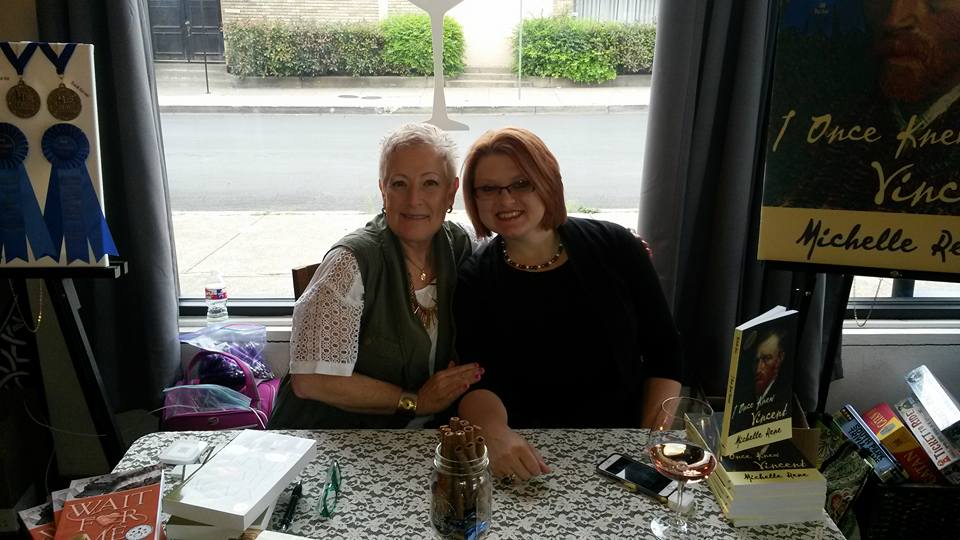
Janet Shawgo shares info about her Wine Bar Book Signings
“In April, another Dallas-area author, Michelle Renee, and I are hosting a book signing at a wine bar in the Bishop Arts district. We contacted the owner to ask if we could set up a table and sell our books on a slow weeknight. In return, we will purchase a few bottles of wine (white, red, and rose). We’ll hand out tickets to people, which entitles them to a glass on us.”
“I’ve had huge success with signings at wine bars. At another signing, I sold a good number of books, people enjoyed the glass of wine, and the wine bar had one of its best nights and welcomed me back to hold another signing.”
How to Make the Most of Your Book Signing – More Info from Janet Shawgo, award winning author of the WAIT FOR ME series
“To make sure people get to your book signing, be sure to spread the word! We’re on social media, sharing information about our wine bar book signing, but we’re also telling people at work, as well as family and friends. Don’t be afraid to ask the place that is hosting you to post on social media about the event, too. Targeted Facebook ads to locals might also help spread the word.”
“At the signing itself, we have a signup sheet for our newsletters to capture emails, and we also choose two or three people from it for door prizes at the end of the evening.”
“Be sure that your table is appealing and inviting. Readers love free items, so we have pens, bookmarks, candy, magnets, and key chains. Items that have information about our books on them keep us in readers’ minds.”
Thank you, Janet Shawgo, for the sharing your great idea with other Chanticleer authors!
Kiffer Brown asks: Where do your books’ targeted readers hang out?
kitchen stores?
gardening centers?
yarn shops?
trivia nights at pubs?
comic book stores?
boat supply stores?
pet stores?
coffee shops?
outdoor recreation suppliers?
The possibilities are endless!
Expand your readership—make your list of author/book signing opportunities today!
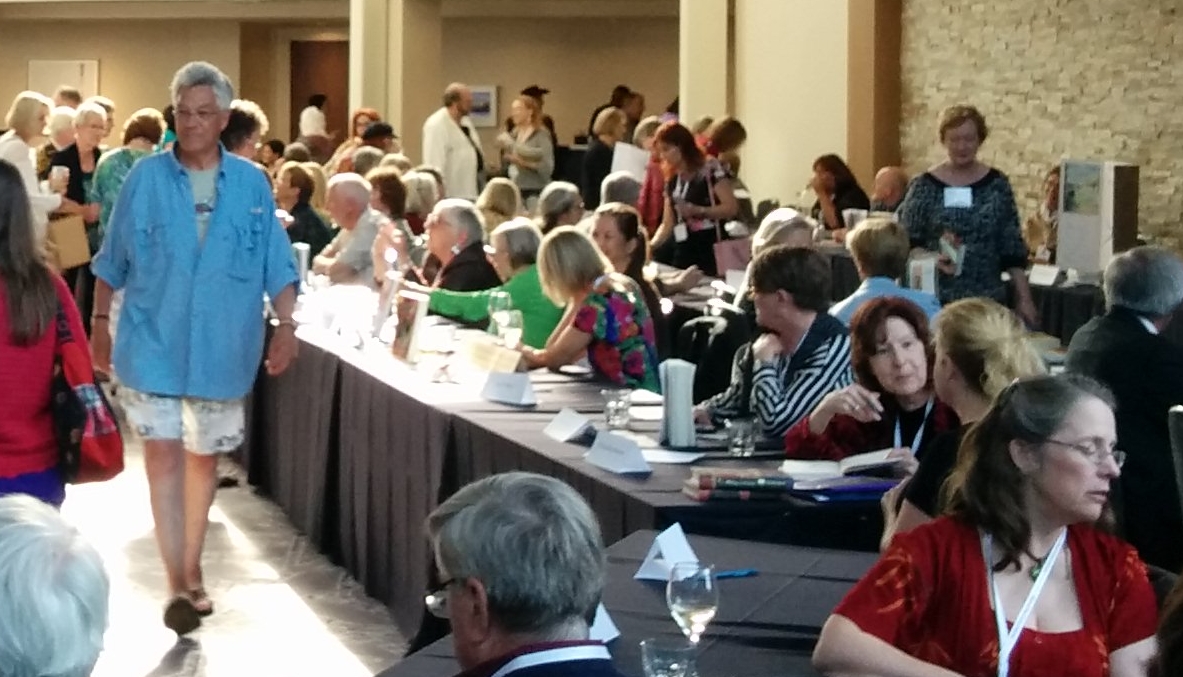
Kiffer Brown here reporting from the 16th Anniversary Weekend Author Extravaganza in Nacogdoches, Texas, home of the Pulpwood Queens and Timber Guys Book Club — the largest book club in the world’s annual weekend gathering!
The Pulpwood Queens Book Club was founded by Kathy (Patrick) Murphy sixteen years. Dreamworks Entertainment has announced plans to make a movie based on Murhpy’s life, and her book The Pulpwood Queens’ Tiara-Wearing, Book-Sharing Guide to Life along with the development of her international book club that has grownto 600-plus devoted chapters.
The Pulpwood Queens’ Book Club has be written about in the OxfordAmerican Magazine, The Magazine of Good Southern Writing, and along with Oprah Winfrey’s OXYGEN NETWORK feature, to The Oprah Winfrey Show, to kicking off Diane Sawyer and Charlie Gipson’s READ THIS Book Club on Good Morning America, and has been featured in The Los Angeles Times, Time Magazine, Newsweek, and The Wall Street Journal to name a few.
I met Kathy Murphy (formerly Patrick) at a conference last April and we had instant rapport, so we stayed in touch. Of course, I just had to attend the “Once Upon a Time in 2016,” Girlfriend Weekend that is being held right now (Jan. 14 – 17, 2016) in Nacogdoches, Texas.
The authors of the 2016 selections are in attendance for panel discussions, author signings, and meeting their readers. The GREAT BIG BALL of HAIR costume themed ball “Once Upon a Time” will be held this evening and the Timber Guy of the Year and the Ball Queen will be announced at this time.
But, most importantly, the 2016 Pulpwood Queen Book Club Selections will be officially announced at the gathering of authors and readers!
Kathy L. Murphy, the founder of the book club, selects all the books with great care and deliberation from stacks and stacks of books (fiction and non-fiction) that she, herself, has read. She lists selections for each month in five categories:
Main Selection of the Month
Backlist Book: This Is a book she feels did not receive the attention it so deserves and should not be missed.
Bonus Books selection is for voracious readers (like Kathy)
Pinecones: Young Adult & Teen Selections
Splinters: Children’s Selections
Selections have been made for January through September 2016, so far! Selections for October, November, and December 2016 have not yet been made.
And now we are honored and excited to announce: DRUM ROLL, please!
The Pulpwood Queens and Timber Guys just selected Chanticleer Reviews Grand Prize award winner J. L. Oakley’s latest book Timber Rose for their 2016 Book Club Selections for the month of February!
We are excited for Janet Oakley and her Timber Rose novel that is set in 1907 in the great timber forests of the Pacific Northwest and features timber roses, women who hike and climb mountains in skirts breaking rules and barriers.
Congratulations to J. L. Oakley for her historical fiction novel, Timber Rose, being selected for the reading list of the largest book club in the world! Now this is something to CROW about!
PULPWOOD QUEEN herself to attend and present at the Chanticleer Authors Conference 2016!
We are honored and excited that Kathy L. Murphy will be a keynote speaker at the Chanticleer Authors Conference 2016 that will take place on April 29, 30, and May 1, 2016. She will be present at the Chanticleer Awards Ceremony on Saturday evening and will be “Queen of the Books By the Bay Book Fair” on Sunday, May 1st, 2016.
You can read more information about CAC16 here! Don’t delay, seating is limited.
This is Kiffer Brown, founder of Chanticleer Reviews, signing off from The Girlfriend Weekend in Nacogdoches, Texas. [/fusion_builder_column][/fusion_builder_row][/fusion_builder_container]
Authoring Is A Business and this is why Tom Wise Ph.D., project management consultant, advises authors to implement AGILE PROJECT MANAGEMENT METHODS to meet their publishing goals.
Recap of Three Steps to Using Your Writing Time More Effectively – Agile for Authors Article One
In the previous article, we discussed how to build a network to create a team. This requires relationships and understanding the skills and abilities of these people. Part One was setting the stage to prepare to work within a strong network of supporters. In this article, we are going to cover how to apply most effectively your network in your business.
Part 2. Authoring is a Business
Knowns
8,760 hours in a year.
Timelines and schedules are precious commodities. Each of us is given only twenty-four hours in the day and one hundred sixty-eight hours in a week. We only receive fifty-two of those weeks in a year filled with eight thousand seven hundred and sixty hours. We spend almost two thousand nine hundred of those hours in sleep and another one thousand hours commuting, shopping, and general time with family duties.
Hours In A Day Breakdown Of Activities
Note: Hours in the day are an estimate of an average person with a full-time job:
For the knowledge worker, that leaves a mere forty-five hundred hours to split between the remaining activities such as leisure and love, eating and playing, housework and writing. If we are lucky or good, and manage to split our time perfectly, that provides the author seven hundred fifty hours, or two potential hours of precious time to write in a twenty-four hour period. Now, I don’t know about you, but I rarely manage to focus for a full couple hours in a day, let alone seven hundred fifty hours straight.
Rework in authoring a novel or book is very costly in time, money, and confidence. The problem is often not the writing or the mechanics, but rather a process. A life-cycle may not be clear to us, but it does exist. Getting published historically took years to complete, but that has changed.
In the new millennium, some software experts developed a twelve-point manifesto for Agile principles to apply to writing novels. They discovered that a network of invested peers made their writing process more effective.
Realize, there is a difference between content writers and authors. Content Writing tends to be paid position or contracted. Authors, and especially Indie Authors, invest their time and money up front hoping for a return on work at the other end of the process. Authors hunker down, close themselves away, and work until they complete the manuscript. Then polish the work, send it off, and hold their breath, cross their fingers, hoping for someone to send a love letter of acceptance.
Top companies in the world understand the necessity of a more streamlined process. Hired consultants make billions of dollars teaching companies how to create processes for efficiency and economic savings. Experts measure, refine and reduce their product processes into effective work segments to complete the product. These techniques can be employed in your authoring efforts.
Some people have learned a family business, and others seem to instinctively know how to segment out their work and organize others to get work done and goals met. For the rest of us, this can be a learned skill.
Agile Manifesto’s Twelve Concepts
Agile authors have the ability to use the flexible methods. The idea, the method of agile, developed during the 1990’s by software developers with the simple focus of targeting the desires of their customers before the work begins. It includes building a team focused on customer satisfaction, a team with shared mission and participation of quality experts, engineers, analysts, and business people. These software developers gathered at The Lodge at Snowbird Ski Resort in the Wasatch Mountains in Utah and developed what is now known as the Agile Manifesto.
The Agile Manifesto expresses twelve concepts of a well working team that can be applied to the business of authoring.
Customer satisfaction is priority
Welcome changes
Deliver working software frequently
Business and Development work together daily
Motivation, Environment, and trust are needed
Face-to-face is best
Working software is the measure
Maintain a constant pace
Technical excellence and good design
Simplicity – maximize work not done
Self-organizing teams
Regular retrospection and adjustment
A Shift in Paradigm – A to Z no longer applies!
In segmenting work – A to Z no longer applies. Now, working on A to D, R to Z, and then E to H,is possible, getting feedback and input along the way, improving as the work progresses, to a thoroughly edited, refined product.
Consider what can be grouped, or segmented into independent units of work, and the need to include people with these skills in your team:
Division of responsibilities to make your group a team
Division of tasks into short phases of work (Sprints) characterized by division of tasks
Publishers
Cover design
Marketing
Bloggers – who and when
Social media
Beta readers
Developmental and line Editors – who and when
Identify who needs to work on what
Who needs what information – focus on that info with those people
Conferences and author signings
Teams and groups work differently. One of the key differences in the behaviors of teams is due to the separation of responsibilities. When an individual is assigned a unique task or given a goal, he/she can take on the leadership role when it comes to meeting the assigned objective.
When work is segmented into small chunks, called sprints, with a short duration and a clear goal, the team can move quickly to completion of a quality product. Prioritize small sprints of two to three weeks on a specific goal, and with the team members that are needed to complete that small chunk of work.
Short Sprints Win the Race
At the end of each sprint, take the time to discuss the past segment. Ask the team the hard questions. By continuous reassessment, your team will quickly become efficient at turning that crank and churning out quality work.
Frequent reassessment and adaptation
People – are they responsive to you and are you responsive to them, working well together.
Communication – are the tools and behaviors working?
Commitment – are you, and they dedicating the time and focus to getting work completed in the way and time agreed?
Time – are the estimates accurate? Is the time to meet convenient and sufficient to get the work done?
When the opportunity to write presents itself, an author must have options ready and prioritized. This requires the author to have a routine that enables them to move into the zone, one zone or another, quickly.
Creating that “zone” means understanding the priority, and what needs to be available that activates the muse. Identify the psychological triggers that engage your creative abilities.
Have a scent prepared that gets you in the mood to write (coffee? cinnamon? campfire smoke? brandy?)
Know the lighting that is needed to make you comfortable (candles? bright light? darkened writing cave?)
Identify the background sounds that move you (white noise? rain forest sounds? dance tunes? sultry Barry White? Western music?)
Choose a setting (busy coffee shop? attic studio? kitchen table? favorite bookstore? local pub? closed office with the door closed?)
Choosing a time of day is ideal (first thing in the morning? late night after everyone goes to sleep? immediately after exercise?)
Have needed ideas listed. (Always jot down or record anything that you think might be useful for writing projects. Don’t let these muse tidbits dissipate into the air.)
Choosing a specific time of day with no distractions is essential. If the author has a family, often this time is before the family awakens, or after the family retires for the night. Perhaps for you, it is after the children head out to school, or during your lunch break at work. Whatever time that is, set that time aside on your calendar and give it to yourself. Don’t allow excuses to infringe on the task. Perhaps you can arrive to work early, or stay late on a preset schedule. This provides the family, or significant other, the ability to support your time to write.
Stage your work area
Be organized and have everything together (prepared)
Know the psychologically stimulating triggers that jog your muse
Diane Gabaldon’s is lighting candles for her muse.
Robert Dugoni’s is reading the Green Mile by Stephen King — again!
[fusion_builder_container hundred_percent=”yes” overflow=”visible”][fusion_builder_row][fusion_builder_column type=”1_1″ background_position=”left top” background_color=”” border_size=”” border_color=”” border_style=”solid” spacing=”yes” background_image=”” background_repeat=”no-repeat” padding=”” margin_top=”0px” margin_bottom=”0px” class=”” id=”” animation_type=”” animation_speed=”0.3″ animation_direction=”left” hide_on_mobile=”no” center_content=”no” min_height=”none”]“What my Coffee says to me” by Jennifer R. Cook
Moving from one role to another, both physically and mentally takes planning, skill, practice, and agility. As an author, if we have a team of people with unique skills and responsibilities, then your team can take a leadership role when necessary. This gives the author more opportunity to shift roles from writing text to editing, scheduling, and organizing for subjects such as cover designs, reviewing publishers, and marketing.
Parting Words
Allow yourself to have every benefit possible to make the transition to your creative self to take advantage of that precious time when it is just you and your story.
NOTES from the Editor:
The fun picture above titled “What My Coffee Says to Me” is by Jennifer R. Cook, a creative graphic design consultant and illustrator. Ms. Cook has been graciously given Chanticleer Reviews permission to use this picture with Tom and Nancy Wise’s AGILE for Authors series. We absolutely love her artwork and graphic designs!
“What my Coffee says to Me” is a daily, illustrated series which began January 1, 2012 by Jennifer R. Cook a strategic graphic designer and illustrator creating for mental health awareness, please visit www.catsinthebag.com”
Tom holds a Ph.D. in Organizational Management and teaches courses in project management and quality at Villanova University and DeSales University. He is currently developing curriculum at Eastern University based on his books: Agile Readiness and Trust In Virtual Teams.
Tom and Nancy are award winning authors. Their book, The Borealis Genome is the 2013 Dante Rossetti Grand Prize Winner and a 2014 Cygnus Award First In Category winner. Their books have won multiple awards including Finalist with the USA Best Book Awards and The International Book Awards.
Chanticleer Reviews is honored to have Bublish, a proven book promotion and marketing tool, as a sponsor of the Chanticleer Reviews Novel Competitions Awards.
The award winners responses were so positive that I asked Kathy Meis, the CEO of Bublish, if there was anyway to make Bublish available at a special rate for the entire Chanticleer Community of Authors. And she said, “Yes!”
Many of you may not be familiar with Bublish and more than several of the Chanticleer writing contest winners had no idea about the marketing power of the CBR Bublish Awards package. But once they did, the compliments came rushing in!
And that is when I knew that I had to try make Bublish marketing power available to all of the Chanticleer Reviews Community of Authors.
Kathy Meis, CEO of Bublish, enthusiastically agreed!
I asked her for an exclusive interview to introduce Bublish to the Chanticleer Reviews Community of Authors and Readers.
And here it is!
Kiffer: I am excited that you have taken time during the busy holiday season to give us an overview of the Bublish platform–especially when many of Chanticleer Community members are deciding on their marketing strategy for the new year.
Kathy: I am delighted to, Kiffer. Bublish is the world’s first complete publishing platform with integrated branding and discoverability features.
Authors can use Bublish to:
write
promote
sell
and track their work.
Our mission is to help authors reach their target readers, engage them and convert them to lifelong fans. We are committed to helping authors build a dynamic brand that drives more book sales. Every feature we build at Bublish, even our writing and eBook creation tools, works to enhance discoverability and build the author’s brand.
Kiffer:What problems does Bublish address for authors?
Kathy: In today’s crowded book marketplace, we know that discoverability is an enormous challenge. First-time and emerging authors face the biggest hurdle when it comes to discoverability. We know that readers are 15 times more likely to seek out and purchase books from authors with recognizable brands. Authors who successfully build a powerful brand can also charge more for their books. Writers who want to build a career as an author, must master brand-building skills in order to be successful. Bublish helps by automatically branding all the samples authors share with readers. The design, the features, the visual elements – it’s all part of our platform for the specific reason of making brand building easier for authors.
Kiffer:Tell us about some of Bublish’s features.
Kathy: Our most popular feature is the Book Bubble – our award-winning book sampling tool that combines crucial brand elements with calls to action. Book Bubbles take only minutes to create, and allow authors to:
Brand themselves along with their books with every book sample they share
Enrich their book excerpt with “the story behind their story” in the Bubble’s. Sharing inspirations, struggles, and your “why” draws readers into their creative journey. Authors get to build a community around their work, rather than feel like salespeople.
Efficiently create, share and track social engagement with multiple Book Bubbles from multiple books all from one dashboard. And because Book Bubbles are “evergreen” content, they can be shared over and over across multiple social platforms. Your dashboard grows into a library of branded digital assets that you can weave into your content marketing calendar.
Track conversions to the book’s product page at the major online retailers. We work with Amazon, Barnes & Noble, Google Play, iBooks and Kobo.
Optimize discoverability in two ways. First by connecting the dots for readers. With one click readers can go from sampling the author’s book in the Bubble to buying that book at their favorite online retailer. If they’re not ready to buy, they can visit the author’s website, view their profile on Bublish or follow them to receive email updates from the author. through automated the SEO (search engine optimization). When an author sets up their profile and their books profile, all the metadata associated with the book (title, subtitle, author’s name, ISBN, cover image, keywords, etc.) all “travel” with the Bubble, so that more readers can find your books through online searches. Secondly, draw interested readers from a social engagement with your Book Bubbles into permission-based email marketing through our “follow” feature.
If authors choose to write their books on Bublish with our eBook Creator, there are also “rough cut” Book Bubbles that can be shared right from an author’s manuscript. This helps build pre-launch buzz, makes it easy to request reviews, and lets authors capture pre-orders. When the author is finished writing the book, they can select a book template with a single click and generate a beautiful ePub for distribution. There’s no other writing tool like it in the world!
Kiffer: You’ve been in publishing for a long time, Kathy. What changes have you seen?
Kathy: I’ve watched the content industry change dramatically in the last 25 years. The rise of mobile devices, digital formats and online shopping has changed everything. You can write the best book in the world, but if no one can find it, it will be lost among the millions of books available at the touch of a button. Authors need new tools to reach and engage their readers and build a dynamic author brand to drive more book sales. Bublish was created to help authors be successful in this transformed book marketplace.
Here is a link to a Bublish Bubble by best-selling author Joni Rodger: http://bit.ly/1NiNt5W.
I’ve also seen this industry become more author-centric. No matter whether an author is independent or traditionally published, they’re taking on more of the marketing of their work. I wanted to make it easier for authors to share their work without feeling like salespeople. The Book Bubble was designed to take care of the marketing, branding and discoverability elements, and let the author focus on storytelling – both through their book excerpt and the Bubble’s Author Insight.
Some of the most powerful brands in the world use storytelling to break through the noise. I wanted authors to have that power, too. I know what it takes to create great content for readers, and I believe every writer deserves a chance to have their books seen by readers. That’s my mission. It’s why I created Bublish.
Kiffer: What does it cost to subscribe to Bublish?
Kathy: Our monthly subscription rate is $9.99 and our annual subscription is $99. We have created a special discount offer just for the Chanticleer community. Authors can sign up for our 30-day free trial at bublish.com. No credit card is required to try us out. If they upgrade by January 31, 2016, and use the discount code CHANTICLEER116, they’ll get a full year subscription to Bublish for only $79. That’s 40% off the monthly rate. It’s our way of supporting the great authors who work with Chanticleer.
Kiffer: Those are great deals! Thank you and the Bublish Team for your wonderful support and for recognizing this past year’s annual Chanticleer Award winners.
Kathy Meis and Kiffer Brown:
Happy Holidays from Bublish and Chanticleer Reviews!
30 day FREE Trial – no credit card required
40% discount code: CHANTICLEER116 valid until Jan. 31, 2016 fora full year subscription for just $79.
Quick and Easy Tips to Get Your Books Ready for the Biggest Book Buying Season of the Year by Kiffer Brown
Point of Sale Marketing – Are Your Books Ready for the Holiday Season’s Annual Sales Spike?
Shoppers are overwhelmed with gift buying decisions at this time of year. The clock is ticking and our lives become even more hectic as the gift giving season approaches; our to-do lists are exponentially expanding as the winter holiday countdown begins.
Authors (and publishers) need to make sure that the gift buyer has easily accessible information about their books to aid the gift buyer with his/her purchasing decisions quickly and easily.
Utilizing time proven Point of Sale Marketing methods could make a huge difference in helping gift givers to decide on your book when making purchasing decisions.
Four Selling Platforms for Books – Make sure that your books are ready to sell across all of them with these handy tips from Chanticleer Reviews
Today we will focus on using point-of-sale tips for Holiday Gift Fairs, Author Signings, and Temporary Markets.
How do you attract potential readers to your table/booth when you are in a sea of authors at a book fair?
IF possible (and this depends on where the event is held), I always suggest adding some “flair” to your booth.
Examples are:
Signs with your cover(s) enlarged on poster boards or free standing signage.
[fusion_builder_container hundred_percent=”yes” overflow=”visible”][fusion_builder_row][fusion_builder_column type=”1_1″ background_position=”left top” background_color=”” border_size=”” border_color=”” border_style=”solid” spacing=”yes” background_image=”” background_repeat=”no-repeat” padding=”” margin_top=”0px” margin_bottom=”0px” class=”” id=”” animation_type=”” animation_speed=”0.3″ animation_direction=”left” hide_on_mobile=”no” center_content=”no” min_height=”none”]Deserted Lands Series by Robert L. Slater
Be sure to dress the part! Dress to reinforce your branding — what your readers expect the author of the title to look like. And this doesn’t mean you have to dress in costume. See the first article for ideas of how to hint at your branding with your dress. If you write Westerns, dress like you are a character from your book. If you write Steampunk, then definitely dress as a “steampunker.” If you write contemporary romance, make sure that you dress with flair – again something that your main characters might wear. Science Fiction author? Then dress in a way that resonates with your targeted reader audience.
Business cards! Make sure that you ALWAYS have your AUTHOR business cards available at your signings/booth. Your cards should include your website, social media tags, pen name, email. You do NOT have to list a telephone number on your business cards, but there should be some way of contacting you either through social media, email, or your website’s contact form. I would suggest on the backside of the card that you list your titles and your genre with your website’s URL. The genre that you are writing in should be reflected in your business cards design.
[/fusion_builder_column][fusion_builder_column type=”1_1″ background_position=”left top” background_color=”” border_size=”” border_color=”” border_style=”solid” spacing=”yes” background_image=”” background_repeat=”no-repeat” padding=”” margin_top=”0px” margin_bottom=”0px” class=”” id=”” animation_type=”” animation_speed=”0.3″ animation_direction=”left” hide_on_mobile=”no” center_content=”no” min_height=”none”]Ann Charles – best selling author – is a master at book promotion.
Don’t forget your own “branding” table cloth to make your area standout from the sea of the inevitable white or black tablecloths.
Candy, mints, or treats are standard draws for any author signing! You can also keep them in the back of your display and offer the treats only when you want to make contact with a potential reader.
Proudly display any ribbons or awards!
If possible, have a drawing at your table to attract traffic. If you are allowed to give something away make sure that it increases your branding in some tangible way. A key chain, a bauble, a fancy pen, a coffee or teacup, a candle, a handkerchief, a shopping bag…. anything, but your book. However, the item used for the drawing should reflect your book’s branding.
We have buttons and I LOVE BOOKS bumper stickers that we give away at events.
Awards Stickers and Shiny “Reviewed” book stickers help to attract the potential readers’ eyes and also help to distinguish your book from the others at the event or on the shelves.
Have a sign up sheet for your newsletter or to gather information. Many times, people who have already purchased and read your book will attend book signings/book fairs just to meet the author. Make sure that you capture the emails of these VERY IMPORTANT PEOPLE who are readers of your work to foster and maintain a readership for your next book.
When ever possible stand at the side of your table or in the front of the table. Remove any friction or barriers between you and your potential readers. If you can’t do that, try not to sit unless you are signing a book. Standing makes you seem much more approachable by potential readers. And SMILE!
Make your display as vertical as possible. Use boxes under the tablecloth or use stacks of your books at different angles to catch the eyes of potential readers as they pass by.
Before the signing/event/fair and during the signing/event/fair make sure that you post about it in your social media. Remind your friends and associates the day of it. Everyone is busy with many activities vying for their attention. Make sure that your event stays on their radar.Are there community calendars or places where you can post signs about your event? If so, make sure that they are posted at least two to three weeks in advance. If the calendars are printed, you may have to notify the calendar coordinators at least three to four months in advance.
Have fun at your event —even if it is with the staff and coordinators. The reason for book-signings, book fairs, seasonal markets is to build awareness about you and your book. Make sure that folks remember a professional author of a particular genre and not some grumpy, desolate “writer” who isn’t selling books. Make sure that you make a professional and positive impression on each every person who comes into contact with you as an “author.”
Cross promote with other authors. Build your network. A new “author colleague” may have connections to get you into another book store, another author event, or book clubs. You never know….
[/fusion_builder_column][fusion_builder_column type=”1_1″ background_position=”left top” background_color=”” border_size=”” border_color=”” border_style=”solid” spacing=”yes” background_image=”” background_repeat=”no-repeat” padding=”” margin_top=”0px” margin_bottom=”0px” class=”” id=”” animation_type=”” animation_speed=”0.3″ animation_direction=”left” hide_on_mobile=”no” center_content=”no” min_height=”none”]Pamela Beason author meeting Robert Dugoni at an bookfair!
Have copies of reviews or a sheet of review blurbs and author quotes that you can hand out with your website address. Try not to let a potential reader leave your area empty handed. Each person should walk away with at least one item with your website address on it.
I’ve found that staying an extra thirty minutes longer at almost any event generates sales worth the extra time. I’ve heard authors tell me that their best sales have come after the event was closed and that they sold more in the thirty minutes after the event closed than during the whole event. It is just a weird thing about the retail biz.
And my final word of advice is this (and please forgive me if I am sounding brusque and maybe a bit rude here, but this must be said):
When you hand a potential reader your book to look at and to consider reading and you can tell that she is actually reading the book blurb on the back or the opening paragraphs, it is time to be quiet. Just stand there and appreciate the fact that someone is considering your book. Do not interrupt their decision making process or their reading time. This is the time to take a breath. If it is awkward, then straighten something on the table, pop a breath mint, greet another potential reader….
Always thank the person for taking the time to look at your book whether or not that they purchase it at that time. One author, who I know, said that he only sold one book at an event but discovered that he had sold 40+ e-pub copies on line that very evening. You just never know what is going on in the potential reader’s mind. And yet another reminder why it is always a good idea to have something to hand the attendee with your website address on it and your book’s titles.
To summarize the above points:
Promote your signing, book fair, and/or marketing event as soon as the date is confirmed.
Continue to promote with more intensity as the count-down to the event approaches.
Promote during the event if possible. Tweet, Facebook, Instagram, Google+ to remind busy people not to forget to pop by.
Bring: business cards, pens, props, review sheets with info and marketing blurbs, ribbons/awards, book stickers, vertical signage, and other ways of making your space standout.
Make a professional and positive impression on each person who comes into contact with you as a author.
Exude your branding in every aspect possible to make you and your book stand out.
Capture email addresses as many email addresses as you can to maintain and nurture the contacts that you made.
The fourth article in this four-part series will be about:
Quick Tips to Make Your Website Sell More Books During the Holiday Gift Season.
Recap of Important Points:
Despite intentions, most gift-givers put off shopping until after Thanksgiving, which leads to our next point.
Holiday shoppers spend more than 31 billion dollars on gift cards (National Retail Foundation survey)
Today’s holiday buying season has extended all the way through the month of January, as recipients of gift cards begin shopping on December 26th
Brick and Mortar Stores – Point of Sale Book Marketing Tips
It is a known fact among booksellers that any little thing that sets a book apart from the other books on the shelf will increase that book’s sales dramatically.
How will you make your books stand out when you are not there to promote them in person?
Book Cover Swag
Award Stickers
If your book has won awards. Be sure that your books are displayed with stickers that catch potential readers’ eyes–like our Chanticleer Award Stickers given to the winners of our writing contests. There are other types of stickers that can help your book stand out such as “Autographed by the Author” stickers.
To help you make the most of your Chanticleer Review:
Has your book received an editorial review from Chanticleer? If so, make sure that it is displayed with a spine sticker and/or sticker on the front or back cover that makes it clear that the work has been vetted by an editorial review.
Here are Chanticleer Reviews stickers for 4 and 5 starred reviews. (Book stickers are not available for books reviewed by Chanticleer that have received less than 4 stars.)
(Image is larger than actual stickers – actual stickers are .75 of an inch in diameter)
Don’t forget to incorporate it into your design
Book covers should, when possible, incorporate awards, book review blurbs, and peer reviews. Notice how gracefully this is done above the author name on Robert L. Slater’s award winning All Is Silencedystopian YA Science Fiction novel below. Reviews or blurbs from reviews can also be incorporated into your book covers. Even if the book has been published, with today’s ebook and print on demand nature of the book industry, it isn’t difficult to add these elements after the fact. Make sure you talk to your cover designer about it.
Got Shelf Talkers?
Shelf Talkers are an indispensable point-of-sale tool. If you have ever purchased a bottle of wine, you have seen these hard working promotional tools. They are placed immediately below the wine bottle with a rating, description, what the wine goes best with. Shelf-talkers help the wine purchaser–or book purchaser–make a buying decision. Clyde Curley, author of the Detective Touissant series, swears by them. He says that wherever his books are offered with shelf talkers that they do very well in the sales.
Start Implementing these Point of Sale tools, and boost your book sales now!
It is usually up to the author and/or publisher to supply the shelf-talkers and to apply the stickers to their books. Book stores will love you if you bring them things like stickers, book marks and shelf talkers for your books; they will almost always make full use of them, because they sell more books.
In marketing terms, using these point of sales tools “reduces friction.” It is up to the author/publisher to help the book seller sell her books and that means providing the necessary point-of-sale tools to attract and catch the customer’s eye.
Point-of-Sale Tools also aid in keeping TOMA (Top of Mind Awareness) and reinforces your book with visual images and affirmations.
Even if your books are already on the shelves, it is not too late to start implementing these point-of-sale tools:
Local bookstores/retail stores – stop by and apply your stickers and shelf talkers to your books and shelves. NOTE: Be sure to use “Magic Tape” for shelf talkers (or ask the store what they use) so you don’t gum up the display shelves.
If the booksellers are not local, ask your relatives, friends, and/or “Street Team” if they would stop by and ask permission (with a letter from you) to place stickers and shelf-talkers on your books.
Mail shelf-talkers directly to the stores that offer your books for sale and ask the bookshop staff if they would mind placing the shelf-talkers with your books. Most retailers would be glad to place them because they know that shelf-talkers increase sales, but they do not have time or the budget to create them. Again, help the bookseller sell your books!
Handy Links for Chanticleer Reviews Point of Sale Tools
Silver Foil Reviewed by Chanticleer Reviews Stickers Each CBR Review Silver Foil Stickers will come with a Chanticleer Shelf Talker Template that features an excerpt from the title’s CBR Editorial Review! 220 silver foil stickers for $35.00 U.S.D. plus shipping
We are including special expedited services for the same low price to get your book stickers to you within two weeks of ordering up to Dec. 20th, 2015.
Don’t delay order your stickers today! Remember that book sales that use gift cards continues all the way through January!
The third article in this four-part series will be about:
How to Use Point-of-Sale Tools at Holiday Gift Fairs, Book Fairs, and Temporary Markets.
Happy Holidays and Wishing YOU Awesome Book Sales!
Point of Sale Marketing – Are Your Books Ready for the Holiday Season’s Annual Sales Spike?
Shoppers are overwhelmed with gift buying decisions at this time of year. The clock is ticking and our lives become even more hectic as the gift giving season approaches; our to-do lists are exponentially expanding as the winter holiday countdown begins.
Authors (and publishers) need to make sure that the gift buyer has easily accessible information about their books to aid the gift buyer with his/her purchasing decisions quickly and easily.
Important Points:
The Holiday Season begins in mid-November
Despite intentions, most gift-givers put off shopping until after Thanksgiving, which leads to our third point
Holiday shoppers spend more than 31 billion dollars on gift cards (National Retail Foundation survey)
Today’s holiday buying season has extended all the way through the month of January, as recipients of gift cards begin shopping on December 26th
Utilizing time proven Point of Sale Marketing methods could make a huge difference in helping gift givers to decide on your book when making purchasing decisions.
Four Selling Platforms for Books – Make sure that your books are ready to sell across all of them with these handy tips from Chanticleer Reviews
Online Sales: Amazon, Goodreads (links), Kobo, etc.
Brick and Mortar Stores (Independent Book Stores, Barnes & Noble, Gift Retail Stores, etc.)
Holiday Gift Fairs, Book Fairs, Temporary Markets
Author websites
Help your potential readers find your books for their gift purchases and gift cards by using these handy point-of- sale tips in this four part series that will be posted consecutively over the next four days.
We will start with maximizing your book’s selling potential with Online Sales Marketing tips.
Today’s focus: Online Book Sales – Point of Sale Marketing Tips
1. Is the Book Information you have with online retailers in tip-top shape?
Make sure that every word of your book’s introduction/marketing blurb (that first paragraph that comes after the title and to the right of the cover) is effective—especially the first ten introductory words. These first ten words are “crawled” by the online sales platform’s search engine whenever a reader does “a search.” If it is a series or you are planning to make the work a series, then be sure to conclude the book’s marketing blurb with this information.
Have you listed blurbs from your book’s trade/editorial reviews in the Editorial Review section?
Sixty-one percent of customers read reviews before making an online purchase (Harvard Business Review)
Editorial/Trade Reviews set the tone for Customer Reviews
(See Amazon’s Author’s Central for instructions on how to do this on Amazon)
Under the Editorial Reviews section, have you listed your book’s:
Awards & Accolades
Editorial/Trade Review blurbs – here is a previous article where we answered the question: What is an Editorial Review
Peer Reviews from notable authors in your genre
If your books are available in other languages besides English, list the languages in this section.
2. Is your Author Information up-to-date and perfectly polished?
Under the “More About the Author” section
List your awards again, but this time in a narrative fashion instead of a listing (don’t worry about being redundant — readers scan for different things depending upon their personalities).
List your author/writing associations. For example: WWA Western Writers of America, Sisters in Crime (writers), RWA Romance Writers of America. The listing of this information will help to separate you from the other million authors as a professional writer and one whom takes her works seriously.
Next list your other published works starting with related books to the specific book selling page.
And, finally, add a personal interests that expand your branding. Make sure that your photo resonates with readers’ expectations. A great example of this is Diana Gabaldon’s Amazon photo; it is one of her standing in front of the Stonehenge monument with a timeless black shawl wrapped around her. The Stonehenge background hints at the historical/fantastical nature of her works.
Take a close look at your Author Central photo. If it doesn’t move your author brand forward, take a look through your photographs for one that does. It doesn’t have to be a photo taken by a professional photographer. It does have to have a layering effect and convey your author branding/personality. If you have a photograph that does convey elements of your author branding and is taken by a professional photographer, then that is even better. Here is an example of a professionally taken author photograph that exudes the author’s branding as a post-apocalyptic fiction writer. Notice that the setting and outfit exude the dystopian aspects of his Deserted Lands series:
Does your Amazon Book-page, Author Central page need updating, or, as it called in the retail biz, re-merchandising?
Make a close inspection of each of your titles’ Amazon pages to ensure your point of sale marketing tools are in the best shape that they can be in for this selling season.
Make sure that your information is up-to-date, fresh and relevant! Like a well written book’s plot, does each piece of information move your book and author brandingforward and into the hands of eager book buyers?
3. Is your author platform up-to-date and fine-tuned to enhance your discoverability for shoppers trying to make purchasing decisions?
A good author platform includes:
A well-designed website with all your books and information–a central hub for all your online activities
A social media presence
Take the time to ensure these are also up to date and in use during the holiday season. Making regular posts, about books, and sales, as well as thoughts and personal tidbits (so you don’t come off like an ad-bot) will keep you visible and in mind when shoppers are starting to think about what to buy.
Online retail sites have a place for you to input your website and social media information–use it!
Make it easy for potential readers to find you and interact with you, make sure the following are input into your author profiles with online retailers:
Blog
Twitter feeds
Facebook/Instagram/Pinterest/Reddit links
Your website’s URL
Updating and re-merchandising the information on your books online selling platforms will not take long, but could make a huge difference in sales potential over the next two months.
Take time today to freshen your pages of your books’ online selling platforms.
How to Increase Sales at Brick and Mortar Stores is the next post in this four-part series on “Quick and Easy Tips to Get Your Book Ready for the Biggest Book Buying Season of the Year.”
Happy Holidays and Wishing YOU Awesome book sales!
Few people in the world can say writing is their primary source of income.
Most part-time authors have income producing careers that command attention. When an opportunity to write appears, making the most of that rare commodity called time is essential.
Being “Agile” includes being prepared to work with flexibility, readiness, and having the commitment to act when and where the availability arises. Knowing how to formulate and segment work will ensure the most efficient use of time for you and your network.
Tapping at the keyboard is only the beginning. Authors need to be competent in many areas:
Find beta readers
Sort beta suggestions
Formulate character traits
Track plot-lines
Rewrite edits with interest grabbing intensity
As if that is not enough, authors need to also provide multiple services and tasks beyond their skill in word craft:
Review for fellow writers
Write and send queries and reply to emails
Social media postings
Develop book covers
Enter contests
Create promotions
Implement marketing strategies
These are only a few of the many activities with which an author must engage in and manage. The shortage of available time requires us to develop the ability to work on any needed task effectively, reinforce successful behaviors, and play well with others.
Step One
Before writing begins, there are a few activities you can undertake to develop an environment where success is inevitable.
Form a strong network base
Evaluate personal strengths
Evaluate personal weaknesses
Identify your strengths and qualities to offer members of your network.
Remember that your talent and connections are your contributions to forming a strong team. Be a member of a responsive network of professionals, able to produce a product while participating as a team, rather than an individual in a large group. Success in any endeavor is often due to the broader team and is much harder to capture as a lone wolf.
Identify your talents.
Each of us has a network, whether small and intimate or large and diverse. And each of the people in our lives has a talent. It is human nature to seek out people with like interests and skills. Seek out and identify the abilities and interests of friends, family, and peers, and realize their values. Step Two
Analyze the people that you know, or have known in the past. What contributions can they add, and what are their needs? Reach out to refresh old connections, and maintain those that are interested in supporting you in developing your craft. Find new ways to contribute to their endeavors and make connections relevant. Everyone has a contribution to make.
For example:
At home, parents can be recruited as beta readers
Retired relatives can be editors
Grandparents are an awesome source of information
Nieces and nephews with art skills help with swag creations for your brand
Step Three
Expand your network by seeking out those with talent where you are weakest. Reach out to as many people, as you can, to develop a network of capable people with whom you may strengthen relationships and develop trust. Compliment your strengths and begin to fill the gaps created by your weaknesses. Assembling a strong network of friends and peers is one way to ensure that you can make the most of every creative opportunity.
Take a long hard look at your existing and possible network for:
People that you may refer to others
People to hire as assistants or experts
People as subject matter experts to respond to inquiries
People with research skills to provide valuable information
People who are great leads to those who can be subject matter experts
Identify new connections that will make your network stronger through:
Social media
Your local community
Your church group or local clubs
Professional associations
Friends of a supportive family member
Hard working peers
New people you meet can build your network with every “Hello.” Follow up with friendly and informative communications, and when you are able, contribute to helping them achieve their goals.
Streamline your time by learning how to segment your work and when to utilize your contacts. Often, deadlines and available time dictate what gets worked on and when. People in a robust network are interested and willing to develop new techniques, learn new strategies, identify new sources of information, and the opportunity to establish new markets or new readers.
Among a supportive network, you should be able to share each other’s pitfalls, successes, and joys, as well as enhance each other’s skills and insights. In this way you may become stronger as a writer and as a person.
When you sit down for those precious moments to write or research you will know that your network contacts are available and will be informative, and responsive as you seek help in the areas of their expertise. in implementing new skills you have learned, and respond in like when contacted. Reach out to them and share your thoughts and ideas, and incorporate their knowledge into your writing preparations.
If you are weak in an area, find someone who is strong in it. Work together to complement each others strengths and weaknesses. For an example, an author friend who is excellent at tweaking websites traded her expertise for another author’s editing skills. Both benefit from each others strengths by working together.
Implementing Agile
For an example, if you found a great beta reader, establish a plan with her/him before beginning, and agree to a time-bound commitment along with clear expectations for both parties. Make sure that your beta reader will feel that she plays a vital part of your writing team to ensure the success of the project. Establish a short-term plan together that fits works for both parties. Work together to budget time, to set a cadence, and work through that plan. It is this cooperation and collaboration that will make for a strong network that will combine experience and knowledge. s
In Conclusion
This year at the Chanticleer Author Conference Nancy and I learned about several new resources on the web to reach new readers, test out new story lines, and met with various support services available to authors. We learned skills that other authors shared in workshops, in panels, and over meals. We enjoyed connecting with new friends and strengthening previous and virtual relationships. It is always energizing and rewarding to be among hardworking, successful, and dedicated industry front-runners and innovators who are willing to aid in each other’s successes.
More to come on developing and utilizing successful techniques that you can apply in your valuable time in the next article of Agile for Authors and Writers.
Tom holds a Ph.D. in Organizational Management and teaches courses in project management and quality at Villanova University and DeSales University. He is currently developing curriculum at Eastern University based on his books: Agile Readiness and Trust In Virtual Teams.
Tom and Nancy are award winning authors. Their book, The Borealis Genome is the 2013 Dante Rossetti Grand Prize Winner and a 2014 Cygnus Award First In Category winner. Their books have won multiple awards including Finalist with the USA Best Book Awards and The International Book Awards.
The third issue of the online Chanticleer Reviews magazine is preparing for publication!
And since we had inquiries from authors and readers asking how to share their favorite reviews on social media along with how to read the magazine, we decided to put together this quick guide.
The Quick Guide to Reading an ISSUU Online Magazine
First, make sure that if you are searching for the ISSUU e-zine platform that you type in ISSUU and not ISSU. ISSU is something totally different. What a difference a letter makes when it comes to acronyms!
ISSUU is the digital publishing platform that we use to publish Chanticleer Reviews e-zine.
Second, how to read the on-online magazine? It isn’t as intuitive as it should be–yet! However, it is easy once you know about a few simple tricks. So, go ahead and click on the link below; this will open the magazine for you in a new browser window. And then you can flick back to here and follow our quick and easy guide.
Next, you will see an arrow to the right of the magazine cover – about half way down the page. The arrow should appear to be light gray –it is very faint. When you click it, the magazine will open up and then you will see a matching gray arrow on the left hand side of the magazine. The magazine should be open where you can see two pages opened up for you to read. (The image below is not clickable. Only the one link above is live. )
Below is an enlargement of the mid-section of the open magazine that is shows the arrows on the right and left side of the open e-zine. You can flip through the magazine by clicking on the arrows.
Next, I will show how to enlarge the magazine pages for easy reading. Just scroll down to the next graphic of the ISSUU toolbar.
Okay, do you see the – •———– + on the left-hand side of the tool bar? That is a slider bar that will allow you to enlarge the ISSUU magazine pages. You can place your cursor over the slider bar on the live site to enlarge or decrease the visual size of the magazine. Then you can use the cursor to move over the section that you want enlarged.
The numbers in the middle of the toolbar denotes which page you are on and how many pages are in the magazine. You will see that the Chanticleer Reviews magazine has 50 pages. The 17/50 denotes that this is page 17 out of 50 pages. E-zines count the cover as page 1.
Next, do you see this symbol on the right-hand side of the tool bar?
This is the symbol for the quick page guide. If you click on it, it will look like this:
You will now be able to scroll and highlight different pages quickly! Try it! The page that you are hovering over will enlarge slightly. If you click on the page, the full-size magazine will open to that particular page. How cool is that?!
How to share information or reviews published in the ISSUU Online e-magazine Chanticleer Reviews?
Okay, now we hope that you have found a review that you would like to share with others in social media or a blog-post. It is super easy to do! Just copy and paste the URL that appears in your browser’s search field. It should look like this:
Or perhaps you want to share the fun new feature: “Writer Horoscopes.” All you need to do is at the page number that the horoscope article begins on like so to take you to the article, which is page 39.
Now all you need to do is copy and paste the link when you post to social media. Or you may want to use Bit.ly to shorten the link — especially if you are sharing on Twitter. If you use the Bit.ly link, you will not be able to add the exact page number to the link. The link will go to the magazine’s front page, but you could add the exact page number to the post.
And we would love for you to share some love with the Chanticleer Reviews online magazine by Following the magazine by clicking on the “Follow publisher chantireviews” button or by clicking on the heart icon!
If you’re an author, perhaps you’ve been here: I had finished my novel The Great Symmetry, done a print run for local bookstores and my website, and had sold some copies. Reviews were encouraging. The wider world beckoned. But how to launch? My Kindle edition was selling a copy every few days on Amazon – not exactly conquering the world.
This post is about my first discount eBook promotion. This discount promotion was a huge learning experience for me!
It turned out well with 600 sales over a 13-day period, due to working through some mistakes and some lucky accidents as well. The great news for everyone is that you can read about all my errors, as well as a few moments when this blind chicken happened upon a grain of corn, to help you plan for your successful promotion.
As I was looking around for ideas, I read an enthusiastic post on KBoards from an author who had just done a discount promotion for her new book. She had signed up for several advertisers at a small cost such as $10 each, and had realized a nice collection of sales over several days.
From this and other posts, I pieced together the concept: Discount your book from its regular price, then each advertiser sends out an email to their list of subscribers.
Here’s the key: The subscribers on each list have specifically signed up to be notified about discounted eBooks. How great is that? You can advertise your book to people who actually want to hear about it. In order for this to work, you need a real regular price that’s $2.99 or higher, so you’re offering an authentic discount.
I figured I could do a promotion too, so I shot off some applications to advertise for dates a couple of weeks ahead. When got my first acceptance from an advertiser (yes they get to choose the books they want to promote), I was thrilled and promptly paid. I was committed. Shortly after, I realized my first mistake – lack of advance planning. The best advertisers require four or more weeks of advance notice, and I had set my promotion dates far too soon.
Now you know: Plan your promotion in advance, and apply to advertisers four weeks or more before your planned dates.
The scramble was on. I sent in applications for the empty days, and after some anxious days was able to put together a lineup of promotions for each day except one. As I waited for the first day of the promotion, I found out more.
Here’s another key point: When you do a discount promotion, the purpose is not to make money – it’s to increase your readership. At a price of $0.99, your commission goes down to 35%, and it takes a lot of sales to cover your advertising costs and then have enough to buy a beer at the end. I set modest goals: Get some new readers, a few reviews, and a “tail” of sales after the promotion is over.
Discount Promotion Steps
Get everything ready: cover, blurb, reviews
Set a regular price: $2.99 or more
Decide your promo period, usually 1-2 weeks duration
Apply to advertisers for spots
Commit, pay, set advertising dates
Set your price to $0.99, a full day before start
Step away from the computer!
After the promo: analyze what worked or not –
As the promotion started, I learned the next hard lesson. Your blurb needs to not suck. My blurb had loads of fascinating information, none of which screamed out to a potential reader that they needed to buy this book. The results on the first day of the promotion reflected this.
After some frantic consultation with other authors, I refined the blurb twice over the next few days in accordance with a key principle: Don’t explain your book. Just find the most enticing few sentences that clearly convey your genre and the idea that it’s a compelling story. Imagine that a person will only read the first few lines before deciding whether to read further, or just skip along to the next book. As soon as I posted my blurb revisions, sales picked up.
When it came to reviews, I lucked out. I had some good reviews from my paperback version before launching on KDP. This really helped. Make sure you have those precious first reviews!
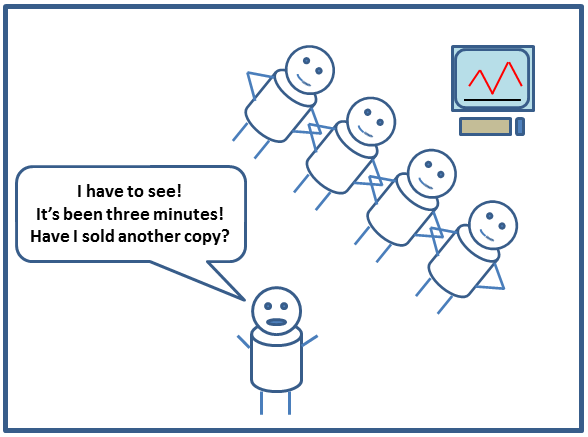
With the blurb revised, there was nothing else to do except watch. Better still: don’t watch. Because refreshing the screen on your KDP sales dashboard every minute is pretty much the dumbest way you can spend your day.
Pro tip: Find a way to be off your computer most of the time during your promotion. You can ask friends to stage an intervention. Some authors provide their passwords to a trusted friend with instructions to change the passwords and provide only a daily summary.
In the matter of staying away, I failed completely. That’s me above. Next time I’m going to make plans to be in a cave or something.
Yep – next time. I realized that as long as I’m an author with books available for sale, it’s going to be worth doing promotions periodically, probably several times a year.
And not just for the tangible results. I took a screen capture of that moment at #15 on the bestseller list for Hard Science Fiction, like Icarus taking a selfie before the inevitable plummet Earthward, to remind myself that I can do this. I belong on that list, and I’ll be back.
A discount eBook promotion is an important tool for building your initial readership. But it’s just part of the picture. Promote what you have, while not losing sight of what matters most – your next book. Keep writing!
Editor’s Note:
We want to thank James R. Wells for sharing his experience and findings with the Chanticleer Community of Authors
James R. Wells writes about the intersection of humans and the natural world. A life-long caver and outdoor adventurer, he has explored and mapped new passages in many of North America’s great caves. When not writing or with family, James can be found in a cave, on a mountain, or anywhere else outside.
James has recently published The Great Symmetry. His work “echoes the timeless social messages of truth, freedom and sacrifice embraced by science fiction greats like Ray Bradbury, Robert Heinlein, and the author’s own great grandfather H. G. Wells. Its powerful premise gives voice to the perils and challenges of our current society and reminds the reader that even the smallest person can change the world. A great read!”


 Bookstore managers don’t always return calls or emails, dates may not be available, or dates may be reserved six months in advance.
 Janet Shawgo shares info about her Wine Bar Book Signings
“Be sure that your table is appealing and inviting. Readers love free items, so we have pens, bookmarks, candy, magnets, and key chains. Items that have information about our books on them keep us in readers’ minds.”













 (Image is larger than actual stickers – actual stickers are .75 of an inch in diameter)

 purchased a bottle of wine, you have seen these hard working promotional tools. They are placed immediately below the wine bottle with a rating, description, what the wine goes best with. Shelf-talkers help the wine purchaser–or book purchaser–make a buying decision.
 Point of Sale Marketing – Are Your Books Ready for the Holiday Season’s Annual Sales Spike?

 Remember that your talent and connections are your contributions to forming a strong team. Be a member of a responsive network of professionals, able to produce a product while participating as a team, rather than an individual in a large group. Success in any endeavor is often due to the broader team and is much harder to capture as a lone wolf.
 Analyze the people that you know, or have known in the past. What contributions can they add, and what are their needs? Reach out to refresh old connections, and maintain those that are interested in supporting you in developing your craft. Find new ways to contribute to their endeavors and make connections relevant. Everyone has a contribution to make.
 Among a supportive network, you should be able to share each other’s pitfalls, successes, and joys, as well as enhance each other’s skills and insights. In this way you may become stronger as a writer and as a person.

 Next, I will show how to enlarge the magazine pages for easy reading. Just scroll down to the next graphic of the ISSUU toolbar.



 Pro tip: Find a way to be off your computer most of the time during your promotion. You can ask friends to stage an intervention. Some authors provide their passwords to a trusted friend with instructions to change the passwords and provide only a daily summary.
 And not just for the tangible results. I took a screen capture of that moment at #15 on the bestseller list for Hard Science Fiction, like Icarus taking a selfie before the inevitable plummet Earthward, to remind myself that I can do this. I belong on that list, and I’ll be back.