Category: Marketing

  • Third in the Seven Must-Haves for Authors series by Kiffer Brown

    Third in the Seven Must-Haves for Authors series by Kiffer Brown

    dreamstime_m_51247787What is the cornerstone of any successful author’s promotional platform? 

    Unlocking the Secrets of Successful Publishing!

    I was asked by Orna Ross of Alliance of Independent Authors to share what I consider to be the “Seven Must-Haves for Independent Authors” at  UPublishU event that was held at the Book Expo of America 2016 held in Chicago. Of course, I agreed!

    However, the Seven Must-Haves are applicable for all authors whether they are self-published, small press published, traditionally published, or hybrid published. Today, I am addressing the second of the Seven Must-Haves for Authors. 

    What is the cornerstone of any author platform? Editorial Book Reviews

    Why? Why is it that the big traditional publishing houses have staff and contractors whose main job responsibility is to secure editorial book reviews for their upcoming releases? 

    First a PDQ lesson about the different types of reviews (and, yes, books should have all four):

    • Editorial Reviews by professional reviewers in the publishing industry (required by librarians before purchase)
    • Peer Reviews by peer authors or same genre authors who further up the top-selling list
    • Consumer Reviews by individual consumers (readers)
    • Manuscript Overviews: these are pre-editing, pre-publication evaluations

    Why are Editorial Reviews Important to Traditional Publishers?

    • Editorial Reviews are needed for pre-launch sales, bookseller tradeshows, sales catalogs, distributor catalogs, sell sheets, and to create marketing collateral.
    • Editorial Reviews establish credibility and competence in the publishing marketplace.
    • Editorial Reviews help set the tone for reader interaction.
    • Editorial Reviews give readers the language and vocabulary to write consumers reviews, thereby, increasing the number of consumer reviews a book receives.
    • Editorial Reviews distinguish your work from the millions of other books that are vying for the reader’s attention and help to crystallize what your book is about (book discovery tools).
    • Editorial Reviews support your author platform by adding evidence that your work has been evaluated and validated by publishing industry professionals.
    • Editorial Reviews are critical to your book’s success in today’s digital age of publishing. Many potential readers may never see your book in print at a book store, but your reviews will be easily available on the internet, add credibility to your books in a digital environment.
    • Editorial reviews connect readers and promote discussion on social media, forums, and book clubs.
    • Editorial Reviews give authors and their publicists something to post, blog, and chat about with their works that a publishing professional has said about a work. Authors can easily re-tweet, share, like, and comment on their Editorial Reviews without sounding “self-promoting.”

    Editorial Book Reviews are consistently one of the most powerful tools available to traditional publishers for promoting their books–making them one of the most powerful tools available to Indie authors for the promotion of their books.

    Authors must recognize the need for strong credentials to demonstrate competence to potential readers, book buyers, librarians, and media professionals.To address the question that comes up the most and to clear the air, I ‘d like to answer this question:

    What about “paid” editorial reviews? Are they “wrong?” 

    Chanticleer Reviews is sent Advanced Reader Copies (ARCs) on a regular basis from the Big 5 traditional publishing companies for us to consider to review for “free.” We are sent the ARCs of future releases six months to a year ahead of the scheduled title launches.

    Let me confirm that these big traditional publishing companies never “pay” for editorial reviews and will, most likely, admonish those authors and publishing houses who do pay for editorial reviews.

    However, I am here to set the record straight. All editorial/professional reviews are paid for–one way or the other. Most indie authors and publishers could not afford to pay Chanticleer Reviews what the traditional big publishers pay us in-kind with promotion and publicity.

    Chanticleer at BEA ChicagoWhoa! That’s right. It is just that the big guys don’t pay us in cash or Paypal. They pay us in-kind with advertising, promotional considerations, press releases, having Chanticleer Reviews name appear on covers of thousands and thousands of books, helping us build relationships with the all important book distributors, and helping us (Chanticleer Reviews) to earn prestige among the traditional publishing houses. How much would we have to pay for this type of priceless promotion? I can’t even think about the number of zeros that would follow the dollar sign. Conversely, how much would we have to charge authors and smaller publishers who do not have staff and contractors to run the p/r machine to match the type of compensation that the big guys offer with each ARC that we receive from them in the mail or from Net Galley?

    That being said, editorial reviews must come from objective, trusted, and unbiased professional editors and reviewers. 

    Chanticleer Book Reviews was established in 2010 when independent authors were still treated unfavorably by many in the book industry, including editorial review companies. Chanticleer was founded on the principle that all authors deserve an equal chance at success. Today, indie authors are finally winning the respect they deserve and Chanticleer remains the young upstart, championing the new, the innovative, and the leading-edge of the book industry.

    “Chanticleer Reviews has quickly risen to the ranks of the premier, respected trade reviews in the industry. Their opinion is highly valued by independent and traditional publishers alike. They have been a wonderful resource for me as an unknown, indie author trying to obtain recognition for my work.” Michael Hurley, author of The Prodigal, The Vineyard, The Passage, and others.

    What do editorial book reviewers look for when evaluating a book?

    • Is the story compelling?
    • Professionalism of editing and formatting
    • Characterization
    • Pacing
    • Continuity of story-line
    • Intriguing opening
    • Satisfying ending (not necessarily “happy”)
    • Uniqueness of story
    • Writing craft
    • Plotting craft
    • Other genre specific criteria

    At Chanticleer Book Reviews, if your work is not well-received, our editors will write a “evaluation” that addresses the major issues and problems found so that the writer may work on improving the quality of the work in question. 

    We do not publish “negative” reviews, but we do give constructive feedback to those who submit their works for an editorial review.

    Positive reviews generate content for:

    • Social Media Posts
    • Point of Sale Marketing Materials
    • Shelf Talkers
    • Press Releases
    • Author Platforms and Websites
    • Meta-data
    • Blogging
    • Interviews
    • Book Discovery
    • Distribution Reviews
    • Increasing Book Sales

    Chanticleer Book Reviews are for the serious author ready for professionally reviewed, unbiased, objective assessments of their work.  

    Does your book to have this “big 5” advantage?

    IF not, submit your work today for the Chanticleer Editorial Review package!

    For more information about the editorial review process at Chanticleer Reviews, please click here.

    To find out how to submit your book for a Chanticleer Editorial Review, please click here.

    SPECIAL DISCOUNT OFFER for Chanticleer Reviews e-news subscribers: 

    And, as a special for those who have read all the way to the end of this article, please accept this discount code for a $50 discount off from the standard $345 rate which includes a two-year digital promotion campaign from date of review posting to the Chanticleer Reviews website.

    $50 Discount Code:  $50CRDISCBEST

    #1 Must Have:

    What is the traditional publishing tool that authors can implement to propel their writing careers to new levels and to earn an income from selling their books?  Click here to read the post: #1 Must-Have 

    #2 Must Have:

    What is the single most important publishing tool for first-time authors? Click here to find out

    Kiffer-Brown-CBR-132x150.jpgAs always, please do not hesitate to contact us with any questions, concerns, or suggestions at KBrown@ChantiReviews.com

    Best, Kiffer Brown

    Inform, Involve, Engage! 
  • What is the Single Most Important Publishing Tool for Indie Authors?

    What is the Single Most Important Publishing Tool for Indie Authors?

    The 2nd Must-Have for Independent Authors:

    What is the single most important publishing tool for first-time authors?

    IMG_20160513_115410I was asked by Orna Ross of Alliance of Independent Authors to share what I consider to be the “Seven Must-Haves for Independent Authors” at  UPublishU event that was held at the Book Expo of America 2016 held in Chicago. Of course, I agreed!

    However, the Seven Must-Haves are applicable for all authors whether they are self-published, small press published, traditionally published, or hybrid published. Today, I am addressing the second of the Seven Must-Haves for Authors. 

    What could be almost or maybe more important than the content of a book? THE COVER!

    Now don’t get me wrong—content is KING/QUEEN. However, when it comes to selling books, especially for Indie published authors, it is the cover that will rule.

    Why is the cover the most important publishing tool for first-time authors? 

    The cover is what makes a reader who has never heard of you or read your other works pick up your book, or click on the link, or choose your book’s digital thumbprint on Amazon’s  Customers Who Bought This Item Also Bought carousel of book covers.

    Book covers are so important that major booksellers demand having the final decision in the cover designs of books that they decide to carry so that the covers will appeal to their particular customer demographics.

    Key Concepts in Book Cover Design (digital and print)

    1. Genre placement – the cover should immediately (less than 3 seconds) convey the genre of the book. Is it an intense suspense/thriller novel? or Historical Fiction? Or How-To?
    2. Category within genre – is it Regency Romance? or Contemporary Women’s Fiction with Southern elements?
    3. Does the color scheme work with the genre?
    4. Do the design elements convey an idea of what the story is about?
    5. Is the cover appealing to the readership that you are targeting?
    6. Is it dated? Covers can and should be refreshed and tweaked at least every five years.
    7. Covers should work whether they are enlarged to be 50 feet tall to hang from scaffolding at tradeshows or whether they are reduced to the size of a thumbnail. Keep in mind that cover design may be slightly different for digital and for print. Slightly.
    8. A book cover is its must important piece of retail real estate. Every inch should be considered for maximum visual and emotional impact.
    9. Make sure that the entire book’s “packaging” (typography, formatting, fonts, and layout) is co-cohesive and that all of the elements are complementary to each other.
    10. Color—use color to convey emotion, time period, genre, theme, etc.

    IMG_20160512_161055

    Key Elements in Book Cover Design (digital and print)

    1. Many authors/publishers overlook the spine of their books as a prime selling tool. Since most first time authors’ books will be shelved spine-out instead of front cover out, it is very important to make the spine of your books as appealing as possible to your targeted audience. I recommend that first time authors start the design process from the spine and then move forward to front cover and then the back cover.
    2. Each design element should convey the story within.
    3. Typography is part of the cover design and should not be an afterthought. It should enhance the design image of the book and be legible. Resist using the latest curly cues fonts or “urban decay” fonts UNLESS they are easily readable. Do not ever use more than three fonts. If you use one font with a “serif” then you should use a complementary font without a serif.
      1. Here is an example of a font with serifs (extra flourish): Georgian
      2. Here is an example of a font that is sans serif.
    4. Note – interior copy (the story) should always be printed (digitally or print) with a serif font for ease of readability.
      1. Here is a link to a Huffington Post  on  Type Fonts: A Totally Definitive Ranking of Fonts
      2. A post by Joel Friedlander about picking fonts for self-published books. 

    Here is a great link to examples of fonts for book covers that will inspire you.

    My advice to authors is to begin thinking of your cover concept long before you type The END to your manuscript.

    Here are some before and after covers for your consideration. What do you think:

    The Great Symmetry by James R WellsThe Great Symmetry by James Wells before cover

    Now ask yourself:

    What is the genre of this book? 

    What is the story about? Is it fiction or non-fiction? 

    Are you compelled to find out more about what is inside? 


    great symmetry james wells

    The Great Symmetry by James Wells after cover

    In less than three seconds, a potential reader can see:

    That this is a science fiction novel and the story is action based — the spaceship looks like it is fleeing something and heading into a dangerous place that must be less scary than what it is escaping from.

    The primary color is “tech-blue.”  Notice how much more pleasing the alignment of the title is and what a difference the typography makes–all caps with a more techie type font. I like how the author’s name and and the book title work together to make a singular visual impression.


    Now you pick, which is the before and which cover is the after for The Only Witness by Pamela Beason

    TheOnlyWitness_updated200tallOnlyWitnessCvr-New-copy-e1426269259568.jpg


    Another example

    virtues-of-war-image1.jpg
    virtues-of-war-e14221387917351.jpg


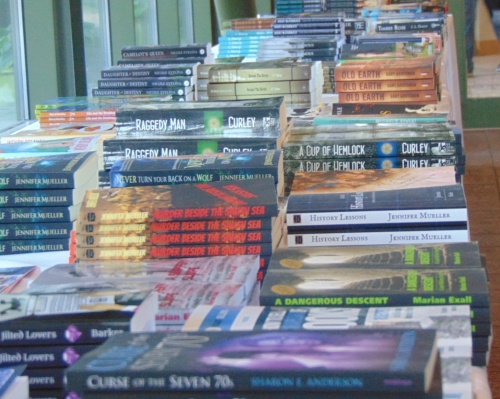
    Here are some photos of book spines to drive the point home about their importance and the 3 second rule of thumb.

    BOOK SPINES MATTER!

    BOOK SPINES MATTER!       Legacy-Cover-w-Spine


       How will your book standout? How to Increase Book Sales in Book Stores


    More exceptional cover designs:

    The Girl and the Clock WOrk Cat - Nikki McCormackNotice  that the reader can immediately tell that this is a steampunk young adult novel that takes place in London,  with a young adult female protagonist and a cat. All of this information is conveyed by the cover design.

    There's Something About MartyCozy mystery readers who like a humorous edge  to their stories can tell immediately that this book may be of interest to them.

    The Treasure of Ching Shih by John GillgrenNo mistaking that this is a children’s book about sea adventures and pirates!
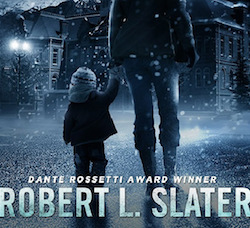


    Farewell to a QUeen

     Yep, I read this book to find out what happened to the Queen of the North!

      Your cover should incorporate your author brand along with some 3rd party P/R.

    STRAIGHT-INTO-DARKNESS-front Award


    Notice how tastefully that this author differentiates himself from the other millions of authors with his designation of being an award winning author.


    Higher Ground by McKendree Long You are probably starting to get the concept….of just how much information a cover is able to convey. Help readers discover your books by using your book’s cover real estate as effectively as possible. Make every little detail work for you. Imagine that your cover is a commercial for your book and make each everyone on those three seconds that you have to hook the potential reader into picking up your book instead of someone else’s or to click on your digital cover instead of someone else’s.

    Covers can sell readers on your first work, but it is the content that will make them come back for book two and three….


    It is the COVER that will sell your books at industry trade shows when book buying professionals pick up your books’ Sell Sheets.  Make your books standout and get noticed. Start working on the cover concept almost as soon as you start working on the story concept. Use it start finding Beta readers, on your website, with your author platform to start lining up book signings for your book launch, and planning promotional materials BEFORE your launch date. Keep in mind hour your cover will influence your marketing materials and web promotions.

    Remember that it doesn’t matter how much time and money that you spend on getting your book in front of potential readers. If the cover isn’t  engaging to the reader, the reader will not pick it up to look at the inside or read the back cover blurb, or click on the image to for more information and all of your time, money, and effort will be for naught.

    Covers should convey an emotion first. The cover should have a visual impact that grabs the potential reader and makes him/her want to know more about what is inside. The cover must be enticing! 

    milkyway-galaxy.jpg

    This is the second blogpost in the Seven Must-Haves for Author series.

    The first article addresses:

    What is the traditional publishing tool that authors can implement to propel their writing careers to new levels and to earn an income from selling their books? Click here to read. 

    The third article in the series asks: What is the corner stone of any author platform?

    Stay tuned! – Kiffer Brown, Head Hen at Chanticleer Book Reviews


  • Top Ten Takeaways from Book Expo of America 2016 by Kiffer Brown

    Top Ten Takeaways from Book Expo of America 2016 by Kiffer Brown

    IMG_20160513_115454Top Ten Takeaways from 2016 Book Expo of America – Chicago

    The Number One publishing industry event in North America and one of the biggest in the world. BEA is the largest gathering of booksellers, librarians, retailers, publishers, rights, licensing, and book industry professionals in North America.

    BEA gave me a press pass that allowed me a carte blanche to walk the show, take in presentations and sessions, attend special events, view the latest products, and meet with exhibitors.

    Here are the ten takeaways that I gathered from overhearing buzz, listening to experts sharing the latest information, and seeing the latest trends at BEA 2016.

    Drum-roll please! 

    The Top Ten Takeaways from BEA 2016

    1. Never ever forget that books for “the trade” (books available to the general public – digital or print) must entertain–even if their purpose is to educate.IMG_20160512_161055
    2. Covers RULE — every spot of a cover whether digital or print is highly valued real estate because it is the number one influencing tool to induce a potential reader to pick-up a book or click on a digital book for more information.
    3. Book buyers for libraries, as a rule, wait to decide on whether or not they will  purchase a book until they can “hold it in their hands” along with requiring that the book has been editorially reviewed (not consumer reviewed). If authors/publishers want to reach librarian book buyers, it behooves them to have their books at the ALA conventions.IMG_20160513_143314 (1)
    4. E-books as a percentage of US wholesale trade market sales are more than 25% of all sales in 2013, 2014, & 2015.  Source: AAP
    5. Readers are “flipping like otters” between e-books and print books.
    6. The publishing market is going global because of E-books. Forty percent of Smashwords/iBooks sales are global. Retail digital platforms (Amazon, Kobo, iBooks, Smashwords, etc.) are global.
    7. Generation Z, X, & Millennials now use YouTube as their Google Search. Keep this in mind when creating channels of book discovery pathways.
    8. Publishers want/need series–not one-offs (single titles)– because that is what bookstores want and, ultimately, what readers want. IMG_20160513_173524
    9. Gen Z, Y, and X want authenticity in engagement. They do not want to be sold to on social media platforms. Gen Z communicates in images — think emoticons.
    10. The nut to crack is to get people to read and buy books rather participate in other kinds of entertainment (gaming, movies, watching TV, etc .) that are competing for their time rather than worrying about Indie vs Traditional publishing.  See Item 1.

    Next year, BEA 2017 will be held in back in New York City and Kiffer Brown of Chanticleer Reviews plans on being there to bring the Chanticleer Community of Authors the latest in publishing news.

    Be sure to check out Kiffer Brown’s marketing blog-post series that she presented at BEA 2016, The Seven Must-Haves for Authors.


  • The Seven Must-Haves for Authors – Unlocking the Secrets of Successful Publishing Series by Kiffer Brown

    The Seven Must-Haves for Authors – Unlocking the Secrets of Successful Publishing Series by Kiffer Brown

    I was asked by Orna Ross of Alliance of Independent Authors to share what I consider to be the “Seven Must-Haves for Independent Authors” at  UPublishU event that was held at the Book Expo of America 2016 held in Chicago. Of course, I agreed!

    However, the Seven Must-Haves are applicable for all authors whether they are self-published, small press published, traditionally published, or hybrid published. I formed the talk based on the following questions:

    What are the Seven Must-Haves?

    1. What is the traditional publishing tool that authors can implement to propel their writing careers to new levels and to earn an income from selling their books?
    2. What is the single most important publishing tool for first-time authors?
    3. What is the cornerstone of any author platform?
    4.  What should every author know about communicating and marketing in the Digital Age?
    5. How can an author set her books apart from the millions of titles that launch each year?
    6. How can an author expand readership?
    7. What should continue to grow and never disappear in today’s new era of publishing?

    Each of one these questions will be answered in the Seven Must-Haves blog-post series.

    1. What is the traditional publishing tool that authors can implement to propel their writing careers to new levels and to earn income from their books?

    Have you ever wondered how best-selling authors can churn out a book or two each year? 

    How they can continue to hit “home-runs” with each new title? 

    They use the tried and true tools that have built the publishing industry. Authors will benefit from taking the best tried and true methods of traditional publishing and combining them with today’s best publishing practices.

    One of the best tools that traditional publishing houses and literary agents make available to their authors is the power of a manuscript overview. Most best-selling authors have great editing and feedback from agents and senior editors from the very beginning of a work. This feedback comes in very early in a work’s process and allows for the author to publish more works and not as an afterthought.

    The Editing Process (when one is working with a literary agent and/or publishing house) goes like this:

    The author works on a rough draft – the early drafts of a novel. He creates the theme, the characters, the setting, the tone, the story, the plot lines, the dialog style, and selects the genre and has an audience in mind (YA or mystery fans, fantasy or Science Fiction readers, etc.). After the author creates the story with a beginning, middle, and end, he then sends this early unedited draft of the story to his editor or agent to read and to get feedback.

    Authors who work within this editing system then begin scratching out the next inklings of story ideas, or they will resume working on other drafts that are further down the editing schedule, while waiting for feedback about the manuscript overview from their agent/editor. Once the feedback (manuscript overview) is received, then the author decides what to incorporate and which suggestions to implement in the next drafts. He then reworks the draft while another work’s manuscript is being over-viewed or is in a separate stage of editing. Some authors who write within this system will have two or three works “in play.”  Also, some authors write in different genres while as the works are in different stages of the editing process.

    Have you ever wished that someone would give you objective feedback about your manuscript? Or that someone would give you the feedback that will take your work from good to great?  

    What is a Manuscript Overview: It is an objective evaluation of a story idea that is fully formed with a beginning, middle, and end, but still in an early draft stage. The MO comes before LINE EDITING and COPY EDITING.

    What is the process:  The entire manuscript is read and evaluated by a top editor for the following:

    • Does the work have a compelling story?
    • Is there more than one story in the manuscript? It is quite common for a manuscript to have two, three, or more storylines.
    • Are the characters engaging? Interesting?
    • Are there too many characters? See above.
    • Are the characters pathetic, sympathetic, or empathetic?
    • Is there inconsistent character development?
    • Are there plot holes? Smoking guns?
    • Does the story wander?
    • Is there “head hopping” or unplanned POV changes?
    • Does it take to long too engage the reader?
    • Does the story stay within its world construct?
    • Does it follow the “laws” of the setting?
    • Does the story sag in the middle?
    • Is the ending satisfying?
    • Does the beginning intrigue?
    • Is the dialog appropriate?
    • Is there too much backstory? Too many details?
    • Does the scenery and setting work with the story?
    • and so forth
    • Or is it spot on and ready for a Line Edit?

    The editor then writes a brief and honest evaluation of the work that addresses the above questions.

    If you do not have an agent or editor, you can still get this type of brutally honest feedback with a manuscript overview from Chanticleer Reviews.

    Remember, that a manuscript overview is NOT a Line Edit or a Copy Edit. It consists of broad sweeping strokes of feedback for the author to consider for the next round of drafts. Incorporating line-editing suggestions can typically shorten a manuscript by at least twenty percent, thereby paying for itself with the savings on copyediting.

    The editor then sends his comments, suggestions, and concerns about the work back to the author in a manuscript overview. It is up to the author to take these recommendations and decide whether or not to incorporate them in the next draft of the manuscript.

    Many of the authors who have used Chanticleer’s Manuscript Overview service have found that their writing was greatly improved and have discovered that the feedback has enabled them to be able to take their next works to a higher level.

    I’m incredibly appreciative of the many positive and helpful things the reviewer had to say in the manuscript overview. The feedback is terrific and more comprehensive than any other I’ve received… Many thanks, again! Brian L.

    All of her suggestions were right and I hope to make them to the best of my ability. It’s like taking a powerful and quick course in advanced writing. Please thank her for me….Working with someone of her caliber would take my writing to another level. – L.V.

     Please thank the editor  for her insightful and pinpoint comments as to how I can make the book better. They were very good and I’ve already incorporated many into the manuscript. –D.S.

    When the author decides that the story is ready (and the lit agent and/or publisher agrees), she may send it off for another manuscript overview with either the same editor or get a second opinion. Or the author may decide that the work is ready for a Line Edit.

    Line Editing is defined as a thorough and focused reading of the manuscript  on a line-by-line basis with suggestions, comments, and remarks noted for the author to consider. For more information about what line-editing encompasses, please visit our Editing Guide.  

    After the author incorporates the line edits, the work then moves to a Copy Edit.

    Copy Editing is a very technical read of a work for flaws in grammar, punctuation, syntax; consistency in spelling, numerals, hyphenation, etc.; flagging any inconsistencies that have made it past the Copy Edit such as eye color, name spelling, location, timing from point A to point B; and tracks any internal inconsistencies in the story (conflicting abilities or inabilities, location inconsistencies), etc.

    After Copy Editing, the work then goes to Final Proofing.

    The manuscript then goes back to the author for final approval to begin the publishing formatting for digital and print.

    To circle back around to the first question:

    What is the traditional publishing tool that authors can implement to propel their writing careers to new levels and to earn income from their books?

    This is how: Each time a work goes back to an editor for evaluation and editing takes time. During these interludes, the author continues to write new works or continues to work on other manuscripts that are further down the editing chain.

    Fundamentally, the manuscript overview allow authors to WRITE and CREATE rather than rework and reword a story idea again and again while trying to get it “right.” The honest feedback gives the author an advantage of the traditional publishing houses where authors continuously get feedback and are under contract to produce. Manuscript overviews allow the author to spend creative time developing stories, characters, unique language, and new plot twists rather than trying to dissect their own works. They also allow for the author to gain fresh perspective.

    The manuscript overview saves the author time and energy, and if the author is self-published, then money in editing fees.

    Each stage of editing brings an entirely new set of fresh eyes and fresh perspective to a work. Imagine the kind of polish that will bring to your work.

    Put the power of traditional publishing’s collaborative expertise behind your work. Begin with a manuscript overview. Our clients, who have taken advantage of the Chanticleer Reviews Manuscript Overview service, swear that they will never go back to writing another novel without first having a manuscript overview conducted on early on.

    How much is the fee for this powerful editing tool?

    $425 for 2,000+  word overview/evaluation from one of Chanticleer’s senior editors for a work under 110,000 words.

    Get objective, honest, and brutal feedback from one of Chanticleer’s top editors who edit for New York Times and Amazon best-selling authors.

    Order your manuscript’s overview today! 

    *If you publish with a hybrid or cooperative publishing house, we can work with their Style Sheets. We work with many authors who publish in a variety of ways, but want honest and objective feedback regarding their manuscripts before they submit them.


  • E-Book Sales as Core of Your Books’ Marketing Plan by James Wells

    E-Book Sales as Core of Your Books’ Marketing Plan by James Wells

    The eBook market is a huge opportunity, especially for indie authors.

    If you’re not focusing on eBook sales as a core part of your marketing plan, you’re missing out.

    great symmetry james wells

    When I published my first novel The Great Symmetry, I printed a few hundred copies and imagined that it would be a great success if I sold them out. I had no idea where I would find the vast majority of my readers.

    Just a year later, about 95% of my sales are eBooks. Every day, readers are buying my book on Amazon and other sites from all over the world.

    To get traction in the eBook market, I tried out new things, made plenty of mistakes, and then had a series of increasing successes. I’m grateful to the authors who helped along the way. Now I’m distilling the most important lessons to help other authors.


    At the upcoming Chanticleer Authors Conference, I’ll be presenting a series of three sessions about eBook publishing. The content won’t focus on mechanics like eBook file formats – that’s boring and you can figure out that stuff easily. Rather, we’ll dig into the most important decisions facing an author in the eBook market. The sessions are:

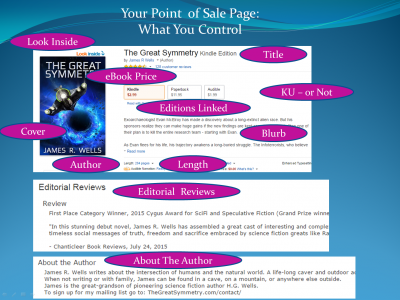
    • eBook Publishing 101: Designing your points of sale (such as your Amazon page) to convert browsers into buyers.
    • eBook Publishing 102: Getting readers to your points of sale. We’ll emphasize the most cost-effective tool around – the discount promotion.
    • eBook Publishing 103: Advanced topics such as series planning, reader magnets, and more.

    An overarching theme of all of these sessions is that your eBooks are a central part of your offering.

    Chanticleer blog post James Wells


    For some types of book (especially genre fiction by indie authors), it’s the most important channel for you. This means you should plan ahead for your eBook. For instance, some cover designs look wonderful in print, but are failures online – we’ll discuss how to avoid that pitfall. There may even be reasons to modify the text of your novel to sell well as an eBook.

    It’s ironic because I don’t even like reading eBooks myself. I only just gave in and bought a Kindle last week. But my preference doesn’t matter to the market – your priority as an author should be to make your book available, and well positioned, in the channels where the readers are found. These days, that means eBooks.

    Note from Kiffer Brown

    [fusion_builder_container hundred_percent=”yes” overflow=”visible”][fusion_builder_row][fusion_builder_column type=”1_1″ background_position=”left top” background_color=”” border_size=”” border_color=”” border_style=”solid” spacing=”yes” background_image=”” background_repeat=”no-repeat” padding=”” margin_top=”0px” margin_bottom=”0px” class=”” id=”” animation_type=”” animation_speed=”0.3″ animation_direction=”left” hide_on_mobile=”no” center_content=”no” min_height=”none”]

    James-Wells-Author-Picture
    James R Wells, Science Fiction Author

    I would like to thank James R. Wells, the author of The Great Symmetry for sharing his knowledge and experience with the Chanticleer Community.

     [/fusion_builder_column][/fusion_builder_row][/fusion_builder_container]

  • One Mental Trick That Will Help You Sell More Books by Tim Vandehey and Naren Aryal

    One Mental Trick That Will Help You Sell More Books by Tim Vandehey and Naren Aryal

    Did you know that the average self-published book sells about 200 copies?

    You’re an author and dialed into the world of books, so you probably did know that. But you didn’t know that most of those authors sabotage their own sales, did you? The thing is, that sabotage has nothing to do with the quality of the final product. It’s all about the attitude they adopt once that Kindle hits the Amazon digital shelves, or that box of freshly printed paperbacks arrives at their door still smelling of toner. With the best of intentions and hope in their hearts, they set out to find readers for their work, but they cut their own throats with some variation on this simple nine-word phrase:

    “People are going to be excited about my book.”

    We hate to break it to you, but no, they’re not.

    Sure, your friends, family members and the folks in your writer’s group will be all up in your business to get a copy and post enthusiastic reviews on Amazon. But unless you’ve built up a loyal readership from a previous book, nobody else is likely to care. That’s not your fault. There are a LOT of books competing for eyeballs. Being an author is a thousand times more competitive than most writers realize. Many don’t even think of themselves as being in a competitive field in the first place! But the harsh truth is, if you can’t compete for readers’ interest and attention, you won’t sell books. 

    [fusion_builder_container hundred_percent=”yes” overflow=”visible”][fusion_builder_row][fusion_builder_column type=”1_1″ background_position=”left top” background_color=”” border_size=”” border_color=”” border_style=”solid” spacing=”yes” background_image=”” background_repeat=”no-repeat” padding=”” margin_top=”0px” margin_bottom=”0px” class=”” id=”” animation_type=”” animation_speed=”0.3″ animation_direction=”left” hide_on_mobile=”no” center_content=”no” min_height=”none”]

    How to Increase Book Sales in Book Stores
    The average book store has 7,000 titles

    We’ve seen it hundreds of times: new authors so certain that their books are going to set the world on fire that they don’t even do basic marketing or branding, like launching a nice looking website. Armed with that misplaced optimism, they set their books free on Amazon like baby birds leaving the nest…and the books fall to the ground and die in the hot sun. Sales Rank: 2,000,000. Oops.

    [/fusion_builder_column][fusion_builder_column type=”1_1″ background_position=”left top” background_color=”” border_size=”” border_color=”” border_style=”solid” spacing=”yes” background_image=”” background_repeat=”no-repeat” padding=”” margin_top=”0px” margin_bottom=”0px” class=”” id=”” animation_type=”” animation_speed=”0.3″ animation_direction=”left” hide_on_mobile=”no” center_content=”no” min_height=”none”]

    tLgzJ
    Amazon Book Warehouse

    Don’t be that author. If you want to give yourself a better chance of selling more books, change how you think about the task of selling books and reaching readers.

    Ditch that blind optimism and gird yourself for battle.

    Be proud of your work, but don’t delude yourself into believing that anyone outside your current circle (including your Facebook friends) cares about buying it. Instead, remember this phrase: 

    “No one cares about my book, but I’m going to make them care.” 

    Book-selling is the art and science of figuring out who your ideal readers are, learning what they care about, and then reaching out to them again and again in ways that pique their interest about you and your work. That takes time and persistence, but most of all, it takes understanding that you don’t have a right to readers.

    You have to earn readers. You need a platform, a great brand, an execution plan, a lot of patience, and doggedness. If you have those qualities and really connect with your readers to earn their loyalty, you’ll build an audience for your work for the next 20 years. 

    Note from Kiffer Brown
    How-to-Sell-CraploadTim Vandehey and Naren Aryal are the co-authors of How to Sell a Crapload of Books: 10 Secrets of Building a Killer Author Platform, and the founders of BeastSellers.com, which helps authors build powerful marketing platforms and winning brands.

    [/fusion_builder_column][fusion_builder_column type=”1_1″ background_position=”left top” background_color=”” border_size=”” border_color=”” border_style=”solid” spacing=”yes” background_image=”” background_repeat=”no-repeat” padding=”” margin_top=”0px” margin_bottom=”0px” class=”” id=”” animation_type=”” animation_speed=”0.3″ animation_direction=”left” hide_on_mobile=”no” center_content=”no” min_height=”none”]

    mascotnaren
    Naren Aryal

    [/fusion_builder_column][fusion_builder_column type=”1_1″ background_position=”left top” background_color=”” border_size=”” border_color=”” border_style=”solid” spacing=”yes” background_image=”” background_repeat=”no-repeat” padding=”” margin_top=”0px” margin_bottom=”0px” class=”” id=”” animation_type=”” animation_speed=”0.3″ animation_direction=”left” hide_on_mobile=”no” center_content=”no” min_height=”none”]

    TimV mugshot2
    Tim Vandehey


    [/fusion_builder_column][/fusion_builder_row][/fusion_builder_container]

  • How to Become a Jedi Knight at Book Marketing by Susan Colleen Browne

    How to Become a Jedi Knight at Book Marketing by Susan Colleen Browne

    jedi“You can’t become a Jedi at whatever it is you’re doing unless you know it.” Jeni Britton Bauer.

    Take book marketing. A lot of students in the writing classes that I teach are really intimidated at the thought of marketing and promoting their book. But it’s not rocket science.

    To get started, you can go to writers’ networking meetings, see what other authors are doing—maybe launch a blog or update your existing one, or join Goodreads and run a contest. You can attend events like the Chanticleer conference, and learn more about social media or refresh your marketing skill set—perhaps get up to speed with book clubs or the latest in online retailers’ promotions, or meet experts in book marketing you may want to collaborate with.

    Once you’ve assessed your options, you can focus on the strategies that especially resonate with you. If you’re the adventuresome type, you can also try the proverbial “throw spaghetti at the wall and see what sticks” approach. Whatever you choose, you can make the most of your marketing funds if those tools not only fit your budget and available time, but are those you’re most likely to follow up on.

    Whether you’ve published your book or you’re an aspiring author, keep your eyes open for inspiration in unexpected places. I recently came across a piece in More magazine about updating your elevator pitch. To take your pitch or tagline from generic to sparkling, don’t begin with your name. Instead, tell a personal mini-story, then use vivid language to briefly describe what sets you apart. (From Robin Hatcher of SpeakEtc., a company that focuses on communication and presentation skills.)

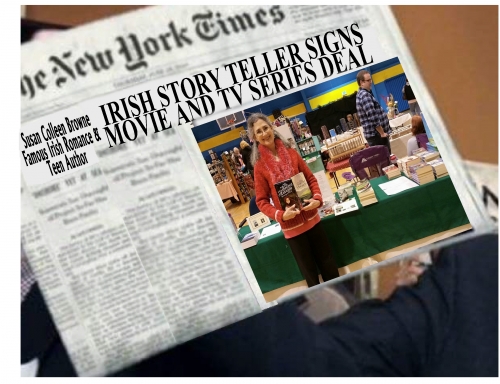
    NEWSPAPER SUSAN (1)

    Ms. Bauer (see the Jedi quote, above) is an ice cream impresario, who not only makes ice cream but lives it. She isn’t talking about executing something perfectly, but mastering a skill until it comes organically to you. And having a great time doing it! Which brings us back to writing…

    Many authors say the best marketing you can do is to write your next book. So…above all, reserve the mental bandwidth you need for storytelling, keep refining your editing talents, nurture your creativity and have fun! Hopefully, you’ll find a balance between writing, promotion, and cultivating an interesting and creative life.

    May the Force be with you!

    A note from Kiffer Brown:

    SusanBrownephotoJune 2013I would like to thank Susan Colleen Browne for her guest blog-post. Susan will present several sessions at the Chanticleer Authors Conference that will be held on April 29, 30, & May 1, 2016 in Bellingham, Wash. She writes Irish stories about love, friendship, and family. You can find her books available for purchase at the Books By the Bay Fair that will be held in conjunction with the conference. 
    We invite you to visit Susan’s delightful website for more information and for links on how to order her books.


  • Three Questions with the Founder of the World’s Largest Book Club – Kathy Murphy

    Three Questions with the Founder of the World’s Largest Book Club – Kathy Murphy

    Pulpwood Queens Book Club’s Founder, Kathy Murphy, tells all! 

    Pulpwood QueensMeet Kathy Murphy, the “Pulpwood Queen” who opened the only Hair Salon/Bookstore, Beauty and the Book in the country in Jefferson, Texas and in 2000, founded and now operates the 600+ chapter book club, The Pulpwood Queens, nationally and in 15 foreign countries. Have a question for the Queen? Bring it to the Chanticleer conference session!


    1. What was your motivation to launch the Pulpwood Queens?

    Shortly after opening my Hair Salon/Book Store, (Beauty and the Book), the local book club invited me to join them for a meeting. I thought they invited me to join and be a MEMBER, not!

    Evidently, only eight members were allowed to join and as the hostess told me, “Unless someone dies or moves away, that is all that will fit around our table.”

    I was secretly thinking, Who made up that RULE?! Anyway, I went home, sat down, and made a list on what I would do if I started my own book club.  This book club would be inclusive, not exclusive.  We would call ourselves The Pulpwood Queens, “where TIARAS are mandatory and reading OUR good books was the only Rule!”

    By wearing the crown, we would tell the world that we were “beauty within” queens as we were real readers.  So for nearly 16 years we have been meeting monthly, first with my charter chapter, The Pulpwood Queens of East Texas.

    Since then we have made the news with appearances on The Oprah Winfrey Show, Good Morning America, we kicked off their “READ THIS” Book Club and other radio and print media with now over 600 chapters nationwide and in 15 foreign countries.

    [fusion_builder_container hundred_percent=”yes” overflow=”visible”][fusion_builder_row][fusion_builder_column type=”1_1″ background_position=”left top” background_color=”” border_size=”” border_color=”” border_style=”solid” spacing=”yes” background_image=”” background_repeat=”no-repeat” padding=”” margin_top=”0px” margin_bottom=”0px” class=”” id=”” animation_type=”” animation_speed=”0.3″ animation_direction=”left” hide_on_mobile=”no” center_content=”no” min_height=”none”]

    Timber Guy sexy reading contest
    Timber Guy Sexy Reading Contest at the Pulpwood Queens’ Girlfriend weekend!
    1. What will readers get out of being a member of a chapter and where/how can they hook up with an existing Pulpwood Queens or Timber Guys chapter?

    Everything pertaining to membership is on our website, www.beautyandthebook.com but the difference our book club has over others is we bring the authors into the picture.  Most of our authors will teleconference, SKYPE or even visit chapters and for sure be featured at our annual Pulpwood Queen Girlfriend Weekend. I know of no other book club where you have this kind of access to the authors.

    I also make all the authors participate in ALL EVENTS at our Girlfriend Weekend.  So it’s no secret that Pat Conroy has served Sweet Tea at our Author Dinner, where I make all the authors wait the tables in crazy costumes.  You eat, drink, and the authors even stay in the same hotels and bed and breakfasts.

    It’s full immersion into the Wonderful World of the Pulpwood Queens with the Grand Finale being our Great Big Ball of Hair Ball. The theme this year is ONCE UPON A TIME.  All the authors dress up, too, and it’s the ultimate Kodak moment, so bring your cameras BIG TIME!

    pulpwood queen & family photo


    Ed. Note: To become a member, visit: www.beautyandthebook.com/membership

    1. What is Kathy Murphy looking for in a good book? What speaks to you as a reader?

    Since my book club is now international, here is what I am looking for:

    1. An unknown author, one that is perhaps a first time/first book or one that hasn’t been discovered in a really big way. Yes, I want to pick a big name once in while but only if they can come and be a Keynote at my annual convention which we call Girlfriend Weekend. Example, Pat Conroy, Fannie Flagg, John Berendt, Jamie Ford, etc.
    2. This is a given but it must be well written, free of flaws and my book club members do not like to read books with gratuitous violence or language, but I do make exceptions. I selected Girl with the Dragon Tattoo because it was just such a great, well written story.
    3. Most important of all, the book must tell a story that has NOT been heard before or from a perspective that gives the reader a different view of a subject. Examples: The Sunday Wife by Cassandra King, The Dive From Claussen’s Pier by Ann Packer, Empty Mansions by Bill Dedman. Do not send me another queen book set in the south, particularly one that is also a hairdresser. I hold that card, DONE.
    4. I want a book that changes people’s lives for the better. Examples: My Orange Duffel Bag, Same Kind of Different As Me, a book that is discuss-able and that includes book club discussion questions written by the author. My book club hates generated book discussion questions, too literary and not very personal. Authors tend to write questions that they answered.
    5. I really don’t care who publishes a book, a good book is a good read no matter who publishes it.
    6. Last, I want a real book to read, I’m on the computer so much, I want to cuddle with a book in bed!

    Book-Clubs-in-Where-Writers-Win-Winner-Circle

    Thank you Shari Stauch, CEO of Where Writers Win, for this informative interview with Kathy L. Murphy, the Pulpwood Queen!

    Shari will present several sessions sharing her book marketing expertise at CAC16 along with Friday evening’s keynote presentation.

    Tell Us About the Live Book Clubs YOU Know!

    The WWW team and the Chanticleer Reviews team are reaching out regularly to bloggers, Twitter-ers, indie bookstores, readers at book festivals and more, once every few months we circle back to the coolest source –YOU– to ferret out the latest book clubs in cities around the world. Because, the club you know about might also be of value to one of our other emerging authors – and their club may be of value to you!

    Contact:  BookClubs@ChantiReviews.com and/or contact Where Writers Win.

    Editor's Note about Kathy L. Murphy:

    DreamWorks signed on to produce a movie about Kathy, though as she says, ”I did not do this alone and am not an overnight sensation,” Murphy said. “This came about through years of struggle and hard work and the incredible friendship and help of my Pulpwood Queens Book Club members and our authors and the love of my daughters, my sister and family. We — note that I say WE have struck a film deal.”

    The latest update regarding the film as of April 2016 is that the screenplay has been written and approved. Dreamworks has sent the script “out to talent,” so stay tuned to see who will play Kathy L. Murphy.  

    We can hardly wait to see it! 

    [/fusion_builder_column][/fusion_builder_row][/fusion_builder_container]

  • Why Book Clubs Matter by Shari Stauch, CEO of Where Writers Win

    Why Book Clubs Matter by Shari Stauch, CEO of Where Writers Win

    Shari_Stauch-171x3001.jpgCEO of Where Writers Win, Shari Stauch, and Pulpwood Queens Book Club founder Kathy Murphy, will conduct a special session at the Chanticleer Conference, “Why Book Clubs Matter” – Here’s some great info to get you ready!

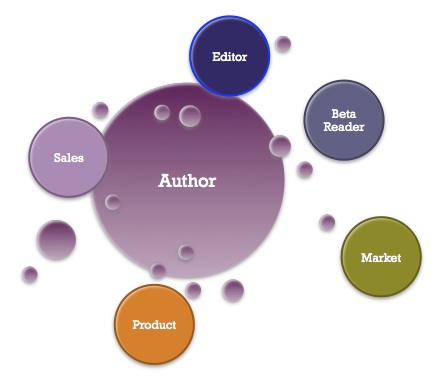
     

    LIVE Book Clubs: Are You Reaching These Critical Influencers?

    IBook clubs can be a defining moment in any author’s career. Fact is, the success of any book is accelerated if book clubs get hold of it and begin spreading the news. That’s why we call them “influencers” and that’s why book club listings are a key component of WWW’s Winner Circle.

    We encourage every author to develop a list of at least 10-12 thoughtful questions that relate to their book(s). Here’s how to get going with your own set of book club questions, what to do with them once you have them, and how you can share book clubs you know about, too! My next article will share some special insights from Pulpwood Queen Kathy Murphy,

    book-club-questions

    1. How to Write Your Book Club Questions

    If you’re unsure where to begin, here are a couple sites to get you started. PLEASE note, these are generic questions and we strongly suggest you use these as your “starter dough” to establish thoughtful reader discussion questions that pertain directly to your own work:

    1. From LitLovers.com – Questions for Fiction: http://www.litlovers.com/run-a-book-club/questions-for-fiction
    2. From LitLovers.com – Questions for Non-Fiction: http://www.litlovers.com/run-a-book-club/questions-for-nonfiction
    3. From AboutEducation.com – A list of general book club questions for discussion: http://classiclit.about.com/od/bookclubs/a/aa_bcquestions.htm
    4. From Book-Club-Queen.com – More general discussion questions for fiction at: http://www.book-club-queen.com/book-club-questions.html
    5. From Book-Club-Queen.com – General non-fiction discussion questions: http://www.book-club-queen.com/book-club-discussion-questions.html
    6. For reading guides/book club questions from hundreds of other books, visit: http://www.booklistreader.com/2008/05/07/book-groups/stalking-the-online-reading-guide/

    Here are a few of our authors with some fun book club questions that began with the starter dough above. Use them to inspire you:

    2. Where to Post Your Book Club Questions

    Your book club questions, book discussion guide, or whatever else you want to call it, should be listed in the back of your book. Whether or not that’s possible, there are other places to share as well:

    On your author website. Have a separate page/tab for your book club questions. We typically suggest that you paste them into the site, but also have a pdf of the questions, (perhaps nicely laid out with a graphic of your book’s cover), that readers can easily download and print for their next meeting.

    Share this page widely on your social media outlets. You might also put up a question a day or one a week over the course of time to create more following and even encourage online discussion of your book.

    book-club-survey

    Include your questions when pitching reviewers or book clubs. Make sure you let reviewers, clubs and conferences you may be pitching know that you have discussion questions. You needn’t list them out in each pitch, but do provide a link to where they can view and/or download your guide. One paid option we’ve seen ($200 and we don’t have feedback yet as to its worth to authors) is ReadingGroupGuides.com – you can visit this link for more info: http://www.readinggroupguides.com/how-to-add-a-guide.

    With your help, our vetted list of LIVE book clubs in the Winner Circle, now already over 300 live clubs and thousands of readers strong, will offer emerging authors the best chance to expose your work to thousands of new readers. And book clubs will have the opportunity to read new work in the genres of their choice, and maybe even influence who the next best-seller will be… That may be you!

    A note from the Chanticleer Reviews Team:

    Thank you, Shari Stauch, CEO of Where Writers Win, for sharing this useful information with the Chanticleer Community. We are looking forward to hearing more from you about reaching out to book clubs at CAC16! 

    We would also like to mention that we have a special blog post just for connecting authors and readers on the homepage of the Chanticleer Reviews website. Be sure to check it out for the latest in specials and offerings just for readers!

    Book Clubs and Readers Community News from Chanticleer

  • CO-OP Publishing: An Indie Option by Sara Stamey

    CO-OP Publishing: An Indie Option by Sara Stamey

    SaraLargerHawaiiPhotoJoin award-winning novelist and editor Sara Stamey to explore one of the newest alternatives to traditional publishing at #CAC16.

    Sara Stamey Unlocks Her Secrets to Successful Publishing 

    After being published by a traditional “Big 5” house and then starting her own “micro-press,” Sara has now joined Book View Café, one of the leading co-op publishers. With over 50 professional novelist members, the co-op takes control of how its authors’ writing is published, bypassing restrictions and delays of mainstream publishers, and distributing straight to their readers.

    “I was frustrated with my treatment by my traditional publisher and the endless delays, as well as mismanagement. But going it alone as an indie author was exhausting. Working together with a supportive group of fellow authors has made all the difference.”

    Join Sara for an introduction to the cooperative publishing model and ideas for joining or creating your own author coop at the Chanticleer Authors Conference 2016. Sara will be sharing her knowledge of this economical and highly vetted publishing avenue that is available to qualified Indie authors.

    “Our members donate the skills they have in return for the skills they need to publish books. So each of our members is both an author and an important cog in a publisher. We emulate everything a major publisher does.

    We have editors, ebook formatters, print typesetters, cover designers, accountants, web designers, IT and legal professionals, PR people, administrators and managers.  We even sell sub-rights – we’ve sold the audio rights to a couple of hundred of our books for a very good six figure sum to Audible.

    We also make our ebooks available in libraries – selling to them direct and via all the major library distributors like Overdrive, 3M, and Gardners.” -Book View Café member Chris Dolley

    http://bookviewcafe.com/bookstore/

    “I love the freedom, the fact that we can mix genres, that our books won’t be slashed to fit marketing’s mandated word count, that we get vigorous editorial feedback and it doesn’t take years, that people will do my formatting and covers for me. The team effort, I feel, makes us much greater than the sum of our parts.” -BVC member Sherwood Smith

    Sara’s newest novels from Book View Café, both Chanticleer Award-winners:

    • The Ariadne Connection – CYGNUS 2014
    • Islands – Paranormal Awards 2014.

    ariadneconnection

    Stamey-Islands_600x9001-200x300

    www.sarastamey.com

    Listen to Sara Stamey talk about indie publishing on Episode 05 of “The Whatcom Wordsmith” podcast with Jennifer Karchmer.