Category: Marketing

  • 10 “Fantasy Gifts” for the Writer in Your Life by Lindsay Schopfer, Fantasy Author

    10 “Fantasy Gifts” for the Writer in Your Life by Lindsay Schopfer, Fantasy Author

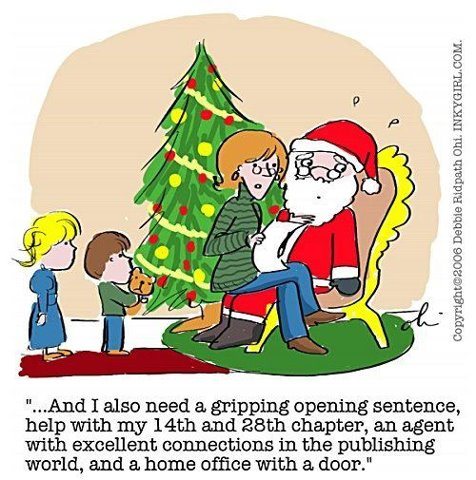
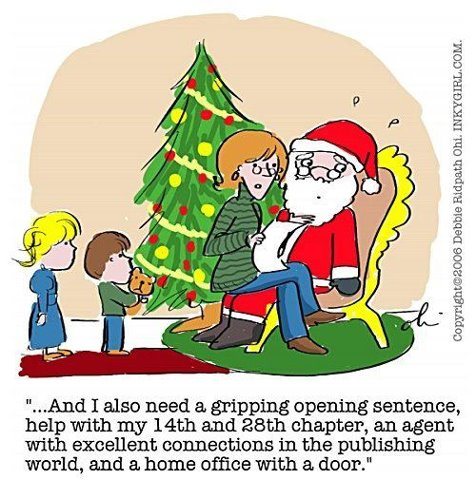
    Oh, if these gifts for writers were but possible — perhaps someday…

    Writer’s Christmas List attributed to Debbie Ridpath Ohi at InkyGirl.com

    Ten Holiday FANTASY Gifts for the Writer in Your Life by Lindsay Schopfer 

    1. A cat video filter for her internet browser  

    2. A “Cliff Notes” version of a book on the craft of writing

    3. A word processor that auto-corrects telling instead of showing (Editor’s note: Why can’t magic wands be word processors, we are fantasizing after all.)

    4. An instant-inspiration pill that is not harmful, habit-forming, or fattening

    5. A mobile desk so she can pace and write at the same time (See gift item #9 below)

    6. A voice-activated graphic design program that will take an infinite number of vocal commands to design the perfect book cover

    7. A music app that syncs up the type of scene she’s writing with the appropriate mood music

    8. Special glasses that can scan peoples’ brains and instantly know whether they’ll be interested in her book or not

    9. An automated candy dispenser that will only release a piece of chocolate for each time she writes another 1,000 words (see Gift Item #5 above)

    10. A keyboard that makes the writer typing feel like petting a dog (or a cat — editor’s note) 

    What would you add to the Fantasy Gifts for Authors List?

    Leave your reply in the comment section below along with the best way to contact you. Ho! Ho! Ho!

    Many thanks to Lindsay Schopfer  (who is very qualified to write an article on fantasy gifts, as he is an acclaimed fantasy author and writing craft coach ) for sharing this blog post with the Chanticleer Reviews Community.

    Lindsay Schopfer is the author of The Adventures of Keltin Moore, a series of steampunk-flavored fantasy novels about a professional monster hunter. He also wrote the sci-fi survivalist novel Lost Under Two Moons and the fantasy short story collection Magic, Mystery and Mirth. His short fiction has appeared in Merely This and Nothing More: Poe Goes Punk from Writerpunk Press and Unnatural Dragons from Clockwork Dragon.  

    However, until these fantasy gifts are available, may we suggest the following last minute gifts for the writer in your life:

    Holiday Book Buying Online

    Perhaps a gift certificate from Chanticleer Book Reviews… the gift receiver will receive a festive email notification within 24 hours — even on Christmas Day! 

    • Gift Certificates starting at $50  to be used on any of Chanticleer’s services, products, authors conference, or workshops. Gift Certificates are valid until Dec. 31, 2020. Click here for more information or to order.

    We are also offering special discounts on two of Chanticleer Reviews services until December 31, 2017 or before the limited quantities at these special rates are sold out — especially for the Chanticleer Community members who have read this far!

    Keep reading for special discounts just for YOU! 

    • a Gift Certificate for a Chanticleer Book Awards contest entry of the author’s choice $75 dollars per entry — Happy Holidays offer is $60 per entry. Limited to 5 contest entries per Gift Certificate purchase. Hurry! Quantities are limited at these special rates.
    • A Chanticleer Book Review – Standard Delivery (six to nine weeks) $395. Special Happy Holidays Gift Certificate rate $325. Limited to 3 Chanticleer Book Reviews per person at the special discount rate.  Hurry! Quantities are limited at these special rates. Gift Certificates valid until Dec. 31, 2020.
    Chanticleer Gift Certificates
    The Perfect Gift for the Writer in Your Life
    Happy Holidays from all of us at Chanticleer Book Reviews & Media!
  • The RELATIVITY of TIME and TRADE SHOWS by Sharon E. Anderson

    The RELATIVITY of TIME and TRADE SHOWS by Sharon E. Anderson

    I agree with Einstein: time is relative.

    I’m no scientist. I’m no brain expert.

    But here’s what I think, time passes quickly when we’re happy and productive or involved in something meaningful. Joy makes us buoyant and time, therefore, becomes lighter and easier to move.

    When we’re faced with something terrible or unpleasant, the opposite happens. We are weighed down by depressed thoughts or depressing situations. We feel every moment because the pain it causes is real and we cannot do anything else but live in it. Time slows because our focus is on the moment.

    Today, (I started writing this on the first flight of the fall trade show season) Kiffer and I are heading to New Orleans for the Southern Independent Booksellers Tradeshow (SIBA). We’re leaving a couple of days before the exhibit portion of the show begins. We’re crossing time-zones. Neither of us has been to NOLA and I have a list of things and places to see and experience. Little did I know, that we would be spending most of our time in the convention center. NOLA sights and sounds will have to wait for another time.

    It is important that we arrive ahead of the exhibit time because TWO of Chanticleer’s authors’ works have been selected for the prestigious SIBA events and everything must be PERFECT:

    • Bernard Mansheim, M.D.’s Somerset award-winning novel, A Doctor A Day was selected for the prestigious Moveable Feast event at SIBA
    • Gregory Erich Phillips’ Chanticleer Overall Grand Prize novel titled Love of Finished Years was selected for the prestigious  First 180 Days event for books that will be published in January 2018.

    Those of you who do a lot of traveling know that your bag cannot weigh more than 50lbs or you pay a hefty price. We had 3 fifty-pound bags plus personal luggage to lug around between the two of us. Our bags easily weigh more than the allotted fifty pounds each. However, eventually, we discover that a $20 tip to the Skycap helps to “lighten” the load.

    Bossy, Bertha, Betty, & Biff

    And those of you who read books know that they tend to be heavy. We’re representing 25 Chanticleer Authors and because books look better with a partner, I’ve packed two of each title. You might think that’s fifty books, but you’d be wrong. Most of our authors have two or three titles coming with us. Do the math.

    I drop Kiffer off at the departure deck at SeaTac with the bags and park my van in the garage. When I catch up to her, she’s at the Alaska counter unpacking the bags… One of the bags is overweight and shuffling of its contents is required. By the time we reconfigure, the agent has closed the counter and we have to move to the next aisle to check in.

    This is how our tradeshow adventure begins.

    We are learning things about ourselves and each other – things we didn’t know before. Kiffer has started calling the luggage by name:  Betty, Bertha, Bossy, Birdie, and Biscuit. I cannot drink McDonald’s coffee. I tried. I can’t. Kiffer thinks I’m a bit of a coffee diva. I guess I am. Kiffer has graciously upgraded our seats to premier economy class – which means more leg room for both of us tall gals and free drinks. She knows how to travel and I’m grateful. After everyone is clicked in and flight safety drill is given, we’re in the air. It will be six hours before we land. Six hours.

    This is the first tradeshow of the season. There will be three more plus auxiliary shows.

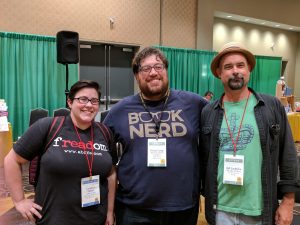
    Sharon Anderson, Editor in Chief of Reviews; Gregory Phillips, a Chanticleer Grand Prize Winner; Josh Floyd of Ingram.

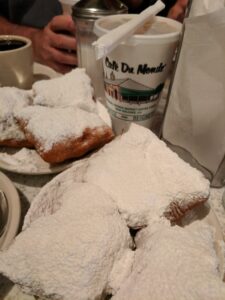
    NOLA is sultry. It’s a city that beckons the visitor to ease on in and sit for awhile. It hits the high notes of the most compelling song and doesn’t judge anyone for anything. The police ride horses whose backs are as tall as my minivan back home. It’s a different world. I love the vibe and the beignets – the coffee and the company.

    Beignets from Cafe du Monde, NOLA

    In N’Orleans, all you have to do is pause for a second and someone will be around to chat you up on how your day is going and if you like the city they call home. It’s very Southern and for me, a Northwest native, it’s lovely. To Kiffer, well, being from the South, I can tell she’s feeling her roots as we venture from one restaurant to another looking for the perfect hush-puppy.

    Hush-puppies

    We’re off to Portland, OR next for the Pacific Northwest Independent Booksellers Tradeshow where two Chanticleer authors’ books were selected for the BUZZ BOOKs event. This time it was Kaylin McFarren of Portland for her Chatelaine award-winning romantic suspense Threads series and Seattle’s own Gregory Phillips, Love of Finished Years was selected – again!

    From there, we hop a plane in Portland to head to Chicago for the Heartland Fall Forum. These are bigger shows than SIBA and I’ve increased my load of authors I’m representing. More luggage is required. We borrow Andy’s orange suitcase and name it Biff.  Once again, Kiffer is the proud mother hen when the Laramie Grand Prize winner, Sara Dahmen’s Widow 1881 (renamed from Doctor Kinney’s Housekeeper) was selected for Heartland’s prestigious Moveable Feast Event! 

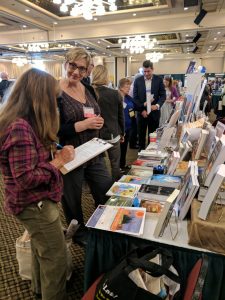
    Sharon hand selling to a PNBA book buyer!

    After the Heartland trade show, we will split up and Kiffer will take our authors’ books to San Francisco for the show there and I will travel up to Surrey for the SiWC for the weekend. For me, it feels odd not being a part of the last trade show, but Chanticleer has been at the Surrey conference for five years running – it’s no time to stop now.

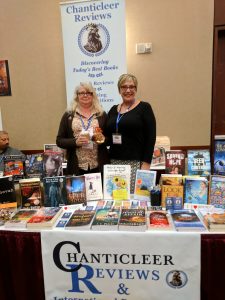
    Kiffer refueling with coffee and Sharon proudly showing off Chanticleer’s Best Books Collection at the Heartland Fall Forum, Lombard, Illinois

    Before leaving, my mother asked me why was I going away for such a long time. I had to smile, as long time means so many different things to so many people. It depends on what you’re doing, right? Spending a week in jail would be rough. Attending tradeshows? I know it will be over before I have had a chance to settle in.

    My mother’s  question is valid, though. What do I hope to gain from being away from my family for most of September and October?  First of all, I expect this time away will work to sharpen my professionalism and further my career in the book industry world. I expect to meet new people, build stronger connections and learn with a little more certainty that I am capable and ready for this new and exciting adventure.  It is exciting to meet the some of the top executives in the publishing industry and mingle with the “Big 5” publishers. There is always a lot to learn and many networking opportunities.

    Equally as well, I hope to increase the visibility of my (Chanticleer’s) authors’ work, widen their footprint, as it were, in the retail world of book-selling. I hope, through our efforts, they gain even more notoriety and, more importantly, benefit from more bookstores placing more orders for their work. I hope their books fly off those bookstore shelves because I’m not taking just anyone to these shows. I’m taking Chanticleer Award winners and those very special people who have earned the very highest scores from our professional reviewers. I’m taking the top books and the booksellers are pleased that we have vetted the books that we are exhibiting. We even had a Disney exec who was interested in Chanticleer’s YA and children’s book selections stop by the Heartland booth—she was looking for new content for Disney. She took away sell sheets and information—we will definitely stay in contact!

    Book buyers would be crazy not to snatch these books up! And we did connect many indie booksellers and book distributors with Chanticleer Reviews’ best books!

    We Discover Today’s Best Books! 

    Endnote: I started this article on the plane to New Orleans and I was right, the Fall trade show season is over before it began! Time does have a knack for passing quickly when you’re having fun and are passionate about what you do!

    Next up are the 2018 American Librarian Association trade shows and the Comic Cons—just around the corner…


  • Part 2 Building Your Readership Community – Not Just for YA Authors by Jesikah Sundin

    Part 2 Building Your Readership Community – Not Just for YA Authors by Jesikah Sundin

    Dear YA Writer,

    In the previous blogisode, the YA Writer stumbled upon a gritty secret. A secret that revealed the often un-used marketing processor installed in every bonding animal who hawks bookish wares inside the All Powerful Cybersphere.

    Socializing.

    Now the YA Writer is forced to make a choice that may alter their impressions, clicks, and engagement foreverrrrrrr…

    <<dramatically clears throat>>

    We are gathered here today to witness the exchange between this author to this reader in meme-y internetrimony. Author, do you take this social media thing-a-ma-gig seriously? Do you solemnly swear to post interactive content and reply to comments until defective accounts do you part?

    Before you shout, “I object!” … THIS is what I believe most authors hear when told to engage their readers online. I’ve talked to hundreds of authors face-to-face on this subject. The reaction is typical­­––dear-in-headlights look, nervous laughter, shifting on their sudden cold feet.

    Yeah, I know … commitment is a scary idea for many. Perhaps even a monstrous call-to-action for us please-dear-cat-gods-of-the-interwebs-don’t-make-me-small-talk introverts. Some view social media as a black vortex that will suck away their humanity until their cyber-Gollum alter ego hisses, “My preciousssss…,” whenever a notification chimes.

    Do not despair, fair YA Writer. Even if socializing with strangers is nothing but rainbows, unicorns, and kittens for you, I have encouraging news.

    You don’t have to love it, therefore you don’t have to marry it.

    You don’t even have to put a ring on it.

    But you do have to care. Because sharing is caring.

    Literally. What you share on your social media accounts reflects what you care about.

    So, what do you care about? Beyond book sales, that is. Dig deeper. Think broader. Embrace this exercise as a way to tone and sculpt your creative marketing muscles.

    Bring to mind a writer or celebrity you enjoy following on any social media platform. Then ask yourself, why? Why do you enjoy following them so much? Is it because they talk incessantly about buying the book you’ve already read and own? Doubt it. Maybe it’s their keeping-things-strictly-business posts that only announce events and new releases?  <<yawns>> Yeah, didn’t think so.

    Every once in a while? Sure. But if that’s all you share? #DontCare

    Make me care. Make them care. You know, your followers. The ones who clicked you into their newsfeed existence. Rise up and say, “My people!” and lead them into a conversation. Actual YA-aged readers long for this. It’s psychologically built into an adolescent and twenty-something to search for and declare “their tribe.” Give your audience, regardless of age or genre preference, a sense of belonging. You found me. You belong here. Welcome. Let’s discuss all the things! Let’s discuss YOU.

    The YA reading crowd is passionate. Intelligent. Lively. Transparent. Witty. And always on the hunt for immersive communities. They also care deeply about the characters and worlds you’ve created. They also care about the word magician behind the curtain who cast a spell over their imagination.

    True confession: I’m legit socially awkward. No, really. Small talk is my arch nemesis. I have a terrible habit of nervously laughing at just about everything. And if I’m not nervously laughing, I’m nervously rambling. Even when I recognize the social cue that I need to stop talking, I CAN’T STOP TALKING [-_-]

    If you’re socially awkward like me, take heart! The best form of caring is sharing the spotlight with another. Just remember, talk with people and not at them. Here are ideas on how:

    • I just finished reading [title] by [author name] and [gush about book]. Not sure what I should read next. What are YOU reading right now? I’ll add your answers to my TBR list on Goodreads.
    • So full. Just enjoyed [food]. Aaahhh, happiness. What’s your favorite comfort food? Bonus points for posting a recipe link!
    • Let’s play a game! [You can use a meme-ready prompt like, “What’s your Hobbit Name?” Or, you can provide your own prompt like, “Using only a meme or GIF, share your favorite female superhero.” Search through Pinterest or various fandom sites on your fave social media for more examples.]
    • [Share an image related to characters or worldbuilding in your book with a quote from said story. You can leave it as is for people to like, comment, and re-post. Or, you can end with a question.] “Is this how you imagined them?” “What would you do in this situation?” “Do you think [character] made the right choice?”

    Examples are endless! The point is to start conversations. People will begin interacting with each other’s comments, or tag their friends to participate, too. #SharingIsCaring

    First, the cautionary tale: Please, for the love of emoji reaction buttons, REPLY. If a friend invited you into a face-to-face discussion but ignored you, how would you feel? Right. That’s how your followers would feel, too. This isn’t a contest to see who has amused you the most. Don’t––I repeat––don’t ignore your followers when they’re taking time out of their busy lives to participate with your conversation prompt. A simple acknowledgement is all that’s needed with a blue thumbs up or a heart-like. Go the extra mile and interact further if you like. Make the reward centers in your follower’s brains light up wildly.

    OMG, she spoke with me!

    He thinks my recipe for pickled shark chops in a beet reduction sauce sounds yummy!

    The more you engage, the more your followers will engage, too.

    Socializing. It’s a thing.

    A thing you need to make time for, like in real life.

    Caring fosters loyalty. And that, folks, is the end goal. All customers for you are short-term. They read your book. They move on. But with a community to keep them company, they’ll stick around until you release your next title. The best launches are built from established reader pre-orders who are in-the-know because they stuck around on your social media to find out. *wink, wink*

    So how often should you post? Totally up to you and your followers. Honestly, I post 1-3 times a week on my author social media accounts, save Twitter. When not posting, I make time to participate in other accounts I follow. It’s a give and take, right?

    Share.

    Care.

    If you don’t? You might discover an intervention at your social media doorstep from fellow YA Writers 😉 But only because we care

    #SocializingWithInternetStrangersForTheWin

    Sincerely,

    Me


    A note from Chanticleer: 

    Many thanks to Jesikah Sundin for sharing her effective and fun social media techniques with us!

    Two words could describe Jesikah: books and coffee. She pours a cup of dark roast writer’s ambrosia before approaching her keyboard. And the forest is her happy place.

    Jesikah invites you to socialize with her on her website and social media pages (visit her website for direct links).

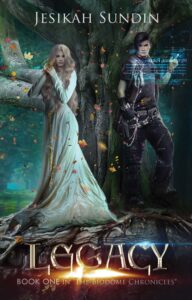
    Jesikah Sundin is the award-winning author of the Biodome Chronicles. 

    Biodome Chronicles

    Short Description of Legacy: Book One

    Siblings born and raised inside an earth-based experimental Mars biodome have only known a rustic medieval life rich in traditions and chivalry. Groomed by The Code, they have built a sustainable community devoid of Outsider interference––until the unthinkable happens.

    Cultures clash when the high technology of the Anime Tech Movement collides with the Middle Ages in a quest for truth, unfolding a story rich in mystery, betrayal and love.

     

  • BISAC Codes — Not just Alphabet Soup — Book Marketing Tools

    BISAC Codes — Not just Alphabet Soup — Book Marketing Tools

    Anyone producing a digital book or setting up an ISBN may come across the acronym BISAC. If you’re a self-published author wondering what a BISAC code actually is, here are some answers.

    Mysterious Coding – BISAC Codes

    Metadata For Your Book

    BISAC is an acronym for Book Industry Standards and Communications, a very helpful tool put out yearly by the BISG (Book Industry Study Group). The BISAC code system is an alpha-numeric system of book classification. The book industry (libraries, universities, Barnes & Noble, local bookstores, and online bookstores) use BISAC code numbers to categorize books.

    For example, if you’ve just written a graphic novel murder mystery, they have a BISAC code for that:

    CGN004010 COMICS & GRAPHIC NOVELS / Crime & Mystery

    In the BISAC code catalog, there are fifty-three (53) main categories with various sub categories – and in some instances, sub-sub categories.

    How do you access the BISAC codes?

    If you are buying an ISBN code for your book directly from Bowker, you will be prompted to select your BISAC code. When you set up your Bowker account when you purchase an ISBN, Bowker will ask you to identify or categorize your book. A list of 53 BISAC codes will appear (if Bowker is truly up-to-date) and you’re off to the races.

    Even if you’re not working with Bowker and using a third party to acquire your ISBNs, you can always access the BISAC code categories directly online.

    How do you determine your book’s BISAC code? 

    YES, you can unlock the secrets to BISAC Codes! 

    The first category you choose should be what the book is about, which genre category it fits into. Think of it as a funnel: a wide opening at the top, narrowing down to a spout at the bottom. Start large, go narrow.

    FICTION > ROMANCE > MYSTERY > PARANORMAL > VAMPIRES

    Don’t let the process intimidate you. Don’t be sidetracked. Get your BISAC codes down so you can start talking about your book in an intelligent manner. For example, when asked what your book is about you can say, “My book is a Sci-fi/Fantasy with elements of the paranormal and badass skateboarding.” Or, you could say that if you were author Jesse James Freeman talking about his book, Billy Purgatory: I am the Devil Bird.

    BIASC Codes and Discoverability

    BIASC codes are used by booksellers, librarians, teachers, and others who need to categorize and catalog your book. But as an author, you can use this coding system to understand your book in the context of all the other books out there.

    Third Party Keywords

    Please note that if you are letting a third-party such as Amazon’s CreateSpace, they have their own codes, some of which match to BISAC and others do not. For example, when you log in to CreateSpace and upload your book files you’ll be prompted to enter keywords. During this process – currently on CreateSpace, Step 3: Target Your Book to Customers > categories –  a screen will pop up and ask you for KEY WORDS. These, like BISAC codes, will help readers find your work. So the principles described below for BISAC codes apply to keywords as well.

    BISAC Identifiers = The Beginning of Interest

    You can also think of BISAC Identifiers as the bones for DISCOVERABILITY.

    Let’s take this wagon on another ride and construct a little scenario where you are attempting to purchase the perfect book for your grandma. You sit down with her and ask her what she likes to read. She tells you that she likes mysteries best – mysteries with a lot of vampire sex. Instead of screaming T.M.I. GRANNY! You smile and say, I will find you the perfect book!

    How? You now know about BISAC codes and how to wield them. You either visit your favorite brick and mortar store – or go online and search:

    Mystery, Erotic, Vampire

    And you’ll find J.D. Ward and Laurell Hamilton – two of the tops authors writing in this category – both of whose books will be perfect for your grandmother.

    Check your BISAC codes yearly

    The BISG is not a static group. They are constantly changing things up with BISAC codes – rearranging codes, creating codes, destroying codes – all in an attempt to make our books more discoverable.

    Once you’ve landed on the codes that best describe your book you will need to check back from time to time (yearly) to ascertain if your chosen codes are:

    • still accurate,
    • still active, and/or
    • if the BISG has come up with a better code for your book.

    In their most recent update,  the BISAC Subject Committee states that they never reuses inactivated codes and that they would never inactivate a code and then reuse that code for an unrelated literal. The committee continues that this has always been the case and inactivated codes have never been reused. So, that has never been a practice – apparent or otherwise. They do, however, “reactivate” codes as necessary. For example, GAR011000 was inactivated after the 2.3 edition (in 2001) and the reactivated for the 2016 Edition with the same exact literal.

    A Concise Context For Your Book  — Unlocking Publishing Secrets 

    Let’s be honest, the real reason you need to know your book’s BISAC Code: It gives you a fast way to describe your book.

    Can you imagine doing that to anyone in the book industry? No one has the time or inclination to listen to you prattle on about it. Base your book description on its BISAC code and everyone will have  a good solid context for its genre, content, and even the type of experience they’ll have when they read it.

    So when your all-too-well-meaning writer friends set your book down and ask in unison, “Yes, but where is this book going to be on the shelf?” Or agents at conferences ask you, “Who’s your audience? How am I supposed to sell this book?” Now you have something smart to say in return. Now you know BISAC codes!

    We will have more articles about BISAC codes and how to decide on which ones to use and how.

    The Chanticleer Authors Conference on April 20, 21, & 22, 2018 will offer BISAC codes workshop.


    This article is by Sharon E. Anderson

    Sharon Anderson is an award-winning author and Chief Reviews Editor for Chanticleer Reviews and International​ Book Awards. Creating and editing content – as well as editing/writing reviews – and outreach are just a few skills she brings to the table. An SPU graduate in Clothing Design and Textiles – something she barely uses in her day-to-day life – Sharon brings her textile know-how into her stories as often as possible. In her spare time, she serves as President of the Skagit Valley Writers League where she promotes authors, engages speakers, leads workshops, and more. She writes dark comedy, horror, short stories, articles, and essays whenever she gets the chance from her home in the Skagit Valley where she lives with her husband, two children, two dogs, a couple of cats, and a sketchy Guinea pig. Working with Chanticleer is like playing every day! Contact: editor@chantireviews.com

  • Building Your Readership Community – Not Just for YA Authors

    Building Your Readership Community – Not Just for YA Authors

    #SocializingWithInternetStrangersForTheWin

    Dear YA Writer,

    You know that moment right before you hit “Post”? The seconds seem to still, like a roller coaster summiting a steep incline. Click. Movement. A loading bar appears. Aaaaand, plunge. Self-promotion rockets into cyberspace on the wings of a WiFi prayer to the cat gods of the interwebs.

    Then the wait.

    Refresh! And still no notification. Doubt creeps in and whispers error messages from your social media past. But you’ve changed. You no longer join the horde of desperate town criers who scream into the void “buy my book!” with every tweet. Your contribution is now a diverse portfolio of hooks and calls to action with appropriate yet ironic hashtags.  

    A notification pops up. Someone has engaged! Impressions increase.

    Inhale relief. You did it! Exhale negativity. Whew, you spelled there/their/they’re right.


    Yeah, that moment.

    Lather. Rinse. Repeat.

    This is authordom. This is #amwriting about #writerslife and #writerproblems. Because, let’s face it. For all our word-slinging bravado, marketing via social media is not our best use of wordsmithery. OK, some of you are seriously boss when it comes to online engagement. Most of us, though, are introverted, please-dear-god-don’t-make-me-have-small-talk-with-strangers types who require naps to recharge our social anxiety batteries. Shooting proverbial fish in a cyberspace barrel cuts into our writing time. <<inserts angry eyebrows>>

    So what do we do? We sin against the Internet by cluttering newsfeeds with our amateur attempts at marketing. Why talk with strangers when we can talk at them?

    No, YA Writer. Just, no. Better to not Internet at all.

    I know, I know, I know… You’ve changed. A reformed self-promotion junkie. I believe you. But revision is the theme song of writing, amirite? And when it comes to engaging young adult readers, one thing is critical.

    Socializing.

    Yeah, you read correctly. I said socializing. Some of you just cringed. Sorry-not-sorry. Strange as it may sound, social media is designed for community and relationship building, not marketing. The kind of place where you talk with people, not at them. YA readers (especially actual YA-aged YA readers) are sensitive to this online phenomenon, too.   

    Get to know your readers and potential readers. Ask them questions about what they like. Be silly. Be serious. Be everything in-between. Share strange but true tidbits about you.

    While plunking away at this blog, shoulders hunched and face pinched with all the feels, my elbow bumped a book stack where an unsuspecting gummy cinnamon bear rolled off the edge and met an untimely end in a cup of tea. Not bad. I think I just found my new favorite sweetener. #RIP #GummyBear2017 #NeverForget

    What is the strangest thing you’ve drank in your coffee or tea?

    What is the strangest thing you've drank in your coffee or tea?
    What is the strangest thing you’ve drank in your coffee or tea?

    See what I did there?

    Did I mention my books? Nope.

    Did I direct someone to my website or Amazon page? Negatory.

    Did I ask them to comment? You betcha.

    But I chose a safe topic. Neutral ground. No sales pressure here. Instead, I’m building a community for my followers and establishing a thread of conversation. Interact with comments. Like, heart, wow, and laugh. Weep with your followers when they give you a piece of their troubled heart. Be outraged when they describe crimes against humanity.

    Be you.

    Socializing.

    You totally got this.

    True confession: I don’t always post like a saint. Sometimes I sin against the Internet with shameless plugs and yadda-yadda-yadda about my product rather than engaging my community. Sometimes this is necessary. Sometimes it’s too much, and my followers show me by ignoring my attempts for attention.

    The best combo is 75% community building and 25% self-promotion.

    Hey, don’t worry. I’m still learning this, too. We’ll do this social media thing together.

    First, a cautionary tale: Please, for the love of cat GIFs, don’t bore your followers with business details. Your readers don’t care. Your younger readers care even less. Authordom is not the Dow Jones Industrial Average, and readers are not brokers waving money and shouting at machines with fluctuating values. OK, so they sorta are, and the giant AI that is Amazon oscillates prices like Oprah. Here’s a saving for you. And a saving for you. Savings for everyone! You get the gist. They don’t need the gritty details of your sales or the publishing industry. <yawns> Plus, people notice when other people stop looking at them as fellow humans and blink $$$ instead.

    Don’t be that author.

    Join the resistance! I’ll stand beside you fellow #YAlit writer as we lift our keyboards and Smart tech in solidarity to reclaim our followers and engagement!

    Click.

    Plunge.

    #SocializingWithInternetStrangersForTheWin

    Sincerely,

    Me


    P.S. Pssst. This isn’t goodbye. Oh, no. You’re stuck with me for a few more blog conversations. So stay tuned!

    P.P.S. Many of us have day jobs or other duties outside of writing. Since we’re getting to know each other here: Using only GIFs, comment on what you do for a living.


    A note from Chanticleer: 

    Many thanks to Jesikah Sundin for sharing her effective and fun social media techniques with us!

    Two words could describe Jesikah: books and coffee. She pours a cup of dark roast writer’s ambrosia before approaching her keyboard. And the forest is her happy place.

    Jesikah invites you to socialize with her on her website and social media pages (visit her website for direct links).

    Jesikah Sundin is the award-winning author of the Biodome Chronicles. 

    Biodome Chronicles

    Short Description of Legacy: Book One

    Siblings born and raised inside an earth-based experimental Mars biodome have only known a rustic medieval life rich in traditions and chivalry. Groomed by The Code, they have built a sustainable community devoid of Outsider interference––until the unthinkable happens.

    Cultures clash when the high technology of the Anime Tech Movement collides with the Middle Ages in a quest for truth, unfolding a story rich in mystery, betrayal and love.
  • A QUICK GUIDE to PUBLISHING LESSONS that YOU NEED NOW by Sharon Anderson & Kiffer Brown

    A QUICK GUIDE to PUBLISHING LESSONS that YOU NEED NOW by Sharon Anderson & Kiffer Brown

    Writing is not the same as publishing.

    That may seem obvious to most. However, imagine a new writer, a hopeful author, with a lot to say – this person writes and writes, day after day. The diligent writer amasses 283,472 words exactly. This person then believes that everyone will want to read her story. Why not? The story is sent off to a literary agent – maybe two. Okay, the manuscript is sent off to five dozen literary agencies with query letters and synopsis. Our dear writer is no sloth; she has done her due diligence!

    And then the wait commences. Six weeks, three months, six months, a year later… no replies. No responses. Nothing – not even a generic letter or automated email response. Not unreasonable—really— when one considers more than two million new works are created each year in the English language. We can tell you this: The slush pile takes no prisoners. Only the best of the best will be noticed.

    Our author is crushed, heartbroken. Vows to never write again….

    THERE IS  A BETTER WAY! Below is a Quick Guide that outlines the crucial steps involved in successful publishing (read book sales). These mimic, for the most part, the tried and true methods of traditional publishing houses that work for Indie and Small Press authors—especially when the advantages of today’s new world of publishing are added into the mix.

    Let’s back up a minute and examine what our aspiring author could have done to have a better chance at succeeding in today’s publishing market: 

    1. Manuscript Overview. You’ve spent many hours writing your manuscript – It’s time to invest in a Manuscript Overview (MOV). What’s that? It’s a process whereby you send your work off to a trusted, experienced editor. This editor will read your work and give you professional, genre-specific feedback: tell you what’s good, what needs work, if your manuscript is ready to publish. If you have a literary agent or work with an acquisitions editor at a publishing house, you would send if off to them for feedback. If you don’t have one of these (yes, it is like trying to get a loan from a bank, the bank will loan you the money if you don’t need it…), then you may want to consider our manuscript evaluation service. It can be painful, but every author who has used it says that it is the only way to go. Most of our authors consider it like taking graduate courses in storytelling. A MOV really helps to hone a work.
    2. Build Your Online Digital Presence. At the same time as the Manuscript Overview is going on, begin strengthening your on-line presence through interactive social media. These days, even Fiction authors need a platform. Facebook is still a good way to do this, as is Instagram. If your book is science fiction, maybe you should try Reddit. Whatever you do, invite your targeted readership community into a relationship on the platform where they can be found. The thing to understand is publishers are looking for authors who already have a following who can be motivated to purchase books.
    3. Line Edit. After you’ve incorporated the suggestions from your Manuscript Overview into your work, and have had several trusted brutally truthful beta readers to thumbs up the story line and characters, it’s time to send it off to a Line Editor. What? Yes, you heard me. Your work will require a LINE EDIT that insures that each and every sentence makes the story move forward. Line Editing is defined as a thorough and focused reading of the manuscript on a line-by-line basis with suggestions, comments, and remarks noted for the author to consider. Take the extra time and send your work off to a professional, experienced editor who will examine your work to make sure you’ve hit all of the plot points, your characters are believable, your story is solid, that it doesn’t sag anywhere, and that the opening is a grabber. Take the time. Do this step.
    4. What’s next? While your work is with the Line Editor, we hope that you are developing  the next work in your series or researching your next story idea. Every agent, every publisher will want to know what you are working on next. Series sell.
    5. Cover Concept. Begin developing cover concepts for your work in progress (WIP) by selecting key elements of it. Your cover should convey time period, location, genre, targeted audience, and story elements. These cover elements should be reflected in your marketing collateral (biz cards, website background, social media elements, etc.).
    6. Fresh Eyes. After incorporating the LINE EDITS that were suggested, we advise that you have another set of fresh eyes read the work. Perhaps, a second independent manuscript overview. This can also fall under the responsibility of your literary agent or publishing house’s acquisitions editor. If you don’t have either of these, then use an independent consultant. See Item 1 above. Professional Fresh Eyes are the Traditional Publishing Houses secret weapon.
    7. Copy Edit. Now that the story is solid, it is time for a COPY EDIT. Copyediting is a very technical read of a work for flaws in grammar, punctuation, syntax, consistency in spelling, numerals, hyphenation, etc.; flagging any inconsistencies that have made it past the Copy Edit such as eye color, name spelling, location, timing from point A to point B. Copy editing also tracks any internal inconsistencies in the story (conflicting abilities or inabilities, location inconsistencies), etc. This is where the story is held accountable to the publisher’s style guide and to the story’s individual world building construct.
    8. Cover Design. If you are indie-publishing or even hybrid publishing, you will need to seriously consider investing in your cover design. Your book has less than 3 seconds – that’s THREE seconds to attract a potential buyer. If you have the chops to do this yourself, that’s awesome. But most authors don’t. Think about it. You have an awesome book. You’ve spent time and money making certain of it. Why wouldn’t you want to put as much time and attention into a cover that will work for you instead of against you? A good cover doesn’t have to cost thousands of dollars, but you do need to hire a professional cover designer who understands your genre. The cover will sell your first book. Your content will sell the second the book.
    9. Author Brand. Create your bio’s. You will need a 100-word, a 200-word, and a 500-word biography to send to agents and publishers, to slap on your sell sheets, to place on the back of your book. The three bio’s will work for different applications. Have these ready to go. You will need professional head shots that reflect your author brand. Get it done.
    10. Proofing. Proofreading is the final step of the writing process. It looks for purely grammatical errors, typos, and spelling errors only.
    11. ISBN Designation. BISAC CODES. Meta Data. The “alphabet soup’ part is extremely important in getting your books into the hands of booksellers and into libraries — more on this in a later post.
    12. Professional Formatting. This is a mystical process that takes your manuscript and transforms it into a book, digital and print. Lack of professional formatting is the reason booksellers can spot a self-published book (besides the cover). They can spot it at a hundred paces. It is best left to professionals—in our not-so-humble-opinion.
    13. ARCs. Advanced Reader Copies for Publishing Industry Professionals and for your Beta Readers. These are needed for launch reviews and for regional independent bookseller trade shows (SIBA, PNBA, NCBA, MPIPA, GLIBA, —more alphabet soup). Use your ARCs to start lining up book-signings, author events, promotional tours, and to create book buzz.
    14. Advance Reviews – make sure that you have professional publishing industry reviews ready to go for the launch (press releases, industry news, etc.) and for the cover blurbs (front and back!).
      Before you hit the publish button, send your work off for a professional, unbiased review. Traditional publishing houses know that advance professional reviews set the tone for consumer reviews. Reviews are considered to be the cornerstone of any book’s marketing strategy.
    15. Trade Shows & Distribution – Do you want your book to be available to independent book stores across the nation? Then it must be available in traditional distribution channels and on display at the regional independent bookseller tradeshows.  This cannot wait until the last minute. Shelf space is hard to come by and shows are not inexpensive.
    16. Proof and Edit again! Formatting issues discovered in the ARCs taken care of?
    17. Publish and Launch- Digital and Print! Do you have your promotional events on the calendar? Your social media postings calendar ready to go? See item 13.  How is that website looking? That is the first place any publishing professional (read literary agents, acquisition editors, etc.) will check if you garner their interest. What will they find when they google your name and the title of the book? Will they find a flurry of posts or will your info be on the eighth page down on a Google search?

    Imagine the polish that following these tried and true methods of traditional publishing will bring to your published work!

    The Secret to Successful Publishing

    Honestly, there are even more things an author can do to ensure that her book has the best chances for publishing success. Enter a writing contest, go to book events for other authors, arrange a signing at some place other than a bookstore, talk to people, take workshops, participate. It may feel overwhelming when you start, but when the connections and preparations start compounding and spreading, it can be life—and career—changing! You will be thankful that you took the extra effort. And your work will be ready for whatever may come its way!

    ***************************************************************************************

    Chanticleer Editorial Services (CES) is proud to have some of the best line editors, copy editors, proof readers, world construct editors, indexers, book formatting professionals, and others in the publishing business on our team. We have secured some of the best from the Big 5. All CES editorial work must start with a manuscript overview. It is the only way that our professional editors will proceed to edit a manuscript (that is how important they believe manuscript overviews are to a work’s commercial and literary success).

    Sharon E. Anderson is an award-winning author and Chief Reviews Editor for Chanticleer Reviews and International Book Awards. Creating and editing content – as well as editing/writing reviews – and outreach are just a few skills she brings to the table. She writes dark comedy, horror, short stories, articles, and essays whenever she gets the chance. She lives in Skagit Valley with her husband, two children, two dogs, a couple of cats, and a sketchy Guinea pig. We are so fortunate to have someone with her talent and experience on the Chanticleer Team! Contact: editor@chantireviews.com

    Kiffer Brown, founder of Chanticleer Reviews, is also founding partner in SillanPaceBrown Publishing + Production + Agency, LLC. SPB uses these tried and true traditional publishing methods to prepare intellectual properties to become fully actualized in the extremely competitive entertainment industry.

  • UNCONVENTIONAL BOOK TOURS — Finding Your Tribe by Susan Conrad

    UNCONVENTIONAL BOOK TOURS — Finding Your Tribe by Susan Conrad

    We have a LOT of terrific sessions planned for CAC17, and we are still adding more. One of those amazing sessions will be:

    My Life as an Unconventional Book Tour – Gone are the days where an author simply reads, opens the floor to Q&A, and then signs books. (Can you say YAWN FEST?)

    Your audience craves engagement, and you want them to leave with your book in their hands—and with vivid memories in their minds.

    The presenter for this class, Susan Conrad, is an author, adventurer, and speaker who has been living her own whirlwind book tour since the release of her debut memoir in May 2016. Susan gives us a sneak preview into the session she will be teaching.

    • Is your book’s unveiling looming excitedly on the horizon? Or are you deep in the throes of promoting a recent release—but feel like you’re spinning your wheels?
    • Or maybe you’re just curious how to get the best bang for your take-over-the-world-book tour campaign.
    A box of chocolates from one of Susan Conrad’s fans who read the book and knows that she adores chocolate!

    Just as there’s so much more to being an author than “simply writing a book,” there’s so much more to a book tour than contacting a few bookstores. Whether you are self-published or traditionally published, you’ll be sure to pick up some priceless tips and tricks to launch your own kick-a&$# book tour.

    You didn’t write your book, pour out your heart, and create interesting characters, plots and themes just to make money, right? I’m assuming you (also) wrote your book to share your passion, spread your message, and tell your story. Indubitably, the next step is about making connections and building relationships—essentially finding your TRIBE!

    This session will help participants wrap their brain around who their audience truly is, where the best venues are to secure those audiences, and once that audience is all under one roof—how to invite them to come into your book. We’ll brainstorm ways to find your audience, organize and present a killer book tour (and not go broke doing it), set the mood, engage and dazzle your audience, and more. We’ll also discuss ways to generate clever promotions and land the venues you want.

    I look forward to meeting all of you at CAC17 and sharing ideas on how to get a leg up on your book tour competition! – Susan Conrad


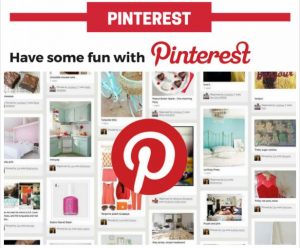
    Susan Conrad is an adventurer, author, educator, and speaker. She’s also an accomplished paddler. Her tenacious exploration by sea kayak has fueled her stories and images of the natural world for decades. Her articles and photographs have appeared in Sea Kayaker, Canoe and Kayak, Adventures Northwest, and Figure magazines. Countless newspapers, guidebooks, and historical journals also feature Susan’s work.

  • USING PINTEREST as an AUTHOR TOOL by  Claire McKinney P/R

    USING PINTEREST as an AUTHOR TOOL by Claire McKinney P/R

    Have some fun with

    Did you know that Pinterest is the world’s catalog of ideas and images? Millions of people are looking for books to read by imagery. Pinterest allows authors to connect with these potential readers.

    Add this powerful social media tool to your author platform!

     It’s hard not to immediately think about recipes, hair tutorials, or DIY projects when someone mentions the word “Pinterest,” and it can seem like there is no room for anything else when your own boards are filled with these exact objects. But as an author, you can take advantage of Pinterest—and most importantly, have fun with it.


    Does your main character that has a love of dresses and cute shoes? You can create a Pinterest board full of the exact clothing that she wears. Was there a specific playlist of songs that you listened to over and over again while you were writing your latest novel?

    It’s USER FRIENDLY

    You can make a board solely based on the songs and artists you listed to. Do you have a blog that you post to weekly? You can upload them onto a board based on your blog.

    Are there a number of quotes from your book that can be added to a graphic? Post them up on a colorful background. Are you participating in the Gilmore Girls/Rory Gilmore books challenge? Add a pin of each book you’ve read so far. (And good luck. That’s quite the goal!)

    There’s so much more that you can do with Pinterest, and the best part about it is that you aren’t just limited to one thing (140 characters, a photo, a status). You can make as many boards as you want, full of as many pins as you want.

    Another great aspect of Pinterest that makes it different from other social media is that it is a passive and harmless: it’s highly unlikely that you’ll come across a critical or a negative comment, and you don’t have to consistently keep others happy with tweeting, retweeting, liking, commenting, etc.

    Don’t Forget to PIN IT

    Make sure that you are maximizing Pinterest by adding a follow button to your website. If you have a blog, you can add a “pin it” button to your website. This allows someone who likes your blog posts to add them to one of their own boards, and it’s one more way that you can market your blog and website.

    One last warning, however: You might want to put a timer on though for how long you can spend on Pinterest each day, because Pinterest is an addiction like no other!

    A note from Kiffer Brown of Chanticleer Reviews:
    This blog post comes to us from Claire McKinney  Public Relations LLC, Communications Strategies for the 21st Century. 

    Claire McKinney PR, LLC

    I met Claire McKinney at Shari Stauch’s  PubSense Summit that was held in Charleston, S.C. several years ago. We were both on the faculty of presenters and were able to get to know each other and have since stayed in contact.

    Her company specializes in campaigns for books, authors, educational programs, websites, art, film, and other intellectual properties. They work carefully with clients to create messaging; branding concepts; and marketing and media strategies that integrate both traditional and new media opportunities.

    Chanticleer Reviews & Media contracts with  Claire McKinney Public Relations LLC for our company’s and client’s publicity and p/r needs.


  • JUMP OFF the SHELF – HOW to MAKE YOUR WORKS GET NOTICED by Diane Sillan Isaacs

    JUMP OFF the SHELF – HOW to MAKE YOUR WORKS GET NOTICED by Diane Sillan Isaacs

    BASIC MAXIMS for CREATING COMPELLING CONTENT

    With 25 years in the film production world, I worked with scripts as the blueprints. I am now focusing on books, but story is story is story.

    The same guidelines I used in Hollywood, apply in publishing. 
    How can you stand out in a sea of new releases- scripts or books- estimated to be 2 million each year? 

    How can you entice readers to find your book, pick it up and read it?

    Whether you are published by the Big 5, hybrid houses, indie imprints or by self, start with these basic maxims for creating compelling content to increase your odds of being discovered:

    Start with a bold, big idea/a high concept– something bold, a twist, an irony. Imagine its own movie poster. Are you asking a profound question, setting forth a new reality,  diving deep into the human psyche, setting up a comedic situation, writing a biography – know your hook and build from there.

    Write the log line <33 words. Your story reduced to its essential core. Try out versions with friends/colleagues to test if they get the true meaning of your book.  Once it has been vetted, memorize it. Practice in the mirror so when someone asks you about your book… voila! without hesitation, you have this compact, crafted and compelling logline. Then, put the logline in a prominent position in your writing space.  As you are writing, the logline acts as the guardrails to keep your stream of consciousness on track. All satellite storylines revolve around that core statement.

    Walk in the skin of your main character. Before writing your book, imagine your character in different scenarios and challenging dilemmas that are outside the projected book’s storyline.  Just observe how he/she reacts to trauma, betrayal, falling in love, danger, as  it informs how your lead character thinks and acts in the world. Crawl inside his/her skin.

    Oftentimes, writers observe a character as if from across the room and paint the characters from the outside. Instead, start on the inside until you really know your protagonist- and antagonist too. These imaginings create an unspoken backstory and uniquely color the voice and reactions of your lead, thereby making him/her memorable and distinct. Characters are why people turn pages, so intrigue your readers with a rich and nuanced characters.

    Front load your story with intrigue, conflict, tension, wonder, the oh-my-goodness. Don’t hold back on the first paragraph or the first chapter. Today’s world is accustomed to videos under 5 seconds and interactions less than 140 characters. The story needs to hook the reader from the first sentence. To that point, no prologues or backstories to start your book off.  Jump on the train that is leaving the station. Backstories that are necessary to drive the story forward can be worked in later, but only if they are relevant and essential to knowing the character today.

    Create a GREAT Cover.  Yes, we do judge a book by its cover. Humans are judging machines and first impressions run deepest. Not that we are superficial all the time…but we definitely are when browsing bookstores and online titles. Covers project the books’ genre, emotion, energy and attract different types of readers. Successful covers are provocative: ironic, funny, intriguing, emotional, brash, curious, colorful- whatever emotions are congruent to your book. You are writers, not graphic artists. Your cover needs outside help. I see far too many times, authors are worn out and at wallet’s end when they get to the cover expense, but it is your most valuable sales force.

    At the upcoming CAC 17, I have a spicy session on how to make a great Story Cocktail- the ingredients to shake, stir and add a twist to light up your story and ultimately, your book sales. Hope to see you there! – Diane  

    Diane is the Creative Director at Chanticleer Reviews & Media.

    Diane Sillan Isaacs brings more than two decades of experience in film and television industries as an executive film producer, president of production for Don Johnson Productions at Universal and Paramount pictures, president of development and production for Green Moon Productions where she produced films for Antonio Banderas and Emma Thompson.

    Diane is also the executive creative director of Luna Design NYC. She and Kiffer Brown co-founded SillanPaceBrown Publishing + Production + Agency, LLC.


  • The Nitty Gritty – Business Growth Strategy Applied to Authorship & Beyond by Sara Dahmen

    The Nitty Gritty – Business Growth Strategy Applied to Authorship & Beyond by Sara Dahmen

    What more does it take to be a successful author?

    Whether you’re represented or self-published or somewhere in between, using overarching business tools are a huge assistance in building success.

    How can the tools commonly manipulated by marketers, large and small companies, and retailers help you create a successful ‘business plan’ as an author?

    From multi-pronged approaches, to developing a tiered ‘clientele’, to organization and presence, business is business, whether you’re an author or the manager of Apple. Use those same tools that business marketers use to create your multi-pronged marketing approach.

    If you’re an author, you’re also, by default, a self-employed business owner. I know many of us don’t take out LLC’s or even own our own URL, but the fact remains, if only on paper, that we are all business owners.  There’s a resounding ring to that.

    Business owner.
    Self-employed.
    My own boss.
    The plotter of my own destiny.

    Excellent.  So, once we’ve all recognized that fact…now what?

    Being a successful author is more than simply selling some (or a lot!) of books. Even getting 20,000 books out there is not going to be a sustainable career. Once those 20,000 books have been read (and unless you continually churn out best-sellers), you’re left with a bit of a hangover and half-formed additional ideas. None of these bode well to continue the business of “you.”

    Success is measured both by income and by long-term growth. It’s a bit hard, and not nearly as wonderfully artsy to say, but it’s the truth. If you’re going to be a successful small business owner, you need to pull up a chair with the left side of your brain and get to work.

    A multiple pronged approach is best, and each person’s strategy will vary widely depending on your audience, which should always be broader than a singular author’s platform. There are a myriad of business tools out there – some expensive, and some free – that can be harnessed to create a wide-scale business bigger than a book.

    A business owner will always have a product or a service. You have that already: your book. And a business owner will also have a marketing strategy (and we all know many of those…but many are also often forgotten or overlooked or we get in a rut and forget to think outside the box) that encompasses far more than a blog, a website and some social media. And a business owner will think long-term. A one-hit wonder will be lovely, but after that advance is gone and the shine has worn from those book covers, you’ll need to ask yourself: what now?

    Business is business, and books are business in many more ways than getting some readers and a publisher. Whether you write it down (pun intended!) or not, writers need some sort of a business plan that goes beyond writing the words “the end” and I’m not just talking about plastering a Twitter page with a bunch of book launch announcements.

    Authors should walk into the arena equipped with answers to the questions:

    What do you believe: about yourself, your book, your future plans?
    What are you going to do to make those future plans happen – and how?
    Who do you need to know to help you?
    And what kind of wacky ideas can you dream up for yourself…and then do?

    I plan to tackle much of this in a presentation (Bigger Than Books: Business Growth Applied to Authorship & Beyond) at the Chanticleer Author Conference in Bellingham WA the weekend of March 31 – April 2 where I promise I will be far less vague and incredibly specific.

    Looking forward to seeing you there! – Sara Dahmen