Category: 10 Questions Interviews

  • 10 Question Author Interview with DESTINY ALLISON – 2016 Grand Prize Winner for JOURNEY AWARDS

    10 Question Author Interview with DESTINY ALLISON – 2016 Grand Prize Winner for JOURNEY AWARDS

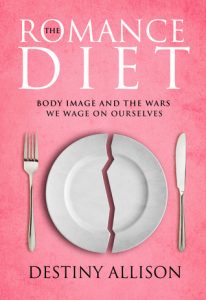
    Destiny Allison writes narrative non-fiction/memoir, and she writes it in a no-holds-barred fashion that captures audiences across the globe. The Romance Diet: Body Image and the Wars We Wage On Ourselves was our pick for Grand Prize in the 2016 Journey Awards.

    Join us in discovering what drives Destiny Allison.

    Chanticleer: Tell us a little about yourself: How did you start writing?

    Allison: I started writing at a very young age. My father was an aspiring writer and I wanted to be like him. I published my first poems when I was nine.

    Chanticleer: Nine-years old? Wow! That is so exciting – Congratulations! When did you realize you that you were an author?

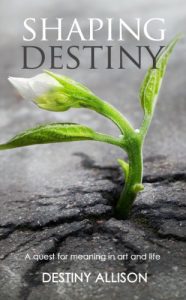
    Allison: The day I released my first book, Shaping Destiny. There’s a big difference between being a writer and being an author. When you become an author, you can change people’s lives.

    Chanti: Well said, Destiny. Thank you for that. What do you do when you’re not writing? Tells us a little about your hobbies.

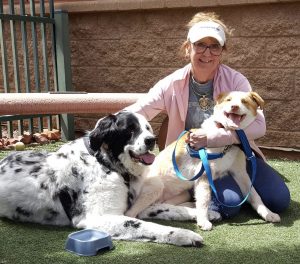
    Allison: I love to hike with my dog and I love to kayak, which is difficult because I live in the desert. Finding water is a constant adventure and a joy. I also own and operate several businesses. I think I was a social entrepreneur before the term was coined.

    Chanti: You’re ahead of your time! How do you come up with your ideas for a story?

    Allison: Most often, they come to me, as long as I’m writing regularly. When I try to force an idea, the writing typically isn’t good.

    Chanti: Speaking of writing regularly, how do you approach your writing day?

    Allison: With anticipation. I’m very disciplined when working on a project and I like to start early in the morning. I have to write at least 500 words every day, but usually, by the time I do, I have the inspiration for a couple of thousand.

    Chanti: What areas of your writing are you most confident in? What advice would you give someone who is struggling in that area?

    Allison: Memoir is my greatest strength. My advice to other memoir authors is simple. Be brutally honest, but don’t feel like you have to provide every detail. Lay bare the bones of your story – know why you’re telling it and what message you hope your readers will take from it – then concentrate on the details that craft that message. Be lush with your imagery, authentic with your dialogue, and borrow from fiction. Your aunt may have been wearing a green hat that day but giving her a red one might flesh out her character and add pop to your story. It’s important to work on your craft. What do you do to grow your author chops? Read, write, repeat.

    Chanti: What do you do in your community to improve/promote literacy?

    Allison: I sponsor readings, support my local library, and help local authors sell their books.

    Chanti: That is so important – Thank you! Give us your best marketing tips, what’s worked to sell more books, gain notoriety, and expand your literary footprint.

    Allison: While we all love to see our work in bookstores, I’ve found that marketing outside the mainstream is more effective. I sell The Romance Diet in a local boutique and it does really well there because the subject matter is so close the hearts of that store’s customers. Knowing you market matters most when promoting your book.

    Chanti: Very smart! What is the most important thing a reader can do for an author?

    Allison: The most important thing a reader can do for an author is to leave a review. The next best thing is telling friends about the books they love and giving those books as gifts. Loaning a book is great, but gifting a book is better. Authors need to eat, too.

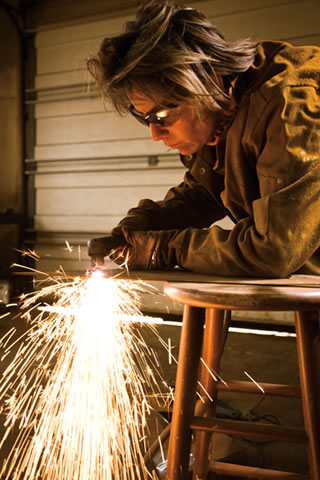
    Chanti: Destiny Allison is also a sculptor and works in steel. Here is a quote from her blog:

    Steel is exciting to me as a medium because it can have an exceptional softness in the final finish. I achieve a combination of organic forms and geometric shapes through the use of my MIG welder and plasma cutter. I create my colors by applying acid patina and heat to the raw metal, after the form has been completed. The combination of techniques allows me the freedom to explore relationships between emotional and intellectual responses to experience.

    Reminds me of the editing process…Chanticleer

    Thank you, Destiny Allison, for being a part of the Chanticleer Author Interview series! 

    Now, readers, you know what to do:

    • Like & follow Destiny’s Facebook Page
    • Check out her books on her Amazon.com author page
    • Read her book and, you guessed it, write those reviews!

    Here are Destiny’s other book links:

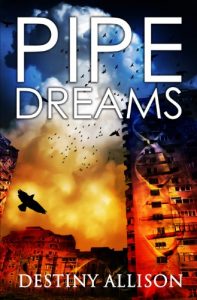
    Pipe Dreams  and Bitter Root 

  • The Writer’s Life: Author Interview with DIANA FORBES – Chatelaine 1st Place Winner, Historical Romance, The Guilded Age

    The Writer’s Life: Author Interview with DIANA FORBES – Chatelaine 1st Place Winner, Historical Romance, The Guilded Age

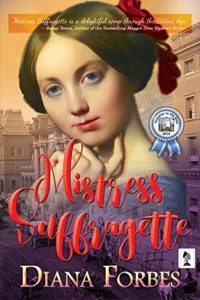
    Diana Forbes writes romantic historical fiction. Her debut novel, Mistress Suffragette is easy to pick up and hard to put down. Recently, I had the opportunity to interview this author and I think you’ll enjoy what she had to say…


    Chanticleer: Tell us a little about yourself: How did you start writing?

    Forbes: I started writing when I was 6 years old. First I wrote poetry. Then I wrote diary entries, heavily influenced by Harriet the Spy. After that, I wrote articles for my school paper. Then I wrote restaurant reviews for the school paper. In college, I wrote features for the college paper.

    Chanticleer: So, basically as soon as you could form cohesive sentences, you were off to the races! Nice job, Diana. But when did you realize that you were an author?

    Forbes: I met with a career coach in 2003 and I told him, “I want to be a writer.” He said, “Why don’t we just say you are a writer since writing is in the doing?”

    Chanticleer: Smart – writing is an active verb… Let’s chat about genre. What genre best describes your work?

    Forbes: Mistress Suffragette, my debut novel, is best described as a romance. It’s historical, so sometimes it’s described as cross-genre: historical-romance. It also has a lot of humor in it.

    Chanti: Cross-genre sweet spot – best of both worlds. What inspired you to write historical/romance? 

    Forbes: I take two writing classes a week in Manhattan where I live, and one of my writing teachers used to tell me, “Don’t worry about the genre. A debut novel is what it is. Just write it.” But, I basically wrote the story I wanted to read. It’s a romance against a very interesting historical backdrop – the late 19th century or Gilded Age.

    Chanti: I love the fact that you continue to work on your craft by taking writing classes. That’s such an important thing to do! Do you find yourself following the rules or do you like to make up your own rules?

    Forbes: I like to break rules selectively. In other words, I love to know what the rules are, then break them if there is a very good reason.

    Chanti: Good. Know the rules, so you know when, why, and how to break them. What do you do when you’re not writing? Tells us a little about your hobbies.

    Forbes: I am an art buff. I like to go to museums and galleries and look around. Recently I have also started going to plays and musicals in Manhattan. I like to poke around antique stores and fairs, too. I have a great respect for history, so if I can learn a little history while I am having fun, that’s even better.

    Chanti: You’re in the perfect place to do all that! Tell us a little about how you structure your writing day.

    Forbes: I am very structured. I am fortunate to have an office that is separate from where I live. I roll into the office at 9 a.m., trying to get in one full hour of reading before the day officially starts, so from 7:30 a.m.-8:30 a.m. Then I write from 9 a.m. until 3:30 p.m., trying to stay off social media and email completely. At 3:30 or so, I return all my emails and hop on social media. After that, I work till between 7 p.m. and 8 p.m. on marketing Mistress Suffragette.

    Chanti: That’s a fantastically structured day! What has been the most helpful marketing tool you’ve used so far?

    Forbes: I really like awards shows. They offer the chance to have the work receive a little recognition as well as a great marketing push. Award shows can also help introduce the work to new readers.

    Chanti: What areas of your writing are you most confident in? What advice would you give someone who is struggling in that area?

    Forbes: Readers often tell me that my strengths are my research, the setting, and the voice. I love stories that whisk me away, and that’s what I aimed for with Mistress Suffragette. I also want to tell untold stories. Some of the things I learned while researching M. Suffragette, I had never ever heard before – even in Political Science classes at my university. Anything I discovered that was really new and really interesting about the time period I made sure to include in the novel.

    Chanti: That’s pretty cool. So, we know that you take two writing classes a week, what other things do you do to grow your author chops?

    Forbes: My writing classes in Manhattan require that I turn in 20 pages at a time to early readers (my classmates) who give me feedback. One of the classes concentrates more on the craft of writing. I also read books about writing. In addition, I look for award show contests that provide feedback, so that I can learn and grow and my writing can improve before I show my work to an agent or editor.

    Chanti: This is how we discovered each other! We’re thrilled you entered your novel into the Chatelaine Awards. What are you working on now? What can we look forward to seeing next from you?

    Forbes: I am working on the sequel to Mistress Suffragette. I see the story as a trilogy. I am not sure when the sequel publication date will be. I write many drafts of my novels before I show them to my agent and editor, so I am somewhere in the revision process.

    Chanti: I certainly hope we get to see the sequels of Mistress Suffragette. Thank you for stopping in! 

    If you love romance (and who doesn’t?) and the Gilded Age, you know what to do! Check out Diana’s website and follow the links to purchase her book, Mistress Suffragette.

    Like her Facebook page and follow her. Trust me, there is more to come from Forbes, and you’ll not want to miss out.


  • Interview with Blaine Beveridge – Multi-Award Winning Historical Fiction Author

    Interview with Blaine Beveridge – Multi-Award Winning Historical Fiction Author

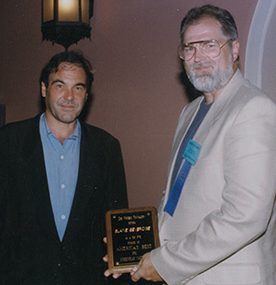
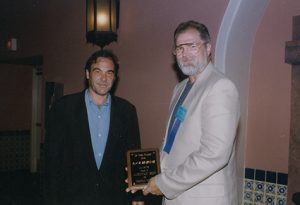
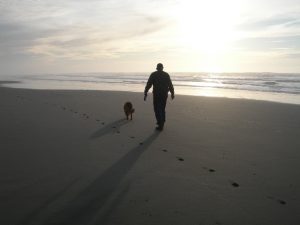
    It isn’t always easy to catch up with some authors. They seem to hide behind their computers or wander on the beach with their dogs… Me? No, I’m not pointing fingers at you, Blaine Beveridge… Well, okay. Maybe I am! Blaine doesn’t really talk a lot about himself, in fact, he doesn’t really like to have his picture taken. But guess what I found on his website… Blaine receiving The Writers Foundation Award from none other than Mr. Oliver Stone himself~ Check it out!


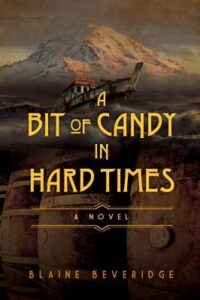
    Recently I was able to catch up with the elusive author and get to know him a little better. May I introduce to you Blaine Beveridge, historical fiction writer and author of, A Bit of Candy in Hard Times… all about rum running in the Pacific Northwest. Enjoy!

    Chanticleer: How did you start writing?

    Beveridge: My earliest memory of writing took place in the 5th or 6th grade when our elementary class spent a week at the Forestry Reserve in the Angeles Crest Mountains above LA. As a class, we published a newspaper and I worked on that singular edition. A couple of years later I served as Scribe in Boy Scout Troop 138, followed by service on journalism staffs in junior and senior high school.

    Chanticleer: So, you’ve always had the knack. There’s nothing like journalism to teach a writer about deadlines, sentence structure, and killing your darlings. What do you do when you’re not writing? Tells us a little about your hobbies.

    Beveridge: I am an enthusiastic reader of biographies, historical tracts, political opinion, sports, and culture. I rarely read fiction these days because it tends to get in the way of my fiction. I love to travel at ground level, where I do a great deal of my research. Music has always played an important part of my creative process. But mostly I focus on my family and, especially, my puppies.

    Chanticleer: Talk to me about music and your creative process? How does that work? 

    Beveridge: Specifically selected music, not random cuts from the radio, that helps to establish total immersion into whatever I’m writing. The suspension of belief while writing fiction is just as important as the suspension of belief one enjoys when reading a story, and having that soundtrack is as indispensable to me as a comfortable working chair and reliable computer. Whether it’s Morricone’s ethereal soundtrack from The Mission or Maurice Jarre’s Lawrence of Arabia, Randy Newman’s scores for The Natural or Avalon, or any number of soundtracks scored by John Williams, I generally prefer big symphonic music when I’m establishing settings. Just as compelling are Mark Knopfler’s scores for Local Hero and Comfort and Joy; Los Lobos’ Desperado, and so many others that I listen to as I outline or write. Jazz often plays a big influence, and how can I overlook Eva Cassidy or Ry Cooder? I can’t believe I’m the only scribbler who relies on music in such a manner and I’d love to hear what music motivates other writers.

    Chanti: Name five of your favorite authors and describe how they influence your work.

    Beveridge: This is a difficult question – as it must be for most folks. How can I overlook the influence that writers like London, Doig, Nichols, Fitzgerald, Clarke, Michener, or so many others, have had on me? But, if I have to choose just five I would say that Stegner, Steinbeck, Bill Kennedy, Atwood, and Theroux have had a profound impact on my style and perspective. Stegner, for his vivid representations of people and place and their relationship to each other; Steinbeck for his cogent, topical social commentary; Kennedy for his unvarnished representation of a particular place and time; Atwood for her ability to portray feminist ideals and concerns in ways which I can empathize with and heartily embrace, and Theroux, especially his travel books whose colorful depictions of such diverse locales as eastern Asia or Pacifica have held me in thrall for years.

    Chanti: Hold the phone–did you say, “puppies?”

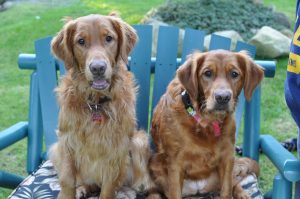
    Beveridge: Yes, I did! Here’s a picture of Captain Bligh on the left and Calliope on the right. They are brother and sister – same mom and dad, just from different litters a year apart.

    Chanti: Sweet puppies! Every author needs puppies to pull them away from their writing and on to the real job of walkies! It’s important to work on your craft. What do you do to grow your author chops?

    Beveridge: Read. Listen. Observe. Experience!

    Chanti: Ha! Are you sure Hemingway isn’t one of your favorite authors? Moving along, what craft books have helped you the most?

    Beveridge: There are the usual suspects from Writer’s Digest and various reference guides. As to the nature of fiction, I’ve certainly spent time with Joseph Campbell’s tome on mythology, and Mark Turner’s The Literary Mind. John Gardner’s On Writing Fiction comes to mind for one important reason. Gardner suggested that, and I’m paraphrasing, “screenwriting has ruined more than one novelist.” And he was likely correct. Effective screenwriting is ruled by a variety of conventions, one paramount rule is that the writer must enter each scene as late as possible. Screenwriters, writing for theatrical or institutional purposes, are compelled by time to cut directly to the bone. Writing prose, conversely, relies on broader descriptive to present the information that visuals would otherwise provide. As someone who previously developed theatrical and corporate films, I have been reminded that prose readers look for, and rely on, deeper points of view that I tend to set aside. I’m still learning to write.

    Chanti: What do you do in your community to improve/promote literacy?

    Beveridge: I spent six years on the board of the Pacific Northwest Writers Association, four as a member of the Executive Board. As Vice President of PNWA, I participated in the founding of a Young Writers Camp, which was held for four days at Camp Burton on Vashon Island. It was disappointing that the organization chose not to continue with the program and, I’m sorry to say, that decision led to my decision to leave what continues to be an ongoing and helpful support group for the many writers in the Puget Sound region.

    Chanti: It’s hard to see something end – especially when you’ve spent so much time and energy breathing life into it. I get that. I’m positive the young authors that had the opportunity to experience Young Writers Camp will never forget it. That sort of things influences people for years and years to come. Imagine, if you will, what opportunities will arise for these young authors in the future because of that program? You just never know… Give us your best marketing tips, what’s worked to sell more books, gain notoriety, and expand your literary footprint.

    Beveridge: Work with arts alliances or organizations like Chanticleer to exploit the opportunities to share discourse with readers and potential readers. Meet and greets are small but meaningful ways to expand reader base and to get feedback on both the product and marketing efforts. For me, this is as much a vocation as it is an avocation and it is treated as such. Advertising can be hit or miss and, unless one has deep pockets, strategizing those opportunities should only be undertaken with professionals in the field. Conferences can be very helpful to meet agents, editors, and publishers. They also provide the opportunity to meet and join in b*tch sessions with other writers. Heh.

    Chanti: Hey, thanks for mentioning us! Maybe we should offer a btch session at our upcoming conference: Btch 101… We can have it in the bar… after hours!  So, what are you working on now? What can we look forward to seeing next from you?

    Beveridge: I’m currently reworking a novel titled Twice Removed. The story is inspired by the life experience of my mentor at UCLA, a Czech filmmaker named Jiri Weiss who was compelled to leave his country twice – first, when the Nazis arrived in 1938, and again when the Russians invaded in 1968. The second book of my Puget Sound Trilogy, following A Bit of Candy in Hard Times, is Playing Out the Hand and is in the queue.

    Chanti: That’s very exciting! I hope we get a chance to see those soon. Who’s the perfect reader for your book?

    Beveridge: Anyone who is interested in the fabric of history. That is the interstitial matrix that fills in the spaces between dates, places, events and the people who serve as points of reference. For example, there are many books that attempt to explain Chamberlain’s assuagement of Hitler in 1938, but Kazuo Ishiguro pulled back the polite curtain of racism, social stratification and political exigency in his great novel The Remains of the Day. I certainly don’t claim to be a peer of Ishiguro, but I am inspired by him.

    Chanti: What is the most important thing a reader can do for an author?

    Beveridge: Buy my book! Okay, seriously, take the time to write honest reviews. Writers depend on reader participation to help spread the word and to provide feedback which might improve further efforts. Five star reviews are great, and positive comments are always welcome, but please don’t blow smoke or troll…well, the latter is inevitable. (Laughs)

    Chanti: Thank you, Blaine. I appreciate your time and energy.

    Well, there you have it, folks! Buy the book – write a review! Support authors near and far and that’s how YOU can support literacy!

    Find Blaine Beveridge at:

    http://www.beveridgebooks.com

    Subscribe to his new blog,  “A View From Offshore,” here

    Follow him on Facebook and Goodreads


  • Interview with Grand Prize CHATELAINE AWARD Winner, Mary Ann Clarke Scott by Sharon E. Anderson

    Interview with Grand Prize CHATELAINE AWARD Winner, Mary Ann Clarke Scott by Sharon E. Anderson

    Author Spotlight Series focuses on M.A. Clarke Scott, an Award-Winning Women’s Lit Author

    Mary Ann Clarke Scott took home the Grand Prize ribbon for the Chatelaine Book Awards in 2016. She not only writes women’s fiction – but sci-fi and fantasy, too! Who knew? I had a chance to catch up with Mary Ann recently to chat about writing and reading and life. Here’s what she had to say. Enjoy!

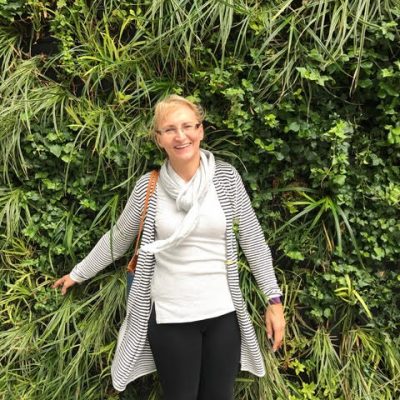
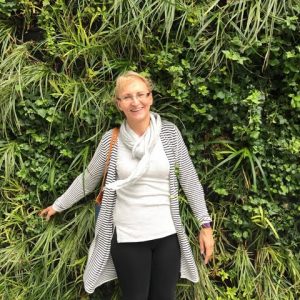
    Mary Ann Clarke Scott

    Chanticleer: Tell us a little about yourself: How did you start writing?

    Clarke Scott: I was always an avid reader and a daydreamer. There were voices in my head, alternate realities playing out in my imagination, and I’ve always loved words. I tried to write my first novel at the age of nine, but abandoned it for other pursuits until 2005, once my son was in preschool and I’d pretty thoroughly given up on architecture as a career. Then I started seriously to learn to write, with purpose and discipline.

    Chanticleer: Oh, that sounds so familiar! You either talk to yourself or talk to your characters… it makes more sense to talk to your characters! So, Mary, what do you do when you’re not putting words on the page?

    Clarke Scott: I like to hike on mountain trails and I do Pilates and yoga. These things keep me limber and healthy, but also centered. I read a great deal. As I’ve got older I’ve become a bit indifferent to things I used to love, like gardening and cooking, but that may be because my focus is on writing. I still enjoy those things. I love to travel, and I love art and history and metaphysics. Recently we were in Europe for the summer, so I had my fill of museums for a while, but I never really tire of that. I aspire to be a visual artist, but never prioritize it with regard to time. It’s for ‘someday’.

    Chanti: How do you come up with your ideas for a story?

    Clarke Scott: Stories come to me primarily via character, but also through place and, what I guess I’d call ‘situation’ as a starting point. I put these elements together and the story grows up out of them, out of necessity, logically, as a response to what the character needs to grow.

    Chanti: Do you find yourself following the rules or do you like to make up your own?

    Clarke Scott: Both, I guess, but mostly I’m a rebel. I’m an Aquarian, and we tend to be rule-breakers. I’ve never been a conformist with regard to story or genre, but at the same time, I’m quite passionate about universal story structure. But I don’t see that as rules so much as patterns, and I love patterns. I think they have meaning.

    Chanti: I totally agree with you! How structured are you in your writing work?

    Clarke Scott: The stories are structured; my workflow is not. I work organically, which is to say, often

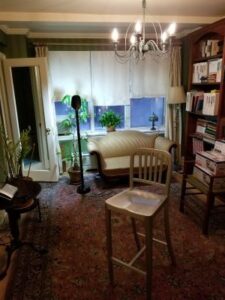
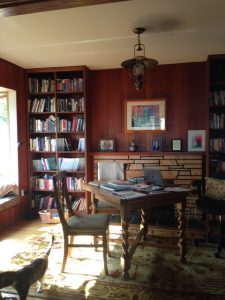
    Mary Ann’s writing room.

    chaotically and in an undisciplined, random way. I procrastinate. I binge. I don’t recommend it!

    Chanti: I’m so glad to hear you say that – as I am the same way…. So, how do you approach your writing day?

    Clarke Scott: I don’t have writing days, per se. I have a writing life. I know coffee is involved, though. I’m trying to incorporate meditation and visualizations into my process, to get a bit of control and rhythm. I’m also experimenting with dictation. It might not work because I rather enjoy touching my keyboard. But we’ll see.

    Chanti: Name five of your favorite authors and describe how they have influenced your work.

    Clarke Scott: Only five! I’m a great fan of Barbara O’Neal. I love the way she builds and paces a story gradually, and layers in so many strands of character and relationship, history and mystery. Nothing is wasted or gratuitous. She makes excellent use of the objective correlative. I admire her use of colour as symbol and leitmotif and the way she weaves vaguely spiritual and mystical elements into her stories, as an element of psychology almost, more than ideology, or anything overtly paranormal. For similar reasons, I’m a huge fan of Canadian author Susanna Kearsley, although the magical elements are often more explicit in her work. I love Georgette Heyer, and Mary Balogh, for their rich and well-researched Regency romances, populated by very believable characters. Classically, I adore Jane Austen, for the same reasons. The way they all paint a universal picture of humanity in a very singular social, political and economic context. I admire British authors Freya North and JoJo Moyes I think because they both take vulnerable, flawed protagonists and build them up through adversity, but make it all very ordinary and relatable (Oh, you poor thing…. Uh oh, don’t do that… Fight back, damn you!) and yet extraordinary in terms of character growth, pushing the readers’ emotional boundaries.

    Chanti: I can see that. Good choices, M.A.! How does being an author influence your

    Mary Ann with her critique group.

    involvement in your community?

    Clark Scott: I think a lot of writers are introverts. But publishing means you must build a platform and build an author presence, both online and in the physical, local community. It’s forced me to embrace who I am, what I create and be willing to advocate for that. Becoming more comfortable online has also made me less shy in person. I’m also able to share my knowledge with other writers and support them because I know how hard it is, and that we need each other. Writers are an incredibly warm, generous and supportive community, so it’s easy to feel a sense of belonging. It’s hard to find that anywhere else.

    Chanti: I agree, it’s so important to find your tribe! What areas in your writing are you most confident in? What advice would you give someone who is struggling in that area?

    Clarke Scott: I suppose my strengths would be story structure, character arc and description of setting. It’s hard to give advice. Those are just things that come more naturally to me. I struggle with other things. About description I’d say, use your senses. Creative visualization helps. It also helps to keep the description filtered through the point of view character and limit what you describe to what is important to them and to the story. I’ve had to learn to do this, to limit my description from ‘everything.’ I think my training and work as an architect made me very observant, but perhaps too much so. So filter it. Story structure is something that comes through study and analysis, reading, but also interest and desire. And about character arc, I’d say, study archetypes, and use the structure of stories to make sure your characters go where they need to go, but that you challenge them enough to change them.

    Chanti: Give us your best marketing tips, what’s worked to sell more books, gain notoriety, and expand your literary footprint.

    Clarke Scott: Well I’m pretty active on social media, and continue to build a community and an online brand that way. I’ve entered and won a few contests (like the Chanticleer Chatelaine!), and I think that helps build familiarity and credibility with readers as well as a presence in the writer’s community. I’ve taken a two-pronged approach to marketing my books: the first is to follow all the advisors and use loss leaders (freebies, giveaways, etc.) to build my email list – although my efforts in this area are in their infancy – and as yet I’m not very good at newsletters and blogging; and secondly, creating an author profile and posting samples of work on reader sites such as Bublish, iAuthor and Goodreads. I think my approach so far has been: try everything! At the moment I believe publishing more books to build my backlist is pretty important to build my credibility as an author, and leverage what marketing I do, so that’s what I’m focused on.

    Chanti: Backlist is so important. Thank you for mentioning that. #tryeverything I think we can make that a thing! Speaking of building a backlist, what are you working on now? What’s next?

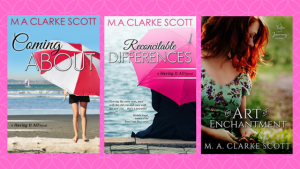
    Clarke Scott: The WIP I’m focused on right now is called Coming About (although I’m still searching for a better title), and it’s Book 2 in my Having it All series. It’s been 75-80% complete for several years, so I’ve been working on finishing and releasing it in 2017. After that, I have two virtually complete books in the Life is a Journey series that need a little attention before they’re ready to publish. One thing at a time. Life interferes a fair bit.

    Chanti: Life does interfere! Who’s the perfect reader for your book?

    Clarke Scott: I think I write primarily for women, though men who’ve read my books say they enjoy them a lot. My audience ranges from quite young women to older women. Readers who are looking for experiences that are a little deeper and more thoughtful, rather than glossy, glamourous or action-packed dangerous fictional situations. There are no murderers or spies in my stories (not yet, anyway) and I’m not drawn to psychological thrillers. I write about real life, real people, and real relationships and hope that my stories are engaging at an emotional, psychological and maybe even a philosophical level. My stories are romantic and entertaining but also hopefully channel healing and personal growth. I believe the human heart is really the last frontier. Fiction is a powerful tool that enables learning and empathy, and therefore can help people reexamine their lives, and the lives of people they know, and hopefully understand that everyone suffers in their own way, and that human beings can always change, grow and move toward enlightenment, contentment, fulfillment and love no matter what lies they were told, what pain they’ve suffered, no matter their handicaps. I’m not writing self-help or how-to books. But I’ve always processed life through narrative and I believe others do, too. It’s in our DNA. So I think I’m looking for readers who aren’t afraid of this conversation.

    Chanti: What is the most important thing a reader can do for an author?

    Clarke Scott: Review and rate their books on Amazon and Goodreads and other sites. Such a tiny percentage of readers actually leave reviews, something like 1%, it’s extremely difficult for authors, even with excellent books, to build up social proof. And yet this is a significant part of what book buyers use to make their choices. And of course, if you admire an author’s work, tell other people about her! Obscurity is the curse of most authors in today’s overcrowded marketplace.

    Chanti: Look for Mary Ann Clarke Scott’s books at Powell’s, Indigo, Barnes & Noble, AbeBooks, IndieBound, Blackwell’s, TheBookDespository, and even Amazon!

  • INTERVIEW with FIRST PLACE CONTEMPORARY GOTHIC WINNER – LINDA WATKINS!

    INTERVIEW with FIRST PLACE CONTEMPORARY GOTHIC WINNER – LINDA WATKINS!

    Author Spotlight Series focuses on Linda Watkins, an American Contemporary Gothic Author

    Linda Watkins’ bio on Amazon is juicy and packed full of wonderful. She hails from the right side of the country – Detroit and has resided in places like Sedona, Arizona,  San Francisco Bay Area, and back to the east coast – to an island off the coast of Maine, to Mateguas Island, the studied focus of her first three books.

    She is a super-hero in her own right, rescuing dogs and organizes groups to help after disasters strike. We love Linda Watkins. And recently I had the chance to chat with her regarding all things writer-ly. I hope you enjoy reading this interview as much as I enjoyed conducting it.

    Here is Linda Watkins…

    Chanticleer: Tell us a little about yourself: How did you start writing? 

    Watkins: I started writing in earnest when I was living on Chebeague Island which is located off the coast of southern Maine. My work before that time consisted of poems, songs, and an occasional whimsical short story. I never thought about publishing any of these works. They were just for fun. However, in 2010 when I got my first iPad, I decided to try to write one of the many longer stories that were rattling around in my brain. The iPad was important in this endeavor because I had issues with

    my back that prevented me from sitting at the computer for long periods of time.

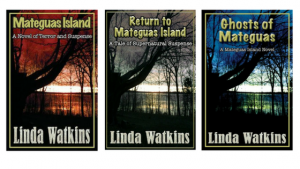
    In addition, living on an unconnected island (access only by boat), you have a lot of ‘down’ time – waiting for the ferry, riding the ferry, etc. Writing gave me something to do to pass that time more quickly. I wrote the first draft of my debut novel, Mateguas Island the summer of 2010. I didn’t publish it until Spring 2014.

    Chanticleer: Technology helps us in so many ways. Thank God for the iPad! Let’s chat about genre. What genre best describes your work? 

    Watkins: Most of my work is described as contemporary gothic fiction. The Mateguas Island Series could also be termed supernatural suspense with elements of romantic suspense intertwined. My novella, Sarah & Zoey, is women’s fiction. Summer Girl, an unpublished manuscript, is literary fiction, and my new novel, Storm Island (also unpublished at this time) is a contemporary gothic mystery. So, I guess you could say that while my main genre is gothic fiction, I do write in other genres as well.

    Chanti: Okay, Women’s Lit, but mostly Gothic/mystery. I like it. What led you to write in this genre?

    Watkins: I’ve always been drawn to novels in the horror and/or thriller arena. I grew up on Stephen King, Shirley Jackson, Peter Straub, and Dean Koontz. In essence, I like my horror firmly grounded in reality with strong, unforgettable characters. Thus, I try to write what I like to read. In addition, I enjoy writing gothic because you can over the top with it and it lends itself to strong, female protagonists.

    Chanti: That’s exactly the reason I love Gothic novels! Let’s shift a little here… What do you do when you’re not writing? Tells us a little about your hobbies.

    Watkins: I’m a pretty solitary person. I believe this stems from the fact that I have a congenital hearing loss that was not identified until I was practically out of high school. Thus, I lived within myself for a long time. My best friends are my dogs. I lost two of my ‘kids’ this past June and it has been very hard for me since. Right now, I only have my puppy, Chomps. When I’m not writing or with him, I can be found at the local Humane Society walking shelter dogs. I’m a strong advocate for animal welfare and all net proceeds from my Mateguas Island Series go to my charitable trust, The Raison d’Etre Fund for Dogs, Dedicated to Rescue and Research. Our most recent grants have gone to two grassroots organizations in Eastern Texas to aid in the care and re-homing of animals lost or abandoned in the wake of Hurricane Harvey. I’m very proud of the work my trust does.

    In addition, I’ve recently moved to Sedona, Arizona and spend a good deal of time hiking the red rocks that surround my new home.

    Chanti:  We love authors with passion. We thank you for your aid for caring and re-homing animals lost or abandoned in the wake of Hurricane Harvey. How structured are you in your writing work?  How do you approach your writing day?

    Watkins: I’d say I’m pretty unstructured. I write most of my novels in my head first. I don’t outline or do character sketches or anything like that. Everything that takes place in one of my novels is worked out solely in my head. When a scene or chapter is complete, I sit down at the computer and put it on virtual paper. Most of my ‘head’ writing is done while hiking, walking my dog, and late at night when I can’t sleep.

    Chanti: That’s a busy day! What areas in your writing are you most confident in? What advice would you give someone who is struggling in that area?

    Watkins: I would say my strength is in characterization. Most of my editorial reviews cite how realistic my characters are. I think this is very important when you’re writing in my primary genre. Horror becomes more frightening when contrasted with characters who are firmly rooted in reality and identifiable to the reader.

    As for advice, I’d suggest a writer fully flesh out his/her characters in his/her mind before writing them down. Know their backstory. You don’t have to include everything in the final work, but you, the writer, must know it. Also, if you’re writing a series, it’s fun to develop and change your recurring characters over time just like real people do. In the Mateguas Island Series, I have actually taken a character who, in the first book, is close to perfect and totally destroyed him by the end of the third book. That’s one part of writing that’s great fun!

    In addition, as a reader, I can say that one of the things that will kill a book for me fast is if I don’t care about the character(s). I don’t have to like them, but I do have to become invested in their fates.

    Chanti: Great point. Thank you for mentioning how creating real characters essentially equals reader investment. It is so true! Moving along, it’s important to work on your craft. What do you do to grow your author chops? 

    Watkins: Mainly, I read others’ work. I’m a member of the Horror Writers Association and, as such, have access to all the works nominated for the Bram Stoker Awards. I read a lot of them. Also, I’m a member of Library Thing’s Early Reviewer Program and I score quite a few free books from there. Thus, I am always reading something, usually in my genre or related genres, and this helps me grow as a writer.

    Chanti: You are so smart! Finding good books, award-winning books, or pre-discovered books always thrills me. Can I ask, what are you working on now? What can we look forward to seeing next from you?

    Watkins: I have two unpublished novels right now. I will probably publish the first, Summer Girl, a coming of age love story, sometime before the end of 2017. The other, Storm Island, a gothic mystery, which I just completed, is being shopped around to agents, etc. I also have a novella, Sarah & Zoey, on preorder. The publication will be on September 15th. (This book is available to readers now! Please click on the link, read, and write a review!)

    Next on my writing agenda is the 4th (and final) installment in the Mateguas Island books and the 2nd installment in the Storm Island Mystery Series.

    Chanti: I am so happy to hear that! Good luck with the shopping around and I am so excited for the 4th Mateguas Island. I can’t wait to read the Storm Island Mysteries! What is the most important thing a reader can do for an author?

    Watkins: Review, review, review! Reviews are very important and they don’t have to be lengthy. If you liked a book, review it! I review every book I finish. Readers can also recommend books they like to their friends. Word of mouth is the best way for a book to get noticed.

    Chanti: Linda, it’s been a pleasure having you participate in our Author Interview Platform! Thank you for spending some time with us and sharing your insights. I’m sure we are all looking forward to reading more award-winning novels from you!
    Linda is a member of the Horror Writers Association, The Great Lakes Association of Horror Writers, The International Association of Crime Writers (N.A.), and the Authors Guild.

    Serious about dog welfare and rescue, all net proceeds from sales of The Mateguas Island Series are donated to Linda’s charitable trust, The Raison d’Etre Fund for Dogs, Dedicated to Rescue and Research.

    Please visit Linda at her website (www.lindawatkins-author.com), her blog where she posts book reviews and other features (www.lindawatkins.biz) and/or her novel website, dedicated to the Mateguas Island Series (www.mateguasisland.com).

    * 2014 Gold Medal, Supernatural Fiction, Readers Favorite International Book Award Competition
    * 2014 First Place Award, Contemporary Gothic, Chanticleer Book Review, Paranormal Awards 
    * 2015 Outstanding Novel in Horror/Suspense, IAN Book of the Year Awards


  • INTERVIEW with Grand Prize LARAMIE AWARD-WINNER, JACQUIE ROGERS!

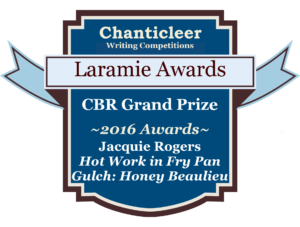
    In honor of the Laramie Awards month, we decided to interview one of our very favorite authors, Jacquie Rogers. It should come as no surprise that Jacquie won the Laramie Grand Prize in 2016 for her rip-roaring, shooting, tooting, humorous Western that features Honey Beaulieu, Man Hunter!

    Jacquie Rogers is a regular contributor for the Western Fictioneers blog. She presents at RWA conferences and workshops, Chanticleer Authors Conferences, and  Western Writers of America. Her works are known for their hilarity, adventure, mistaken identities, and romance. Rogers’ books are  a hit for anyone who has a penchant for classic Westerns and Shakespearean comedies. She lassos the genres together in a most enjoyable way making her tales a true pleasure to read. From saddles sores and thorns from the trail, to finally being able to breathe when the last binding on the corset is released, even the most die hard Western readers will be impressed with Roger’s knowledge and expertise she portrays as she takes you back in time to the Old West.
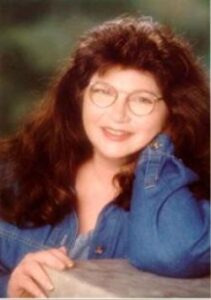
    Jacquie Rogers: Thanks for inviting me to the Chanticleer blog.  I’ve been privileged to be part of the Chanticleer family right from the get-go, so that makes it extra special for me to be here.  I had help, though—the folks at the Pickle Barrel Bar and Books on Facebook choose my questions, so here we go!

    Chanticleer: We’re so glad you have some time to spend with us. Let’s jump right in…What areas in your writing are you most confident in? What advice would you give someone who is struggling in that area?

    Rogers: Dialogue and chaos.  For dialogue, the advice is easy—listen to people talk.  Two nuances I’ve noticed is they rarely speak in complete sentences and seldom use the other person’s name.  More specifically, listen to people who are similar to your characters.  In the case of Honey Beaulieu, I draw strength from the old Missourians in our family, and mix in a little Owyhee County speak.  As for chaos scenes, the main thing to remember is that the first thing you think of is also the first thing the reader will expect, so turn left when expected to turn right.

    Chanticleer: That’s really good advice, Jacquie. How do you keep track of all the… left turns? Do you work with a storyboard? 

    Rogers: When a character turns left and it’s a better idea than what you’d planned, then it’s best to go with them.  However, that does cause a ripple effect on that particular thread, and sometimes several or all threads.  I try to veer into position so I don’t have to go back and change things, but very often that simply can’t happen.  Either way,  from the turn-left point forward, the whole plot needs to be tweaked.  I’m happy to take the fun route to the end, but I do have to know where and how the story is going to end, and all the characters need to be in the right spot for that to happen, and all (or most, in the case of a serial type series such as Honey Beaulieu – Man Hunter) threads need to be tied in a neat bow.  So it’s a matter of connecting the dots in a logical but relatively unpredictable manner that allows the reader to play along with you.  Because books are really a group activity—the interaction of characters, readers, and the author.

    Even with all that, continuity errors can and do occur.  My first line of defense is Your WorldKeeper, Diane Garland.  She has an eagle eye for continuity and can take me all the way through the thread so I can see what needs fixing  Or sometimes it can’t be fixed (e.g., in a previously published book), and we have to come up with a logical explanation for how things are in the current book.  I work with her as I’m writing, so she usually nails my hide to the wall before even the editor sees the story.

    Rogers: An author can’t keep writing unless readers buy the books—simple economics.  Books are expensive to produce.  So telling others about the author’s books is absolutely gold.  There are a variety of ways to do this, including sharing the author’s posts on social media, reviews (many advertising sites require a certain number of reviews before the author can purchase ads), and telling all your friends in real life to buy the book.  Visibility is the name of the game.  And keep reading!  Your enjoyment is a gift to me.

    Chanticleer: Thank you for mentioning the social media aspects and sharing. Very important. What are you working on now? What can we look forward to seeing next from you?

    Rogers:  My next book will be Hearts of Owyhee #6, Much Ado About Mail-Order Brides.  If you’ve read the third and fifth books of the series, you’re acquainted with the McKinnon brothers.  This book will be Bram’s book.  He’s the oldest brother and the hardest to place because he’s perfect.  Flawed heroes are much, much easier to write.  But since he’s perfect, he has to end up in an impossible situation, and I’ve definitely got him in a big to-do.  Believe me, he has a lot more help than he wants.  I’ll start writing next week and hope to have the book done by the end of the year.

    Chanti: Oh, we’ll be looking forward to that! We love it when characters get knocked around! Let’s move on to craft… It’s important to work on your craft. What do you do to grow your author chops?

    Rogers: I try new techniques.  For instance, I wrote I Heard the Brides on Christmas Day in four points of view—and it’s only a 15,000-word story.  I think I pulled it off but believe me, I won’t be doing that again!  Also, the Honey Beaulieu series is in first person point of view, and the narrative is written in Honey’s vernacular just as if she were actually speaking.  I did this because we think the way we talk, so the narrative can’t be in modern correct grammar.  My Hearts of Owyhee series is in the third person.  So I’m always switching back and forth, writing one book in first and one in third.  That gives me the opportunity to remember the strengths in each and apply them in both series.

    When I first started writing, I read a ton of craft books.  I was so hung up on the rules that I couldn’t write a word for nearly a year, so I tossed it all out and decided the only way to write is to let my hair down and go for it.  Then I heard an interview with Johnny Depp where he remarked that actors had to be brave enough to look stupid (paraphrasing).  I think that goes for writers, too.

    Chanti: We love that you were naturally brave enough to follow your gut on this one. And we love that Johnny Depp backed you up on this one… because, you know, Johnny Depp! Let’s switch gears a bit – give us your best marketing tips, what’s worked to sell more books, gain notoriety, and expand your literary footprint.
    Western Pioneeer Civil War Fiction Award

    Rogers: Depends on what year, month, time of day.  This business is changing fast.  When MySpace was king, I had a strong presence there.  I’ve never had much success on Twitter and only go there because I feel like I should.  Facebook is the place to be right now, which isn’t to say that it’ll still be popular next year.  It’s important to have a presence on social media that is personable (notice I didn’t say “personal”), where people see you and want to be your friend.  This is what marketing is all about these days—the personal touch.  Frankly, I think we’re moving on from social media to real people in the real world contact.  The pendulum is swinging back.  That’s why I put on the Silver City event every year, and try to get out as much as possible to meet my readers.

    I also think it’s important to hang out with other industry professionals—reviewers, publishers, and other authors.  Getting a Chanticleer review and entering the Chanticleer contest is great for raising the discoverability of your books.  Attend the conference and blast pictures all over social media.   The added bonus is that these conferences are lots of fun as well as informative.


    Chanticleer: Talk a little more about the Silver City event… What was that like? Who came? How did you set it up – C’mon, Jacquie! Spill the beans!

    Rogers: I enjoy getting together with my readers and fellow book lovers, and I had this bright idea that it would be fun to meet where the Hearts of Owyhee series is set, which is in Owyhee County, Idaho.  (Owyhee is pronounced oh-WYE-hee, and is the original anglicized spelling of Hawaii.)  Most of the books in the series have scenes in Silver City, and two of them are set there for most of the story.  Silver City is a treasure that few people know about.  It’s a genuine Old West town that still exists as it did in the 19thCentury.  There’s no power or telephones—although they did have telephones in the early 1880s.  The Idaho Hotel is a gem and staying there is like spending the weekend in a living museum, although it’s a soft landing because they did install flush toilets and showers.  The hotel restaurant has always been known for its fine cuisine and believe me, the current owners are living up to the historical standards.  Jerri Nelson’s pies are simply divine.

    There’s a lot more to say about the place, but I’ll go on to the event.  Keep in mind that Silver City is not a tourist town.  You won’t find staged shoot-outs or slot machines (that work).  People there live like folks did in the 1800s.  So visitors live like that, too.  What does it mean?  It means that whatever we do, we have to create ourselves.  If we want music, then we need to play it.  I can’t play anything so I enlisted the aid of fiddler Daria Paxton and her dad, Matt Paxton, who plays guitar and sings.  They’re both talented musicians and old family friends—my dad and Matt’s parents were in the same class.  Relationships were everything in the old days, and there, they still are today.

    The event in Silver City is for everyone, young and old.  In the olden days, families would come to a dance.  The musicians would play and everyone would dance, including the kids.  Then the kids would play and dance until they got tired, and the parents would put them to bed on the pile of coats while they continued to party into the night.  That’s the feeling I wanted to create at our event and we succeeded.  Wildly.  Some of us dressed in costume, others didn’t.  No one really cared because we all were there to have a rip-snortin’ good time.  Which we did.

    Poet Roberta Whittemore joined me at the book signing and that was fun.  Everyone raved about the melodrama, billed as the worst melodrama in history, which had a terrible script (I wrote it), and bad actors (except for Ichabod—he was great, and so were Curtain Rod #1 and Curtain Rod #2).  But the audience participated and had a great time.  The cool thing was that half the audience were walk-ins, not part of the event, and they loved it.  After that, we had an auction for charity.  Sherry Walker chaired the auction with Ken Walker as the auctioneer.  The gals in the kitchen soon learned not to bang pans or he’d call their bid.  We raised over $300 for the Children’s Tumor Foundation to find a cure for neurofibromatosis.

    So I’d like to invite everyone to join us next year.  The tentative date is July 20-21, 2018.  Information will be on my website at http://www.jacquierogers.com/silvercityevent.html.

    Chanticleer: What a terrific event! Thank you for letting us in on Silver City! What do you do when you’re not writing? Tells us a little about your hobbies.

    Rogers: Reading is my first love, make no mistake about it.  I was a reader long before I ever wrote a single word of fiction.  Other than that, I like rodeo, cooking (but not doing the dishes), and baseball.

    Chanticleer: Tell us more! What’s your favorite rodeo event? If we came to your house for dinner, what would you cook? and Who’s your favorite baseball team? 

    Rogers: Favorite rodeo event—well, that would be hard to pick.  Of course, I love the bull-riding but all of the events are fun to watch.  I like all the rough stock events, but then I’m amazed at the ropers, too.  And I know how hard it is to run the barrels without knocking one over.  I also look forward to the specialty acts they bring in.  At the Snake River Stampede, they had the Stampeders—a horseback drill team that performs in the dark so all you see is the lights on the horses and rides.  It’s pretty spectacular.

    If you came to my house for dinner, you’d get down home cookin’.  I cook everything from scratch—even yogurt and salad dressing.  I do buy mayonnaise, though, because we eat too much of it when I make it myself.  So what’s on the menu?  How about homemade bread bowls filled with genuine Idaho potato soup, salad with ranch dressing, and strawberry shortcake (with real shortcakes hot out of the oven) for dessert?  Or maybe you’d like Thai fried rice, spring rolls, and bok choy stir fry.  I’m willing to give just about anything a go.

    As for baseball, I’m a Mariners fan, unfortunately.  Go M’s!

    Chanticleer:  That all sounds good! What led you to write in the western humor genre?

    Rogers: Writing westerns was a simple choice—I grew up where the Old West is still alive so I didn’t have much to research.  Also, in light of the urbanization of our country and the vast change in communications, I want to do my part to keep the culture in people’s awareness.  It’s hard to explain to someone how people lived in the late 1800s without television and cell phones, and that’s why we have so much fun at the Silver City event.  We’re not connected, so we have to create our own entertainment and [gasp] actually visit with one another face to face.

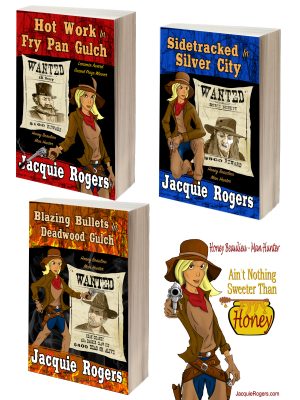
    Humor?  I don’t actually write humor.  Every time I do, no one laughs.  There’s one line in Blazing Bullets in Deadwood Gulch (Honey Beaulieu #3) that absolutely cracked me up, but not one person has laughed or even noticed it. [Update: one person finally got it!  Made my day.]

    Chanticleer: Really, no humor? Well, certainly situational, character driven humor. We love your books and love how you put your characters in situations they can’t possibly imagine! How structured are you in your writing work?
    Rogers: Horribly unstructured and unfocused.  My marbles are rattling around somewhere and they’re not even in the same room, or house, or state.  How I ever manage to finish a book is beyond me.  But when the deadline looms, I do hunker down and git ’er done.

    However, my approach to writing a novel is quite structured.  I don’t write a single word until I know the main and secondary characters inside and out.  The better I know the characters, the easier it is to throw obstacles in their way (that’s also called plotting).  I always have one scene in mind for the opener.  But I confess that the opening scene very rarely stays the opening scene.  The first scene I wrote in the Honey Beaulieu series will be in book #5.  The first scene I wrote in Much Ado About Miners is now in chapter 7.  I always start too far in, probably because I have little tolerance for backstory and I want to get on with things.

    Chanticleer: We appreciate that, Jacquie. How do you approach your writing day?

    Rogers: I always try to leave off in the middle of a scene so I don’t have to figure out what I’m going to write.  So after that scene is finished, then I check with my plot bones chart to see if I’m on track.  If not, I turn left.  Actually, I turn left a lot because sometimes things happen on the page that are too fun to throw out, so then I have to make it work with the rest of the story.  An example is Louie Lewie in Blazing Bullets in Deadwood Gulch.  He was supposed to be a throwaway character, but he kept coming into the story, so I resigned myself that he’s now part of it.  In fact, he’ll probably be in the next book, too.  So a lot of my day is thinking and while I’m thinking, the best way to come up with new ideas is to bake bread.  My extended family gets a lot of bread.

    Once everything’s figured out for the day, I fire up my laptop and use speech recognition to rough out a scene.  Believe me, “rough” is the right word considering when I said “bustier” it typed “buzzard ears.”  I end up with about 90% dialogue.  Then I send the scene to my desktop computer and edit using the keyboard.  If the scene starts out at 500 words, it’ll be 1,000 by the time I’m done adding the narrative.  A side note: I detest description and always skip it when I’m reading for pleasure, which means I have to make an extra effort to make sure I’ve created a picture for the reader.  This is by far my weakest area.

    Chanticleer: Ah, bread. Here’s the part where we wish we lived closer! The idea of using speech recognition software is pure genius – and time-saving, too. How do you come up with your ideas for a story?

    Rogers: I actually don’t know.  Usually, some phrase, prank, or predicament makes me laugh.  Then I put characters to it and voila! We have the concept for a new book.  Honey helps me out because I know that if I dig a hole big enough, she’ll keep me entertained.

    My entertainment is the determiner as to whether I use an idea or not.  If I’m entertained, then I hope the readers are, too.  But on the other hand, if I get bored writing, then you can bet that readers will also be yawning.
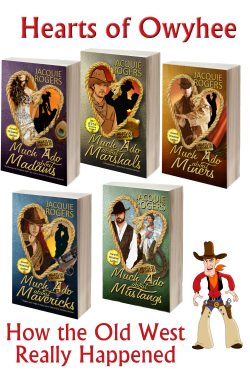
    A few of my ideas for books are identifiable, though.  In Sleight of Heart, I wanted to write a heroine who was as good at math as Aunt Grace, and I always wondered how she’d get along with Maverick.  So Lexie Campbell and Burke O’Shaughnessy were born.  The idea for Much Ado about Mustangs came from an article I read in The Owyhee Avalanche about the local theater group booking a national star to headline their local production.  Hence, we have Lady Pearl Montford and local rancher Josh McKinnon, whose heart’s desire was to raise Friesians.

    The next book I’m going to write, Hearts of Owyhee #6: Much Ado About Mail-Order Brides, came from the fact that the hero, Bram McKinnon, is perfect.  Perfect is boring.  Perfect makes for no conflict.  Unless he’s put in a situation where there’s absolutely no solution.  Bwahahaha.  Naughty me.

    As for Honey Beaulieu, what happens isn’t much of a surprise.  What’s interesting about her is the journey, so I’m always on the lookout for incidents that aren’t exactly your usual bill of fare.  Honey obliges by reacting in ways that surprise me every time.  Of course, she constantly changes the plot, too, which can get frustrating.  But I learned just to go along for the ride and let Honey take me with her.  We get along much better that way.

    Chanticleer: And what a ride! Thank you, Jacquie, for being our first interview of the year! We love what you do and love how you do it.

    Rogers: Thanks again for inviting me here today!

     

  • Three Questions with the Founder of the World’s Largest Book Club – Kathy Murphy

    Three Questions with the Founder of the World’s Largest Book Club – Kathy Murphy

    Pulpwood Queens Book Club’s Founder, Kathy Murphy, tells all! 

    Pulpwood QueensMeet Kathy Murphy, the “Pulpwood Queen” who opened the only Hair Salon/Bookstore, Beauty and the Book in the country in Jefferson, Texas and in 2000, founded and now operates the 600+ chapter book club, The Pulpwood Queens, nationally and in 15 foreign countries. Have a question for the Queen? Bring it to the Chanticleer conference session!


    1. What was your motivation to launch the Pulpwood Queens?

    Shortly after opening my Hair Salon/Book Store, (Beauty and the Book), the local book club invited me to join them for a meeting. I thought they invited me to join and be a MEMBER, not!

    Evidently, only eight members were allowed to join and as the hostess told me, “Unless someone dies or moves away, that is all that will fit around our table.”

    I was secretly thinking, Who made up that RULE?! Anyway, I went home, sat down, and made a list on what I would do if I started my own book club.  This book club would be inclusive, not exclusive.  We would call ourselves The Pulpwood Queens, “where TIARAS are mandatory and reading OUR good books was the only Rule!”

    By wearing the crown, we would tell the world that we were “beauty within” queens as we were real readers.  So for nearly 16 years we have been meeting monthly, first with my charter chapter, The Pulpwood Queens of East Texas.

    Since then we have made the news with appearances on The Oprah Winfrey Show, Good Morning America, we kicked off their “READ THIS” Book Club and other radio and print media with now over 600 chapters nationwide and in 15 foreign countries.

    [fusion_builder_container hundred_percent=”yes” overflow=”visible”][fusion_builder_row][fusion_builder_column type=”1_1″ background_position=”left top” background_color=”” border_size=”” border_color=”” border_style=”solid” spacing=”yes” background_image=”” background_repeat=”no-repeat” padding=”” margin_top=”0px” margin_bottom=”0px” class=”” id=”” animation_type=”” animation_speed=”0.3″ animation_direction=”left” hide_on_mobile=”no” center_content=”no” min_height=”none”]

    Timber Guy sexy reading contest
    Timber Guy Sexy Reading Contest at the Pulpwood Queens’ Girlfriend weekend!
    1. What will readers get out of being a member of a chapter and where/how can they hook up with an existing Pulpwood Queens or Timber Guys chapter?

    Everything pertaining to membership is on our website, www.beautyandthebook.com but the difference our book club has over others is we bring the authors into the picture.  Most of our authors will teleconference, SKYPE or even visit chapters and for sure be featured at our annual Pulpwood Queen Girlfriend Weekend. I know of no other book club where you have this kind of access to the authors.

    I also make all the authors participate in ALL EVENTS at our Girlfriend Weekend.  So it’s no secret that Pat Conroy has served Sweet Tea at our Author Dinner, where I make all the authors wait the tables in crazy costumes.  You eat, drink, and the authors even stay in the same hotels and bed and breakfasts.

    It’s full immersion into the Wonderful World of the Pulpwood Queens with the Grand Finale being our Great Big Ball of Hair Ball. The theme this year is ONCE UPON A TIME.  All the authors dress up, too, and it’s the ultimate Kodak moment, so bring your cameras BIG TIME!

    pulpwood queen & family photo


    Ed. Note: To become a member, visit: www.beautyandthebook.com/membership

    1. What is Kathy Murphy looking for in a good book? What speaks to you as a reader?

    Since my book club is now international, here is what I am looking for:

    1. An unknown author, one that is perhaps a first time/first book or one that hasn’t been discovered in a really big way. Yes, I want to pick a big name once in while but only if they can come and be a Keynote at my annual convention which we call Girlfriend Weekend. Example, Pat Conroy, Fannie Flagg, John Berendt, Jamie Ford, etc.
    2. This is a given but it must be well written, free of flaws and my book club members do not like to read books with gratuitous violence or language, but I do make exceptions. I selected Girl with the Dragon Tattoo because it was just such a great, well written story.
    3. Most important of all, the book must tell a story that has NOT been heard before or from a perspective that gives the reader a different view of a subject. Examples: The Sunday Wife by Cassandra King, The Dive From Claussen’s Pier by Ann Packer, Empty Mansions by Bill Dedman. Do not send me another queen book set in the south, particularly one that is also a hairdresser. I hold that card, DONE.
    4. I want a book that changes people’s lives for the better. Examples: My Orange Duffel Bag, Same Kind of Different As Me, a book that is discuss-able and that includes book club discussion questions written by the author. My book club hates generated book discussion questions, too literary and not very personal. Authors tend to write questions that they answered.
    5. I really don’t care who publishes a book, a good book is a good read no matter who publishes it.
    6. Last, I want a real book to read, I’m on the computer so much, I want to cuddle with a book in bed!

    Book-Clubs-in-Where-Writers-Win-Winner-Circle

    Thank you Shari Stauch, CEO of Where Writers Win, for this informative interview with Kathy L. Murphy, the Pulpwood Queen!

    Shari will present several sessions sharing her book marketing expertise at CAC16 along with Friday evening’s keynote presentation.

    Tell Us About the Live Book Clubs YOU Know!

    The WWW team and the Chanticleer Reviews team are reaching out regularly to bloggers, Twitter-ers, indie bookstores, readers at book festivals and more, once every few months we circle back to the coolest source –YOU– to ferret out the latest book clubs in cities around the world. Because, the club you know about might also be of value to one of our other emerging authors – and their club may be of value to you!

    Contact:  BookClubs@ChantiReviews.com and/or contact Where Writers Win.

    Editor's Note about Kathy L. Murphy:

    DreamWorks signed on to produce a movie about Kathy, though as she says, ”I did not do this alone and am not an overnight sensation,” Murphy said. “This came about through years of struggle and hard work and the incredible friendship and help of my Pulpwood Queens Book Club members and our authors and the love of my daughters, my sister and family. We — note that I say WE have struck a film deal.”

    The latest update regarding the film as of April 2016 is that the screenplay has been written and approved. Dreamworks has sent the script “out to talent,” so stay tuned to see who will play Kathy L. Murphy.  

    We can hardly wait to see it! 

    [/fusion_builder_column][/fusion_builder_row][/fusion_builder_container]