
Author: vadim-babenko

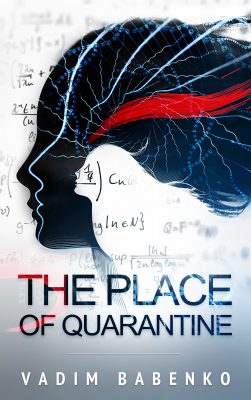
  • The PLACE of QUARANTINE by Vadim Babenko – Astronomy of the Universe, Russian Dramas/Plays, System Theory & Physics, Sci-Fi

    The PLACE of QUARANTINE by Vadim Babenko – Astronomy of the Universe, Russian Dramas/Plays, System Theory & Physics, Sci-Fi

    Theo awakens to a sound, which he likens to that of a trembling copper string. He finds himself midway up a stairway and realizes that the sound emanates from an ordinary fluorescent tube, about to burn out. He climbs to the next floor, where a door is open. A woman introduces herself as Elsa and welcomes him in.

    Not remembering anything, or knowing where he is, Theo asks Elsa. Her answer confounds him. He is in their apartment, in a place called Quarantine. In support of her response, she hands him a laminated paper that reads, “WELCOME. YOU HAVE EXPERIENCED CORPOREAL DEATH FOR THE FIRST TIME. THE DEATH OF THE BODY IS NOT AS SIGNIFICANT AS YOU MIGHT THINK. THERE IS NOTHING TO FEAR.” Really? Theo goes cold. Memories begin to emerge—a gunshot and terrifying pain, a woman in tears, the old streets of Bern. Then it all fades.

    Vadim Babenko, Russian-born physicist and businessman, left his former careers behind to become a writer of fiction—in The Place of Quarantine, thought-provoking fiction that begs us to consider what the reality of life truly is. In this effort, he draws on principles from the work of renowned researchers, such as Italian physicist Giuseppe Vitiello, to support the protagonist, Theo’s work, in particular, his concept of “the application of quantum field theory to the modeling of human memory and intelligence.”

    Yes, science plays a significant role in this book, but it’s a supportive role, a means to an end: our consideration of the possibilities of life beyond that which we experience on Earth, and of the regeneration of our knowledge and memories, and their further development to benefit the inhabitants of the place of a subsequent life. Theo is assigned an advisor/mentor/friend, called Nestor, to help him with the task of reviving the memories of his renowned, but uncompleted research on Earth. His knowledge and intelligence are needed in Quarantine and perhaps beyond. Since the particular vocabulary of physics and metaphysics is not familiar to many of us, a glossary of the terminology is at the reader’s fingertips.

    The science, however, is interwoven with the stories of characters from Theo’s very international first life—in particular, a beautiful young Asian woman, Tina, whom he met and loved in Bangkok and yearns for even in Quarantine; and a Russian businessman named Ivan Brevich, who is consumed with revenging the murder of his beloved wife, Nok. In Quarantine, his roommate Elsa adds a human element to his life, making his breakfast of coffee, fried eggs, and toast, and generally being his companion, although as phantom beings in a world of images. Nestor, who is but a face, with a voice, on the wall screen, is a friend as well as an advisor and research colleague.

    As Theo comes to believe in what his research is telling him, he becomes increasingly obsessed with finding Tina, if not in Quarantine, then in whatever life awaits him next, if indeed one does. Can he be satisfied with continuing his work for the benefit of Quarantine, or must he try to prove his belief by taking the chance to move on?


  • An Editorial Review of “The Black Pelican” by Vadim Babenko

    An Editorial Review of “The Black Pelican” by Vadim Babenko

    Vadim Babenko is a master of delving into the mind and heart of post-Soviet Russia with his contemporary literary works. The Black Pelican, his first novel, transcends genres with its complexity of story and supernatural elements. It was nominated for Russian Big Book Awards and the National Bestseller Awards.

    Told in two parts, The Black Pelican, utilizes a borderline stark narrative style that does not follow a traditional plot driven storyline. Written with intermittent lush and beautiful turns of phrase, Babenko  describes his hauntingly bizarre world. Readers may find themselves wondering if there really are mysterious men randomly running through restaurants or if animals with unsettling purple eyes really do exist. Rest assured, every bizarre scenario where the narrator finds himself in is one hundred percent real.

    The story centers on Vitus, the narrator, who is journeying to the mysterious and enigmatic City of M., in pursuit of Julian, a former co-worker. Vitus cannot forgive Julian his sins: his success at work, his charisma, and perhaps worst of all, his triumphant wooing of Vera back from Vitus. Vera is one of the few women Vitus has connected with on an emotional level.

    When Vitus arrives in the City of M. he is paranoid, on the border of nihilism, and at a tipping point in his life. The one thing he holds dear is his secret–his plan to kill Julian and get his revenge.

    Soon after his arrival, Vitus meets the menacing hotel-keeper Piolin, and Gibbs, a man with only half a face that he says is due to an encounter with the Black Pelicans—birds that live only in myth for most of the population despite their very real and incredibly violent existence.

    Unable to find Julian, Vitus fears that he will fail to carry out his murder. Piolin and Gibbs quickly come up with a plan to help him track down Julian. Vitus finds himself going to the surreal landscape of the Dunes with Gibbs and a motley crew: Sylvia and Stella. He soon realizes that the group itself has an ulterior motive. Meanwhile, the Black Pelicans loom menacingly on the horizon.

    Inevitably, Vitus finds himself face to face with one of the Black Pelicans. His encounter leaves him scarred both mentally and physically. After the occurrences in the Dunes, Vitus takes time to heal and begins to contemplate his life.  What happens next is something neither the reader nor Vitus expect.

    Marked for life after his encounter with the Black Pelicans, Vitus must face several choices.  Shall he return to the Capital and his old way of life?  Should he go back to the City of M.?  And most importantly, what should he do about Julian?  At the heart of the novel is one man’s quest for fulfillment and meaning in an often cold and irrational world.

    Those who take pleasure in contemplative literary works will find Vitus’ scenes of self-reflection, philosophical conjectures, and observations of others satisfying. This novel reflects the emotional turning point in Babenko’s life where he, indeed, met his own Black Pelicans face to face. His writing draws you into the construct of this treacherous and threatening landscape and engages you with its twisted and gripping characters.

    The Black Pelican is a sagacious novel that is powerfully written. You will find yourself reflecting on the philosophical questions Babenko puts forth long after you have read the last page. We look forward to reading Babenko’s next work.

    “Each book is a separate universe, a cosmos with its own metrics. The only thing that makes sense in my life is nourishing these universes in my mind for years, and when they’re mature enough, converting them into written narratives, fixing their inner logic, setting the laws of their physics.” – Vadim Babenko


  • An Editorial Review of “A Simple Soul” by Vadim Babenko

    An Editorial Review of “A Simple Soul” by Vadim Babenko

    In this character-driven novel that delves deeply into the psyches of six flawed individuals seeking life’s meaning in post-Soviet Moscow, the most enigmatic character is Russia itself.

    A Simple Soul begins apparently as a romantic endeavor that turns into an enthralling perilous thriller with plot twists, humor, and retribution.

    Russian-born Babenko’s novel, A Simple Soul, is filled with souls who are anything but simple. They are bored workers and wily entrepreneurs, all hardened to the murky world of Russian commerce, rampant corruption, and the decay of society. Yet each one seeks an elusive truth—happiness, love, the meaning of life. Elizaveta sees herself as a cold Venus, breaking the hearts of the men she dates, only to leap at marrying her long-ago love, Timofey, whose proposal has shady underpinnings. Alexander, her spurned lover, finds contentment in collecting words of wisdom, then loses it to despair. Seeking “his true mission,” Nicolai Kramskoy plans to steal and doctor a historical document to “prove” a connection to folk hero Pugachev, which links him to American Frank White Jr., who’s pursuing Pugachev’s alleged treasure map, along with a connection to his own Russian roots. Eventually joining them is Andrei, Nicolai’s old friend and a writer struggling to find confidence and purpose in his work.

    For much of this complex story, plot is relegated to the background as internal monologues become the focus. Personal histories and meandering thought processes draw the reader into a compelling maze of metaphysics and social commentary. Each character’s life is beset by small mysteries: Elizaveta finds mysterious symbols; Frank studies star signs; even Nicolai, the most cynical of all, once ran a business called the Astro-Occult Parlor. He observes that “people here were too fond of prophets, oracles, soothsayers, and magicians of all kinds,” but it becomes easy to see why even he is drawn to peering into the future.

    One could argue that Babenko’s characters all carry the same voice: intelligent, cynical, questioning, opinionated. What separates them is where that voice takes them: on personal journeys of soul-searching analysis, perhaps best exemplified in Nikolai’s comment while traveling by train:

    “Any country could be proud of its limitless vastness. Any except this one: people here don’t know how to be proud of anything, and perhaps they never did. Where there’s a lot of space, there’s free will and farsightedness, but there’s also no respite and an eternal restlessness, which results in universal sadness.”

    Such observations show the author’s skill in portraying the depths of functional loneliness.

    As Elizaveta sums up:

    “I don’t need this – riddles, higher powers. … – could the issue be with me? Do I have an overly simple soul?”

    After delving into the heart and mind of this postmodern Russian, the answer can only be, not in the least.  A Simple Soul transcends genres and time as its characters move across the vast lands of Russia and its ever-changing socio-economic landscape. Prepare to be transported.

    Vadim Babenko, who has a doctorate in physics from the Moscow Institute of Physics and Technology, has published six books, three are novels.  A Simple Soul was nominated for Russia’s most prestigious literary awards: The Big Book Awards (the Russian equivalent of the Booker Awards) and the Russian Bestseller Awards. His stories are complex with many subtle philosophical questions and dilemmas.  His prestige is sure to follow in North America as well.

     [fusion_builder_container hundred_percent=”yes” overflow=”visible”][fusion_builder_row][fusion_builder_column type=”1_1″ background_position=”left top” background_color=”” border_size=”” border_color=”” border_style=”solid” spacing=”yes” background_image=”” background_repeat=”no-repeat” padding=”” margin_top=”0px” margin_bottom=”0px” class=”” id=”” animation_type=”” animation_speed=”0.3″ animation_direction=”left” hide_on_mobile=”no” center_content=”no” min_height=”none”][Reviewer’s Note:  I found A Simple Soul a fascinating and entertaining read. I am fortunate to have been introduced to Babenko’s masterful works as they are still relatively unknown in North America. ]

     [/fusion_builder_column][/fusion_builder_row][/fusion_builder_container]

  • An Editorial Review of “Semmant” by Vadim Babenko

    An Editorial Review of “Semmant” by Vadim Babenko

    A Russian scientist with a PhD from the Moscow Institute of Physics and Technology, a widely recognized leader in the field of artificial intelligence, an entrepreneur in high-tech development, Vadim Babenko closed the door on his past achievements to fulfill his desire to write. We his readers are in his debt.

    In Semmant (not his first novel), Babenko has created a fascinating story, peopled with unbelievable characters in whom we believe nonetheless. He introduces emotions where we would not expect to find them, and keeps us rapidly turning the pages to learn the fate of his protagonist, a genius in cybernetics named Bogdan Bogdanov, who creates a “gift for the world” named Semmant.

    This literary work of fiction, which defiantly transcends the ordinary scheme of genres, begins in Bogdan’s white-walled room in an elite mental institution near Madrid, where he is erotically contemplating the sexual merits of his various nurses and pondering his chances of enticing one or another of them into his bed. As the sun sets behind the jagged mountain peaks that comprise the view from his window, and the institutionalized genius awaits a gourmet dinner accompanied by an expensive French wine, he begins composing his evening letter to Semmant—his friend, whom he can never desert.

    Bogdan’s thoughts laze across the course of his life since the discovery of his phenomenal giftedness in mathematical calculation—an Indigo child, they had called him. While this afforded him an excellent education, he remained a misfit in society, seldom forging friendships, including with women.

    Finally stumbling into the field of artificial intelligence, Bogdan glimpses a path for his future. As a means to an income, he has always earned more than his share in the stock market. What if he applied artificial intelligence to the task? Yes! He acquires state-of-the-art knowledge in the field and leaves yet another job—this time for entrepreneurship.

    Bogdan decides on Madrid as his new home, finds an apartment, and begins the creation of a robot in a computer. He expends much money and many months in meticulously programming the robot to successfully challenge the financial markets of the world. Finally his work is done. Not surprisingly, a relationship of sorts has emerged between Bogdan and his creation. He affectionately names it Semmant and sometimes whimsically sends him messages, as to a friend. Semmant, housed in his gleaming computer, learns to respond in kind—in almost human terms.

    As Semmant settles in to work, and money pours into the trading account, Bogdan goes out to play, to enjoy the amusements and the women of Madrid. Unfortunately, his success with Semmant has not spilled over to his savoir faire. Though his money attracts, Bogdan cannot understand (and certainly cannot program!) women, especially the intriguingly erotic, violently emotional, red-haired Lidia Alvares Alvares. Their initial passionate love affair gives way to an undulating path of hot and cold, which pushes Bogdan to create another colorful character, this time pseudonymously on the e-pages of a literary forum. The exploits of a high-class prostitute named Adele titillate the forum members, including an unwitting Lidia. As her character develops, Adele is lent a resemblance to Cervantes’ Dulcinea in attracting a knight in shining armor.

    Babenko brings his compelling story to an emotionally charged and thought-provoking conclusion—one this reviewer will likely not forget.

    Editor’s Note: This is this is one of the best books that I have recently read. I loved the writing and the complexity of the story along with the many subtle philosophical questions and dilemmas that it presents. Semmant is Babenko’s third novel. His first two, The Black Pelican and A Simple Soul, were both nominated for the Russian National Bestseller Awards and the Big Book Awards (the Russian equivalent of the Booker Awards), Russia’s most prestigious literary awards.