Author: tom-p-and-nancy-wise

  • Quotes for MEMORIAL DAY and Suggested Books that remember the sacrifices of those who served their country – Kiffer Brown

    Quotes for MEMORIAL DAY and Suggested Books that remember the sacrifices of those who served their country – Kiffer Brown

    Quotes for Memorial Day

    “Guard against the impostures of pretended patriotism.” — President George Washington

    “With malice toward none; with charity for all; with firmness in the right, as God gives us to see the right, let us strive on to finish the work we are in; to bind up the nation’s wounds; to care for him who shall have borne the battle, an d for his widow, and his orphan—to do all which may achieve and cherish a just, and a lasting peace, among ourselves, and with all nations.”— President Abraham Lincoln 1865

    “Here is your country. Cherish these natural wonders, cherish the natural resources, cherish the history and romance as a sacred heritage, for your children and your children’s children. Do not let selfish men or greedy interests skin your country of its beauty, its riches or its romance.” — President Theodore Roosevelt

    “Patriotism means to stand by the country. It does not mean to stand by the president or any other public official.” –President Theodore Roosevelt

    “In the truest sense, freedom cannot be bestowed; it must be achieved.” — President Franklin D. Roosevelt

    “Those who have long enjoyed such privileges as we enjoy forget in time that men have died to win them.” —President Franklin D. Roosevelt

     “Let every nation know, whether it wishes us well or ill, that we shall pay any price, bear any burden, meet any hardship, support any friend, oppose any foe to assure the survival and the success of liberty.” — President John F. Kennedy

    Memorial Day is a federal holiday in the United States in remembrance of the people who died while serving in the country’s armed forces. It is observed the last Monday of May.

    Originally, there were two different holidays celebrated by the North and the South to honor their Civil War dead in 1868. After World War One, the two holidays were combined to honor all Americans who died while in the military service.

    Veterans Day, which honors all U.S. veterans, is celebrated annually on November 11th–the day that WWI officially ended. V-E Day (Victory in Europe), May 8th, 1945 is the date United States and Great Britain celebrated defeating the Nazi war machine.

    We at Chanticleer Reviews are honored to present four excellent reads that exemplify the honor and courage of the men and women who serve in the U.S. military. For information about each book, please click on the link provided. 

    NON-FICTION

    NO TOUGHER DUTY, NO GREATER HONOR  by GySgt L. Christian Bussler

    GySgt. Bussler served three tours of duty in Iraq in 2003. The last tour (2005 -2006) proves to be the most challenging when Bussler narrowly escapes an IED blast with his life and sent home with injuries. The year proved challenging not just for Bussler, but for his whole team and it leaves each one of them forever changed. After recovery, Bussler then served as a Mortuary Affairs officer.

    Though now retired from the Marines, GySgt L. Christian Bussler is still active in the veteran community and acts as a mentor for other veterans. A truly magnificent and heartfelt memoir, No Tougher Duty, No Greater Honor is a must-read for every American.

    Journey Book Awards, 1st Place award-winner.

    MERRY CHRISTMAS AND A HAPPY PTSD  by Christopher Oelerich (non-fiction)

    “I went away to war one person and came back another, and in my wildest dreams would never have chosen to be the one who came back.” – Christopher Oelerich

    For those who suffer from PTSD, understanding that they are not alone and that they can help themselves is a huge step toward embracing a recovery program. Oelerich, as one who has experienced combat and traumatic events, wrote this book as a “How To” guide for combat soldiers, like himself, who suffer from PTSD.

    Christopher Oelerich relates his own personal history, beginning from when he was drafted into the military during the Vietnam War, and continuing through his return to civilian life and his own rocky road to recovery.

    GENERAL in COMMAND – The Life of Major General John B. Anderson by Michael M. Van Ness

     A remarkable biography chronicling the adventures of a farm boy born in 1891 who rose high rank in the US military and served with distinction in two world wars as a combatant, officer, and sage observer. He served in the Mexican War, WWI, the Civilian Conservation Corps in the Great Depression, and WWII. 

    HILLBILLIES to HEROES: Journey from the Black Hills of Tennessee to the Battlefields of World War II – The Memoir of James Quinton Kelley by S.L. Kelley.  

    A farm boy from the hills of Coker Creek, Tennessee to driving tanks across France and into Germany as part of an initiative that ultimately saw the end of Hitler’s Third Reich. A heartfelt recollection of the sacrifices of America’s soldiers in WWII.

    FICTION

    None of Us the Same by Jeffrey K. Walker 

    Love. Honor. Friendship. Exactly what we need from a historical fiction novel, at exactly the right time. WWI. 


    WAIT FOR ME

    Wait For Me by Janet K. Shawgo  –World War II  (historical fiction)

    The often-unknown role of women in wartime as travel nurses and pilots, as well as the use of herbs for natural healing, adds interesting and relative historical content to the story. The WASP pilots and their active role in the war effort was particularly fascinating reflecting Shawgo’s vigilance with her medical and military history research. 

    After the prologue shows Pearl Harbor on December 7, 1941, establishing the World War II setting, the story begins on September 23, 1940 in New York.

    Readers may find it interesting that Shawgo, along with being an award winning novelist, is also a travel nurse who goes where and when she is needed for national disasters.


    LIfe on Base: Quantico Cave review

    Life On Base:  Quantico Cave by Tom and Nancy Wise  (contemporary fiction)

    A riveting portrayal of the lives of children whose parents serve in the armed forces. Being a teenager is hard enough, but adding the constant uprooting and moving from base to base adds its own unique challenges as well as rewards.

    The story focuses around young Stephen, a “military brat”—a term that these children use to distinguish themselves from their civilian counterparts. Stephen finds himself uprooted once again from his most recent home in California and moved across the country to Quantico Bay, Virginia. His father is a Marine and relocating often has become a part of Stephen’s life. However, becoming accustomed to something is not the same as liking it.

    “Patriotism is supporting your country all the time, and your government when it deserves it.“
    Mark Twain

    “How important it is for us to recognize and celebrate our heroes and she-roes!” – Maya Angelou

    “A hero is someone who has given his or her life to something bigger than oneself.” —Joseph Campbell

    MemorialDay

    Remembering those who have served and made the ultimate sacrifice….

    As my father who passed in 1981 from 100% service-connected disabilities (a Marine Corps lifer with WWII, Korean War, and Vietnam conflict in his military service) repeated,  

    “May we never forget freedom isn’t free.”Unknown

    [/fusion_builder_column][/fusion_builder_row][/fusion_builder_container]
  • LIFE ON BASE: QUANTICO CAVE by Tom and Nancy Wise,

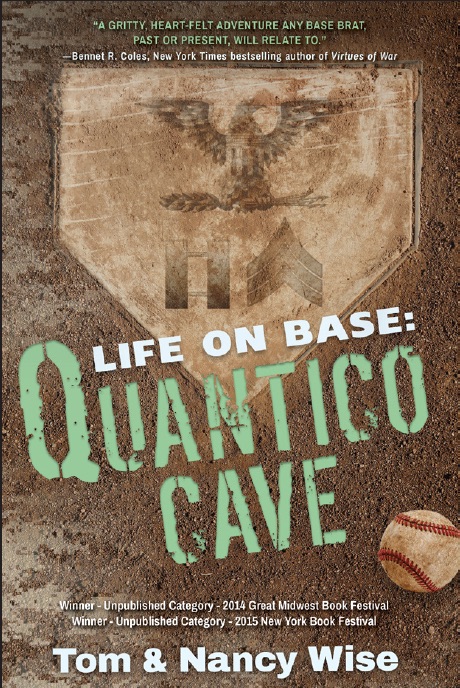
    LIFE ON BASE: QUANTICO CAVE by Tom and Nancy Wise,

    Life on Base: Quantico Cave is a riveting portrayal of the lives of children whose parents serve in the armed forces. Being a teenager is hard enough, but adding the constant uprooting and moving from base to base adds its own unique challenges as well as rewards.

    The story focuses around young Stephen, a “military brat”—a term that these children use to distinguish themselves from their civilian counterparts. Stephen finds himself uprooted once again from his most recent home in California and moved across the country to Quantico Bay, Virginia. His father is a Marine and relocating often has become a part of Stephen’s life. However, becoming accustomed to something is not the same as liking it. And Stephen didn’t like it. No matter the location the houses looked the same, the colors were the same, even the base housing furniture was made from the same Naugahyde vinyl. However, the faces did change and, like most of the other kids; Stephen knew the drill about making friends quickly, along with finding his place in the military-influenced hierarchy of who is who among the kids.

    Quite frankly, Stephen was becoming complacent about the continuous moving and felt that life was becoming the same old same old, but that was all about to change.

    An old acquaintance from Stephen’s past has returned and things are not perfect between the two. From day one of their renewed “relationship,” Rick is determined to make life difficult for Stephen. What was Stephen to do with someone that constantly wanted to fight? This rivalry sets the background for a story that all middle school to high school children can relate to—there always seems to be a bully or a hotheaded kid to contend with and no way to avoid the inevitable conflicts.

    For those unaware of the surroundings of Quantico Bay, authors Tom and Nancy Wise give a good background in the introduction. The USMC base is located near the Potomac and was built right over top of old Civil War encampments. This setting provides the local military brats with trench works, cannon balls, and makeshift bunkers that, simply put, make it an irresistible place to hang out.

    The story takes a gripping and unsuspected twist when a hurricane hits the base. When Stephen goes exploring the next day, amidst the uprooted trees and overflowing creeks, he discovers a mysterious cave. Little did he know how much of an integral role that this cave will take in his life and the lives of his cohorts.

    This book not only does an admirable job of giving readers an insight on military base life for a youth growing up, it also gives an accurate portrayal of life as a kid today. Challenges exist, personalities will clash, and there will always be that one person that tends to resort to bullying to prove that he or she is king/queen of the hill.

    Authors Tom and Nancy Wise effectively use this book, while telling a suspenseful story, to show middle grade readers that there are positive ways to handle these situations without sounding preachy or admonishing. Avoiding physical confrontations, resolution of disagreements with the help of others, the value of real friendship, and the importance of family are issues that are wrestled within this captivating and enlightening book that will appeal to parents and children alike. All of this is delivered in a truly engaging and spirited story—the first installment of the “Life on Base” series—that will ring true to young people of all walks of life about the challenges that they face every day.


  • AGILE PROJECT MANAGEMENT for AUTHORS by Tom Wise, Ph.D. and Nance Wise

    AGILE PROJECT MANAGEMENT for AUTHORS by Tom Wise, Ph.D. and Nance Wise

    Authoring Is A Business and this is why Tom Wise Ph.D., project management consultant, advises authors to implement AGILE PROJECT MANAGEMENT METHODS to meet their publishing goals.

    Recap of Three Steps to Using Your Writing Time More Effectively – Agile for Authors Article One

    In the previous article, we discussed how to build a network to create a team. This requires relationships and understanding the skills and abilities of these people. Part One was setting the stage to prepare to work within a strong network of supporters. In this article, we are going to cover how to apply most effectively your network in your business.

    Part 2. Authoring is a Business

    Knowns

    8,760 hours in a year.

    Timelines and schedules are precious commodities. Each of us is given only twenty-four hours in the day and one hundred sixty-eight hours in a week. We only receive fifty-two of those weeks in a year filled with eight thousand seven hundred and sixty hours. We spend almost two thousand nine hundred of those hours in sleep and another one thousand hours commuting, shopping, and general time with family duties.

    Agile for Authors

    Hours In A Day Breakdown Of Activities

    Note: Hours in the day are an estimate of an average person with a full-time job:

    1. Working/Living/Education:  8 hrs a day
    2. Sleeping: 8 hrs a day
    3. Commuting/Eating/Chores/Grooming/Exercising/Family Duties/Community Participation (clubs, volunteering, reading) 6 hours
    4. Writing???? 2 hours

    For the knowledge worker, that leaves a mere forty-five hundred hours to split between the remaining activities such as leisure and love, eating and playing, housework and writing. If we are lucky or good, and manage to split our time perfectly, that provides the author seven hundred fifty hours, or two potential hours of precious time to write in a twenty-four hour period. Now, I don’t know about you, but I rarely manage to focus for a full couple hours in a day, let alone seven hundred fifty hours straight.


    Rework in authoring a novel or book is very costly in time, money, and confidence. The problem is often not the writing or the mechanics, but rather a process. A life-cycle may not be clear to us, but it does exist. Getting published historically took years to complete, but that has changed.

    In the new millennium, some software experts developed a twelve-point manifesto for Agile principles to apply to writing novels. They discovered that a network of invested peers made their writing process more effective.

    Agile Principles for Authors


    Realize, there is a difference between content writers and authors. Content Writing tends to be paid position or contracted. Authors, and especially Indie Authors, invest their time and money up front hoping for a return on work at the other end of the process. Authors hunker down, close themselves away, and work until they complete the manuscript. Then polish the work, send it off, and hold their breath, cross their fingers, hoping for someone to send a love letter of acceptance.

    AGILE FOR AUTHORS

    Top companies in the world understand the necessity of a more streamlined process. Hired consultants make billions of dollars teaching companies how to create processes for efficiency and economic savings. Experts measure, refine and reduce their product processes into effective work segments to complete the product. These techniques can be employed in your authoring efforts.

    Some people have learned a family business, and others seem to instinctively know how to segment out their work and  organize others to get work done and goals met. For the rest of us, this can be a learned skill.

    Agile Manifesto’s Twelve Concepts

    Agile authors have the ability to use the flexible methods. The idea, the method of agile, developed during the 1990’s by software developers with the simple focus of targeting the desires of their customers before the work begins. It includes building a team focused on customer satisfaction, a team with shared mission and participation of quality experts, engineers, analysts, and business people. These software developers gathered at The Lodge at Snowbird Ski Resort in the Wasatch Mountains in Utah and developed what is now known as the Agile Manifesto.

    The Agile Manifesto expresses twelve concepts of a well working team that can be applied to the business of authoring.

    1. Customer satisfaction is priority
    2. Welcome changes
    3. Deliver working software frequently
    4. Business and Development work together daily
    5. Motivation, Environment, and trust are needed
    6. Face-to-face is best
    7. Working software is the measure
    8. Maintain a constant pace
    9. Technical excellence and good design
    10. Simplicity – maximize work not done
    11. Self-organizing teams
    12. Regular retrospection and adjustment

    A Shift in Paradigm –  A to Z no longer applies!

    In segmenting work – A to Z no longer applies. Now, working on A to D, R to Z, and then E to H, is possible, getting feedback and input along the way, improving as the work progresses, to a thoroughly edited, refined product.

    Agile for Authors

    Consider what can be grouped, or segmented into independent units of work, and the need to include people with these skills in your team:

    • Division of responsibilities to make your group a team
    • Division of tasks into short phases of work (Sprints) characterized by division of tasks
    • Publishers
    • Cover design
    • Marketing
    • Bloggers – who and when
    • Social media
    • Beta readers
    • Developmental and line Editors – who and when
    • Identify who needs to work on what
    • Who needs what information – focus on that info with those people
    • Conferences and author signings

    Teams and groups work differently. One of the key differences in the behaviors of teams is due to the separation of responsibilities. When an individual is assigned a unique task or given a goal, he/she can take on the leadership role when it comes to meeting the assigned objective.

    When work is segmented into small chunks, called sprints, with a short duration and a clear goal, the team can move quickly to completion of a quality product. Prioritize small sprints of two to three weeks on a specific goal, and with the team members that are needed to complete that small chunk of work.

    Agile for Authors

    Short Sprints Win the Race

    At the end of each sprint, take the time to discuss the past segment. Ask the team the hard questions. By continuous reassessment, your team will quickly become efficient at turning that crank and churning out quality work.

    • Frequent reassessment and adaptation
    • People – are they responsive to you and are you responsive to them, working well together.
    • Communication – are the tools and behaviors working?
    • Commitment – are you, and they dedicating the time and focus to getting work completed in the way and time agreed?
    • Time – are the estimates accurate? Is the time to meet convenient and sufficient to get the work done?

    When the opportunity to write presents itself, an author must have options ready and prioritized. This requires the author to have a routine that enables them to move into the zone, one zone or another, quickly.

    Creating that “zone” means understanding the priority, and what needs to be available that activates the muse. Identify the psychological triggers that engage your creative abilities.

    • Have a scent prepared that gets you in the mood to write (coffee? cinnamon? campfire smoke? brandy?)
    • Know the lighting that is needed to make you comfortable (candles? bright light? darkened writing cave?)
    • Identify the background sounds that move you (white noise? rain forest sounds? dance tunes? sultry Barry White?  Western music?)
    • Choose a setting (busy coffee shop? attic studio? kitchen table? favorite bookstore? local pub? closed office with the door closed?)
    • Choosing a time of day is ideal (first thing in the morning? late night after everyone goes to sleep? immediately after exercise?)
    • Have needed ideas listed. (Always jot down or record anything that you think might be useful for writing projects. Don’t let these muse tidbits dissipate into the air.)

    Choosing a specific time of day with no distractions is essential. If the author has a family, often this time is before the family awakens, or after the family retires for the night. Perhaps for you, it is after the children head out to school, or during your lunch break at work. Whatever time that is, set that time aside on your calendar and give it to yourself. Don’t allow excuses to infringe on the task. Perhaps you can arrive to work early, or stay late on a preset schedule. This provides the family, or significant other, the ability to support your time to write.

    • Stage your work area
    • Be organized and have everything together (prepared)
    • Know the psychologically stimulating triggers that jog your muse
      • Diane Gabaldon’s is lighting candles for her muse.
      • Robert Dugoni’s is reading the Green Mile by Stephen King — again!

    [fusion_builder_container hundred_percent=”yes” overflow=”visible”][fusion_builder_row][fusion_builder_column type=”1_1″ background_position=”left top” background_color=”” border_size=”” border_color=”” border_style=”solid” spacing=”yes” background_image=”” background_repeat=”no-repeat” padding=”” margin_top=”0px” margin_bottom=”0px” class=”” id=”” animation_type=”” animation_speed=”0.3″ animation_direction=”left” hide_on_mobile=”no” center_content=”no” min_height=”none”]

    Jennifer Cook - coffee pic (1)
    “What my Coffee says to me” by Jennifer R. Cook


    Moving from one role to another, both physically and mentally takes planning, skill, practice, and agility. As an author, if we have a team of people with unique skills and responsibilities, then your team can take a leadership role when necessary. This gives the author more opportunity to shift roles from writing text to editing, scheduling, and organizing for subjects such as cover designs, reviewing publishers, and marketing.

    Parting Words

    Allow yourself to have every benefit possible to make the transition to your creative self to take advantage of that precious time when it is just you and your story. 


    NOTES from the Editor:

    The fun picture above titled “What My Coffee Says to Me” is by Jennifer R. Cook, a creative graphic design consultant and illustrator. Ms. Cook has been graciously given Chanticleer Reviews permission to use this picture with Tom and Nancy Wise’s AGILE for Authors series.  We absolutely love her artwork and graphic designs!

    “What my Coffee says to Me” is a daily, illustrated series which began January 1, 2012 by Jennifer R. Cook a strategic graphic designer and illustrator creating for mental health awareness, please visit www.catsinthebag.com

    For more information on building an environment for Agile success read Agile Readiness; Four Spheres Of Lean And Agile Readiness by Thomas P Wise and Reuben Daniel. Available at Amazon, Barnes & Noble, and Gower Publishing, and anywhere books are sold.

    Tom holds a Ph.D. in Organizational Management and teaches courses in project management and quality at Villanova University and DeSales University. He is currently developing curriculum at Eastern University based on his books: Agile Readiness and Trust In Virtual Teams.

    Tom and Nancy are award winning authors. Their book, The Borealis Genome is the 2013 Dante Rossetti Grand Prize Winner and a 2014 Cygnus Award First In Category winner. Their books have won multiple awards including Finalist with the USA Best Book Awards and The International Book Awards.


     [/fusion_builder_column][/fusion_builder_row][/fusion_builder_container]

  • Three Steps to Using Your Writing Time More Effectively: Agile for Authors, by Tom P. and Nancy Wise

    Three Steps to Using Your Writing Time More Effectively: Agile for Authors, by Tom P. and Nancy Wise

    Writers Are Agile Too

    Few people in the world can say writing is their primary source of income.

    Most part-time authors have income producing careers that command attention. When an opportunity to write appears, making the most of that rare commodity called time is essential.

    Being “Agile” includes being prepared to work with flexibility, readiness, and having the commitment to act when and where the availability arises. Knowing how to formulate and segment work will ensure the most efficient use of time for you and your network.

    Tapping at the keyboard is only the beginning. Authors need to be competent in many areas:

    • Find beta readers
    • Sort beta suggestions
    • Formulate character traits
    • Track plot-lines
    • Rewrite edits with interest grabbing intensity

    As if that is not enough, authors need to also provide multiple services and tasks beyond their skill in word craft:

    • Review for fellow writers
    • Write and send queries and reply to emails
    • Social media postings
    • Develop book covers
    • Enter contests
    • Create promotions
    • Implement marketing strategies

    These are only a few of the many activities with which an author must engage in and manage.  The shortage of available time requires us to develop the ability to work on any needed task effectively, reinforce successful behaviors, and play well with others.

    Step One

    Before writing begins, there are a few activities you can undertake to develop an environment where success is inevitable.

    • Form a strong network base
    • Evaluate personal strengths
    • Evaluate personal weaknesses
    • Identify your strengths and qualities to offer members of your network.

    Agile is for AuthorsRemember that your talent and connections are your contributions to forming a strong team. Be a member of a responsive network of professionals, able to produce a product while participating as a team, rather than an individual in a large group. Success in any endeavor is often due to the broader team and is much harder to capture as a lone wolf.


    Identify your talents.

    Each of us has a network, whether small and intimate or large and diverse. And each of the people in our lives has a talent. It is human nature to seek out people with like interests and skills. Seek out and identify the abilities and interests of friends, family, and peers, and realize their values.
    Step Two

    Agile for AuthorsAnalyze the people that you know, or have known in the past. What contributions can they add, and what are their needs? Reach out to refresh old connections, and maintain those that are interested in supporting you in developing your craft. Find new ways to contribute to their endeavors and make connections relevant. Everyone has a contribution to make.


    For example:

    • At home, parents can be recruited as beta readers
    • Retired relatives can be editors
    • Grandparents are an awesome source of information
    • Nieces and nephews with art skills help with swag creations for your brand

    Step Three

    Expand your network by seeking out those with talent where you are weakest. Reach out to as many people, as you can, to develop a network of capable people with whom you may strengthen relationships and develop trust. Compliment your strengths and begin to fill the gaps created by your weaknesses. Assembling a strong network of friends and peers is one way to ensure that you can make the most of every creative opportunity.

    Take a long hard look at your existing and possible network for:

    • People that you may refer to others
    • People to hire as  assistants or experts
    • People as subject matter experts to respond to inquiries
    • People with research skills to provide valuable information
    • People who are great leads to those who can be subject matter experts

    Identify new connections that will make your network stronger through:

    • Social media
    • Your local community
    • Your church group or local clubs
    • Professional associations
    • Friends of a supportive family member
    • Hard working peers

    New people you meet can build your network with every “Hello.” Follow up with friendly and informative communications, and when you are able, contribute to helping them achieve their goals.

    Streamline your time by learning how to segment your work and when to utilize your contacts. Often, deadlines and available time dictate what gets worked on and when. People in a robust network are interested and willing to develop new techniques, learn new strategies, identify new sources of information, and the opportunity to establish new markets or new readers.

    Authors Are Agile AlsoAmong a supportive network, you should be able to share each other’s pitfalls, successes, and joys, as well as enhance each other’s skills and insights. In this way you may become stronger as a writer and as a person.

    When you sit down for those precious moments to write or research you will know that your network contacts are available and will be informative, and responsive as you seek help in the areas of their expertise. in implementing new skills you have learned, and respond in like when contacted. Reach out to them and share your thoughts and ideas, and incorporate their knowledge into your writing preparations.

    If you are weak in an area,  find someone who is strong in it. Work together to complement each others strengths and weaknesses. For an example, an author friend who is excellent at tweaking websites traded her expertise for another author’s editing skills. Both benefit from each others strengths by working together.

    Implementing Agile

    For an example, if you found a great beta reader, establish a plan with her/him before beginning, and agree to a time-bound commitment along with clear expectations for both parties. Make sure that your beta reader will feel that she plays  a vital part of your writing team to ensure the success of the project. Establish a short-term plan together that fits works for both parties. Work together to budget time, to set a cadence, and work through that plan. It is this cooperation and collaboration that will make for a strong network that will combine experience and knowledge. s

    In Conclusion

    This year at the Chanticleer Author Conference Nancy and I learned about several new resources on the web to reach new readers, test out new story lines, and met with various support services available to authors. We learned skills that other authors shared in workshops, in panels, and over meals. We enjoyed connecting with new friends and strengthening previous and virtual relationships. It is always energizing and rewarding to be among hardworking, successful, and dedicated industry front-runners and innovators who are willing to aid in each other’s successes.

    More to come on developing and utilizing successful techniques that you can apply in your valuable time in the next article of Agile for Authors and Writers.

    Editor’s Note:

    For more information on building an environment for agile success read Agile Readiness; Four Spheres Of Lean And Agile Readiness by Thomas P Wise and Reuben Daniel. Available at Amazon, Barnes & Noble, and Gower Publishing, and anywhere books are sold.

    Tom holds a Ph.D. in Organizational Management and teaches courses in project management and quality at Villanova University and DeSales University. He is currently developing curriculum at Eastern University based on his books: Agile Readiness and Trust In Virtual Teams.

    Tom and Nancy are award winning authors. Their book, The Borealis Genome is the 2013 Dante Rossetti Grand Prize Winner and a 2014 Cygnus Award First In Category winner. Their books have won multiple awards including Finalist with the USA Best Book Awards and The International Book Awards.