Author: nick-k-adams

  • Memorial Day 2021– Remembering our History and Honoring Those Who Died in Service by Kiffer Brown & David Beaumier

    Memorial Day 2021– Remembering our History and Honoring Those Who Died in Service by Kiffer Brown & David Beaumier

    Memorial Day is a federal holiday in the USA to honor and remember those who died in service to our nation. The date of the holiday changes but it always falls on the last Monday of May.

    The United States has three official days to honor those who serve or have served in the Armed Forces.

    1. Memorial Day, a federal holiday, is observed the last Monday in May, honors those who have lost their lives in action in service to our nation.
    2. Veterans Day, a federal holiday, that is observed every year on November 11th to honor all those who have served in the Armed Forces.
    3. Armed Forces Day is a celebration day that honors all active and former personnel across the six branches of the United States military. It is celebrated on the third Saturday of every May. This year’s (2021) was on May 15.

    [Note from Kiffer Brown: As a military brat, I want to pass on the importance of understanding the difference of these three very important days are to military personnel and to their families and loved ones. Thank you]

    National Moment of Remembrance

    On Memorial Day, remember that there is a National Moment of Remembrance. To honor the moment, pause for one minute at 3 p.m. at your local time, and remember those who have died in service to this nation.
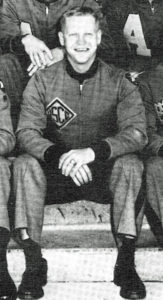
    Second Lieutenant Billy Wayne Flynn was killed in action, Vietnam, January 23, 1967. He was 24 years old. (He gave to me my first book of poetry before he left for Vietnam. I still have it. Kiffer Brown)

    History of Memorial Day

    All of us at Chanticleer have family who have served, and that makes holidays like Memorial Day important to us. We ask you to take time out of your day to remember the veterans in your life and those who have died in active service on this day of reflection.

    A Green sketch of Robert Gerard Beaumier Sr. Shared herfor Memorial Day with the family's permission
    Robert Gerard Beaumier Sr. who served in WWII

    My father would often tell the story of how his grandfather, Robert, was in France during World War II. At one point a dog came and wouldn’t stop barking at his unit, no matter how much they told it to go away. Finally, Robert said “Va t’en!” and immediately the dog ran off. Everyone was suitably impressed that the dog spoke French!

    Memorial Day Started in the Wake of the Civil War

    Memorial Day began to be celebrated when the United States was split in two during the Civil War, as the Confederate States seceded from the United States in order to continue to preserve the institution of enslaving people.

    The Civil War ended on May 5, 1868, and three years later Major General John Logan formalized that Decoration Day (the original name of Memorial Day) should be on May 30 (now May 31) , chosen probably because that’s when most flowers would bloom across most of the country.


    Black and white photo of John Logan
    John Logan went on to become a senator for Illinois

    The Civil War remains the bloodiest conflict in terms of US life, with 620,000-750,000 dying throughout its four years. You can see the VA’s (Veteran Affairs) full list of statistics here, and it shows just how long the US has been at war for 245 years we have been a country. After the first World War, Memorial Day officially became more in recognition of all veterans who died serving the US. You can read more about the history of Memorial Day here.

    For a long time, people have recognized and honored those who died in war. There’s a record of Pericles (429 B.C.), a statesman in Athens stating:

    A sculpture of Pericles in front of a red background

    Not only are they commemorated by columns and inscriptions, but there dwells also an unwritten memorial of them, graven not on stone but in the hearts of men. ~ Pericles of Athens

    Quotes from some of our favorite notable authors:

    “Patriotism is supporting your country all the time, and your government when it deserves it.“–Mark Twain

    “How important it is for us to recognize and celebrate our heroes and she-roes!” – Maya Angelou

    “A hero is someone who has given his or her life to something bigger than oneself.” —Joseph Campbell

    Remembering those who have served and made the ultimate sacrifice….


    Without further ado, the following are recent reviews of books with a military theme that we highly recommend!

    The Stories of Veterans and about Those Who Died in Action Matter

    We review and award several books each year that have to do with military service. Oftentimes, with Fiction, those books appear in our Somerset, Chatelaine, Laramie and Global Thriller Awards, and in Non-Fiction they appear in our Journey Awards. We also plan to launch a new Non-Fiction division this year that specifically honors and recognizes work with military themes.

    NO TOUGHER DUTY, NO GREATER HONOR
    By GySgt L. Christian Bussler
    First Place Winner in Journey Awards

    From a family with a long history of military service dating back to the civil war, GySgt L. Christian Bussler brings to life his experience as a Mortuary Affairs marine and sheds light on a duty that few ever talk about. He is called to duty for his first of three tours in Iraq in February of 2003 after spending many years training as a reservist.

    This fear becomes reality when he narrowly escapes an IED blast with his life. Afterward, Bussler wrestles with the guilt of going back home injured, leaving his team behind to fight without him. The final and longest section of No Tougher Duty, No Greater Honor mirrors the length of the final and longest tour from 2005-2006. This tour especially proves to be the most challenging for not just Bussler, but his whole team, and it leaves them all forever changed.

    Continue Reading…

    AWAY at WAR: A CIVIL WAR STORY of the FAMILY LEFT BEHIND
    By Nick K. Adams
    First Place Winner in Laramie Awards

    In 1861, like so many other American men, David Brainard Griffen took leave of his family and enlisted in the army, volunteering as a soldier for the Union. Also like so many other American men, he hoped he’d be home in a few months, that this Civil War would soon be over, and he’d be reunited with his wife, Minerva, his daughters, Alice, seven-years-old, Ida May, five-years-old, and his infant son, Edgar Lincoln. To minimize the pain of separation from his family, he wrote them letters from the field of battle, more than 100 accounts of what he was doing and witnessing as a 2nd Minnesota Volunteer. While the book is one of historic fiction, the letters are genuine, and the characters are based on actual people. The author of this fine account, Nick K. Adams, is the great-great-grandson of Corporal David Brainard Griffen.

    Continue Reading…

    A CROWDED HEART
    By Andrea McKenzie Raine

    Willis Hancocks survives fighting in Western Europe during World War II but faces continuing battles of the mind at war’s end in Andrea McKenzie Raine’s poignant study of the plight of the former soldier in her historical novel, A Crowded Heart.

    Willis decides to remain in London rather than return to his native Canada where his parents and sister live near Vancouver. Eager to put the war behind him, he marries Ellie, an intelligent young woman who has studied art at Cambridge University. Her affluent parents approve of Willis, and her father offers to finance his new son-in-law’s study of law at Cambridge. The newlyweds’ future could not look rosier.

    Continue Reading…

    The SEARCH (ACROSS the GREAT DIVIDE, Book II)
    By Michael L. Ross

    The Search (Across the Great Divide: Book II)by Michael L. Ross brings to life the history and events of the Westward Expansion in a post-Civil War US. In this sequel to The Clouds of War (Book I), we once again follow Will Crump, now a young Confederate Veteran, a POW survivor, and a sufferer from what must be PTSD. With the war over, nightmares and tension with the family disrupt his life and plans to marry his pre-war sweetheart. He wants to get away from civilization, build a little cabin in the mountains, and live in peace. 

    Will strikes out on his horse Dusty and soon picks up a stray dog he names Lightening. Both animals play essential roles in Will’s survival throughout his journey, and readers will worry for and root for them as much as for Will as they face the wild west head-on. 

    Continue Reading…

    The Ack Ack Girl book cover

    The ACK-ACK GIRL (Love and War #1)
    By Chris Karlsen

    Chris Karlsen’s new work, The Ack-Ack Girl, is the first in her World War II series, Love and War, and serves up plenty of story on both sides of that equation in its portrayal of Ava Armstrong, the “Ack-Ack” girl of the title. And what a story it is!

    Bombs are dropping on London in the heat and fire of the infamous Blitz. Shells are falling, as are the buildings that surround them, while fires spring up in the wake of the bombs that never seem to end. But when they finally stop, Ava and her friends are determined to get their loved ones somewhere safe and to find a way to serve up some revenge on the Germans.

    Continue Reading…

    CHASING DEMONS
    By John Hansen

    First Place Winner in Laramie Awards

    In the first several pages of Chasing Demons, a novel of the Old West not long after the American Civil War, the following happens to U.S. Army Private Gus O’Grady: he kills two Apache Indians, saves the lives of a troop of U.S. soldiers, kills two more Indians, kills a bad guy, winds up being mistaken for a man who may have robbed a bank of $20,000 in gold, and gets arrested for possibly being the man who raped a lass in an Arizona town populated by Mormons, and meets a woman he thinks is far too good for him. Oh yes, and he deserts the Army after 13 years.

    That’s just for openers.
    Continue Reading…


    Have a great story about veterans and war history?

    When you’re ready, did you know that Chanticleer offers editorial services? We do and have been doing so since 2011.
    Our professional editors are top-notch and are experts in the Chicago Manual of Style. They have and are working for the top publishing houses (TOR, McMillian, Thomas Mercer, Penguin Random House, Simon Schuster, etc.).

    If you would like more information, we invite you to email Kiffer or Sharon at KBrown@ChantiReviews.com or SAnderson@ChantiReviews.com for more information, testimonials, and fees.

    We work with a small number of exclusive clients who want to collaborate with our team of top-editors on an on-going basis. Contact us today!

    Chanticleer Editorial Services also offers writing craft sessions and masterclasses. Sign up to find out where, when, and how sessions being held.

    A great way to get started is with our manuscript evaluation service, with more information available here.

    And we do editorial consultations for $75. Learn more here.  

    If you’re confident in your book, consider submitting it for a Editorial Book Review here or to one of our Chanticleer International Awards here.
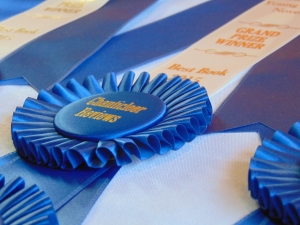
    Also remember! We’re hosting our 2020 CIBA Ceremonies for First Place Category and Grand Prize Winners June 5th at the Hotel Bellwether in Beautiful Bellingham, Wash. Attending the June 5, 2021 VIRTUAL Ceremonies for the 2020 CIBAs is Free. However,  registration is required. We will have the link posted on our website after the Finalists are announced.
    Thank you to veterans everywhere!

  • LARAMIE Book Awards – SPOTLIGHT Focus on ALL Works of Western Fiction and Uniquely American Tales

    LARAMIE Book Awards – SPOTLIGHT Focus on ALL Works of Western Fiction and Uniquely American Tales

    Welcome to our SPOTLIGHT on LARAMIE Book Awards, the stories that stick!

    Western Pioneeer Civil War Fiction Award

    The Laramie Book Awards recognize emerging new talent and outstanding works in the Americana / Western, Pioneer, Civil War, Frontier, and First Nations Novels. The Laramie Book Awards is a division of the Chanticleer International Book Awards.

    Charles M. Russell painted the cowboy scene on Chanticleer’s very own Laramie Book Awards badge. It is one of many such paintings he did that encompassed the Old American Wild West. He was an advocate for the Northern Plains Indians. Charles M. Russell also helped establish a reservation in Montana for the Chippewa people.

    *More interesting facts about Laramie, Wyoming, and its historical icons are immediately after the Laramie Hall of Fame listing below. A fun read! 

    The Laramie Book Awards for American Western Fiction Hall of Fame First Place and Grand Prize winners!


    The 2018 Laramie Book Awards Grand Prize:

    Blood Moon: A Captive’s Tale by Ruth Hull Chatlien

    Laramie Book Awards

     2018 Laramie Book Awards for American Western Fiction First in Category Winners


    The 2017 Laramie Book Awards Grand Prize Winning Book also won the OVERALL Prize! Best book of 2017:

    HOUR GLASS by Michelle Rene

    2017 Laramie Book Awards for American Western Fiction First in Category Winners


    The 2016 Laramie Book Awards Grand Prize:

    Hot Work in Fry Pan Gulch: Honey Beaulieu – Man Hunter #1
    by Jacquie Rogers

    2016 Laramie Book Awards for American Western Fiction First in Category Winners


    The 2015 Laramie Book Awards Grand Prize:

    Widow (formerly known as Doctor Kinney’s Housekeeper) by Sara Dahmen

    2015 Laramie Book Awards for American Western Fiction First in Category Winners


    The 2014 Laramie Book Awards Grand Prize:

    Not on My Mountain Jared McVay

    Not On My Mountain by Jared McVay

    2014 Laramie Book Awards for American Western Fiction First in Category Winners


    The 2013 Laramie Book Awards Grand Prize:

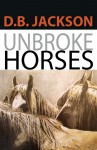
    Unbroken Horses by Dale B. Jackson

    Unbroke Horses clean

    Congratulations to the Laramie Awards 2013 1st Place Category Winners:

    • Mystery:  Double or Nothing by Meg Mims
    • Action/Adventure:  Haunted Falls by Ken Farmer & Buck Stienke
    • Historical Fiction: Because of the Camels by Brenda Blair
    • Civil War:  Ford at Valverde by Anita Melillo
    • Prairie Pioneer:  They Rode Good Horses by Dale B. Jackson
    • Literary Western:  Unbroke Horses by Dale B. Jackson
    • First Novel:  Confessions of  a Gunfighter by Tell Cotten
    • Best Manuscript: Lick Creek by Deborah Lincoln


    HOW DO YOU HAVE YOUR BOOKS COMPETE? Submit them to the Chanticleer International Book Awards –Click here for more information about The CIBAs! 

    Western Pioneeer Civil War Fiction Award

    Want to be a winner next year? The deadline to submit your book for the 2020 Laramie awards is July 31, 2020. Enter here!

    Grand Prize and First Place Winners for 2019 will be announced during our Virtual Conference in early September 2020.

    Any entries received on or after July 31, 2020, will be entered into the 2021 Laramie Book Awards. The Grand Prize and First Place for 2020 CIBA winners will be held on April 17, 2021.

     As our deadline draws near, don’t miss this opportunity to earn the distinction your American Western readers deserve!  Enter today!

    The LARAMIE Book Awards is a division of the Chanticleer International Book Awards – the CIBAs.

    The 2020 winners will be announced at the CIBA  Awards Ceremony, which will take place during the 2020 Live/Online Chanticleer Authors Conference. All Semi-Finalists and First Place category winners will be recognized, the first place winners will be virtually whisked up on “stage” to receive their custom ribbon and wait to see who among them will take home the Grand Prize. Covid19 has made our celebrations a bit different this year, but we still will celebrate!

    Don’t delay! Enter today!  

    As always, please do not hesitate to contact us with questions, concerns, or suggestions at Chanticleer@ChantiReviews.com

    [20] McDougall, Walt, “Pictures in the Papers,” American Mercury, 6:21 (September 1925), 72.


    What’s a Laramie?

    We thought you’d never ask!

    We titled the Chanticleer International Book Awards (CIBAs) division for Western American Fiction and all things that gather around the campfire singing a lonesome tune, the Laramie Awards, after the county and city in Wyoming. You know the one, tucked into the lower right-hand corner of the state between the Snowy Mountain Range and the Laramie Mountain Range.

    Yes, but why Laramie? 

    The small outpost was changed almost overnight when the Union Pacific Railroad moved their “Hell on Wheels” tent town from Cheyenne, Wyoming to Laramie after building the rails over the Sherman Summit at an elevation of 8,200 feet all the way to Laramie on May 4, 1868. Lawlessness and the Wild West ruled in Laramie. Luckily, “Hell on Wheels” moved on West as more track was laid down.

    But where did that name Laramie come from? 

    Laramie was named after Jacque LaRamie, a French or French-Canadian trapper who disappeared in the mountain range that was later named for him in the early 1810s. LaRamie was one of the first Europeans to visit the area. Laramie is a French name much like DuBois, Wyoming. And, yes, it is pronounced Doo – Boys (and NOT Du Bwai).

    There are several reasons we chose Laramie for our iconic Americana Book Awards. For us, and those in the know, Laramie, Wyoming immediately calls to mind the image of a Wild West town filled with rough-and-tumble cowboys. At one point, the only law in Laramie was “lawlessness. Wild Bill Hickok was even known to visit from time to time.

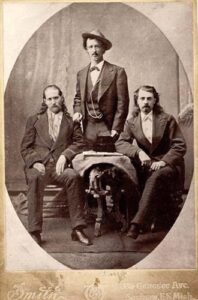
    Here’s a picture of the man, himself, on the left with his friends, Texas Jack Omohundro (center), and Buffalo Bill Cody on the right.

    Butch Cassidy and the Wild Bunch robbed trains and passengers with the first recorded train robbery taking place on June 2, 1899 in Wyoming. Butch was known to be very polite and dislike violence.

    But that’s not the only reason we chose Laramie.

    And, yes, there is yet one more reason we love Laramie! 

    The WOMEN!

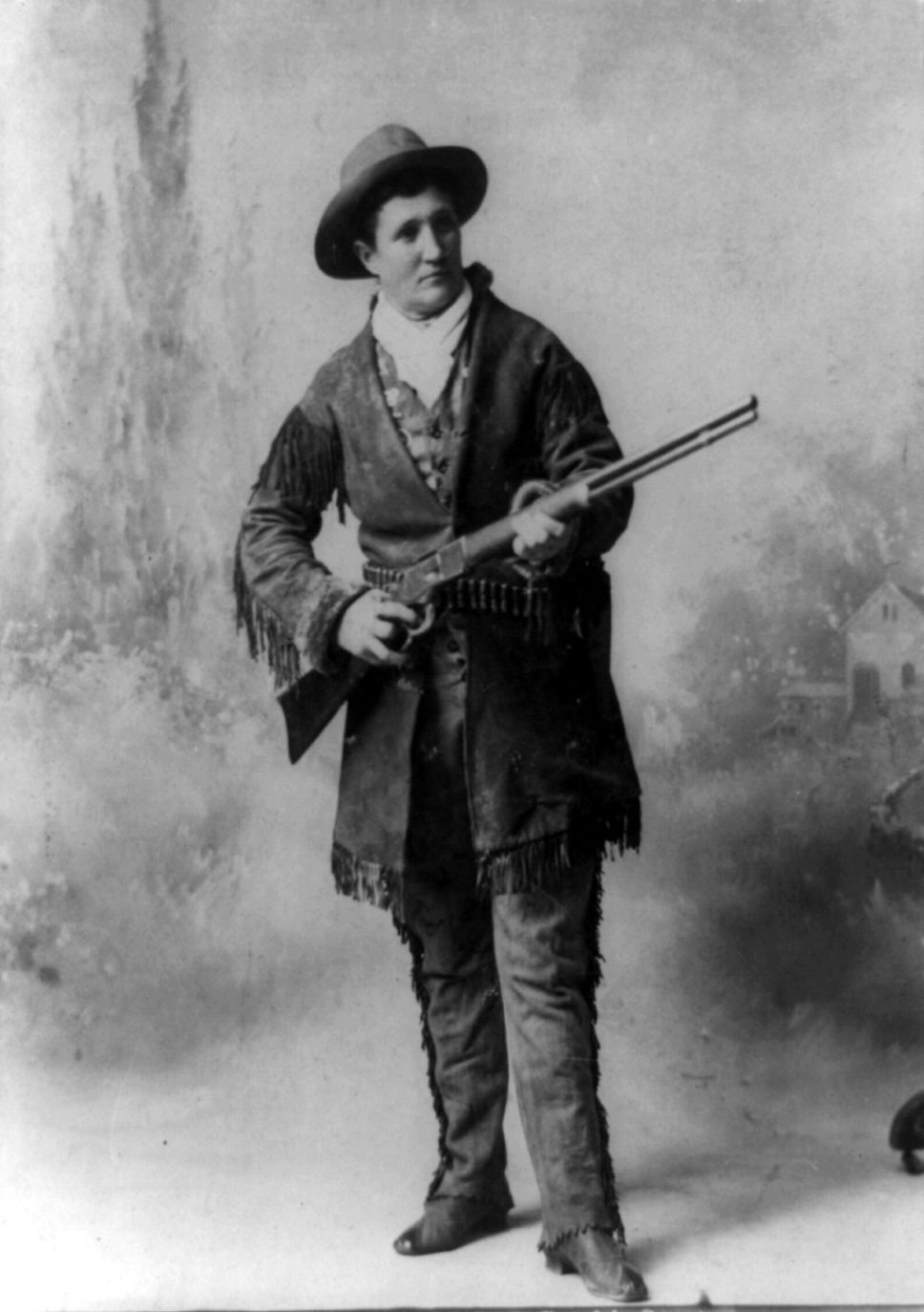
    Calamity Jane hails from Laramie, Wyoming – a skilled sharpshooter who was born to a gambler and a prostitute. She cared for her five younger siblings in Utah before traveling on to Wyoming in search of a better life. There she found work as a dance hall girl and then as a prostitute at Fort Laramie. It was there that she reinvented herself by wearing buckskins and dressing like a man. She was also known for her swearing and hard-drinking ways, but Calamity Jane was also known even more for her kind heart and helping folks out of calamities–thus her nickname.

    Calamity Jane — She was the inspiration for Michelle Rene’s HOURGLASS novel.

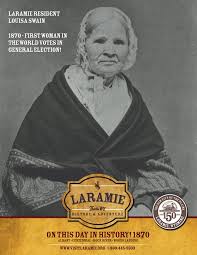
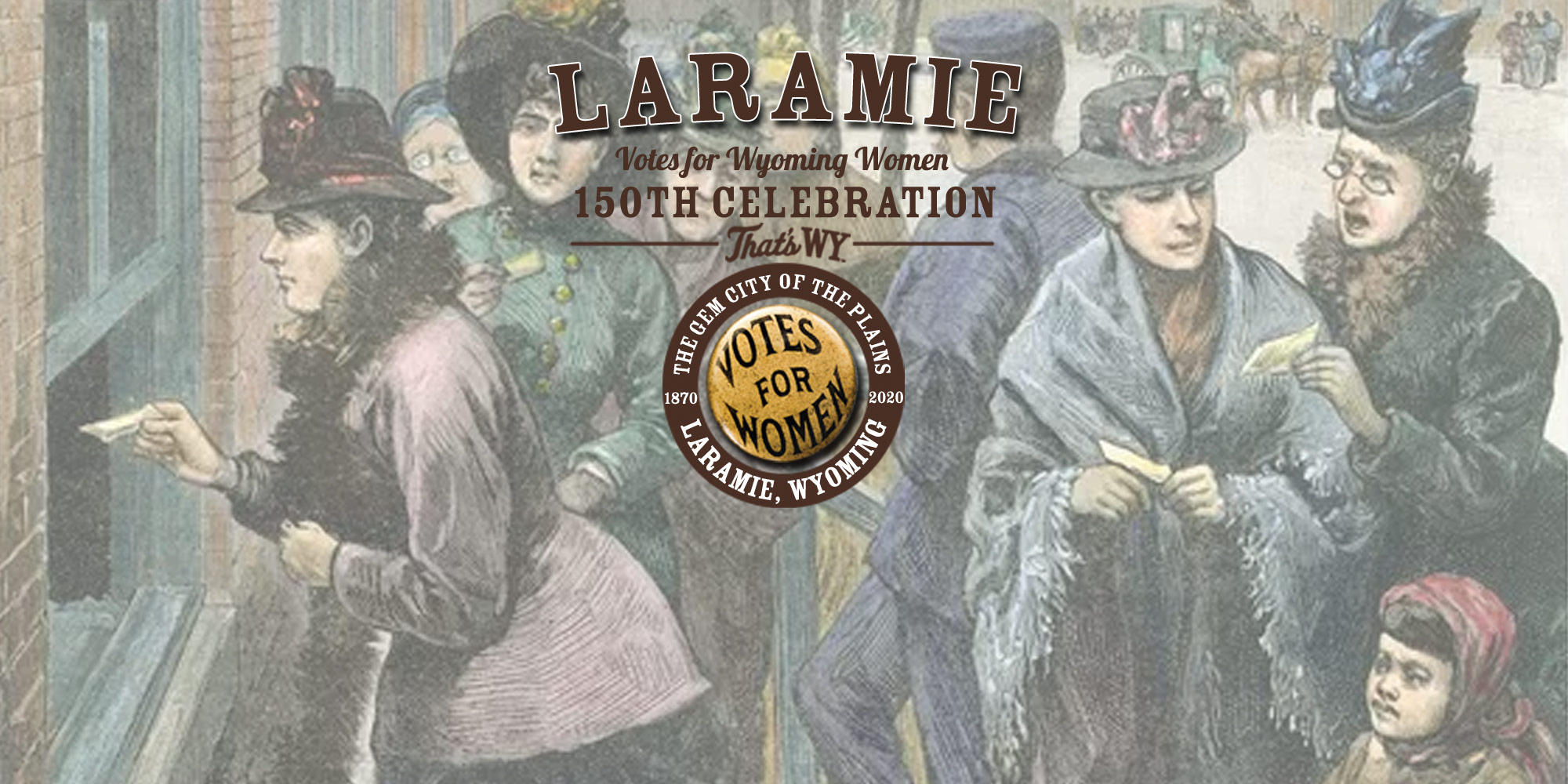
    While the men were wrestling in the streets and shooting up the place, it was really the women who brought civilization to Laramie and Wyoming Territory. They established the first school in 1869, served on a formal jury in the Spring of 1870,  and were the first to gain the vote; which is exactly what Louisa Swain and 92 of her friends did on September 6, 1870 –150 years ago!

    Louisa Swain, the first woman to cast a ballot and she did it in Laramie, Wyoming!

    Louisa Swain – she was made of stern stuff!

    Early in the morning on September 6, 1870 in Laramie, Wyoming Louisa Swain became the first woman in the world to cast a ballot under democratically enacted laws granting women equal political rights with men. In the fall of 2008, 138 years later, the U.S. Congress passes a resolution proclaiming September 6th as “Louisa Swain Day” in recognition of this historic event.The Louisa Swain Foundation

    In 1870, Esther Hobart Morris (59 years old) became the first female Justice of the Peace. She served in South Pass City, Wyoming, which is to the northwest of Laramie.

    Esther Morris "to pettifoggers she showed no mercy." Wyoming Tribune
    Esther Morris, first female Justice of the Peace — Wyoming

    Esther Morris “to pettifoggers she showed no mercy.” Wyoming Tribune

    The Union’s first all-female jury was assembled in Wyoming in 1870.

    Later, in 1894, Estelle Reel Meyer became Superintendent of Public Instruction, the country’s first female statewide elected official.

    And the grand coup d’etat was when in 1889 when Wyoming vied for statehood—and refused to join the Union if the laws giving equality to women were not upheld, telling Congress (which wanted the suffrage law rescinded) via telegram,

    “We will remain out of the Union 100 years rather than come in without the women.”

    Wyoming is also the first state in the USA to allow women to own property and sign legal documents.

    In 1910, Mary Godat Bellamy became the first woman to be elected to the Wyoming Legislature. Two other western states, Colorado and Idaho, elected women legislators in 1895 and 1899, respectively. Wyoming was third in the nation.

    Quotes are from the Smithsonian Magazine
    Read more: https://www.smithsonianmag.com/travel/women-voting-wyoming-150-years-here-how-state-celebrating-180971263/#6UKzMfMeCQsmbIIQ.99
    Give the gift of Smithsonian magazine for only $12! http://bit.ly/1cGUiGv
    Follow us: @SmithsonianMag on Twitter

    {https://www.wyohistory.org/encyclopedia/brief-history-laramie-wyoming}


  • In Celebration of Mother’s Day – Interesting Tidbits, Some History, and a Few of Our Favorite Books

    In Celebration of Mother’s Day – Interesting Tidbits, Some History, and a Few of Our Favorite Books

    Photo by George Dolgikh of Giftpundits


    While mothers are as varied and diverse as the many varieties of flowers in the world, none of us would be here without them! When I think of the word “mother,” there is no possible way I can disassociate the word from my mother. She is strong-willed, strong-minded, and strong-opinioned. And her love rivals the strength of the greatest army the world has ever known. She is my mother. She is the one person who loves me enough to tell me when I am wrong and, yet, loves me anyway.

    How and When was “Mother’s Day” Started

    As all things of Western Civilisation seem to have started in ancient Greece it seems (reference: My Big Fat Greek Wedding), so did Mother’s Day. Well, sort of, honoring the goddess, Cybele/Rhea (depending on time and region). The early Christian Church co-opted the day, calling it “Mothering Sunday,” a festival day in which the faithful would return to the church of their birth. 

    When is Mother’s Day Celebrated Around the World?

    • Mother’s Day is celebrated on the second Sunday in May, in the USA, Canada, most European countries, Australia, New Zealand, India, China, Japan, the Philippines, and South Africa.
    • The UK and Ireland celebrate Mother’s Day on the fourth Sunday in Lent.
    • Most Arab countries celebrate Mother’s Day on March 21st (vernal equinox).
    • Most East European countries celebrate Mother’s Day on March 8th. For a complete overview of the dates of Mother’s Day around the world see Mother’s Day on Wikipedia.

    The Rise of Mother’s Day in America

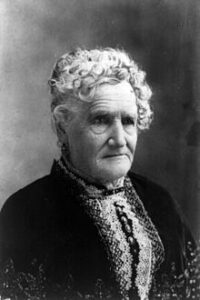
    Before the Civil War, Ann Jarvis and her friend, Julia Ward Howe decided to set up regional clubs, “Mothers Day Work Clubs” designed to teach young mothers how to care for their infants. Their involvement and the clubs continued throughout the Civil War and once the war ended, they held a Mothers’ Friendship Day and invited both Union and Confederate soldiers and their mothers to attend. Big strides toward reconciliation were made through the efforts of these women.

    The women who inspired Mother’s Day were social activists, abolitionists, suffragettes, and educators who wanted to make their world – and their children’s world a much better place. And that is something to celebrate!

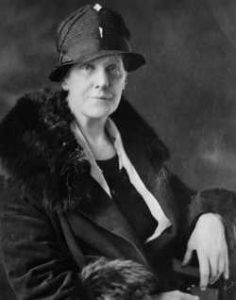
    It was all made a legal holiday when Anna Jarvis, inspired by her social activist mother, Ann Maria Reeves Jarvis, decided to memorialize a day in which to celebrate her mother. In 1907, three years after her mother’s death, she did just that. She chose a white carnation to inspire people to remember their mothers and what they sacrificed for them.

    “Its whiteness is to symbolize the truth, purity and broad-charity of mother love; its fragrance, her memory, and her prayers. The carnation does not drop its petals, but hugs them to its heart as it dies, and so, too, mothers hug their children to their hearts, their mother love never dying. When I selected this flower, I was remembering my mother’s bed of white pinks (flowers)…”  – Anna Jarvis  (quote)

    It wasn’t until 1914 that Woodrow Wilson signed a decree that designated the second Sunday in May as the United States official day to celebrate Mother’s Day. Of course, Mother’s Day is celebrated all over the world (in at least 49 countries) on different days.

    It should be noted that Anna Jarvis wasn’t very happy with the commercialization of Mother’s Day and she fought long and hard to try and get it withdrawn as a national holiday, but we all know how that ended. And if you don’t, well, let’s just say it is a most intriguing mystery…

    Suggested Reads 

    Because mothers are incredibly diverse in their habits and reading lists, we invite you to dive into our reviews and choose what’s you think your mother would like to read most and to perhaps enjoy the books yourself.

    Chanticleer Mother’s Day Reading List!


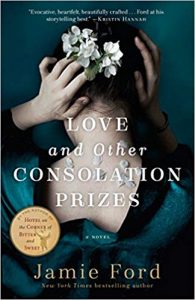
    Jaimie Ford‘s Love and Other Consolation Prizes is powerful storytelling from a master storyteller! Jaimie Ford breathes to life a little-known piece of Seattle history spanning the early to the mid 21st century. And a truly unique story of the many ways a mother’s love can manifest itself. 


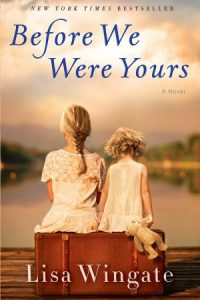
    Before We Were Yours by Lisa Wingate is a disturbing look into what those who should know better, choose to do to society’s most vulnerable during the 30-years between 1920 and 1950 at the Tennessee Children’s Home Society.


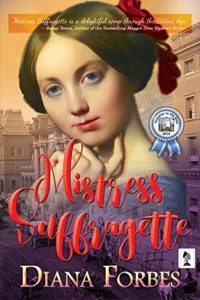
    DianForbesMistress Suffragette examines the facts of life, the challenges of social restrictions, and the woes of youthful love through the eyes of a sharp-minded, sharp-shooting young woman. Mistress Suffragette is now available on Audible


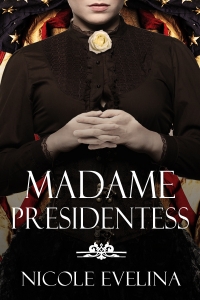
    Nicole Evelina‘s Madame Presidentess is a fascinating story of a woman’s meteoric rise from rags to riches, from subservience to achievement – based on a true story that was instrumental in propelling the Suffragette Movement. 


    A Theory of Expanded Love by Caitlin Hicks


    A Theory of Expanded Love by Caitlin Hicks is a bold, authentic, & captivating –a young teen in the 1960s confronts doctrine when it threatens to outweigh compassion.


    Caregiving Our Loved Ones by Nanette Davis, Ph.D. Dr. Davis passes on her knowledge to caregivers for dealing with the ongoing emotional, financial and health toll of taking care of someone who will never get better.


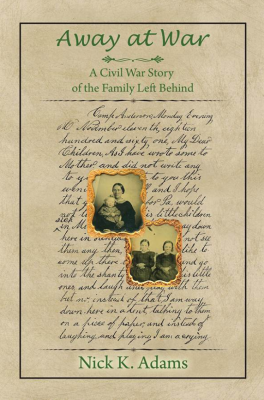
    Nick AdamsAway at War: A Civil War Story of the Family Left Behind is a rich and fascinating account of day-to-day life in rural America in the mid-19th century set against the backdrop of the Civil War. Taken from primary sources, this narrative brings to life all that was loved and all that was lost.


    This is just the beginning of our list! To find more amazing reads in every genre, please click here to discover our favorites!

    We would like to wish all mothers, mothers-to-be, stand-in mothers, and those who possess the mothering instinct, a very Happy Mother’s Day! 


    Electronic Bibliography:

    Mother’s Day Photo Attribution:  https://giftpundits.com/our-free-photos/

    History.com

    Wikipedia

    http://www.calendarpedia.com/when-is/mothers-day.html

  • AWAY at WAR: A CIVIL WAR STORY of the FAMILY LEFT BEHIND by Nick K. Adams – Historical/Bibiography, Family Saga, Civil War

    AWAY at WAR: A CIVIL WAR STORY of the FAMILY LEFT BEHIND by Nick K. Adams – Historical/Bibiography, Family Saga, Civil War

    In 1861, like so many other American men, David Brainard Griffen took leave of his family and enlisted in the army, volunteering as a soldier for the Union. Also like so many other American men, he hoped he’d be home in a few months, that this Civil War would soon be over, and he’d be reunited with his wife, Minerva, his daughters, Alice, seven-years-old, Ida May, five-years-old, and his infant son, Edgar Lincoln. To minimize the pain of separation from his family, he wrote them letters from the field of battle, more than 100 accounts of what he was doing and witnessing as a 2nd Minnesota Volunteer. While the book is one of historic fiction, the letters are genuine, and the characters are based on actual people. The author of this fine account, Nick K. Adams, is the great-great-grandson of Corporal David Brainard Griffen.

    As compelling as the Corporal’s letters are, the mainstay of this book is about those left behind on the Minnesota prairie. In the introduction, Adams notes, “I invite you, dear reader, into the lives of this family who represent the high personal cost that waging war – for whatever cause, good or evil, inevitably produces.”  In this manner, the reader spends time with a family doing the best it can while the head of the household is away.

    One feels like an invisible member of the clan while watching Minerva and her children go about their ordinary, but in many ways, extraordinary lives. Their days are made up of chores. They care for chickens and livestock, barter eggs in the nearby town of Alba for fruit, shoes, and fabric. They make candles out of beeswax and tallow and plant crops to harvest. Livestock are slaughtered. Minerva teaches her daughters to make cheese, a skill she learned during her girlhood in Vermont. They visit with family members who live in the area, enjoy spring and summer days and bundle warmly for the frigid Minnesota winters. Alice attends school and, eventually, Ida May does as well. Edgar Lincoln graduates from baby clothes to his first set of overalls.

    It’s the minutiae of life, the everyday details that build and hold this family, and every family, together. But the reminder of the Civil War is always there. Alice uses a game of checkers to explain warfare to her little sister, and the family gathers to read and reread letters from a husband and a father they miss dearly. They write to him, as well, letting him know how they are coping in his absence. And, of course, there is the added tension of not knowing how long the war will last and whether Brainard will be among the fortunate men to make it home.

    Like the best young adult novels, this book draws a universal audience.  Every reader will feel enriched reading this vivid, charming, and poignant account of farm life in the mid-19th century amidst the backdrop of the Civil War. In addition to an account of family life, one learns much about practical matters in a rural, historic setting.

    Teachers who use Laura Ingalls Wilder’s books in their curriculums will want to add Away at War: A Civil War Story of the Family Left Behind to their lesson plans. There’s a connection between the authors; Alice Griffen married Laura Ingalls Wilder’s cousin. For those interested in simply reading Brainard Griffen’s letters, Adams published them as a collection in an earlier work, My Dear Wife and Children:  Civil War Letters from a 2nd Minnesota VolunteerPut in the context in this lovely novel, however, the letters are a reminder of what was happening in these lives when pen wasn’t put to paper, when a mother and her children had to do whatever was necessary to get through the day and rest for the coming one. This book is both simple and profound, a reminder of a time and place during a tumultuous time in American history.

    Away at War: A Civil War Story of the Family Left Behind won 1st Place in the 2017 CIBA competitions for unique stories of the United States, the Laramie Awards.

    My Dear Wife and Children: Civil War Letters from a 2nd Minnesota Volunteer won Mr. Adams 1st Place in the 2016 CIBA competitions for Memoir, the Journey Awards.


  • MY DEAR WIFE and CHILDREN: CIVIL WAR LETTERS FROM a 2nd MINNESOTA VOLUNTEER by Nick K. Adams – Civil War Memoir, Family Letters

    MY DEAR WIFE and CHILDREN: CIVIL WAR LETTERS FROM a 2nd MINNESOTA VOLUNTEER by Nick K. Adams – Civil War Memoir, Family Letters

    Collected and annotated by the great-great-grandson of a Union soldier, these recollections of the Civil War take on new life and meaning in current times.

    Nick K. Adams, a retired schoolteacher and Civil War re-enactor, was fortunate to have access to letters written by his ancestor, Brainard Griffin. A Minnesota farmer, Griffin volunteered to fight for the Union, leaving behind his wife Minerva, their two young daughters and baby son. His first letter home was written on September 30, 1861. The letters, 100 in all, express his longing to be back home while describing in often minute detail the life of an ordinary combatant.

    Griffin wrote the letters in quiet times, holding a board or his knapsack on his lap as a table. The repeated themes are poignant: loving messages to his wife and children, advice for the management of the farm, even bits of gossip.

    Money worries were constant; at one point Griffin washed the clothes of other soldiers so he could send more of his pay back to his family. Around the mid-point in his service he avows that, “experience is a good school,” assuring “Nerva” that when he returns, he will “prize” his time with family and home.

    Griffin’s regiment traveled extensively through Kentucky, Tennessee, and Alabama, constantly on the alert, experiencing battles, sickness and the travails of heat, mud, and snow. He observed the ravages of war in the farming communities and burned-down towns he passed through and saw firsthand the horrors of a field hospital. He met slaves and engaged them in personal conversation. He often lamented “the curse of slavery” and vowed to fight to end it. From the outset, he believed that the war would soon be over—in a few months, or a year at the most. His accounts of mealtimes indicate the increasing stress on the army’s resources: from coffee twice a day, pancakes, beef, fresh fruits, even pies, to half rations for months at a time, and towards the end of his accounts, mostly salted meat and crackers.

    Despite his optimism that the war would soon end, and his repeated visions of returning to Minerva and the children, Griffin was killed in the first few moments of the savage Battle of Chickamauga, two years after his first letter home, and was buried by Confederate soldiers in a mass grave.

    Adams has taken care to present the letters in their original form. Before each section, he highlights the coming contents and includes a map of troop movements. Though there is repetition, it seems fitting that almost every letter begins and ends with loving greetings to Griffin’s wife and children (some written directly to the girls), and that all express the simple daily trials of the foot soldier. Griffin had illnesses, lost teeth, grew a beard, and never ceased encouraging his wife in her work on their homestead.

    His homey remarks and even a bit of good-natured joking show him as a strong-willed, positive person, and his views on the progress of the national struggle reveal him as a thoughtful patriot with a mind to the future of his country and all its inhabitants.