Author: john-wells

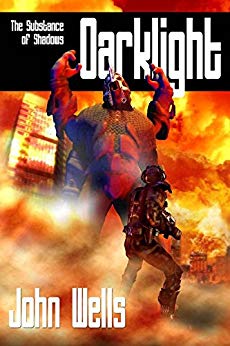
  • Darklight 1: The Substance of Shadows by John Wells – Hard SciFi, Genetic Engineering, Military SciFi

    Darklight 1: The Substance of Shadows by John Wells – Hard SciFi, Genetic Engineering, Military SciFi

    In the aftermath of the Second American Civil War, a feisty, determined genius develops a new way to explore outer space making himself and those he cares about the central target in an interplanetary war in this first-of-a-series Space Opera, Darklight 1: The Substance of Shadows by John Wells.

    Isaac “Crash” Tyson gets his nickname from refusing to give up. When faced with any problem, he just crashes on until whatever is in his way is resolved. A mathematics genius, Crash developed a new field of math, one that will open up space in such a way that earth explorers can take to the stars without any of the usual limitations. He only has to convince P-Quan, the Planetary Governor of Earth and his colleagues at the World Science Council to fund the project. They are all part of the PLAG (Planetary Government) a group of bureaucrats as crooked as they are ruthless.

    Surprisingly, P-Quan goes along with Crash’s proposal; in fact, he’s had his eyes on Crash for some time. He plans to acquire all of Crash’s test data and develop the technology for the exclusive use of the PLAG. Of course, if Crash has a problem with this, P-Quan has the power and the position to crush Crash, permanently.

    Crash is a genius all right, one who’s smart enough to be suspicious of P-Quan’s motivations. He takes on three assistants: the beautiful Lynn, in charge of operations, Nessi, the tech guy, and a hard-boiled policeman, DP, who is even more suspicious than his boss, and utterly loyal. After receiving the funding necessary, Crash gets busy and constructs the Spatial Exclusion Wave Generator (SEG) in a short time.

    The first test of the SEG successfully canceled the spatial field’s interaction with matter and energy. To put it in layman’s terms, the SEG created a Space Hole, an enormous glass-covered hole. So formidable is its power that Nessi pronounces that Shiva, the Hindu god of destruction, has been set loose. The good news: SEG works, creating the space hole Crash predicted. The bad news: before Crash can do anything more, PLAG rushes in for the kill.

    And in a distant galactic outpost, the drama on Earth is being monitored by the Cren Empire who have their own reasons for destroying Crash’s mission.

    The Substance of Shadows is a classic sci-fi of Operatic proportions, positing futuristic technologies, armaments, deep thought, and hidden dimensions. It links a home planet under threat to a small intrepid group of rebels who dare to go beyond known limits, and in doing so, realize that the universe is far more complex and dangerous than any of them could have imagined.

    At the offset, Wells paints a compelling, if bleak, scenario of a Second American Civil War predicated on some current political ideologies. The newly divided country will soon need what Crash can supply in the form of energy resources. In Crash, Wells offers an empathic leader for the Earthlings and other interstellar beings who will need guidance after the dust settles.

    Our review of Darksight II: Conflagaration can be read and enjoyed here.



  • An Editorial Review of “Darklight II: Conflagration” by John Wells

    An Editorial Review of “Darklight II: Conflagration” by John Wells

    Five years after the publication of the military sci-fi thriller Darklight I: The Substance of Shadows, comes the second installment in the series, Darklight II: Conflagration,  the continuation of the conflicts between human and Matarin rebels and the genocidal Cren Empire.

    The stakes have considerably risen since mathematician and rebel fighter Crash Tyson first encountered the billions-year-old Cren Empire in the battle against the equally ancient ESOG Empire. The remaining freedom fighters seek a new sanctuary where they can rebuild their fleet and enhance the Spatial Exclusion Wave technology that Tyson created. They find safe haven with the Skarr, a species that had battled the Luin—the telepathic race controlling the Cren Empire—many eons ago.

    The Skarr hold an advantage: the Luin believe them extinct, along with the Sargen and the Valm, two species that had fought alongside the Skarr. Tyson, however, has the distinct disadvantage of being the Cren Empire’s sole focus, with his capture worth the destruction of billions of their own warriors.

    What warrants such galactic wastage? Tyson is the Progenitor Being, the model human that P-Quan, the Cren governor, created as an experiment in accelerating human genetic evolution in order to generate someone capable of solving The Great Problem.  It is with this experiment that Wells compels us to consider the purpose of sentient life in the Universe. The nature of that problem serves as a teaser until late in the game, when the conflict escalates into a war of multi-dimensional magnitude.

    The depiction of intergalactic war and its futuristic weaponry is where author Wells excels. The astrophysics and engineering of such advanced technology is at once mind-boggling and wholly believable. As E.E. Smith’s works (1890 – 1965) that explored the universe outside of our solar system with fictional technologies, extra-dimensional beings, and time travel before NASA, string theory, or the Hubble Telescope, the Darklight series take readers beyond  the confines of the known universe and into mind-boggling technologies that venture into multi-dimensional applications of  universal cataclysmic potential.

    Warfare comprises much of the story, with telepathic and directed-energy combat filling the gaps between massive, planet-destroying battles. Brisk pacing keeps readers enthralled as other ancient species join the fight, and each apparent victory sees a new threat emerge—none more so than the thousand-mile-long rift in space created by the increasingly powerful weaponry used on both sides.

    Wells explores the connection of life with the ultimate fate of the universe itself and sentient life’s connection to that fate in his Darklight series.  When the godlike being that dwells on the other side of the rift raises the stakes to an unfathomable level, the stage is set for the next Darklight installment.

    If you enjoy E.E. Smith’s space operas that influenced the first generation of computer war games, and (some say) the authors of Earthlight, Star Wars, Babylon 5, and Superman, then venture forth into the Darklight series to expand your universe.