Author: james-r-wells

  • Five Essential Book Cover Elements by Kiffer Brown

    Five Essential Book Cover Elements by Kiffer Brown

    Or Effective Book Covers Deconstructed

    A  few weeks ago, a wonderful and talented author named Debu Mujumdar contacted me about how to begin creating an effective book cover. Effective cover meaning one that will sell itself to readers, bookstores, agents, distributors, librarians…He knows that his current cover is not serving his novel well, but where to start. “What are the first steps to create an effective book cover? Where do I begin?” he asked.

    You see, Debu’s novel, Sacred River: A Himalayan Journey, has won multiple prestigious awards. You can read the Chanticleer review by clicking this link.  He published it in 2016. However, from what I could surmise from his email, he isn’t pleased with its sales or readership reach.  The story is unique and exceptionally well written and has a suspenseful climax. It is filled with tense sub-plots that are engrossing and the stakes are high!

    But the cover he now has reflects very little about the story within. We discussed his cover at last year’s Chanticleer Authors Conference session on book covers. I think I will call the session this year THE GREAT CHANTICLEER COVER “Bake-Off” (with a nod and a hat tip to The Great British Bake-Off TV show). At these sessions in the past, brave authors (self-published) have lain their books on the Cover Altar to be scrutinized—and not just by me, which would be tough enough, but by their peers.  Debu was one of the brave authors who laid his book on the Cover Altar for judgment.

    I then would hold up the targeted book for about 3 to 5 seconds to the group and ask the following question: “What is the genre of this book?”

    Notice, that I did not ask, “Do you like this cover?”  An effective book cover is not necessarily “pleasing.”

    An effective book cover communicates information. And not just the basics—that is a given.

    Most of the time (99% I’d say), not one person in the group could tell the genre of the (self-published) books laid on the Cover Altar —much to the chagrin of the books’ authors.
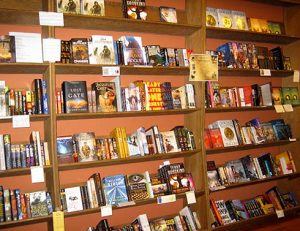
    Village Books Bellingham, Wa

    Why 3 – 5 seconds? That is the time that the cover has to attract a potential readers’ attention.

    Potential Readers being booksellers at tradeshows, librarians at the ALA shows, shoppers on Amazon, shoppers at your local bookstore, shoppers at WalMart or Barnes & Nobles or at the airport … Well, you get the picture.

    In this 3 to 5 seconds, your cover must communicate quickly and effectively the following 5 Elements:

    1. The Genre (Historic? Thriller? SciFi? Romance? Cozy Mystery? Literary? etc.)
    2. The Primary Targeted Age Group (Adult for the Trade? Guys? (think Tom Clancy) or Gals? (think Rebecca Wells), General Audience? Young Adult? Middle-Grade? Clean reads market? (think Jan Karon) etc.)
    3. Mood (Humorous? Suspenseful? Adventurous? Dark? Light-hearted? Romantic? Horror? Spiritual? etc.)
    4. Timeframe (Current? Futuristic? Regency? WWI? Western? Classic Roman? etc.)
    5. Place or Cultural Reference (India? New York? Africa? Outer Space? California? Paris? Russia? Japan? etc.)

    An effective book cover will convey all of this information (or enough of it) to capture a potential reader’s attention in less than 5 seconds—three seconds really. It will garner enough interest to have the potential reader to pick it up or click on the link to find out more. If it does not, your book is invisible to potential readers. And yes, that is a publishing industry’s insider’s term.

    Invisible books rarely sell.

    Effective covers sell the first book. The content between the covers sells the second book. And you can quote me on that.

    Here are some examples of before and after covers that have been lain upon the Book Cover Altar:

    Example No. 1
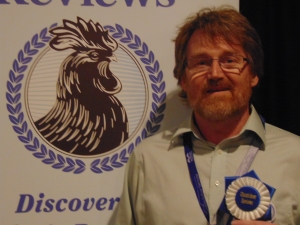
    James R. Wells Awarded the Cygnus Grand Prize for THE GREAT SYMMETRY


    James Wells’ The Great Symmetry, a Cygnus Grand Prize Book Award for Science Fiction:

    BEFORE                                                        AFTER

    The Great Symmetry from James R Wells


    The comments regarding the original cover were:

    • Is it a biology book? Is it a math biology book? I dunno? Is it a non-fiction book?

    Point made.

    Bookbub picked up The Great Symmetry with its new cover. ‘Nuff said.

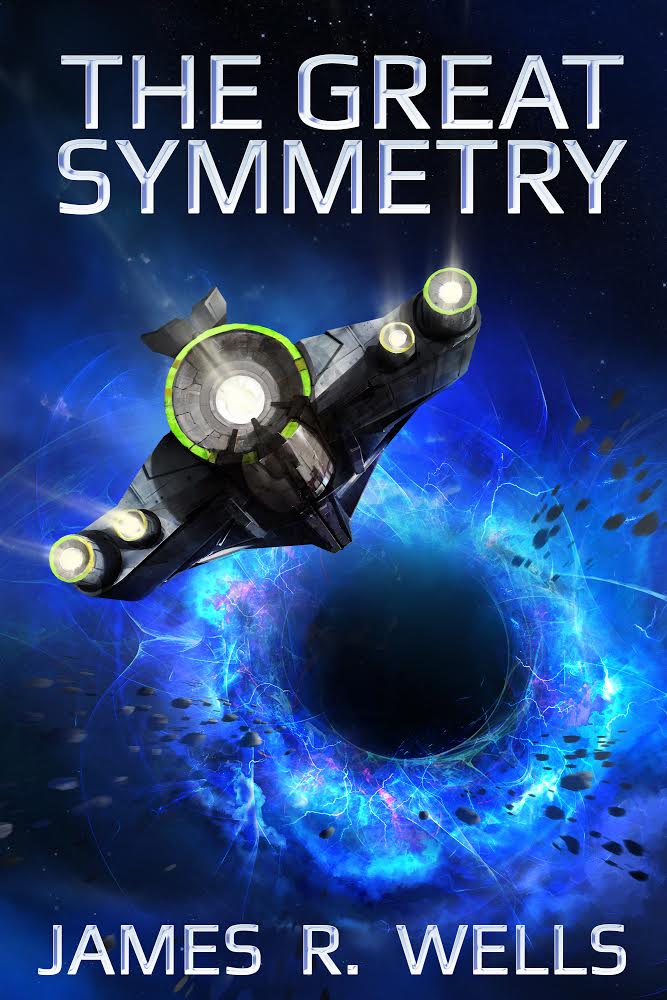
    Does the new cover  communicate quickly the 5 Elements above:

    1. Genre – yes. Clearly Science Fiction
    2. Primary Age Target Group – yes. General Audience for the Trade (i.e. commercially viable, a plus!)
    3. Mood – yes. Suspenseful with Action — Is that a black hole? Looks scary!
    4. Timeframe – yes. Futuristic with high technology
    5. Place or Cultural Reference – yes. OuterSpace — possibly intergalactic.

    Example Number 2

    Sara Dahmen’s Doctor Kinney’s Housekeeper, Laramie Grand Prize Winner for Western Fiction
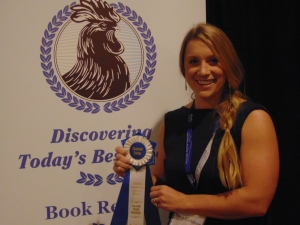
    Sara Dahmen awarded Laramie Grand Prize for DR. KINNEY’S HOUSEKEEPER


    BEFORE                                         AFTER


    The comments made during the Great Cover Bake-Off regarding the original cover were:

    • Is it a cookbook for baking? Is it a book about a baker? Again: I dunno? Is it a non-fiction book?

    Point made.

    Dr. Kinney’s Housekeeper was picked up by a publisher because it had an interesting storyline and commercial potential (read, TV series). After some rewriting to pose the book as a series, a new cover was created that reflected the storyline along with a new title Widow 1881: Flats Junction Series

    Does the new cover communicate quickly the 5 Elements above:

    1. Genre – yes. Clearly Historical Fiction, the late 1800s
    2. Primary Age Target Group – yes. General Audience for the Trade – female-focused
    3. Mood – yes. Change is coming. The fancy wallpaper from city life Back East to the map of the territory clearly shows this. The cultured young woman standing in front of fancy wallpaper is wearing clothes that do not allow for much movement or made for working.  Note the tiny waist from wearing a corset, her fine gloves, the fine wool flannel, and her hair arrangement, her hat. This young woman is heading out alone to a place where there will be little refinements that she has become accustomed to. Will she survive? What awaits her?
    4. Timeframe – yes. 1881 (And what was it like being a young widow in 1881 going out to unknown territory alone)
    5. Place or Cultural Reference – yes. North America West against Back East culture in the late 1800’s

    Sara is happy to report that book sales are brisk and the novel (first in the Flat Junction series) is under consideration for film options.

    Example No. 3

    Now let’s go back to Debu‘s award-winning novel, Sacred River:   A Himalayan Journey

    Click on the link above if you want to visit Debu’s website.

    The tags for the book are Literary Fiction, Multiculturalism Issues, Mystery, Thriller/Suspense, India.

    Here is the novel’s cover:
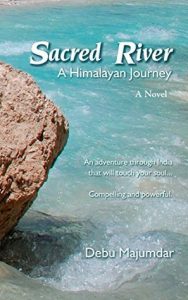
    Now let’s apply the 5 Elements. What does the cover tell you in less than 5 seconds?

    1. The Genre:  Travel? Non-fiction?
    2. The Primary Targeted Age Group:  General Audience? Probably. Literary audience? Probably not. Suspense/Thriller audience? No way.
    3. Mood: Don’t know.
    4. Timeframe: No idea.
    5. Place or Cultural Reference: No idea?

    Does the cover convey any of the following (blurbs from the Chanticleer Review of it)?

    “A tour de force of India’s history, religion, culture, philosophy, anthropology, sociology, and politics are neatly packaged as a mystery…”

    “…As speculation of a golden hoard hidden in the sacred temples arises, Chetti and his associate scheme to locate and plunder treasure for a noble cause…”

    “An engrossing and tense subplot unfurls, one that will ensnare a temple swami along with some of the pilgrims to the Ganges. This adventure, which culminates in an enormously suspenseful climax…”

    “Readers will feel they are in a marketplace, on the side of the mountain, in a temple, and bathed in light and water. Especially lovely are the passages noting religious rituals and the spiritual significance of the Ganges. The author weaves in Indian legends and morality stories, artfully juxtaposing parallels between ancient tales and his characters’ modern lives.”

    Nope.

    How to Increase Book Sales
    Make your book stand out in a sea of books!

    Debu’s award-winning novel deserves a cover worthy of the time and writing craft that he invested into it. His cover has to intrigue potential readers and booksellers to pick it up wherever it is displayed. The cover must convince the web surfer to click on the image.

    But how?

    My advice to Debu is to begin collecting visual elements of people, objects,  paintings, locations, symbols, ideas, etc. that reflect the content of the work. Take several weeks to do this. Enlist friends, family, and readers to help with this. Gathering visual elements would make a great social media campaign. Ask readers to post photos or graphics of images that remind them of the novel.

    Dig deep. Come up with at least 30 elements, if not more.

    Lay the visual printouts where you can see the elements from far away, close up, upside down. Such as writing the novel, exploring the cover concepts will take time. Deciding on the cover concept will take more time and feedback.

    In a few weeks of letting ideas percolate, particular visual elements will begin to resonate. Then you will have something to explore.

    Update! Debu has re-released his book with this cover

    Don’t let your book become invisible to its potential readers!

    Effective covers sell the first book. The content between the covers sells the second book. And you can quote me on that. (And yes, I am repeating myself. )

    I will continue with another blog post that discusses what comes next—How to Put the Elements Together for an Effective Book Cover.

    Here is a link to Canva. It is a FREE graphic-design tool website that is easy to use. It is a great way to explore cover ideas and to play with visual elements to discover what will resonate cover-wise with your readers.

    Meanwhile, keep on writing! ~ Kiffer

    Click here if you would like information about the Chanticleer Authors Conference

    Or here for more information about the Chanticleer International Book Awards. 


  • E-Book Sales as Core of Your Books’ Marketing Plan by James Wells

    E-Book Sales as Core of Your Books’ Marketing Plan by James Wells

    The eBook market is a huge opportunity, especially for indie authors.

    If you’re not focusing on eBook sales as a core part of your marketing plan, you’re missing out.

    great symmetry james wells

    When I published my first novel The Great Symmetry, I printed a few hundred copies and imagined that it would be a great success if I sold them out. I had no idea where I would find the vast majority of my readers.

    Just a year later, about 95% of my sales are eBooks. Every day, readers are buying my book on Amazon and other sites from all over the world.

    To get traction in the eBook market, I tried out new things, made plenty of mistakes, and then had a series of increasing successes. I’m grateful to the authors who helped along the way. Now I’m distilling the most important lessons to help other authors.


    At the upcoming Chanticleer Authors Conference, I’ll be presenting a series of three sessions about eBook publishing. The content won’t focus on mechanics like eBook file formats – that’s boring and you can figure out that stuff easily. Rather, we’ll dig into the most important decisions facing an author in the eBook market. The sessions are:

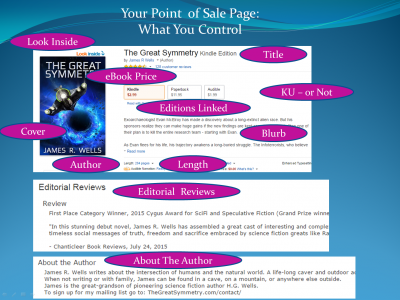
    • eBook Publishing 101: Designing your points of sale (such as your Amazon page) to convert browsers into buyers.
    • eBook Publishing 102: Getting readers to your points of sale. We’ll emphasize the most cost-effective tool around – the discount promotion.
    • eBook Publishing 103: Advanced topics such as series planning, reader magnets, and more.

    An overarching theme of all of these sessions is that your eBooks are a central part of your offering.

    Chanticleer blog post James Wells


    For some types of book (especially genre fiction by indie authors), it’s the most important channel for you. This means you should plan ahead for your eBook. For instance, some cover designs look wonderful in print, but are failures online – we’ll discuss how to avoid that pitfall. There may even be reasons to modify the text of your novel to sell well as an eBook.

    It’s ironic because I don’t even like reading eBooks myself. I only just gave in and bought a Kindle last week. But my preference doesn’t matter to the market – your priority as an author should be to make your book available, and well positioned, in the channels where the readers are found. These days, that means eBooks.

    Note from Kiffer Brown

    [fusion_builder_container hundred_percent=”yes” overflow=”visible”][fusion_builder_row][fusion_builder_column type=”1_1″ background_position=”left top” background_color=”” border_size=”” border_color=”” border_style=”solid” spacing=”yes” background_image=”” background_repeat=”no-repeat” padding=”” margin_top=”0px” margin_bottom=”0px” class=”” id=”” animation_type=”” animation_speed=”0.3″ animation_direction=”left” hide_on_mobile=”no” center_content=”no” min_height=”none”]

    James-Wells-Author-Picture
    James R Wells, Science Fiction Author

    I would like to thank James R. Wells, the author of The Great Symmetry for sharing his knowledge and experience with the Chanticleer Community.

     [/fusion_builder_column][/fusion_builder_row][/fusion_builder_container]

  • Observations from a Discount eBook Promotion by James R. Wells

    Observations from a Discount eBook Promotion by James R. Wells

    Like Icarus Taking a Selfie — Observations from a Discount eBook Promotion by James R. Wells

    [fusion_builder_container hundred_percent=”yes” overflow=”visible”][fusion_builder_row][fusion_builder_column type=”1_1″ background_position=”left top” background_color=”” border_size=”” border_color=”” border_style=”solid” spacing=”yes” background_image=”” background_repeat=”no-repeat” padding=”” margin_top=”0px” margin_bottom=”0px” class=”” id=”” animation_type=”” animation_speed=”0.3″ animation_direction=”left” hide_on_mobile=”no” center_content=”no” min_height=”none”]

    Paperback Writer by the Beatles
    Paperback Writer – Lyrics by the Beatles

    If you’re an author, perhaps you’ve been here: I had finished my novel The Great Symmetry, done a print run for local bookstores and my website, and had sold some copies. Reviews were encouraging. The wider world beckoned. But how to launch? My Kindle edition was selling a copy every few days on Amazon – not exactly conquering the world.

    This post is about my first discount eBook promotion. This discount promotion was a huge learning experience for me!

    It turned out well with 600 sales over a 13-day period, due to working through some mistakes and some lucky accidents as well. The great news for everyone is that you can read about all my errors, as well as a few moments when this blind chicken happened upon a grain of corn, to help you plan for your successful promotion.

    As I was looking around for ideas, I read an enthusiastic post on KBoards from an author who had just done a discount promotion for her new book. She had signed up for several advertisers at a small cost such as $10 each, and had realized a nice collection of sales over several days.

    From this and other posts, I pieced together the concept: Discount your book from its regular price, then each advertiser sends out an email to their list of subscribers.

    Here’s the key: The subscribers on each list have specifically signed up to be notified about discounted eBooks. How great is that? You can advertise your book to people who actually want to hear about it. In order for this to work, you need a real regular price that’s $2.99 or higher, so you’re offering an authentic discount.

    I figured I could do a promotion too, so I shot off some applications to advertise for dates a couple of weeks ahead. When got my first acceptance from an advertiser (yes they get to choose the books they want to promote), I was thrilled and promptly paid. I was committed. Shortly after, I realized my first mistake – lack of advance planning. The best advertisers require four or more weeks of advance notice, and I had set my promotion dates far too soon.

    Now you know: Plan your promotion in advance, and apply to advertisers four weeks or more before your planned dates.

    The scramble was on. I sent in applications for the empty days, and after some anxious days was able to put together a lineup of promotions for each day except one. As I waited for the first day of the promotion, I found out more.

    Here’s another key point: When you do a discount promotion, the purpose is not to make money – it’s to increase your readership. At a price of $0.99, your commission goes down to 35%, and it takes a lot of sales to cover your advertising costs and then have enough to buy a beer at the end. I set modest goals: Get some new readers, a few reviews, and a “tail” of sales after the promotion is over.

    Discount Promotion Steps

    1. Get everything ready: cover, blurb, reviews
    2. Set a regular price: $2.99 or more
    3. Decide your promo period, usually 1-2 weeks duration
    4. Apply to advertisers for spots
    5. Commit, pay, set advertising dates
    6. Set your price to $0.99, a full day before start
    7. Step away from the computer!
    8. After the promo: analyze what worked or not –

    As the promotion started, I learned the next hard lesson. Your blurb needs to not suck. My blurb had loads of fascinating information, none of which screamed out to a potential reader that they needed to buy this book. The results on the first day of the promotion reflected this.

    After some frantic consultation with other authors, I refined the blurb twice over the next few days in accordance with a key principle: Don’t explain your book. Just find the most enticing few sentences that clearly convey your genre and the idea that it’s a compelling story. Imagine that a person will only read the first few lines before deciding whether to read further, or just skip along to the next book. As soon as I posted my blurb revisions, sales picked up.

    When it came to reviews, I lucked out. I had some good reviews from my paperback version before launching on KDP. This really helped. Make sure you have those precious first reviews!

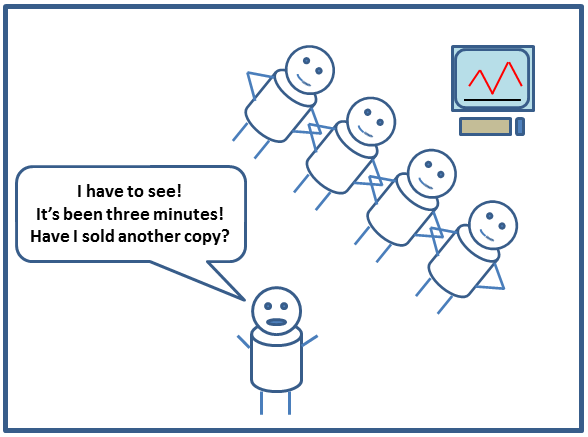
    With the blurb revised, there was nothing else to do except watch. Better still: don’t watch. Because refreshing the screen on your KDP sales dashboard every minute is pretty much the dumbest way you can spend your day.

    james wellsPro tip: Find a way to be off your computer most of the time during your promotion. You can ask friends to stage an intervention. Some authors provide their passwords to a trusted friend with instructions to change the passwords and provide only a daily summary.

    In the matter of staying away, I failed completely. That’s me above. Next time I’m going to make plans to be in a cave or something.

    Yep – next time. I realized that as long as I’m an author with books available for sale, it’s going to be worth doing promotions periodically, probably several times a year.

    james wellls chartAnd not just for the tangible results. I took a screen capture of that moment at #15 on the bestseller list for Hard Science Fiction, like Icarus taking a selfie before the inevitable plummet Earthward, to remind myself that I can do this. I belong on that list, and I’ll be back.
    A discount eBook promotion is an important tool for building your initial readership. But it’s just part of the picture. Promote what you have, while not losing sight of what matters most – your next book. Keep writing! 

    Editor’s Note: 

    We want to thank James R. Wells for sharing his experience and findings with the Chanticleer Community of Authors

    James R. Wells writes about the intersection of humans and the natural world. A life-long caver and outdoor adventurer, he has explored and mapped new passages in many of North America’s great caves. When not writing or with family, James can be found in a cave, on a mountain, or anywhere else outside.

    James has recently published The Great Symmetry. His work “echoes the timeless social messages of truth, freedom and sacrifice embraced by science fiction greats like Ray Bradbury, Robert Heinlein, and the author’s own great grandfather H. G. Wells. Its powerful premise gives voice to the perils and challenges of our current society and reminds the reader that even the smallest person can change the world. A great read!”

    Click here to read the full review.


     [/fusion_builder_column][/fusion_builder_row][/fusion_builder_container]

  • The GREAT SYMMETRY by James R. Wells, a Science Fiction Thrill Ride

    The GREAT SYMMETRY by James R. Wells, a Science Fiction Thrill Ride

    At the dawn of the 24th Century, seven corporations or “families” known as the Sisters dictate every aspect of human life. “The Spoon Feed” spits out the latest curated news while Marcom, a marketing communications group, composes “The True Story,” their version of reality for public consumption. Tight control of information is necessary for total corporate domination of all planetary enterprises and the Sisters are willing to go to extreme measures to maintain their stranglehold on humanity.

    Driven by a thirst for new information, exoarcheologist Evan McElroy makes a discovery that takes him outside of the perceived safety of the “True Story” and hurls him into the nearest glome, a wormhole-like space portal, where he runs for his life.

    His discovery, an ancient artifact from the extinct Versari race, contains data with the potential to dismantle the control of the Sisters and destroy the carefully crafted society they’ve created. A discovery worth killing for.

    From the first sentence to the last, The Great Symmetry is a science fiction thrill ride. Opening with Evan in the crosshairs and missiles of Affirmatix (a family of companies within the Sisters), he is forced to take a leap of planetary faith. Evan sends out a final coded message then, with the artifact safely tucked into his EVA suit, he steps out of his runabout craft and propels himself into deep space to escape obliteration by the Affirmatix.

    With a dwindling oxygen supply his only hope is that expert pilot and longtime friend Mira Adastra will decode his message before death or Affirmatix takes him. But Affirmatix is already targeting all of Evan’s known associates and Mira has had her own run-ins with the Sisters. It’s only through the unlikely help of Evan’s ex-partner, Kate DelMonaco, that any of the three have a chance to make it out of Evan’s giant leap alive.

    In this stunning debut novel, James R. Wells has assembled a great cast of interesting and complex characters embedded in a well-planned dual narrative. Pitting the infoterrorists – seekers of reality and truth – against the corporate, profit-before-people decision makers of Affirmatix creates a dynamic “good versus evil” scenario that allows for a deeper understanding of the motivations that drive each side. The shifting narrative also enables the reader to travel between unique environments that reveal rich and clever world-building components.

    With its Kafka-esque view of an escalating, dominant corporate presence, James R. Wells’ The Great Symmetry echoes the timeless social messages of truth, freedom and sacrifice embraced by science fiction greats like Ray Bradbury, Robert Heinlein, and the author’s own great grandfather H. G. Wells. Its powerful premise gives voice to the perils and challenges of our current society and reminds the reader that even the smallest person can change the world. A great read!

  • COMMUNITY MARKETING for AUTHORS by James R. Wells – author of THE GREAT SYMMETRY, a science fiction novel

    COMMUNITY MARKETING for AUTHORS by James R. Wells – author of THE GREAT SYMMETRY, a science fiction novel

    When you are getting ready to self-publish your book, two questions loom over your project and, in fact, your entire life:Paperback Writer by the Beatles

    – Who will read my book?

    – How will I find them?

    You’ll find lots of advice online about how to promote your book. Typical ideas may include setting bargain days (especially for the ebook version) and then paying promoters to send out thousands of emails about your opus to their subscribers. You are advised to set up your website and Facebook page, and flood the ether with tweets (doing your part to alleviate the serious shortage of tweets out there).


    Some sites may advocate a kinder, gentler version of self-promotion, where you locate online groups who might be interested in things similar to your book and so you join, making a point of doing enough to be recognized as a contributor before you do much mentioning of your great work. Conducting the delicate dance of promoting while seeming not to. Flying casually past the imperial star destroyer of being perceived as selling or spamming.

    There is another approach to consider: Community Marketing.

    One of your best opportunities to get your book started is to bring it, directly and honestly, to the communities where you already are a contributor and a known friend. You’ll be surprised how many people are willing to give your book a chance, and, if it’s excellent (that part’s up to you), they will tell their friends about it or write a review.

    This may seem to be in conflict with another piece of advice that you’ll see – to seek out people interested in the subject matter of your book, rather than people you simply know.

    Here’s how that apparent conflict resolves:

    The people you choose to spend time with probably think about similar themes as you, and hopefully what matters about your book is theme – those ideas that you care mostly deeply about – just as much as the overt subject matter.

    [fusion_builder_container hundred_percent=”yes” overflow=”visible”][fusion_builder_row][fusion_builder_column type=”1_1″ background_position=”left top” background_color=”” border_size=”” border_color=”” border_style=”solid” spacing=”yes” background_image=”” background_repeat=”no-repeat” padding=”” margin_top=”0px” margin_bottom=”0px” class=”” id=”” animation_type=”” animation_speed=”0.3″ animation_direction=”left” hide_on_mobile=”no” center_content=”no” min_height=”none”][Let’s be clear that affinity groups matching your subject matter can be great. I won’t turn down a chance to meet with a bunch of scifi readers!]

    Here’s an example of community marketing from the launch of my science fiction novel The Great Symmetry. A reasonable person would think that it’s important to find science fiction enthusiasts – that’s the overt subject matter. But that posed a problem, because as much as I love science fiction, it happens I have not become part of scifi affinity groups.

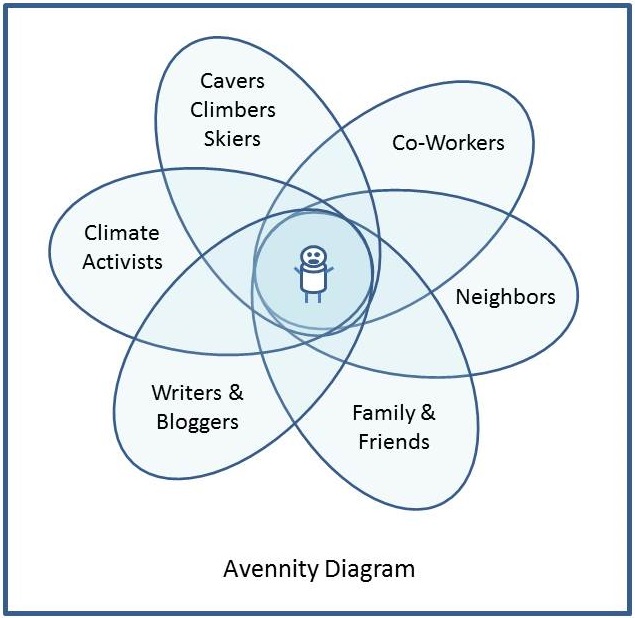
    Rather, my community is defined mostly by the groups shown in the Affinity (Avvenity) diagram below.

    Avennity Diagram Luckily, there’s some alignment going – more than I would have thought. Out of each population, some people like science fiction. Others care about freedom of ideas and social equity, which are strong themes of the novel. Others just like an adventure story in any setting.

    It’s really worth evaluating which of your communities may be interested in your book, even if you initially don’t see any alignment. For example, members of all six of the groups I list above have bought my novel.

    Now you need to learn how to tell people about your book. It’s scary. Nobody wants to sell to their friends.

    Here’s the key realization to help you through this stage: You are probably not going to make money on your first self-published book.

    It’s not a commercial venture. Some day in the future? Okay, maybe. But not today, or next week, or next month. The selling price of your book isn’t income, not by a long shot – it’s cost recovery.

    This is actually good news.

    Your book is your art. It’s your labor of love. And that changes everything.

    Instead of selling, you are sharing a part of yourself. People respect that. Once you embrace this idea, suddenly you can ask where you never could before. Go for it – tell people about your book. Ask them to come to your book launch. If they read it and liked it, ask them to post a review on Amazon or elsewhere.

    You can ask because it matters. The ideas in your book matter. Sharing those ideas with your friends matters.

    My friend Kurt told me this one day, as I was pondering how many Facebook posts about the book launch was too many:

    “James, DO NOT apologize for promoting your book! Use any legitimate means at your disposal to get the word out!”

    As the date of my first public reading and the official  book launch date approached, I faced a level of social terror that I don’t think I have ever experienced before. I had spent years on this project. But – no matter what I might do to get the word out, what if nobody other than my mom showed up?

    So I asked.

    I wrote individually to friends to tell them about the event. I asked a local talk radio host for a radio interview. I asked the editor of our local paper, The Cascadia Weekly, to profile the book. I made a Facebook event and invited everyone in the known universe. The results were encouraging.

    The Great Symmetry Reading by author James R Wells

    Attendee count: 123 people, the third highest in the history of the bookstore (Tom Robbins and Ivan Doig outdrew me). Mostly because I asked. And in case you were wondering, my mom did make it.

    Community Marketing won’t work forever. After a while, you’ll run out of friends who don’t yet know about your book. In the long term, it can’t be your only plan. But I believe Community Marketing can be very effective in helping your book get started: getting some copies out into the world, having an encouraging first reading event, and accruing those all-important first few reviews.

    Just remember – it’s okay to ask for something you think is important.


    Helpful Notes:

    All the community marketing in the world won’t help your book if it’s not good enough. See this post The Kübler-Ross Stages of Editing about the process of getting ready for publication.

    Song Lyrics from “Paperback Writer” by John Lennon and Paul McCartney.

    CBR Editor's Note about James R. Wells, the author of this post:

    James R. Wells is the author of The Great Symmetry, a science fiction novel set 300 years in the future, but is definitely about the world we live in here and now.The Great Symmetry by James R Wells

    In an asteroid in the Aurora star system, exoarcheologist Evan McElroy has made a discovery about the Versari, a long-departed alien race. He doesn’t realize that his findings will reawaken the long-buried struggle of the Infoterrorists, who believe that all knowledge screams to be free, against those who maintain the True Story that holds all of civilization together.”

    With its Kafka-esque view of an escalating, dominant corporate presence, James R. Wells’ The Great Symmetry echoes the timeless social messages of truth, freedom and sacrifice embraced by science fiction greats like Ray Bradbury, Robert Heinlein, and the author’s own great grandfather —H. G. Wells. You may find out more about this stunning debut sci-fi novel and its author at www.TheGreatSymmetry.com.  

     [/fusion_builder_column][/fusion_builder_row][/fusion_builder_container]

  • A stunning new Sci Fi novel: THE GREAT SYMMETRY at Super Launch Price of 99 cents!

    A stunning new Sci Fi novel: THE GREAT SYMMETRY at Super Launch Price of 99 cents!

    great symmetry james wellsIf you could hold in the palm of your hand an object that could change the course of humanity’s future. What would you do?

    Archaeologist Evan McElroy has made a discovery about an extinct alien race. But Evan’s corporate sponsor sees the potential to make huge gains if the new findings are kept completely secret. Step one of their plan is to kill the entire research team – starting with Evan.

    As Evan flees for his life, his trajectory awakens a long-buried struggle. The Infoterrorists, who believe all ideas are screaming to be free, have been waiting for the right moment to take on the seven great families that control all of civilization. This could be their opportunity. Or, it could be time for millions to die.

    “The Great Symmetry” is pure classic science fiction from the great-grandson of science fiction pioneering author H.G. Wells, James R. Wells.

    CLICK HERE for the direct link to the Amazon Page and the 99 cents special! Hurry — Offer ends July 26st!