Author: jacquie-rogers

  • Spotlight on the 2021 MARK TWAIN Book Awards for Satire & Allegory

    Spotlight on the 2021 MARK TWAIN Book Awards for Satire & Allegory

    A cackle, a hoot, a snort

    You wish the group across the room was laughing about your book.

    The Deadline for the Mark Twain Book Awards is fast approaching!

    It might seem odd, but Franz Kafka and his friends reportedly sat around at bars reading excerpts of The Metamorphosis with tears of laughter streaming down their faces.

    Franz Kafka staring seriously into the camera
    Franz Kafka (1883-1924)

    While he might not seem like a natural pairing with Mark Twain, Kafka certainly had a sense of humor. We may not quite understand his early 1900s thought process that would cause him to need to stop in the middle of reading “The Trial” due to laughing so hard (read more from The Guardian here), but we definitely can still appreciate a healthy dose of humor.

    Fun Fact: Franz Kafka’s writing was known to deal with modernism, existentialism, Surrealism, and is considered a precursor to magical realism. Despite his fame, he never finished a single novel (unless you count The Metamorphosis as a short novel).

    The Mark Twain Awards, named after the famous satirist, are still a fairly new division of The Chanticleer Int’l Book Awards. You can see a full write up on Mark Twain’s relationship with Bellingham, WA here.
    Do you have a book that features Humor, Satire, or Allegory? Submit it here before the end of November to be entered into the 2021 Mark Twain Book Awards!

    Let’s do a quick breakdown on the three main categories of Mark Twain books.

    Satire: The Dangerous Tool

    Probably one of the most difficult genres to write in, Satire can have trouble with rubbing people the wrong way. One of the most commonly known pieces of satire is “A Modest Proposal” by Jonathan Swift, made ubiquitous by English courses teaching it for decades. You can read the full essay here.

    Gulliver being held down by the Lilliputians
    Jonathan Swift is best known as the author of Gulliver’s Travels. Above, Gulliver is restrained by the Lilliputians

    The essence of it is that Swift proposes eating Irish children instead of feeding them, as it will save more money for England in the long run, and cause less suffering for the kiddos in the long run. This obvious, garish suggestion highlights the ways in which England may as well be eating the children in a way that both shames those who have acted poorly, and serves as a call to action to offer better care to the poor.

    Of course, MasterClass.com has an excellent definition at the ready for us:

    Satire in literature is a type of social commentary. Writers use exaggeration, irony, and other devices to poke fun of a particular leader, a social custom or tradition, or any other prevalent social figure or practice that they want to comment on and call into question.

    Contemporary writers have used satire to comment on everything from capitalism (like Brett Easton Ellis’s American Psycho, which uses extreme exaggerations of consumption, concern with social status, and masculine anger and violence to skewer American capitalism) to race (Paul Beatty’s The Sellout, for example, features a young black male protagonist in Southern California who ends up before the Supreme Court for trying to reinstate slavery).

    The word Satire filled with newspaper clippings

    As you can see, satire is a sharp tool that must be wielded carefully to avoid cutting yourself on accident. A good rule of thumb when writing satire to always aim at those who are in power. Trying to poke fun or ridicule people who are already disadvantaged or targeted in some way will often leave a bad taste in your audience’s mouth, and that’s the fastest way to have your book closed.

    Here are some classic examples of Satire:

    • Matt Groening – The Simpsons, Futurama
    • David Sedaris – Naked, Me Talk Pretty One Day
    • Chuck Palahniuk – Fight Club
    • Douglas Adams – The Hitchhiker’s Guide to the Galaxy
    • Kurt Vonnegut – Slaughterhouse-Five
    • Evelyn Waugh – Brideshead Revisited
    Newspaper Clipping of Grandpa Simpson Yelling at a cloud
    “Get outta my sky!”

    Now let’s talk allegory.

    Allegory: Not Just for Kids!

    When you want to talk around something or use a stand in to describe it you might try allegory.

    Margritte's painting of a pipe, appropriately labeled as not a pipe
    What is Allegory? Not quite this…

    Of course, MasterClass.com has yet another definition at the ready for us:

    The word “allegory” comes from the Latin “allegoria,” meaning speaking to imply something else. An allegory is a simple story that represents a larger point about society or human nature, whose different characters may represent real-life figures. Sometimes, situations in the story may echo stories from history or modern-day life, without ever explicitly stating this connection.

    Allegories are similar to metaphors in that both illustrate an idea by making a comparison to something else. However, allegories are complete stories with characters, while metaphors are brief figures of speech.

    Note: We are not affiliated with MasterClass in any way, we simply believe in sharing our sources, and they do great work with genre definitions.

    Cover of Aesop's fables, featuring donkies, mice, lions, and foxes to name a few

    One popular example of allegory is Aesop’s Fables. As you may know, the fables tend to follow animals as they make decisions regarding moral dilemmas, and then face the consequences – whatever those may be. Of course, those moralistic fables directed at children always run the risk of sounding paternalistic. Here are some great examples of allegory:

    Allegory examples

    • Chaucer’s The Canterbury Tales
    • George Orwell – Animal Farm, 1984
    • Frank Baum’s – The Wonderful Wizard of Oz
    • Arthur Miller – The Crucible
    • C.S. Lewis – The Chronicles of Narnia

    Finally, we have Humor.

    Humor Writing

    The key to humor writing is simple: it should make you laugh! There are countless different takes on what makes something funny – just try watching someone explain humor to the android Data in Star Trek.

    Data laughing at his ops console
    Data experiencing laughter for the first time as a gift from the omnipotent being Q

    So rather than go on too long, we’ll share our Editorial Reviews of books that make us laugh!

    Arnold Falls
    By Charlie Suisman
    Grand Prize Winner in Mark Twain Awards
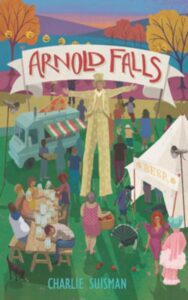
    Cover of Arnold Falls by Charlie Suisman

    Charlie Suisman’s debut novel is a wonderful escape to a small fictional community in upstate New York. Here a melting pot of quirky residents brings Arnold Falls to life, a town with a unique history and charming inhabitants whose lives are intimately intertwined.

    Settled in 1803 by the unscrupulous Hezekiah Hesper, the town for unknown reasons was named after Benedict Arnold. Adding to the oddities, the closest waterfall is twenty miles away. The area is known for sudden bursts of crab apple-size hail pelting the landscape without any scientific explanation. Hence the incentive for “Hail Pail Day,” a neighborly tradition surrounding the distribution of galvanized bucket head-coverings.

    Read more here!


    My Only Sunshine
    By Lou Dischler

    Lou Dischler delivers an intricately woven story about one well-meaning boy who tries to make sense of the crazy he’s been born into. Get ready for one belly laugh of an adventure in My Only Sunshine.

    Welcome to the Louisiana low country, home of 9-year-old Charlie Boone, a kid growing up in 1962. Charlie, a most unreliable narrator, concerns himself with giant wingless wasps and biting red velvet ants. Combine his critter-concerns with the legend of the giant slugs, the story of his mother taken up by a hurricane, and the episode of the puddle he and his brother dug that grew into a pond, then turned into a lake, and we have one wildly imaginative ride well-worth taking.

    Read more here!


    Elephants in my Room
    By Christie Nicholls

    A bitingly funny collection of life-stories from Christie Nicholls – stand-up comedian, actor, and writer – made all the more piquant by her repeated insistence that she has no short-term memory. Fortunately for us, her long-term reminiscences more than make up the deficit.

    Nicholls has divided the book into four parts. In the first, “A Broad Abroad,” she recalls her experiences of traveling to far-flung places, beginning with a summer in Belém, Brazil as a child. She and her brother, for some reason nicknamed Beluga, slept in hammocks and played in a swimming pool, but much of her cherished time involved a German Shepherd named Ferdinand, from whom she learned dog talk. Raucous family bowling in Bologna, Italy, is contrasted with attendance at a staid English wedding. At a later period, Nicholls and her mother went to Sweden, where the budding comic tried her hand at stand-up in newly acquired Swedish, leading to an amusing mix-up of jargon.

    Read more here!


    Blazing Bullets in Deadwood
    By Jacquie Rogers

    Honey Beaulieu is going to get her man–no matter how many tries it takes. Determined to capture the elusive Boyce McNitt, Honey is off to Deadwood Gulch despite the warnings that the dangerous road is plagued by thieves and natives.  But before she can pursue the $500 bounty, she needs to take care of issues at home, including finding a shop for a pregnant seamstress, sixteen-year-old Emma, a home for eight-year-old Myles Cavanaugh, his two younger sisters, and their pregnant mother. Between her do-gooding, denying her blossoming feelings for Deputy US Marshal Sam Lancaster, and a run-in with a herd of escaped pigs determined to destroy Fry Pan Gulch, Honey barely has time to get out of town before she gets trapped by winter. Once on the road, she comes face-to-face with Sean Chaney, the Badger Claw Kid, a bounty worth $400, and is intent on capturing him, as well. With a little otherworldly, albeit not entirely helpful, advice from her ghost guide Roscoe, Honey will have to take down two dangerous fugitives. But, when she runs into a fireball-throwing ghost bent on revenge, her real adventure begins.

    Kiffer loves the undercurrent of a Shakespearean slant to Jacquie Rogers’ works. Sublime.

    Read more here!


    Ruth 66
    By Elizabeth Barlo

    When a banged-up old bus pulls into his family’s driveway, Charlie has no idea that the rattling junker would be his ride to freedom. For years he’d been suffering under the thumb of a cold-hearted mother and a vindictive twin sister, while his father languished behind bars for tax fraud. The only family member with whom the young man held a loving bond was his grandfather, Opa Bill. Since Bill’s recent death, Charlie has been holding it together by listening to the music he and his grandfather loved. That musical thread weaves its way throughout the story as a sort of narrative jukebox.

    Now Charlie’s respectable Oma Ruth has careened back into his life in a shocking new incarnation: a freewheeling hippie in kaftan and beads, unafraid to swap barbed words with her appalled daughter, nor to insist that Charlie accompany her on her road trip. He’s dead-set against it – he’d just found his dream job at a record store – and is disgusted when his mother dumps him on her mother without hesitation.

    Read more here!


    Have a laugh out loud story? Submit before the end of Novemberfor the 2021 CIBAs! 
    A blue and gold badge for the 2020 Grand Prize Winner for Mark Twain Humor and Satire Arnold Falls by Charles Suisman

    See the 2020 Mark Twain Book Award Winners here!

    When you’re ready, did you know that Chanticleer offers editorial services? We do and have been doing so since 2011.
    Our professional editors are top-notch and are experts in the Chicago Manual of Style. They have and are working for the top publishing houses (TOR, McMillian, Thomas Mercer, Penguin Random House, Simon Schuster, etc.).

    If you would like more information, we invite you to email Kiffer or Sharon at KBrown@ChantiReviews.com or SAnderson@ChantiReviews.com for more information, testimonials, and fees.

    We work with a small number of exclusive clients who want to collaborate with our team of top-editors on an on-going basis. Contact us today!

    Chanticleer Editorial Services also offers writing craft sessions and masterclasses. Sign up to find out where, when, and how sessions being held.

    A great way to get started is with our manuscript evaluation service, with more information available here.

    And we do editorial consultations for $75. Learn more here.  

    If you’re confident in your book, consider submitting it for a Editorial Book Review here or to one of our Chanticleer International Awards here.
    Also remember! Our 10th Anniversary Chanticleer Authors Conference (CAC22) will be April 7-10, 2022, where our 2021 CIBA winners will be announced. Space is limited and seats are already filling up, so sign up today!  CAC22 and the CIBA Ceremonies will be hosted at the Hotel Bellwether in Beautiful Bellingham, Wash. Sign up and see the latest updates here!

    Featuring Cathy Ace and Robert Dugoni!

    Writer’s Toolbox

    Thank you for reading this Chanticleer Writer’s Toolbox article.

    Writers Toolbox Helpful Links: 

    Kafka’s Jovial Side Revealed from The Guardian

    The MARK TWAIN Book Awards for Satire and Allegorical Fiction

    A Modest Proposal by Jonathan Swift

    What Is Satire? by MasterClass

    What Is Allegory? by MasterClass

    The traditional publishing tool that indie authors can use to propel their writing careers to new levels?  The Seven Must-Haves for Authors – Unlocking the Secrets of Successful Publishing Series by Kiffer Brown
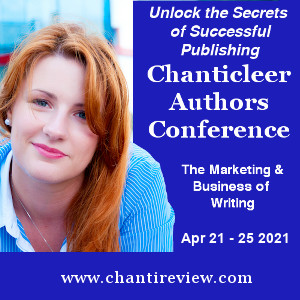

  • LEARN FROM THE BEST at VCAC 20 – J.D.Barker, Bob Dugoni, Chris Humphreys, Don Maass, Jessica Morrell

    LEARN FROM THE BEST at VCAC 20 – J.D.Barker, Bob Dugoni, Chris Humphreys, Don Maass, Jessica Morrell

    Learn from the Best at VCAC 20

    Join us at the Virtual Chanticleer Authors Conference

    Tuesday – Sunday, Sept 8 – 13, 2020 

    9:30 a.m. to 4:30 p.m. PST

    VIRTUAL LIVE SESSIONS via ZOOM

    The New ERA of Content Creation in All Its Forms

    J.D. Barker, Robert Dugoni, Chris Humphreys,

    Donald Maass, Jessica Morrell,

    Scott Steindorff

    Read more about the VCAC faculty, by clicking here. 

    Sessions will be recorded and available later viewing through VIMEO exclusively to all registered participants.

    Only one session will be presented at a time so YOU select which ones you want to see LIVE and which ones you will want to view later via VIMEO or revisit the session. Master Classes and Workshops will be held the following week starting on Wednesday, Sept 16, 2020. 

    Tuesday – Sunday, Sept 8 – 13, 2020 – VCAC Sessions

    9:30 a.m. to 4:30 p.m. PST

    Click here for the VCAC Schedule

    Headliners Include: 

    JD Barker
    Robert Dugoni
    Chris (C.C.) Humphreys
    Scott Steindorff

    Technical Workshops with Hindenburg Systems Experts

    Wed. Sept 16, 2020

    Audiobook Creation with Jonathan Hurley

    Podcast Nuts and Bolts with Anita Michalski

    Click here to learn more about the Hindenburg Workshops

    Master Writing Classes to Take Your Works to the Next Level 

    with Donald Maass

    Sunday, Sept 20, 2020 (9:30 – 4:30 PST with breaks, lunch breaks and Q & A)

    and Jessica Morrell

    Jessica Page Morrell

    Thursday and Friday mornings, Sept 17 & 18, 2020 (9:30 a.m. – 12:30 p.m. PST with breaks)

    Click here to learn more about the Master Writing Classes

    Don’t Delay! Register Today!   You may register for Workshops and Master Classes separately

    Click here for the VCAC Schedule of Sessions

    Topics at VCAC 20

    • Virtual Author Events: How To Pivot from LIVE to VIRTUAL for Book Launches, Book Clubs, and Book Events with Janet Oakley, Sean Dwyer, & Gail Noble Sanderson
    • Book to Film Panel Discussion with Scott Steindorff, Robert Dugoni, and J.D. Barker. Moderator is Chris Leibig
    • It Takes a Village to Make a Film – Authors, Actors, Screenwriters, Producers, & Directors  a Discussion with Tina Sloan, Scott Steindorff, & Kaylin McFarren, and Talk to Crows Production Company 
    • The Critical Role Authors Play in Fostering a Better Society – Janice S. Ellis, Ph.D. 
    • Exploration of New and Revolutionary Ways of Storytelling including Delving into Immersive, Mixed Reality, and Digital Art – Scott Steindorff 
    • How to Have 1,048 Readers Requesting Your Book in the 1st Day of a 100 Book Giveaway – Kaylin McFarren shares her Goodreads and Amazon Secrets to increasing book sales. 
    •  Writing and Selling Children’s Books – Children’s Book Authors Share Their Tips & Tools – Denise Ditto Satterfield, Barbara Jean Hicks, M.J. Evans, 
    •  Voice Driven Technology and the Future of Publishing – Paul Cutsinger 
    • Why Amazon Alexa Should Be Telling Your Story – 3 Sessions– Amy Stapleton and Wayne Richard
    • How to Create a Sustainable and Compelling Series – Panel : Diane Garland, Wendy Delaney, Pamela Beason, J.D. Barker 
    • 5 Reasons Why You Should Publish Your Epubs on  Bookchain – Simon-Pierre Marion
    • Your Story World: Beyond Eye Color and the Weather – Diane Garland
    • Don’t be Left OUT and OFF the Airwaves – Intro to Podcasting with Hindenburg Systems’ expert Anita Michalski
    • Historical Fiction–Chris Humphreys will examine how to both fictionalize real characters and realize fictional ones. 
    • Just Call Out My Name – Collaborating with Other Authors – Janet Shawgo & Sean Dwyer
    • Writers: Improve Your Productivity and Your Health by  Correcting Posture with Tana Hope
    • 5 Reasons Why You Should Publish Your Epubs on  Bookchain – Simon-Pierre Marion

    And more …

    Click here to read more about the VCAC presenters and panelists! 

    Don’t Delay. Register Today for these LIVE ZOOM SESSIONS! 

    Sessions Start in just 7 Days! Tuesday, Sept. 8, 2020! 

    The 2019  CIBA Awards First Place Awards Winners will be announced  every day (Tuesday – Saturday, Sept 8 -12, 2020) starting at 5 p.m. PST at the CIBA Virtual Ceremonies.  All 2019 CIBA Finalists will be recognized during VCAC!

    The 2019 CIBA Grand Prize Division Winners and the Overall Grand Prize for Best Book will be announced and recognized on Sunday, Sept 13, 2020 starting at 5: 30 p.m. PST ceremony.

    All announcements are LIVE and we will have a Virtual Celebration Party after each day! 

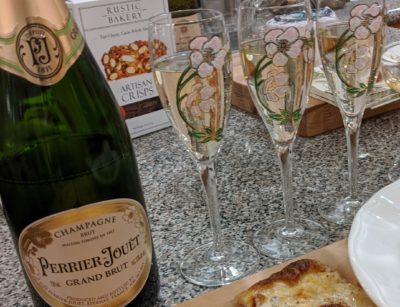
    Have your favorite bubbly ready to cheer on your favorite authors! LIVE and INTERACTIVE! 

    See YOU at VCAC 20!

  • LARAMIE Book Awards – SPOTLIGHT Focus on ALL Works of Western Fiction and Uniquely American Tales

    LARAMIE Book Awards – SPOTLIGHT Focus on ALL Works of Western Fiction and Uniquely American Tales

    Welcome to our SPOTLIGHT on LARAMIE Book Awards, the stories that stick!

    Western Pioneeer Civil War Fiction Award

    The Laramie Book Awards recognize emerging new talent and outstanding works in the Americana / Western, Pioneer, Civil War, Frontier, and First Nations Novels. The Laramie Book Awards is a division of the Chanticleer International Book Awards.

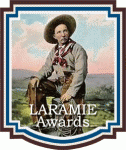
    Charles M. Russell painted the cowboy scene on Chanticleer’s very own Laramie Book Awards badge. It is one of many such paintings he did that encompassed the Old American Wild West. He was an advocate for the Northern Plains Indians. Charles M. Russell also helped establish a reservation in Montana for the Chippewa people.
    *More interesting facts about Laramie, Wyoming, and its historical icons are immediately after the Laramie Hall of Fame listing below. A fun read! 

    The Laramie Book Awards for American Western Fiction Hall of Fame First Place and Grand Prize winners!


    The 2018 Laramie Book Awards Grand Prize:

    Blood Moon: A Captive’s Tale by Ruth Hull Chatlien

    Laramie Book Awards

     2018 Laramie Book Awards for American Western Fiction First in Category Winners


    The 2017 Laramie Book Awards Grand Prize Winning Book also won the OVERALL Prize! Best book of 2017:

    HOUR GLASS by Michelle Rene

    2017 Laramie Book Awards for American Western Fiction First in Category Winners


    The 2016 Laramie Book Awards Grand Prize:

    Hot Work in Fry Pan Gulch: Honey Beaulieu – Man Hunter #1
    by Jacquie Rogers

    2016 Laramie Book Awards for American Western Fiction First in Category Winners


    The 2015 Laramie Book Awards Grand Prize:

    Widow (formerly known as Doctor Kinney’s Housekeeper) by Sara Dahmen

    2015 Laramie Book Awards for American Western Fiction First in Category Winners


    The 2014 Laramie Book Awards Grand Prize:

    Not on My Mountain Jared McVay

    Not On My Mountain by Jared McVay

    2014 Laramie Book Awards for American Western Fiction First in Category Winners


    The 2013 Laramie Book Awards Grand Prize:

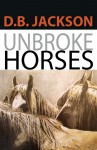
    Unbroken Horses by Dale B. Jackson

    Unbroke Horses clean

    Congratulations to the Laramie Awards 2013 1st Place Category Winners:

    • Mystery:  Double or Nothing by Meg Mims
    • Action/Adventure:  Haunted Falls by Ken Farmer & Buck Stienke
    • Historical Fiction: Because of the Camels by Brenda Blair
    • Civil War:  Ford at Valverde by Anita Melillo
    • Prairie Pioneer:  They Rode Good Horses by Dale B. Jackson
    • Literary Western:  Unbroke Horses by Dale B. Jackson
    • First Novel:  Confessions of  a Gunfighter by Tell Cotten
    • Best Manuscript: Lick Creek by Deborah Lincoln


    HOW DO YOU HAVE YOUR BOOKS COMPETE? Submit them to the Chanticleer International Book Awards –Click here for more information about The CIBAs! 

    Western Pioneeer Civil War Fiction Award

    Want to be a winner next year? The deadline to submit your book for the 2020 Laramie awards is July 31, 2020. Enter here!

    Grand Prize and First Place Winners for 2019 will be announced during our Virtual Conference in early September 2020.

    Any entries received on or after July 31, 2020, will be entered into the 2021 Laramie Book Awards. The Grand Prize and First Place for 2020 CIBA winners will be held on April 17, 2021.

     As our deadline draws near, don’t miss this opportunity to earn the distinction your American Western readers deserve!  Enter today!

    The LARAMIE Book Awards is a division of the Chanticleer International Book Awards – the CIBAs.

    The 2020 winners will be announced at the CIBA  Awards Ceremony, which will take place during the 2020 Live/Online Chanticleer Authors Conference. All Semi-Finalists and First Place category winners will be recognized, the first place winners will be virtually whisked up on “stage” to receive their custom ribbon and wait to see who among them will take home the Grand Prize. Covid19 has made our celebrations a bit different this year, but we still will celebrate!

    Don’t delay! Enter today!  

    As always, please do not hesitate to contact us with questions, concerns, or suggestions at Chanticleer@ChantiReviews.com

    [20] McDougall, Walt, “Pictures in the Papers,” American Mercury, 6:21 (September 1925), 72.


    What’s a Laramie?

    We thought you’d never ask!

    We titled the Chanticleer International Book Awards (CIBAs) division for Western American Fiction and all things that gather around the campfire singing a lonesome tune, the Laramie Awards, after the county and city in Wyoming. You know the one, tucked into the lower right-hand corner of the state between the Snowy Mountain Range and the Laramie Mountain Range.

    Yes, but why Laramie? 

    The small outpost was changed almost overnight when the Union Pacific Railroad moved their “Hell on Wheels” tent town from Cheyenne, Wyoming to Laramie after building the rails over the Sherman Summit at an elevation of 8,200 feet all the way to Laramie on May 4, 1868. Lawlessness and the Wild West ruled in Laramie. Luckily, “Hell on Wheels” moved on West as more track was laid down.

    But where did that name Laramie come from? 

    Laramie was named after Jacque LaRamie, a French or French-Canadian trapper who disappeared in the mountain range that was later named for him in the early 1810s. LaRamie was one of the first Europeans to visit the area. Laramie is a French name much like DuBois, Wyoming. And, yes, it is pronounced Doo – Boys (and NOT Du Bwai).

    There are several reasons we chose Laramie for our iconic Americana Book Awards. For us, and those in the know, Laramie, Wyoming immediately calls to mind the image of a Wild West town filled with rough-and-tumble cowboys. At one point, the only law in Laramie was “lawlessness. Wild Bill Hickok was even known to visit from time to time.

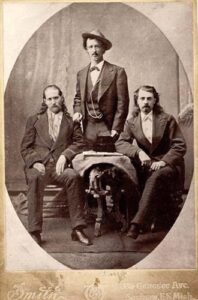
    Here’s a picture of the man, himself, on the left with his friends, Texas Jack Omohundro (center), and Buffalo Bill Cody on the right.

    Butch Cassidy and the Wild Bunch robbed trains and passengers with the first recorded train robbery taking place on June 2, 1899 in Wyoming. Butch was known to be very polite and dislike violence.

    But that’s not the only reason we chose Laramie.

    And, yes, there is yet one more reason we love Laramie! 

    The WOMEN!

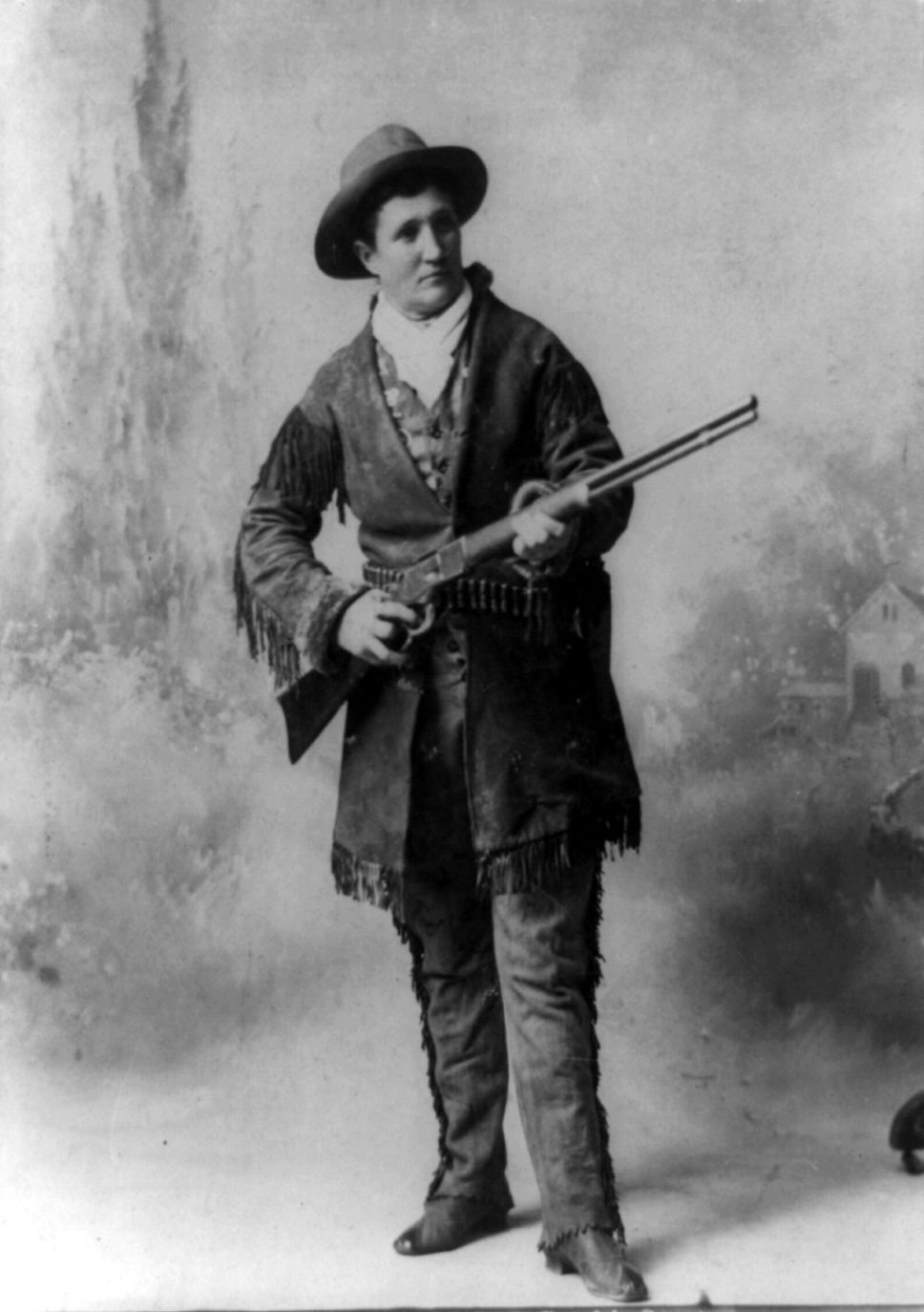
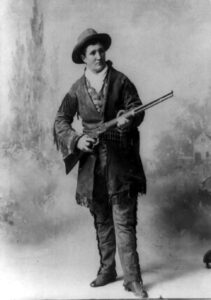
    Calamity Jane hails from Laramie, Wyoming – a skilled sharpshooter who was born to a gambler and a prostitute. She cared for her five younger siblings in Utah before traveling on to Wyoming in search of a better life. There she found work as a dance hall girl and then as a prostitute at Fort Laramie. It was there that she reinvented herself by wearing buckskins and dressing like a man. She was also known for her swearing and hard-drinking ways, but Calamity Jane was also known even more for her kind heart and helping folks out of calamities–thus her nickname.

    Calamity Jane — She was the inspiration for Michelle Rene’s HOURGLASS novel.

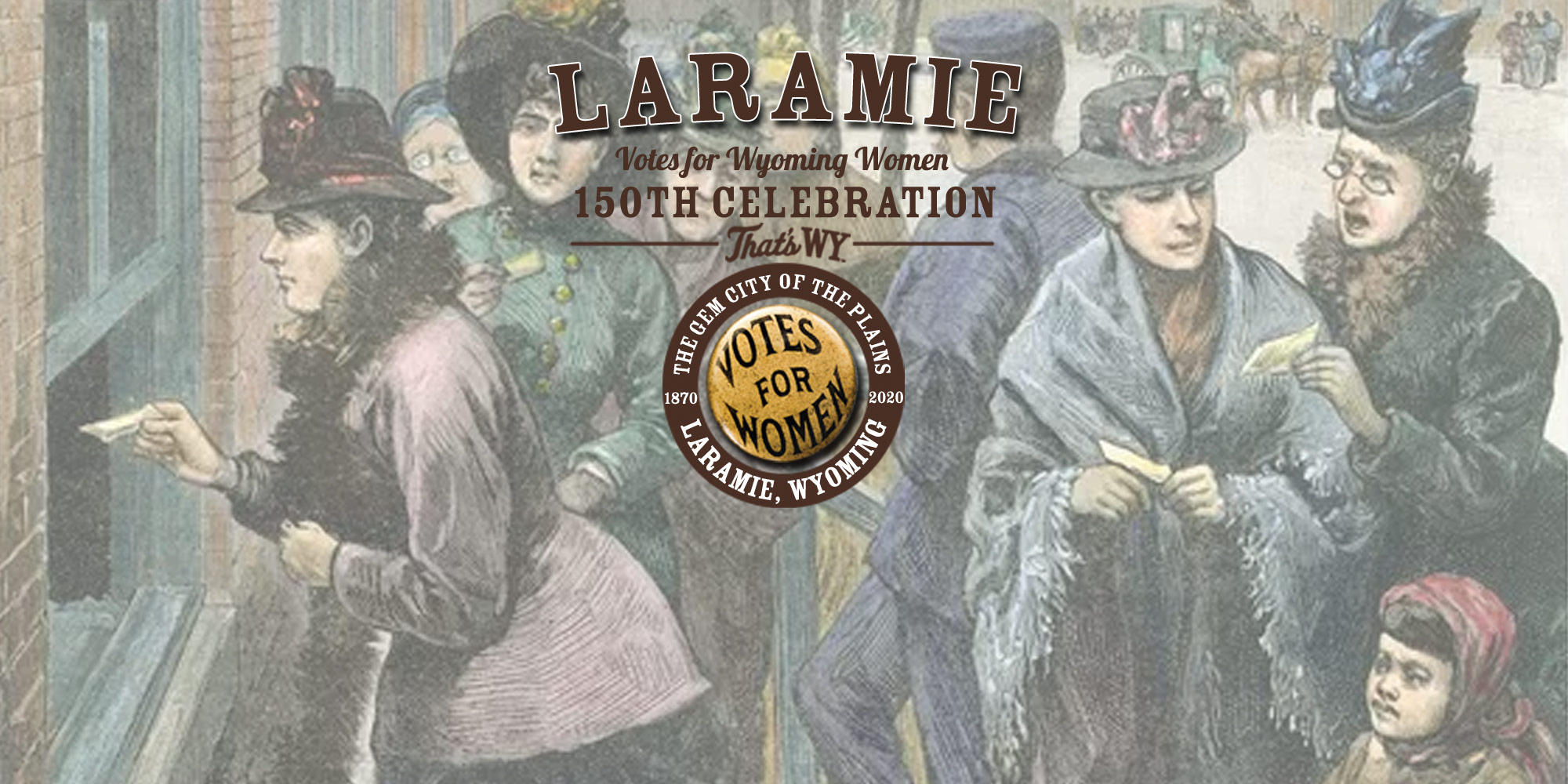
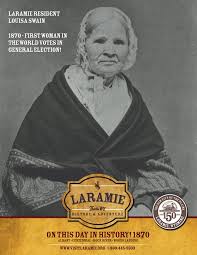
    While the men were wrestling in the streets and shooting up the place, it was really the women who brought civilization to Laramie and Wyoming Territory. They established the first school in 1869, served on a formal jury in the Spring of 1870,  and were the first to gain the vote; which is exactly what Louisa Swain and 92 of her friends did on September 6, 1870 –150 years ago!

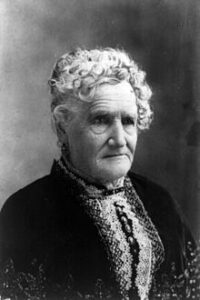
    Louisa Swain, the first woman to cast a ballot and she did it in Laramie, Wyoming!

    Louisa Swain – she was made of stern stuff!

    Early in the morning on September 6, 1870 in Laramie, Wyoming Louisa Swain became the first woman in the world to cast a ballot under democratically enacted laws granting women equal political rights with men. In the fall of 2008, 138 years later, the U.S. Congress passes a resolution proclaiming September 6th as “Louisa Swain Day” in recognition of this historic event.The Louisa Swain Foundation

    In 1870, Esther Hobart Morris (59 years old) became the first female Justice of the Peace. She served in South Pass City, Wyoming, which is to the northwest of Laramie.

    Esther Morris "to pettifoggers she showed no mercy." Wyoming Tribune
    Esther Morris, first female Justice of the Peace — Wyoming

    Esther Morris “to pettifoggers she showed no mercy.” Wyoming Tribune

    The Union’s first all-female jury was assembled in Wyoming in 1870.

    Later, in 1894, Estelle Reel Meyer became Superintendent of Public Instruction, the country’s first female statewide elected official.

    And the grand coup d’etat was when in 1889 when Wyoming vied for statehood—and refused to join the Union if the laws giving equality to women were not upheld, telling Congress (which wanted the suffrage law rescinded) via telegram,

    “We will remain out of the Union 100 years rather than come in without the women.”

    Wyoming is also the first state in the USA to allow women to own property and sign legal documents.

    In 1910, Mary Godat Bellamy became the first woman to be elected to the Wyoming Legislature. Two other western states, Colorado and Idaho, elected women legislators in 1895 and 1899, respectively. Wyoming was third in the nation.

    Quotes are from the Smithsonian Magazine
    Read more: https://www.smithsonianmag.com/travel/women-voting-wyoming-150-years-here-how-state-celebrating-180971263/#6UKzMfMeCQsmbIIQ.99
    Give the gift of Smithsonian magazine for only $12! http://bit.ly/1cGUiGv
    Follow us: @SmithsonianMag on Twitter

    {https://www.wyohistory.org/encyclopedia/brief-history-laramie-wyoming}


  • BLAZING BULLETS in DEADWOOD, Man Hunter #3 by Jacquie Rogers – Classic Western, Humorous, Western Fiction

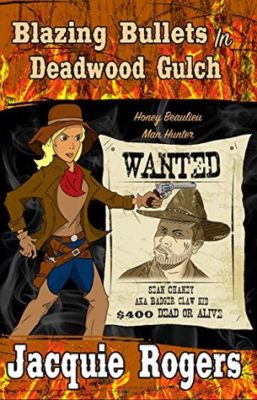
    BLAZING BULLETS in DEADWOOD, Man Hunter #3 by Jacquie Rogers – Classic Western, Humorous, Western Fiction

    Honey Beaulieu is going to get her man – no matter how many tries it takes. Determined to capture the elusive Boyce McNitt, Honey is off to Deadwood Gulch despite the warnings that the dangerous road is plagued by thieves and natives.  But before she can pursue the $500 bounty, she needs to take care of issues at home, including finding a shop for a pregnant seamstress, sixteen-year-old Emma, a home for eight-year-old Myles Cavanaugh, his two younger sisters, and their pregnant mother. Between her do-gooding, denying her blossoming feelings for Deputy US Marshal Sam Lancaster, and a run-in with a herd of escaped pigs determined to destroy Fry Pan Gulch, Honey barely has time to get out of town before she gets trapped by winter. Once on the road, she comes face-to-face with Sean Chaney, the Badger Claw Kid, a bounty worth $400, and is intent on capturing him, as well. With a little otherworldly, albeit not entirely helpful, advice from her ghost guide Roscoe, Honey will have to take down two dangerous fugitives. But, when she runs into a fireball-throwing ghost bent on revenge, her real adventure begins.

    This third installment of the Honey Beaulieu – Man Hunter series reunites the reader with the unique cast from Honey’s previous adventures as well as introducing some new characters sure to return. This quirky cast shares in the ultimate theme of the novel, good old-fashioned “help your fellow man.” Only with the help of Agnes, Honey’s mother, the madam of the Tasty Chicken Emporium; her thoroughbred racing mule, Pickles; and Roscoe, the mind-reading ghost, is Honey able to rid the Wyoming Territory of bad guys. This theme permeates every aspect of the plot. Most of the citizens of Fry Pan Gulch perform some act of kindness for another character. From gifting poor children with small treats to hiring criminals to keep them out of trouble, the townspeople’s pay-it-forward attitude embodies the spirit of what most readers associate with a simpler, kinder time in American history. These tiny acts of humanity remind the reader that caring for people, not things, can make the most significant difference in someone’s life.

    Warm and kind-hearted while remaining fiercely independent and tough, Honey is a woman ahead of her time. Much like her bonnet-wearing mule, Sassy, she refuses to be led blindly along but forges a path of her own, not allowing herself to worry about finding a husband and assume her womanly role as a homemaker but choosing instead to follow her “papa’s roving blood.” She has seen too much of what happens to weak women in her mother’s brothel, and she knows she could never allow herself the weakness she sees in most women. This poker-playing bounty hunter purses a life of freedom unheard of for 1879 and trades in the homestead for the dusty trail and freedom. She is more than sassy enough to hold the reader’s interest, surprising everyone except herself with what she can accomplish. But Honey isn’t the only strong woman in the novel. Agnes, Honey’s mother, owns and operates one of the most successful whorehouses in the Territory and manages to do it as “ethically” as possible. She cares about her employees and providing a safe environment where they choose to remain rather than to be enslaved by impossible contracts and cruel pimps. Even Emma and Myles’s mother show strong women. Emma is only a child herself, but she still manages to make a life for her and her unborn child by starting a sewing business. Myles’s mother, Ivy Mae, has been abandoned by her husband (stepfather to her children) and is also expecting a child. She is willing to sacrifice herself to feed her children. In this world where husbands are killed, and boyfriends shirk responsibilities, the women manage to survive – and sometimes flourish – in true female fashion!

    Honey Beaulieu, “too scrawny to be a whore [and] . . . too tainted to be respectable,” will take the reader on a wild romp. With a fun dialect and a crazy cast, you’ll find yourself snorting with laughter. Chances are, readers new to the rip-roaring, laugh out loud, side-splitting Rogers universe will want to check out the first and second books in the series: Hot Work in Fry Pan Gulch, Honey Beaulieu, Man Hunter #1 and Sidetracked in Silver City, Honey Beaulieu, Man Hunter #2!


  • SPOTLIGHT on LARAMIE Book Awards — American Western Fiction

    SPOTLIGHT on LARAMIE Book Awards — American Western Fiction

    Image result for laramie wy
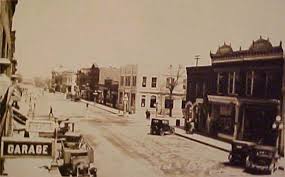
    Downtown Laramie, Wyoming

    What’s a Laramie?

    We thought you’d never ask!

    We titled the Chanticleer International Book Awards (CIBAs) division for Western American Fiction and all things that gather around the campfire singing a lonesome tune, the Laramie Awards, after the county and city in Wyoming. You know the one, tucked into the lower right-hand corner of the state…

    Yes, but why Laramie?

    There are several reasons we chose Laramie for our iconically American Book Awards. For us, and those in the know, Laramie, Wyoming immediately calls to mind the image of a Wild West town filled with rough-and-tumble cowboys. At one point, the only law in Laramie was “lawlessness. Wild Bill Hickok was even known to visit from time to time.

    Here’s a picture of the man, himself, on the left with his friends, Texas Jack Omohundro (center), and Buffalo Bill Cody on the right.

    But that’s not the only reason we chose Laramie.

    And, yes, there is yet one more reason we love Laramie! 

    The WOMEN!

    Calamity Jane hails from Laramie, Wyoming – a skilled sharpshooter who was born to a gambler and a prostitute. She cared for her five younger siblings in Utah before traveling on to Wyoming in search of a better life. There she found work as a dance hall girl and then as a prostitute at Fort Laramie. It was there that she reinvented herself by wearing buckskins and dressing like a man. She was also known for her swearing and hard-drinking ways, but Calamity Jane was also known even more for her kind heart and helping folks out of calamities–thus her nickname.

    Calamity Jane

    While the men were wrestling in the streets and shooting up the place, it was really the women who brought civilization to Laramie and Wyoming Territory. They established the first school in 1869, served on a formal jury in the Spring of 1870,  and were the first to gain the vote; which is exactly what Louisa Swain and 92 of her friends did on September 6, 1870 – 150 years ago!

    Louisa Swain – she was made of stern stuff!

    Early in the morning on September 6, 1870 in Laramie, Wyoming Louisa Swain became the first woman in the world to cast a ballot under democratically enacted laws granting women equal political rights with men. In the fall of 2008, 138 years later, the U.S. Congress passes a resolution proclaiming September 6th as “Louisa Swain Day” in recognition of this historic event. The Loiusa Swain Foundation

    In 1870, Esther Hobart Morris (59 years old) became the first female Justice of the Peace. She served in South Pass City, Wyoming, which is to the northwest of Laramie.

    Esther Morris "to pettifoggers she showed no mercy." Wyoming Tribune
    Esther Morris “to pettifoggers she showed no mercy.” Wyoming Tribune

    The Union’s first all-female jury was assembled in Wyoming in 1870.

    Later, in 1894, Estelle Reel Meyer became Superintendent of Public Instruction, the country’s first female statewide elected official.

    And the grand coup d’etat was when in 1889 when Wyoming vied for statehood—and refused to join the Union if the laws giving equality to women were not upheld, telling Congress (which wanted the suffrage law rescinded) via telegram,

    “We will remain out of the Union 100 years rather than come in without the women.”

    Wyoming is also the first state in the USA to allow women to own property and sign legal documents.

    Quotes are from the Smithsonian Magazine
    Read more: https://www.smithsonianmag.com/travel/women-voting-wyoming-150-years-here-how-state-celebrating-180971263/#6UKzMfMeCQsmbIIQ.99
    Give the gift of Smithsonian magazine for only $12! http://bit.ly/1cGUiGv
    Follow us: @SmithsonianMag on Twitter

    {https://www.wyohistory.org/encyclopedia/brief-history-laramie-wyoming}

    That, Chanticleerians, is why we love Laramie and have championed the name for our most iconic American awards group, The LARAMIE AWARDS. There is nothing better than the Wild West, Women’s Suffragette Success stories, Cowboys and Indians, History and Adventure all coming together with a true sense of the American West! 

    So, it is with pride we sponsor  the LARAMIE Book Awards for American Western Fiction


    Western Pioneeer Civil War Fiction Award
    Painting by C.M. Russell

    Charles M. Russell painted the cowboy seen on Chanticleer’s very own Laramie contest badge. It is one of many such paintings he did that encompassed the Old American Wild West. An advocate for the Native Americans, Charles M. Russell also helped establish a reservation in Montana for the Chippewa people.

    The Laramie Book Awards for American Western Fiction Hall of Fame First Place and Grand Prize winners!


    2018 Laramie Book Awards for American Western Fiction First in Category Winners

    • Living Where the Rabbits Dance by Jr. R. Collins
    • Promise of Tomorrow  by TK Conklin
    • Chasing Demons   by John Hansen
    • A Female Doctor in the Civil War  Richard Alan
    • Splintered by Curt Locklear   

    The 2018 Laramie Book Awards Grand Prize:

    Blood Moon: A Captive’s Tale by Ruth Hull Chatlien


    2017 Laramie Book Awards for American Western Fiction First in Category Winners

    • Grasshoppers at Dusk by Kiki Watkins
    • Mist-chi-mus: A Novel of Captivity by J.L. Oakley
    • Sacrificial Lions by John Simons/David Simons
    • The Hour Glass by Michelle Rene
    • Away at War: A Civil War Story of the Family Left Behind by Nick K. Adams
    • Threads of Passion by T.K. Conklin
    • Desertion by Michael Aloysius O’Reilly
    • Death in the Black Patch by Bruce Wilson     

    The 2017 Laramie Book Awards Grand Prize:

    HOUR GLASS by Michelle Rene


    2016 Laramie Book Awards for American Western Fiction First in Category Winners

    • Western Romance: Seize the Flame by Lynda J Cox
    • Prairie/First Nation: Big Horse Woman by Barbara Salvatore
    • Classic Western (Manuscript): Clevenger Gold: The True Story of Murder and Unfound Treasure by Scott Eldon Swapp
    • Contemporary Westerns: Improbable Fortunes by Jeffrey Price
    • Civil War: Lincoln’s Hat by David Selcer
    • Adventure/Caper: Hot Work in Fry Pan Gulch (Honey Beaulieu – Man Hunter) by Jacquie Rogers

    The 2016 Laramie Book Awards Grand Prize:

    Hot Work in Fry Pan Gulch: Honey Beaulieu – Man Hunter #1 by Jacquie Rogers


    2015 Laramie Book Awards for American Western Fiction First in Category Winners

    • Adventure/Drama: Martha Conway – Thieving Forest
    • Classic: McKendree Long – Higher Ground
    • Prairie: Alethea Williams – Walls for the Wind
    • Debut: Lynda J. Cox – The Devil’s Own Desperado
    • Romance: Kristy McCaffrey – The Blackbird
    • Mystery: Linell Jeppsen – Second Chance

    The 2015 Laramie Book Awards Grand Prize:

    Doctor Kinneys Housekeeper - Sara Dahmen

    Doctor Kinney’s Housekeeper by Sara Dahmen


    2014 Laramie Book Awards for American Western Fiction First in Category Winners

    • Historical: Rebecca Rockwell for The Last Desperado 
    • Romance/Dramatic: Jacqui Nelson for Between Heaven and Hell 
    • Romance/Comedy: Jacquie Rogers for Much Ado About Miners
    • Contemporary Western: Jared McVay for Not on My Mountain
    • Adventure: Lorrie Farrelly  for Terms of Surrender
    • Classic: Ken Farmer and Buck Stienke for Nations
    • Debut Novel: Juliette Douglas for Freckled Venom Copperhead
    • Civil War: Christi Corbett for Along the Way Home
    • YA: Elisabeth Ward for Wolf Eye’s Silence
    • Blended Genre: Peggy L. Henderson for Come Home to Me
    • Drama: Michael J. Rouche for A River Divides: Book Two of Beyond the Wood
    • Literary Western: Theo Czuk for Heart-Scarred

    The 2014 Laramie Book Awards Grand Prize:

    Not on My Mountain Jared McVay

    Not On My Mountain by Jared McVay


    Congratulations to the Laramie Awards 2013 1st Place Category Winners:

    • Mystery:  Double or Nothing by Meg Mims
    • Action/Adventure:  Haunted Falls by Ken Farmer & Buck Stienke
    • Historical Fiction:  Because of the Camels by Brenda Blair
    • Civil War:  Ford at Valverde by Anita Melillo
    • Prairie Pioneer:  They Rode Good Horses by Dale B. Jackson
    • Literary Western:  Unbroke Horses by Dale B. Jackson
    • First Novel:  Confessions of  a Gunfighter by Tell Cotten
    • Best Manuscript: “Lick Creek” by Deborah Lincoln

    The 2013 Laramie Book Awards Grand Prize:

    Unbroke Horses clean

    Unbroken Horses by Dale B. Jackson


    HOW DO YOU HAVE YOUR BOOKS COMPETE? Submit them to the Chanticleer International Book Awards – Click here for more information about The CIBAs! 

    Western Pioneeer Civil War Fiction Award

    Want to be a winner next year? The deadline to submit your book for the 2019 Laramie awards is July 31, 2019. Enter here!

    Grand Prize and First Place Winners for 2019 will be announced on April 18, 2020.

    Any entries received on or after July 31, 2019, will be entered into the 2020 Laramie Book Awards. The Grand Prize and First Place for 2020 CIBA winners will be held on April 17, 2021.

     As our deadline draws near, don’t miss this opportunity to earn the distinction your American Western readers deserve!  Enter today!

    The LARAMIE Book Awards is a division of the Chanticleer International Book Awards – the CIBAs.

    The 2019 winners will be announced at the CIBA  Awards Ceremony on April 18, 2020,  that will take place during the 2020 Chanticleer Authors Conference. All Semi-Finalists and First Place category winners will be recognized, the first place winners will be whisked up on stage to receive their custom ribbon and wait to see who among them will take home the Grand Prize. It’s an exciting evening of dinner, networking, and celebrations! 

    Don’t delay! Enter today!  

    As always, please do not hesitate to contact us with questions, concerns, or suggestions at Chanticleer@ChantiReviews.com

    [20] McDougall, Walt, “Pictures in the Papers,” American Mercury, 6:21 (September 1925), 72.

  • INTERVIEW with Grand Prize LARAMIE AWARD-WINNER, JACQUIE ROGERS!

    INTERVIEW with Grand Prize LARAMIE AWARD-WINNER, JACQUIE ROGERS!

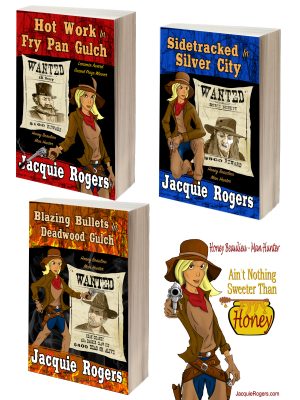
    In honor of the Laramie Awards month, we decided to interview one of our very favorite authors, Jacquie Rogers. It should come as no surprise that Jacquie won the Laramie Grand Prize in 2016 for her rip-roaring, shooting, tooting, humorous Western that features Honey Beaulieu, Man Hunter!

    Jacquie Rogers is a regular contributor for the Western Fictioneers blog. She presents at RWA conferences and workshops, Chanticleer Authors Conferences, and  Western Writers of America. Her works are known for their hilarity, adventure, mistaken identities, and romance. Rogers’ books are  a hit for anyone who has a penchant for classic Westerns and Shakespearean comedies. She lassos the genres together in a most enjoyable way making her tales a true pleasure to read. From saddles sores and thorns from the trail, to finally being able to breathe when the last binding on the corset is released, even the most die hard Western readers will be impressed with Roger’s knowledge and expertise she portrays as she takes you back in time to the Old West.

    Jacquie Rogers: Thanks for inviting me to the Chanticleer blog.  I’ve been privileged to be part of the Chanticleer family right from the get-go, so that makes it extra special for me to be here.  I had help, though—the folks at the Pickle Barrel Bar and Books on Facebook choose my questions, so here we go!
    Chanticleer: We’re so glad you have some time to spend with us. Let’s jump right in…What areas in your writing are you most confident in? What advice would you give someone who is struggling in that area?

    Rogers: Dialogue and chaos.  For dialogue, the advice is easy—listen to people talk.  Two nuances I’ve noticed is they rarely speak in complete sentences and seldom use the other person’s name.  More specifically, listen to people who are similar to your characters.  In the case of Honey Beaulieu, I draw strength from the old Missourians in our family, and mix in a little Owyhee County speak.  As for chaos scenes, the main thing to remember is that the first thing you think of is also the first thing the reader will expect, so turn left when expected to turn right.

    Chanticleer: That’s really good advice, Jacquie. How do you keep track of all the… left turns? Do you work with a storyboard? 

    Rogers: When a character turns left and it’s a better idea than what you’d planned, then it’s best to go with them.  However, that does cause a ripple effect on that particular thread, and sometimes several or all threads.  I try to veer into position so I don’t have to go back and change things, but very often that simply can’t happen.  Either way,  from the turn-left point forward, the whole plot needs to be tweaked.  I’m happy to take the fun route to the end, but I do have to know where and how the story is going to end, and all the characters need to be in the right spot for that to happen, and all (or most, in the case of a serial type series such as Honey Beaulieu – Man Hunter) threads need to be tied in a neat bow.  So it’s a matter of connecting the dots in a logical but relatively unpredictable manner that allows the reader to play along with you.  Because books are really a group activity—the interaction of characters, readers, and the author.

    Even with all that, continuity errors can and do occur.  My first line of defense is Your WorldKeeper, Diane Garland.  She has an eagle eye for continuity and can take me all the way through the thread so I can see what needs fixing  Or sometimes it can’t be fixed (e.g., in a previously published book), and we have to come up with a logical explanation for how things are in the current book.  I work with her as I’m writing, so she usually nails my hide to the wall before even the editor sees the story.

    Rogers: An author can’t keep writing unless readers buy the books—simple economics.  Books are expensive to produce.  So telling others about the author’s books is absolutely gold.  There are a variety of ways to do this, including sharing the author’s posts on social media, reviews (many advertising sites require a certain number of reviews before the author can purchase ads), and telling all your friends in real life to buy the book.  Visibility is the name of the game.  And keep reading!  Your enjoyment is a gift to me.

    Chanticleer: Thank you for mentioning the social media aspects and sharing. Very important. What are you working on now? What can we look forward to seeing next from you?

    Rogers:  My next book will be Hearts of Owyhee #6, Much Ado About Mail-Order Brides.  If you’ve read the third and fifth books of the series, you’re acquainted with the McKinnon brothers.  This book will be Bram’s book.  He’s the oldest brother and the hardest to place because he’s perfect.  Flawed heroes are much, much easier to write.  But since he’s perfect, he has to end up in an impossible situation, and I’ve definitely got him in a big to-do.  Believe me, he has a lot more help than he wants.  I’ll start writing next week and hope to have the book done by the end of the year.

    Chanti: Oh, we’ll be looking forward to that! We love it when characters get knocked around! Let’s move on to craft… It’s important to work on your craft. What do you do to grow your author chops?

    Rogers: I try new techniques.  For instance, I wrote I Heard the Brides on Christmas Day in four points of view—and it’s only a 15,000-word story.  I think I pulled it off but believe me, I won’t be doing that again!  Also, the Honey Beaulieu series is in first person point of view, and the narrative is written in Honey’s vernacular just as if she were actually speaking.  I did this because we think the way we talk, so the narrative can’t be in modern correct grammar.  My Hearts of Owyhee series is in the third person.  So I’m always switching back and forth, writing one book in first and one in third.  That gives me the opportunity to remember the strengths in each and apply them in both series.

    When I first started writing, I read a ton of craft books.  I was so hung up on the rules that I couldn’t write a word for nearly a year, so I tossed it all out and decided the only way to write is to let my hair down and go for it.  Then I heard an interview with Johnny Depp where he remarked that actors had to be brave enough to look stupid (paraphrasing).  I think that goes for writers, too.

    Chanti: We love that you were naturally brave enough to follow your gut on this one. And we love that Johnny Depp backed you up on this one… because, you know, Johnny Depp! Let’s switch gears a bit – give us your best marketing tips, what’s worked to sell more books, gain notoriety, and expand your literary footprint.

    Western Pioneeer Civil War Fiction Award

    Rogers: Depends on what year, month, time of day.  This business is changing fast.  When MySpace was king, I had a strong presence there.  I’ve never had much success on Twitter and only go there because I feel like I should.  Facebook is the place to be right now, which isn’t to say that it’ll still be popular next year.  It’s important to have a presence on social media that is personable (notice I didn’t say “personal”), where people see you and want to be your friend.  This is what marketing is all about these days—the personal touch.  Frankly, I think we’re moving on from social media to real people in the real world contact.  The pendulum is swinging back.  That’s why I put on the Silver City event every year, and try to get out as much as possible to meet my readers.

    I also think it’s important to hang out with other industry professionals—reviewers, publishers, and other authors.  Getting a Chanticleer review and entering the Chanticleer contest is great for raising the discoverability of your books.  Attend the conference and blast pictures all over social media.   The added bonus is that these conferences are lots of fun as well as informative.


    Chanticleer: Talk a little more about the Silver City event… What was that like? Who came? How did you set it up – C’mon, Jacquie! Spill the beans!

    Rogers: I enjoy getting together with my readers and fellow book lovers, and I had this bright idea that it would be fun to meet where the Hearts of Owyhee series is set, which is in Owyhee County, Idaho.  (Owyhee is pronounced oh-WYE-hee, and is the original anglicized spelling of Hawaii.)  Most of the books in the series have scenes in Silver City, and two of them are set there for most of the story.  Silver City is a treasure that few people know about.  It’s a genuine Old West town that still exists as it did in the 19thCentury.  There’s no power or telephones—although they did have telephones in the early 1880s.  The Idaho Hotel is a gem and staying there is like spending the weekend in a living museum, although it’s a soft landing because they did install flush toilets and showers.  The hotel restaurant has always been known for its fine cuisine and believe me, the current owners are living up to the historical standards.  Jerri Nelson’s pies are simply divine.

    There’s a lot more to say about the place, but I’ll go on to the event.  Keep in mind that Silver City is not a tourist town.  You won’t find staged shoot-outs or slot machines (that work).  People there live like folks did in the 1800s.  So visitors live like that, too.  What does it mean?  It means that whatever we do, we have to create ourselves.  If we want music, then we need to play it.  I can’t play anything so I enlisted the aid of fiddler Daria Paxton and her dad, Matt Paxton, who plays guitar and sings.  They’re both talented musicians and old family friends—my dad and Matt’s parents were in the same class.  Relationships were everything in the old days, and there, they still are today.

    The event in Silver City is for everyone, young and old.  In the olden days, families would come to a dance.  The musicians would play and everyone would dance, including the kids.  Then the kids would play and dance until they got tired, and the parents would put them to bed on the pile of coats while they continued to party into the night.  That’s the feeling I wanted to create at our event and we succeeded.  Wildly.  Some of us dressed in costume, others didn’t.  No one really cared because we all were there to have a rip-snortin’ good time.  Which we did.

    Poet Roberta Whittemore joined me at the book signing and that was fun.  Everyone raved about the melodrama, billed as the worst melodrama in history, which had a terrible script (I wrote it), and bad actors (except for Ichabod—he was great, and so were Curtain Rod #1 and Curtain Rod #2).  But the audience participated and had a great time.  The cool thing was that half the audience were walk-ins, not part of the event, and they loved it.  After that, we had an auction for charity.  Sherry Walker chaired the auction with Ken Walker as the auctioneer.  The gals in the kitchen soon learned not to bang pans or he’d call their bid.  We raised over $300 for the Children’s Tumor Foundation to find a cure for neurofibromatosis.

    So I’d like to invite everyone to join us next year.  The tentative date is July 20-21, 2018.  Information will be on my website at http://www.jacquierogers.com/silvercityevent.html.

    Chanticleer: What a terrific event! Thank you for letting us in on Silver City! What do you do when you’re not writing? Tells us a little about your hobbies.

    Rogers: Reading is my first love, make no mistake about it.  I was a reader long before I ever wrote a single word of fiction.  Other than that, I like rodeo, cooking (but not doing the dishes), and baseball.

    Chanticleer: Tell us more! What’s your favorite rodeo event? If we came to your house for dinner, what would you cook? and Who’s your favorite baseball team? 

    Rogers: Favorite rodeo event—well, that would be hard to pick.  Of course, I love the bull-riding but all of the events are fun to watch.  I like all the rough stock events, but then I’m amazed at the ropers, too.  And I know how hard it is to run the barrels without knocking one over.  I also look forward to the specialty acts they bring in.  At the Snake River Stampede, they had the Stampeders—a horseback drill team that performs in the dark so all you see is the lights on the horses and rides.  It’s pretty spectacular.

    If you came to my house for dinner, you’d get down home cookin’.  I cook everything from scratch—even yogurt and salad dressing.  I do buy mayonnaise, though, because we eat too much of it when I make it myself.  So what’s on the menu?  How about homemade bread bowls filled with genuine Idaho potato soup, salad with ranch dressing, and strawberry shortcake (with real shortcakes hot out of the oven) for dessert?  Or maybe you’d like Thai fried rice, spring rolls, and bok choy stir fry.  I’m willing to give just about anything a go.

    As for baseball, I’m a Mariners fan, unfortunately.  Go M’s!

    Chanticleer:  That all sounds good! What led you to write in the western humor genre?

    Rogers: Writing westerns was a simple choice—I grew up where the Old West is still alive so I didn’t have much to research.  Also, in light of the urbanization of our country and the vast change in communications, I want to do my part to keep the culture in people’s awareness.  It’s hard to explain to someone how people lived in the late 1800s without television and cell phones, and that’s why we have so much fun at the Silver City event.  We’re not connected, so we have to create our own entertainment and [gasp] actually visit with one another face to face.

    Humor?  I don’t actually write humor.  Every time I do, no one laughs.  There’s one line in Blazing Bullets in Deadwood Gulch (Honey Beaulieu #3) that absolutely cracked me up, but not one person has laughed or even noticed it. [Update: one person finally got it!  Made my day.]

    Chanticleer: Really, no humor? Well, certainly situational, character driven humor. We love your books and love how you put your characters in situations they can’t possibly imagine! How structured are you in your writing work?
    Rogers: Horribly unstructured and unfocused.  My marbles are rattling around somewhere and they’re not even in the same room, or house, or state.  How I ever manage to finish a book is beyond me.  But when the deadline looms, I do hunker down and git ’er done.

    However, my approach to writing a novel is quite structured.  I don’t write a single word until I know the main and secondary characters inside and out.  The better I know the characters, the easier it is to throw obstacles in their way (that’s also called plotting).  I always have one scene in mind for the opener.  But I confess that the opening scene very rarely stays the opening scene.  The first scene I wrote in the Honey Beaulieu series will be in book #5.  The first scene I wrote in Much Ado About Miners is now in chapter 7.  I always start too far in, probably because I have little tolerance for backstory and I want to get on with things.

    Chanticleer: We appreciate that, Jacquie. How do you approach your writing day?

    Rogers: I always try to leave off in the middle of a scene so I don’t have to figure out what I’m going to write.  So after that scene is finished, then I check with my plot bones chart to see if I’m on track.  If not, I turn left.  Actually, I turn left a lot because sometimes things happen on the page that are too fun to throw out, so then I have to make it work with the rest of the story.  An example is Louie Lewie in Blazing Bullets in Deadwood Gulch.  He was supposed to be a throwaway character, but he kept coming into the story, so I resigned myself that he’s now part of it.  In fact, he’ll probably be in the next book, too.  So a lot of my day is thinking and while I’m thinking, the best way to come up with new ideas is to bake bread.  My extended family gets a lot of bread.

    Once everything’s figured out for the day, I fire up my laptop and use speech recognition to rough out a scene.  Believe me, “rough” is the right word considering when I said “bustier” it typed “buzzard ears.”  I end up with about 90% dialogue.  Then I send the scene to my desktop computer and edit using the keyboard.  If the scene starts out at 500 words, it’ll be 1,000 by the time I’m done adding the narrative.  A side note: I detest description and always skip it when I’m reading for pleasure, which means I have to make an extra effort to make sure I’ve created a picture for the reader.  This is by far my weakest area.

    Chanticleer: Ah, bread. Here’s the part where we wish we lived closer! The idea of using speech recognition software is pure genius – and time-saving, too. How do you come up with your ideas for a story?

    Rogers: I actually don’t know.  Usually, some phrase, prank, or predicament makes me laugh.  Then I put characters to it and voila! We have the concept for a new book.  Honey helps me out because I know that if I dig a hole big enough, she’ll keep me entertained.

    My entertainment is the determiner as to whether I use an idea or not.  If I’m entertained, then I hope the readers are, too.  But on the other hand, if I get bored writing, then you can bet that readers will also be yawning.

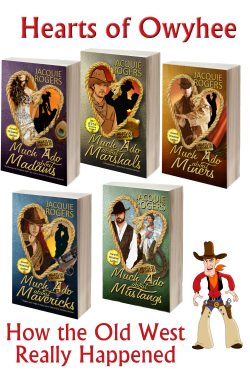
    A few of my ideas for books are identifiable, though.  In Sleight of Heart, I wanted to write a heroine who was as good at math as Aunt Grace, and I always wondered how she’d get along with Maverick.  So Lexie Campbell and Burke O’Shaughnessy were born.  The idea for Much Ado about Mustangs came from an article I read in The Owyhee Avalanche about the local theater group booking a national star to headline their local production.  Hence, we have Lady Pearl Montford and local rancher Josh McKinnon, whose heart’s desire was to raise Friesians.

    The next book I’m going to write, Hearts of Owyhee #6: Much Ado About Mail-Order Brides, came from the fact that the hero, Bram McKinnon, is perfect.  Perfect is boring.  Perfect makes for no conflict.  Unless he’s put in a situation where there’s absolutely no solution.  Bwahahaha.  Naughty me.

    As for Honey Beaulieu, what happens isn’t much of a surprise.  What’s interesting about her is the journey, so I’m always on the lookout for incidents that aren’t exactly your usual bill of fare.  Honey obliges by reacting in ways that surprise me every time.  Of course, she constantly changes the plot, too, which can get frustrating.  But I learned just to go along for the ride and let Honey take me with her.  We get along much better that way.

    Chanticleer: And what a ride! Thank you, Jacquie, for being our first interview of the year! We love what you do and love how you do it.

    Rogers: Thanks again for inviting me here today!


  • Sidetracked in Silver City by Jacquie Rogers – Humorous Western

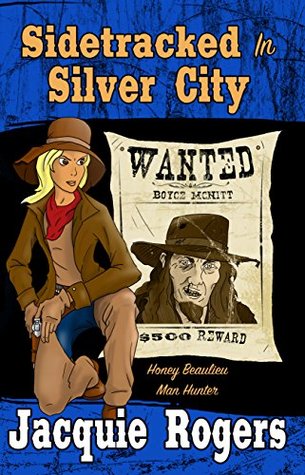
    Sidetracked in Silver City by Jacquie Rogers – Humorous Western

    Stuffed with memorable characters, including a mule named Pickles and a donkey named Sassy, our heroine Honey Beaulieu navigates the difficult path of being a female bounty hunter in the Western territories, circa mid-1879.

    As one might expect, all kinds of men get in Honey’s way, but it isn’t just Pickles who can show a stubborn streak. Jacquie Rogers’ newest release, Sidetracked in Silver City, is as full of humor and colorful western dialogue as any saddle bruising, gun-toting tale could be.

    The story begins in crisis and with a familiar sense of frustration, as Honey Beaulieu, intent on leaving town as soon as possible and catching her next bounty, is confronted with problem after problem rooting her in place. Rogers is talented in keeping the dialogue moving, even as Honey is often lost in her own thoughts or speaking to a ghost that only she can see, named Roscoe who hangs out with a with a three-legged ghost horse named Luther, naturally.

    Honey’s big heart is on every page as she strives to make enough money to buy a future for herself and others. Talking to her animal companions as if they are humans isn’t all that peculiar for Honey – especially when a racing mule, a bonnet-wearing donkey, a surprise goat, and more than one horse all seem to understand. And while carrying multiple guns and knowing darn well how to shoot them builds the tough outer layer the world sees when they look upon Honey, her aim is to never have to use them. It takes her big, handsome admirer, Sam Lancaster, to see that soft inside of her soul.

    From Silver City to Fry Pan Gulch, Honey wrestles with being in the right place at the right time, whether it’s missing the morning train or being there in time to hold her sister’s hand when she gives birth. For anyone who has ever fought the clock and lost the battle, Honey’s exasperation is palpable. We want her to “get her man” no matter what it takes, and Rogers is quite good at building the dramatic tension with the many characters that both complicate Honey’s plans and endear us to her in this wild, wild west she calls home.

    5 Star Best Book Chanticleer Reviews round silver sticker

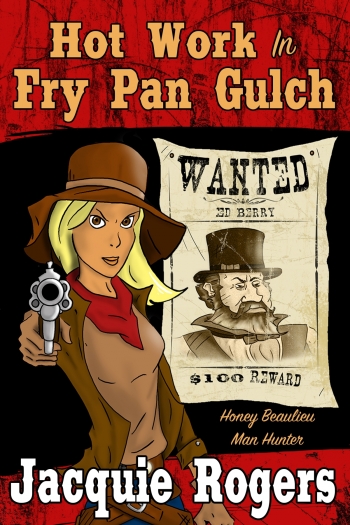
  • HOT WORK in FRY PAN GULCH (Honey Beaulieu – Man Hunter) Book One by Jacquie Rogers – Take a ride to the Old West

    HOT WORK in FRY PAN GULCH (Honey Beaulieu – Man Hunter) Book One by Jacquie Rogers – Take a ride to the Old West

    Feisty, independent Honey Beaulieu is nobody’s fool, and she darned sure isn’t any man’s plaything. So earning a living on her back at her mama’s Tasty Chicken Emporium is not part of her life plan. Problem is, she doesn’t know exactly what her plan should be.

    Fortunately for Honey, her no-nonsense mama sees the proverbial writing on the bordello wall and does her own brand of arm-twisting to get Honey a job at the town marshal’s office.

    Lazy Marshal Fripp is none too thrilled to have a woman invading his domain and if it weren’t for his day-long excursions to the Tasty Chicken he and Honey would be banging heads constantly. With Fripp out of the office, Honey straps on her “Peacemakers” and gets a leg up on the career ladder, climbing from clerk-and-cleaner to Deputy Marshal. But Honey learns the hard way that Fripp is not about to stand on the sidelines while she hops on the fast-track to success.

    Plus, “lawdoggin’” doesn’t come close to paying the bills, let alone paying for all of the stray livestock that comes her way. So when a wanted man rides out of town on the back of Marshal Fripp’s horse, Honey is faced with the most important career decision of her life.

    Should she stick it out as the deputy marshal of Fry Pan Gulch or should she trade in her badge and a steady paycheck for a chance to leave the marshal in the dust and make some real money bounty hunting?

    In this hilarious first installment of the Honey Beaulieu – Man Hunter series author Jacquie Rogers introduces a lively and engaging main character whose heart of gold shines brightly through her tough-as-nails façade. Saddled with a strong conscience and her own set of rules, Honey sets the good old boy franchise on its ear, proving that they’re no match for a resourceful and enterprising, sharp-shooting woman.

    In addition to her fresh, new Honey Beaulieu – Man Hunter series, award-winning author Jacquie Rogers is well known for her popular Hearts of Owyhee western historical romance series and for her highly entertaining story-telling.

    Set in the Old West’s rough-and-tumble Wyoming Territory, Hot Work in Fry Pan Gulch is a tightly-written, action-packed romp that delivers page after page of laugh-out-loud fun—and maybe even a bit of romance along the way.

  • MUCH ADO ABOUT MINERS by Jacquie Rogers

    MUCH ADO ABOUT MINERS by Jacquie Rogers

    What happens when a handsome gun-slinging cowboy, tries to stop a bank robbery only to get shot by the one and only Miss Iris Gardner, the farsighted, bespectacled bank teller with a loaded peacemaker, and the president of her local suffragist branch. Kade McKinnon, overhears her name as he fades in and out of consciousness. If memory serves him, it belongs to the most ornery, rambunctious girl to ever cross Kade’s path during his younger days.

    But Iris is no longer a young girl; she has developed into a hot blooded, intelligent, and beautiful woman. And unbeknownst to Iris, she has caught the attention of the most well-known gunslinger-for-hire in the West, by trying to blow his head off. It isn’t the first time Iris has shot a man.

    Iris is by far the most independent woman you will meet in all the territory. She is a woman with a plan, and there is no man around that can steer her off her path. She believes that there is more for her than “cleaning and breeding.” She, along with several other suffragists in Silver City, Idaho, created a mining investment company that is sure to set them all on the path for financial independence. All seems to be going according to plan until Kade, the older boy she used to have a crush on, rides into town and she shoots him.

    Kade is a gunslinger, a “for hire” true rough and tough man of the West. He lives for the adventure and loves life on the trail. He has made it plain that he is not going to get tied down by a wife. He is in town to get the job he was hired to do done, and then it is back on the trail to his next paid adventure.  And there’s nothing that will change his mind. As much as he is attracted to Iris, he knows that he is not the settling down type of man. So Kade tries to keep his mind on his work and off from her fine figure and blonde tresses.

    Hilarity, adventure, mistaken identities, and romance make Much Ado about Miners by Jacquie Rogers a hit for anyone who has a penchant for classic Westerns and Shakespearean comedies. She lassos the genres together in a most enjoyable way making this tale a true pleasure to read. From saddles sores and thorns from the trail, to finally being able to breathe when the last binding on the corset is released, even the most die hard Western readers will be impressed with Roger’s knowledge and expertise she portrays as she takes you back in time to Silver City.

    Rogers’ delightful characters bring their own distinct flavor to Much Ado About Miners: the Shakespeare quoting sidekick, Phineas; a trouble-making scraggly yellow feline named “Duke;” dastardly despicable bad guys; and others. Her scenes had me laughing so hard at times, I was  in tears! This entertaining tale will have you rooting for the good guys while hanging on for a wild and fun ride that starts on the first page and doesn’t let up to the very end. And, trust me, you’ll never think about biscuits in the same way again.

    I was caught hook, line and sinker in this heartwarming, romantic tale of the old West with its unforgettable characters and delightful surprises. There are three more rollicking adventures in the Hearts of Owyhee series by Jacquie Rogers waiting to be enjoyed. What are you waiting for?