When gold miners discover Choestoe Valley, Jebediah Collins must fight for his family – whether blood-related or not – in J.R. Collins’ historical adventure, Spirit of the Rabbit Place
Fourteen-year-old Jebediah Collins lives in paradise, also known as Choestoe Valley, or to the Cherokee as the “land where the rabbits dance.” The Collins consider Dancing Bear, a Cherokee elder, and his relatives as family. They share with and help each other in good times and bad.
When Jeb’s grandfather settled in the valley after immigrating from Ireland, he quickly learned the benefits of befriending the Native Americans living in the area. Now Jeb’s father, Thompie, gives freely of his farm’s bounty to the Cherokee, who help work the land and teach the Collins how to survive in this beautiful but deadly landscape. Cain, Jeb’s older brother even marries Rose, Dancing Bear’s daughter, and becomes a full-fledged Cherokee warrior in his own right. Dancing Bear symbolically adopts Jeb, who shares an age with his own son, Wolf. Jebediah and Wolf become blood brothers, learning to be Cherokee warriors together and taking on any and every adventure that comes their way.
Their adventures take a darker turn with the arrival of gold miners to their sacred valley.
These unscrupulous men threaten their very way of life. The ruthless miners capture Wolf and force him into slavery, pushing Jeb to risk himself for the chance to rescue his friend.
The third novel in the Choestoe series builds on a theme of unity. Jeb’s family and nearly all of the settlers in the valley honor and respect the Cherokee who inhabited this area long before the settlers arrived. From plowing fields to hunting game, the Collins family and Dancing Bear’s clan work seamlessly, easily with each other. Under the age-old adage, “treat folks how you want to be treated,” Jeb understands that what he does and says will be returned to him tenfold. Though the white man’s greed threatens to change his home forever, he would never make an enemy of the Cherokee, a people so much more knowledgeable than his own. He trusts implicitly and without question, and with that comes the need to protect and love his family.
The people of Choestoe take responsibility for one another.
Their hearts beat as one; their minds think as one. When any neighbor needs help, neither the settlers nor their Cherokee brethren forsake them, chasing down murderous outlaws and helping free slaves. More people than just Jeb’s family show this amazing generosity of spirit. Throughout the valley, families return in kind the goodness shown to them. Mrs. England, for example, takes in orphaned children, especially those with disabilities and special needs.
The settlers not only want to fight for their way of life, but also for the ancient ways of their Cherokee neighbors, who the gold seekers and US government treat more cruelly every day. This community defines the emotional journey of Spirit of the Rabbit Place.
Spiritualism plays an important role as well, with a mixture of and deep respect for Cherokee and Christian beliefs.
Jeb’s faith often brings him comfort and strength, and many times, the Cherokee turn to prayer for direction and guidance on huge decisions. Though he fears evil when he comes face-to-face with it, Jeb knows the Great Creator protects him and finds solace in the idea that no evil can hurt someone who is protected by the Peace of Jesus. All of the Cherokee warriors repeatedly assure Jeb, whose Cherokee name is Spirit Filled One, that he should trust in and heed the voice of the Spirit that comes to him; that very faith not only saves him and George Black Oak, Wolf’s blood uncle, but also shows them some much-needed information in the midst of an important emotional struggle. This faith shines through in Jeb’s loving nature and brings light to all those around him.
Welcome to our SPOTLIGHT on LARAMIE Book Awards, the stories that stick!
The Laramie Book Awards recognize emerging new talent and outstanding works in the Americana / Western, Pioneer, Civil War, Frontier, and First Nations Novels. The Laramie Book Awards is a division of the Chanticleer International Book Awards.
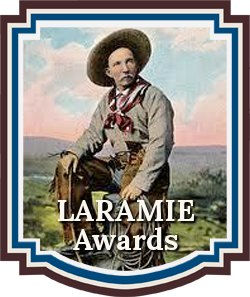
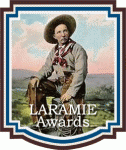
Charles M. Russell painted the cowboy scene on Chanticleer’s very own Laramie Book Awards badge. It is one of many such paintings he did that encompassed the Old American Wild West. He was an advocate for the Northern Plains Indians. Charles M. Russell also helped establish a reservation in Montana for the Chippewa people.
*More interesting facts about Laramie, Wyoming, and its historical icons are immediately after the Laramie Hall of Fame listing below. A fun read!
The Laramie Book Awards for American Western Fiction Hall of Fame First Place and Grand Prize winners!
Want to be a winner next year? The deadline to submit your book for the 2020 Laramie awards is July 31, 2020. Enter here!
Grand Prize and First Place Winners for 2019 will be announced during our Virtual Conference in early September 2020.
Any entries received on or after July 31, 2020, will be entered into the 2021 Laramie Book Awards. The Grand Prize and First Place for 2020 CIBA winners will be held on April 17, 2021.
As our deadline draws near, don’t miss this opportunity to earn the distinction your American Western readers deserve! Enter today!
The LARAMIE Book Awards is a division of the Chanticleer International Book Awards – the CIBAs.
The 2020 winners will be announced at the CIBA Awards Ceremony, which will take place during the 2020 Live/Online Chanticleer Authors Conference. All Semi-Finalists and First Place category winners will be recognized, the first place winners will be virtually whisked up on “stage” to receive their custom ribbon and wait to see who among them will take home the Grand Prize. Covid19 has made our celebrations a bit different this year, but we still will celebrate!
As always, please do not hesitate to contact us with questions, concerns, or suggestions at Chanticleer@ChantiReviews.com
[20] McDougall, Walt, “Pictures in the Papers,” American Mercury, 6:21 (September 1925), 72.
What’s a Laramie?
We thought you’d never ask!
We titled the Chanticleer International Book Awards (CIBAs) division for Western American Fiction and all things that gather around the campfire singing a lonesome tune, the Laramie Awards, after the county and city in Wyoming. You know the one, tucked into the lower right-hand corner of the state between the Snowy Mountain Range and the Laramie Mountain Range.
Yes, but why Laramie?
The small outpost was changed almost overnight when the Union Pacific Railroad moved their “Hell on Wheels” tent town from Cheyenne, Wyoming to Laramie after building the rails over the Sherman Summit at an elevation of 8,200 feet all the way to Laramie on May 4, 1868. Lawlessness and the Wild West ruled in Laramie. Luckily, “Hell on Wheels” moved on West as more track was laid down.
But where did that name Laramie come from?
Laramie was named after Jacque LaRamie, a French or French-Canadian trapper who disappeared in the mountain range that was later named for him in the early 1810s. LaRamie was one of the first Europeans to visit the area. Laramie is a French name much like DuBois, Wyoming. And, yes, it is pronounced Doo – Boys (and NOT Du Bwai).
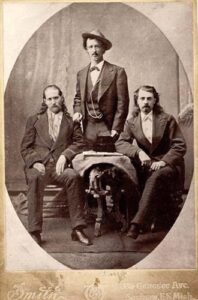
There are several reasons we chose Laramie for our iconic Americana Book Awards. For us, and those in the know, Laramie, Wyoming immediately calls to mind the image of a Wild West town filled with rough-and-tumble cowboys. At one point, the only law in Laramie was “lawlessness. Wild Bill Hickok was even known to visit from time to time.
Here’s a picture of the man, himself, on the left with his friends, Texas Jack Omohundro (center), and Buffalo Bill Cody on the right.
Butch Cassidy and the Wild Bunch robbed trains and passengers with the first recorded train robbery taking place on June 2, 1899 in Wyoming. Butch was known to be very polite and dislike violence.
But that’s not the only reason we chose Laramie.
And, yes, there is yet one more reason we love Laramie!
The WOMEN!
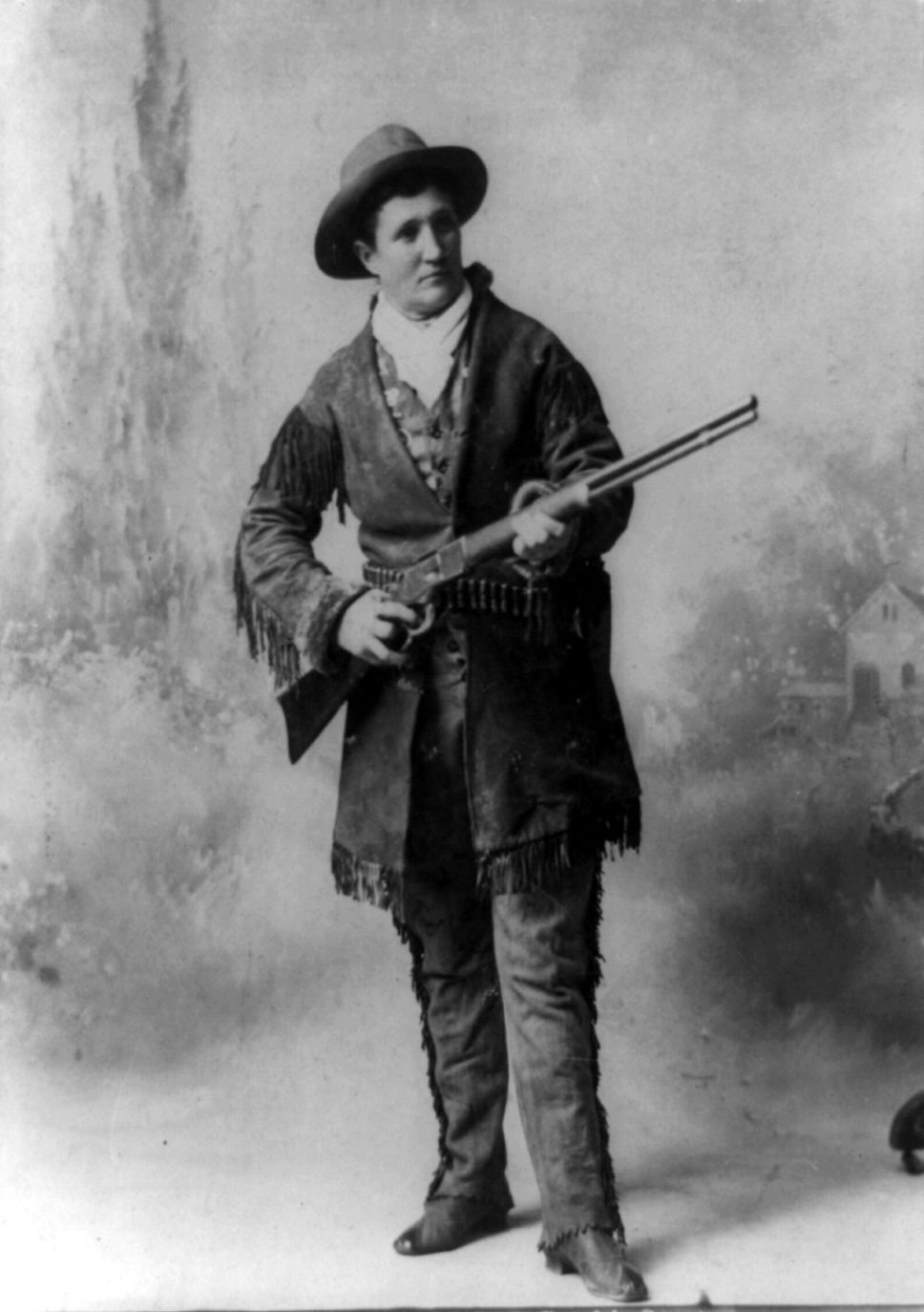
Calamity Jane hails from Laramie, Wyoming – a skilled sharpshooter who was born to a gambler and a prostitute. She cared for her five younger siblings in Utah before traveling on to Wyoming in search of a better life. There she found work as a dance hall girl and then as a prostitute at Fort Laramie. It was there that she reinvented herself by wearing buckskins and dressing like a man. She was also known for her swearing and hard-drinking ways, but Calamity Jane was also known even more for her kind heart and helping folks out of calamities–thus her nickname.
Calamity Jane — She was the inspiration for Michelle Rene’s HOURGLASS novel.
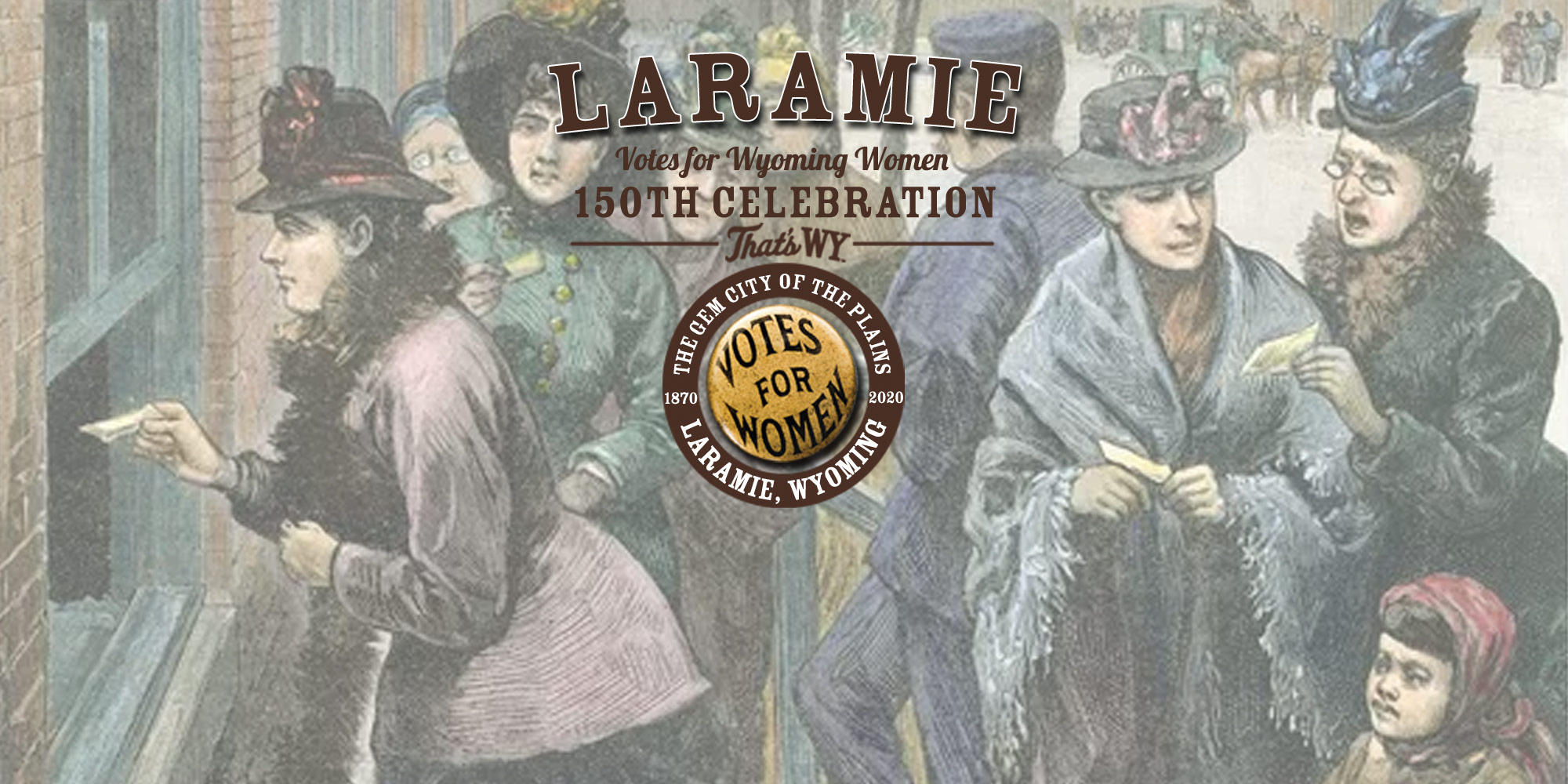
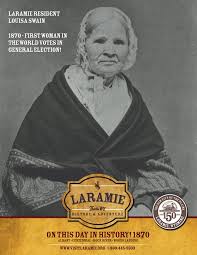
While the men were wrestling in the streets and shooting up the place, it was really the women who brought civilization to Laramie and Wyoming Territory. They established the first school in 1869, served on a formal jury in the Spring of 1870, and were the first to gain the vote; which is exactly what Louisa Swain and 92 of her friends did on September 6, 1870 –150 years ago!
Louisa Swain, the first woman to cast a ballot and she did it in Laramie, Wyoming!
Louisa Swain – she was made of stern stuff!
Early in the morning on September 6, 1870 in Laramie, Wyoming Louisa Swain became the first woman in the world to cast a ballot under democratically enacted laws granting women equal political rights with men. In the fall of 2008, 138 years later, the U.S. Congress passes a resolution proclaiming September 6th as “Louisa Swain Day” in recognition of this historic event.The Louisa Swain Foundation
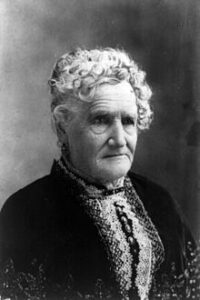
In 1870, Esther Hobart Morris (59 years old) became the first female Justice of the Peace. She served in South Pass City, Wyoming, which is to the northwest of Laramie.
Esther Morris, first female Justice of the Peace — Wyoming
Esther Morris “to pettifoggers she showed no mercy.” Wyoming Tribune
The Union’s first all-female jury was assembled in Wyoming in 1870.
Later, in 1894, Estelle Reel Meyer became Superintendent of Public Instruction, the country’s first female statewide elected official.
And the grand coup d’etat was when in 1889 when Wyoming vied for statehood—and refused to join the Union if the laws giving equality to women were not upheld, telling Congress (which wanted the suffrage law rescinded) via telegram,
“We will remain out of the Union 100 years rather than come in without the women.”
Wyoming is also the first state in the USA to allow women to own property and sign legal documents.
In 1910, Mary Godat Bellamy became the first woman to be elected to the Wyoming Legislature. Two other western states, Colorado and Idaho, elected women legislators in 1895 and 1899, respectively. Wyoming was third in the nation.
Quotes are from the Smithsonian Magazine
Read more: https://www.smithsonianmag.com/travel/women-voting-wyoming-150-years-here-how-state-celebrating-180971263/#6UKzMfMeCQsmbIIQ.99
Give the gift of Smithsonian magazine for only $12! http://bit.ly/1cGUiGv
Follow us: @SmithsonianMag on Twitter
In this stirring, coming of age saga by J. R. Collins, an old man shares his recollections of a time when the good old life was turning bad in his home region of the Tennessee mountains.
Jebediah, known as Jeb, Collins was born in 1815 in a place known to the local Cherokee Indians as Cho-E-Sto-E, “Land of the Dancing Rabbits.” Owing to their closeness and their many shared needs, the family is, in a sense, adopted by the Cherokees. Jeb’s brother marries a Cherokee girl, and he himself is blessed by a sort of spiritual brotherhood with a Cherokee boy named Wolf who was born the same night as he. The story, a sequel to Collins’ earlier work, The Boy Who Danced with Rabbits, opens in 1827 as Jeb and Wolf, just on the brink of adolescence and able to act in manly ways, go on a hunting expedition. They slaughter a huge wild boar and are enjoying their conquest when renegade Indians enter their camp, demanding to know the whereabouts of a female slave who has run away into the woods. The intrepid lads manage to turn their intruders away and set out on their own to find the woman, after being alerted to her possible location by a panther, known in that part of the world as a “painter” cat. They find her nearly dead. Wolf sets her in a cave known to his people for its healing powers, where a huge bear will remarkably take part in her care before Jeb’s sister Anne can arrive with herbs and other remedies she has learned from her Cherokee relations.
But lurking in the hills at that time are many, even greater dangers, as Jeb and Wolf learn when they encounter two surveyors for the United States Army, even now planning what will someday be called the “Trail of Tears,” driving the indigenous people abruptly, violently, from their spiritual and physical homeland. The reminiscences of Jeb as an old man give hints of that shameful time to come, while he sees his younger self resting rather easily after having helped to save the dying woman who, it evolves, has reason to rejoice at being found by members of Wolf’s tribe.
Collins was raised in the area about which he writes so knowledgeably. He has an ear for the local dialect that runs throughout the narrative, and sensitive awareness of local lore with its powerful undertones of Native American culture and history. His sense of the tight connection between humans – both Irish and Cherokee – and the land they occupy is a dominant theme, along with the deep distrust both have for government men and the miners that have come to strip the area of its store of gold. Many supernatural events also demarcate the story, like the bear’s healing attention on the wounded escapee, and the many etheric visions experienced by Jeb as he realizes he is growing into manhood through his perils and victories.
Those with a love of the old ways – both the real, factual events of America’s early development and the mystical imponderables that infuse the natural world of its native peoples – will savor Collins’ dramatic Choestoe series as thus far conceived, and wait excitedly for the next episode.
Living Where the Rabbits Dance (Choestoe Series, Book 2) won First in Category in the CIBA 2018 LARAMIE Awards for American Literature.
Welcome to the SPOTLIGHT on post-1750 Historical Fiction novels… in other words,
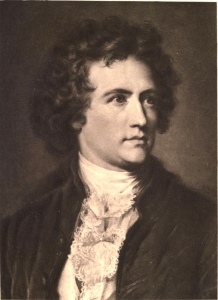
Welcome to the GOETHE Book Awards!
Why do we like Johann Wolfgang von Goethe so very much? It’s simple! He’s the guy who wrapped up everything we believe in with this simple sentence:
“Whatever you can do or dream, you can begin it. Boldness has genius, power, and magic in it.” – Goethe
Of course, this was also said about Goethe (Super Goethe by Ferdinand Mount) that “…[his] company could be exhausting. One minute he would be reciting Scottish ballads, quoting long snatches from Voltaire, or declaiming a love poem he had just made up; the next, he would be smashing the crockery or climbing the Brocken mountain through the fog.”
So…, moving on… Goethe was also a very cool guy. In his lifetime, he saw the beginning of the Industrial Revolution in 1750 through Mary Shelley’s publishing of Frankenstein in 1818 – and everything in between! Check out the list of what happened during those nearly seventy decades at the end of this post – you will be A-Mazed!
Now, Welcome to the GOETHE Hall of Fame!
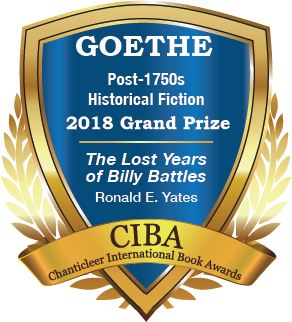
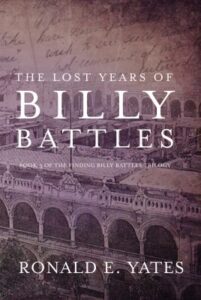
We wish to congratulate 2018’s Goethe Book Awards Grand Prize Winner –
Billy Battles is as dear and fascinating a literary friend as I have ever encountered. I learned much about American and international history, and you will too if you read any or all of the books. Each is an independent work, but if read in relation to the others, the reader experiences that all too rare sense of complete transport to another world, one fully realized in these pages because the storytelling is so skillful and thoroughly captivating. Trust me; you’ll want to read all three volumes. Chanticleer Reviewer’s Note
Mr. Ronald Yates not only won Grand Prize in the CIBAs 2018 GOETHE Awards – he won OVERALL GRAND PRIZE!
To learn more about Ronald E. Yates, please click here.
Congratulations to the 2018 Goethe Book Awards First Place Category Winners!
Submit your manuscript or recently released Historical Fiction (post-1750s) to the Chanticleer International Book Awards!
Want to be a winner next year? The deadline to submit your book for the Goethe Awards is June 30, 2020.Enter here!
Grand Prize and First Place Winners for 2019 will be announced during our 2020 conference, #CAC20.
The Grand Prize and First Place for 2020 CIBA winners will be held on April 17, 2021.
Any entries received on or after June 30, 2020, will be entered into the 2021 Goethe Book Awards that will be announced in April 2022.
As our deadline draws near, don’t miss this opportunity to earn the distinction your historical fiction deserves! Enter today!
The GOETHE Book Awards is a division of the Chanticleer International Book Awards – the CIBAs.
The 2020 winners will be announced at the CIBA Awards Ceremony during #CAC20. All Semi-Finalists and First Place category winners will be recognized, the first-place winners will be whisked up on stage to receive their custom ribbon and wait to see who among them will take home the Grand Prize. It’s an exciting evening of dinner, networking, and celebrations!
Goethe
Some events that occurred during Goethe’s lifetime:
1750 – The Industrial Revolution began in England
1756 – Wolfgang Amadeus Mozart was born in Salzburg Austria
1761 – The problem of calculating longitude while at sea was solved by John Harrison
1765 – James Watts perfects the steam engine
1770 – Ludwig van Beethoven was born in Bonn, Germany
1774 – Goethe’s romantic novel, The Sorrows of Young Werther, propels him into European fame
1774 – Goethe’s play Gotz von Berlichingen, a definitive work of Sturm und Drang premiers in Berlin
1776 – America’s 13 Colonies declare independence from England. Battles ensue.
1776 – Adam Smith publishes the Wealth of Nations (the foundation of the modern theory of economics)
1776 – The Boulton and Watt steam engines were put to use ushering in the Industrial Revolution
1783 – The Hot Air Balloon was invented by the Montgolfier brothers in France.
1786 – Le Nozze di Figaro by Mozart premiered in Vienna
1789 – George Washington is elected the first president of the United States of America
1780 – Antoine Lavoisier discovers the Law of Conservation of Mass
1789 – The French Revolution started in Bastille
1791 – Thomas Paine publishes The Rights of Man 1792 – Napoleon begins his march to conquer Europe
1799 – Rosetta Stone discovered in Egypt
1802 – Beethoven created and performed The Moonlight Sonata 1802 – A child’s workday is limited to twelve hours per day by the British parliament when they pass their first Factory Act
1804 – Napoleon has himself proclaimed Emperor of France
1808 – Atomic Theory paper published by John Dalton
1811 – Italian chemist Amedeo Avogadro publishes a hypothesis, about the number of molecules in gases, that becomes known as Avogadro’s Law
1811 – Jane Austen’s Sense and Sensibility was published anonymously. It was critically well-received
1814 – Steam-driven printing press was invented which allowed newspapers to become more common
1818 – Mary Shelley publishes Frankenstein 1832 – Goethe’s Faust, Parts 1 & 2 are published posthumously (March 22, 1832)
In 1830, Eugene Delacroix created Liberty Leading the People to epitomize the French Revolution. The movement officially began with the Storming of the Bastille on July 14, 1789, a day that is still celebrated in France. The French people were rebelling against the extreme wealth of the French royal family who overtaxed and underpaid the people of France to the point where they could not even feed themselves and had nothing to lose by going to battle. They were starving to death. The uprising of 1830 was featured in Victor Hugo’s Les Miserables (1862)
Claude-Michel Schönberg and Alain Boublil’s (1980s) musical can look at Delacroix’sLiberty Leading the Peopleand hear the lyrics of the song that serves as a call to revolution:
Do you hear the people sing? Singing a song of angry men? It is the music of a people. Who will not be slaves again.
Liberty Leading the People by Eugene Delacroix, 1830. On display at the Lourve, Paris.
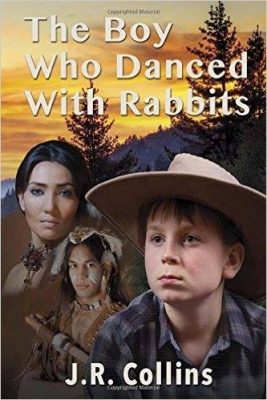
J.R. Collins has given a voice to an ancestor, Jeb Collins, who was almost killed at birth – twice. His survival is significant for that, but also for the fact that in another part of the Georgia mountains, a Cherokee boy, Wolf, is born on the same night. The families of the two boys will meet and mix in the early days of American settlement when everyone had to struggle for survival, and such friendships were still possible.
Jeb learns smatterings of Cherokee language, and Wolf and his kin pick up English with a sharp mountain twang from their settler neighbors. Together Jeb and Wolf explore the mystical, mountainous part of Appalachia named Cho-E-Sto-E for the prevalence of rabbits there.
Both of the boys’ fathers remember and despise the British who killed the American rebels and betrayed the Indians who agreed to help them; and both hate all evil-doers, like the ones who kidnapped Jeb’s sister or the sneak-thieves who stole from Jeb’s family. But most of all, they will stand united against a nearby tribe that wants Wolf’s sister as a bride for their leader.
The author grew up in the region he describes so vividly in this, his first novel, and has a sequel, the award-winning, Living Where the Rabbits Dance. The story, focusing on the boy’s view of a sometimes-dangerous world, is told in a satisfyingly recognizable dialect, using many endearing folk expressions – one of our favorites being, My heart melted like butter on a hot biscuit.
This multilayered saga presages the time that will come when the Cherokees will be marched away on the Trail of Tears, and family connections like those depicted here will be destroyed in the name of Manifest Destiny. It is heartening to read about the few years enjoyed by such friends as Jeb and Wolf when they could roam the land together with the approval of their elders. There is a finely-honed homage paid to two religions, the Christianity of the Collins clan and the animist visionary beliefs of the Cherokees, each playing a role in Jeb’s perceptions of the world around him.
From learning to fish to making bead bracelets from local gemstones, to seeing visions invoked by Cherokee spirits, here is a tale of a boy coming of age in a significant time and place. Collins’ book records that history, that atmosphere, with equal measures of zeal and reverence.
The Boy Who Danced with Rabbits by J. R. Collins won First Place in the 2017 CIBAs for the Goethe Awards, Western Fiction.
I first met Joe Collins at CAC18 this last April. He’s a tall, quiet man who carries himself with a certain nuance, a particular look in his eyes that lets a person know he’s looking for fun. He writes from the heart and although he won 1st Place in the Goethe Awards for 2017, his book could have done just as well in the Laramie Awards.
I am honored that Joe took the time to participate in our 10 Questions Interview Series. He has a lot to say and I hope you enjoy this piece as much as I do.
Let me introduce you to J.R. (Joe) Collins:
Chanticleer: Tell us a little about yourself: How did you start writing?
Collins: I was raised in the Southern Appalachian town of Blairsville, GA. Our whole county had a population of around eight thousand at the time of my birth, 1962. I spent my growing up years helping my father farm beef cattle and attending the local school for my education. I went to church as a kid. Learned a deep respect for a love that would sacrifice itself for me. I believe I was considered normal by the local folks. You knew everybody in my confined, little world, and their business, too, whether you wanted to know it or not. News traveled fast because of how the telephone worked. Most all the homes were on a “party line,” if you had a telephone at all. You knew folks’ business because you could listen in on your neighbor’s phone conversations over that “party line.” The older generation was judgmental to a point. That mattered to families. You didn’t want folks thinking bad of you or yours.
My trail after high school began by following the same path many of the kids from my area walked. College, job, then family. I couldn’t stay on that trail long, though. I discovered competitive golf after a couple years in college and turned pro after obtaining an Associate degree. Spent many years beatin’ that little ball trying to catch a break while working at different golf courses here, there, and yonder. I loved it. Did okay for a small-town, mountain-born boy. I got no regrets. Won a few good tournaments. Maybe I should’ve been a caddie?
Met my wife at the ripe old age of thirty-five. We have two kids, Alex and Emma, they’re twins. Fortunately, we all get along for the most part with little tension outside of normal weekly stress. We like the outdoors but have regrettably had little time over the years to enjoy vacationing there because of work and the crash of the economy. I do regret that.
I started writing because I wanted to tell a story. A story of my heritage to some degree. A story to enlighten those who read it about a frontier that came and went with little recognition outside a state of confusion about the grave mis-justice done to the native Cherokee. I won’t claim all that is in (or will be in) my books as actual, but I can guarantee you they are based on fact in my imagination. I love that about writing. I’ve always enjoyed a good “yarn” be it a ghost story that will haunt my nights, a mystery that challenges my intuition or an adventure that will take me to someplace I may never see. Introduce me to people I would never meet otherwise. It is a true blessing when I learn someone has enjoyed my work. Somebody give me a hug!
Chanticleer: We do love you, Joe! When did you realize you that you were an author?
Collins: That’s an easy one. It’s when I heard my name called out for First in Category at the Chanticleer Awards Gala. I for sure knew I belonged behind the scenes writing when I broke protocol and absent-mindedly went for the ribbon Kiffer was holding without shaking Gregory’s hand first. “What a stupid I am” — I feel terrible about that. I hope he understood. Accepting that ribbon was extra special to me. That’s the moment I knew I could actually think of myself as a writer. Thank you guys soooo much!
Chanticleer: Those of us who have won awards know what it’s like to be in that is-this-really-happening? moment. I’m sure Gregory Erich Phillips knows exactly what that’s like! What genre best describes your work?
Collins: Historical Fiction for sure. I love learning about history that is based in the lives of those who actually lived it. I respect heritage, so I enjoy creating stories combining the two. Those aspects wound together give me great pleasure when I write. My publisher told me early on in the publishing of my first book, “Write from your heart when you write, Joe. Don’t force it if it doesn’t fit.” I follow that. I want my reader to enjoy their trip back in time to a place they will never see outside of my book, and to be comfortable with the journey. I want them to experience the surroundings of each scene like they are actually standing there watching in person. To taste the smells, feel the air, hear the sounds and to comprehend the emotion I want them to feel. I love taking them back as they read. I’ve heard it said that history repeats itself. I believe history stays with us if we as authors write it, understand it, feel it; then our readers can believe and be transported. I want folks to escape to a world I completely understand. All they need do is be willing to go inside my mind for a while. It’s not such a bad place, really.
Chanticleer: That’s wonderful, Joe. Can you tell us a little more about it?
Collins: I grew up in a part of the Southern Appalachian that holds a rich history of ancestral heritage for those who were founded there. I basically grew up an only child as my siblings are much older than me. Being the only child on a big cattle farm surrounded by mountains and forest is heaven for a boy of my put together. My imagination had unlimited boundaries. I hunted constant when game was in season. I fished when hunting wasn’t allowed or whenever I got a hankerin’ for some fresh, juicy cold-water trout. One stream I would fish regular produced a lot of Brown Trout, another produced more Rainbow Trout. Just depended on which flavor I had a taste for as to where I’d go try and catch fish. Those days are gone. The fish have lost their flavor. The creeks and rivers now polluted with housing and folks. What a shame.
We got little in the way of television reception where I lived growing up, so entertainment had to be something other than watching TV. On some evenings after we’d worked hard on the farm all day, Dad would take Momma and me and we’d go visit the old-timers at their original family homes where they were born, then raised their own kids, and still lived in then. Some were family, others not so much. I loved goin’ with my dad and doing that. Sittin’ out on the porch rocking in a chair made right there in the work shed of whatever elder we were visiting. I’d rock and listen to their tales while they smoked or chewed tobacco. Spitting dark, brown burley tobacco juice out between their fingers while thinking on thoughts about the tale they were spinning. You had to watch where they spit that stuff because it would splatter in all directions when it landed. Get all over your feet and ankles if you were in too close. I heard stories from the days of old that sank into my soul. Are they in my book? Some, maybe. Remnants, mostly. The ideas? – for sure.
Of course, where I grew up was rich in Indian ancestral heritage as well. As a kid, I hunted the plowed bottoms up and down the river Notla whenever I got the chance hoping to find Indian made artifacts. After a good rain was the best time. We found some unbelievable things, too. Seriously, you wouldn’t believe a body could make such as we found on occasion from just the natural resources right where whatever it was you found was laying. I could live like settlers did back in those days. I can relate. I guess that’s why I like historical fiction so much. It takes me back to a time in my life where I had no worries. We all need a little of that from time-to-time. I miss it. #GroupHug.
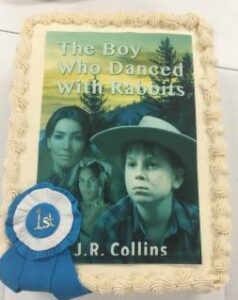
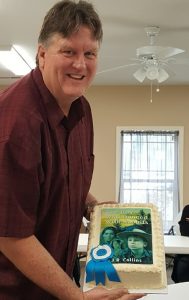
Joe received this beautiful cake from his work family. #GroupHugJoe showing off his beautiful cake! Sure looks good!
Chanticleer: Do you find yourself following the rules or do you like to make up your own rules?
Collins: I don’t like rules. I trust myself and my judgment more than I do most folks who make the rules. Politicians and government folk are prime examples of rule makers who care little for the common folk — ask the Native American. Being a person of faith, and knowing what lies ahead, I get confused as to why we have locks? Or why we hire our own to protect us from ourselves? I prefer a time when folks looked after them and theirs. In writing, I follow that same train of thought. Conversation can be lawless!
Chanticleer: You’re giving us a lot to think on, Joe. Thank you! How do you take all of these memories, all of these stories, and come up with a full-length novel?
Collins: If I can live it in my mind, I can make it into a story. I try to pull everyday occurrences and mix those with any corresponding relative history that I know about. That concoction has to settle in my center for me to know it’s something I can focus on. But, the difficulty comes when I try to pinpoint the objective of why I want to write about that particular subject. It has to satisfy my soul. If it ain’t there, it ain’t to write. But, God.
Chanticleer: How structured are you in your writing work?
Collins: Aghhhhhhhhhh! Hahahahahahaha! STRUCTURED? Don’t even know what that means. I write when I can feel the words going on to the paper (screen). I need to work on this area of my “authorshipness” profile. Hahahaha! I love you guys! I know y’all are structured. I saw it first hand in Bellingham back in April.
Chanticleer: [Don’t you just love this guy? #GroupHug]How do you approach your writing day?
Collins: That all depends on where I am in the writing process of the particular thing that I am writing. For a novel, I can spend a lot of time with story content and character development or I can work on the comfort of the read if I’m well enough along. The priority status of either of those two aspects will designate the attempts I will make for any particular day. Stories have to flow to achieve [the desired] effect. A story written poorly does not catch the imagination of the reader even though the topic is of interest. I prioritize where I believe a reader would want to be in the progression of what is taking place at a certain point in the story. Then, of course, you sit down to write and it all comes crashing down. No reason just crashes. Your mind shuts off. That’s when you reach for something other than your pencil (laptop) . . . like bourbon. No more writing that day. Sometimes intention to write and creative juices are way too far apart for my simple mind. I try to plan and prioritize, but it doesn’t always go the way I want. On those kinds of days, we all need a hug.
Chanticleer: [#Group Hug] What are you working on now? What can we look forward to seeing next from you?
Collins: Right now, I’m finishing the final book in the trilogy I call, “Home from Choestoe”, that I’ve been working on for the last few years. Originally, I’d planned on four books but I’m ready to move on. I want to start something else. Being raised in the Southern Appalachian Mountains offers many different opportunities to write about interesting topics. I haven’t fully decided on what my fourth book will be about as of yet, but it will come to me before long. I have some ideas, but nothing has settled with me that would spur me on to write a novel.
Chanticleer: What is the most important thing a reader can do for an author?
Collins: Enjoy what we write, then tell others so they can hopefully enjoy it as well. Give us reviews that we can share. Selling books is important, sure, but most all good stories have an underlying point of concern. If a reader finds that and is moved by it, then that is all we can hope for as authors. That, to me, is the most important consideration for what we do. Is the reader touched by what we write? Do they feel, then understand what we are saying? Let’s hope they get it because that’s why we do what we do. It sure ain’t for the money.
Love you guys! Take care, and God Bless . . . Joe
We certainly love you back, Joe! Thank you for spending some time with us today.
If you liked this interview with author J.R. Collins, please leave a comment below. We love being connected to our amazing author community, don’t you?

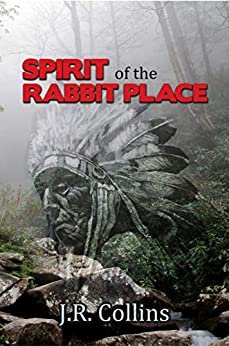
 When gold miners discover Choestoe Valley, Jebediah Collins must fight for his family – whether blood-related or not – in J.R. Collins’ historical adventure, Spirit of the Rabbit Place







 What’s a Laramie?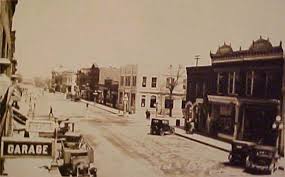










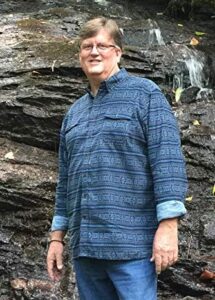 I first met Joe Collins at CAC18 this last April. He’s a tall, quiet man who carries himself with a certain nuance, a particular look in his eyes that lets a person know he’s looking for fun. He writes from the heart and although he won 1st Place in the Goethe Awards for 2017, his book could have done just as well in the Laramie Awards.