

What’s that note say on your piggy bank?

Deadlines aren’t just for taxes, sign up today for the Harvey Chute Awards today!
Do you have money on your mind and your mind on money?
The Origins of the Harvey Chute Awards

The Harvey Chute Awards hold a special place in our hearts as Harvey was a presenter at Chanticleer in the past. We named the Awards after him to honor his contributions and the business savvy that he brought to all interactions.
An author in his own right, Chute wrote Stone and Slit, a cozy historical mystery set during the gold-rush in British Columbia, just across the border. What he was most well know for though were his guides in the For Dummies series.

For those who might not know: The For Dummies books are a series published by Wiley that break down difficult tasks into approachable, friendly how-to guides. Chute worked on a series detailing how to best use the Amazon Kindle.
Kiffer and Harvey met just after he founded KBoards.com, a Kindle forum that’s well-known among readers and authors. Harvey Chute passed away in the fall of 2015, but the impression he made remains to this day.
Let’s take a closer look at KBoards, one of the many legacies left behind by Chute.
KBoards

KBoards.com is a lot like what you’d expect from a Reddit forum, but everything is related to Kindle and Amazon publishing. It reads like a community run FAQ for best practices. And speaking of, they have an FAQ to help use the platform right here. It’s a remarkable tool for any author willing to invest the time into making it work.
Speaking of authors trying to make it work…
Business & Finance
One of the toughest questions facing authors is how to maximize their book sales. Discounting a global pandemic, this was already hard enough to manage between digital sales and physical hand sales, not to mention author websites, social media, online presence, tours, events, and everything else! Writers are entrepreneurs, whether their books are independently or traditionally published.

If you’re not sure where to get started marketing your book, consider this article here written by Kiffer Brown and Sharon Anderson as your starting point!
Want to write better about business and finance? The best place to start is by reading what others have already written!
You can see some of our reviews of entrepreneurial literature below
RETIRE SECURELY: Insights on Money Management from an Award-Winning Financial Columnist
By Julie Jason
First Place Winner in I&I Awards

If you’re wondering what the difference is between a Roth IRA and a traditional IRA, then you’ll want to pick up Julie Jason’s Retire Securely: Insights on Money Management from an Award-Winning Financial Columnist. You will be treated to a crash course on financial terms like these and get inside information on saving and investing thanks to scores of conversations she’s had with her readers over the years.
Plenty of titles on financial planning and investing exist on bookstore shelves, but what makes Jason’s compilation different is that hers is culled from more than 1,000 columns she has written over the years for the Connecticut newspapers, Greenwich Time and the Stamford Advocate. In 2013, King Features syndicated her “Retirement Planning and Investment” column, where she explores topics like 401(k) investing, choosing a financial adviser and how to determine if sending your kid to college is a good value. Jason, who worked as a Wall Street lawyer, money manager, and investment counselor, really knows her stuff: whether it’s unraveling the complicated world of market trends or explaining estate planning, her columns are worth reading and applying to your financial life. Her column has recently moved from King Features to Andrews McMeel Syndicate [Chanticleer Reviews was notified about this change on April 3, 2020].
PRIVATE MONEY LENDING: How to Consistently Generate a Passive Income Stream
By Gustavo J. Gomez, Ph.D.
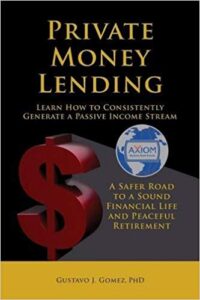
Are you in retirement, or close to it, wondering how you’re going to make ends meet pulling from your portfolio? Well, you’re not alone if you’re staying up at night thinking about how low-interest rates are killing your investments.
In a practical and easy to read format, Gomez explains to investors the particulars of a little known, yet potentially lucrative investment technique that can handle the ups and downs of the stock market. Unlike stocks, the underlying security of private money lending is a tangible asset – brick and mortar, so there is another layer of protection for you, the investor.
But what is Private Money Lending? According to Gomez, it refers to a private individual or organization that lends money. Typically, when you’re looking for financing, you would go to a bank. With private funds, on the other hand, you’re going to an individual or organization that specializes in this type of lending. The upside of private money lending is that it’s less regulated, which means less red tape. The icing on the cake, he says, is that these investments have consistently generated 9 to 12 percent returns* – not bad considering stock market investments have averaged closer to 7 percent, and with much more fluctuations. We can’t forget the economic crash of 2008 when many stock market investments plummeted close to 40 percent.
APE: Author, Publisher, Entrepreneur
By Guy Kawasaki and Shawn Welch
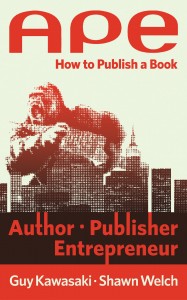
APE is the how-to compendium for today’s self-publishers.
Authors will findAPEan indispensable resource. Guy Kawasaki passes along his publishing experience in his “no-shitake,” but affable manner. Imagine having an extremely successful uncle in the publishing biz who also has a tech-wizard pal (co-author Shawn Welch) of digital publishing magic. Fortunately for us, this dynamic duo decided to share their publishing know-how.
APE’s premise is that publishing is a parallel process “that requires simultaneous progress along multiple fronts.” Hence, self-publishers are challenged with how to: market, brand, design, promote, publish, distribute, and finance a book–all at the same time. Oh, and don’t forget the time required for actually writing the book. Indisputably, each self-publisher is an:Author, Publisher and Entrepreneur.
WELFARE CHEESE to FINE CAVIAR
By Thomas Wideman, MBA, PMP
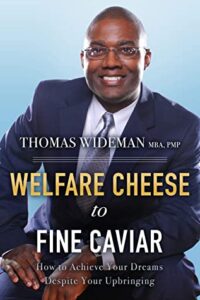
Thomas Wideman, the author of this dynamic self-help manual, Welfare Cheese to Fine Caviar: How to Achieve Your Dreams Despite Your Upbringing, rose from poverty and dismay to a life of security and personal achievement through techniques he shares with readers who can incorporate them into their own life plans.
Wideman came from an impoverished African American family wracked by confusion, chaos, and, at times, criminality. His mother had three sons by three fathers, and he would come to know his own father only peripherally, eventually learning that the man murdered people and subsequently died in prison. The boy grew up in tough neighborhoods and ate “welfare cheese” (a block of pre-sliced heavy American cheese that supposedly melted well). Every month, making ends meet became more and more difficult. In an early chapter of this finely woven chronology, we see him taking food from trains parked along the railroad tracks and running from the authorities. In this, as in each new chapter, he speaks of confronting severe issues and finding ways to resolve them. In the case of the theft and other childhood incidents of fighting, experiencing bullies, and battling racism, he speaks of making up his mind that “my circumstances need not be my limitation.”
Have a book on Business and Enterprise? Submit by the end of November for the 2021 CIBAs!
See the 2020 Harvey Chute Award Winners Here!
Looking to submit to our other Non-Fiction Divisions? See them all here!
When you’re ready, did you know that Chanticleer offers editorial services? We do and have been doing so since 2011.

Our professional editors are top-notch and are experts in the Chicago Manual of Style. They have and are working for the top publishing houses (TOR, McMillian, Thomas Mercer, Penguin Random House, Simon Schuster, etc.).
If you would like more information, we invite you to email Kiffer or Sharon at KBrown@ChantiReviews.com or SAnderson@ChantiReviews.com for more information, testimonials, and fees.
We work with a small number of exclusive clients who want to collaborate with our team of top-editors on an on-going basis. Contact us today!
Chanticleer Editorial Services also offers writing craft sessions and masterclasses. Sign up to find out where, when, and how sessions being held.
- A great way to get started is with our manuscript evaluation service, with more information available here.
- And we do editorial consultations for $75. Learn more here.
- If you’re confident in your book, consider submitting it for a Editorial Book Review here or to one of our Chanticleer International Awards here.
And remember! Our 10th Anniversary Chanticleer Authors Conference (CAC22) will be April 7-10, 2022, where our 2021 CIBA winners will be announced. Space is limited and seats are already filling up, so sign up today! CAC22 and the CIBA Ceremonies will be hosted at the Hotel Bellwether in Beautiful Bellingham, Wash. Sign up and see the latest updates here!

Writer’s Toolbox
Thank you for reading this Chanticleer Spotlight Article.
Important Links from this Article
12 MUST-DO’s for AUTHORS for a Successful and Productive 2020 and Beyond
The traditional publishing tool that indie authors can use to propel their writing careers to new levels? The Seven Must-Haves for Authors – Unlocking the Secrets of Successful Publishing Series by Kiffer Brown