
Author: dr-harish-malhotra

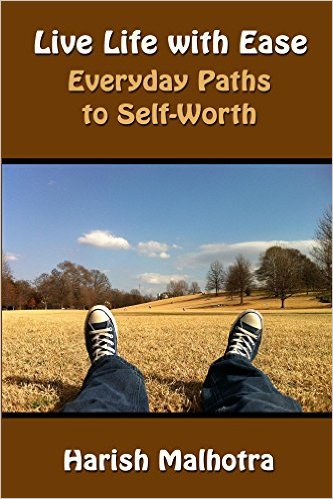
  • LIVE LIFE WITH EASE by Dr. Harish Malhotra, a practical self-help guide on self-healing

    LIVE LIFE WITH EASE by Dr. Harish Malhotra, a practical self-help guide on self-healing

    Readers of Dr. Harish Malhotra’s two previous books (Metaphors of Healing: Playful Language in Psychotherapy and Everyday Life and Pathways to Hope: Innovative Insights for Therapists and Patients) are in for a treat as his third title continues us on the healing path paved with entertaining metaphors. New readers too will enjoy holding Dr. Malhotra’s hand through life’s ups and downs as he takes us on a journey with 55 stories in Live Life with Ease: Everyday Paths to Self-Worth, each tale replete with his amusing touch.

    In chapters like, “Settle Into Your Ideal Lifestyle,” “Pain, Pain, Go Away,” “Overthrowing Fear,” and “The Weight of Eating,” Dr. Malhotra tackles universal themes in a lighthearted, yet practical way. By weaving these humorous metaphors, he blesses us with the way he sees life as we confront fear, worry, addiction, lack of self-worth, sleeplessness, and unhealthy eating.

    Take for example, the chapter “Infatuation,” where Dr. Malhotra advises us to employ the “Sleep on it/24-hour rule.” He compares decision-making to buying a new house – one that seems to boast a gorgeous skyline but is located on a dangerous street. “Let your excitement simmer down before making decisions. Reason may replace infatuation,” he counsels.

    In one of the more playful stories, Dr. Malhotra poses to the reader: “Are you like a fart or a flower?” Despite the silliness, he raises a sincere dilemma: why would we surround ourselves with people who are “toxic” and “seething with resentment,”  rather than those who are “fragrant” with a “pleasant demeanor and gracious words.” Point well taken, Dr. Malhotra, with a nod to our olfactory.

    We have to assume that Dr. Malhotra, a board certified psychiatrist in private practice in Summit, NJ, pulls from his more than 40 years in a white lab coat as many of the sketches include (imaginary?) dialogue between doctor and patient. “Don’t fight the smoke with a sword of worry,” he says to a patient who is anxious about the future.

    Throughout the book’s 304 pages (or 364 pages via e-reader), we feel like he is our own personal guru and we are a better person for it.

    In one of my favorites, “Dating, Inc.” he likens relationships to “Hair Softener or Chewing Gum.” Holding on too tight is like getting chewing gum balled up in your partner’s hair,” he says. “Some hair has to be cut off to get rid of the gum… Some problems in relationships stem from too much contact.”

    Perhaps the book, which makes a delightful gift for a college graduate or a loved one needing inspiration, can best be enjoyed as a bedside reader, referring nightly to the index to locate specific passages in times of stress: “Reframing Problems,” “Risk Taking,” “Welcoming Attitude,” and “Unlearning Habits.”

    For further inspiration, you can see Dr. Malhotra on his YouTube channel, “Helpful Hints for Hangups,” where he acts out the rousing metaphors with members of his family.
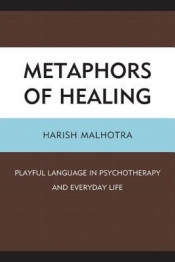
  • Metaphors of Healing by Dr. Harish Malhotra

    Metaphors of Healing by Dr. Harish Malhotra

    One rarely sees a self-help book from a practicing psychotherapist that offers more humor and appeal to the common denominator in all of us than this collection of brief stories: Metaphors of Healing : Playful Language in Psychotherapy and Everyday Life. Dr. Malhotra offers a simple, but brilliant, idea: Use the healing language of metaphor as a therapeutic strategy and a curative approach for daily life.

    Metaphors of Healing organizes metaphors by themes, including “The Daily Grind,” “Dating,” “Being a Better and Happier You,” and “Addiction,” among the 14 chapter titles. For instance, try reading “Is the Left Lane Too Fast?” as a metaphor for slowing down, easing the professional load, and getting reacquainted with our family. Its appeal is in the simplicity of applying the idea toward easing anxiety and cutting back on the “daily grind” most of us know too well. In addition, we gain a visceral sense of how the self-imposed pressure to succeed contributes to everyday unease and unnecessary fears.

    Another feature of Metaphors is how easily one remembers a story, but forgets most of the high-minded advice of a therapist. If the story fits (and most of these have the superb quality of fitting very well) a client can leave his therapy session with an entirely new way of dealing with his or her issue. For instance, he says, “A dead-end road is not the same as a dead end journey.” We can always find another route more effective than the lost cause we thought was our destiny.

    Malhotra’s training in both psychotherapy and behavioral approaches offered flexibility for initially coping with his patients’ various maladies. Shifting to metaphor when confronting dis-ease, he discovered, incorporated an even broader spectrum: healing words from unexpected sources. Who knew a figure of speech could have such transformative powers?

    Malhotra aims to move people beyond their negativity, beyond their holding on to old problems, and even beyond their expectations to achieve a lifestyle free of judgment and criticism. I found his ideas on marriage as mindfulness exercises very significant—he speaks of empathy as the path to marital happiness: “Walking in the moccasins of one’s spouse” contributes to compassion and forgiveness, opening the door to an enduring love.

    The author is not a Pollyanna, an everything-is-beautiful-if only-you employ-a-metaphor to your life issues. Change requires commitment and persistence. We all seek successful relationships, whether we are talking about a difficult boss, an annoying neighbor next-door or our beloved spouse. Malhotra stresses how precious any relationship can be when it is working, even when it is very challenging. The healing power of any relationship blooms only under certain conditions, however: practicing the difficult virtues of restraint and diligence.

    This is not a book to be read in one sitting or all at once. It is one that the reader will find herself/himself picking up again and again taking in a chapter or a metaphor to ponder and, perhaps, adapt. It will become, more or less, a gentle companion that guides and inspires. One will find, on reflection and on rereading, that these simple stories contain deep insight and wisdom. Clinicians and those seeking to increase their understanding of themselves and their fellow humans would benefit immensely from reading Metaphors of Healing.