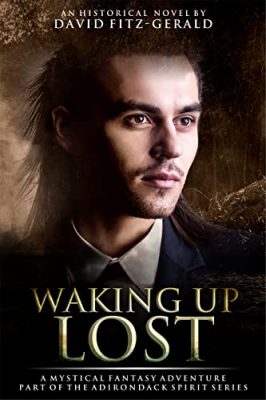
Seventeen-year-old Noah Munch craves acceptance more than anything in David Fitz-Gerald’s coming of age novel, Waking Up Lost.
As a biracial boy growing up in a small village in upper New York, Noah doesn’t feel that he belongs to either part of his heritage. Having lost his Native American father before he was born, Noah has spent his short life trying to connect with that missing part of himself. Meanwhile, he has to keep the peace with the Wilmington villagers who find his native side offensive. Noah also protects a family secret. His mother, Mehitable, speaks with spirits and his brother, Moses, has an uncanny ability to predict disaster and show up with inhuman speed to prevent it.
As a result of his complex home life, Noah spends a great deal of time alone. He dreams of someday being a mountain man, living off his wits and the nature around him. However, Noah can’t stop himself from admiring Arminda, the prettiest girl in town. He doubts he will ever have a chance to court the blonde beauty, especially considering the meanest young man in town, Erastus Moss, has spoken for her.
Erastus, whose grandparents died at the hands of Native Americans on a journey out West, begins to harass Noah when he notices Noah’s interest in Arminda.
Noah endures taunts, feeling the burden of prejudice and simultaneously the inadequacy of being the only “normal” member of his family until the night he wakes up on top of a mountain.
He begins to experience strange episodes, which he believes are sleepwalking fits. One night appears inside the home of his beloved Arminda. Once the town discovers his odd behavior, suspicion and fear turn even more people against him, and Erastus uses it as an excuse to escalate his torture. Can Noah stop the crazed man and find a way to control his abilities before it’s too late?
The fourth installment of the Adirondack Spirit Series revolves around Noah’s coming of age.
In true bildungsroman style, Noah embarks on both a physical and spiritual journey. He suffers the distance between himself and other boys, including his twenty-year-old brother. Noah, small, scrawny, and by his own admission, doesn’t have the physical presence that others expect of a boy his age. Though often the most handsome boy in Wilmington, Noah’s dark hair and olive skin set him apart in his racist town.
However, Noah never knew his father’s people, so he has nobody other than his white neighbors to socialize with. He can’t see himself as anything other than a clumsy daydreamer who will never fit in, driving him to live alone in the mountains as his father had done years ago. Noah yearns to connect to the father he resembles, but when he isolates himself, nature and man conspire to bring him right back to the town he hates.
He finds no solace in his mother and brother, even as they assure him that he possesses great power.
Even amongst his family, Noah doesn’t fit. He despairs his ordinary nature with a mother who guides spirits to the afterlife and brother with inhuman speed. If he could rely on a secret talent, he could tolerate his neighbors’ prejudice. But when he does develop an unexplainable ability, it proves nightmarish and deadly. Noah never knows when it will happen or, more importantly, where it will take him. Ironically, this strange power becomes paramount in discovering the very purpose he longs to find.
Faith and trust in God frame Noah’s life.
Noah often relies on his faith to carry him through the unbelievably tricky situations in his life. In pain, he turns to prayer for comfort and reassurance, and later when he commits a crime (albeit justified), he only frees himself of the burden when he seeks absolution from God. Though his episodes sometimes prove horrific, Noah realizes his power borders on the miraculous.
He searches for God’s plan for his life even while questioning how he will know it when he sees it. When Noah hits his lowest point, fearing for his life, he feels the “warmth” of God physically and hears His message that Noah isn’t alone. Noah becomes God’s servant, and he begins to understand that he must become what God expects, not what he wants.
The supernatural elements in the story set it apart from the typical novel of this genre, creating a hybrid between historical and paranormal.
The family members’ unusual abilities heighten their outsider status. Mehitable raised her biracial sons in a town of hate and prejudice for seventeen years. Though she does have a few staunch supporters, these people can’t always keep the wolves at bay. She and her sons suffer from the racism so prolific during the 1800s in America. Compounding her pariah-like treatment, she speaks to spirits and must keep her gifts secret for fear of further mistreatment. Moses must also keep his powers hidden. Noah suffers for his gift. Though he has no control over its occurrence, the townspeople practically exile him, leaving the young man to find a way to bridge this chasm between himself and others.
Recognizing and Celebrating Indigenous Peoples Day and Discussing our Laramie Awards.
It’s October 11th, which in Bellingham, Wash. means it’s Indigenous People’s Day. We believe in recognizing the rich history and contributions of native peoples here in the Americas, and are always working to expand our knowledge and understanding. To that end, we would like to acknowledge that our company is located in downtown Bellingham which is the ancestral home of the Coast Salish Peoples who lived and still live here today. They have a strong connection with the Salish Sea—the marine ecosystem that spans the United States-Canada coastal waterways from Olympia, Wash. to Comox, British Columbia, Canada.
Coastal Salish Annual Tribal Journey on the Salish Sea. Approximately 100 canoes participate in the Potlatch.
There are more than 65 Tribes and First Nations who have lived here for tens of thousands of years. Primarily, the Lummi and the Nooksack Nations reside here in Whatcom County by the Salish Sea. Whatcom is Salish for “noisy water.”
The name Salish Sea was officially recognized by the United States in 2009 and Canada in 2010. Click here if you would like to know more about the Tribal Canoe Journeys: Paddle to Lummi
Members of the Lummi Tribe in the PNW
Indigenous People’s Day began to be celebrated as far back as 1991, with people suggesting it be celebrated as far back as 1977! Of course as most people know, the holiday was intentionally created to overlap, and in some places, replace Columbus Day. Why? History.com offers an answer:
Some may ask why replace Columbus Day with Indigenous Peoples’ Day? Activists have long argued that holidays, statues, and other memorials to Columbus sanitize his actions—which include the enslavement of Native Americans—while giving him credit for “discovering” a place where people already lived.
While there’s no denying that the bloody history of Columbus that has been sanitized throughout historical retellings, the original origin of Columbus Day was never meant to celebrate the brutalization of the people who lived on this side of the hemisphere. Within 60 years after Columbus landed, only a few hundred of what may have been 250,000 Taino were left on their island (currently known as the Dominican Republic in the Caribbean). History.com
The holiday originated as an annual celebration of Italian-American heritage in San Francisco in 1869. In 1934, at the request of the Knights of Columbus and New York City’s Italian community, President Franklin Delano Roosevelt declared the first national observance of Columbus Day. (Smithsonian Magazine)
President Franklin Delano Roosevelt
Of course, as we learn more, we always aim to improve and progress as a society and as a country, working for the betterment of all, we can make updates and changes to reflect history more accurately and remember those who have been wronged in the past. Toward that end, we’d like to take a look at our Laramie Awards.
Spotlight on Laramie Awards
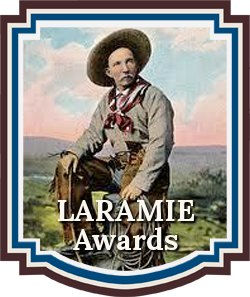
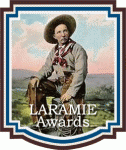
This artwork is from a 1907 postcard. The artist is unknown. The Laramie Awards recognize the best in Americana fiction.
The word Laramie has French origins, meaning The Leafy Grove. However, Kiffer named the Laramie Book Awards after Laramie, Wyoming when she lived just south of there when in Fort Collins, Colorado. Laramie was named for Jacques LaRamie, a French-Canadian trapper. He was one of the first Europeans to visit the area (1820s). He disappeared into the local mountain range. Laramie was founded in the 1860s as a “tent city” as a stopover on the Overland Stage Trail that was needed for the development of the first transcontinental railway.
In spite of having stores, houses, a school, and churches, Laramie was known for its rough frontier town lawlessness led by the town’s first marshal (Big Steve Long) who was a notorious gunman and a brutal bully who murdered dozens of Laramie’s people. It wasn’t until October 28, 1868 that some of the townspeople led by the county’s sheriff and fellow rancher, N.K. Boswell, fought back and lynched the marshal and his accomplices, thereby bringing some sort of law and order to Laramie.
It is also said that it was the women who tamed Wyoming.
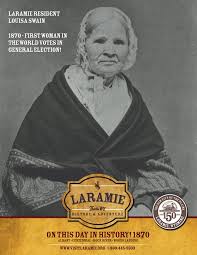
In 1869, Wyoming with Laramie leading the way, was the first legislature led entirely of men that empowered women with voting rights and to hold office. In March 1870, five Laramie women became the first women in the world to serve on a civil jury. It was a Laramie woman, Louisa Swain, who was the first woman to cast a legal, recognized vote in a United States general election on September 6, 1870.
In 1890, when Wyoming petitioned Congress to for statehood the U.S. Congress pushed back stating that Wyoming’s woman suffrage was obstacle and was delaying approval. The legislature, via a telegram from Joseph M. Carey (who later became governor of Wyoming), replied to the threat, “We will stay out of the Union a hundred years rather than come in without our women.” It was a very close vote in the U.S. Congress of 139 for – 127 against.
In 1890, Wyoming became the 44th state—with the women.
And those weren’t the only female firsts that took place in Wyoming. The first female governor was elected in Wyoming and the nation’s first woman to be appointed to public office was done so in South Pass City, Wyoming. In addition, the Equality State is home to the first female jurors, the world’s first female bailiff and the first town that was governed entirely by women.
Native Americans in their traditional attire holding American flag at the Lincoln Memorial building. STUNNING images of the indigenous Native Americans have been brought back to life through vivid colorization. The remarkable pictures show the group during the 1920s, with some of the leaders meeting with then American president, Calvin Coolidge, at the White House.
The Indian Citizenship Act still didn’t offer full protection of voting rights to Indians. As late as 1948, two states (Arizona and New Mexico) had laws that barred many American Indians from voting, and American Indians faced some of the same barriers as Blacks, until the passage of the Civil Rights Act of 1965, including Jim Crow-like tactics and poll taxes.
The last state to guarantee voting rights Native people was Utah in 1962.
The Voting Rights Act of 1965 was the most significant statutory change in the relationship between Federal and State governments in the area of voting since the Civil War. The act prohibited poll taxes, intimidation tactics, harassment, physical violence, or economic reprisals for voting in civil elections. OurDocuments.gov
Sadly, tragically, Laramie is also known for the inhuman murder of Matthew Shepard on October 12, 1998. It seems that bullying can still find cracks to rear its ugly head. Yet, once again the people of Laramie were not going to put up with it. Law and justice were served.
Americana Fiction
We recently changed the description of the Laramie Awards from “Western Fiction” which could mean a great many things, to “Americana Fiction.” A quick search for Western Fiction shows that it refers the American Old West that takes place anywhere from late 18th to the late 19th century. While this covers our categories of Pioneer and Civil War (the pioneer period is often referred to as 1760-1850 with the Civil War raging from 1861-1865). Also, great contemporary Western Fiction such as New York Time’s bestselling author and the basis for the hit Netflix series, Craig Johnson’s (a Wyoming author) Longmire Series.
And we can’t forget Jim Harrison’s works. You might be familiar with one of his stellar works—Legend’s of the Fall.
Legends of the Fall book cover before the film was made of it.
On the other hand, Americana Fiction is defined by Goodreads as “Novels that help tell the history, culture and folklore of what makes Americans uniquely American.” You can even see a list here of what they consider to be Americana Fiction, which really shows the wide, incredible expanse, that Americana Fiction and history can transcend, though we tend to consider it more of a historical genre than some of these incredible books are.
We made this change to promote a more accurate and inclusive representation of what we are accepting for the Laramie Awards.
So what are some excellent reads featuring indigenous identities that have already been vetted by Chanticleer you might enjoy? We’re glad you asked!
Jerkwater
By Jamie Zerndt
Somerset Award Winner
Three friends in Mercer, Wisconsin find ways to deal with their problems amid a racist town in Jamie Zerndt’s Jerkwater.
Shawna Reynolds’ life changed when her white stepdad murdered her Ojibwa mother. Now living with her Naan (grandmother), Shawna surrounds herself with those who make her feel most comfortable. Besides Naan, she clings to her horse Seven, her behind-the-scenes Ojibwa boyfriend Elmer, and two white friends: Kay O’Brien and her son Douglas. But racial tension cuts through the town of Mercer itself, galvanized by a fight over fishing rights.
Dr. Nerida Green travels across Australia, tending to struggling communities and connecting with her wife Mari—as well as the three spirits who Mari channels through her body, in Miki Mitayn’s climate-fiction novel The Conscious Virus: An Aedgar Wisdom Novel.
Nerida works sporadic jobs as a doctor, from the mining community of Newman to the small town of Fitzroy Crossing, and back east to a disappointing stint at a naturopathy clinic in Byron Bay. Between her working hours, Nerida speaks with M’Hoq Toq, the Native American medicine man, Bartgrinn the Celtic druid, and Aedgar, an ancient being of the Earth. Nerida asks the spirits for their opinions on topics as broad as climate change and as narrow as her personal matters, engaging them in deep conversation.
Wanders Far
By David Fitz-Gerald
Laramie Award Winner
An engaging history of ancient Native American peoples is brought to magical life by author David Fitz-Gerald.
In the early 1100s, in a region now known to us as the Adirondack Mountains of northern New York, a small band of tribal people is living in longhouses, growing crops, fishing, hunting, and enjoying certain rituals such as face and body painting, occasional migration for food survival, and even seasonal “vacations,” all while willingly obeying a simple form of governance with elements of basic democracy. In this tribe, we meet Wanders Far, a child who earns his nickname after showing a propensity to disappear and explore since he could walk. His mother, Bear Fat, is the recognized chieftainess of their group, mother of a large brood, one of whom is stolen as the book opens. Wanders Far would be considered an unusual child in any society, gifted with a highly accurate memory and the ability to visualize future events. He can also run like the wind, and with his love for travel, he is often the first to see and warn his people of danger, such as a cadre of warriors from a hostile tribe heading towards his home settlement.
Buck: Keeper of the Meadows
By Gloria Two-Feathers
In this engaging children’s tale by author Gloria Two-Feathers, a young colt named Buck will learn how to obey, how to defend, and how to strike out on his own.
The scene is set in the Great Plains, where a river named Minisose divides a sea of tall green prairie grass. Many animals call that grassland their home, and the most magnificent is the herd of wild horses led by a dark stallion named Plenty Coups and his chosen mate, the lovely cream-colored mare, Cloud. By tradition and instinct, Plenty Coups protects the herd from attackers, while Cloud leads them to safety.
When you’re ready,did you know that Chanticleer offers editorial services?We do and have been doing so since 2011.
Our professional editors are top-notch and are experts in the Chicago Manual of Style. They have and are working for the top publishing houses (TOR, McMillian, Thomas Mercer, Penguin Random House, Simon Schuster, etc.).
If you would like more information, we invite you to email Kiffer or Sharon at KBrown@ChantiReviews.com or SAnderson@ChantiReviews.com for more information, testimonials, and fees.
We work with a small number of exclusive clients who want to collaborate with our team of top-editors on an on-going basis.Contact us today!
Chanticleer Editorial Services also offers writing craft sessions and masterclasses. Sign up to find out where, when, and how sessions being held.
A great way to get started is with our manuscript evaluation service, with more information availablehere.
And we do editorial consultations for $75. Learn morehere.
If you’re confident in your book, consider submitting it for a Editorial Book Reviewhereor to one of our Chanticleer International Awardshere.
Also remember! Our 10th Anniversary Chanticleer Authors Conference (CAC22) will be April 7-10, 2022, where our 2021 CIBA winners will be announced. Space is limited and seats are already filling up, so sign up today! CAC22 and the CIBA Ceremonies will be hosted at the Hotel Bellwether in Beautiful Bellingham, Wash. Sign up and see the latest updates here!
We are deeply honored and excited to continue to announce the 2020 Winners of the Chanticleer International Book Awards (The CIBAs) with our second of three official postings.
The winners were recognized at a special CIBAs ceremony held on June 5th, 2021 in-person and by ZOOM webinars based at the luxurious Hotel Bellwether, Bellingham, Wash.
The CIBA announcements were made LIVE with Chanticleerians participating and interacting from around the globe and North America.
We cheered on the CIBA Premier Finalists with our bubbly of choice from wherever we were Zooming!
Btw, Kiffer’s favorite Champagne!
We want to thank all of the CIBA judges who read each and every entry and then comment, rate, and rank within each of the 24 CIBA Divisions. Without your labors of love for books, the Chanticleer International Book Awards would not exist. THANK YOU!
We want to thank all of the authors and publishers who participated in the 2020 Chanticleer International Book Awards (the CIBAs). Each year, we find the quality of the entries and the competitiveness of the division competitions increasing exponentially. We added a new level to the judging rounds in 2020—the premier Level of FINALIST per each CIBA Division. The CIBA judges wanted to add the Finalist Level of Achievement as a way to recognize and validate the entries that had outstanding merit but were not selected for the very few First Place Award positions within each genre division.
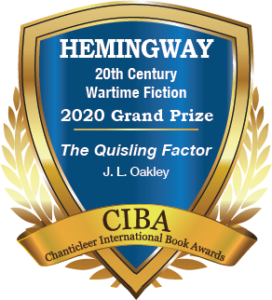
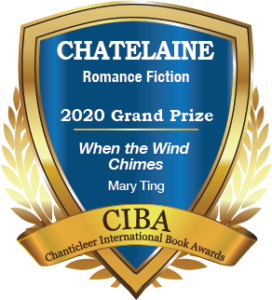
This post will recognize the First Place and Grand Prize Winners for the Laramie, Chaucer, Goethe, Hemingway, Chatelaine, Mark Twain, and Somerset Awards.
Coveted Chanticleer Blue Ribbons!
We are honored to present the
2020 Chanticleer International Book Awards
Grand Prize Winners
The 2020 CIBA Winners!
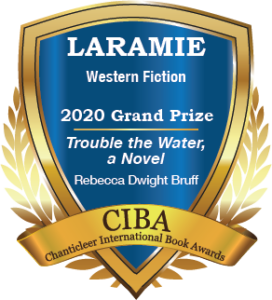
The LARAMIE Book Awards for
American, Western, Pioneer, Civil War, and First Nation Novels
The Grand Prize Winner is
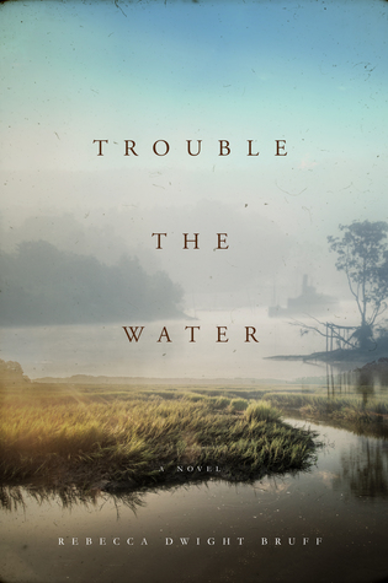
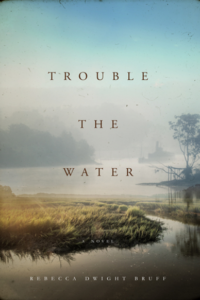
TROUBLE THE WATER, A NOVEL by Rebecca Dwight Bruff
As always, if you have any questions, concerns, or suggestions, please email us at Chanticleer@ChantiReviews.com We will try our best to respond within 3 business days.
Thank you for joining us in celebrating the 2020 CIBA Winners! – The Chanticleer Team
The Laramie Book Awards recognize emerging talent and outstanding works in the genre of Western, Pioneer, & Civil War Historical Fiction and First Nation Novels. The Laramie Book Awards is a genre division of the Chanticleer International Book Awards (The CIBAs).
Chanticleer International Book Awards is looking for the best books featuring, the wild west, pioneering, Civil War, North American History, and First Nation Novels. These books have advanced to the Premier Level of Achievement in the 2020 CIBAs.
The 2020 LARAMIE Book Awards First Place Category Winners and the LARAMIE Grand Prize Winner were announced by Janet Oakley on Saturday, June 5, 2021 at the Hotel Bellwether and broadcast via ZOOM webinar and Facebook Live.
It is our privilege and profound honor to announce the 1st in Category winners of the 2020 LARAMIE Awards, a division of the 2020 CIBAs.
This is the OFFICIAL 2020 LIST of the LARAMIE BOOK AWARDS First Place Category Winners and the LARAMIE Grand Prize Winner.
Congratulations to all!
Rebecca Dwight Bruff – Trouble the Water, a Novel
Eileen Charbonneau –Mercies of the Fallen
James Kahn –Matamoros
Daniel Greene –Northern Wolf
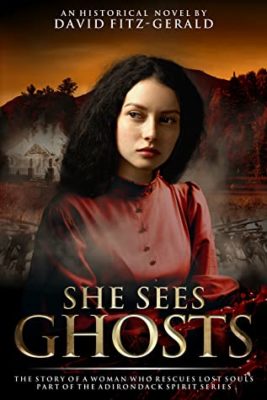
David Fitz-Gerald –She Sees Ghosts? The Story of a Woman Who Rescues Lost Souls
Gerry Robinson –The Cheyenne Story
J.B. Richard –Jesse
Mike Shellenbergar –Quail Creek Ranch
Mike Shellenbergar – Refuge
J. Palma –The Chaffee Sisters
Fred Dickey – Days of Hope, Miles of Misery – Love and Loss on the Oregon Trail
The Grand Prize Winner for the CIBA 2020 LARAMIE Awards is:
Rebecca Dwight Bruff for
Trouble the Water, a Novel
The 2021 LARAMIE Book Awards winners will be announced at CAC22 on April 10, 2022. Save the date for CAC22, scheduled April 7-10, 2022, our 10 year Conference Anniversary!
Submissions for the 2022 LARAMIE Book Awards are open until the end of July. Enter here!
A Note to ALL the WINNERS: The coveted CIBA Blue Ribbons will be mailed out starting in July. We will contact you with an email to verify your mailing address and other items. We thank you for your patience and understanding.
Thinking of submitting to the Chanticleer International Book Awards for Earth Day? While we don’t have a specific category for environmental work, you can find all sorts of eco-focused work in our Global Thriller Awards, Journey Awards, Little Peeps Awards, and our Cygnus Awards.
The origins of Earth Day…
Can be traced back to Rachel Caron’s book Silent Spring which caused people to sit up and begin taking seriously the concerns that had been brought up for centuries about how the land was treated by imperialist powers. Carson’s book is cited as inspiration for the founding of the Environmental Protection Agency under the Nixon administration. After the book’s publication, she was hounded by those who promoted pesticides like DDT who said Carson’s would return us to an era where insects and vermin ruled the world.
Rachel Carson, author of Silent Spring
Earth Day’s foundation was a bipartisan venture in the United States, supported by both major political parties at the time of founding. By 1990, it became an international holiday around the world for all people to celebrate! It is now the largest non-secular holiday celebrated worldwide.
What is considered environmental writing?
Environmental writing or eco-fiction is most often described as a sub genre. Some people will claim that it just doesn’t exist, probably because of how nebulous it can be, but there definitely is a market for any book that examines the environment at large. From Leanne Betasamosake Simpson and Terry Tempest Williams, to Annie Dillard and Ralph Waldo Emerson, the variety of people and forms for writing about the environment is endless.
So What is Eco-Fiction?
Eco-Fiction, at a minimum, needs to highlight the environment in some way. With that definition, something like Moby Dick could even count as eco-fiction because it features a whale and lots of time at sea, including the impact of whaling at large. What almost all eco-fiction does though is look at the world through a syncretic lens.
What we mean by syncretic is that it crosses borders. For a long time, the unrecognized leaders of environmental writing have been Indigenous thinkers and writers. This, by necessity, ties up the question of environmentalism with economic policy, racism, and colonialism in fascinating and important ways that draw in readers.
While Non-Fiction Environmental work often looks at the questions of where we are and what can we do, Eco-Fiction will ask what is happening and what will the world look like when we continue on this path? Work like that of Octavia Butler and NK Jemisin (renowned scifi writers) show us, using cross-cultural syncretism, the worst paths our current choices could lead us down.
Whether we decide to accept Eco-Fiction as real or not, no one can say that environmental fiction and non-fiction can’t be marketed.
Join us in looking at some of the wonderful books that draw inspiration from our Earth and environmental themes.
The Suburban Micro-Farm: Modern Solutions for Busy People by Amy Stross
5-Star Book Review
1st Place Winner in the Instructional & Insightful Awards
Author, educator, and urban farmer Amy Stross offers a comprehensive look at how to repurpose a small yard in the city for basic sustenance and so much more.
Award-winning writer Stross has composed a thoroughly practical guide to everything a reader would need to know to do what she did: transform a yard into a farm. Acknowledging that the ground surrounding a town dwelling is hardly what one thinks of when one thinks farmland, Stross draws from her personal experience to show precisely how the transformation can take shape. Her colorfully illustrated manual gives the basics for managing an ample garden space, or micro-farm, almost down to the minute (in fact, seven minutes twice a day).
Genetic engineering, murder, corporate-conglomerate profiteering, Interpol, and a plot to control humanity make Dark Seed, by Lawrence Verigin, a suspenseful thriller novel.
When jaded journalist Nick Barnes learns that Dr. Carl Elles has contacted him to say that Barnes’ recent article about the positive contributions of Naintosa Corporation is all wrong, Barnes feels compelled to educate the scientist about information laundering—the strategic planting of false information in the media so the planting organization can quote the media later for their own benefit. “It makes total sense,” Dr. Elles replies. “Naintosa employs that strategy on a regular basis.” Nick was about to explain to the scientist why he needed to check Dr. Elles’ information, when the scientist soon proves to Nick that the journalist is the lazy dupe who just published Naintosa’s propaganda in a complimentary article.
WANDERS FAR by David Fitz-Gerald
5-Star Book Review
First Place Winner in the Laramie Awards
In the early 1100s, in a region now known to us as the Adirondack Mountains of northern New York, a small band of tribal people is living in longhouses, growing crops, fishing, hunting, and enjoying certain rituals such as face and body painting, occasional migration for food survival, and even seasonal “vacations,” all while willingly obeying a simple form of governance with elements of basic democracy. In this tribe, we meet Wanders Far, a child who earns his nickname after showing a propensity to disappear and explore since he could walk. His mother, Bear Fat, is the recognized chieftainess of their group, mother of a large brood, one of whom is stolen as the book opens. Wanders Far would be considered an unusual child in any society, gifted with a highly accurate memory and the ability to visualize future events. He can also run like the wind, and with his love for travel, he is often the first to see and warn his people of danger, such as a cadre of warriors from a hostile tribe heading towards his home settlement.
BLOSSOM — The Wild Ambassador of Tewksbury (Audiobook Review) by Anna Carner
5-Star Book Review
Author Anna Carner lived in a horse-friendly farming area of New Jersey in 1999, when she encountered a newborn fawn, barely breathing, near her home. The animal seemed to be communicating its need to her, and, with some experience of animal and human care, Carner set out to revive the fawn. She took the baby deer into her house and nursed her back to health. When she and her husband, Pino, saw the fawn curled up asleep with the family dog, the couple knew they had a new pet. Her name, Blossom, seemed suited to her sweetness and soft, gentle beauty.
The ONLY ONE LEFT (The Neema Mysteries, Book 3)
by Pamela Beason
First Place Winner in the Clue Awards
While spending some time with his sweetheart, animal behavior scientist Grace McKenna and her adopted family of gorillas, Detective Matthew Finn finally endures a kiss from Neema while keeping an eye on the huge silverback Gumu. He accepts a ‘toy’ from their baby, Kanoni. But upon further inspection, Matt and Grace believe the object might be part of a human finger bone. Where did it come from? How did it get in the gorillas’ remodeled barn? The homicide detective knows he’ll need to investigate, but just then, his cell phone chirps.
Desk Sergeant Greer of the Evansburg, Washington, Police Department tells Matt to get back on duty and head directly to the Gorge Amphitheatre, where the Sasquatch Festival has just ended. A car belonging to a 17-year-old girl, last seen by her parents in Bellingham, Washington, three days earlier, has been found abandoned next to a tent in the Amphitheatre campground.
In this engaging children’s tale by author Gloria Two-Feathers, a young colt named Buck will learn how to obey, how to defend, and how to strike out on his own.
The scene is set in the Great Plains, where a river named Minisose divides a sea of tall green prairie grass. Many animals call that grassland their home, and the most magnificent is the herd of wild horses led by a dark stallion named Plenty Coups and his chosen mate, the lovely cream-colored mare, Cloud. By tradition and instinct, Plenty Coups protects the herd from attackers, while Cloud leads them to safety.
Chanticleer Editorial Services – when you are ready
Did you know that Chanticleer offers editorial services?We do and have been doing so since 2011.
Tools of the Editing Trade
Our professional editors are top-notch and are experts in the Chicago Manual of Style. They have and are working for the top publishing houses (TOR, McMillian, Thomas Mercer, Penguin Random House, Simon Schuster, etc.).
If you would like more information, we invite you to email Kiffer or Sharon at KBrown@ChantiReviews.com or SAnderson@ChantiReviews.com for more information, testimonials, and fees.
We work with a small number of exclusive clients who want to collaborate with our team of top-editors on an on-going basis.Contact us today!
Chanticleer Editorial Services also offers writing craft sessions and masterclasses. Sign up to find out where, when, and how sessions being held.
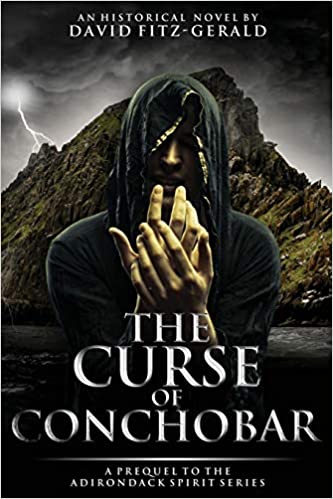
Conchobar wakes, barely alive and in a world he does not know.
When he’s found by the tribes who call this land home, he’ll become caught by the ties of family, violence, and love, none of which he’s ready to face.
Conchobar lives in the house of Spits Teeth, the patriarch of his adoptive family. He struggles to learn their way of life, still tied by memory and longing to his home at the monastery of Skellig Michael. But he must learn to hunt, fish, and fight if he wants to survive and belong.
Despite his struggles and the language barrier itself, Conchobar begins to care for the new family around him. But an endless cycle of battle and bloodshed roars between his new tribe and their neighbors. Soon, events will rise and test his peaceful nature and put his beloved family in great peril. Beyond the threat of warclubs and arrows, a dark curse threatens to swallow all the good that he might find in this new world.
Conchobar’s life amongst the tribe of Spits Teeth is defined by his distance from them, his sense of being a fish out of water.
No matter how much he learns to live as the people around him do, he never quite understands them, always somehow on the outside looking in or yearning for his past life. He spends much of his time in his own head, musing on the world around him as he faces new and strange things. The world is interesting and alive through his eyes. The dynamic villagers show their place in the world with every word and action; as Conchobar grows close to them, they show more of who they are, what they want, and what they fear. Conchobar offers his love to his new family and his grave concern as he realizes the danger they’re in.
Fitz-Gerald takes time and great care with Conchobar, sitting with his thoughts and sorrows and joys.
His growing sense of doom becomes one with the story, as cruel twists of fate begin to unfold upon his new family. But between this dread, the people of the village open up as Conchobar learns their language, and the action of their battles and hunts together flows smoothly across the page. Their material world slowly mingles with the supernatural and mystical, spurred by Conchobar’s strange place between the two. But he doesn’t have the time to unravel his curse and his connection to the natural world, as the longer he stays in the midst of battle, the more personal it becomes to him.
The Curse of Conchobar is a tale of violence begetting violence, of the perseverance of faith and hope in the face of grief and fear. Conchobar’s dreamlike connection to nature becomes a religious experience, showing him wonders of the world, cut off by the approach of a people who never needed to be enemies.
Throughout the story, Conchobar’s voice remains strong. Fitz-Gerald breathes life into his Spits Teeth characters. In love, loss, and anger, the emotion is palpable to the reader and will remain long after the book is read. The Curse of the Conchobar – A Prequel to the Adirondack Spirit Series scratches the itch for rich character exploration, historical fiction in a time and place often underrepresented, and a love story marked by tragedy and transcendence. In other words, Fitz-Gerald delivers a worthy prequel to the Adirondack Spirit Series.
An engaging history of ancient Native American peoples is brought to magical life by author David Fitz-Gerald.
In the early 1100s, in a region now known to us as the Adirondack Mountains of northern New York, a small band of tribal people is living in longhouses, growing crops, fishing, hunting, and enjoying certain rituals such as face and body painting, occasional migration for food survival, and even seasonal “vacations,” all while willingly obeying a simple form of governance with elements of basic democracy. In this tribe, we meet Wanders Far, a child who earns his nickname after showing a propensity to disappear and explore since he could walk. His mother, Bear Fat, is the recognized chieftainess of their group, mother of a large brood, one of whom is stolen as the book opens. Wanders Far would be considered an unusual child in any society, gifted with a highly accurate memory and the ability to visualize future events. He can also run like the wind, and with his love for travel, he is often the first to see and warn his people of danger, such as a cadre of warriors from a hostile tribe heading towards his home settlement.
Fitz-Gerald’s book interweaves family chronology, legend (such as tales of Hiawatha), and fact-weighted history into what is essentially a human drama focused on the personal lives of Wanders Far and his cultural community. Through the happenings described, we learn more about how such indigenous people survived and progressed. We see them fishing, hunting, and foraging, as well as loving, celebrating, and mourning. One dominant theme concerns the mixture of tribes in the area – Mohawk, Onondaga, Oneida, Cayuga, and Seneca. We see how they interact, with some being more generally friendly and others being enemies who may become allies as, in the future, they will meld into what is called The Iroquois Confederacy, serving a significant role in the founding of the first European colonies. We see Wanders Far and his relatives – all with earthy, practical names like Squash, Gentle Breeze, and Big Canoe – as real people who laugh and cry, fall in love, make war and form alliances in their nature-bound, intuitively guided, pre-technological circumstances.
Imbuing his hero with “second sight” along with exceptional physical prowess, Fitz-Gerald states that he was drawn to compose the story of Wanders Far through his own powers of imagination coupled with a fascination for the region where he himself has lived and explored. He draws a dynamic portrait of how specially gifted people were and can still be welcomed into the fold despite their differences. Wanders Far will experience a long life, here skipping from his early twenties to his mid-seventies, and readers will hope that a future novel may reveal more of the exploits of his full manhood. A small hint at the book’s end alludes to a distant identity and makes us want to see more from this multi-talented, highly creative author.
Wanders Far won First Place in the CIBA 2019 Laramie Awards for American Western Fiction.
A gentle and patient story, She Sees Ghosts is a unique addition to the historical fiction genre. Take a break from the hectic modern world and get transported to a simpler time where the full effect of the industrial revolution has yet to change America’s face forever.
Mehitable lives with her large loving family in a small town in New England and has been hiding a secret her whole life. She sees the spirits of the departed and wishes they would leave her alone. The town is busy getting ready for the upcoming New Year celebration, which will not only mark the start of a new century but also happens to be Mehitable’s sixteenth birthday. On the cusp of adulthood, all around Mehitable, there is talk of love and marriages, but she does not feel ready and wants to keep enjoying her current life.
After Mehitable rejects the troublesome Anson Smudge, tragedy strikes. Anson accidentally starts a fatal fire that claims Mehitable’s family’s lives, leaving her to face the turn of the century alone. Years pass, and she slowly learns to live with her grief but is still visited by the ghost of Anson every night. After moving with her friend Polly and her husband Reuben to rural upstate New York, Mehitable begins to see countless souls of soldiers from past wars, and there she finds her calling. By helping these lost souls, will Mehitable find a way to move on?
She Sees Ghost is a perfect choice for readers who like multifaceted stories with paranormal elements, historical fiction, and Christian influences. Fans of coming-of-age stories will especially like She Sees Ghosts as the story centers around Mehitable’s struggles and her journey to help lost souls. Some books are driven by action, while others allow the characters to unveil the truth behind their pain. This is a story more akin to the latter. Fitz-Gerald weaves characters that will live in readers’ hearts long after putting the book down.
David Fitz-Gerald has a knack for writing historical fiction with supernatural influences. She Sees Ghosts is the second in the ongoing Adirondack Spirit Series. In this installment, time is a big theme. Mehitable’s story begins at the turn-of-a-century, where she grows up hearing stories of the fight for independence. She experiences a cultural tradition for storytelling where people look into the past for lessons to bring into the future.
A story about love, loss, and the various forms grief can take over the years, Fitz-Gerald’s She Sees Ghosts is a compassionate tale about a woman using her unique gifts to help those around her, living or long passed.
Congratulations to the First Place Category Winners and the Grand Prize Winner of the LARAMIE Book Awards for Western, Civil War, Pioneer, First Nation Novels and Americana Fiction, a division of the 2019 CIBAs.
The Search for the Best New Western and Americana Books!
Chanticleer International Book Awards is celebrating the best books featuring, the Wild West, Pioneers, Civil War, Americana, and First Nation Novels. We love them all.
The 2019 Laramie Book Awards First Place Category Winners and the LARAMIE Grand Prize winner were announced at the Virtual Chanticleer Authors Conference that was broadcast via ZOOM webinar the week of Sept 8 -13, 2020 from the Hotel Bellwether in Bellingham, Wash.
Jacquie Rogers, author of Honey Beaulieu, Many Hunter series– 2016 Laramie Grand Prize Winner announced the 2019 Laramie Book Award Winners.
This is the OFFICIAL 2019 LIST of the LARAMIE Book Awards First Place Category Winners and the LARAMIE Grand Prize Winner.
Congratulations to All!
E. Alan Fleischauer – Rescued
Lynwood Kelly – The Gamble: Lost Treasures
David Fitz-Gerald– Wanders Far-An Unlikely Hero’s Journey
Eileen Charbonneau – Seven Aprils
Juliette Douglas – Bed of Conspiracy
John Hansen – Hard Times
J. R. Collins – Spirit of the Rabbit Place
The Laramie Book Awards
2019 Grand Prize Winner is
Seven Aprils by Eileen Charbonneau
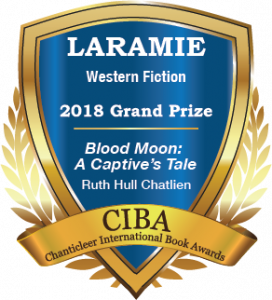
This is the digital badge for the 2018 Laramie Grand Prize Winner – Blood Moon: A Captive’s Taleby Ruth Hull Chatlien.
How to Enter the Laramie Book Awards?
We are accepting submissions into the2021 LARAMIE Book Awardsuntil July 31, 2021. Submissions into the 2020 Laramie Book Awards are closed.
The 2020 Laramie Book Awards winners will be announced at CAC 21 on April 17, 2021.
A Note to ALL the WINNERS: The coveted CIBA Blue Ribbons will be mailed out starting in October. We will contact you with an email to verify your mailing address and other items. We thank you for your patience and understanding.
If you have any questions, please email info@ChantiReviews.com == we will try our best to reply in 3 or 4 business days.