
Now that you’ve completed your beautiful manuscript and have made several draft revisions, you are ready for the next move.
You know, the one that comes before starting the editing process.

Now for some Real-Life Ruthless Editorial Terms:
-
- Reconciliation or Go Separate Ways
- Search and Destroy (SAD)
- Cull and Extract
- Wrench Out Passive Voice – Mistakes Were Made
- Clichés, Platitudes, and Banalities – Oh NO!
- Kill Your Darlings – Stephen King
- Are You Listening to How You Sound?

Are You Listening to How Your Work-in-Progress Sounds? Really?
Continue reading to the end of this post if you would like more information about these scary but necessary editing tactics.
Some writers like to put their draft into a drawer for six weeks or so to allow themselves fresh eyes before endeavoring on one more draft revision as Stephen King recommends in his On Writing: A Memoir of Craft.
Here at Chanticleer, we see basically two camps that writers fall into.
- Writers who rework every sentence before moving on to the next sentence trying to reach perfection. If this is you, (And you know who you are.) then we advise you to click on this link to read an article by the multiple award-winning author, Michelle Rene.
OR
- Writers who bang out work and then think they are ready to publish with perhaps just a quick once over for typos. (And you know who you are.) Just upload to Amazon and you are done. Au contraire, mon ami!, as Q from Star Trek notoriety might say.

Is this conundrum the same as the age-old question of writing style: Are you a plotter or pantzer?
No, it isn’t. Writing styles are deeply personal. What we are discussing here is the editing process for novels.
So, what’s a writer to do?
Emulate what has worked successfully for traditional publishing houses.
After your draft, but before you begin the editing process, have a manuscript overview (MOV) – an evaluation performed on your work by a professional editor. If you are with a literary agent, or if you work with a traditional publisher or acquisitions editor, this is the time to turn it over to them for their feedback.
We hear you, “Well, if I had a literary agent or was working working with a traditional publishing house, I wouldn’t need to read this article.”
If you don’t have any of these professionals on your team, then consider using a professional manuscript evaluation service such as Chanticleer’s. A manuscript evaluation will save you time and money and it will give you feedback about your work’s pacing, plotline, characters, atmosphere, P-O-V structure, dialog, and if you have a compelling story—one that will keep your targeted reader engaged.
Here at Chanticleer Reviews, we come across many published works that skipped over this vital step. The work might have been copy-edited and proofed before clicking the publish button, but the story just isn’t compelling, or it has a saggy middle, or the characters are flat, or dialog stilted, or there is no “voice.” It is almost impossible for the author to “see” these issues because the story lives in the author’s head. The authors’ who receive this feedback generally exclaim to us, “But I’ve paid to have it edited. There are no typos.”
No typos, does not a story make. However, authors and writers can create story magic. But it is difficult to get the story out of the writer’s mind and into words that communicate the “mind-film” that many authors see. This is where having an unbiased reading of your work with feedback will make your work shine. kb
Others know there are choices they made at the end of the book that will require changes earlier in the book (maybe it started in 3rd person and the moved to 1st person). Whatever your process is, this article will help your work shine!

1. Reconciliation or Go Separate Ways
Getting Ready to Polish Now that Your Work-in-Progress has had a MOV
There’s no universal way to use writing tools. As always, remember these are recommendations that have worked well for many of our authors, though it’s okay if they don’t work for you.
Consider the Following for when you receive your manuscript’s MOV
First off, give yourself time after reviewing notes from your MOV editor/agent/publisher. After receiving feedback try the following:
- Consider recommended changes from your second pair of fresh eyes. It is good to keep in mind, that each one of the readers who decide to read your published book will be reading it with fresh eyes also.
- Address issues. The editor will have made suggestions where needed. Deal with the biggest issues first.
- Save a clean draft of your copy where the suggested changes don’t stand out. (Of course, you’ll want to save one where they do stand out as well, just in case.)
- Wait two weeks.
- Revisit the work. Ask yourself if anything stands out as odd or a change in voice.
And, yes, sometimes, we do receive a ms that is ready to move on to either a line-edit or a copy-edit. It does happen. If this is the case, won’t you breathe easier knowing that it is ready to invest editing and shining.
Rarely will suggestions from professional readers and editors let you down–just see the difference yourself!
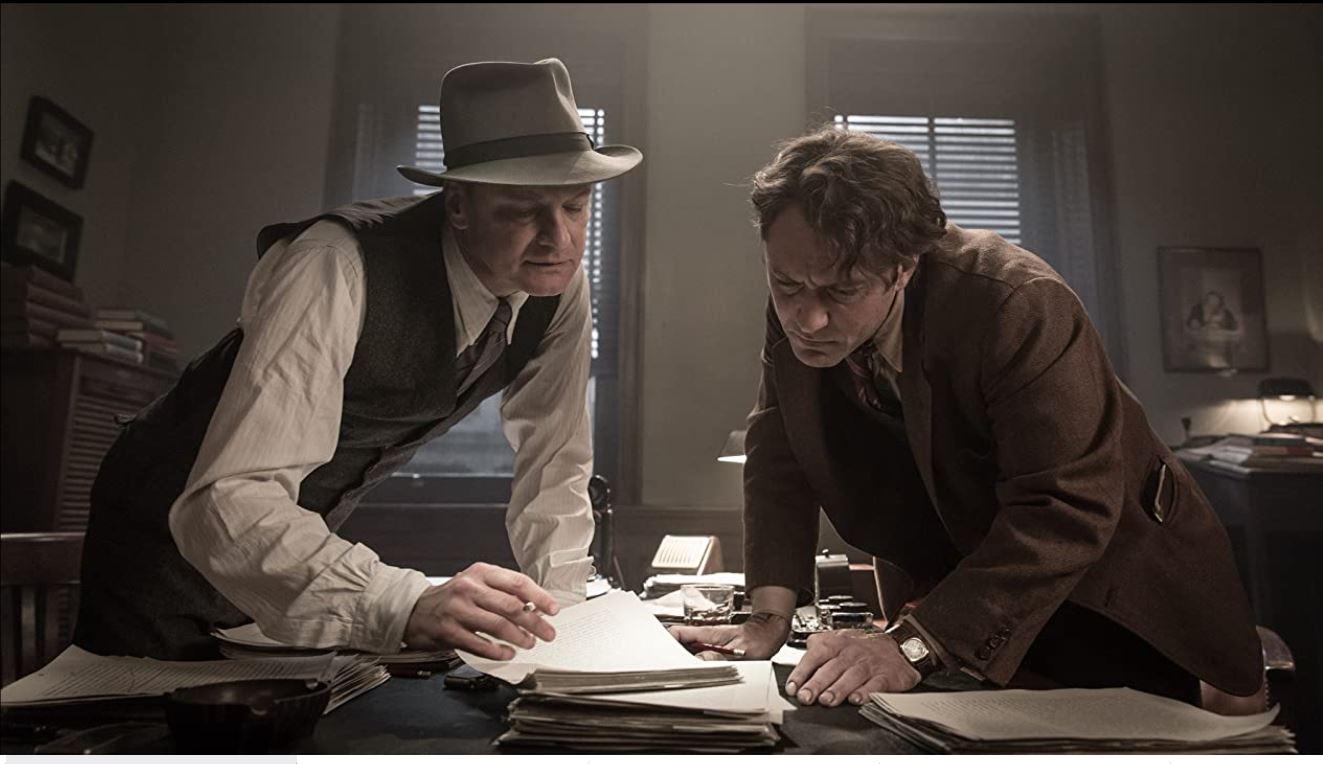
The Editor film is based on award-winning book Max Perkins: Editor of Genius by A. Scott Berg. “Max Perkins discovered Ernest Hemingway and F. Scott Fitzgerald. But he never met anyone like Thomas Wolfe.” The film’s tagline. Yes, even great authors such as these benefited from working with an editor.
When you are satisfied that you have a compelling story—the work has had a manuscript overview and then you have reconciled the w-i-p with the advice given, it is now the time to begin the Self- Editing Process! (Do the following before line editing or copy editing.)
2. Search and Destroy (SAD)
When we’re inspired by outside work, we love to tell you about it. The best line editing tools we know about come from Brenda Miller and Susan Paola’s book on creative nonfiction Tell It Slant, which features clear and direct steps to make your writing stronger.

First, identify all your “to be” verbs. If you can think of a comfortable, easy replacement, use it. Obviously, not all of them need to go (just glance through this article and you’ll see plenty), but a “to be” verb, while almost always the easiest choice, is not always the best choice.
For example, here’s a piece of the short story Medusa by David Beaumier. First, with “to be” verbs shown in bold:
She isn’t happy about it, but she had been encouraged to join Visitation to help people, not because it was personally comfortable for her. So she is sent into decontamination, followed by the sound of a seal behind her as the hermetic vacuum in front of her is opened. Her hair is only a little fluffed up by the experience, and is easily coiffed back into place after the blast of ionization that would be deadly to any foreign compounds in the air.

And now revised without the repetitive verb choice:
She doesn’t like it, but she joined the Visitation to help people, not for her own personal comfort. So into the decontamination room she goes, followed by the locking of one hermetic seal behind her and a second one in front. Her hair only needs to be patted down a little bit after the blast of ionization that should kill any foreign compounds in the air.
3. CULL and EXTRACT
Second, find your adverbs and adjectives. These can be the condiments and spice of your piece that really give it life, but too much mayonnaise is never a good thing, so look at each of them and see if there’s a weak verb or noun that’s being propped up by them.

Consider your proportion here, too. In one YA urban fantasy dredged up from the out of print pile was this unforgettable villainous dialogue spoken to the protagonist: “‘I’ll kill your whole family,’ he hissed maliciously.” While the intent is clearly to be evil, we can also see that the author didn’t trust the reader to understand that the villain wasn’t very nice.

4. Wrench Out Passive Voice
The last suggestion from Miller and Paola is to look for passive voice, often indicated using “have” or “had.” A favorite trick for finding passive voice is to see if you can add “by zombies” to the end of the sentence. Like the previous rules, knowing why we use active and passive voice is important. Active voice tells us who does what to whom. Passive voice tells us what actions are done to whom, but not necessarily who did them.
Looking to get more weasel words? Check out this article here by Jessica Morrell on decluttering your sentences.
For a great example on passive voice, see this video below. (It is non-partisan, we promise.)
5. CLICHES, PLATITUDES, and BANALITIES — Oh NO!
Taking Advice from the Best: Jessica Morrell – Top-Tiered Developmental Editor

Those who attended VCAC21 will know, Jessica Morrell is one of our favorite contributors. In her two workshops, Jessica goes deeper discussing the idea of “junk” words for writers. Maybe you’ve avoided all the pitfalls so far, but do you notice your characters do a lot of the following?
Jessica’s advice on eliminating junk words can be found on the link below:
- Shrug
- Wrinkle their nose in disgust
- Widen their eyes in surprise
- Nod
- Smile
- Any other sort of repetitive description that doesn’t really subvert the reader’s expectations?
What would you say your own junk words are?
Jessica even provided a long list of words to give an idea of what hints that writing might not be as strong as we hope.
Definitely, absolutely, particularly, actually, decidedly, quite, very, totally, mostly, dearly, ideally
Notice how all of those are also adverbs? Keep an eye on your work!
6. KILL YOUR DARLINGS and TOO MUCH EXPOSITION – TMIF
Show vs Tell
Showing and telling goes well with the debate about active and passive voice. In my mind, there is almost no writing rule more contentious or less understood than the rule that writers should always show rather than tell. Dialogue is often the heart of showing, but be careful! Occasionally dialogue can sneak in as a form of telling when it’s being used to explain something the characters probably already know for the sake of the reader.
Another video on the potential pitfalls of too much exposition and when dialogue tells too much. TMIF.
We dare you to see just how long you last watching Too Much Exposition. (Kiffer lasted about 30 seconds)
Go ahead, give it a try. We double dare you.
So how should we define Show and Tell? Well, Showing is an example of narrative scene—something happens in real time! Meanwhile, Telling is an example of narrative description where there’s either a moment of summary or interiority, something that probably isn’t happening in real time. Like passive and active voice, there’s a time and a place for each.
Consider the structure of your work. Has there been quite a bit of showing happening as characters flit from scene to scene? Even in a thriller, the reader will need a moment to rest, to have the narrator examine the main character’s interiority and explain a little bit of the backstory or the connection the hero makes just before solving the mystery.
The moment where everything clicks into place often isn’t a show, but a tell, directly informing the reader that the most important discovery of the book has been made. That lets it happen fast rather than laboring to show each and every scene.
We are quite proud of the articles on our website and to be a leading resource for writers, and you might also like some of what these websites say about writing craft:
6. Are You Listening to How You Sound?
Listening: The Most Powerful Tool
The last secret here is one of the most useful things we’ve heard of for any writer or editor, and that is read your work aloud. You can ask a friend or loved one to do this for you, or you can find a screen reader that will take you through your story, but words always sound different when they’re vocal vibrations rather than fixed to a page.

Reading aloud, especially for dialogue, can help you better understand your tone, and it helps you find where words may have been repeated more than necessary. Sometimes, especially if writing a play, it can help to highlight the piece with different colors based on whose speaking. If there’s an emotion that should be conveyed in the story, assign colors to each emotion and highlight lines with how they should land. Then, while reading it aloud, you can check to make sure that the assigned tones fit.
Jessica Page Morrell has an excellent article on Glissando And Wordcraft you can read here.
If you’re looking for voice recording software beyond Voice Memos on your phone, consider the following programs:
In Conclusion, Remember that the Work is Always Yours
In the end, remember that you are the author of your work, which means you get final say. Peer review is excellent, and, as said above, it can be helpful to practice accepting all feedback and then reading your work after you’ve given it some space.
Remember, the earliest time we recommend submitting your work to one of our Twenty-Three divisions for the Chanticleer International Book Awards here or for a much sought after Editorial Review here is once you’ve reached the proofreading stage of your manuscript. Again, that’s the earliest we recommend sending your work in.

For further reading on what we’ve said in the past at Chanticleer, check out parts one and two of articles written by Jessica Page Morrell here and here, plus a bulleted list of tips she put together here.
Looking to demystify even more of the editing terminology? Learn about it here from Kiffer Brown herself.
Chanticleer Editorial Services – when you are ready

Did you know that Chanticleer offers editorial services? We do and have been doing so since 2011.

Tools of the Editing Trade
Our professional editors are top-notch and are experts in the Chicago Manual of Style. They have and are working for the top publishing houses (TOR, McMillian, Thomas Mercer, Penguin Random House, Simon Schuster, etc.).
If you would like more information, we invite you to email Kiffer or Sharon at KBrown@ChantiReviews.com or SAnderson@ChantiReviews.com for more information, testimonials, and fees.
We work with a small number of exclusive clients who want to collaborate with our team of top-editors on an on-going basis. Contact us today!
Chanticleer Editorial Services also offers writing craft sessions and masterclasses. Sign up to find out where, when, and how sessions being held.
A great way to get started is with our manuscript evaluation service. Here are some handy links about this tried and true service: https://www.chantireviews.com/manuscript-reviews/
And we do editorial consultations. for $75. https://www.chantireviews.com/services/Editorial-Services-p85337185

Writer’s Toolbox
Thank you for reading this Chanticleer Writer’s Toolbox article.
Writers Toolbox Helpful Links:
First Draft in Thirty Days? No Tricks! Award-Winning Author Michelle Rene Shares How She Does It!
Part One WRITING FICTION GUIDELINES — by Jessica Page Morrell
15 Self-Editing Tips from the Editor’s Desk of Jessica Morrell
GLISSANDO and WORDCRAFT from Jessica Morrell
“The Strange World of Editing and the Beasts Who Inhabit It” by Kiffer Brown
The traditional publishing tool that indie authors can use to propel their writing careers to new levels? https://www.chantireviews.com/2016/05/15/the-seven-must-haves-for-authors-unlocking-the-secrets-of-successful-publishing-series-by-kiffer-brown/


