Author: carol-m-cram

  • The Ropes Around Research for the Accurate Writer — Chanticleer Toolbox Article by David Beaumier

    The Ropes Around Research for the Accurate Writer — Chanticleer Toolbox Article by David Beaumier

    When you start researching a project? Where do you begin? What should you include?

    Doing research for your stories isn’t just for creative Non-Fiction, though we do have 7 Non-Fiction Book Awards ready to discover new books year round. The other categories that we think benefit most from research are the Lab Lit section of our Global Thriller Awards here, hard SciFi as seen in our Cygnus Awards here, and of course our pre-1750s Chaucer Awards here, and post-1750s Goethe Awards here, both in historical fiction.  

    Speaking of our Chanticleer International Book Awards, remember that the 2023 CIBAs will be announced at our 12th Anniversary Conference on April 18-21, 2024! Seating is limited, so register today!

    A Black woman in a white lab coat doing research with vials and beakers

    In this article, we’ll look through different types of research, including interviews, ethnographies, and place-based research. You can learn more from Carol M. Cram’s article here on tapping experts for your book.

    1. Interview for Research

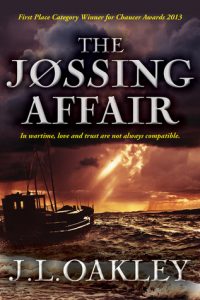
    This is a simple and reliable option to learn more about the subject at hand. For example, one of our favorite ChanticleeriansJanet Oakley (interviewed here), is no stranger to tracking down people to talk to in order to complete her novels. In writing her book, The Jøssing Affair (read the review here) set in occupied Norway during WWII, Oakley interviewed people who lived through the occupation to better understand what they went through.  
    In giving an interview, you often want to start out with the easier questions, warming your subject up and giving them a chance to relax into the easy rhythm of responding. This gives you a chance to form a connection with a real person that might even last beyond the interview, and it lets you warm up to more difficult questions. 

    2. Ethnography for Research

    Binoculars In Hand From The Bushes Stock Photo - Download Image Now - iStock

    Ethnography refers to observing people from the outside to better understand how they work. If you’re writing a police procedural (as one might for the Clue Awards) and want to capture the atmosphere in a police station, you might ask to sit in one for a while and take notes.

    In conducting good ethnographic research, you want to record the day of the week, the time, and a basic standard for how you take notes. If it’s quiet, how do you interpret the quiet and why? Is it the end of the day when people are ready to go off shift or has something bad happened that’s set a pall over the precinct? How do those quiets look different to you?  

    You’ll record the day of the week and the time because places look different at different times. There’s a Friday feel, even at places that work through the weekend, and any obstetrician will tell you the difference between a normal workday and a full moon. 

    3. Place-Based Research

    This is similar to ethnography except you are going and spending time in the location where your work takes place – whether Non-Fiction or Fiction. You can bet that Janet Oakley also went to Norway to better understand what living there would be like and see what changes have taken place since WWII. Plus, it’s always easier to find people to interview in the country that you’re writing about.  

    Someone conducting research at the base of a tree
    Fantasy writers travel to new lands through portals in trees.

    The question to ask here is how does the setting become a character for you in a way that will let your reader believe that the place is real. And remember, just because it is real or what you’re describing really happened a certain way, that doesn’t mean the way you’ve described it is believable to the reader. Having the extra experience of actually lived or visited the place that you’re writing about adds that extra touch of veracity.  

    4. Research Map

    As you embark on your research you can begin your research map. We recommend starting with your central question. Oakley’s question for The Jøssing Affair was “What would it be like to be a couple in occupied Norway?” 
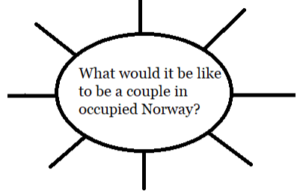
    Beginning of a web brainstorm

    From this point she can begins to expand into other interests as she goes through the story. As you start your research map, you might end up finding out that your central question, while great for generating research, might not end up being the focus of the story. Be open, let the ideas take you where they need to go in the story.  

    5. Find a Second Pair of Eyes

     

     Once you’ve put everything together it’s easy to be so close to your work that you can’t be objective about it in a regular novel, but once you start using research it can fall into many pitfalls. Maybe your historical novel starts to sound too much like a travelogue, or your lab lit begins to like a textbook instead of a thriller. Inviting someone from outside your area of the specialized novel is a great way to find out how your readers will react to your text.

    We always recommend a Manuscript Overview that does a deep dive into the general strokes of your book followed by our Editorial Services to move step by step through your book and really make it sing.

    No matter where you are in your story, you should be proud of the work you have put in so far! Research is difficult, and we know you’re on your way to great things!


    Writer’s Toolbox

    Thank you for reading this Chanticleer Writer Toolbox article.

    Writer Toolbox Helpful Links: 

    TAPPING the EXPERTS – Researching for Your Works in Progress by Carol M. Cram

    10 QUESTION INTERVIEW WITH MULTI-AWARD WINNING AUTHOR JANET OAKLEY

    An Editorial Book Review of The Jøssing Affair by J.L. Oakley

    The traditional publishing tool that indie authors can use to propel their writing careers to new levels?  https://test.chantireviews.com/2016/05/15/the-seven-must-haves-for-authors-unlocking-the-secrets-of-successful-publishing-series-by-kiffer-brown/

    Got a great book?

    The 2023 CIBAs are open now!
    Blue button that says Enter a Writing Contest

    View all awards and upcoming deadlines here. Over 30,000 in Cash and Prizes are given away annually!

    When you’re ready, did you know that Chanticleer offers editorial services? We do and have been doing so since 2011.

    Our professional editors are top-notch and are experts in the Chicago Manual of Style. They have and are working for the top publishing houses (TOR, McMillian, Thomas Mercer, Penguin Random House, Simon Schuster, etc.).

    If you would like more information, we invite you to email Kiffer or Sharon at KBrown@ChantiReviews.com or SAnderson@ChantiReviews.com for more information, testimonials, and fees.

    We work with a small number of exclusive clients who want to collaborate with our team of top-editors on an on-going basis. Contact us today!

    Chanticleer Editorial Services also offers writing craft sessions and masterclasses. Sign up to find out where, when, and how sessions being held.

    A great way to get started is with our manuscript evaluation service, with more information available here.

    And we do editorial consultations for $75. Learn more here.  

    If you’re confident in your book, consider submitting it for a Editorial Book Review here or to one of our Chanticleer International Awards here.


  • ALL THINGS GOETHE! June 2020 SPOTLIGHT on Post-1750 Historical Fiction

    ALL THINGS GOETHE! June 2020 SPOTLIGHT on Post-1750 Historical Fiction

    Post 1750s Historical Fiction Award


    Welcome to the SPOTLIGHT on post-1750 Historical Fiction novels… in other words,
    Welcome to the GOETHE Book Awards!


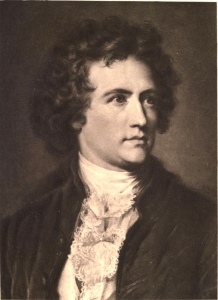
    Why do we like Johann Wolfgang von Goethe so very much? It’s simple! He’s the guy who wrapped up everything we believe in with this simple sentence:


    “Whatever you can do or dream, you can begin it. Boldness has genius, power, and magic in it.” – Goethe


    Of course, this was also said about Goethe (Super Goethe by Ferdinand Mount) that “…[his] company could be exhausting. One minute he would be reciting Scottish ballads, quoting long snatches from Voltaire, or declaiming a love poem he had just made up; the next, he would be smashing the crockery or climbing the Brocken mountain through the fog.”  

    So…, moving on… Goethe was also a very cool guy. In his lifetime, he saw the beginning of the Industrial Revolution in 1750 through Mary Shelley’s publishing of Frankenstein in 1818 – and everything in between! Check out the list of what happened during those nearly seventy decades at the end of this post – you will be A-Mazed!

    Goethe Book Awards Semi-Finalist Badge


    Now, Welcome to the GOETHE Hall of Fame!

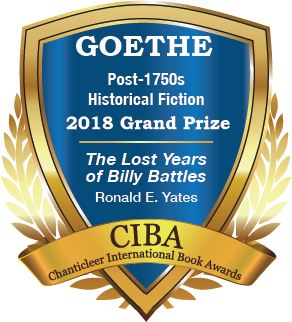
    We wish to congratulate 2018’s Goethe Book Awards Grand Prize Winner –

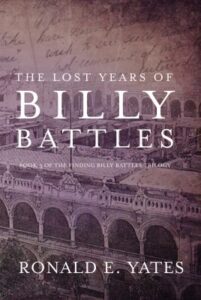
    The Lost Years of Billy Battles by Ronald E. Yates

    Billy Battles is as dear and fascinating a literary friend as I have ever encountered. I learned much about American and international history, and you will too if you read any or all of the books. Each is an independent work, but if read in relation to the others, the reader experiences that all too rare sense of complete transport to another world, one fully realized in these pages because the storytelling is so skillful and thoroughly captivating. Trust me; you’ll want to read all three volumes. Chanticleer Reviewer’s Note

    Mr. Ronald Yates not only won Grand Prize in the CIBAs 2018 GOETHE Awards – he won OVERALL GRAND PRIZE!


    To learn more about Ronald E. Yates, please click here.


    Congratulations to the 2018 Goethe Book Awards First Place Category Winners! 


    The GOETHE Book Awards for post-1750s Historical Fiction Grand Prize is awarded to:


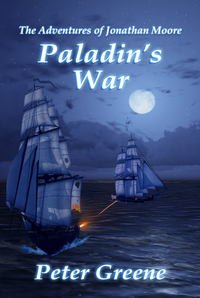
    Paladin’s War: The Adventures of Jonathan Moore by Peter Greene

    Congratulations to the 2017 Goethe Book Awards First Place Category Winners! 


    The Goethe Grand Prize Ribbon for Historical Fiction Post 1750s 2016 was awarded to:

    The Jøssing Affair by J.L. Oakley

    Congratulations to the 2018 Goethe Book Awards First Place Category Winners! 

    • Women’s Historical: A Seeping Wound by Darryl Wimberley
    • Manuscript World Wars and Other Wars: In Their Finest Hour by Duncan Stewart
    • North American Turn of the Century: The Depth of Beauty by A.B. Michaels
    • Regency, Victorian, 1700s/1800s: A Woman of Note by Carol M. Cram
    • British/Europe Turn of the Century: Silent Meridian by Elizabeth Crowens
    • Historical Fiction Manuscript: Running Before the Wind by Carrie Kwiatkowski
    • 20th Century: The Boat House Cafe by Linda Cardillo


    Post 1750s Historical Fiction AwardThe deadline for entering manuscripts and recently published works into the 2020 Goethe Book Awards is coming up fast! JUNE 30, 2019 is the deadline!

    For more information, please click here!


    Submit your manuscript or recently released Historical Fiction (post-1750s) to the Chanticleer International Book Awards!


    Want to be a winner next year? The deadline to submit your book for the Goethe Awards is June 30, 2020. Enter here!

    Grand Prize and First Place Winners for 2019 will be announced during our 2020 conference, #CAC20.

    The Grand Prize and First Place for 2020 CIBA winners will be held on April 17, 2021.

    Any entries received on or after June 30, 2020, will be entered into the 2021 Goethe Book Awards that will be announced in April 2022.

     As our deadline draws near, don’t miss this opportunity to earn the distinction your historical fiction deserves!  Enter today!

    The GOETHE Book Awards is a division of the Chanticleer International Book Awards – the CIBAs.

    The 2020 winners will be announced at the CIBA  Awards Ceremony during #CAC20. All Semi-Finalists and First Place category winners will be recognized, the first-place winners will be whisked up on stage to receive their custom ribbon and wait to see who among them will take home the Grand Prize. It’s an exciting evening of dinner, networking, and celebrations! 


    Goethe

    Some events that occurred during  Goethe’s lifetime:

    1750 – The Industrial Revolution began in England
    1756 – Wolfgang Amadeus Mozart was born in Salzburg Austria
    1761 – The problem of calculating longitude while at sea  was solved by John Harrison
    1765 – James Watts perfects the steam engine
    1770 – Ludwig van Beethoven was born in Bonn, Germany
    1774 – Goethe’s romantic novel, The Sorrows of Young Werther, propels him into European fame
    1774 – Goethe’s play Gotz von Berlichingen, a definitive work of Sturm und Drang premiers in Berlin
    1776 –  America’s 13 Colonies declare independence from England. Battles ensue.
    1776 – Adam Smith publishes the Wealth of Nations (the foundation of the modern theory of economics)
    1776 –  The Boulton and Watt steam engines were put to use ushering in the Industrial Revolution
    1783 – The Hot Air Balloon was invented by the Montgolfier brothers in France.
    1786 – Le Nozze di Figaro by Mozart premiered in Vienna
    1789 – George Washington is elected the first president of the United States of America
    1780 – Antoine Lavoisier discovers the Law of Conservation of Mass
    1789 – The French Revolution started in Bastille
    1791 – Thomas Paine publishes The Rights of Man
    1792 – Napoleon begins his march to conquer Europe
    1799 – Rosetta Stone discovered in Egypt
    1802 – Beethoven created and performed The Moonlight Sonata
    1802 – A child’s workday is limited to twelve hours per day by the British parliament when they pass their first Factory Act
    1804 – Napoleon has himself proclaimed Emperor of France
    1808 – Atomic Theory paper published by John Dalton
    1811 –  Italian chemist Amedeo Avogadro publishes a hypothesis, about the number of molecules in gases, that becomes known as Avogadro’s Law
    1811 – Jane Austen’s Sense and Sensibility was published anonymously. It was critically well-received
    1814 – Steam-driven printing press was invented which allowed newspapers to become more common
    1818 – Mary Shelley publishes Frankenstein
    1832 – Goethe’s Faust, Parts 1 & 2 are published posthumously (March 22, 1832)

    In 1830, Eugene Delacroix  created Liberty Leading the People to epitomize the French Revolution. The movement officially began with the Storming of the Bastille on July 14, 1789, a day that is still celebrated in France.  The French people were rebelling against the extreme wealth of the French royal family who overtaxed and underpaid the people of France to the point where they could not even feed themselves and had nothing to lose by going to battle. They were starving to death.  The uprising of 1830 was featured in Victor Hugo’s Les Miserables (1862)

    Claude-Michel Schönberg and Alain Boublil’s (1980s) musical can look at Delacroix’s Liberty Leading the People and hear the lyrics of the song that serves as a call to revolution:
    Do you hear the people sing? Singing a song of angry men? It is the music of a people. Who will not be slaves again.
    Liberty Leading the People by Eugene Delacroix, 1830. On display at the Lourve, Paris.


    Resources 

    *Britannica Encyclopedia 

    ** Oxford Reference

    ***New Yorker Magazine

  • The MUSE of FIRE by Carol M. Cram – Historical Fiction, Historical Romance, Theater Life

    The MUSE of FIRE by Carol M. Cram – Historical Fiction, Historical Romance, Theater Life

    Grace Johnson dreams of a life bigger than the one expected of a woman in the early nineteenth century. At twenty-two, she should be hoping for marriage and a home of her own. Instead, after a childhood spent privately acting for her mother, Grace secretly longs for a life in the spotlight, a place on a London stage, embracing the roles of Shakespeare’s greatest heroines. Alas, she fears her dream will never come true. Not only is Grace overly tall, clumsy, and what some would call plain, her father, a harsh man, blames her for her mother’s death. When his temper and drunkenness cause him to beat Grace, she finds herself alone on the dark streets of London’s theatre district, where a young man named Ned Plantagenet rescues her.
    Ned, a stage manager at the Theatre Royal in Covent Garden, gives Grace a place to stay, and as their friendship grows, he takes her to a play, a rare event for the woman who has only seen one other play years ago. When she fills in for an absent chorus girl one night, she knows this is where she belongs and defies her father by begging her estranged aunt for a place to stay. However, the more time spent with her newfound theatre family, the more Grace realizes her mother and aunt had a strange connection to the cast and crew. Questions emerge. In this world where women’s dreams have little agency, Grace must decide just how far she is willing to go to build a new life for herself.

    Perhaps the most striking trait of Grace Johnson is her willingness to accept the stigma associated with acting in the early 1800s. Though better than in centuries past, the theatre atmosphere was considered morally corrupt for women, even married ones. This world of impassioned men playing daring roles sure to seduce even the most hard-hearted of women often led to unwanted pregnancies and homeless girls, and Grace isn’t immune to the charms of one such rogue. Grace is well aware of what society might say about her, but that won’t stop her now. She makes her way on her own terms, doing what she must to continue acting even following her father’s disownment and her somewhat forced marriage. When her first acting performance flops, she licks her wounds then forges ahead.

    This optimistic-survivor attitude isn’t particular to Grace alone, though. Both Mr. John Kemble and Ned exhibit the same trait. Mr. Kemble, renowned actor and owner of the Theatre Royal, knows he must find a way forward when fire destroys his precious theatre. Kemble begs and borrows to finance a new building, one that’s larger than any other theatre in England and later stands firm against the raging crowds rioting in every theatre. Ned understands that ‘he can’t change what [he] can’t change’ and refuses to mourn his lowly birth in the Foundling Hospital. This broad-shouldered, gentle giant rose from an orphanage to become the right-hand man of Kemble, a staple in the wings of this successful company. He is like everyone’s big brother, protective and watchful, a “white knight,” showing his bravery during the OP Riots and his pure heart caring for Grace in her hour of need.

    This sprawling historical fiction takes the reader spinning through time with a cast of real-life stars of the London theatre in the early nineteenth century. The fictional characters interweave through the true story of two significant fires in the theatre district and the “Old Price” Riots, which disrupted theatre-goers and actors for months. Readers will see what life was like for the actors of the day as well as the average patron.

    The Muse of Fire won 1st Place in the CIBA 2018 GOETHE Awards for Late Historical Fiction.

  • Carol M. Cram – Award-winning Author of Historical Fiction, Communications Expert, & Academic

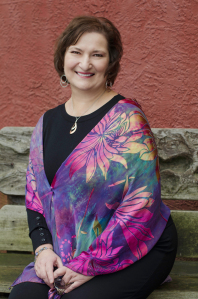
    Carol M. Cram – Award-winning Author of Historical Fiction, Communications Expert, & Academic

    Carol M. Cram is the author of three novels of historical literary fiction. Her first novel, The Towers of Tuscany (Lake Union Publishing, 2014) and her second novel, A Woman of Note (Lake Union Publishing, 2015), were both designated Editor’s Choice by the Historical Novel Society in the UK, and both won First in Category for the Chaucer and Goethe awards (Chanticleer Book Awards), with The Towers of Tuscany also winning the Grand Prize Chaucer Award for best historical novel pre-1750. Her third novel, The Muse of Fire, published in January 2018 by Kindle Press (e-book) and New Arcadia Publishing (print), won the Bronze for Best Historical Fiction from the Independent Publishers’ Book Awards and is currently short-listed for the Goethe award.

    Carol has also written over fifty best-selling college textbooks in computer applications and communications for major US publisher Cengage Learning and was on faculty at Capilano University in North Vancouver for over two decades. In addition, she was Vice President of Clear Communications Consultants and facilitated communications workshops for corporate and government clients.

    Carol holds a BA in English Language and Literature from the University of Reading in England, an MA in Drama from the University of Toronto and an MBA from Heriot-Watt University in Edinburgh. Carol and her husband, painter Gregg Simpson, live on beautiful Bowen Island near Vancouver, BC.

    SESSIONS & PANELS 

    • Tapping into the Experts for Researching Your Work in Progress
      • Whether or not you write Thrillers, Science Fiction, Mysteries, Contemporary Social Themes, YA,  Historical, or any genre, Carol’s guidelines and Tips for connecting with sources and tapping experts will come in handy.
    • NaNoWriMo Panel – Or Why I Broke Up with NaNoWriMo OR Why Am I Obsessed with NaNoWriMo
      • There is no doubt that this will be a lively panel discussion!
    • Historical Authors Panel
    • Carol M. Cram will announce the new CHAUCER Book Awards winners on Saturday, April 27, 2019, at the Chanticleer International Book Awards ceremony.

    And she adores cookbooks and traveling! Check out Carol’s blog –it is like going on a mini-vacay!

  • TAPPING the EXPERTS – Researching for Your Works in Progress by Carol M. Cram

    TAPPING the EXPERTS – Researching for Your Works in Progress by Carol M. Cram

    Guidelines for Connecting with Sources and Experts While Researching Novels

    Editor’s Note: Whether or not you write Thrillers, Science Fiction, Mysteries, Contemporary Social Themes, YA,  Historical, or any genre, these guidelines for connecting with sources and tapping experts will come in handy.

    One of the questions I get asked frequently when people discover I like to write historical novels is “How do you do your research?” I don’t have a pat answer (I wish I did!). The reality is that I “do my research” as I’m writing a novel and that, for me, it’s my least favorite part of the process. There, I said it!

    I know many historical novelists who adore research, who like it even more than writing, but I’m not one of them. I like research. I enjoy prowling through dusty libraries and doing endless Internet searches and reading stacks of books, but most of the time I’d rather be writing my story.

    That said, I have picked up some techniques over the past few years that I’ll share in this blog to help you find your feet when you’re researching and writing a novel set in the past. Getting the facts right is very important. You discover that the first time a reader finds a mistake (and tells you about it).

    In my novel set in early 19th Century London, I had a character refer to the third season of the year as “Fall.” A British reader set me straight, in no uncertain terms. Thank goodness she was a Beta reader and I was able to catch the error before the novel was published!

    Books are great, the Internet can’t be beaten for looking up and verifying facts quickly, and libraries are awesome. But even better are the academics who write all those books and articles. In other words, the experts. Many experts are happy and eager to share what they know with you. And many go well beyond just answering questions.

    Following are some tips and advice for reaching out and working with subject matter experts.

    Do your homework before contacting a subject matter expert. You don’t want to waste an expert’s time asking questions that you could easily answer yourself with a bit of reading. Consult books and articles to become as conversant as you can with the subject and then prepare a list of specific questions to focus the discussion. Experts who see that you’ve made an effort to understand their field are usually very generous with their time and interested to hear about your Work in Progress.

    Keep the number of questions reasonable. A half-hour interview is about right, although if your expert wants to go on longer, sit back and enjoy! You never know what great information you’ll get—often on a subject you weren’t looking for but that will fit beautifully into some part of your story. Experts are often fascinated by the creative process and may suggest plot ideas based on their more in-depth understanding of the period. When an expert says something like “What if you have your character do such and such…”, listen up!

    Experts care a great deal about their fields of expertise and as a result, most welcome the opportunity to work with a novelist to bring their knowledge to a wider audience. An academic I consulted for The Muse of Fire told me how thrilled he was that someone apart from his students was interested in early 19th Century British theater.

    Make sure you end an interview with a request for additional book and research recommendations. Most experts are happy to provide you with more references than you’ll probably have time to read.

    Find experts by looking up faculty lists at universities, consulting bibliographies, conducting searches for specialist groups, and asking for recommendations. You can click the Ask a Librarian link on any Library website to get all sorts of academic questions answered. Before contacting experts—generally by email—familiarize yourself with their credentials and read at least some of their articles and books. When you take the time to read their writing, you’re more likely to ask intelligent questions.

    Photo Credit: Myrabella / Wikimedia Commons
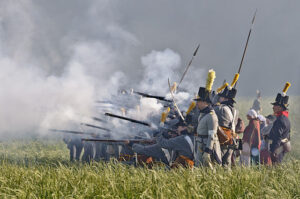
    Soldiers in front of the wood of Hougoumont during the reenactment of the battle of Waterloo (1815)

    Another place to find experts, particularly in specific historical eras, is to seek out re-enactment groups and themed events such as Renaissance Fairs. Here you’ll find experts who have really steeped themselves in your period and are eager to share what they know.

    Approach experts with a polite email that includes a short description of your Work in Progress and a few sample chapters. In my experience, experts are most eager to help when I give them an opportunity to first read my work. Many want to be sure they are associating their names with writing that they personally like.

    For all three of my novels, I’ve been fortunate to have experts give me advice during the writing process and then to read drafts of my novel to catch stray errors. Several of them became almost as invested in the accuracy of my novel as I was and are now fans!

    In your introductory email to an expert, make sure you include your own web address in your signature line and a short summary of your own background and credentials. I know that several of the experts I’ve reached out to told me they checked out my website before replying to my request. They understandably wanted to verify my background and learn about my books before connecting with me.

    Thank experts in your acknowledgments. I always include historical notes at the end of my novels to cite books I consulted while writing. I also personally thank experts with whom I’ve connected personally. Everyone appreciates being thanked.

    Send complimentary copies of your novels to experts who have provided you with significant help. I think it’s money well spent to let the people who have helped me know how much I appreciate them.

    We are incredibly fortunate as novelists to be able to easily connect worldwide with experts in a dizzying array of subjects. I’ve visited with the curator of the Narrenturm—an anatomical museum housed in Europe’s first insane asylum in Vienna; taken tea in London with an expert on 19th Century women composers; become good friends with a professor of medieval art history, and connected with several wonderful specialists in early 19th Century British theater. Each of them did much more than just answer my questions. They actively contributed ideas about plot and character motivation appropriate to the era I was writing in and inspired me to explore all sorts of new ideas.

    You never know what might come from your interactions with experts once you get the nerve to approach them – respectfully and after having done your homework.

    And then all you need to do is weave what you’ve learned into a compelling novel that people will not want to put down. Easy, right?


    Carol M. Cram, CIBA Award-Winning Author (both Goethe and Chaucer Historical Book Awards) for these outstanding novels:

    Carol M. Cram will announce the new CHAUCER Book Awards winners on Saturday, April 27, 2019, at the Chanticleer International Book Awards ceremony. She is also presenting at the sixth annual Chanticleer Authors Conference. Her award-winning historical fiction books will be available in the CAC19 Books By the Bay Book Fair hosted by Village Books on April 27 & 28, 2019.