Author: buck-stienke

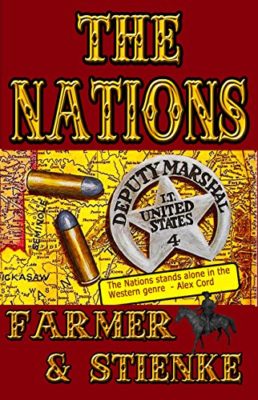
  • The NATIONS by Ken Farmer and Buck Stienke – African American Historical Fiction, Old West History in the USA, Western Fiction

    The NATIONS by Ken Farmer and Buck Stienke – African American Historical Fiction, Old West History in the USA, Western Fiction

    “Return now to those thrilling days of yesteryear,” may sound familiar. It’s the opening for the radio version of The Lone Ranger.

    It’s also an appropriate introduction to The Nations by Ken Farmer and Buck Steinke and not just because the dialog will ring in the reader’s ear as very reminiscent of plenty of classic TV and movie Westerns. But also, because the hero of The Nations, Deputy U.S. Marshal Bass Reeves, may have been the inspiration for the Lone Ranger himself.

    Reeves, born in slavery, was the first black Deputy U.S. Marshal west of the Mississippi. He was also one of the most successful Deputy Marshals of his own or any subsequent era, arresting over 3,000 felons during his long career, but was never wounded by any of the desperate criminals he brought to justice.

    But this story, the first in a 10-book series – at least so far – fictionalizes Reeves’ exploits into something that will be savored by readers looking for the kind of story that Louis L’Amour, Zane Grey and Elmer Kelton used to write – and that William Johnstone still does.

    This adventure pits Reeves and his partner, Deputy U.S. Marshal Jack McGann, against a gang of outlaws known as the Larson Brothers’ gang after its leaders Wesley and Ben Larson. The brothers typify different stereotypes of outlaws, with Wesley as the leader and voice of reason who is in it for the money, while his younger brother Ben is a killer because that seems to be how he gets his kicks.

    The story begins with Wesley and the gang rescuing Ben from the clutches of the law after Ben gets himself captured – yet again – by being overconfident and disobeying his brother’s orders.

    That escape begins a cat and mouse game between Reeves and McGann and the Larson gang, as Ben is captured again, his brother helps him escape, and the lawmen become even more determined to bring them in.

    The Nations reads like a classic western tale of the school of Louis L’Amour and Zane Grey. The lawmen are always on the side of angels, and the outlaws are forever threatening the towns, laws, and lawmen. There’s no question about which side represents the “good guys.”

    And there’s no question that compassionate, professional Reeves is the star of this story. What makes this story shine – is Reeves truly was as good a lawman as the story makes him out to be, a good tracker, an excellent marksman, good at disguises, kind but fair to those he captured – and always riding a white stallion. If any of the above sounds familiar, it’s all part of the reason that some believe Reeves was the inspiration for The Lone Ranger.

    The Nations, and the entire series that follows it, will be loved by readers of those classic westerns and is recommended for that audience.

    Simultaneously, there are welcome differences from the typical stories of those “thrilling days of yesteryear.” Bass Reeves is the hero of this otherwise classic western who hands out evenhanded treatment of all the characters despite the color of their skin.

    Even the female characters are a bit more well-rounded than is usual for the genre, again on both sides of the law. But this story still centers on the male characters – who spend more time with their horses than they do with the women in their lives.

    This story’s grounding is in real history, not just in the characters of Reeves and McGann, but also in the background character of “Hanging Judge” Isaac Parker, who sent the Marshals out to retrieve criminals to be tried and frequently executed. That portrait of life in the American West in its heyday will appeal to readers who are fascinated with that period – and they are legion.

    The Nations won First Place in the CIBA 2014 Laramie Awards for American Western Fiction.


  • LARAMIE Book Awards – SPOTLIGHT Focus on ALL Works of Western Fiction and Uniquely American Tales

    LARAMIE Book Awards – SPOTLIGHT Focus on ALL Works of Western Fiction and Uniquely American Tales

    Welcome to our SPOTLIGHT on LARAMIE Book Awards, the stories that stick!

    Western Pioneeer Civil War Fiction Award

    The Laramie Book Awards recognize emerging new talent and outstanding works in the Americana / Western, Pioneer, Civil War, Frontier, and First Nations Novels. The Laramie Book Awards is a division of the Chanticleer International Book Awards.

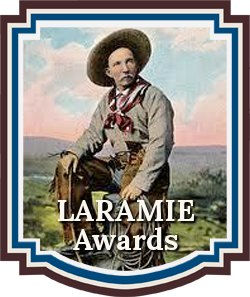
    Charles M. Russell painted the cowboy scene on Chanticleer’s very own Laramie Book Awards badge. It is one of many such paintings he did that encompassed the Old American Wild West. He was an advocate for the Northern Plains Indians. Charles M. Russell also helped establish a reservation in Montana for the Chippewa people.

    *More interesting facts about Laramie, Wyoming, and its historical icons are immediately after the Laramie Hall of Fame listing below. A fun read! 

    The Laramie Book Awards for American Western Fiction Hall of Fame First Place and Grand Prize winners!


    The 2018 Laramie Book Awards Grand Prize:

    Blood Moon: A Captive’s Tale by Ruth Hull Chatlien

    Laramie Book Awards

     2018 Laramie Book Awards for American Western Fiction First in Category Winners


    The 2017 Laramie Book Awards Grand Prize Winning Book also won the OVERALL Prize! Best book of 2017:

    HOUR GLASS by Michelle Rene

    2017 Laramie Book Awards for American Western Fiction First in Category Winners


    The 2016 Laramie Book Awards Grand Prize:

    Hot Work in Fry Pan Gulch: Honey Beaulieu – Man Hunter #1
    by Jacquie Rogers

    2016 Laramie Book Awards for American Western Fiction First in Category Winners


    The 2015 Laramie Book Awards Grand Prize:

    Widow (formerly known as Doctor Kinney’s Housekeeper) by Sara Dahmen

    2015 Laramie Book Awards for American Western Fiction First in Category Winners


    The 2014 Laramie Book Awards Grand Prize:

    Not on My Mountain Jared McVay

    Not On My Mountain by Jared McVay

    2014 Laramie Book Awards for American Western Fiction First in Category Winners


    The 2013 Laramie Book Awards Grand Prize:

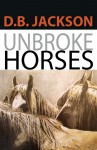
    Unbroken Horses by Dale B. Jackson

    Unbroke Horses clean

    Congratulations to the Laramie Awards 2013 1st Place Category Winners:

    • Mystery:  Double or Nothing by Meg Mims
    • Action/Adventure:  Haunted Falls by Ken Farmer & Buck Stienke
    • Historical Fiction: Because of the Camels by Brenda Blair
    • Civil War:  Ford at Valverde by Anita Melillo
    • Prairie Pioneer:  They Rode Good Horses by Dale B. Jackson
    • Literary Western:  Unbroke Horses by Dale B. Jackson
    • First Novel:  Confessions of  a Gunfighter by Tell Cotten
    • Best Manuscript: Lick Creek by Deborah Lincoln


    HOW DO YOU HAVE YOUR BOOKS COMPETE? Submit them to the Chanticleer International Book Awards –Click here for more information about The CIBAs! 

    Western Pioneeer Civil War Fiction Award

    Want to be a winner next year? The deadline to submit your book for the 2020 Laramie awards is July 31, 2020. Enter here!

    Grand Prize and First Place Winners for 2019 will be announced during our Virtual Conference in early September 2020.

    Any entries received on or after July 31, 2020, will be entered into the 2021 Laramie Book Awards. The Grand Prize and First Place for 2020 CIBA winners will be held on April 17, 2021.

     As our deadline draws near, don’t miss this opportunity to earn the distinction your American Western readers deserve!  Enter today!

    The LARAMIE Book Awards is a division of the Chanticleer International Book Awards – the CIBAs.

    The 2020 winners will be announced at the CIBA  Awards Ceremony, which will take place during the 2020 Live/Online Chanticleer Authors Conference. All Semi-Finalists and First Place category winners will be recognized, the first place winners will be virtually whisked up on “stage” to receive their custom ribbon and wait to see who among them will take home the Grand Prize. Covid19 has made our celebrations a bit different this year, but we still will celebrate!

    Don’t delay! Enter today!  

    As always, please do not hesitate to contact us with questions, concerns, or suggestions at Chanticleer@ChantiReviews.com

    [20] McDougall, Walt, “Pictures in the Papers,” American Mercury, 6:21 (September 1925), 72.


    What’s a Laramie?

    We thought you’d never ask!

    We titled the Chanticleer International Book Awards (CIBAs) division for Western American Fiction and all things that gather around the campfire singing a lonesome tune, the Laramie Awards, after the county and city in Wyoming. You know the one, tucked into the lower right-hand corner of the state between the Snowy Mountain Range and the Laramie Mountain Range.

    Yes, but why Laramie? 

    The small outpost was changed almost overnight when the Union Pacific Railroad moved their “Hell on Wheels” tent town from Cheyenne, Wyoming to Laramie after building the rails over the Sherman Summit at an elevation of 8,200 feet all the way to Laramie on May 4, 1868. Lawlessness and the Wild West ruled in Laramie. Luckily, “Hell on Wheels” moved on West as more track was laid down.

    But where did that name Laramie come from? 

    Laramie was named after Jacque LaRamie, a French or French-Canadian trapper who disappeared in the mountain range that was later named for him in the early 1810s. LaRamie was one of the first Europeans to visit the area. Laramie is a French name much like DuBois, Wyoming. And, yes, it is pronounced Doo – Boys (and NOT Du Bwai).

    There are several reasons we chose Laramie for our iconic Americana Book Awards. For us, and those in the know, Laramie, Wyoming immediately calls to mind the image of a Wild West town filled with rough-and-tumble cowboys. At one point, the only law in Laramie was “lawlessness. Wild Bill Hickok was even known to visit from time to time.

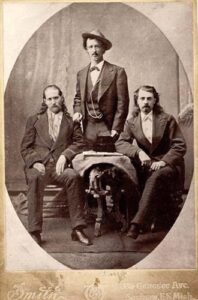
    Here’s a picture of the man, himself, on the left with his friends, Texas Jack Omohundro (center), and Buffalo Bill Cody on the right.

    Butch Cassidy and the Wild Bunch robbed trains and passengers with the first recorded train robbery taking place on June 2, 1899 in Wyoming. Butch was known to be very polite and dislike violence.

    But that’s not the only reason we chose Laramie.

    And, yes, there is yet one more reason we love Laramie! 

    The WOMEN!

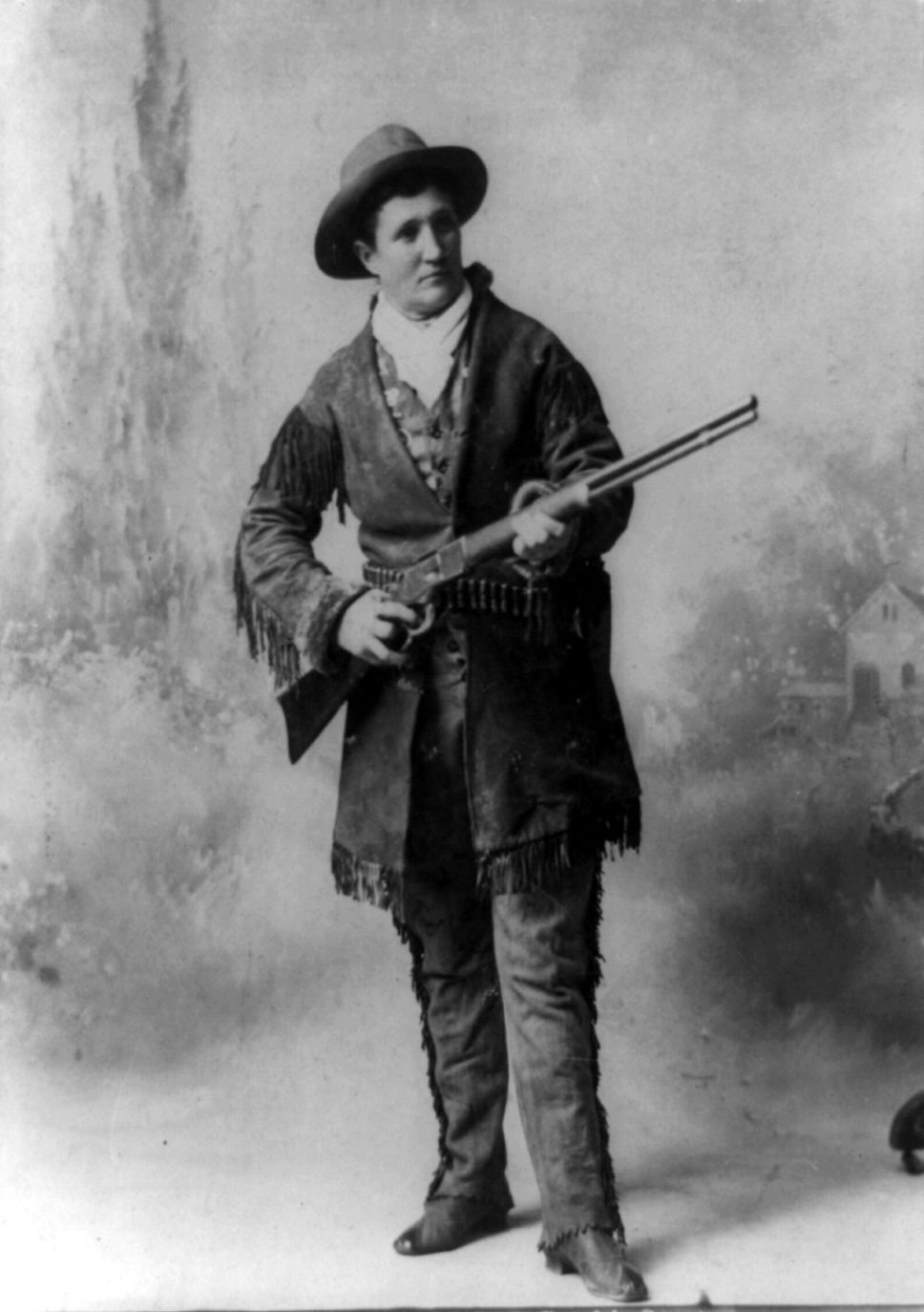
    Calamity Jane hails from Laramie, Wyoming – a skilled sharpshooter who was born to a gambler and a prostitute. She cared for her five younger siblings in Utah before traveling on to Wyoming in search of a better life. There she found work as a dance hall girl and then as a prostitute at Fort Laramie. It was there that she reinvented herself by wearing buckskins and dressing like a man. She was also known for her swearing and hard-drinking ways, but Calamity Jane was also known even more for her kind heart and helping folks out of calamities–thus her nickname.

    Calamity Jane — She was the inspiration for Michelle Rene’s HOURGLASS novel.

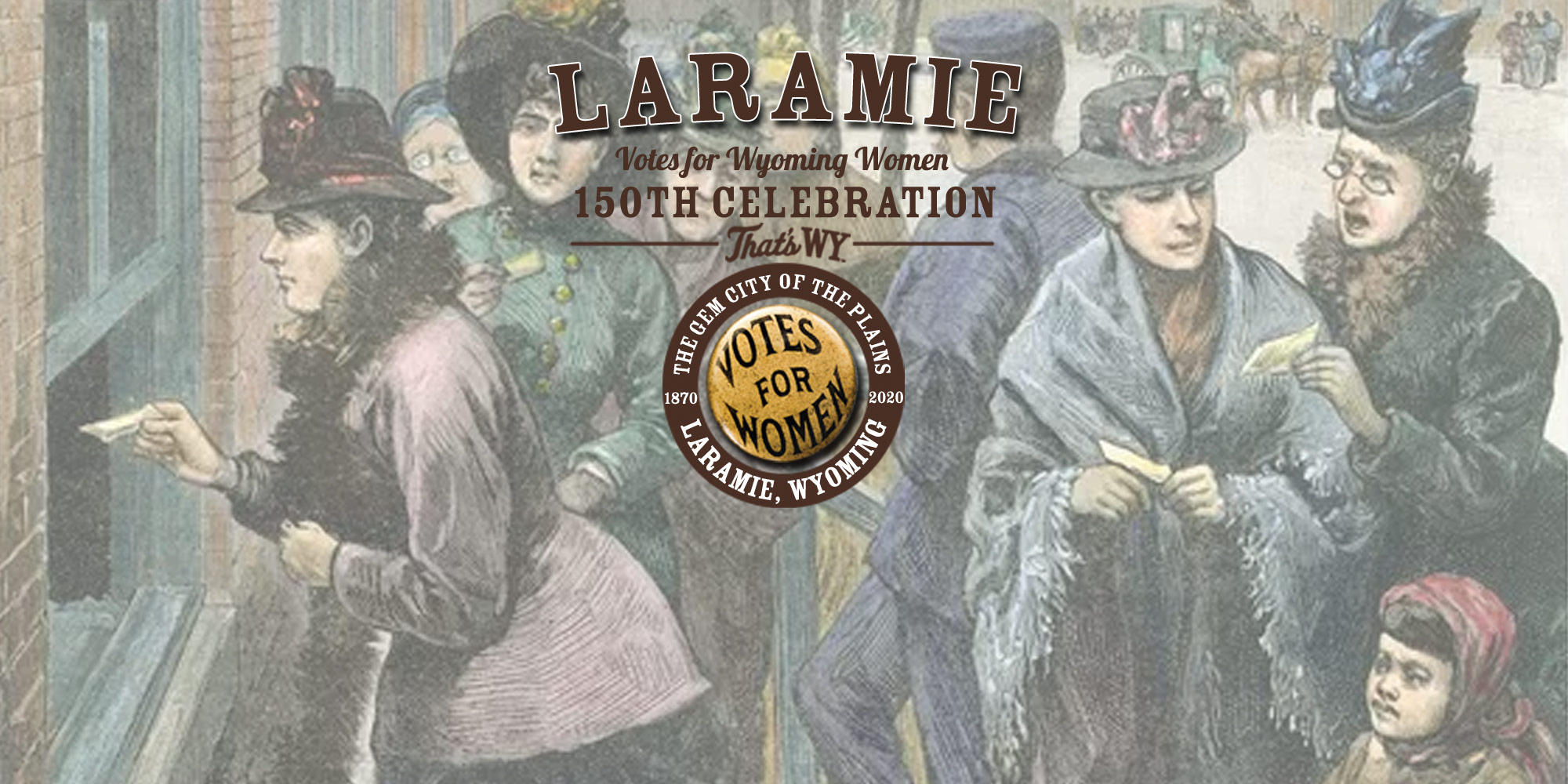
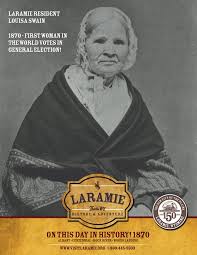
    While the men were wrestling in the streets and shooting up the place, it was really the women who brought civilization to Laramie and Wyoming Territory. They established the first school in 1869, served on a formal jury in the Spring of 1870,  and were the first to gain the vote; which is exactly what Louisa Swain and 92 of her friends did on September 6, 1870 –150 years ago!

    Louisa Swain, the first woman to cast a ballot and she did it in Laramie, Wyoming!

    Louisa Swain – she was made of stern stuff!

    Early in the morning on September 6, 1870 in Laramie, Wyoming Louisa Swain became the first woman in the world to cast a ballot under democratically enacted laws granting women equal political rights with men. In the fall of 2008, 138 years later, the U.S. Congress passes a resolution proclaiming September 6th as “Louisa Swain Day” in recognition of this historic event.The Louisa Swain Foundation

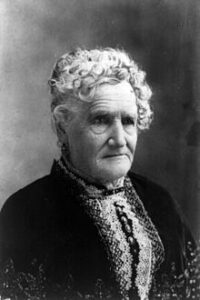
    In 1870, Esther Hobart Morris (59 years old) became the first female Justice of the Peace. She served in South Pass City, Wyoming, which is to the northwest of Laramie.

    Esther Morris "to pettifoggers she showed no mercy." Wyoming Tribune
    Esther Morris, first female Justice of the Peace — Wyoming

    Esther Morris “to pettifoggers she showed no mercy.” Wyoming Tribune

    The Union’s first all-female jury was assembled in Wyoming in 1870.

    Later, in 1894, Estelle Reel Meyer became Superintendent of Public Instruction, the country’s first female statewide elected official.

    And the grand coup d’etat was when in 1889 when Wyoming vied for statehood—and refused to join the Union if the laws giving equality to women were not upheld, telling Congress (which wanted the suffrage law rescinded) via telegram,

    “We will remain out of the Union 100 years rather than come in without the women.”

    Wyoming is also the first state in the USA to allow women to own property and sign legal documents.

    In 1910, Mary Godat Bellamy became the first woman to be elected to the Wyoming Legislature. Two other western states, Colorado and Idaho, elected women legislators in 1895 and 1899, respectively. Wyoming was third in the nation.

    Quotes are from the Smithsonian Magazine
    Read more: https://www.smithsonianmag.com/travel/women-voting-wyoming-150-years-here-how-state-celebrating-180971263/#6UKzMfMeCQsmbIIQ.99
    Give the gift of Smithsonian magazine for only $12! http://bit.ly/1cGUiGv
    Follow us: @SmithsonianMag on Twitter

    {https://www.wyohistory.org/encyclopedia/brief-history-laramie-wyoming}