Author: bernard-mann

  • A Good New Year and a Safe Fast | Celebrating Yom Kippur by David Beaumier

    A Good New Year and a Safe Fast | Celebrating Yom Kippur by David Beaumier

    Yom Kippur is coming up soon for our Jewish friends around the world.

    As a gentile, I  learned a lot in putting this article together, and I understand how much more there is to learn! Links will be included for further reading from all of our sources below!

    One particularly useful site was Chabad.org, which says:

    Yom Kippur is the holiest day of the year, when we are closest to G-d and to the essence of our souls. Yom Kippur means “Day of Atonement,” as the verse states, “For on this day He will forgive you, to purify you, that you be cleansed from all your sins before G-d.”

    Many readers may know the events of the first Yom Kippur, but not realize the connection. Tradition states that the first Yom Kippur happened after the Israelites’ exodus from Egypt when God gave Moses the Ten Commandments at Mt. Sinai. When Moses came down from the mountain, he found his people worshipping a golden calf, and he broke the tablets in a rage. When the people saw the error of their ways, Moses returned to the mountain and returned with two more tablets and God’s forgiveness.
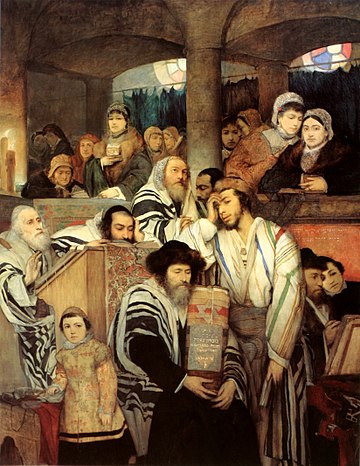
    Jews Praying in the Synagogue on Yom Kippur, by Maurycy Gottlieb (1878)

    Yom Kippur translates as “the Day of Atonement”

    [I]t marks the culmination of the 10 Days of Awe, a period of introspection and repentance that follows Rosh Hashanah, the Jewish New Year. Read more here.

    Many people will fast for 26 hours, and, being a holiday of asking for forgiveness, it’s not very common to hear “Happy Yom Kippur!” This article from USA Today explains that the traditional greeting is “G’mar chatima tova,” which means “may you be sealed in the Book of Life.”

    The “ch” sound in “chatima” is not pronounced like the English word “chat.” Instead, it should sound more like guttural utterance from the throat, like a backwards snore, because it comes from the Hebrew letter Chet. “G’mar hatima tov” is also acceptable to say.

    You can always also just say “Have an easy fast” or “have a good year” since the Jewish New Year has just started.

    Breaking the Fast after Yom Kipper

    Yom Kippur is the tenth day of the seventh month according to the Hebrew Calendar. It is also known as the “Sabbath of Sabbaths.” Yom Kippur has five prayer services that include the public and private confessions of sins and guilt with atonement and repentance. Along with the prayers is asking others for forgiveness, and give to charity and those in need.

    This year, Yom Kippur is sunset of September 15th, until nightfall on September 16th, 2021. Food and drink are refrained from during this time for fasting. Fasting for 26 hours begins at sunset for all males over the age of thirteen and females over the age of twelve. It may be waived for certain medical conditions. It is tradition to eat one large meal on the afternoon of Yom Kippur and then to break the fast with a large feast to celebrate in the evening of the day after. After the last Yom Kippur service, most will return home for a joyous meal, which focuses largely on comfort foods often associated with breakfast like blintzes, noodle pudding, and other baked goods.

    A man blowing on a shofar while wearing a white cloth
    White is the traditional color worn on Yom Kippur. The Shofar, held above, is sounded at the beginning of Rash Hashanah and the end of Yom Kippur


    Now we want to take the time to celebrate some of the books that highlight some aspect of the Jewish experience that we’ve reviewed.

    HENRY: A Polish Swimmer’s True Story of Friendship from Auschwitz to America
    By Katrina Shawver
    First Place Winner in Journey Awards
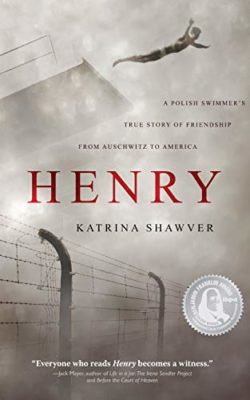
    Katrina Shawver, a journalist for a Phoenix newspaper, was seeking a story for her weekly column. She had heard from a friend that a Holocaust survivor named Henry Zguda and his American wife, Nancy, lived in Phoenix. She called Zguda and was invited to come to his home, only a few blocks from her own. Shawver quickly bonded with both Henry and Nancy. Then she and Henry decided to have a series of weekly interviews, which she would draw on for her column and, later, for a book—this biography.

    The horror story of Henry Zguda, a Catholic Pole born and raised in Krakow, Poland, begins with Henry walking down the street toward the YMCA for swim practice in 1942. A Gestapo car screeches to a stop beside him. Two men leap out, arrest Henry on the spot, throw him into the car, and take him to prison. After several days of torture, a practice used by the Gestapo to obtain information (of which Henry had little), he is taken to the train station and shoved into a cattle car so filled with people that it is impossible to do anything but stand, shoulder to shoulder. The door is slammed shut, and the train pulls out of the station. Henry has no idea what fate awaits him.

    Continue Reading Here…


    DAVID and AVSHALOM: Life and Death in the Forest of Angels
    By Bernard Mann
    First Place Winner in Chaucer Awards

    Debut novelist Bernard Mann has diligently researched a wide-ranging saga centered on the life, loves, songs, and struggles of King David, a central figure in the Old Testament and author of the Book of Psalms.

    The tale begins at a crucial stage of David’s life as he is escaping the wrath of King Saul. Once a father-figure to the former shepherd boy, Saul’s view of David sours when the majority of his subjects begin to revere David over him. David flees with a small band of loyal stalwarts. He is still a fast friend to Saul’s son and likely successor, Jonathan, and is married to Saul’s daughter Maacah. Moreover, he still holds fast to his faith in God and continues to compose poems and songs in praise of Him. When both Saul and Jonathan perish in battle, David takes up the struggle, amasses an army, receives the crown, and seizes the city of Jerusalem, making it the seat of Israelite power.

    Continue Reading Here…


    The TRAVELS of IBN THOMAS
    By James Hutson-Wiley
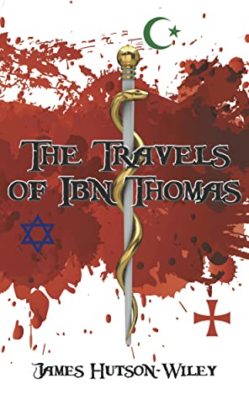
    In an ancient world split in three by religion, a conflicted young man seeks the truth about his past and builds his future in this colorful panorama created by author James Hutson-Wiley.

    Ibn Thomas, the book’s narrator, taken from his boyhood home In Aegyptus after his father and mother disappeared, lives in a monastery where he is mocked for his name and his knowledge of Arabic. At age 12, the monks send him from England to Salerno, Italy, where he will study medicine, supported, he learns, by considerable wealth to which he is heir from the commercial activities of his father, a trader in Al-Sukkar, or sugar, considered a precious commodity at the time.

    Continue Reading Here…


    A FEMALE DOCTOR in the CIVIL WAR
    By Richard Alan
    First Place Winner in Laramie Awards

    Imagine a fearless, hard-as-nails contract surgeon hired by the Union Army who often works 48-hour shifts in battlefield medical tents amputating limbs, healing previously inoperable gut wounds, sewing up children’s hare lips, and diagnosing what we now call PTSD as critical in military patient care as patching physically wounded bodies.

    A native of the Pacific Northwest, Dr. AbbyKaplan  stands six feet tall and exchanges her dresses for breeches, totes a gun on her hip, engages in military defensive maneuvers, and is wounded multiple times for her efforts. Dr. Kaplan takes no guff from anyone and uses the language of soldiers appropriate to the situation. In a time when men are in charge and women are not, she wins the respect of her male colleagues in the most gruesome medical cases, winning over even those who could not fathom a woman examining a man’s most private parts.

    Continue Reading Here…


    WRAPPED in the STARS
    By Elena Mikalsen
    First Place Winner in Chatelaine Awards

    Maya Radelis has spent the last seven months running from herself. After the death of a patient, she abandons her pediatric residency in New York City for the jungles of Guatemala and the Family Health Volunteers Mission. However, after exhausting her six-month leave, she still cannot bring herself to return to New York. Instead, Maya ends up in Edinburgh, Scotland, where fate intervenes.

    In a small antique shop, an inscribed ring somehow “calls” to her. Unwilling to part with it, Maya purchases the ring and traces its history. She has seven days before she must return to the university and face the consequences of her absence, as well as the investigation of her patient’s death. Fearing she will no longer be allowed to pursue a medical career and dreading the meeting where her fate will be revealed. Maya wants to make the most of her search for the ring’s previous owner, especially after she begins to have strange dreams and memory-like episodes of the woman she thinks owned the ring. Enlisting the help of Pauline, her French friend, she traces an odd, twisting path through Paris then Bern, Switzerland. The more she discovers, the more she begins to question her destiny.

    Continue Reading Here…


    YISHAR KOACH: FORWARD with STRENGTH
    By Susan Lynn Sloan

    Yishar Koach: Forward with Strength shares the account of a man who was entrusted with inspiring some of these precious few orphans to find strength and hope after experiencing tremendous loss. At Aglasterhausen, a United Nations school for WWII orphans, Fred Fragner took on the mantle of principal and teacher at the school—a daunting responsibility for most, but not for Fragner—a fighter of the Nazi regime who was shot, captured, and interrogated by the Gestapo and then imprisoned for five years in Buchenwald Concentration Camp.

    The life of this most remarkable man of integrity and altruism was inspiration for Susan Sloan to write Fragner’s biography—a five year project that she undertook with great passion after being introduced to him at a café in Bellingham, Washington. Sloan researched transcripts of lectures and speeches made by Fragner, she refers to newspaper clippings and documents about him, listened to audio and video tapes, and interviewed many who knew him as mentor, coach, friend, family member, and teacher. Most importantly, Sloan had access to Fragner’s own scrapbook about Aglasterhausen that vividly tells how “the children gave him his life back” as he tried to help restore theirs.

    Continue Reading Here…


    Have a great story about an experience?

    When you’re ready, did you know that Chanticleer offers editorial services? We do and have been doing so since 2011.

    Our professional editors are top-notch and are experts in the Chicago Manual of Style. They have and are working for the top publishing houses (TOR, McMillian, Thomas Mercer, Penguin Random House, Simon Schuster, etc.).

    If you would like more information, we invite you to email Kiffer or Sharon at KBrown@ChantiReviews.com or SAnderson@ChantiReviews.com for more information, testimonials, and fees.

    We work with a small number of exclusive clients who want to collaborate with our team of top-editors on an on-going basis. Contact us today!

    Chanticleer Editorial Services also offers writing craft sessions and masterclasses. Sign up to find out where, when, and how sessions being held.

    A great way to get started is with our manuscript evaluation service, with more information available here.

    And we do editorial consultations for $75. Learn more here.  

    If you’re confident in your book, consider submitting it for a Editorial Book Review here or to one of our Chanticleer International Awards here.

    Also remember! Our 10th Anniversary Chanticleer Authors Conference (CAC22) will be April 7-10, 2022, where our 2021 CIBA winners will be announced. CAC22 and the CIBA Ceremonies will be hosted at the Hotel Bellwether in Beautiful Bellingham, Wash. See the latest updates here!
    Wishing You Peace and Goodness for Yom Kippur!

  • June SPOTLIGHT on CHAUCER AWARDS – Early Historical Fiction, Historical Fiction, Historical Romantic Fiction, Crusades, Medieval

    June SPOTLIGHT on CHAUCER AWARDS – Early Historical Fiction, Historical Fiction, Historical Romantic Fiction, Crusades, Medieval

    Pre 1750 Historical Fiction Award

    Do you have an early historical fiction manuscript or recently released novel? Submit your work to the CIBA 2019 CHAUCER Awards by
    June 30, 2020, and see how your work stacks up against others. 


    We know you want to – because we never tire of promoting our authors’ achievements!

    As in Chaucer’s words in the Nun’s Priest Tale of the Canterbury Tales,

    “For crowing there was not his equal in all the land.”


    Click here to find out more. 

    We titled the Chanticleer International Book Awards (CIBAs) division for Pre-1750s Historical Fiction the Chaucer Awards, after the English poet and author of the Canterbury Tales, because #CHAUCER.

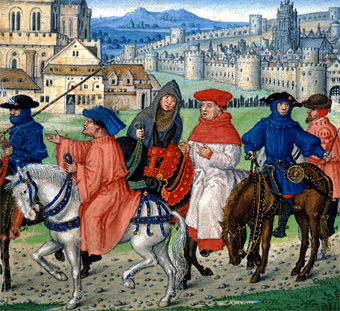
    But seriously, did you know that The Canterbury Tales is considered one of the greatest works in the English language? In fact, it was among the first non-secular books written in Middle English to be printed. So, yeah, #Chaucer

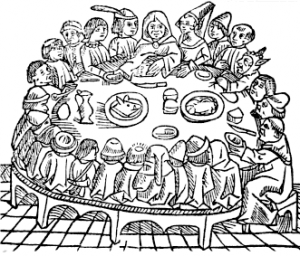
    A woodcut from William Caxton’s second edition 0f the Canterbury Tales printed in 1483

    Some interesting tidbits about Geoffrey Chaucer

            • born c. 1342/43 probably in London. He died on October 25, 1400
            • his father was an important London vintner
            • His family’s finances were derived from wine and leather
            • Chaucer spoke Middle English and was fluent in French, Latin, and Italian
            • He guided diplomatic missions across the continent of Europe for ten years where he discovered the works of Dante, Petrarch, and Boccaccio whose The Decameron had a profound influence on Chaucer’s later works
            • He married well as his wife received an annuity from the queen consort of Edward III
            • His remains are interred in the Westminster Abbey


     As our deadline draws near, don’t miss this opportunity to earn the distinction your historical fiction deserves!  Enter today!

    Welcome to the CHAUCER BOOK AWARDS HALL OF FAME

    Click on the links below to read the Chanticleer Review of the award-winning work!

    Pre 1750 Historical Fiction Award


    The 2018 Chaucer Book Awards Grand Prize Winner:

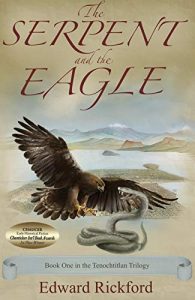
    The SERPENT and The EAGLE  by Edward Rickford 


    2018 Chaucer Book Awards for Pre-1750s Historical Fiction First in Category Winners:


    The 2017 Chaucer Book Awards Grand Prize:

    The Traitor’s Noose: Lions and Lilies Book 4 by Catherine A. Wilson and Catherine T. Wilson

    2017 Chaucer Book Awards for Pre-1750s Historical Fiction First in Category Winners:


    The 2016 Chaucer Book Awards Grand Prize Winner:

    (Chaucer Book Awards was the Historical Fiction division until we divided it for the 2016 CIBAs into two divisions because of the number of entries:

    Goethe Book Awards for post-1750s Historical Fiction and Chaucer Book Awards for pre-1750s Historical Fiction).

    The Towers of Tuscany by Carol M. Cram


    2016 Chaucer Book Awards for Pre-1750s Historical Fiction First in Category Winners:


            The 2015 Chaucer Book Awards Grand Prize Winner:

            (Chaucer Book Awards was the Historical Fiction division until we divided it into two divisions for the 2016 CIBAs because of the number of entries:

            Goethe Book Awards for post-1750s Historical Fiction and Chaucer Book Awards for pre-1750s Historical Fiction).

            Valhalla Revealed by Robert A. Wright

            Valhalla Revealed by Robert A Wright


            2015 Chaucer Book Awards for Pre-1750s Historical Fiction First in Category Winners:


            The 2014 Chaucer Book Awards Grand Prize:

            (Chaucer Book Awards was the Historical Fiction division until we divided it into two divisions because of the number of entries:

            Goethe Book Awards for post-1750s Historical Fiction and Chaucer Book Awards for pre-1750s Historical Fiction).

            The Love of Finished Years  by Gregory Erich Phillips

            2014 Chaucer Book Awards for Pre-1750s Historical Fiction First in Category Winners


            The 2013 Chaucer Book Awards Grand Prize Winner:

            Propositum - Front Cover 2

            Propositum by Sean Curley

            2013 Chaucer Book Awards for Pre-1750s Historical Fiction First in Category Winners:

            • Adventure/Young Adult:  I, Walter by Mike Hartner
            • N.A. Western:  Crossing Purgatory by Gary Schanbacher
            • World War II (European):  Deal with the Devil by J. Gunner Grey
            • Adventure/Romance/YA: “Lady Blade” by C.J. Thrush
            • Nordic History:  The Jøssing Affair by J.L.Oakley
            • Regency:  Traitor’s Gate by David Chacko & Alexander Kulcsar
            • Women’s Fiction/WWII: Wait for Me  by Janet K. Shawgo
            • Medieval/Dark Ages: Divine Vengeance by David Koons
            • Women’s Fiction/World History: Daughters of India by Kavita Jade

            What are you waiting for? Before long the CHAUCER Book Award deadline will be history.

            Submit your manuscript or recently released Historical Fiction (pre-1750s) to the Chanticleer International Book Awards!

            Want to be a winner next year? The deadline to submit your book for the Chaucer awards is June 30, 2020. Enter here!

            Grand Prize and First Place Winners for 2019 will be announced on September 5, 2020.

            Any entries received on or after June 30, 2020, will be entered into the 2021 Chaucer Book Awards. The Grand Prize and First Place for 2020 CIBA winners will be held on April 17, 2021.

             As our deadline draws near, don’t miss this opportunity to earn the distinction your historical fiction deserves!  Enter today!

            The CHAUCER Book Awards is a division of the Chanticleer International Book Awards – the CIBAs.

            The 2020 winners will be announced at the CIBA  Awards Ceremony on September 5, 2020, which will take place during the 2020 Chanticleer Authors Conference. All Semi-Finalists and First Place category winners will be recognized, the first-place winners will be whisked up on stage to receive their custom ribbon and wait to see who among them will take home the Grand Prize. It’s an exciting evening of dinner, networking, and celebrations! 

            Don’t delay! Enter today! 

          • DAVID and AVSHALOM: Life and Death in the Forest of Angels by Bernard Mann – Ancient History, Augmented Historical Accounts, Jewish Literature and Fiction

            DAVID and AVSHALOM: Life and Death in the Forest of Angels by Bernard Mann – Ancient History, Augmented Historical Accounts, Jewish Literature and Fiction

            Debut novelist Bernard Mann has diligently researched a wide-ranging saga centered on the life, loves, songs, and struggles of King David, a central figure in the Old Testament and author of the Book of Psalms.

            The tale begins at a crucial stage of David’s life as he is escaping the wrath of King Saul. Once a father-figure to the former shepherd boy, Saul’s view of David sours when the majority of his subjects begin to revere David over him. David flees with a small band of loyal stalwarts. He is still a fast friend to Saul’s son and likely successor, Jonathan, and is married to Saul’s daughter Maacah. Moreover, he still holds fast to his faith in God and continues to compose poems and songs in praise of Him. When both Saul and Jonathan perish in battle, David takes up the struggle, amasses an army, receives the crown, and seizes the city of Jerusalem, making it the seat of Israelite power.

            The title, David and Avshalom, is reflective of the King’s sin of infidelity and murder. David lusts after his general’s wife. He sends the soldier to the front line of battle with a cryptic deadly message so he can take Batsheva as his lover and wife. David loses two precious sons, one of them his beloved Avshalom (often spelled “Absalom”) whom he had hoped to crown as his successor.

            The details of King David’s life, as told in the Bible, are generally accepted. Mann includes augmented material in this lengthy portrait of one of history’s most significant players, whose actions in the restoration of the city of Jerusalem impact the region today. Portions of psalms (poetry/songs) speckle the narrative, put in place as the inspiration to critical junctures in the King’s life, such as the death of Samuel or the conquest of Goliath.

            One aspect of David’s personality that Mann stresses is his respect for women. Calling together numerous scribes to begin recording his people’s history, David is introduced to the works of Judith and includes them and the writings of other women in the endeavor. Here is a king who contradicts the standard practices of the day and honors his daughters equally with his sons.

            An international architecture expert, Mann pieced David’s exploits together by drawing on several books of the Bible – Samuel I and II, Joshua, Kings I, Chronicles I, and Psalms. He describes his book as “presented in fictional fabric” while assuring the reader of its scholarly sources and attributions. He has included some lesser-known facts about his main character – alliances, weaponry, and, again, the belief in the equality of women. Mann proclaims, “… David…was cast by the Lord in a different mold than that of any other man.”

            The result? Mann delivers smart text, worthy of study, as well as a lively plot capable of engaging thoughtful readers. His prose is rich and his imagination equally so, as he brings King David back to life in a fresh way sure to invite attention and appreciation.

            David and Avshalom:  Life and Death in the Forest of Angels won First Place in the 2018 CIBAs, Chaucer Awards for Early Historical Fiction.