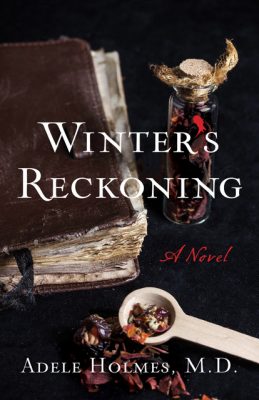
 In Winter’s Reckoning by Adele Holmes, a mercurial new pastor in town threatens the families of two women.
Welcome to 1917. A time of suspenders for men and, in the cities, bloomers for women. Horse-drawn wagons range the landscape, stoves burn wood, and people have to use outdoor facilities. A time of few vaccines and no antibiotics. People understood little of most diseases. Germ theory still had ground to cover. Women routinely died in childbirth. Life could vanish in a moment.
In rural Jamesville, a Southern Appalachian town, Madeline Fairbanks does what she can to make the lives of friends and neighbors more comfortable. She works as the healer in this community – and has for the past quarter of a century. Madeline eases the passage into and out of life, treating aches and pains in between.
Maddie comes from a long line of healers. Her grandmother taught her, and she’ll pass along what she knows to her granddaughter in turn. Hannah already has the inclination. The time has almost come to give her the ancestral box, which holds herbal remedy recipes and sketches and notes. That box contains all the learning from the women in their family who came before them.
Maddie has also trained an apprentice, Renetta Morgan, who is just about ready to begin working in the community, her own community, alone.
Maddie is white. Renetta is Black. They walk through town together, brazenly traversing from North Main (the white section of town) to South Main (the Black) and back again. Sometimes they go to tend the sick. Sometimes, to the fields and hillsides, gathering the healing flowers and roots and herbs. Other times, they work in Maddie’s cabin, creating tinctures, potions, and ointments. When Renetta learns enough, the two of them must no longer work together.
The long-promised railroad has recently bypassed the town, spelling a slow death for the community, cut off now from the lifeline of the new transportation. With their Main Street shops shutting down, the townsfolk face hard times. In the South, rigid segregation, Jim Crow laws, black codes, and the Klan divide the community. In Jamesville, the pointy hat boys haven’t been active in recent memory, but that’s about to change. Not everyone turns a blind eye to the flagrant close fraternizing of Maddie and Ren, two uppity women who don’t seem to know their place. Tempers are fraying.
Into this small town closing in on itself rides a lone horseman one day, who, after a brief look around, announces that he’s the new pastor. Reverend Carl Howard is the match to the powder keg.
As the town adjusts to this new pastor in their midst, and Reverend Howard takes his measure of the place, we will watch events unfold from the vantage point of three characters, all of whom have secrets to keep. Secrets that could be their undoing.
With the loss of the railroad, another potential casualty looms – one of education.
The town is divided on whether to invest in secondary education or not. Currently, only the primary school offers its young charges the most rudimentary learning. Nothing to build on. With more education, Maddie thinks, real change might be possible. Greater equality between peoples, despite their gender or skin color. Greater freedom for women. Or at least a good step in that direction.
The theme of education and what it can bring – more profound understanding, greater personal freedom and fulfillment, and economic opportunities – underlies the struggle of those for and against keeping women and Blacks “in their place.” One side looks forward to what could be; the other looks back to what has been. The balance of power always tilts in favor of those who have always held it. As the tension mounts, where words fail, violence threatens.
When a severe winter storm hits, everyone’s lives are suspended.
As they wait out the freeze, rationing their supplies and tearing up the porch for firewood, Maddie and Ren will come to know things about each other and themselves. And Hannah will grow up a little.
Set in the brooding rural South, and for a good portion of the novel in the challenging and crystalline world of a deep snowstorm, Winter’s Reckoning is rich in storyline and character with plenty of mystery woven throughout. Simply put, here’s a story that takes on issues whose harm remains with us today. With a climactic pulpit scene that’s not to be missed – and one novel we can highly recommend!
Winter’s Reckoning was a First Place Winner in the 2021 Goethe Awards.