Blog

  • An Editorial Review of “Trudy, Madly, Deeply” by Wendy Delaney

    An Editorial Review of “Trudy, Madly, Deeply” by Wendy Delaney

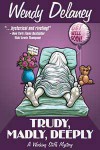
    Witty, fresh, and full of surprises, Trudy, Madly, Deeply, delivers. Wendy Delaney’s debut novel in her Working Stiffs mystery series is a fun and immensely entertaining read with its odd assortment of lovable characters, clever writing, and twists and turns that will keep you turning the pages.

    When Charmaine Digby is cut loose as “excess baggage” from her ex-husband whom she met at culinary school in California, she heads back home to the small town of Port Merritt, a retirement mecca on the waterfront of Washington state.  She finds herself living with her Gram, slinging cheeseburgers at her great-aunt Alice’s diner, and living across the street from a guy who used to pull her pigtails when they were in grade school together.

     Charmaine Digby is also living up to her school moniker of “Chow Mein;” she has been eating her way through her divorce. She is out of work, out of money, and out of shape.

    This wonderfully humorous cozy mystery will have you cracking up at the trouble that “Char” manages to get into when she finally lands a “real job” as a deputy coroner to the Chimacam  County Prosecutor’s office—if she can make it past Day One of her 30-day-trial period.

    She was hired not for her crime fighting abilities (unless that includes her handiness with a rolling pin), but for her special ability – Charmaine is a human lie detector. Apparently only .25 percent of the population has this uncanny ability—these few people are known as “truth wizards.” Really.  And Charmaine, bless her heart, is one, which doesn’t help to make her life any easier. And it is about to get tougher.

    A handsome doctor at the local hospital reports a suspicious death of a patient, Trudy Bergenson, who was a  dear friend of Char’s Aunt Alice. Trudy was supposed to be released to come home on Charmaine’s first day of work–not end up at the county morgue.

    With Aunt Alice’s diner at the eye of the gossip hurricane of Port Merritt, it isn’t long until Char is in hot pursuit of clues to discover if Trudy’s unexpected demise is the most recent in a chain of suspicious deaths at the county hospital.  It seems that childhood neighbor, now all grown-up and sexy, Detective Steve Sixkiller, is not appreciative of Charmaine ‘playing detective.’ Sparks fly—in more ways than one.

    If you enjoyed reading Janet Evanovich’s Stephanie Plum series, you will love Delaney’s Trudy, Madly, Deeply. I had no idea whodunit until the very end (and I have read hundreds of mysteries). Well done, Ms. Delaney, well done!

    I cannot wait to read the next novel in Delaney’s Working Stiffs mystery series so I can learn more about the goings-on of Chimacam County, its cast of lovable (if not, peculiar) characters, and any new mysterious treats that Ms. Delaney decides to dish out to her awaiting fans, yours truly included.

    Trudy, Madly, Deeply by Wendy Delaney is a Finalist in the M&M Awards 2013 for Mystery & Mayhem Novels, a division of Chanticleer Book Reviews writing competitions.


  • The M&M Awards 2013 – Finalists for Mystery & Mayhem Fiction

    The M&M Awards 2013 – Finalists for Mystery & Mayhem Fiction

    agatha-christie-cozy

    Once again, the FINALISTS of the M&Ms Awards, 2013! 

    It is our pleasure to post the official list of the FINALISTS Round of The Mystery & Mayhem Awards (M&Ms)  2013.

    Finalists will compete for 1st Place Category positions. First Place Category winners will compete for Overall Best of M&M Genre 2013.

    The M&Ms Awards recognize emerging new talent and outstanding works in the genre of  Cozy Mystery Fiction. It is a division of Chanticleer Book Reviews Blue Ribbon Awards Writing Competitions.

    Finalists for the Mystery & Mayhem Awards 2013 are:

    • Murder in the Round by Patricia Rockwell
    • Blue Virgin by Marni Graff
    • Fatal Induction by Bernadette Pajer
    • Body in the Bus Barn by Judith Pettibone
    • Trudy, Madly, Deeply by Wendy Delaney
    • Rules of Lying by Stephie Smith
    • Mrs. Kaplan in the Soup by Mark Reutlinger
    • Murder Actually by Stephanie McCarthy
    • Tea Leafing by Weezie Macdonald
    • Murder Strikes a Pose by Tracy Weber
    • The Last Dance by Lonna Enox
    • Small Town Storm by Elise Ackers
    • Parchman Preacher by Michael Thompson
    •  Package Deal by Kate Vale
    • Bayview by Penny Page
    • Her Boyfriend’s Bones by Jeanne Matthews

    Now this is something to CROW about!

    Congratulations to the Mystery & Mayhem Awards Finalists!

    Good luck to all in the next two rounds!  1st Place Category winners will be announced before Oct. 15, 2013.

    Note from the Editor-in-Chief: We are re-announcing the Finalists for the Mystery & Mayhem Awards because the first time (July 2013) that we published the announcement our entire website system was down ( due to a  system-wide failure on Amazon’s server which had “multiple failures of the underlying hardware components and we (Amazon) we were unable to recover it….(which also caused) concurrent hardware failures of multiple components.”   

    Moral to the story:
    Always back-up your back-up and then do an in-house back-up even if you were promised redundant system wide back-ups. – Chanticleer

  • POE: Nevermore by Rachel M. Martens – Horror, Paranormal, Thriller, Mystery

    POE: Nevermore by Rachel M. Martens – Horror, Paranormal, Thriller, Mystery

    Poe: Nevermore, by Rachel M. Martens, is a contemporary suspense thriller with a nod to paranormal elements of the Romanticism Movement. This dark and dense novel that borders on horror is told in the first person by a young woman, Elenora Allison Poe, known simply as ‘Poe.’

    The story begins innocently enough; it seems that the characters and the plot are driven by mental illness (even Poe) until the impetus is revealed. That is the hook of Martens’ writing—just when you think you’ve got it figured out, the game changes. The plot twists and turns as it sinks its hook deeper into you. At first, as I read, I thought  that this novel might be another variation of Fight Club or the Dragon Tattoo series. It is not.

    For some, it may be too haunting a tale. The author skillfully builds tension and anticipation with complex characters that are not easily dismissed. The antagonists are evil incarnate. The scary part is that they could be someone you speak with every day, the next date that you are on, the person you work with….

    The beginning of the story manifests Poe’s awkwardness of Poe  in trying to make her way in the world alone, as many young adults do. The ordeals Poe has survived so far in her young life have reduced her to perilously low levels of self-worth and confidence. You think to yourself that Poe needs to get a grip on herself, to stop feeling sorry for herself. But soon enough the reasons for her self-defeatist attitude are divulged and you will wonder how she functions at all and why, … indeed, why she is still alive.

    Poe learns that her family has been accursed since Edgar Allan Poe’s foster father had a witch invoke it. The curse destroys the victim psychologically and emotionally. It will destroy everything and everyone to torture its victim, to make the victim’s life a living hell.

    Poe must unravel the details of the family curse in order to save the few loved ones she has left in this world. She pursues this with the help of a budding relationship with Frost, a homicide detective who sees something worth saving in her, and shares her interest in the writings of Edgar Allan Poe.  Edgar Poe himself aids her pursuit, explaining the curse, and presenting himself as her spirit guide.

    The 19th century Romantic Movement, a revolt against societal norms in art, was represented by deep emotional response to experience, including emphasis on terror, horror, and the supernatural. Edgar Allan Poe’s writings, known for their mystery, their macabre methods of death, and his delving into the human psyche, were part of this movement. The parallels between our heroine’s life and that of Edgar Allan Poe are brilliantly developed by the genre and style in which Poe: Nevermore has been written.

    Be warned; Poe: Nevermore is not a cozy mystery. Ms. Martens succeeds at painting dark, suspenseful, sometimes horrific pictures. It is the type of psychological horror that locking the doors and windows and reading with the lights on will not keep out.

    I highly recommend this book for my fellow edge-of-our-seat junkies—those of us who are constantly seeking the book we ever so briefly fear picking up, then can’t put down in the relentless pursuit of discovering whatever comes next! Martens’ Poe: Nevermore deliciously feeds these cravings along with satisfying those with classical literary interests. I anxiously look forward to reading  Marten’s next installment of Poe.

    5 Star Best Book Chanticleer Reviews round silver sticker

  • An Editorial Review of “A Simple Soul” by Vadim Babenko

    An Editorial Review of “A Simple Soul” by Vadim Babenko

    In this character-driven novel that delves deeply into the psyches of six flawed individuals seeking life’s meaning in post-Soviet Moscow, the most enigmatic character is Russia itself.

    A Simple Soul begins apparently as a romantic endeavor that turns into an enthralling perilous thriller with plot twists, humor, and retribution.

    Russian-born Babenko’s novel, A Simple Soul, is filled with souls who are anything but simple. They are bored workers and wily entrepreneurs, all hardened to the murky world of Russian commerce, rampant corruption, and the decay of society. Yet each one seeks an elusive truth—happiness, love, the meaning of life. Elizaveta sees herself as a cold Venus, breaking the hearts of the men she dates, only to leap at marrying her long-ago love, Timofey, whose proposal has shady underpinnings. Alexander, her spurned lover, finds contentment in collecting words of wisdom, then loses it to despair. Seeking “his true mission,” Nicolai Kramskoy plans to steal and doctor a historical document to “prove” a connection to folk hero Pugachev, which links him to American Frank White Jr., who’s pursuing Pugachev’s alleged treasure map, along with a connection to his own Russian roots. Eventually joining them is Andrei, Nicolai’s old friend and a writer struggling to find confidence and purpose in his work.

    For much of this complex story, plot is relegated to the background as internal monologues become the focus. Personal histories and meandering thought processes draw the reader into a compelling maze of metaphysics and social commentary. Each character’s life is beset by small mysteries: Elizaveta finds mysterious symbols; Frank studies star signs; even Nicolai, the most cynical of all, once ran a business called the Astro-Occult Parlor. He observes that “people here were too fond of prophets, oracles, soothsayers, and magicians of all kinds,” but it becomes easy to see why even he is drawn to peering into the future.

    One could argue that Babenko’s characters all carry the same voice: intelligent, cynical, questioning, opinionated. What separates them is where that voice takes them: on personal journeys of soul-searching analysis, perhaps best exemplified in Nikolai’s comment while traveling by train:

    “Any country could be proud of its limitless vastness. Any except this one: people here don’t know how to be proud of anything, and perhaps they never did. Where there’s a lot of space, there’s free will and farsightedness, but there’s also no respite and an eternal restlessness, which results in universal sadness.”

    Such observations show the author’s skill in portraying the depths of functional loneliness.

    As Elizaveta sums up:

    “I don’t need this – riddles, higher powers. … – could the issue be with me? Do I have an overly simple soul?”

    After delving into the heart and mind of this postmodern Russian, the answer can only be, not in the least.  A Simple Soul transcends genres and time as its characters move across the vast lands of Russia and its ever-changing socio-economic landscape. Prepare to be transported.

    Vadim Babenko, who has a doctorate in physics from the Moscow Institute of Physics and Technology, has published six books, three are novels.  A Simple Soul was nominated for Russia’s most prestigious literary awards: The Big Book Awards (the Russian equivalent of the Booker Awards) and the Russian Bestseller Awards. His stories are complex with many subtle philosophical questions and dilemmas.  His prestige is sure to follow in North America as well.

     [fusion_builder_container hundred_percent=”yes” overflow=”visible”][fusion_builder_row][fusion_builder_column type=”1_1″ background_position=”left top” background_color=”” border_size=”” border_color=”” border_style=”solid” spacing=”yes” background_image=”” background_repeat=”no-repeat” padding=”” margin_top=”0px” margin_bottom=”0px” class=”” id=”” animation_type=”” animation_speed=”0.3″ animation_direction=”left” hide_on_mobile=”no” center_content=”no” min_height=”none”][Reviewer’s Note:  I found A Simple Soul a fascinating and entertaining read. I am fortunate to have been introduced to Babenko’s masterful works as they are still relatively unknown in North America. ]

     [/fusion_builder_column][/fusion_builder_row][/fusion_builder_container]

  • An Editorial Review of “Darklight II: Conflagration” by John Wells

    An Editorial Review of “Darklight II: Conflagration” by John Wells

    Five years after the publication of the military sci-fi thriller Darklight I: The Substance of Shadows, comes the second installment in the series, Darklight II: Conflagration,  the continuation of the conflicts between human and Matarin rebels and the genocidal Cren Empire.

    The stakes have considerably risen since mathematician and rebel fighter Crash Tyson first encountered the billions-year-old Cren Empire in the battle against the equally ancient ESOG Empire. The remaining freedom fighters seek a new sanctuary where they can rebuild their fleet and enhance the Spatial Exclusion Wave technology that Tyson created. They find safe haven with the Skarr, a species that had battled the Luin—the telepathic race controlling the Cren Empire—many eons ago.

    The Skarr hold an advantage: the Luin believe them extinct, along with the Sargen and the Valm, two species that had fought alongside the Skarr. Tyson, however, has the distinct disadvantage of being the Cren Empire’s sole focus, with his capture worth the destruction of billions of their own warriors.

    What warrants such galactic wastage? Tyson is the Progenitor Being, the model human that P-Quan, the Cren governor, created as an experiment in accelerating human genetic evolution in order to generate someone capable of solving The Great Problem.  It is with this experiment that Wells compels us to consider the purpose of sentient life in the Universe. The nature of that problem serves as a teaser until late in the game, when the conflict escalates into a war of multi-dimensional magnitude.

    The depiction of intergalactic war and its futuristic weaponry is where author Wells excels. The astrophysics and engineering of such advanced technology is at once mind-boggling and wholly believable. As E.E. Smith’s works (1890 – 1965) that explored the universe outside of our solar system with fictional technologies, extra-dimensional beings, and time travel before NASA, string theory, or the Hubble Telescope, the Darklight series take readers beyond  the confines of the known universe and into mind-boggling technologies that venture into multi-dimensional applications of  universal cataclysmic potential.

    Warfare comprises much of the story, with telepathic and directed-energy combat filling the gaps between massive, planet-destroying battles. Brisk pacing keeps readers enthralled as other ancient species join the fight, and each apparent victory sees a new threat emerge—none more so than the thousand-mile-long rift in space created by the increasingly powerful weaponry used on both sides.

    Wells explores the connection of life with the ultimate fate of the universe itself and sentient life’s connection to that fate in his Darklight series.  When the godlike being that dwells on the other side of the rift raises the stakes to an unfathomable level, the stage is set for the next Darklight installment.

    If you enjoy E.E. Smith’s space operas that influenced the first generation of computer war games, and (some say) the authors of Earthlight, Star Wars, Babylon 5, and Superman, then venture forth into the Darklight series to expand your universe.

  • BOOKS & BREWS Festival

    BOOKS & BREWS Festival

    books&brews_logo_edit

    Join Chanticleer

    at the

    first annual

    Books & Brews Festival

    on Saturday, Sept. 14th

    noon to four o’clock

    Boundary Bay Brewery’s

    Beer Garden!


    FREE and FAMILY FRIENDLY ♦ BEERS, BRATS, & BOOKS ♣ AUTHORS ♥ DOOR PRIZES ♦ 

    • Rain or Shine – the Beer Garden is Covered
    • The event is directly across the street from Bellingham’s well attended Farmers’ Market
    • Drawings every 30 minutes for PRIZES
    • Meet other authors & writers
    • Chanticleer authors are welcome to sell and promote their books at CBR’s tables.
    • Boundary Bay Brewery is one of the largest brewpubs in North America and has won numerous awards for its beers. www.BBayBrewery.com   Boundary Bay Brewery is located at 1107 Railroad Ave, Bellingham, WA 98225

    If you are interested in  participating in the BOOKS & BREWS Festival, please email Kiffer Brown at KBrown@ChantiReviews.com to reserve your space. Space is limited and reservations are required.

    Upcoming Events

    • September 14:  BOOKS & BREWS at Boundary Bay Brewery;  Bellingham, Wash.
    • Sept, 19 – 22: BoucherCon2013 Mystery Convention; Alabany, N.Y.
    • Oct. 6 – 8: Pacific Northwest Booksellers Association Trade Show; Portland, Oregon
    • Oct. 17 – 20: Emerald City Writers Conference; Bellevue, Wash.
    • Oct. 24 – 27: Surrey International Writers Conference; Surrey, British Columbia
    • Nov. 2 & 3: NorthWest Book Fest; Kirkland, Wash.
    • March 20 – 23, 2014: Left Coast Crime Scene; Monterey, Calif.

    Be sure to check Chanticleer’s calendar often to keep up with on-going promotional opportunities.


  • An Editorial Review of “More Faster Backwards, Rebuilding David B.” by Christine Smith

    An Editorial Review of “More Faster Backwards, Rebuilding David B.” by Christine Smith

    More faster backwards,” she yells to the boat captain. Christine Smith’s angst makes her words tumble out scrambled. These words, now the book title, summarize how obstacles pushed Christine and her husband Jeffrey “more faster backwards” during their boat’s reconstruction.

    They race against time, money, and natural elements to save the David B—the vessel that they bet all of their resources on in hopes of making their dream of owning and operating a small expedition cruise boat in the Pacific Northwest come true.

    The adventure begins when Christine and Jeffrey Smith, searching for an old boat to transform into a small passenger vessel, examine a sixty-five foot 1929 work-boat, precariously moored on Lopez Island—the neglected wooden vessel that hovers near death is the David B.  However, Jeffrey sees the elegant beauty of a three cylinder antique engine and the strength of the hull made from Northwest timber. Christine saw the look in Jeffrey’s eyes and knew that this was the boat.

    In the opening pages, we learn they’ve accomplished part of their dream and we’re ready to climb aboard. The author seamlessly carries us from her present experiences and joy during the sea voyage, back into her memories, where she re-lives the enormous hurdles of the rebuild process.  The flashbacks work well because we want to know. Need to know.

    With hearts captivated by the David B, the couple gambles everything. Looming bankruptcy lurks alongside the other huge challenges. Anxiety heightens because their cherished family and friends (without whom they couldn’t have succeeded) share the risk. Readers will think, “This can’t be done” and then ask themselves, “How did they do it?” Intrigued from beginning to end, we peek into the lives of the author, her husband, the crew, family, and friends. We yearn for their success and their safety.

    More Faster Backwards, Rebuilding David B  seamlessly mixes nautical terms with natural elements and boat builder’s craft. Those who enjoy cooking and baking will also discover it a delightful read. Seafaring people will sail through the narrative like soul mates, but landlubbers might appreciate a glossary of boating terms. The map provides great references and the photo albums heighten the pleasure.

    A sample of Smith’s fluid writing style:   “Jeffrey worked the boat with the skill of a lover. Every movement she made, he watched carefully, to see how she responded to his commands, the light breeze, and the incoming tide.” 

    When the literary boat trip ends, readers might sense an inner torch quicken along with the call to embrace their dreams anew.  As for Christine and Jeffrey, the restoration of the David B is just the beginning.

    More Faster Backwards,  Rebuilding David B by Christine Smith won the Grand Prize of the Journey Awards for Narrative Non-fiction, a division of Chanticleer Book Reviews Blue Ribbon Writing Competitions.


  • An Editorial Review of “Artemis Rising” by Cheri Lasota

    An Editorial Review of “Artemis Rising” by Cheri Lasota

    Rendered with a lush and lyrical touch, this Y/A historical fantasy depicts the romantic yearnings of two innocent lovers, both dedicated to and trapped by the belief that they embody tragic figures from myth and legend.

    Born of a pagan mother and a strict Catholic father, fifteen-year-old Eva Maré learns the hard way that when the two religions clash, catastrophic results follow. Aboard a ship bound for the Azores, Eva undertakes a ritual to transfer the role of Arethusa, a sea nymph dedicated to Artemis, from mother to daughter. But instead of the Goddess’s blessing, hell’s own fury is unleashed. The ship crashes into the volcanic face of Ilhéu das Cabras, though not before Diogo Cheia, a marquês’s son possessed by his desire for Eva, displays his wrath over her rejection.

    Eva, now Arethusa, regains consciousness on the Azorean island of Terceira, surrounded by the flotsam of the shipwreck that took the lives of her parents and nearly everyone else on board. Badly wounded and rendered mute by an act of violence she cannot remember, she is rescued by a beautiful young man, who takes her to the orphanage in Angra do Heroísmo, where he lives. There Arethusa is healed, but it won’t be long before she discovers Diogo survived as well.

    Thus begins the ages-old tale of two men fighting over the woman they both love. But this is no ordinary triangle: Diogo believes himself heir to the role of Alpheus, the river god to whom, in Greek mythology, Arethusa is bound for eternity. To complicate matters, Tristão Vazante, Arethusa’s rescuer, had been led to believe he is the embodiment of the Cornish knight Tristan and that Arethusa is his Isolde.

    This well-written and crisply paced novel mixes the two myths: one Greek, the other of the canon of Arthurian literature. It’s possible the author intended the two disparate myths to represent the clash between paganism and Christianity—and the way the main characters eventually reconcile their religious conflicts—but one is distorted to emphasize evil, while the other is less a Christian morality play than a medieval tale of courtly love.

    However, the sweetly chaste passion of Tristan and Arethusa carries the day, along with the Azorean setting, with its seaports and beaches, caves and cities, all wonderfully evoked and enhanced by a sprinkling of Portuguese expressions. An early scene, when Arethusa dreams between life and death after the shipwreck, is a sensory feast. The inevitable showdown between Arethusa’s two suitors challenges the traditional endings of the two myths in a way that is as anticipated as it is satisfying. Readers who enjoy being swept away in romantic fantasy will not be disappointed.

    Artemis Rising by Cheri Lasota was awarded First Place in the Mythological Category, The Cygnus Awards 2013. The Cygnus Awards is a division of Chanticleer Book Reviews Blue Ribbon Writing Competitions.

  • The Care and Feeding of Your AERs

    milkyway galaxy

     Help Readers Discover Your Book

     The Care and Feeding of Your AERs:


    • Anyone who reads your manuscript or book, even a chapter at a time, is an AER.
    • You should know the name of each and everyone your AERs along with how to communicate with them.
      • Is your AER on Twitter, Facebook, Google+ ?
      • Does your AER have a blog? If so, comment on it. Subscribe to it.
    • AERs do NOT have to buy your book. However, they must read your work even if it is a chapter at a time.
    • If you give your manuscript/book to an AER, they should expect to give you some kind of feedback about it. Make this as easy as possible for the AER.
      • When you receive this feedback, whether it is good, bad, or indifferent, you must be “insanely appreciative” of it.
    • Your AERs may receive your work a chapter at a time or all at once. Beta Readers make the very best AERs and they require special handling.
    • Interact with your AERs on FaceBook, Twitter, Google+, blog posts, websites, etc.  and, most importantly, in person if possible. Nothing beats face time—not even FaceBook.
    • Reward your AERs for being evangelical about your work!

    Remember, Acquired Early Readers  help authors  build their  networks—online and off.

    Next post will be about how to build your AER base and increase your number of AERs along with more on the care and feeding of AERs. 


  • How to Find AERs

    How to Find AERs

    milkyway galaxyHow to go about finding AERs (Acquired Early Readers)?


    • The Sales Curve of Your Book will Follow the AER Curve. 

    • Conversely, Do Not Confuse Book Sales with AERs. 

    AERs (Acquired Early Readers) may be:

      • Beta readers
      • Other Finalists in writing competitions that you competed in
      • Critique partners
      • Book reviewers,
      • Manuscript evaluators
      • Writing group members
      • Friends & family
      • Those who would take a special interest in your story-line–your niche markets.
        • How to determine your niche markets?
          • Is your amateur sleuth a real estate agent, a hospital administrator, or a chef?
          • Does your protagonist always diet? Does he love wine? Does she knit? Does she travel, research, teach, or strips at a dance club?
      • After you determine your niche markets, then begin building relationships with the people who are in them. Share advice and tips, ask questions, attend meetings and gatherings. Members of your niche markets are potential AERs.

    Next post will be on the Care and Feeding of AERs.

    Each week we will go into more detail of the “hows” and “wheres”  to acquire more Readers for your books…. stay tuned!

    Thanks for Reading!