Blog

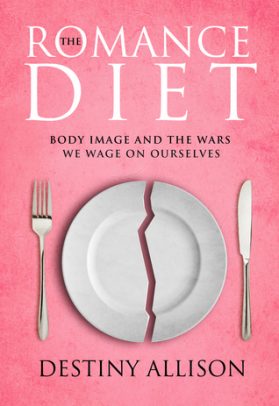
  • The ROMANCE DIET: BODY IMAGE and the WARS WE WAGE on OURSELVES by Destiny Allison – Memoir, Weight Management, Body Image

    The ROMANCE DIET: BODY IMAGE and the WARS WE WAGE on OURSELVES by Destiny Allison – Memoir, Weight Management, Body Image

    A woman struggling with external self-image finds that inner self-awareness is the true key to permanent, meaningful reshaping, in Destiny Allison’s unusual, memorable true story, The Romance Diet – Body Image and the Wars We Wage on Ourselves.

    Happily married and successful, metal sculptor Destiny Allison was forced to give up her chosen profession when an unexpected health disaster—damage to her spine— took its toll. A year later, after fighting with pain and subsequent weight gain, she was further devastated to learn that her cholesterol was dangerously high. Fortunately, she found support from her husband, Steve, a thriving entrepreneur. Having gained a lot of unnecessary pounds himself, and concerned about his wife’s declining health, he agreed to go on a diet with her. At first, it didn’t seem too difficult; the couple would simply order or prepare one meal and split it. They took up dancing at nightclubs, reviving lost youthfulness as the pounds disappeared. The exercise made their bodies more attractive; their sex life regained its energy.

    Gradually, though, the process began to fray. Destiny, now running her own business in cooperation with her spouse, wanted more credit for the work she did but began to notice that clients and colleagues always preferred to do business with the man. Steve, innocently, basked in the attention and took his superior status for granted. His wife began to suspect, was sure, that he was having an affair. As their relationship fractured, it became increasingly difficult, sometimes impossible, to communicate. Destiny felt that she was the one always conceding and sacrificing. Things came to a head when she was molested by a man in one of the bars where the couple liked to show off their sometimes suggestive dancing feats. The incident brought back memories of a rape that happened when she was still in her teens, and Steve’s attempts to console her turned into a shared nightmare.

    Told with utter frankness, The Romance Diet reveals, what Allison describes as “…my personal hell, my deepest shame.” Women will recognize and learn from the many ways that this bold, feminist autobiographer examines her many rationalizations, her self-abnegating strategies for getting along with men, and most importantly, readers will share Destiny’s growing sense of pride and empowerment as she learns that these tactics are not necessary, either in casual social context or in the center of a hard-won, long term, committed relationship.

    Author (Shaping Destiny, Pipe Dreams, Bitter Root) Allison has developed her artistry as a well-practiced wordsmith, but just as importantly, here she demonstrates her ability as an explorer of that perilous country, the mind. She and Steve lost weight, nearly lost their marriage, and were able to recoup the companionship and mutual sense of responsibility that marriage requires without the extra pounds—all in all, a truly remarkable accomplishment.

    In this highly emotive memoir, a couple’s shared commitment to improvement takes longer and hurts more than originally planned, but the result is a new, better and brighter promise—one that can endure in Destiny Allison’s The Romance Diet.

    5 Star Best Book Chanticleer Reviews round silver sticker

  • DEATH of a DIVA: from BERLIN to BROADWAY by Brigitte Goldstein – Historical Fiction, Mystery, Thriller & Suspense

    DEATH of a DIVA: from BERLIN to BROADWAY by Brigitte Goldstein – Historical Fiction, Mystery, Thriller & Suspense

    An innocent man is charged with the murder of a stage diva in 1941. Misia Safran’s mission is to save him while unraveling the layers of a woman’s life she idolized, in Brigitte Goldstein’s exceptionally well-researched novel, Death of a Diva: From Berlin to Broadway.

    Misia Safran stops in a horrified state of shock in front of a newsstand, headlines reading: Stella Berger brutally murdered in her dressing room! Stella was Misia’s mentor, and as heartbroken as she is, the police are charging an innocent man in her murder and she must do everything in her power to save him.

    The police investigation begins when two New York City Police Officers take Misia into custody for questioning. The two detectives’ interrogation turns verbally abusive and threatening body language before she is finally released, remaining under suspicion as an accomplice. Her motivation to take every risk, investigate every clue, and follow every trail to the end anchors her determination to exonerate an innocent man, restore her good name, and punish the real villain who killed Stella Berger.

    The murder of Misia’s beloved Stage Star is the axle that turns the wheel of the story. Misia’s long journey begins, wading through uncertain relationships with friends (or are they foes?) and uncovering dark conspiracies. She examines each possible culprit for motive and studies their behavior throughout her search for the true killer. Energized during the eras of WWI and WWII, the murder mystery is rich in character studies, historical accounts, and plot twists.

    Misia Safran, a German Jewish immigrant, escaped the pending cruelties of Hitler, and experiences double doses of prejudice from a few in America. The Diva, Stella Berger, was also a German (but kept her Jewish heritage a secret) who had emigrated to America because of her open and vocal hatred of Hitler and the Nazis during her monologues after every stage performance.

    Brigitte Goldstein presents a sharp analysis of events from the big picture to the minute – often, stream of consciousness – detail, revealing her historical expertise and keen research skills. Readers who appreciate the intricacies of the English language and sophisticated prose will enjoy Goldstein’s work. A dictionary might enhance the enjoyment for some readers as the author does utilize German and French in her dialogue.

    The author’s unique style manages intricate character studies via mini-memoirs for each key player. The reader gains an understanding of their involvement, motivation and actions surrounding the winding twists of the tale, and their relationships to each other.

    The proof reading is near perfect and the story proceeds at a good pace and grips the reader—Death of a Diva is a mystery novel hard to put down. The resolution closes the case and though it may take time, we believe the damaged hearts might heal. Brigitte Goldstein is an author to watch.

  • A CHERRY BLOSSOM in WINTER by Ron Singerton – Historical Fiction, Literary, War/Military, Romance

    A CHERRY BLOSSOM in WINTER by Ron Singerton – Historical Fiction, Literary, War/Military, Romance

    The story behind any war is a difficult one to tell. A Cherry Blossom in Winter by Ron Singerton takes us into not just one, but two, cultures at the turn of the last century in an attempt to show us both sides of a decisive naval conflict that would shape both countries and people for years to come.

    Alexei Brusilov is a young man destined for a talented future. He is bright and courageous, lightning-quick with a saber, and longs to join the Russian Naval Academy at the turn of the 20th century.  Like his father before him and many nobles of the Russian court of Tsar Nicholas II, Alexei sees his path as a military one, full of honor and discipline. Trouble always begins at home, however, as Alexei’s best friend becomes involved with Marxist revolutionaries ready to overthrow the Tsarist regime. Luckily, elements beyond his youthful control are in motion and before he can be caught for treason, Alexei will find himself in another world, another culture, and called upon to use all of his wits for the sake of love.

    Ron Singerton’s book, A Cherry Blossom in Winter, is a blending of historical and romantic fiction as we follow the young Russian Alexei to Japan and his first true test of manhood. He is there to accompany his father, Count Brusilov, a man of violent temper who disdains all things Japanese. But politics are politics, and all hints are pointing to a coming war between their two countries. It could be strategically important for young naval officers to understand Japanese in the near future, but Alexei’s goals are of a more personal nature. Readers will struggle with him as he attempts to make friends and learn the language, absorbed by the beauty and culture he sees. High Society, Religion, and Honor will all have different definitions by the time Alexei unexpectedly returns home.

    Yet the Moscow court and the Tsar have not been idle. A violent peasant revolution seems closer to reality all the time, as Alexei enters the Academy on the cusp of a family crisis. Everything seems to be on the verge of great, though not necessarily peaceful, change as the young man, now a brave naval cadet, attempts to finish school.

    In this way, Singerton’s book does a great job in presenting this pre-war time as one of both personal and national conflict.  History buffs need only go to the official record to discover the facts, the dates, and the battle locations of the Russo-Japanese war, but A Cherry Blossom in Winter works hard to make it a visceral experience. By pulling in the geopolitics of the beginning of the last century, along with developments such as the introduction of Marxist ideology, the near-collapse of Russian court nobility, anti-Jewish pogroms, the mistreatment of Russian peasants, and widespread anti-Asian sentiment, the overall effect is a slow-build to the climatic and brutal naval battle. Singerton’s use of the actual historic names for places, battle ships, and generals on both sides of the conflict also help the reader to feel right in the middle of that dangerous time. And yet the wartime reality is carefully balanced with not just one, but several love stories. Passion, whether for love or war, is keenly portrayed.

    Complex in its historical scope and list of characters, A Cherry Blossom in Winter is more successful in understanding men at war than the background love stories. This book won’t be for every romance reader as the plot points issue from exceptionally visceral entanglements – however, history buffs and those who love wartime epics will devour the read. Reminiscent of Puccini’s Madame Butterfly, readers will journey through an emotional landscape as dangerous as the raging battles themselves.

    5 Star Best Book Chanticleer Reviews round silver sticker

  • A MATTER of JUSTICE by Keith Tittle – Mystery & Suspense, Thriller

    A MATTER of JUSTICE by Keith Tittle – Mystery & Suspense, Thriller

    2016 Grand Prize Clue Awards Badge for Keith Tittle's A Matter of JusticeWhen Jefferson Dawes is called in on a cold case, he will be forced to revisit his past – both professional and personal. His old friend and former workmate Alex Burwell, now deceased, was sure that Jeff was the right man to investigate a series of suspicious “accidental” deaths, all linked directly to a trial that took place three years ago. Those deaths now include Burwell’s own mysterious demise.
    Three years ago, a nice young man with no blot on his name was imprisoned when circumstantial evidence piled up to convict him of a brutal, sexually tinged killing. He never denied the crime. He died in prison. Now the judge who tried the case, the jury foreman, and several others connected to the conviction are also dead, each lost to freak happenings: a boat explodes; a man jumps off a bridge; a body is found in a rental car.

    Tough-minded District Attorney Cynthia Orbison, who sees bonds of coincidence between the current killings and a vicious Latino drug lord she is trying to bring down, hires Jeff away from his job with a security firm and sets him up in his former workplace among her staff. He’s tasked with using his investigative skills to go through the evidence Alex compiled before he suddenly passed away. Cynthia gives Jeff a team: Samantha, or Sam, young, smart and anxious to prove herself; and Paul, a little older, seasoned and cautious. Their lives are at risk despite measures taken to keep the case under wraps. And even as they plug away at a solution, a methodical killer is stalking and slaying more hapless victims.

    Tying all the threads together will be Jeff’s job, as he examines a jumble of apparently unrelated facts. He discerns links to the Russian mafia, Latin drug cartels, and some sad but very human motivations that have remained hidden over the years. As the team gathers testimony from various witnesses, Dawes sees the circle tightening around one suspect whose deviant brilliance may yet prevent the hoped-for apprehension.

    Author Keith Tittle rings all the challenges in this complex, gripping mystery. His story combines diverse elements lending the story opportunity for multiple mayhem. Jeff Dawes is a believable hero – determined, diligent, dogged by past failures that spur him to try harder. The setting – Portland, Oregon, with its scenic natural environs makes for a variety of well-staged scenarios.

    A gripping, page-turning novel poised to entertain thriller fans across a wide spectrum. A Matter of Justice by Keith Tittle provides the lead-in for a new series from a promising new author.

    5 Star Best Book Chanticleer Reviews round silver sticker

  • WILLOW’S DISCOVERY by Joanne Jaytanie – Romantic Thriller, Military, Genetic Engineering

    WILLOW’S DISCOVERY by Joanne Jaytanie – Romantic Thriller, Military, Genetic Engineering

    More danger lurks around the Winters Corporation with Willow as the next target in Willow’s Discovery, book three of the romantic thriller series by Joanne Jaytanie.

    Willow enters her office one morning to find it completely trashed.  Fortunately for them, the Winters Corporation’s files weren’t touched. But Wyatt Farraday, Tristan’s brother, believes that this was an inside job and he thinks Willow should use her newfound aura skills to interview the corporation’s staff in an attempt to uncover a mole. The interviewing process leads to clues that Biotec (connected to the infamous Kaleidoscope Group) is indeed spying on the Winters Corporation.

    Meanwhile, Willow plans to meet with a potential buyer for her parent’s old complex. But when she gets there, things go from eerie to dangerous as a strange man attempts an attack. Although Willow narrowly escapes, she can’t shake the memory of the event – which is understandable – but moreover, there is something about the man that seems familiar… Willow is shocked to realize she knows the man’s voice. Now, if only she can place it.

    Willow’s experience is nothing less than unnerving. Yet, she has no idea that there will be more attempts on her life. Amid unsettling scenes, a burgeoning romance ripens between Willow and her protector, Wyatt. Whether or not Wyatt can successfully shield her from harm remains to be seen, especially when she finds herself face-to-face with her stalker.

    Winters series’ fans have much to look forward to in Jaytanie’s third installment. Willow’s Discovery is a nail-biter and as more familial secrets surface, danger mounts for Willow! Jaytanie surrounds Willow with both favorite and dark characters from the previous novels—plus a few new members—and then places her cast within settings that are a balanced mix of engaging dialogue, suspense, romantic tension, and steamy love scenes. Of course, as with Victory and Payton in books one and two, Willow not only discovers but also must find a way of embracing her own set of telepathic abilities in order to survive the road ahead.

    Joanne Jaytanie aptly incorporates back-stories from the previous books a little at a time and savvy readers new to the series will want to go back and read from the beginning. Each book is truly a stand-alone story, but readers of the romantic thriller genre won’t want to miss one word of Jaytanie’s hot, steamy action scenes and compelling storylines.  Jaytanie closes Willow’s Discovery with an eye-opening cliffhanger—a perfect set-up for book four, Corralling Kenzie.

    Thrilling and tantalizing, Joanne Jaytanie’s third book in the Winters Sisters series, is sure to please loyal fans and have new readers begging for more in Willow’s Discovery.

    5 Star Best Book Chanticleer Reviews round silver sticker

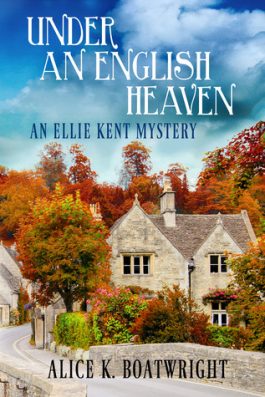
  • UNDER an ENGLISH HEAVEN by Alice Boatwright – Cozy Mystery, Amateur/Woman Sleuth

    UNDER an ENGLISH HEAVEN by Alice Boatwright – Cozy Mystery, Amateur/Woman Sleuth

    Can a Californian College Professor find true love with her English Vicar husband while under suspicion of murder in his small town?

    Under an English Heaven – An Ellie Kent Mystery by Alice K Boatwright is a cozy mystery with a very American protagonist set in a very English village. Ellie Kent is said American, newly married to the village Vicar, Reverend Graham Kent. It’s the second marriage for both of them. Ellie is a former University English Classics Professor from California and her husband, Graham oversees St. Michael’s and All Angels’ Church in Little Beecham and is the widowed father of a college-age daughter.

    Ellie is also a skeptic about faith, something her new husband seems bemused by. Although she has taken to wearing tweeds and walking the Jack Russell named Hector, Ellie can’t help but feel out of place in the shadow of Graham’s first wife, Louise, whom all the village seemed to hold in the highest esteem. Louise also was the one many of the congregation turned to with their secrets. As Ellie says to her new husband in the very beginning of the novel “No matter what I wear I’ll never be Mrs. Vicar of Little Beecham. People will always think of me as the young wife who snared you on that unfortunate sabbatical in California”.

    Ellie is just settling in when she finds a body in the graveyard next to the vicarage after some mischief in the church on Halloween Night. No one in town seems to know the man, but his new British clothes are at odds with his worn Italian underwear (this is important to the plot…I promise).

    As with most cozy mysteries, the police suspect Ellie for the simple reason that her first husband was an Italian-American poet and they once lived in Italy, and she is a “foreigner”.

    When another death occurs, and Ellie is given a found book of Italian poetry written by the first victim, the mystery deepens and Ellie finds herself trying to figure out who the killer is while also trying to figure out her place in the village, the church and in her marriage, while also trying to stay out of jail.

    The events of the novel start the day before Halloween and extend to Remembrance Day (November 11th) including All Saints Day, All Souls Day, and Bonfire Night-a tribute to the failed gunpowder plot of Guy Fawkes (made famous in the graphic novel and film “V for Vendetta”).  Each of these days are unique celebrations for an American experiencing them for the first time.

    Twists and turns a plenty, along with great pacing and quirky characters, make Under an English Heaven an entertaining classic cozy mystery. Boatwright adds just the right amount of descriptions of the bucolic village landscape and teas to make any one who loves all things British happy juxtaposed against an adventuresome contemporary American amateur sleuth. A second delectable Ellie Kent Mystery is promised sometime this year.

    5 Star Best Book Chanticleer Reviews round silver sticker

  • The TOWERS of TUSCANY by Carol Cram – Literary, Historical Fiction, Pre-Italian Renaissance

    The TOWERS of TUSCANY by Carol Cram – Literary, Historical Fiction, Pre-Italian Renaissance

    Powerful written and richly depicted, historical fiction novel, The Towers of Tuscany by Carol Cram brings to life 14th century Sophia, a talented artist who must find a way to continue her art in secret or have her life put in danger.

    “The bells for nones caught her by surprise…,” drawing Sofia’s mind away from the panel of the Nativity she is painting. She rises, steps over to the narrow tower window, and gazes out across the towers of San Gimignano, in central Tuscany. It is mid-afternoon of a day in March 1338.

    In little more than a page, Carol Cram’s expertly crafted prose transports us across time and space to Sofia’s world. But what we find is not exactly what we might have expected—at least, not I. Sofia is assailed by the pounding of hammers and clanging of iron tools deriving from the endless construction in this rapidly growing town. The air is filled with dust, causing her to squint. Her tower view is so filled with other towers that she has but a tiny, oblique view of the countryside beyond the city walls. She longs to escape the cacophony.

    Hearing her husband below, Sofia does not smile. He was once her Romeo, but not after their marriage. Now she longs to escape Giorgio’s brutish sexual assault on her body night after night, as well as his rigid control over her daily life. At this moment, his angry voice assaults her sensibility: “Wife! What the devil are you doing up there?” She gasps, fearful that Giorgio will learn she is painting and destroy her work! (In the fourteenth century, well-married women were forbidden to engage in “manual” activities.) She hurriedly wipes her hands and scrambles down the tower ladder.

    Thus begins the saga of Sofia, daughter of a master painter who, behind closed doors, taught her from early childhood how to draw and paint. Still in secret, she now works as his apprentice. While Maestro Antonio Barducci is often overtly critical of her work, he is aware that her skill might one day surpass his own, though how she could continue to employ it after he is gone is a quandary contemplated by both. That time arrives sooner than either expected when local political violence leads to Barducci’s death.

    Her father’s dying words reveal a way forward for Sofia, though it turns out to be not an easy one. Leaving Giorgio through subterfuge, she escapes to Siena disguised as a boy (named Sandro, from Alessandro), and her artistry continues in the painting workshop of her father’s friend, Maestro Manzini. Sofia/Sandro lives with few amenities and no small danger of discovery, which could end her life. But, she is painting again, and nothing else matters—at least not for the time being.

    Cram cleverly takes advantage of the workshop setting to share with us some of the techniques and practices of pre-Renaissance painting, which was usually done on wooden panels (carefully smoothed and prepared with gesso), rather than canvas. Paints were made with pigments from natural substances—usually plants—mixed with urine and other materials, some of them poisonous. Painting in 14th century Italy could be dangerous work! Certain techniques are described by Maestro Barducci, whose fatherly voice Sofia often hears in her head, guiding her work as well as her life.

    The best and worst parts of this dramatic, spellbinding work of historical fiction, with its many intriguing characters, deserves of your private reading—every word of it. Readers will find delight in a delicious love story, horror in a representation of the deadly bubonic (black) plague that decimated a large part of the European population of that time, and, in the end, a hint of peace and hope for the future.

    Carol Cram, the author of The Towers of Tuscany and A Woman of Note, is lauded for her skillful and colorful writing, intricate weaving of a many-faceted plot, and minute attention to the details of daily life in a Europe approaching the Renaissance—all in a read you’ll not forget.

    One woman clandestinely practices her art, risking not only her reputation but her life, in pre-renaissance Italy. Carol Cram presents a masterpiece in prose with historical fiction novel, The Towers of Tuscany. A must read!

    5 Star Best Book Chanticleer Reviews round silver sticker

  • HEART-SCARRED by Theo Czuk – Literary Western, Coming of Age

    HEART-SCARRED by Theo Czuk – Literary Western, Coming of Age

    Author Theo Czuk provides a refreshing wave of storytelling in his award-winning literary Western debut novel, Heart-Scarred.

    Rory Casso works as a shotgun freighter with the Pinkerton Detective Agency alongside his partner, Juke Bauque, running capital (i.e., money, furs, gold) up and down the Platte for the Reynolds Savings and Loan payroll. Because bandits lay traps along the way, the partners travel separately. Rory, who lived among the Hunkpapa Indian tribe when he was a boy, uses his skill of trail scouting to keep away from the gang. Juke may be part Native American, but he isn’t familiar with indigenous skills since he was “privately tutored and socially cultured.”

    Enter Bronwyn Mason, a childhood friend of Rory’s who plans to open the first one-room school house in Rawlings. Although she hasn’t seen Rory in years, Bronwyn is relieved to meet Rory’s partner, Juke so that she can hire him to be one of her drivers to transport three wagon loads of school material. Bronwyn’s joy about establishing a school house quickly turns to sorrow when she hears that the Thompson gang murdered her father, the esteemed Marshal Isham Mason. Even though she is grief-stricken, she is determined to fulfill her mission. Bronwyn’s traveling band faces various calamities en route, especially when they get held up by Indian warriors. What she doesn’t expect is that the person who comes to the rescue is none other than Rory. Romance blooms between the childhood friends and all appears to go well until the Thompson gang catches up with them.

    Western enthusiasts in search of a refreshing take on their favorite genre have much to look forward to in Czuk’s award-winning novel. Czuk adds verisimilitude to his story by incorporating a host of realistic characters. Veering away from stereotypes, Czuk presents protagonists that mimic the educational and societal waves taking place during the mid to late 1800s.

    Czuk creates three different people from three different educational backgrounds. Rory is a white man whose comes from a dysfunctional home but finds stability living among Native Americans. Juke, who is half black and half Native American, is brought up in the cultural surroundings of Boston—the antithesis of what would traditionally come out of western tribes. Bronwyn—who learned everything she needed to know about life through her father—in many respects reflects an “Annie Oakley” figure, but much more feminine.

    There is more to the Old West than being chock-full of rough and tough characters. Much of the gruff personas came from merely surviving day to day. Czuk aptly weaves in plenty of historical information that shines a light on the differences of what life was like between the eastern and western territories. While pointing out Native American history (including connections with Ireland during the Great Potato Famine), Czuk gives attention to education, or the lack thereof, especially in the West, and thus Bronwyn’s desire to develop a one-room schoolhouse.

    Czuk offers a well-balanced mix of storytelling, history, engaging dialogue, and thought-provoking themes that go beyond the good, bad and the ugly in his novel, “Heart-Scarred.”

  • INTERVIEW with Grand Prize LARAMIE AWARD-WINNER, JACQUIE ROGERS!

    INTERVIEW with Grand Prize LARAMIE AWARD-WINNER, JACQUIE ROGERS!

    In honor of the Laramie Awards month, we decided to interview one of our very favorite authors, Jacquie Rogers. It should come as no surprise that Jacquie won the Laramie Grand Prize in 2016 for her rip-roaring, shooting, tooting, humorous Western that features Honey Beaulieu, Man Hunter!

    Jacquie Rogers is a regular contributor for the Western Fictioneers blog. She presents at RWA conferences and workshops, Chanticleer Authors Conferences, and  Western Writers of America. Her works are known for their hilarity, adventure, mistaken identities, and romance. Rogers’ books are  a hit for anyone who has a penchant for classic Westerns and Shakespearean comedies. She lassos the genres together in a most enjoyable way making her tales a true pleasure to read. From saddles sores and thorns from the trail, to finally being able to breathe when the last binding on the corset is released, even the most die hard Western readers will be impressed with Roger’s knowledge and expertise she portrays as she takes you back in time to the Old West.

    Jacquie Rogers: Thanks for inviting me to the Chanticleer blog.  I’ve been privileged to be part of the Chanticleer family right from the get-go, so that makes it extra special for me to be here.  I had help, though—the folks at the Pickle Barrel Bar and Books on Facebook choose my questions, so here we go!

    Chanticleer: We’re so glad you have some time to spend with us. Let’s jump right in…What areas in your writing are you most confident in? What advice would you give someone who is struggling in that area?

    Rogers: Dialogue and chaos.  For dialogue, the advice is easy—listen to people talk.  Two nuances I’ve noticed is they rarely speak in complete sentences and seldom use the other person’s name.  More specifically, listen to people who are similar to your characters.  In the case of Honey Beaulieu, I draw strength from the old Missourians in our family, and mix in a little Owyhee County speak.  As for chaos scenes, the main thing to remember is that the first thing you think of is also the first thing the reader will expect, so turn left when expected to turn right.

    Chanticleer: That’s really good advice, Jacquie. How do you keep track of all the… left turns? Do you work with a storyboard? 

    Rogers: When a character turns left and it’s a better idea than what you’d planned, then it’s best to go with them.  However, that does cause a ripple effect on that particular thread, and sometimes several or all threads.  I try to veer into position so I don’t have to go back and change things, but very often that simply can’t happen.  Either way,  from the turn-left point forward, the whole plot needs to be tweaked.  I’m happy to take the fun route to the end, but I do have to know where and how the story is going to end, and all the characters need to be in the right spot for that to happen, and all (or most, in the case of a serial type series such as Honey Beaulieu – Man Hunter) threads need to be tied in a neat bow.  So it’s a matter of connecting the dots in a logical but relatively unpredictable manner that allows the reader to play along with you.  Because books are really a group activity—the interaction of characters, readers, and the author.

    Even with all that, continuity errors can and do occur.  My first line of defense is Your WorldKeeper, Diane Garland.  She has an eagle eye for continuity and can take me all the way through the thread so I can see what needs fixing  Or sometimes it can’t be fixed (e.g., in a previously published book), and we have to come up with a logical explanation for how things are in the current book.  I work with her as I’m writing, so she usually nails my hide to the wall before even the editor sees the story.

    Rogers: An author can’t keep writing unless readers buy the books—simple economics.  Books are expensive to produce.  So telling others about the author’s books is absolutely gold.  There are a variety of ways to do this, including sharing the author’s posts on social media, reviews (many advertising sites require a certain number of reviews before the author can purchase ads), and telling all your friends in real life to buy the book.  Visibility is the name of the game.  And keep reading!  Your enjoyment is a gift to me.

    Chanticleer: Thank you for mentioning the social media aspects and sharing. Very important. What are you working on now? What can we look forward to seeing next from you?

    Rogers:  My next book will be Hearts of Owyhee #6, Much Ado About Mail-Order Brides.  If you’ve read the third and fifth books of the series, you’re acquainted with the McKinnon brothers.  This book will be Bram’s book.  He’s the oldest brother and the hardest to place because he’s perfect.  Flawed heroes are much, much easier to write.  But since he’s perfect, he has to end up in an impossible situation, and I’ve definitely got him in a big to-do.  Believe me, he has a lot more help than he wants.  I’ll start writing next week and hope to have the book done by the end of the year.

    Chanti: Oh, we’ll be looking forward to that! We love it when characters get knocked around! Let’s move on to craft… It’s important to work on your craft. What do you do to grow your author chops?

    Rogers: I try new techniques.  For instance, I wrote I Heard the Brides on Christmas Day in four points of view—and it’s only a 15,000-word story.  I think I pulled it off but believe me, I won’t be doing that again!  Also, the Honey Beaulieu series is in first person point of view, and the narrative is written in Honey’s vernacular just as if she were actually speaking.  I did this because we think the way we talk, so the narrative can’t be in modern correct grammar.  My Hearts of Owyhee series is in the third person.  So I’m always switching back and forth, writing one book in first and one in third.  That gives me the opportunity to remember the strengths in each and apply them in both series.

    When I first started writing, I read a ton of craft books.  I was so hung up on the rules that I couldn’t write a word for nearly a year, so I tossed it all out and decided the only way to write is to let my hair down and go for it.  Then I heard an interview with Johnny Depp where he remarked that actors had to be brave enough to look stupid (paraphrasing).  I think that goes for writers, too.

    Chanti: We love that you were naturally brave enough to follow your gut on this one. And we love that Johnny Depp backed you up on this one… because, you know, Johnny Depp! Let’s switch gears a bit – give us your best marketing tips, what’s worked to sell more books, gain notoriety, and expand your literary footprint.

    Western Pioneeer Civil War Fiction Award

    Rogers: Depends on what year, month, time of day.  This business is changing fast.  When MySpace was king, I had a strong presence there.  I’ve never had much success on Twitter and only go there because I feel like I should.  Facebook is the place to be right now, which isn’t to say that it’ll still be popular next year.  It’s important to have a presence on social media that is personable (notice I didn’t say “personal”), where people see you and want to be your friend.  This is what marketing is all about these days—the personal touch.  Frankly, I think we’re moving on from social media to real people in the real world contact.  The pendulum is swinging back.  That’s why I put on the Silver City event every year, and try to get out as much as possible to meet my readers.

    I also think it’s important to hang out with other industry professionals—reviewers, publishers, and other authors.  Getting a Chanticleer review and entering the Chanticleer contest is great for raising the discoverability of your books.  Attend the conference and blast pictures all over social media.   The added bonus is that these conferences are lots of fun as well as informative.


    Chanticleer: Talk a little more about the Silver City event… What was that like? Who came? How did you set it up – C’mon, Jacquie! Spill the beans!

    Rogers: I enjoy getting together with my readers and fellow book lovers, and I had this bright idea that it would be fun to meet where the Hearts of Owyhee series is set, which is in Owyhee County, Idaho.  (Owyhee is pronounced oh-WYE-hee, and is the original anglicized spelling of Hawaii.)  Most of the books in the series have scenes in Silver City, and two of them are set there for most of the story.  Silver City is a treasure that few people know about.  It’s a genuine Old West town that still exists as it did in the 19thCentury.  There’s no power or telephones—although they did have telephones in the early 1880s.  The Idaho Hotel is a gem and staying there is like spending the weekend in a living museum, although it’s a soft landing because they did install flush toilets and showers.  The hotel restaurant has always been known for its fine cuisine and believe me, the current owners are living up to the historical standards.  Jerri Nelson’s pies are simply divine.

    There’s a lot more to say about the place, but I’ll go on to the event.  Keep in mind that Silver City is not a tourist town.  You won’t find staged shoot-outs or slot machines (that work).  People there live like folks did in the 1800s.  So visitors live like that, too.  What does it mean?  It means that whatever we do, we have to create ourselves.  If we want music, then we need to play it.  I can’t play anything so I enlisted the aid of fiddler Daria Paxton and her dad, Matt Paxton, who plays guitar and sings.  They’re both talented musicians and old family friends—my dad and Matt’s parents were in the same class.  Relationships were everything in the old days, and there, they still are today.

    The event in Silver City is for everyone, young and old.  In the olden days, families would come to a dance.  The musicians would play and everyone would dance, including the kids.  Then the kids would play and dance until they got tired, and the parents would put them to bed on the pile of coats while they continued to party into the night.  That’s the feeling I wanted to create at our event and we succeeded.  Wildly.  Some of us dressed in costume, others didn’t.  No one really cared because we all were there to have a rip-snortin’ good time.  Which we did.

    Poet Roberta Whittemore joined me at the book signing and that was fun.  Everyone raved about the melodrama, billed as the worst melodrama in history, which had a terrible script (I wrote it), and bad actors (except for Ichabod—he was great, and so were Curtain Rod #1 and Curtain Rod #2).  But the audience participated and had a great time.  The cool thing was that half the audience were walk-ins, not part of the event, and they loved it.  After that, we had an auction for charity.  Sherry Walker chaired the auction with Ken Walker as the auctioneer.  The gals in the kitchen soon learned not to bang pans or he’d call their bid.  We raised over $300 for the Children’s Tumor Foundation to find a cure for neurofibromatosis.

    So I’d like to invite everyone to join us next year.  The tentative date is July 20-21, 2018.  Information will be on my website at http://www.jacquierogers.com/silvercityevent.html.

    Chanticleer: What a terrific event! Thank you for letting us in on Silver City! What do you do when you’re not writing? Tells us a little about your hobbies.

    Rogers: Reading is my first love, make no mistake about it.  I was a reader long before I ever wrote a single word of fiction.  Other than that, I like rodeo, cooking (but not doing the dishes), and baseball.

    Chanticleer: Tell us more! What’s your favorite rodeo event? If we came to your house for dinner, what would you cook? and Who’s your favorite baseball team? 

    Rogers: Favorite rodeo event—well, that would be hard to pick.  Of course, I love the bull-riding but all of the events are fun to watch.  I like all the rough stock events, but then I’m amazed at the ropers, too.  And I know how hard it is to run the barrels without knocking one over.  I also look forward to the specialty acts they bring in.  At the Snake River Stampede, they had the Stampeders—a horseback drill team that performs in the dark so all you see is the lights on the horses and rides.  It’s pretty spectacular.

    If you came to my house for dinner, you’d get down home cookin’.  I cook everything from scratch—even yogurt and salad dressing.  I do buy mayonnaise, though, because we eat too much of it when I make it myself.  So what’s on the menu?  How about homemade bread bowls filled with genuine Idaho potato soup, salad with ranch dressing, and strawberry shortcake (with real shortcakes hot out of the oven) for dessert?  Or maybe you’d like Thai fried rice, spring rolls, and bok choy stir fry.  I’m willing to give just about anything a go.

    As for baseball, I’m a Mariners fan, unfortunately.  Go M’s!

    Chanticleer:  That all sounds good! What led you to write in the western humor genre?

    Rogers: Writing westerns was a simple choice—I grew up where the Old West is still alive so I didn’t have much to research.  Also, in light of the urbanization of our country and the vast change in communications, I want to do my part to keep the culture in people’s awareness.  It’s hard to explain to someone how people lived in the late 1800s without television and cell phones, and that’s why we have so much fun at the Silver City event.  We’re not connected, so we have to create our own entertainment and [gasp] actually visit with one another face to face.

    Humor?  I don’t actually write humor.  Every time I do, no one laughs.  There’s one line in Blazing Bullets in Deadwood Gulch (Honey Beaulieu #3) that absolutely cracked me up, but not one person has laughed or even noticed it. [Update: one person finally got it!  Made my day.]

    Chanticleer: Really, no humor? Well, certainly situational, character driven humor. We love your books and love how you put your characters in situations they can’t possibly imagine! How structured are you in your writing work?

    Rogers: Horribly unstructured and unfocused.  My marbles are rattling around somewhere and they’re not even in the same room, or house, or state.  How I ever manage to finish a book is beyond me.  But when the deadline looms, I do hunker down and git ’er done.

    However, my approach to writing a novel is quite structured.  I don’t write a single word until I know the main and secondary characters inside and out.  The better I know the characters, the easier it is to throw obstacles in their way (that’s also called plotting).  I always have one scene in mind for the opener.  But I confess that the opening scene very rarely stays the opening scene.  The first scene I wrote in the Honey Beaulieu series will be in book #5.  The first scene I wrote in Much Ado About Miners is now in chapter 7.  I always start too far in, probably because I have little tolerance for backstory and I want to get on with things.

    Chanticleer: We appreciate that, Jacquie. How do you approach your writing day?

    Rogers: I always try to leave off in the middle of a scene so I don’t have to figure out what I’m going to write.  So after that scene is finished, then I check with my plot bones chart to see if I’m on track.  If not, I turn left.  Actually, I turn left a lot because sometimes things happen on the page that are too fun to throw out, so then I have to make it work with the rest of the story.  An example is Louie Lewie in Blazing Bullets in Deadwood Gulch.  He was supposed to be a throwaway character, but he kept coming into the story, so I resigned myself that he’s now part of it.  In fact, he’ll probably be in the next book, too.  So a lot of my day is thinking and while I’m thinking, the best way to come up with new ideas is to bake bread.  My extended family gets a lot of bread.

    Once everything’s figured out for the day, I fire up my laptop and use speech recognition to rough out a scene.  Believe me, “rough” is the right word considering when I said “bustier” it typed “buzzard ears.”  I end up with about 90% dialogue.  Then I send the scene to my desktop computer and edit using the keyboard.  If the scene starts out at 500 words, it’ll be 1,000 by the time I’m done adding the narrative.  A side note: I detest description and always skip it when I’m reading for pleasure, which means I have to make an extra effort to make sure I’ve created a picture for the reader.  This is by far my weakest area.

    Chanticleer: Ah, bread. Here’s the part where we wish we lived closer! The idea of using speech recognition software is pure genius – and time-saving, too. How do you come up with your ideas for a story?

    Rogers: I actually don’t know.  Usually, some phrase, prank, or predicament makes me laugh.  Then I put characters to it and voila! We have the concept for a new book.  Honey helps me out because I know that if I dig a hole big enough, she’ll keep me entertained.

    My entertainment is the determiner as to whether I use an idea or not.  If I’m entertained, then I hope the readers are, too.  But on the other hand, if I get bored writing, then you can bet that readers will also be yawning.

    A few of my ideas for books are identifiable, though.  In Sleight of Heart, I wanted to write a heroine who was as good at math as Aunt Grace, and I always wondered how she’d get along with Maverick.  So Lexie Campbell and Burke O’Shaughnessy were born.  The idea for Much Ado about Mustangs came from an article I read in The Owyhee Avalanche about the local theater group booking a national star to headline their local production.  Hence, we have Lady Pearl Montford and local rancher Josh McKinnon, whose heart’s desire was to raise Friesians.

    The next book I’m going to write, Hearts of Owyhee #6: Much Ado About Mail-Order Brides, came from the fact that the hero, Bram McKinnon, is perfect.  Perfect is boring.  Perfect makes for no conflict.  Unless he’s put in a situation where there’s absolutely no solution.  Bwahahaha.  Naughty me.

    As for Honey Beaulieu, what happens isn’t much of a surprise.  What’s interesting about her is the journey, so I’m always on the lookout for incidents that aren’t exactly your usual bill of fare.  Honey obliges by reacting in ways that surprise me every time.  Of course, she constantly changes the plot, too, which can get frustrating.  But I learned just to go along for the ride and let Honey take me with her.  We get along much better that way.

    Chanticleer: And what a ride! Thank you, Jacquie, for being our first interview of the year! We love what you do and love how you do it.

    Rogers: Thanks again for inviting me here today!


  • CYGNUS Book Awards Long Listers for 2017

    CYGNUS Book Awards Long Listers for 2017

    Cygnus Award for Science FictionThe Cygnus Awards recognize emerging new talent and outstanding works in the genre of Science Fiction, Steampunk, Alternative History, and Speculative Fiction.  The Cygnus Awards is a genre division of Chanticleer International Book Awards and Novel Competitions.

    These titles have moved forward in the judging rounds from SLUSH pile to the 2017 Cygnus Book Awards LONG LIST. We incorporate the Long List when the judges request an additional round of judging to accommodate the number and/or quality of entries received.  These entries are now in competition for 2017 Cygnus Semi-Finalists List known as the SHORT LIST. Short Listers will compete for the limited First  Place Category Positions of the 2017 Cygnus Book Awards in the last rounds of judging and will be announced at the Awards Gala on Saturday, April 21st, 2018. 

    Chanticleer Book Reviews is looking for the best books featuring space, time travel, life on other planets, parallel universes, alternate reality, and all the science, technology, major social or environmental changes of the future that author imaginations can dream up. Hard Science Fiction, Soft Science Fiction, Apocalyptic Fiction, Cyberpunk, Time Travel, Genetic Modification, Aliens, Super Humans, Interplanetary Travel, and Settlers on the Galactic Frontier, Dystopian, we will put them to the test and choose the best among them.

    These titles are in the running for the SHORT LIST  the 2017 Cygnus Book Awards novel competition for Science Fiction!

    • Pamela LePage – Virtuous  Souls
    • Lou Dischler – Meet Me Under the Comet
    • Elizabeth Crowens – A Pocketful of Lodestones, Book 2 of The Time Traveler Professor 
    • Sara Stamey – Wild Card Run
    • M. W. Anderson – Breaching The Parallel
    • John Yarrow – The Future’s Dark Past
    • Darrell Lee – The Gravitational Leap
    • David Neuner – Fear Factory
    • Chris Rasmussen – The Cat & The Fiddle
    • Rhett Bruno – From Ice to Ashes
    • Elizabeth Crowens – Silent Meridian
    • Magnus Victor – Oort Rising
    • Brian Cohn – The Last Detective
    • Julian North – Age of Order
    • Wende Dikec – Starr Valentine
    • Dayna Ingram – All Good Children
    • Sydney M. Cooper – Forsaken Lands Book II: Sacrifice
    • Michele Fogal – Root of the Spark
    • Michael Simon – First Command
    • Andrew Craven – Wintercity Crossing
    • Andrew Craven – Moshiah
    • Alexander Weinstein – Children of the New World
    • Darren D. Beyer – Casimir Bridge
    • KB Shaw – Neworld Papers: The Warrior’s Tale
    • Cathy Parker – The Power of Three: The Novel of a Whale a Woman, and an Alien Child
    • Jerry Amernic – The Last Witness
    • Matthew Buscemi – Schrodinger’s City
    • Michelle Bryan – Strain of Resistance
    • Andrew P. Blaber – Fallow
    • Jim Cronin – Hegira

    Good Luck to All as they compete for the 2017 Short List!