A beautiful story of determination, dedication, and drive to fulfill one’s goals, even when those goals seem impossible to achieve, wrapped up in love for family and belief in self and others.
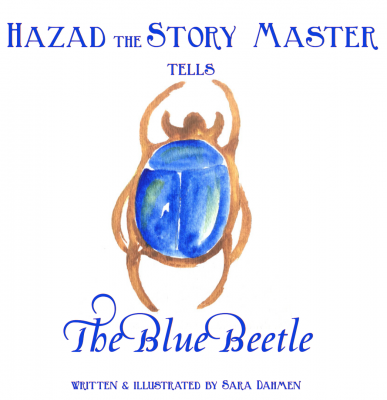
Renni dreams of becoming a scribe, but his family is too poor to afford school. Renni’s father, Pentu, wants to give his son the education he craves; however, he has no job, and finding a way to earn the money proves nearly impossible for Pentu because he doesn’t have the strength required for most of the jobs in the city. After trying and failing at farming and fishing, Pentu returns home dejected, but Renni greets him each time with a reassuring hug.
When he finally tries his hand at carving, Pentu is noticed by the local goldsmith who gives him a job. Pentu excels at making scarabs, a much-valued part of Egyptian culture. His favorite is a large, expensive lapis lazuli scarab, and Pentu knows that selling the jewel will give him the money needed to educate Renni for as long as he likes. When a traveling merchant finally buys the blue beetle, Renni will be able to make his dream come true.
In this third volume of the Story Master series, Hazad, the storyteller, transports children to ancient Egypt where education is a privilege. With Pentu’s repetitive trials, this beautifully illustrated frame story is a bit like a cumulative tale. No matter how hard Pentu tries, he endures disappointment after disappointment; however, he never stops trying. His “never give up” attitude is inspiring. No matter the hardship, he will overcome anything to give his son the education he desires.
The lesson about the value of education isn’t lost on the reader either. Children often undervalue the opportunity to learn while Renni yearns for only that, but even in the midst of Pentu’s disappointments, Renni remains positive. With every failure, he supports his father, reassuring Pentu of his love and never berating his father for being unsuccessful as he searches for his niche.
In this celebration of artistry, The Blue Beetle will touch and inspire children to appreciate what they have, never stop trying regardless of the obstacles, and dream big.
Sara Dahmen has worked in numerous facets in the publishing industry, including editing trade publications. Not only does she write children’s books, she also illustrates them and her historical fiction series, Flats Junction. However, publishing isn’t Sarah’s only talent. She is a copper and tinsmith apprentice, a wedding planner, and creator of her own cookware line. Throughout all of her many successful ventures, Sara cherishes life with her children and her husband.
The following titles and their authors have made it past the initial “Slush-Pile Rounds” and will compete in the next rounds to see which titles will be Short Listed for the 2017 Goethe Book Awards.
Congratulations to following 2017 Goethe post 1750s Historic Fiction Slushpile Survivors!
Blaine Beveridge – A Bit of Candy in Hard Times
Peter Curtis – The Dragontail Buttonhole
Michael T. Sheahan – Curse of MacSweeney Doe
PJ Devlin – Wissahickon Souls
Ellen Butler – The Brass Compass
John Hansen – Pursuit of Glory
Elizabeth Crowens – A Pocketful of Lodestones, Book Two in the Time Traveler Professor series
Gail Noble-Sanderson – The Passage Home to Meuse
Kristin Beck – The Rising Road
Sean Blair – The World We Forge
Michelle Rene – Hour Glass
Paul A. Barra – Murder in there Charleston Cathedral
Ron Singerton – A Cherry Blossom in Winter
J.R. Collins – The Boy Who Danced with Rabbits
Mark Fins – Imagine That
Joe Vitovec – Full Circle: A Refugee’s Tale
Robert G. Makin – Dirt McGirtt
Elizabeth Crowens – Silent Meridian, Book One in the Time Traveler Professor series
Eleanor Tatum – Silver Cotton
Nick K. Adams – Away at War: A Civil War Story of the Family Left Behind
Sean P. Mahoney – Fenian’s Trace
Michelle Cox – A Ring of Truth
Barb Warner Deane – On The Homefront
Johnnie Bernhard – A Good Girl
Peter Greene – Paladin’s War
Michael Aloysius O’Reilly – Desertion
Jack Mayer – Before the Court of Heaven
Jessica Dainty – The Shape of the Atmosphere
Lucinda Brant – Deadly Peril: A Georgian Historical Mystery
Caren Umbarger – The Passion of Marta
Helen Walsh Folsom – Kells: The Risin’ of the Rebellion
Bruce Graham – Visitor from the Reich
Suzette Hollingsworth – Sherlock Holmes and the ChocolateMenace
L.L. Holt – Invictus
L.L. Holt – The Black Spaniard
Kalen Vaughan Johnson – Robbing the Pillars
These titles are currently competing to be SHORTLISTED.
Good Luck to All!
We are accepting entries into the 2018 Goethe Book Awards for post 1750s Historical Fiction.
To compete in the 2018 Dante Rossetti Book Awards or for more information, pleaseclick here.
Chanticleer Book Reviews & Media, L.L.C. retains the right to not declare “default winners.” Winning works are decided upon merit only. Please visit our Contest Details page for more information about our writing contest guidelines.
CBR’s rigorous writing competition standards are why literary agencies seek out our winning manuscripts and self-published novels. Our high standards are also why our reviews are trusted among booksellers and book distributors.
Please do not hesitate to contact Info@ChantiReviews.com with any questions, concerns, or suggestions about CBR writing competitions. Your input and suggestions are important to us.
Thank you for your interest in Chanticleer Book Reviews International Writing Competitions and Book Awards.
In Denise Ditto’s The Tooth Collector Fairies: Batina’s Best First Day, Batina wants one thing, to be the best Tooth Collector in all of Brushelot. Batina is a Tooth Fairy, and she can’t wait to get her first collecting assignment. Unfortunately, her first day doesn’t go quite as she planned. With her huge wings (three times the size of most of the fairies), she’s clumsy and a little awkward, but Batina has a job to do, collecting well-brushed teeth which can be turned magically into the rainbow dust that gives all of the fairies the ability to fly.
Despite the sneers of Jolene, an unhappy fairy who isn’t allowed to gather the precious teeth, Batina and her friends, Lulu and Lainey, can’t wait to begin their tasks, and each of them hopes to win the Best First Day ribbon awarded by Crown Mistress Molar. However, gathering the teeth from under the pillows of sleeping children is only the first step. When Batina returns with her prized first tooth, she must find a way to help the Tooth Inspector with a sabotaged conveyor belt and to fix the Super-Duper Magic Dust-Making Machine, or her first day might be ruined.
Batina’s story is one of determination and teamwork. Again and again, she must overcome her problems and celebrate her differences. Those huge wings often get in her way, but she remains undaunted. Instead, she finds a way to make the wings work in her favor. She also values the role of her friends and calls on them to help her solve the day’s problems. She recognizes the importance of their individual talents and even finds a way to help Jolene the bully, stop being a bully, and be her friend. The positive message of working together and embracing diversity makes this early-level chapter book, illustrated by Gabhor Utomo, shine.
Young and not-so-young readers alike will be happy to learn that Batina’s Best First Day is the first in the Tooth Collector Fairies series. There is more adventure waiting for all!
Author Denise Ditto not only loves writing children’s books, but she is also the Executive Director at Houston Writers House, a position she shares with her business partner Rebecca Nolen, and is the former Director of the Houston Writers Guild. A graduate of the University of Houston-Downtown, she has also published an award-winning short story. She lives in Texas, her home state, with her husband.
The Tooth Collector Fairies: Batina’s Best First Day won Grand Prize in CIBAs 2016 LITTLE PEEPS Awards for Children’s Literature. Follow this link to the Chanticleer Review of the second book in the series, Home from Decay Valley.
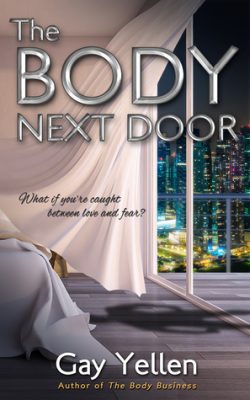
Samantha’s lost practically everyone important in her life, her self-made career now lay in ruins, the romantic dream man she’d found had suddenly disappeared, and then, of course, there’s also The Body Next Door.
As Samantha Newman ponders the steps to put her life back on track, murder and intrigue come knocking close to home. Now she’ll need to follow her instincts and gather clues, like a child tracks a summer ice cream truck, and lick this mystery.
As the girl next door to the body, Samantha’s intelligence, generosity, and engaging humor combine to delight all amateur sleuths reading along. First, she wants to help calm and soothe others living in the condominium. That leads to some interesting clues and suspects begin to surface. But with the police investigation in full swing, will Samantha and her mystery man/love interest be able to coax their relationship into full bloom? That’s a lot to handle when your life is in tatters.
Readers will fall for Yellen’s wonderfully light, conversational writing and fall for Samantha as she tells the story. Of course, she doesn’t always come to the right conclusions, but she’s a very honest spirit who always reaches out to do the right thing. Wherever Samantha goes, she goes with all her heart. While you can certainly dive right in with this second book in the Samantha Newman series, the recommendation is to start at the beginning with The Body Business because you won’t want to miss any of Samantha’s exciting adventures, and romantic entanglements.
Yellen creates dynamic and interesting characters, a skill, no doubt she honed as she gained her start as an actress in theater and film. Later she moved behind the camera as Assistant to the Director of Production at the American Film Institute. Her writing background comes as a former magazine editor and national journalism award winner, now an award-winning novelist. The best news is that she’s currently working on the third book in this series.
A cozy mystery with exceptional heart. A satisfying read to curl up with this Fall.
Alice Huffman is an interesting young woman. She likes to go by the name of Al, likes to wear tuxedoes when she’s allowed to and has a burning desire to run a nightclub in NYC where beautiful men and women can mix, mingle, sing, and dance in whatever way they please. World War II has just ended. People should be ready to celebrate!
But Al has other burning desires as well, some she’s not quite ready to talk about. After all, she tells herself, having these kinds of feelings for one gorgeous woman doesn’t really make her one of those sexual perverts other people are talking about, or does it? Luckily, she has close friends, more like family, to help her deal with these questions during the tumultuous decade following the war. With them by her side, Al becomes the woman she was meant to be.
The extended title, or subtitle, LGBT Life in the Early Post War Years 1945-1955 is really the best description of this work. The novel begins immediately after the war and is chock full of specific details that may not have made it into the history books. In just one example, if a man like Al’s friend Max, was discovered to be homosexual while serving in the army, he was given a “blue discharge,” a piece of paper that would limit his employment possibilities for life.
We learn that freedoms for women, more public during the war, are severely curtailed as the men returning from overseas expect the home life they remember. In this tale, husbands exert control over their wives and women like Al are immediately suspected of “perversion” if they choose not to marry. It’s a tense time, growing more violent across the decade as McCarthyism and fear of communists in a Cold War with the Soviets becomes interwoven with the public campaign against all homosexuals, men and women alike. Every manner of insult is thrown at them. Al and Max understand they could lose everything they’ve worked for should either of them be discovered.
It’s against this historic backdrop that Vanda develops her characters. In this second book of the Juliana series, the singer figures prominently, but in many ways, it’s Al cast as her young, secret, confused lover and eventual career director, who steals the floor show. The tension between Al and Juliana’s legal husband, Richard, is tragic and powerful and continues to grow throughout the work. Al herself is growing in every chapter, and changes from a terrified girl with an impossible dream, to a businesswoman who has earned the grudging respect of many powerful men.
In this way, Olympus Nights can be seen as a Lesbian coming-of-age story with all the recognizable dangers present in the past that a more modern audience can still feel. Yet, even though the story really is centered on the women, the men in Al’s life also have important roles to play. We’re treated to historical glimpses of stars, such as Walter Winchell, Liberace, and Mayor O’Dwyer; and squirm with Max, Al’s mentor and ally, and Marty, a former soldier and aspiring actor, as they struggle to be their true selves. In every chapter, Vanda highlights the political climate of the times and brings forth a wealth of information describing the anti-Gay, anti-People of Color, anti-Communist, anti-Jew, and anti-Woman policies in New York City and America, during that decade.
It isn’t hard to make the connections Vanda wants the reader to see, that these intolerant policies are making a resurgence years later, and that they have an ugly history of repression and violence effecting real people. Her creation of characters we care about, struggling to be themselves against every threat, every unjust law, attempts to remove the stigma of “other” and “pervert” and every other horrible name homosexual individuals have been forced to live under.
A peaceful home in the San Juan Islands turns perilous when two women are persecuted by residents who have plenty to hide when The Camera’s Eye is turned on them. Master storyteller Judith Kirscht presents a thrilling mystery with heart, ripe for today’s environment and rich for readers.
Veronica and Charlotte considered themselves unlikely targets of hate crimes, after all, who wouldn’t like two nice white-haired ladies who share a home for economy and company on an island in Washington’s Puget Sound? Both women have tragic family histories which they thought they’d left behind, but trouble never really lies quietly for long.
Veronica has the gift of capturing the truth with her constant companion, Constance, her beloved Nikon camera. When she captures an uncomfortable truth in their new neighborhood, the eye of persecution turns and focuses on her and Charlotte. In The Camera’s Eye, the reader comes face to face with how perception encourages action, and how action can either heal or destroy.
From the beginning scene, Veronica and Charlotte are in jeopardy as a rock is thrown through their window in the middle of the night. Who would do such a thing? With pasts that cultivated their own sets of demons, the friends have their own ideas, and the field is rife with possibilities. However, when the local law enforcement shows up and suggests that their lifestyle is to blame for the attack, the women go on the defense and start their own investigation as to who and why they have suddenly become targets.
This story is not to be confused with a cozy. Kirscht opens the story with violence and forces the reader to examine the many results of hard decisions made with the best intentions, and question philosophies based on the letter of the law rather than on love. It’s a mystery, certainly, but with an unrelenting grip and careful sleuthing that feels more sinister as the plot unfolds.
Rich with superb dialogue and beautifully penned scenes, The Camera’s Eye is typical of Kirscht’s style and readers will be hard-pressed to set this book down. As one event leads to another escalating event, our characters wits and wills are tested as they struggle to make sense of the violent hatred surrounding them and the blatant disregard for their well-being at the hands of the authorities who are supposed to protect them.
A Chicago native and multi-award-winning author, Judith Kirscht makes her home on an island in the Puget Sound in Washington state where she spends her time taking her dogs for walks, discussing dinner plans with friends, and penning her next literary masterpiece. The Camera’s Eye is Kirscht’s fifth novel.
“In a world where too many rocks are thrown at those who represent anything other than the norm in middle-class white America, two friends decide to take matters into their own hands and stand up to the hatred with which they are targeted in order to save their home and ultimately their lives. Hot off the shelf from the literary award-winning author, Judith Kirscht, The Camera’s Eye will challenge the reader to focus on what they believe and how their beliefs inform their actions. A very important book for our times.”
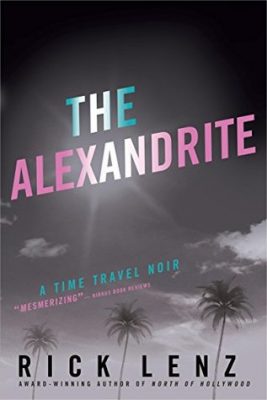
Time-travel Noir becomes High Art with a wicked sense of humor in this fast-paced novel that offers up alternate views of Hollywood’s past and present.
Washed-out and with the doors of opportunity slamming shut on all sides, actor Jack Cade is the poster boy for the “bad things happen in threes” mantra. Getting cut from a crappy, no-pay play was just the tip of his career-crushing iceberg. His agent, who lost faith in Jack way back in another epoch, manages to dig up a temporary life preserver – an audition for a part that has Jack written all over it. An audition he misses. And Jack’s wife, no longer able to stay afloat in his sinkhole of alcohol and “bleeding actor’s ego,” jumps ship.
Just when it starts looking like it’s lights-out for Jack, an anonymous envelope lands in his mailbox. Inside is a pawn ticket that leads him to an Alexandrite ring and a psycho-physicist who claims to hold the secret of time travel. With Jack’s personal and professional lives collapsing in on him like a black hole, he walks out of 1996 and into the heyday of mid-Century Hollywood. He also walks into another man’s shoes, not to mention the scene of his recurring nightmare. Armed with “fore-knowledge” Jack has a chance to make things right in two different time periods. The only question is, how many times will he have to jump across the spectrum of an alternate reality to get it right?
Drawing from his extensive experience in the entertainment industry, author Rick Lenz delivers a stellar and believable cast of characters. From Jack Cade, whose love-hate relationship with the movie industry keeps him on the razor’s edge of failure, to Jack’s 1956 incarnation – or possibly alter-ego – Richard Blake, a movie-star handsome gemologist, whose an angry alcoholic wife and sultry, mentally impaired sister-in-law set the stage for their own rendition of a sweaty Tennessee Williams play. And there’s the incomparably complex, multi-faceted Marilyn Monroe, at the peak of her career—the golden thread that weaves everyone’s story together.
Steeped in Hollywood history and culture, The Alexandrite entices the reader with snippets of iconic set locations, facades, meeting places, studios, and stars. But the novel is more than a torch song to the movie industry. It is also a paean to hard-working actors whose careers, like Jack’s, straddle a razor.
Somerset Grand Prize award winner for Literary and Contemporary Fiction along with multiple other literary awards, The Alexandrite by Rick Lenz playfully challenges the reader to ask questions about a world that exists outside of the four dimensions in which we live. A must-read for anyone and everyone who has been touched by the magic of Hollywood.
The CHAUCER Writing Competition recognizes emerging new talent and outstanding works in the genre of Historical Fiction pre-1750s. The Chaucer Book Awards is a division of Chanticleer International Novel Writing Competitions.
More than $30,000.00 dollars worth of cash and prizes will be awarded to Chanticleer Book Reviews 2017 writing competition winners at the Chanticleer Authors Conference April 21st, 2018!
This is the Official Semi-Finalists List of the Authors and Titles of Works that have been SHORT-LISTED for the Chaucer 2017 Book Awards. These titles will now compete for the First In Category positions.
The Chaucer Awards FIRST IN CATEGORY sub-genres are: Pre-Historical Fiction, Ancient Historical Fiction, World/International History (non-western culture historical fiction pre-1750s), Americas-Historical Fiction Pre-1750s, Dark Ages/Medieval, Renaissance, and Elizabethan/Tudor 1600’s.
Kenneth W. Meyer – Lion’s Shadow
Edward Rickford – The Serpent and the Eagle
K.M. Pohlkamp – Apricots and Wolfsbane
Richard T. Rook – Tiernan’s Wake
DJ Munro – Slave to Fortune
Catherine A Wilson and Catherine T Wilson – The Traitor’s Noose: The Lions and Lilies
Crystal King – Feast of Sorrow: A Novel of Ancient Rome
Gita Simic/G.T. Sim – Occam’s Razor
Lilian Gafni – Flower from Castile: A Safe Haven
Elizabeth Crowens – A Pocketful of Lodestones, Time Traveler Professor Series Book 2
Val Jon Jensen II – The People’s Crusade
Joseph Scott Amis – To Shine with Honor, Book One: Coming of Age
Marcia Fine – Hidden Ones: A Veil of Memories
Elisabeth Storrs – Call to Juno: A Tale of Ancient Rome
Susan E Kaberry – The Good Shepherd and the Last Perfect
Brett Savill – The Medici Apprentice
Leigh Grant – Mask of Dreams
Susan E Kaberry – The Chatelaine of Montaillou
Ken Frazier – Alexander of the Ashanti
Prue Batten – Guillaume: Book Two of The Triptych Chronicle
Martha Kennedy – Martin of Gfenn
Christian Kachel – Spoils of Olympus II: World on Fire
Good Luck to all of the 2017 Chaucer Short-Listers as they compete for the First Place Category positions.
First In Category announcements will be made at the Awards Ceremony. The Chaucer Grand Prize Winner and First Place Category Winners will be announced at theApril 21st, 2018 Chanticleer Writing Contests Annual Awards Gala, at the Chanticleer Authors Conference that will be held in Bellingham, Wash.
We are now accepting submissions into the 2018 Chaucer Awards and the Goethe Awards writing competitions for Historical Fiction. Pleaseclick herefor more information.
But here’s what I think, time passes quickly when we’re happy and productive or involved in something meaningful. Joy makes us buoyant and time, therefore, becomes lighter and easier to move.
When we’re faced with something terrible or unpleasant, the opposite happens. We are weighed down by depressed thoughts or depressing situations. We feel every moment because the pain it causes is real and we cannot do anything else but live in it. Time slows because our focus is on the moment.
Today, (I started writing this on the first flight of the fall trade show season) Kiffer and I are heading to New Orleans for the Southern Independent Booksellers Tradeshow (SIBA). We’re leaving a couple of days before the exhibit portion of the show begins. We’re crossing time-zones. Neither of us has been to NOLA and I have a list of things and places to see and experience. Little did I know, that we would be spending most of our time in the convention center. NOLA sights and sounds will have to wait for another time.
It is important that we arrive ahead of the exhibit time because TWO of Chanticleer’s authors’ works have been selected for the prestigious SIBA events and everything must be PERFECT:
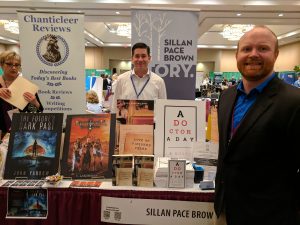
Bernard Mansheim, M.D.’s Somerset award-winning novel, A Doctor A Day was selected for the prestigious Moveable Feast event at SIBA
Gregory Erich Phillips’ Chanticleer Overall Grand Prize novel titled Love of Finished Years was selected for the prestigious First 180 Days event for books that will be published in January 2018.
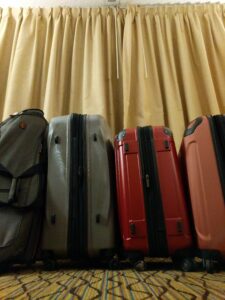
Those of you who do a lot of traveling know that your bag cannot weigh more than 50lbs or you pay a hefty price. We had 3 fifty-pound bags plus personal luggage to lug around between the two of us. Our bags easily weigh more than the allotted fifty pounds each. However, eventually, we discover that a $20 tip to the Skycap helps to “lighten” the load.
Bossy, Bertha, Betty, & Biff
And those of you who read books know that they tend to be heavy. We’re representing 25 Chanticleer Authors and because books look better with a partner, I’ve packed two of each title. You might think that’s fifty books, but you’d be wrong. Most of our authors have two or three titles coming with us. Do the math.
I drop Kiffer off at the departure deck at SeaTac with the bags and park my van in the garage. When I catch up to her, she’s at the Alaska counter unpacking the bags… One of the bags is overweight and shuffling of its contents is required. By the time we reconfigure, the agent has closed the counter and we have to move to the next aisle to check in.
This is how our tradeshow adventure begins.
We are learning things about ourselves and each other – things we didn’t know before. Kiffer has started calling the luggage by name: Betty, Bertha, Bossy, Birdie, and Biscuit. I cannot drink McDonald’s coffee. I tried. I can’t. Kiffer thinks I’m a bit of a coffee diva. I guess I am. Kiffer has graciously upgraded our seats to premier economy class – which means more leg room for both of us tall gals and free drinks. She knows how to travel and I’m grateful. After everyone is clicked in and flight safety drill is given, we’re in the air. It will be six hours before we land. Six hours.
This is the first tradeshow of the season. There will be three more plus auxiliary shows.
Sharon Anderson, Editor in Chief of Reviews; Gregory Phillips, a Chanticleer Grand Prize Winner; Josh Floyd of Ingram.
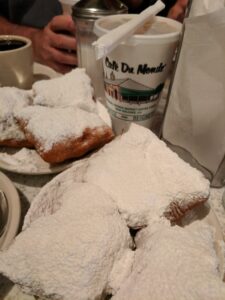
NOLA is sultry. It’s a city that beckons the visitor to ease on in and sit for awhile. It hits the high notes of the most compelling song and doesn’t judge anyone for anything. The police ride horses whose backs are as tall as my minivan back home. It’s a different world. I love the vibe and the beignets – the coffee and the company.
Beignets from Cafe du Monde, NOLA
In N’Orleans, all you have to do is pause for a second and someone will be around to chat you up on how your day is going and if you like the city they call home. It’s very Southern and for me, a Northwest native, it’s lovely. To Kiffer, well, being from the South, I can tell she’s feeling her roots as we venture from one restaurant to another looking for the perfect hush-puppy.
Hush-puppies
We’re off to Portland, OR next for the Pacific Northwest Independent Booksellers Tradeshow where two Chanticleer authors’ books were selected for the BUZZ BOOKs event. This time it was Kaylin McFarren of Portland for her Chatelaine award-winning romantic suspense Threads series and Seattle’s own Gregory Phillips, Love of Finished Years was selected – again!
From there, we hop a plane in Portland to head to Chicago for the Heartland Fall Forum. These are bigger shows than SIBA and I’ve increased my load of authors I’m representing. More luggage is required. We borrow Andy’s orange suitcase and name it Biff. Once again, Kiffer is the proud mother hen when the Laramie Grand Prize winner, Sara Dahmen’s Widow 1881 (renamed from Doctor Kinney’s Housekeeper) was selected for Heartland’s prestigious Moveable Feast Event!
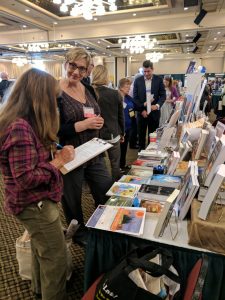
Sharon hand selling to a PNBA book buyer!
After the Heartland trade show, we will split up and Kiffer will take our authors’ books to San Francisco for the show there and I will travel up to Surrey for the SiWC for the weekend. For me, it feels odd not being a part of the last trade show, but Chanticleer has been at the Surrey conference for five years running – it’s no time to stop now.
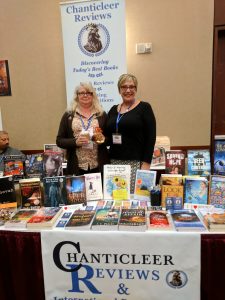
Kiffer refueling with coffee and Sharon proudly showing off Chanticleer’s Best Books Collection at the Heartland Fall Forum, Lombard, Illinois
Before leaving, my mother asked me why was I going away for such a long time. I had to smile, as long time means so many different things to so many people. It depends on what you’re doing, right? Spending a week in jail would be rough. Attending tradeshows? I know it will be over before I have had a chance to settle in.
My mother’s question is valid, though. What do I hope to gain from being away from my family for most of September and October? First of all, I expect this time away will work to sharpen my professionalism and further my career in the book industry world. I expect to meet new people, build stronger connections and learn with a little more certainty that I am capable and ready for this new and exciting adventure. It is exciting to meet the some of the top executives in the publishing industry and mingle with the “Big 5” publishers. There is always a lot to learn and many networking opportunities.
Equally as well, I hope to increase the visibility of my (Chanticleer’s) authors’ work, widen their footprint, as it were, in the retail world of book-selling. I hope, through our efforts, they gain even more notoriety and, more importantly, benefit from more bookstores placing more orders for their work. I hope their books fly off those bookstore shelves because I’m not taking just anyone to these shows. I’m taking Chanticleer Award winners and those very special people who have earned the very highest scores from our professional reviewers. I’m taking the top books and the booksellers are pleased that we have vetted the books that we are exhibiting. We even had a Disney exec who was interested in Chanticleer’s YA and children’s book selections stop by the Heartland booth—she was looking for new content for Disney. She took away sell sheets and information—we will definitely stay in contact!
Book buyers would be crazy not to snatch these books up! And we did connect many indie booksellers and book distributors with Chanticleer Reviews’ best books!
We Discover Today’s Best Books!
Endnote: I started this article on the plane to New Orleans and I was right, the Fall trade show season is over before it began! Time does have a knack for passing quickly when you’re having fun and are passionate about what you do!
Next up are the 2018 American Librarian Association trade shows and the Comic Cons—just around the corner…
Author Spotlight Series focuses on M.A. Clarke Scott, an Award-Winning Women’s Lit Author
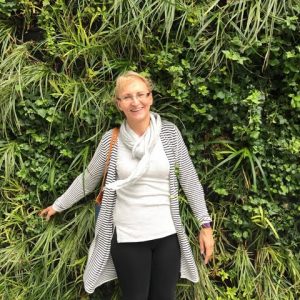
Mary Ann Clarke Scott took home the Grand Prize ribbon for the Chatelaine Book Awards in 2016. She not only writes women’s fiction – but sci-fi and fantasy, too! Who knew? I had a chance to catch up with Mary Ann recently to chat about writing and reading and life. Here’s what she had to say. Enjoy!
Mary Ann Clarke Scott
Chanticleer: Tell us a little about yourself: How did you start writing?
Clarke Scott: I was always an avid reader and a daydreamer. There were voices in my head, alternate realities playing out in my imagination, and I’ve always loved words. I tried to write my first novel at the age of nine, but abandoned it for other pursuits until 2005, once my son was in preschool and I’d pretty thoroughly given up on architecture as a career. Then I started seriously to learn to write, with purpose and discipline.
Chanticleer: Oh, that sounds so familiar! You either talk to yourself or talk to your characters… it makes more sense to talk to your characters! So, Mary, what do you do when you’re not putting words on the page?
Clarke Scott: I like to hike on mountain trails and I do Pilates and yoga. These things keep me limber and healthy, but also centered. I read a great deal. As I’ve got older I’ve become a bit indifferent to things I used to love, like gardening and cooking, but that may be because my focus is on writing. I still enjoy those things. I love to travel, and I love art and history and metaphysics. Recently we were in Europe for the summer, so I had my fill of museums for a while, but I never really tire of that. I aspire to be a visual artist, but never prioritize it with regard to time. It’s for ‘someday’.
Chanti: How do you come up with your ideas for a story?
Clarke Scott: Stories come to me primarily via character, but also through place and, what I guess I’d call ‘situation’ as a starting point. I put these elements together and the story grows up out of them, out of necessity, logically, as a response to what the character needs to grow.
Chanti: Do you find yourself following the rules or do you like to make up your own?
Clarke Scott: Both, I guess, but mostly I’m a rebel. I’m an Aquarian, and we tend to be rule-breakers. I’ve never been a conformist with regard to story or genre, but at the same time, I’m quite passionate about universal story structure. But I don’t see that as rules so much as patterns, and I love patterns. I think they have meaning.
Chanti: I totally agree with you! How structured are you in your writing work?
Clarke Scott: The stories are structured; my workflow is not. I work organically, which is to say, often
Mary Ann’s writing room.
chaotically and in an undisciplined, random way. I procrastinate. I binge. I don’t recommend it!
Chanti: I’m so glad to hear you say that – as I am the same way…. So, how do you approach your writing day?
Clarke Scott: I don’t have writing days, per se. I have a writing life. I know coffee is involved, though. I’m trying to incorporate meditation and visualizations into my process, to get a bit of control and rhythm. I’m also experimenting with dictation. It might not work because I rather enjoy touching my keyboard. But we’ll see.
Chanti: Name five of your favorite authors and describe how they have influenced your work.
Clarke Scott: Only five! I’m a great fan of Barbara O’Neal. I love the way she builds and paces a story gradually, and layers in so many strands of character and relationship, history and mystery. Nothing is wasted or gratuitous. She makes excellent use of the objective correlative. I admire her use of colour as symbol and leitmotif and the way she weaves vaguely spiritual and mystical elements into her stories, as an element of psychology almost, more than ideology, or anything overtly paranormal. For similar reasons, I’m a huge fan of Canadian author Susanna Kearsley, although the magical elements are often more explicit in her work. I love Georgette Heyer, and Mary Balogh, for their rich and well-researched Regency romances, populated by very believable characters. Classically, I adore Jane Austen, for the same reasons. The way they all paint a universal picture of humanity in a very singular social, political and economic context. I admire British authors Freya North and JoJo Moyes I think because they both take vulnerable, flawed protagonists and build them up through adversity, but make it all very ordinary and relatable (Oh, you poor thing…. Uh oh, don’t do that… Fight back, damn you!) and yet extraordinary in terms of character growth, pushing the readers’ emotional boundaries.
Chanti: I can see that. Good choices, M.A.! How does being an author influence your
Mary Ann with her critique group.
involvement in your community?
Clark Scott: I think a lot of writers are introverts. But publishing means you must build a platform and build an author presence, both online and in the physical, local community. It’s forced me to embrace who I am, what I create and be willing to advocate for that. Becoming more comfortable online has also made me less shy in person. I’m also able to share my knowledge with other writers and support them because I know how hard it is, and that we need each other. Writers are an incredibly warm, generous and supportive community, so it’s easy to feel a sense of belonging. It’s hard to find that anywhere else.
Chanti: I agree, it’s so important to find your tribe! What areas in your writing are you most confident in? What advice would you give someone who is struggling in that area?
Clarke Scott: I suppose my strengths would be story structure, character arc and description of setting. It’s hard to give advice. Those are just things that come more naturally to me. I struggle with other things. About description I’d say, use your senses. Creative visualization helps. It also helps to keep the description filtered through the point of view character and limit what you describe to what is important to them and to the story. I’ve had to learn to do this, to limit my description from ‘everything.’ I think my training and work as an architect made me very observant, but perhaps too much so. So filter it. Story structure is something that comes through study and analysis, reading, but also interest and desire. And about character arc, I’d say, study archetypes, and use the structure of stories to make sure your characters go where they need to go, but that you challenge them enough to change them.
Chanti: Give us your best marketing tips, what’s worked to sell more books, gain notoriety, and expand your literary footprint.
Clarke Scott: Well I’m pretty active on social media, and continue to build a community and an online brand that way. I’ve entered and won a few contests (like the Chanticleer Chatelaine!), and I think that helps build familiarity and credibility with readers as well as a presence in the writer’s community. I’ve taken a two-pronged approach to marketing my books: the first is to follow all the advisors and use loss leaders (freebies, giveaways, etc.) to build my email list – although my efforts in this area are in their infancy – and as yet I’m not very good at newsletters and blogging; and secondly, creating an author profile and posting samples of work on reader sites such as Bublish, iAuthor and Goodreads. I think my approach so far has been: try everything! At the moment I believe publishing more books to build my backlist is pretty important to build my credibility as an author, and leverage what marketing I do, so that’s what I’m focused on.
Chanti: Backlist is so important. Thank you for mentioning that. #tryeverything I think we can make that a thing! Speaking of building a backlist, what are you working on now? What’s next?
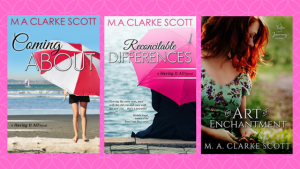
Clarke Scott: The WIP I’m focused on right now is called Coming About (although I’m still searching for a better title), and it’s Book 2 in my Having it All series. It’s been 75-80% complete for several years, so I’ve been working on finishing and releasing it in 2017. After that, I have two virtually complete books in the Life is a Journey series that need a little attention before they’re ready to publish. One thing at a time. Life interferes a fair bit.
Chanti: Life does interfere!Who’s the perfect reader for your book?
Clarke Scott: I think I write primarily for women, though men who’ve read my books say they enjoy them a lot. My audience ranges from quite young women to older women. Readers who are looking for experiences that are a little deeper and more thoughtful, rather than glossy, glamourous or action-packed dangerous fictional situations. There are no murderers or spies in my stories (not yet, anyway) and I’m not drawn to psychological thrillers. I write about real life, real people, and real relationships and hope that my stories are engaging at an emotional, psychological and maybe even a philosophical level. My stories are romantic and entertaining but also hopefully channel healing and personal growth. I believe the human heart is really the last frontier. Fiction is a powerful tool that enables learning and empathy, and therefore can help people reexamine their lives, and the lives of people they know, and hopefully understand that everyone suffers in their own way, and that human beings can always change, grow and move toward enlightenment, contentment, fulfillment and love no matter what lies they were told, what pain they’ve suffered, no matter their handicaps. I’m not writing self-help or how-to books. But I’ve always processed life through narrative and I believe others do, too. It’s in our DNA. So I think I’m looking for readers who aren’t afraid of this conversation.
Chanti: What is the most important thing a reader can do for an author?
Clarke Scott: Review and rate their books on Amazon and Goodreads and other sites. Such a tiny percentage of readers actually leave reviews, something like 1%, it’s extremely difficult for authors, even with excellent books, to build up social proof. And yet this is a significant part of what book buyers use to make their choices. And of course, if you admire an author’s work, tell other people about her! Obscurity is the curse of most authors in today’s overcrowded marketplace.

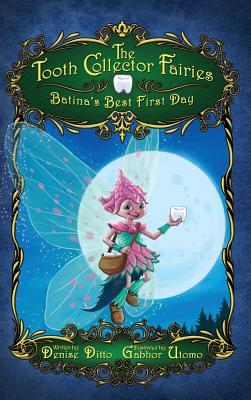
 In Denise Ditto’s The Tooth Collector Fairies: Batina’s Best First Day, Batina wants one thing, to be the best Tooth Collector in all of Brushelot. Batina is a Tooth Fairy, and she can’t wait to get her first collecting assignment. Unfortunately, her first day doesn’t go quite as she planned. With her huge wings (three times the size of most of the fairies), she’s clumsy and a little awkward, but Batina has a job to do, collecting well-brushed teeth which can be turned magically into the rainbow dust that gives all of the fairies the ability to fly.


 The CHAUCER Writing Competition recognizes emerging new talent and outstanding works in the genre of Historical Fiction pre-1750s. The Chaucer Book Awards is a division of Chanticleer International Novel Writing Competitions.