Mae Keaney is looking for a way back to her childhood, back to safety, and finds it in a property on Chappaquiddick Island. A wind-tattered cottage and an old boathouse she envisions as a café will be her haven, as long as she can keep her regrets and sorrows hidden.
With determination, she brings her talents as cook and waitress to bear, attracting locals and tourists alike with her hearty sandwiches, delicious cakes, and teas. She has her privacy and her shelter, and that is all she craves – until she meets Tobias, a quiet, kind, dark-skinned fisherman who begins the difficult process of enflaming her cold heart. Tobias is the son of the chief of the island’s Wampanoag tribespeople and scurrilous rumors begin to fly about Mae and her lover.
Set during the Second World War years and beyond, The Boathouse Café reminds us of a time when an unwanted pregnancy could ruin a woman for life and prejudice against Native Americans was status quo. These factors affect the star-crossed, inter-cultural relationship between Mae and Tobias, twisting it into a complex carpet of unanswered–and unanswerable–questions. Only strong, sincere, honest love can hold them together to face the storms that will beset them before their union can be secured.
This is a story that breaks through the barriers of race and challenges tradition and social mores for love.
Award-winning writer Cardillo planned out this stunning family saga with extreme care. Though the motivations and histories of her well-constructed characters may be mysterious at first, the author will thoughtfully tie up every thread as the story progresses. Her setting, a tiny dot of land hanging out in the Atlantic Ocean, subject to torments of both harsh weather and human weakness, gives the tale great power, somehow presenting more potential for drama than similar yarns spun on safe, dry land. When a fire rages on Mae’s property or a vindictive enemy vandalizes her cozy home, there will be people on “Chappy” who value the land and the traditions of the island and will step in to help and widen the circle of Mae’s support. The island, in Cardillo’s skilled hands, becomes not just an enthralling environment but a shared ethos.
Ultimately, this beautifully written, passionate, page-turning adventure of a blended family history and a romance of grand proportions will have readers yearning to continue the series with The Uneven Road and Island Legacy.
Scott Steindorff has agreed to come back for CAC 19 – for two full days!
We are beyond excited to announce that Scott Steindorff, A-List Executive Film Producer will be joining us again at #CAC19
Robert Scott Steindorff is an American film and television producer who is known for adapting literary works into film works. He works with some of the top people in the entertainment industry such as Natalie Portman, Nicole Kidman, Matthew McConaughey, Ewan McGregor, Robert Downey Jr., Scarlett Johansson, Jon Favreau, John Leguizamo, Will Farrell, Jack Black, and others.
Scott has produced Chef, Jane Got A Gun, Las Vegas, The Lincoln Lawyer, Penelope, Empire Falls (TV Series), The Human Stain, Love in the Time of Cholera, and other works.
Michele Miron, Editor for Press Publications wrote that “When producer Scott Steindorff buys rights to a book, there’s a good chance that story will show up on the big screen.” She continues to report that “he makes two to three movies each year.”
Known as Hollywood’s bookman – Scott has chosen the books from these authors to adapt into movies include Philip Roth, Richard Russo, Gabriel Garcia Marquez, T.C. Boyle, Nicholas Sparks, as well as Michael Connelly’s “Lincoln Lawyer” and Mikhail Bulgakov’s “Master and Margarita”.
And yes, I am going to say it again!
SCOTT STEINDORFF is COMING BACK to the Chanticleer Authors Conference!!! He will be here for two days at CAC19 to discuss books and the entertainment industry.
Special Topics – Scott Steindorff
The Art of Developing Books to Film
Deconstructing a Novel into Three Acts
The Dangerous Task of Turning Beloved Bestsellers into Film or TV
The Hook in a Book
On Word
Join Scott in an Actor’s Studio-style Interview with Diane Sillan for the Chanticleer Reviews video series, On Word.
Scott’s upcoming projects are mostly “based on a novel” as he continues to develop and produce commercially successful and award-winning television series and films. “…books that are so well developed with their stories and characters that they attract top writers, actors, and directors for film and TV.”
Click here for more information about the 2018 Chanticleer Authors Conference and Int’l Book Awards Banquet and Ceremony.
Madison Cruz wants a breakthrough acting job, money in her purse, and fun with the sexy guys vying for her attention. Instead, she delivers singing telegrams for a living. Then her grandfather gives her mysterious evidence that must be kept sealed and hidden, he disappears, and now, spies are watching her every move. In other words, Madison’s life is a hot scheming mess!
Estranged from her FBI mother, Madison feels her family ties are confusing. Recent attempts by mother and daughter to bond often result in awkwardly hilarious scenes. Also, when her beloved grandfather disappears and Madison begins investigating, her creative problem-solving skills are downright laugh-out-loud funny. As luck would have it, she’s up against some organized bad boys. Fortunately, she’s got some willing and loyal friends she can count on as things begin to heat up. Among those friends is one particularly appealing hot interest nicknamed ExBoy with his dangerously handsome looks. He and Madison become entangled in the mystery and much, much more. But he’s not the only guy interested in knowing Madison better.
Spenser, Madison’s best girlfriend, repeatedly advises her to use more caution – a piece of advice that never lasts for long. The two gals have a relationship where they not only have good times together sharing jokes and stories, they also look out for each other in this wild, Los Angeles life.
This story, the first book in the Madison Cruz Mystery series, is an entertaining whirlwind that will keep readers breathless with plot twists and turns, and roaring with laughter. The funny situations the characters find themselves in are so imaginative, and their innovative solutions will delight and thrill cozy mystery fans. Best of all, at the core of this fun story is a very well plotted, intricate mystery to solve, about cleverly fleshed-out characters who will tug at your heart.
Author Lucy Carol is an entertainer and a storyteller. Her background is in the performing arts as an actress, voiceover artist, choreographer, and even a singing telegram performer. She married the love of her life, enjoys martinis, flowers, dancing, a good lipstick, cake, and of course fun and fast-paced mysteries. She lives in the Pacific Northwest, and has three books in this series, with the next one out soon.
Madison Cruz demonstrates that a sharp mind, a sense of humor, and a full purse can work wonders. Never be caught without them.
What’s more fun than Neanderthals? How about Neanderthals on the high seas? Now that we have your attention…
Author Alex Paul delivers a highly imaginative, middle-grade epic fantasy adventure-packed story with everything you could ever ask for to have a rip-roaring good time.
SeaJourney (Book One) opens with an ancient archive stating that the Arken Freeth, lived 11,000 years prior, before the great flood. It follows that Arken’s world is inhabited by saber-toothed tigers and other monstrous beasts – and populated by both humans and Neanderthals.
It’s Arken’s fourteenth birthday and he’s looking forward to graduating from school and going on a sea journey with his classmates. All he needs to do is balance a huge rock on a small point. That sounds easy enough, right? Well, he fails.
The only way he can redeem himself is to combat Gart, a very large, bully of a boy who happens to hate him. Arken wins the skirmish – and more of Gart’s wrath in the process. However, both boys will board the Sea Nymph with their classmates to serve their country, Lanth. It turns out that the people of Tolaria (allies of the Lanths) are under attack. Yolanta, King of Tookan, is even now traveling with pirates to hunt down Tolarian Princess Sharmane and steal her magic necklace. The Sea Nymph is readying for war.
Arken meets a girl named Talya, a freckle-faced scout-in-training, who warns Arken that Gart plans to kill him. And when word reaches the Sea Nymph that Princess Sharmane’s vessel has been attacked, Arken, who has proved his worth leads the charge against the enemy ship. Somewhere in the middle of all that is happening aboard the Sea Nymph, there’s a Neanderthal who is gearing up to join in the fun.
With three other Arken Freeth volumes in production, SeaJourney introduces readers to a worthy hero and reveals some of his secrets and hidden powers. The book is well suited for tweens who identify with the underdog who overcomes hardships and ultimately triumphs. Also, our heroine is not based on her looks so much as her energetic attitude.
With fast-escalating action on every page, a likable, capable hero, plenty of mystery and an abrupt ending, readers will be lining up for more. Arken Freeth and the Adventure of the Neanderthals, SeaJourney #1 is sure to please those who crave fantastical adventures with pirates, underdogs, prehistoric beasts, and Neanderthals!
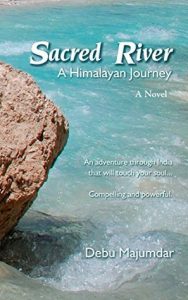
A few weeks ago, a wonderful and talented author named Debu Mujumdar contacted me about how to begin creating an effective book cover. Effective cover meaning one that will sell itself to readers, bookstores, agents, distributors, librarians…He knows that his current cover is not serving his novel well, but where to start. “What are the first steps to create an effective book cover? Where do I begin?” he asked.
You see, Debu’s novel, Sacred River: A Himalayan Journey, has won multiple prestigious awards. You can read the Chanticleer review by clicking this link. He published it in 2016. However, from what I could surmise from his email, he isn’t pleased with its sales or readership reach. The story is unique and exceptionally well written and has a suspenseful climax. It is filled with tense sub-plots that are engrossing and the stakes are high!
But the cover he now has reflects very little about the story within. We discussed his cover at last year’s Chanticleer Authors Conference session on book covers. I think I will call the session this year THE GREAT CHANTICLEER COVER “Bake-Off” (with a nod and a hat tip to The Great British Bake-Off TV show). At these sessions in the past, brave authors (self-published) have lain their books on the Cover Altar to be scrutinized—and not just by me, which would be tough enough, but by their peers.Debu was one of the brave authors who laid his book on the Cover Altar for judgment.
I then would hold up the targeted book for about 3 to 5 seconds to the group and ask the following question: “What is the genre of this book?”
Notice, that I did not ask, “Do you like this cover?” An effective book cover is not necessarily “pleasing.”
An effective book cover communicates information. And not just the basics—that is a given.
Most of the time (99% I’d say), not one person in the group could tell the genre of the (self-published) books laid on the Cover Altar —much to the chagrin of the books’ authors.
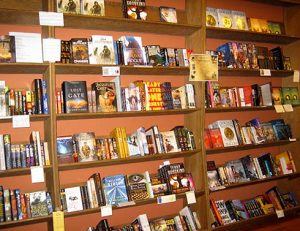
Village Books Bellingham, Wa
Why 3 – 5 seconds? That is the time that the cover has to attract a potential readers’ attention.
Potential Readers being booksellers at tradeshows, librarians at the ALA shows, shoppers on Amazon, shoppers at your local bookstore, shoppers at WalMart or Barnes & Nobles or at the airport … Well, you get the picture.
In this 3 to 5 seconds, your cover must communicate quickly and effectively the following 5 Elements:
The Genre (Historic? Thriller? SciFi? Romance? Cozy Mystery? Literary? etc.)
The Primary Targeted Age Group (Adult for the Trade? Guys? (think Tom Clancy) or Gals? (think Rebecca Wells), General Audience? Young Adult? Middle-Grade? Clean reads market? (think Jan Karon) etc.)
Place or Cultural Reference (India? New York? Africa? Outer Space? California? Paris? Russia? Japan? etc.)
An effective book cover will convey all of this information (or enough of it) to capture a potential reader’s attention in less than 5 seconds—three seconds really. It will garner enough interest to have the potential reader to pick it up or click on the link to find out more. If it does not, your book is invisible to potential readers. And yes, that is a publishing industry’s insider’s term.
Invisible books rarely sell.
Effective covers sell the first book. The content between the covers sells the second book. And you can quote me on that.
Here are some examples of before and after covers that have been lain upon the Book Cover Altar:
Example No. 1
James R. Wells Awarded the Cygnus Grand Prize for THE GREAT SYMMETRY
Is it a biology book? Is it a math biology book? I dunno? Is it a non-fiction book?
Point made.
Bookbub picked up The Great Symmetry with its new cover. ‘Nuff said.
Does the new cover communicate quickly the 5 Elements above:
Genre – yes. Clearly Science Fiction
Primary Age Target Group – yes. General Audience for the Trade (i.e. commercially viable, a plus!)
Mood – yes. Suspenseful with Action — Is that a black hole? Looks scary!
Timeframe – yes. Futuristic with high technology
Place or Cultural Reference – yes. OuterSpace — possibly intergalactic.
Example Number 2
Sara Dahmen’s Doctor Kinney’s Housekeeper, Laramie Grand Prize Winner for Western Fiction
Sara Dahmen awarded Laramie Grand Prize for DR. KINNEY’S HOUSEKEEPER
BEFORE AFTER
The comments made during the Great Cover Bake-Off regarding the original cover were:
Is it a cookbook for baking? Is it a book about a baker? Again: I dunno? Is it a non-fiction book?
Point made.
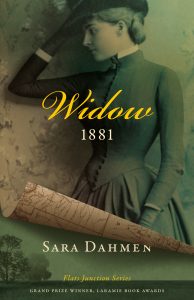
Dr. Kinney’s Housekeeper was picked up by a publisher because it had an interesting storyline and commercial potential (read, TV series). After some rewriting to pose the book as a series, a new cover was created that reflected the storyline along with a new title Widow 1881: Flats Junction Series
Does the new cover communicate quickly the 5 Elements above:
Genre – yes. Clearly Historical Fiction, the late 1800s
Primary Age Target Group – yes. General Audience for the Trade – female-focused
Mood – yes. Change is coming. The fancy wallpaper from city life Back East to the map of the territory clearly shows this. The cultured young woman standing in front of fancy wallpaper is wearing clothes that do not allow for much movement or made for working. Note the tiny waist from wearing a corset, her fine gloves, the fine wool flannel, and her hair arrangement, her hat. This young woman is heading out alone to a place where there will be little refinements that she has become accustomed to. Will she survive? What awaits her?
Timeframe – yes. 1881 (And what was it like being a young widow in 1881 going out to unknown territory alone)
Place or Cultural Reference – yes. North America West against Back East culture in the late 1800’s
Sara is happy to report that book sales are brisk and the novel (first in the Flat Junction series) is under consideration for film options.
Example No. 3
Now let’s go back to Debu‘s award-winning novel, Sacred River: A Himalayan Journey.
Click on the link above if you want to visit Debu’s website.
The tags for the book are Literary Fiction, Multiculturalism Issues, Mystery, Thriller/Suspense, India.
Here is the novel’s cover:
Now let’s apply the 5 Elements. What does the cover tell you in less than 5 seconds?
The Genre: Travel? Non-fiction?
The Primary Targeted Age Group: General Audience? Probably. Literary audience? Probably not. Suspense/Thriller audience? No way.
Mood: Don’t know.
Timeframe: No idea.
Place or Cultural Reference: No idea?
Does the cover convey any of the following (blurbs from the Chanticleer Review of it)?
“A tour de force of India’s history, religion, culture, philosophy, anthropology, sociology, and politics are neatly packaged as a mystery…”
“…As speculation of a golden hoard hidden in the sacred temples arises, Chetti and his associate scheme to locate and plunder treasure for a noble cause…”
“An engrossing and tense subplot unfurls, one that will ensnare a temple swami along with some of the pilgrims to the Ganges. This adventure, which culminates in an enormously suspenseful climax…”
“Readers will feel they are in a marketplace, on the side of the mountain, in a temple, and bathed in light and water. Especially lovely are the passages noting religious rituals and the spiritual significance of the Ganges. The author weaves in Indian legends and morality stories, artfully juxtaposing parallels between ancient tales and his characters’ modern lives.”
Nope.
Make your book stand out in a sea of books!
Debu’s award-winning novel deserves a cover worthy of the time and writing craft that he invested into it. His cover has to intrigue potential readers and booksellers to pick it up wherever it is displayed. The cover must convince the web surfer to click on the image.
But how?
My advice to Debu is to begin collecting visual elements of people, objects, paintings, locations, symbols, ideas, etc. that reflect the content of the work. Take several weeks to do this. Enlist friends, family, and readers to help with this. Gathering visual elements would make a great social media campaign. Ask readers to post photos or graphics of images that remind them of the novel.
Dig deep. Come up with at least 30 elements, if not more.
Lay the visual printouts where you can see the elements from far away, close up, upside down. Such as writing the novel, exploring the cover concepts will take time. Deciding on the cover concept will take more time and feedback.
In a few weeks of letting ideas percolate, particular visual elements will begin to resonate. Then you will have something to explore.
Update! Debu has re-released his book with this cover
Don’t let your book become invisible to its potential readers!
Effective covers sell the first book. The content between the covers sells the second book. And you can quote me on that. (And yes, I am repeating myself. )
I will continue with another blog post that discusses what comes next—How to Put the Elements Together for an Effective Book Cover.
Here is a link to Canva. It is a FREE graphic-design tool website that is easy to use. It is a great way to explore cover ideas and to play with visual elements to discover what will resonate cover-wise with your readers.
Jessica Page Morrell, Developmental Editor for Books and Screenplays
Jessica Page Morrell is a top-tier developmental editor for books and screenplays. Her articles have appeared in Writer’s Digest and The Writer magazines. She is known for explaining the hows and whys of what makes for excellent writing and for sharing very clear examples that examine the technical aspects of writing that emphases layering and subtext. Her books on writing craft are considered “a must have” for any serious writer’s toolkit.
She is sharing her handy Writing Craft Checklist with us because we all can use reminders. We advise that you make sure that your manuscripts do not have any of the following issues prior to submitting them to agents and acquisition editors. If you are too close to a work to evaluate it, you may want to consider having an objective and unbiased manuscript overview to catch these issues.
Editors and agents are word people, most were English majors in college and have a great love and respect for the written word. They will notice your level of craft within the first sentences, so your efforts must be polished, vivid and exceptional.
Your manuscript lives or dies on your opening sentences and each word must be perfect, precise, and weighted with meaning.
Editors notice and are turned off by passive voice and wimpy verbs.
Editors notice when the viewpoint jumps or shifts within a scene.
Editors notice too much telling (reporting or summary) and not enough showing in all types of writing including essays and memoir.
Editors notice when emotions are announced instead of dramatized.
Editors notice frequent use of names in dialogue. Generally, leave out names.
An editor notices sloppy punctuation such as the excess use of exclamation points, quote marks around inner thoughts, improper use of semicolons and ellipsis.
Editors notice protagonists who are not proactive, heroic in some way, and bigger than life.
Editors notice characters with a limited emotional range and expression.
Editors notice large and small inaccuracies and inconsistencies—when the character has blue eyes on page 23 and green eyes on page 57; when a character drives an old, beat-up, pick-up truck that is inexplicably equipped with airbags; when an animal, plant, or species of any sort is misnamed or shows up in the wrong region of the country.
Editors notice when technical details don’t ring true—such as in a mystery when police don’t follow standard arrest procedure; when a yacht sinks from a single bullet hole; or explosive materials are used haphazardly.
Editors notice vague descriptions (plant instead of ivy, tree instead of oak) and generalities instead of details that bring the reader into a specific time and place.
Editors notice when writers don’t write for all the senses, especially leaving out smells.
Editors notice small confusions such as misusing it’s and its, that and which, affect and effect, compliment and complement, lay and lie.
Editors notice overly long paragraphs and a general lack of white space. Generally, paragraphs are five or six sentences long and as taught in grade school introduce a topic, develop a topic, then conclude or lead on to the next paragraph.
Editors notice a lack of transitions—the words and phrases that announce a change in mood or emotion, time, and place so the reader can easily follow. They also know excess transitions as when you follow your characters across every room and along every sidewalk.
Editors notice excess modifiers, purple prose, and too much description. The best writing is lean and economical and every word in every sentence has a job to do.
Editors notice a voice that is flat, inappropriate, or boring. Voice, whether it is the writer’s voice in an essay or the viewpoint character or narrator in fiction, must breathe life into the piece and hint at the person behind the words.
CAC18 Writing Craft Sessions and Workshops presented by Jessica Page Morrell to take your writing craft to the next level. #SeriousAuthors
Click hereto read more in-depth descriptions of the sessions.
Learning from the Greats – Sunday Master Morning Writing Craft Class – Intermediate to Advanced Levels
The Anchor Scenes of Fiction – Sunday Afternoon Master Writing Class – Fiction, Film
How High Concept Really Works – Regular Session – Friday Regular Session – Fiction, Film
Subtext: The Quiet River Beneath the Story – 1.5 hours Regular Session on Saturday – Writing Craft
KaffeeKlatch Session – What’s in a Title? – Book Promotion Tools & Tips
Each year we offer writing craft sessions from the best editors and authors in the publishing industry.
This year we are excited to announce that we have Jessica Page Morrell as the teacher of the Master Writing Craft Sessions.
Jessica understands both sides of the editorial desk–as a highly-sought after developmental editor and an author. Her work also appears in multiple anthologies and The Writer and Writer’s Digest magazines. She is known for explaining the hows and whys of what makes for excellent writing and for sharing very clear examples that examine the technical aspects of writing that emphases layering and subtext. Her books on writing craft are considered “a must have” for any serious writer’s toolkit.
CAC18 Writing Craft Sessions and Workshops presented by Jessica Page Morrell
If you are not registered for CAC18, you may register for only the Master Classes taught by Ms. Morrell by clicking here.
Learning from the Greats – Sunday Morning Writing Craft Master Class 9:30 – 12:30, April 22, 2018
Although writers can feel inundated by all the writing advice available in our current times; dissecting, reflecting, and even emulating great writers can be a powerful tool. It’s especially helpful to study the best in the genre you write in. This workshop teaches writers how to deconstruct and analyze elements of craft. It will demonstrate how to study the balance of narrative and dialogue; how POV shifts in an ensemble cast; how figurative and descriptive language are used in varying kinds of scenes; how pace and action are entwined; the benefits of first and third-person viewpoint, and the subtle variations of each. In this workshop, we’ll discuss the techniques used by a variety of authors including Alice Munro, Raymond Carver, Ernest Hemingway, Elmore Leonard, Marilyn Robinson, Ray Bradbury, Anne Patchett, and others. We’ll also cover work habits, language, and sentence potency, and we’ll synthesize the best commandments on writing from the best and brightest.
The Anchor Scenes of Fiction – Sunday Afternoon Writing Craft Master Class 1:30 – 4:30, April 22, 2018
The task of a novelist or screenwriter is to tell a story so riveting that it will hold a reader’s attention for hundreds of pages or a viewer’s attention for several hours in a theater. This requires an intimate knowledge of your characters and thorough understanding of plot, the sequence of events that take readers from beginning to end. Your structure will reveal the protagonist’s struggles to solve problems and achieve goals. This, in turn, brings emotions to life and explains the importance of what a character is trying to achieve and what stands in his way.
These events won’t hang together without a compelling structure that underlies the whole—the essential scenes that every story needs to create drive, tension, conflict, climax, and resolution. We’ll illustrate and come to understand the anchor scenes needed in fiction and film: Inciting Incident, First Plot Point, and Mid-point Reversal, Point of No Return, Darknight of the Soul, Climax, and Resolution. We’ll discuss how the protagonist stars in these scenes, how they’re emotionally-charged, build the plot, and illustrate character growth.
Subtext: The Quiet River Beneath the Story – 1.5 hours Regular Session
For most writers subtext is the most elusive of all writing techniques. However, life is often lived between the lines, and scenes often simmer with the unspoken beneath dialogue and action. In this workshop, subtext will be explained with examples from various genres. We’ll also discuss nonverbal communication and how to render it onto the page and how to hint at lies and secrets in scenes so that dialogue scenes are enhanced. We’ll cover how metaphor and visual clues create subtext. Mostly we’ll investigate all the ways to insert subtext—the unspoken, innuendo, gestures, pauses, misdirection, colors, clothing, setting details—in other words, the nuanced moments that are not directly represented.
KaffeeKlatch Session – an informal session where we discuss Q & A – Simple Steps to Solve Story Problems. Ballroom Saturday, (9 – 9:50)
Click here for more information about the 2018 Chanticleer Authors Conference
Catherine Abbott has everything a young lady of quality could wish for in England, 1660’s. She lives on her father’s comfortable estate in the village of Wells, Buckinghamshire and she’s soon to be wed to Miles Houghton, a childhood friend recently returned from several years in France. For Miles, the wedding is just the ticket to free him from his rather large gambling debt. His heart isn’t in it, though, as he still yearns for the Parisian nightlife.
However, Catherine has had an interest in science, books, and “the mysteries of this world” that inspires her to make complex drawings of butterflies and track the constellations in the night skies. Can she be happy as an idle wife? When she meets Simon, a young doctor who has been assigned to care for her aging, gout-ridden father, she begins to dream of a different future, impossible, she understands, but she still can dream, right?
Then the Black Plague strikes England. Taking orders from Simon whom he has grown to respect, Lord Abbott orders the village of Wells to be quarantined and ships Catherine’s brother Charles off to the colonies. Miles, unwilling to be hemmed in, flees without a word to Catherine, ignoring their planned nuptials. She, who once helped a servant girl in the throes of childbirth, finds a way to assist Simon in treating plague victims. He recognizes Catherine’s remarkable medical talents and begins to envision a way he and she might someday make a medical partnership. Or will their relationship go beyond the professional?
Award-winning writer Halverson has given us a character so completely believable, and so empathetic that readers will fall in love with her from the opening scene, when, as a little girl, Catherine sneaks out one night to observe the movements of the stars. We are hooked and are convinced that this heroine is a prodigy who will only find what she seeks in life by breaking the bounds of convention. Drawing on events of the time, such as England’s trade with India, the colonization of America, the controversial issue of autopsies as a means of studying illness, and of course the horrors of the plague itself, Halverson reveals extensive research into the century she writes about. And employing rich idiomatic phrasing and restrained but appropriate accents as needed, she shows her gift for the sound as well as the sense of well-constructed prose. In a short Afterword, the author relates the story of a little English village on which she patterned her fictional Wells, where quarantine did serve to save lives at the time of the Black Plague.
Set against the backdrop of England’s Black Plague, one woman bravely challenges the rules of stature and class to find her true love and true calling. Historical romance readers will enjoy curling up with Halverson’s first book in The Stockbridge Series and look forward reading the next one.
Hana Samek Norton begins her epic and engrossing novel of historical fiction, The Serpent’s Crown; A Novel of Medieval Cyprus, with this quotation: “It sometimes happens that exploits, however, known and splendidly achieved, come, by length of time, to be less known to fame, or even forgotten among posterity.” (Itinerarum Peregrinorum et Gesta Regis Ricardi) How fortunate for readers, then, that the author brings to life a captivating chapter of history that occurred in Cyprus and Jerusalem in the early thirteenth century.
While many may be familiar with the main players of the royal Lusignan and Ibelin families, dynastic houses that feuded and intermarried during medieval times, Samek Norton proves that the characters waiting in the wings often play covert but essential parts in history. Had they not been there, events may have played out very differently. Much is owed to these minor characters who were discounted or overlooked, characters who utilized that obscurity to accomplish what their more famous peers didn’t or couldn’t because their lives were too public.
The Serpent’s Crown is a ringing endorsement of the idea that the personal is political. This is not a novel of battles and treaties, although they are referenced often with explanatory details. Instead, this novel is a stunning examination of how history is forged through the relations between husbands and wives, parents and children, siblings and every configuration of blended families. Spouses were lost to illnesses, pirates, poisons, accidents, and every other possible cause of death. Kings and queens had to have consorts, however, so marriages kept occurring with elaborate step-relations resulting.
Families were fertile ground for stirrings of love and loyalty, but also betrayals and extortions. The Lusignans and the Ibelins conspired to gain political power, but these families were often openly hostile towards each other. Juliana often contemplates family matters and specifically “what makes a marriage.” She is married to Guerin de Lasalle, a nephew of King Aimary de Lusinan, King of Jerusalem and Cyprus. Lasalle has a far less grand title, Lord of Parthenay. He had been betrothed to another as a child, a fact that unsettles Juliana and causes her to worry that her marriage is not valid, that in the eyes of the church, she is an adulterer. While she wants for nothing, she is often exasperated by her husband’s absolute loyalty to his uncle, his readiness to do whatever is necessary to assure the stability of the King’s realms. Juliana, a former nun used to a quiet life of piety and religious devotion, springs to action when her father-in-law kidnaps her infant daughter, Eleanor, and takes her to France. Nothing will deter her from recovering the child, but her quest is a long one, comprising several years and many events.
Samek Norton’s prose is vibrant and evocative. Her detailed descriptions of the ornate, often layered gowns worn by queens and their ladies make one long for a Project Runway of medieval fashions. The sumptuous descriptions of food and the fleshing out of time, of locales, of palaces, of Mediterranean sunlight, provide an exquisite backdrop for the action of the novel.
The book is thick with details, testimony to the author’s in-depth research, and keeping the many royal relations straight can be a challenge at times. The Cast of Characters listed at the outset of the novel is a great help. Even servants of households are noted because, again, this is a book that shines a light in dusty corners in piecing together events that affected outcomes noted in history books. In this regard, there are no insignificant characters. Samek Norton proves that the broad events of history rest on the shoulders of ordinary men and women. She gives them their long overdue recognition.
Alisdair “Dair” Fitzstuart, spy and war hero, wants to enjoy a carefree life now that his service to his country is over. After spending years creating the daredevil reputation that has earned him fame beyond his heroic war efforts, he’s eager to return to the London town life, sample the season’s beauties, and carouse with his lifelong friends, but when his latest escapade literally throws him into the arms of Rory Talbot, his plans are turned upside down.
Rory, the granddaughter of England’s Spymaster, enjoys her quiet existence cultivating pineapples and spending time with her grandfather. Because of a crippling birth defect, she’s spent her entire life on the sidelines, secretly falling in love with the handsome Major Fitzstuart, who happens to be her brother’s closest friend. She never expects Dair to notice her, but after their chance meeting at the beginning of the novel, Dair can’t seem to get the beauty off his mind. However, his womanizing past complete with an illegitimate son, has everyone, including Rory, questioning Dair’s sincerity. The two must battle the odds if they dare to have a future together.
With a complicated storyline and abundance of character-rich scenes, Lucinda Brandt delivers in Dair Devil another volume of the Roxon Family Saga. For those unfamiliar with Brandt’s brand of historical romance, this is not a frivolous read. The narration and dialogues are lengthy and complex, the weaving storyline on top of storyline in a masterful fashion, therefore we strongly recommend starting with the first novel in the series, Midnight Marriage, and move on from there. Those who are familiar with Brandt’s work will submerge themselves in the interweaving storyline and swoon to Alex Wyndham’s voice as he narrates series.
Both Rory and Dair break the typical romance novel mold. Rory’s physical disability is a refreshing change to the typical perfection of the romance heroine. Though still feisty and spunky, Rory’s life is far from the easy existence of the regular heroine; however, her issues don’t hold her back. Rory’s never allows her physical problems to stand in the way of whatever she wants to accomplish, creating an inspirational protagonist, which is uncommon in the traditional romance novel.
Dair challenges the romance norm as well: he has an illegitimate son, not uncommon in the Georgian time period, but unusual for the heartthrob of this genre. Though typically seen as the hunky bad boy, heroes of romance novels don’t often have illegitimate children, much less a child that plays a role in the plot. Dair not only has a son, he shows his fatherly love repeatedly, again testing the tried-and-true conventions of the “normal” historical romance.
Lucinda Brant has created a complex story where strength lies in family, and history is more than a setting. Whether siblings or cousins, these characters rely on their bonds and show that love triumphs despite the odds, and although this theme is not unusual within the genre, Brant’s use of familial bonds saturates the plot and creates a web of stories to delight readers of romantic fiction.

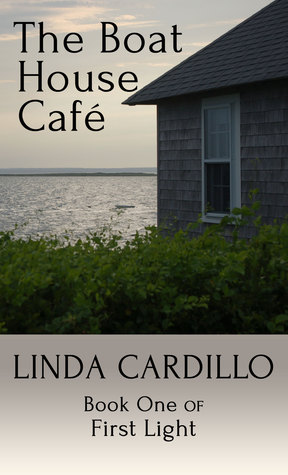
 Mae Keaney is looking for a way back to her childhood, back to safety, and finds it in a property on Chappaquiddick Island. A wind-tattered cottage and an old boathouse she envisions as a café will be her haven, as long as she can keep her regrets and sorrows hidden.




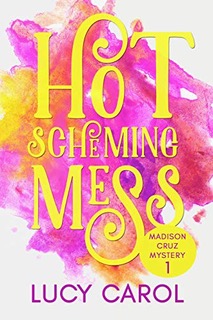
 Madison Cruz wants a breakthrough acting job, money in her purse, and fun with the sexy guys vying for her attention. Instead, she delivers singing telegrams for a living. Then her grandfather gives her mysterious evidence that must be kept sealed and hidden, he disappears, and now, spies are watching her every move. In other words, Madison’s life is a hot scheming mess!

 What’s more fun than Neanderthals? How about Neanderthals on the high seas? Now that we have your attention…












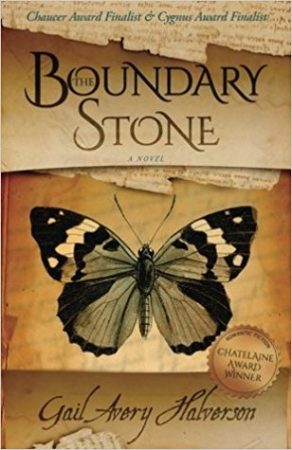
 Catherine Abbott has everything a young lady of quality could wish for in England, 1660’s. She lives on her father’s comfortable estate in the village of Wells, Buckinghamshire and she’s soon to be wed to Miles Houghton, a childhood friend recently returned from several years in France. For Miles, the wedding is just the ticket to free him from his rather large gambling debt. His heart isn’t in it, though, as he still yearns for the Parisian nightlife.
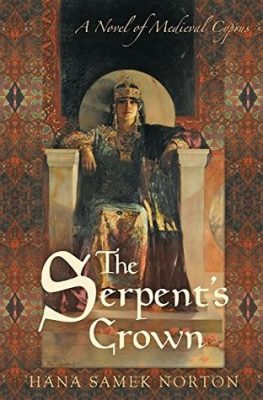
 Hana Samek Norton begins her epic and engrossing novel of historical fiction, The Serpent’s Crown; A Novel of Medieval Cyprus, with this quotation: “It sometimes happens that exploits, however, known and splendidly achieved, come, by length of time, to be less known to fame, or even forgotten among posterity.” (Itinerarum Peregrinorum et Gesta Regis Ricardi) How fortunate for readers, then, that the author brings to life a captivating chapter of history that occurred in Cyprus and Jerusalem in the early thirteenth century.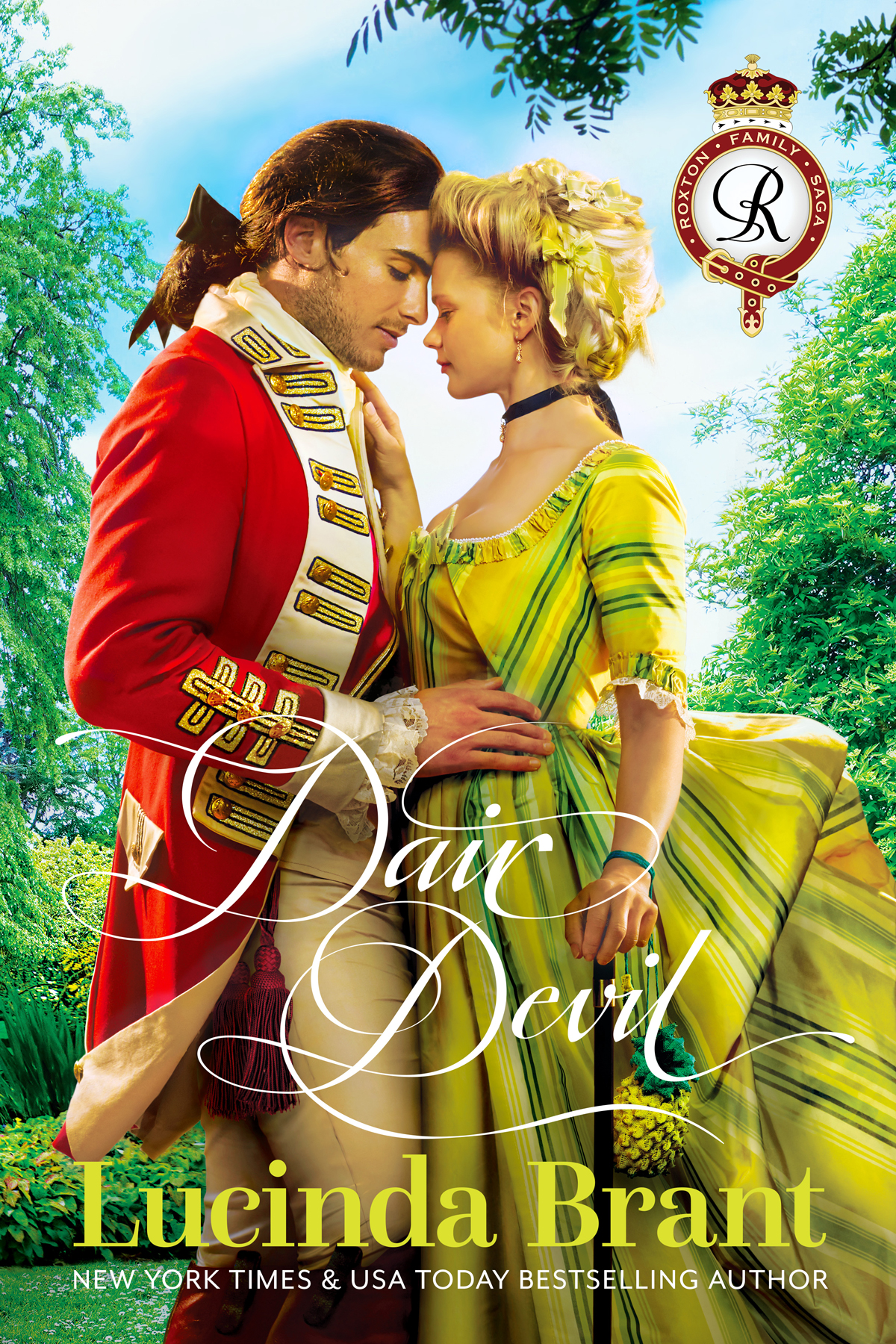
 Alisdair “Dair” Fitzstuart, spy and war hero, wants to enjoy a carefree life now that his service to his country is over. After spending years creating the daredevil reputation that has earned him fame beyond his heroic war efforts, he’s eager to return to the London town life, sample the season’s beauties, and carouse with his lifelong friends, but when his latest escapade literally throws him into the arms of Rory Talbot, his plans are turned upside down.