Blog

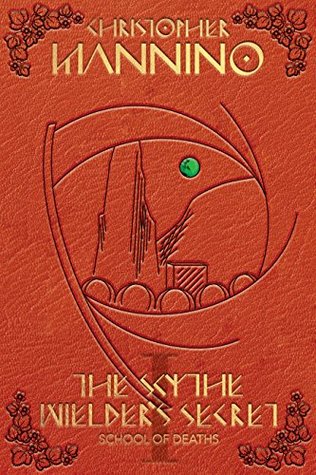
  • SCHOOL of DEATHS (The Scythe Wielder’s Secret Book 1) by Christopher Mannino – YA Fantasy, Coming of Age, Magical Worlds

    SCHOOL of DEATHS (The Scythe Wielder’s Secret Book 1) by Christopher Mannino – YA Fantasy, Coming of Age, Magical Worlds


    Christopher Mannino’s young adult fantasy novel, School of Deaths, opens with a portrayal of adolescent angst that goes waaaaay beyond “I have nothing to wear!” or “Oh, no!  I have a zit!

    Readers will immediately sympathize with the main character, Suzie Sarnio, who’s having the worst first day of eighth grade ever. For starters, she looks like death. Seriously. For mysterious reasons, she’s lost so much weight over the last three months that her bones are about to burst through her skin. Her black hair is stringy, and she peers out at the world through lifeless, gray eyes. There’s no chance of her blending into the crowd.

    Everyone wants to talk about her appearance. Her parents, her brother, her friends, her teachers, everyone comments on how terrible she looks. Just what every girl wants to hear, right? As if being thirteen wasn’t hard enough! No matter how much Suzie eats, she can’t gain weight. Of course, everyone assumes she’s anorexic.

    To top it off, she’s having nightmares in which a grim-reaper-like dude tells her, “I’ve come to take you back. You are a Death.” And then it really happens. The doorbell rings and there he is, the Grim Reaper in all his glory, and he does indeed take Suzie away.  Take a deep breath and join Suzie as she travels – not over the rainbow – but to The World of Deaths.

    Once over her bafflement of how she got there, Suzie learns about her locale at the School of Deaths. It’s a bit like Hogwarts, but she’s not learning to be a wizard. No, she’s in training to be a “Death,” one of those who reaps and transports souls that have died from the World of the Living to the World of the Dead. She doesn’t study the use of a wand but instead takes classes on how to use the iconic scythe pictured with grim reapers. It’s very difficult but Suzie is determined to wield it like a pro, to reap and transport with the best of them.

    If at the end of one year she passes the test given to all first-year Deaths, she can return home to her family, her memory of time spent in this ghostly school erased. The odds are heavily against her; most Deaths fail the test and must remain forever. To make matters super worse, Suzie is the only female in the school! The last one, Lovethar, attended more than a million years ago and the school hasn’t fully recovered from her scandalous dealings with dangerous dragons. So, Suzie has her work cut out for her.

    Students and even some faculty are cruel and go out of their way to throw shade her way. She’s no cream puff, however, and refuses to be intimidated, at least in public.  Hermione Granger herself would be impressed. After all, she had female classmates and professors while poor Suzie manages all girl-stuff entirely on her own. Fortunately, there are a few kind students who dare to befriend her and stick up for her when she’s bullied by the nastiest of the boys. Billy, Jason, and Frank help Suzie stand her ground in and out of the classroom. She and her squad become thick as thieves and join forces to discover what really happened to Lovethar.

    Their investigation will also lead them to unlock the mysteries of the school’s servants, the “Elementals,” usually referred to with the slur, ‘Mentals. The author does a bang-up job describing these fascinating beings that come in various sizes and colors, with multiple attributes of plants and animals. Suzie and the boys are awed by a plant-like woman and winged boys, a seer with black eye sockets and a man whose skin has blue stripes.

    They’re even more intrigued by the rivalrous history between the Deaths and the Elementals. It’s not surprising the Elementals revolt on the school’s campus, but it makes the foursome’s contact with them incredibly dangerous. Suzie feels tremendous compassion for them, but she can’t lose sight of her goal to get through the year, pass the test, and finally get home. That’s the plan, right? Hmmm, but if she succeeds, she’ll have to leave her friends and, well, one of them may be more than a friend. Yes, there’s a bit of romance tucked into all the suspense, and it adds a yummy complication.

    From start to finish, this book rocks! It’s a story of female empowerment, the gifts of friendship, the curse of slavery, and the mystical mysteries of great beyond. It also makes the grade nailing the ubiquitous sexism and bullying students deal with as teenagers.

    The YA audience will devour School of Deaths, as well as adults who love the genre. The prose and the plot sizzle with smarts and confidence. One finishes the book wanting more and thank goodness there is more. School of Deaths is the first volume in a series, The Scythe Wielder’s Secret.  You’ll want to travel on with Suzie to volume 2, The Sword of Deaths, and to volume 3, Daughter of Deaths.

    Christopher Mannino won 1st Place in the 2016 Chanticleer Int’l Writing Competition, in the Dante Rossetti Awards, for YA Fiction.


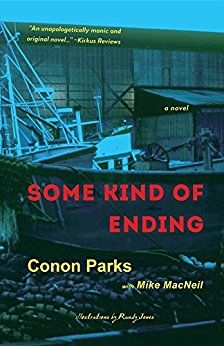
  • SOME KIND of ENDING by Conon Parks – Literary, Contemporary, Pacific Northwest

    SOME KIND of ENDING by Conon Parks – Literary, Contemporary, Pacific Northwest

    Blue and Gold Somerset First Place Winner Badge for Best in CategoryIf you were 18 or older in 1984, if you were from or migrated to Seattle in the latter half of the 20th Century, if you used far too many drugs, drank too much alcohol, thought Alaska was the Promised Land, thumbed your nose at the conventional American culture of the ‘80s, explored life aboard fishing boats, had too much sex, and had madcap adventures in global hotspots from Honduras to Cambodia, then you are the right audience for Some Kind of Ending by Conon Parks.

    Calling this book an experimental novel is appropriate; there is little approximating a cohesive narrative. But that’s not a bad thing. It’s the tale of several drunken, chemically dependent people—not the kind you would take home to Mother—who converge on Seattle in 1984, wind up on a variety of fishing boats bound to Alaska in search of great fortunes to be made from the fishing industry and return to Seattle. More specifically the dives and women of Seattle’s Ballard seafaring community. Nothing in common seems to draw them together except the desire to live according to their Rabelaisian taste for life.

    There are at least two explosions—one breaking out a colleague from a mental hospital, the other blowing up a submarine that may have rammed a Greenpeace sailing vessel and in turn, was blown up by another boat carrying an inordinate amount of military ordnance. There are fights galore, long meditations on the Foreign Legion, Gurdjieff, the Iran-Contra hearings, and disparaging comments about “Hanoi Jane” Fonda.

    The closest to recognizable characters may be Andre, a literate college drop-out with at least one prison sentence in his past; and Doug, an idealist from the Midwest. But even identifying those names gives no sense of the swirl of characters and stories that circle through this picaresque novel. Characters pop up like moles in a garden, or more appropriately, whack-a-moles.

    What is the book about? It’s a question not easily answered except to call it a diary, a 20th Century Samuel Pepys observation of a particular 1980s-based time and space. “Diatribe” is an equally applicable description. At one point, Andre reminisces about all the many images he has witnessed in his life, “from riots in Barcelona, to martial laws and Gestapo goons after the Kurds he was runnin’ within Istanbul, to Guatemalan guerillas and Mayan Indios, to Easy St. Louis hoods, to Israel and the West Bank, to Wounded Knee, to polio victims hobbling about with their knees above their ears.”

    Stream-of-consciousness at its best, Some Kind of Ending drives readers on a colorful, and somewhat perplexing journey of absurdism. Recommended.

    Parks won First Place in the 2017 SOMERSET Book Awards for Contemporary and Literary Fiction Novels for Some Kind of Ending.

  • JOURNEY Book Awards for Narrative Non-Fiction – 2018 Slush Pile Survivors

    JOURNEY Book Awards for Narrative Non-Fiction – 2018 Slush Pile Survivors

    The Journey Book Awards recognize emerging new talent and outstanding works in the genre of Narrative Non-Fiction and Memoir. The Journey Book  Awards is a genre division of Chanticleer International Book Awards and Novel Competitions (CIBAwards).
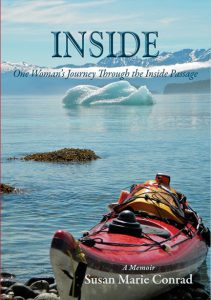
     

    These titles have moved forward in the judging rounds from SLUSH pile to the 2018 Journey Book Awards LONG LIST (aka the Slush Pile Survivors). We incorporate the Long List when the judges request an additional round of judging to accommodate the number and/or quality of entries received.  These entries are now in competition for the 2018 Journey Semi-Finalists List known as the SHORT LIST. Short Listers will compete for the limited First  Place Category Winners of the 2018 Journey Book Awards in the last rounds of judging and will be announced at the Awards Banquet and Ceremony on Saturday, April 27th, 2019.

    Chanticleer Book Reviews is looking for the best books featuring true stories about adventures, life events, unique experiences, travel, personal journeys, global enlightenment, and more. We will put books about true and inspiring stories to the test and choose the best among them.

    These titles are in the running for the SHORT LIST of the 2018 JOURNEY Book Awards novel competition for Non-fiction Fiction and Memoir!

    • Joy Ross Davis – Mother Can You Hear Me?
    • Cheryl Aguiar – Great Horned Owlets Rescue: Where There’s a Will, There’s a Way…
    • Sean Dwyer – A Quest for Tears: Overcoming a Traumatic Brain Injury
    • Philip Muls – Mind on Fire: A Case of Successful Addiction Recovery
    • H. Alan Day with Lynn Wiese Sneyd – Cowboy Up! Life Lessons from Lazy B
    • Andrew Jurkowski and Lisa Wright – Between The Swastika and the Bear: A Polish Memoir 1925 – 1948
    • Reanne Hemingway-Douglass – Baidarka Diaries: Voyages and Explorations: British Columbia and Alaska, 1992 – 2003
    • Donna LeClair – Waking Reality – Overcoming the Heartache of Abuse
    • Janice S. Ellis – From Liberty to Magnolia: In Search of the American Dream
    • Julie Morrison – Barbed
    • Kayce Stevens Hughlett – SoulStroller: experiencing the weight, whispers, & wings of the world
    • Liberty Elias Miller – The Heart of the Runaway
    • Jody Rae – Criminy Sakes Alive: And Other Generational Curses
    • Karen A. Anderson – The Amazing Afterlife of Animals; Messages and Signs From Our Pets on the Other Side
    • Kevin Howard – The Evolution of a Man
    • Abby Wilton – Machiavellian Bluff
    • Jeff O’Driscoll, MD – Not Yet
    • Dr. Rick Scarnati – Soul Explosion 2nd Edition
    • R. Scott Decker – Recounting the Anthrax Attacks: Terror, the Amerithrax Task Force, and the Evolution of Forensics in the FBI
    • Ellen Krohne – We Lost Her
    • GySgt L Christian Bussler – No Tougher Duty, No Greater Honor – a memoir of a Mortuary Affairs Marine
    • Terry Milos – North of Familiar: A Woman’s Story of Homesteading and Adventure in the Canadian Wilderness
    • Nick Delmedico – Biography
    • Carolyn Porter – Marcel’s Letters: A Font and the Search for One Man’s Fate
    • Dennis M. Clausen – Goodbye to Main Street
    • Russell Vann – Ghetto Bastard, A Memoir
    • Diane Pomerantz – Lost in the Reflecting Pool: a memoir
    • Rebecca Brockway – Miss Matched at Midlife: Dating Episodes of a Middle-Aged Woman
    • Austin M Hopkins – The Loose Ends Became Knots
    • Janis Couvreux – Sail Cowabunga! A Family’s Ten Years at Sea
    • Katrina Shawver – HENRY: A Polish Swimmer’s True Story of Friendship from Auschwitz to America
    • Carol Folbre, Ph.D. – Edge of Abundance: Asian Sketchbook
    • Donna LeClair – IMMUNITY: Entitlement of Wealthy Political Notables
    • Lou McKee – Klee Wyck Journal
    • Cheryl Hughes Musick – The Day the Musick Died

    The JOURNEY Long Listers will compete for the 2018 JOURNEY Short List. Short Listers will then compete for the First Place Category positions. The First Place Category winners will automatically be entered into the JOURNEY GRAND PRIZE AWARD competition.  The CBR Grand Prize Genre Winners will compete for the CBR Overall Grand Prize for Best Book and its $1,000 purse.

    All Short Listers will receive high visibility along with special badges to wear during the Chanticleer Authors Conference and Awards Gala.

    As always, please do not hesitate to contact us with any questions, concerns, or suggestions at Info@ChantiReviews.com. 

    Grand Prize Ribbons!

    Good Luck to each of you as your works compete for the JOURNEY Awards Short List. 

    The JOURNEY Grand Prize Winner and the Five First Place Category Position award winners will be announced at the April 27th, 2019 Chanticleer Book Awards Annual Awards Gala, which takes place at the Chanticleer Authors Conference that will be held in Bellingham, Wash. 

    We are now accepting submissions into the 2019 JOURNEY Awards writing competition. The deadline for submissions is April 30th, 2019. Please click here for more information. 

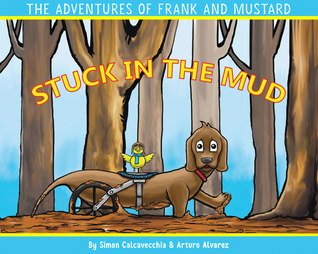
  • The ADVENTURES of FRANK and MUSTARD: STUCK in the MUD by Simon Calcavecchia, Illustrated by Arturo Alvarez – Children’s Literature, Encouragement Friendship

    The ADVENTURES of FRANK and MUSTARD: STUCK in the MUD by Simon Calcavecchia, Illustrated by Arturo Alvarez – Children’s Literature, Encouragement Friendship

    Little Peeps 1st Place Best in Category Blue and Gold Badge ImageThe Adventures of Frank and Mustard: Stuck in the Mud, written by Simon Calcavecchia and illustrated by Arturo Alvarez is a heartening picture book that tells the story of an afternoon spent between two friends, and what happens when one of them finds himself in need of help.
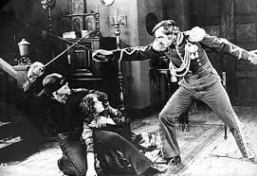
    Frank, a differently-abled wiener dog with wheels for back legs, and Mustard, a small yellow bird, are out adventuring when they find a new trail they want to explore. Everything is going wonderfully until Frank literally gets stuck in the mud. He tries his best to get himself out, and then Mustard helps him as well, but to no avail. Frank seems hopelessly stuck. Undaunted, Mustard has an idea and rallies a group of new friends to help them. For a brief while, Frank despairs that he’ll be stuck forever, but together they succeed in helping Frank pull himself out of the mud.

    Illustrated with bold, colorful images and large text bubbles, The Adventures of Frank and Mustard is an excellent, encouraging book to read with children ages three to five. The story is all the more affirming given the author’s own life and experiences. There are questions in the back to get young minds thinking and involved in the story. The action is easy to follow and the message is spot on: Sometimes we need a little help from our friends, and that’s okay. And when you succeed, celebrate!

    The Adventures of Frank and Mustard: Stuck in the Mud won First Place in the Chanticleer Awards category for Early Readers – Little Peeps – in 2016.

    5 Stars! Best Book Chanticleer Book Reviews


  • How to Write a Potent Action Scene by Jessica Page Morrell – Writing Craft Series

    How to Write a Potent Action Scene by Jessica Page Morrell – Writing Craft Series

    [fusion_builder_container hundred_percent=”no” equal_height_columns=”no” menu_anchor=”” hide_on_mobile=”small-visibility,medium-visibility,large-visibility” class=”” id=”” background_color=”” background_image=”” background_position=”center center” background_repeat=”no-repeat” fade=”no” background_parallax=”none” parallax_speed=”0.3″ video_mp4=”” video_webm=”” video_ogv=”” video_url=”” video_aspect_ratio=”16:9″ video_loop=”yes” video_mute=”yes” overlay_color=”” video_preview_image=”” border_size=”” border_color=”” border_style=”solid” padding_top=”” padding_bottom=”” padding_left=”” padding_right=””][fusion_builder_row][fusion_builder_column type=”1_1″ layout=”1_1″ background_position=”left top” background_color=”” border_size=”” border_color=”” border_style=”solid” border_position=”all” spacing=”yes” background_image=”” background_repeat=”no-repeat” padding_top=”” padding_right=”” padding_bottom=”” padding_left=”” margin_top=”0px” margin_bottom=”0px” class=”” id=”” animation_type=”” animation_speed=”0.3″ animation_direction=”left” hide_on_mobile=”small-visibility,medium-visibility,large-visibility” center_content=”no” last=”no” min_height=”” hover_type=”none” link=””][fusion_text]

    Action is eloquence. William Shakespeare, Coriolanus

    There are a few techniques it seems like I’m always passing on to my clients: amp up your verbs; use language and details to create more tension, and force scenes to rise. By ‘rise’ I mean writers need to thrust the drama level to a crisis, a confrontation, an explosion. Because in most scenes you’re aiming for the worst outcome.

    Components of an Action Scene

    Characters The main players in the scene with their key traits visible & engaged. Secondary characters need a reason for being.
    Setting The time, place and context in which the scene takes place. The setting is not just a backdrop; stage action scenes for maximum wattage.
    Scene Driver:  The inciting event/change/stimulus/threat.

    The event/stimulus/threat that starts the action rolling in the scene (action can be precipitated before the scene begins)

    Internal response

    External response


    How the main characters react emotionally to actions, threat, choice. How the main characters react physically–dialogue, movement, escape confrontation, fisticuffs. Typically there is a second driver (event or response)that starts the action.
    Goal What the main character decides to do as a reaction to the inciting event or threat.
    Consequence How the main character struggles to accomplish the goal.
    Resolution How the scene goal turns out–win, lose, draw, escape, disaster.
    • Three words to write by—cause and effect.
    • Action scenes are high stakes.
    • The action needs to build to a full boil crisis.
    • Whenever possible structure action scenes with a midpoint which is also a reversal.
    • Use all your tools to create a character’s emotional responses including, subtext, posture, facial expressions, gestures, mannerisms, eye movements, and voice quality. Voice includes pitch, the rate of speech (does the character talk fast when nervous?), and intonation.
    • As you write, imagine you’re holding a camera catching the action blow-by-blow.
    • With intense action, use short sentences to pick up the pace. Action scenes usually have a minimal amount of description unless it contributes to the scene. The scent of blood. The sound of a gun cocking, or the creak of a floorboard. This is not the place for describing the scenery or the characters.
    • Action scenes feature choppy and incomplete sentences. Such as, “What was that noise?” “What the . . .”
    • If the setting is complex and the action intricate, sketch out a map. Place coins or placeholders to mark your players, define the sight lines, scene’s boundaries (how far can a character reach?), and how long it might take to walk, run (or sneak) from point A to point B.
    • If the action is complicated, ask friends or family members to act it out so you can verify the sequence and reactions.
    • Read your dialogue out loud.
    • Use simple past tense verbs such as “kicked” or “punched” rather than those pesky ‘ing’ participles such as “kicking” or “punching.”
    • Your protagonist has skills, strengths, and weaknesses you can exploit and showcase. Foreshadow those traits throughout the story so when the reader reaches the action scene, he is expecting complications and credibility.
    • Scenes are never random events—they all need a logical connection to the storyline and to create ramifications.
    • Pay special attention to endings—they need weight, potency, and to reveal consequences.
    • Pacing is key but should be controlled by the scenes that come before and after. These will typically be slower to set up and react to the fight/conflict.
    • When writing fight scenes or violence, pack these scenes with an emotional punch too.
    • Read screenplays to digest the moment-to-moment breakdowns.
    • When you watch films study the reaction shots.
    • Some emotions in an action scene will be brief or fleeting.
    • When a gunshot is fired nobody has time to think. However, the body’s chemistry shifts to handle lethal threats, allowing the brain to process far more information in a shorter period of time.
    • Keep in mind that action scenes happen at several levels and much of the fight needs to be about internal changes, the inner world of the protagonist.
    • During revisions fine tune character’s emotional reactions so they’re unique, fresh, and individual. This aspect of revision can be difficult, but it is crucial.
    • Make certain you can justify carnage and bloodshed.
    • Don’t bog down the sequence with too much technical description. Show who has the upper hand, rack up the tension to the nines and tap into the motivations of the character readers root for. And if someone gets punched or shot or knocked to the ground, readers should feel it too.
    • Utilize all the senses and never rely solely on the physical description.

    The next article from Jessica Page Morrell will include an example of screenplay action from Air Force One by Andrew Marlowe.

    Jessica Page Morrell is a top-tier developmental editor and a contributor to Writer’s Digest magazine,  and she teaches Master Writing Craft Classes at the Chanticleer Authors Conference that is held annually.

    Jessica Page Morrell
    Jessica Page Morrell

    Jessica understands both sides of the editorial desk–as a highly-sought after content development editor and an author. Her work also appears in multiple anthologies and The Writer and Writer’s Digest magazines.  She is known for explaining the hows and whys of what makes for excellent writing and for sharing very clear examples that examines the technical aspects of writing that emphases layering and subtext. Her books on writing craft are considered “a must have” for any serious writer’s toolkit. For links for her writing craft books, please click on her above. 

    Chanticleer Reviews and OnWord Talks will interview Jessica for more of her writing tips and advice. Stay tuned! ~ Chanticleer

    We are planning a writing craft workshop soon that will be taught by Jessica.[/fusion_text][/fusion_builder_column][/fusion_builder_row][/fusion_builder_container]

  • DRAGON ASCENDANTS (Luminess Legends Book 1) by Paul E. Vaughn – Epic Fantasy, Paranormal & Urban , Young Adult

    DRAGON ASCENDANTS (Luminess Legends Book 1) by Paul E. Vaughn – Epic Fantasy, Paranormal & Urban , Young Adult


    Dragon Ascendants, Luminess Legends Book 1 WON First Place in the CIBA 2018 OZMA Awards for Fantasy Fiction. Congratulations!


    A boy comes of age when he learns his true heritage in a magical, mountainous land of dwarves, elves, men, and dragons, which is threatened by a powerfully malevolent force.

    Tallian is the adopted son of Meerkesh, a dwarf whose wife died when his only child, Killmesh, was just five years old. Killmesh and Tallian are the same age – 18 – but have very different personalities. Killmesh tries to please his father, but his responsibilities are almost overwhelming as the apparent heir to the role his father holds as Spokesman for their burrow.

    Tallian works with all the others in the gem mines of the Furin Mountains, and because he towers over his co-workers, he works faster and finishes sooner than the others. Tallian spends his spare time walking alone in the woods where he discovers a dragon he names Emerald Wildfire.

    When terrifying bats formed of rocks invade the burrows, things go from bad to worse. Killmesh, charged with guarding wagonloads of jewels, is drawn away by a villain who shows him an axe he longs to buy. It’s a set-up. While he is gone, all the gems go missing. Killmesh can’t take the disgrace. He runs away, finds the axe and uses it for violence, which he finds very satisfying. He joins up with the evil elf-dragon monster Fearoc, who is bent on finding Tallian’s birth parents. They slipped from his cruel grasp 18 years before, and he has vowed savage vengeance.

    Meerkesh, seeing the desperate situation in the burrows, finally tells Tallian the story of his origins, setting the stage for a colossal battle between Tallian with his dwarf family and the dreaded Fearoc and his minions.

    Dragon Ascendants (Luminese Book 1) is a well-constructed soon-to-be-classic YA fantasy by debut author Vaughn, who envisions this as the first part of a series. He has carefully laid the scene: Tallian, aided by his brash but brave friend Briskarr and Briskarr’s gentle sister Briska, faces a barrage of challenges from Fearoc, with more to be revealed in future volumes of the Luminess saga.

    Vaughn conveys a steady, credible view of his mystical setting. Tallian is a readily likable hero, someone who has such love for his adopted dwarf clan that he will do everything in his power to save them. Killmesh, by contrast, is disturbed and impulsive, driven by some anger within that causes him to wreak havoc among his kin.

    Magic interspecies transformations, sparkling gems, and powerful weapons that make great mischief in the wrong hands all underpin Vaughn’s plot, resulting in a fast-paced page-turner for every age.

  • CYGNUS Book Awards for Science Fiction – 2018 Slush Pile Survivors

    CYGNUS Book Awards for Science Fiction – 2018 Slush Pile Survivors

    Cygnus Award for Science FictionThe Cygnus Book Awards recognize emerging new talent and outstanding works in the genre of Science Fiction, Steampunk, Alternative History, and Speculative Fiction.  The Cygnus Awards is a genre division of Chanticleer International Book Awards and Novel Competitions (CIBA).


    These titles have moved forward in the judging rounds from SLUSH pile to the 2018 Cygnus Book Awards LONG LIST. We incorporate the Long List when the judges request an additional round of judging to accommodate the number and/or quality of entries received.  These entries are now in competition for 2018 Cygnus Semi-Finalists List known as the SHORT LIST. Short Listers will compete for the limited First  Place Category Winners of the 2018 Cygnus Book Awards in the last rounds of judging and will be announced at the Awards Banquet and Ceremony on Saturday, April 28th, 2019. 

    Chanticleer Book Reviews is looking for the best books featuring space, time travel, life on other planets, parallel universes, alternate reality, and all the science, technology, major social or environmental changes of the future that author imaginations can dream up. Hard Science Fiction, Soft Science Fiction, Apocalyptic Fiction, Cyberpunk, Time Travel, Genetic Modification, Aliens, Super Humans, Interplanetary Travel, and Settlers on the Galactic Frontier, Dystopian, we will put them to the test and choose the best among them.

    These titles are in the running for the SHORT LIST of the 2018 Cygnus Book Awards novel competition for Science Fiction!

    • Andrew Lueders – Youth Patrol
    • Matthew D. Hunt – Solar Reboot
    • Mark Daniel Seiler – River’s Child
    • Samuel Winburn – Ten Directions
    • Rhett C Bruno – Titan’s Wrath
    • Catori Sarmiento – The Fortune Follies
    • Paul A. Vasey – Trinity’s Legacy
    • Isadora Deese – Right of Capture
    • Jim Cronin – Recusant
    • Phillip R. Onagan – Within The Gambit
    • O@4 – Europe United
    • Stu Jones & Gareth Worthington – It Takes Death to Reach a Star
    • Ryan London – Pillars of the Mortal Monarchies
    • Pamela LePage – Virtuous Souls
    • Richard Mann – Zeus 25 – Jory and Zenobia
    • Denise Lammi – Lucid World
    • M.Black – Electric Gardens
    • Mark Daniel Seiler – River’s Child
    • Daniel Zadow – Pigeon
    • Elizabeth Crowens – Silent Meridian, Book 1 in the Time Traveler Professor series
    • Elizabeth Crowens – A Pocketful of Lodestones, Book 2 in the Time Traveler Professor series
    • Gareth Worthington – Children of the Fifth Sun
    • KB Shaw – From the Shadows 
    • Sarah Katz – Apex Five
    • Lou Dischler – Meet Me Under the Comet
    • Cary Allen Stone – Seeds – The Journey Begins
    • Justine Avery – The One Apart: A Novel
    •  J. I. Rogers – The Korpes File
    • Timothy Vincent – Jack Out of the Box
    • Alexander Edlund – Keelic and the Pathfinders of Midgarth
    • Ted Neill – The Selah Branch
    • E.C. Fisher – The Deceived
    • Isadora Deese – Right of Capture
    • Megan Wetzel – Abandon
    • G.R. Morris – Tomorrows End

    The CYGNUS Long Listers will compete for the 2018 CYGNUS Short List. Short Listers will then compete for the Semi-Finalists positions. The Semi-Finalists will compete for the First Place Category positions. The First Place Category winners will automatically be entered into the CYGNUS GRAND PRIZE AWARD competition.  The 16 CBR Grand Prize Genre Winners will compete for the CBR Overall Grand Prize for Best Book and its $1,000 purse. The CIBA Awards!

    Bennett Coles, CYGNUS Grand Prize Winner for his VIRTUES OF WAR series that was picked up by TITAN BOOKS U.K. for a three book series and recently by  Harper Collins.

    All Short Listers will receive high visibility along with special badges to wear during the Chanticleer Authors Conference and Awards Gala.

    As always, please do not hesitate to contact us with any questions, concerns, or suggestions at Info@ChantiReviews.com. 

    Grand Prize Ribbons!

    Good Luck to each of you as your works compete for the CYGNUS Awards  Short List. 

    The CYGNUS Grand Prize Winner and the Five First Place Category Position award winners will be announced at the April 28th, 2019 Chanticleer Book Awards Annual Awards Gala, which takes place at the Chanticleer Authors Conference that will be held in Bellingham, Wash. 

    We are now accepting submissions into the 2019 CYGNUS  Awards writing competition. The deadline for submissions is April 30th, 2019. Please click here for more information. 


  • ADVENTURES in SELF-PUBLISHING, #1: VANQUISHING the FEAR by Gail Noble-Sanderson – Self Publishing, Marketing, Moving Beyond Fear

    ADVENTURES in SELF-PUBLISHING, #1: VANQUISHING the FEAR by Gail Noble-Sanderson – Self Publishing, Marketing, Moving Beyond Fear

    We can do nothing, including taking risks, if fear is our overriding emotion. Fear is paralyzing and certainly, there are many of us who write that feel fear around the edges of our egos and emotions as we put pen to paper, share our work with others, send a letter to an agent, speak with a publisher or, even vaguely consider self-publishing our own work.

    You’ve GOT THIS!

    Moving through our fears is the only way to the other side where we can step fully forward making choices true to who we are.

    Many years ago, on Sunday afternoons when living in Maryland, I would pack up my two young daughters and, along with my guitar, we would visit with the very elderly in a nearby long-term care facility.  Although these senior folks could no longer carry on conversations regarding the present, they could remember the words to the old hymns, singing along as I strummed my guitar and my small girls dispensed hugs all around.

    I continued these weekly visits over several years becoming familiar with the relatives of these precious people and much about the lives they had lived.  I became especially close to a woman of 80 years named Calle.  Fragile of body, but sharp of mind, displaying a caustic wit and a no-nonsense approach to all of life, she was the last person whom we visited on those Sundays.  Calle was not especially social and did not attend the hymn singing as she was still living in the present and very conversive. All her friends had passed on and her two sons lived quite a distance away, seldom visiting their mother. We became fast friends.

    Calle was a woman ahead of her time.  She went to university and studied nursing and radiology. Radiology technology in the early 1900’s was a field in which she worked for over forty years.  She would tell me of the challenges of working in a profession primarily occupied by men and how her fiercely competitive nature and desire to constantly learn, often got her “into trouble.”

    She was never afraid to pursue excellence, never afraid to take risks.

    Calle thought me a fine young woman but extremely meek.  She persisted in challenging me to think about my own future.  What were my dreams and aspirations in addition to being a mother? I told her I loved playing music, writing songs, poetry, and stories.  And that because I stuttered, I wanted to someday go to college and become a Speech-Language Pathologist. She told me that “someday was here” and I was to plot a plan for how my future dreams were to be accomplished.  I told her I was afraid.  Afraid my husband would object to my going to university, afraid I would be seen as a negligent mother, afraid I wasn’t intelligent enough, afraid my music and writing would be found wanting by everyone – especially me.  With a great sigh, Calle asked me what I was NOT afraid of and I should start there.

    • Can you identify your fears related to your writing?
    • Where, as a writer, does your confidence lie?
    • Do you aspire to self-publish your stories, poems, novel, memoir, non-fiction – whatever you are wanting to publish?

    It is important first to recognize all your strengths and make them work for you.

    Gail Noble-Sanderson

    If you have entertained the thought that you might want to self-publish, I am here to tell you it is not rocket science (although I’m sure you could do that as well).  If you have done all the hard work of research, writing, and editing and are ready to send your work out into the world, then you can certainly self-publish.  Especially if you have attempted over some time to find an agent and/or publisher and there has been no forward movement. Or if you have spoken with other self-published writers, some of whom were published with a publishing house and later decided to self-publish, or if you feel strongly that you want to retain control of and manage your work from the beginning and thinking self-publishing is best for your vision.

    A few days before we moved to Washington state, I said my good-byes to Calle. I asked her if she had to live her life over what would she do differently.  She fiercely took hold of my hands and said, “I would have vanquished fear and taken more risks.”

    So, if you are considering the option of self-publishing your work, walk through the fear because, truly, it is not the difficult, frightening process some would lead writers to believe.  The next article in this series will look at where to begin and how to proceed when you decide to publish your own work.  Remember, “keep falling in love with the potential of what you are doing” and move you and your work forward without fear.

    Read the follow up to this article here.


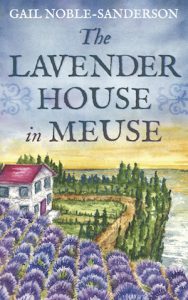
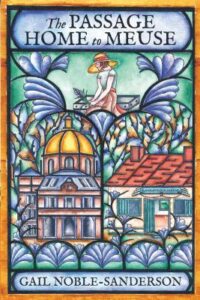
    Gail Noble-Sanderson is the author of two works of historical fiction, both of which are self-published under her own Noble Press.  The Lavender House in Meuse is an emotional, intriguing, and sensitive account of the crises of World War I and one woman’s journey towards recovery and growth. Her second novel, The Passage Home to Meuse 

    won 1st Place in the 2017 Chatelaine Awards, the Chanticleer International Writing Competition for romantic fiction.

    Both books are available through Amazon and Village Books.

    Visit Gail’s homepage at http://gailnoblesanderson.com/ and follow her on social media.

  • NEW YORK CITY BUM: A NEW AGE JOURNEY THROUGH the SEWERS of PARADISE – Ten Years on the Streets of New York City by David Boglioli – Memoir, Social Science, Poverty/Crime

    NEW YORK CITY BUM: A NEW AGE JOURNEY THROUGH the SEWERS of PARADISE – Ten Years on the Streets of New York City by David Boglioli – Memoir, Social Science, Poverty/Crime

    Portrayals of bums and hobos in American culture are often comic (Red Skelton’s “Freddie the Freeloader,” carefree (Rodgers and Hart 1932 song, “Hallelujah, I’m a Bum,”) or sociological (“Hobos, Hustlers, and Backsliders” by Teresa Gowan).

    Not so in David Boglioli’s first-person narrative of ten years spent on the streets in his aptly titled New York City Bum (Midway Books, 2017): in turn a memoir, guidebook, and first-person exploration of Dante’s Inferno, 20th-century style.

    Readers may want to listen to Lou Reed’s classic street ode, “Walk on the Wild Side” to get into the mood for this book.

    Boglioli started using crack cocaine in the mid-1980s. A highly successful chef (New York’s Ritz Carlton Hotel, among others) from an affluent background, well educated, living the life in a luxurious apartment, he was dissatisfied with his well-appointed life. The “netherworld,” as he calls it, fascinated him: “The street was the gutter, the very bottom of the barrel, always a trek through new territory where experience, caution and instinct are one’s only guide… A long way from anyplace with places that might not even exist. Such was my challenge; my catharsis. My escape.”

    He becomes a bum by choice, with his crack habit as his mentor, releasing the person inside—the person trapped by his Middle-class American roots. He offers no apologies nor excuses for his downward spiral. Instead, he embraces his desire for more, always more of the life. Whether it is trashing several apartments, a methodical listing of all the places for him to score dope, his seemingly endless friendships with hookers that were more about using drugs together than sex, and the sheer paranoia interwoven with his lifestyle of choice, he sets out on his newly chosen life with the intimacy of a diary and the mindset of a reporter.

    The greatest surprises of this book may be his portrayal of how he and his fellow bums find shelter and work in the often-squalid streets of Manhattan. He describes every conceivable way that people survive, from cardboard “houses” to charitable housing provided by churches and other institutions. It is possible to be a bum and yet find life’s basics—provided, of course, that the self-destructive behavior on his part and at the hands of others that went with The Life didn’t destroy these respites from the streets.

    He also shows the many jobs that street people have access to, from fast food places to hotel services, putting enough cash in their collective pockets so they can score more dope. “One’s entire waking existence, which was often incessant for days at a time, was directed towards getting high. Get the money, cop, get off.” He shows how selling stuff, often his own as well as someone else’s, provides a steady cash flow. At one point he makes money by renting out his apartment by the half-hour to crack users or whores. The jobs are there if you know how to find them.

    With all the lengthy description of his life of choice, he is somewhat chaste while describing his personal cravings. He gives us all-too-brief glimpses of his coming out as a cross-dresser and some vague references to his pansexuality, but he gives us few glimpses of his intimate relationships. A typical peek-a-boo remark on the women in his life goes something like this: “Although my steady girlfriends were top of the line, I too enjoyed the scuzziest of skanks, depending on my current level of degeneracy. From five star to closed by order of the Board of Health.”

    Whether he is describing his many walkabouts in New York’s streets or detailing the many ways that people ingest crack, he writes with an almost manic level of detail. He wants us to see his world precisely as he sees it. And while he mostly paints his life and his fellow bums with broad strokes, there are some downright frightening gems, such as the whores who are happy to have contracted AIDS so they can have a warm, safe place to stay and get off the hustle—for a while, that is.

    There is no simple way to explain how his street life ends for him, other than the reality that he had lived it as much as he could. There is no magic friend, family member or therapist, only a bird, some hamsters and his discovery of “the kid” within him that takes him from his mean streets to the streets where most of his readers are only too happy to live.

    A gritty, hard-knocking plunge into the gutters of New York City in Boglioli’s self-inflicted journey to hell and his subsequent rise. A Dante’s Inferno for the 21st century.

    Highly recommended.


  • 10 Questions – Author Interview: Paul Aertker Shares His Marketing Tips, Struggles, and  Inspirations

    10 Questions – Author Interview: Paul Aertker Shares His Marketing Tips, Struggles, and Inspirations

    Meet Paul Aertker, 2017 Grand Prize Winner in the
    Chanticleer Gertrude Warner Awards

    I first met Paul Aertker when we were in Portland Oregon last year. My first impression: Dynamic, Intelligent, Generous. In short, I am so glad we met! When I found out he was coming to our Chanticleer Authors Conference, CAC18, and that he was indeed in the running for an award – I was thrilled.

    Paul is an amazing human being – but don’t take my word for it! Find out for yourself! Read on and be sure to comment at the end – and share if you like.

    Chanticleer: Paul, tell us, how did you start writing?

    Aertker: I started writing on September 12th—the day after 9/11. I guess I saw what the world had become or rather, what adults were capable of doing, and I thought maybe I should focus on kids and maybe kids could make things better. So that’s how I got started writing.

    Chanticleer: That’s amazing, Paul. Thank you for taking action in this way. What led you to the middle-grade crowd? 

    Aertker: I write middle-grade books mostly because I act like an 11-year-old. No, but seriously, I do. I enjoy working with and writing for the middle grades for several reasons. Nine to twelve-year-olds are at a perfect stage in life—before the challenging ages of young adult, yet they are still old enough to understand what’s going on in the world, and most importantly, they get my jokes!

    Chanticleer: You’re right! What inspired you to write this particular series, The Crime Travelers? I hear, by the way, that this series is doing quite well…

    Aertker: I think most everything I write is about travel. The Crime Travelers series is about international action adventure—”like the Bourne Identity but for kids.” What’s more, this new book Posthumous is about an American family in Paris, and the mother dies, and the dad and daughter move back to the US. I think of travel as a catalyst for writing, a means of generating ideas mostly because I see reading and writing as a form of travel.

    Chanticleer: Oh, good answer! Reading is the best form of escapism. Give us five authors whom you would love to meet on your travels – and tell us how they have influenced your work.

    Aertker: What I’ve done is a little different from most children’s book writers. I love Roald Dahl and Margaret Peterson Haddix and Rick Riordan and Gordon Korman and the rest. However, most of my influence comes from the adult authors who write international and action adventure novels—specifically, James Patterson, Robert Ludlum, Lee Child, John Grisham, etc. I like these guys, and I like their work. In the Crime Travelers series, I bring the action and adventure of adult novels into the kid world.

    Chanticleer: I think Middle-Grader readers are ready for these books. Look at their video games! Tell us a little about areas of writing you feel most confident in – and what advice you can give someone who is struggling in this area. 

    Aertker: I’ve gotten much better at getting the words on the page. I used to struggle to create a lot of volume of pages.  But, I have a trick that has helped me. I think we all struggle with the internal critic telling us that we are not good enough or whatever we’ve done is terrible. We all have this. Sometimes I find that I cannot sleep so instead of tossing and turning, I will get up, put on my glasses, and sit at my desk. I’ll write in the middle of the night for hours. And what I’ve learned is that my internal critic doesn’t get up with me! He’s too tired to criticize. So I write for a while and then go back to sleep. In the morning I wake up and notice that someone has written in my document! Yes, sure it needs work, but editing seems to be easier than cranking out the first draft.

    Chanticleer: Good advice – If your inner critic is too loud, wait until it passes out, and then write. So, I hear you sell a lot of books… Which business books have helped you the most?

    Aertker: I think one of the best business books for writers is Tim Ferriss’s 4-Hour Work Week. We all know that we will not work just four hours a week. Writing has no end. We know this. What I took from this book was that it’s important to delegate tasks. You need to hire an excellent cover designer, and you need a good interior designer for your book… You also need a developmental editor, a copy editor, and a proofing editor. Then you need to assemble a team of beta readers. And, and, and. The point being: ask (or hire) others to help.

    Chanticeer: What do you do in your community to improve/promote literacy?

    Aertker: I frequently speak at local schools whether I’m in my hometown or traveling to a new place. I love speaking to classrooms and bringing excitement to books and reading. I promote reading for the sake of reading. Period. I think it’s important for kids to enjoy the activity. If we want kids to read great literature and to be healthy adult readers, we have to get them to like reading, first.

    Chanticleer: Love your passion for reading and helping kids discover the joy of reading. Give us your best marketing tips, what’s worked to sell more books, gain notoriety, and expand your literary footprint.

    Aertker: The single best marketing tip for me has been to give my books away. I give mostly to teachers, fourth, fifth and sixth-grade teachers, and to librarians. If you’re a teacher, please write me, and I will send you a set of books for free. Yes for free! The reason being that a set of books in a teacher’s classroom is without question the best calling card I could ever have. I often have teachers write me back and say, “Oh thank you so much for sending the books. The kids are fighting over them!” That is awesome marketing. (Reach Paul at https://www.paulaertker.com/)

    Chanticleer: Wow! Well done. So, what are you working on now? What can we look forward to seeing next from you?

    Aertker: I am super excited about this next book coming out called, Posthumous. It’s a book about a 12-year-old girl who wants to publish her late mother’s stories. It’s one of those books that I wrote in the middle of the night, and I think it’s the best thing I’ve ever written. It’s sad and sweet, and it’s all about the kids making things right.

    Chanticleer: I think we will all want to read this one. Please keep us updated. What is the most important thing a reader can do for an author?

    Aertker: The most important thing a reader can do for an author? That’s easy. Write a review! I am amazed at how critical getting reviews are, and how difficult it can sometimes be to get people actually to go on Amazon and write the review.

    Chanticleer: Paul, it’s been a pleasure. Thank you for spending some time with us. You are a bright star in the universe! 

    Okay, now it’s your turn… If you have a question for Paul Aertker, please feel free to comment on this post or reach him directly through his website https://www.paulaertker.com/.  If you enjoyed this interview, please SHARE it! Sharing is Caring, baby.

    Paul won the 2017 Grand Prize Gertrude Warner Award for Middle-Grade Books because he entered the contest! If you have a middle-grade book the world needs to see, enter the competition here.  The deadline is fast approaching – May 31, 2018.