Drawing on fact, fable and inherited lore, author Bruce Wilson has created an imaginative, at times unsettling view of upheaval in southern American history and its effects on local culture, economy and family ties.
With a large brood to care for, Wes Wilson grows tobacco in a region known as the Dark Patch, a cluster of counties in Kentucky and Tennessee. Their way of life suddenly comes under threat when the greedy reach of the newly burgeoning American Tobacco Company seeks a monopoly on the crop.
In a powerful pushback, zealous local farmers form an Association sworn to combat ATC’s grip on their livelihood. To join the Association, or to ally with ATC, becomes Wes’s obsessive dilemma. Day by day he calls on his brother, cousin, and friends to see which way they are tending. Night by night he and his son Anthie keep vigil with firearms, lest their property becomes one of the targets of the Association, which menaces, even destroys, farms whose owners, like Wes, are still uncommitted in their loyalties. Wes’s steadfast wife Zora carries on the ceaseless round of women’s tasks, worrying and praying as she sees Wes more likely to take comfort from whiskey than from the Lord. The situation grows daily more perilous until Wes realizes that someone he believed he could trust with his secrets has turned traitor, and hell finally breaks loose.
Author Wilson, a History Teacher by trade, has pieced his novel together from tales told by his father and a few snippets of evidence detailing his forebears’ involvement in what became known as the Black Patch Tobacco Wars of 1904-1909. Wilson’s settings and dialog are well rooted in the time and region. His ability to delve into the minds of his characters is a notable strength.
Wes is introspective but gutsy—willing to step outside the comfort of his culture to examine all sides of the questions he faces while defending his homestead and family at any cost. Zora is the long-suffering partner who knows her husband as both a hard-drinking man with a deep well of anger and a hero who will put himself at risk to maintain his responsibilities. Their oldest boy, Anthie, is in love, and, seeking more time to pursue romance, often resents his father’s domination, while stolidly obeying him. Others add to the suspenseful plot creating depth and intrigue that will likely thrill readers.
Wilson’s Death in the Black Patch is historical fiction at its best, melding a little- known patch of the big American picture with an exploration of one man’s willingness to fight corruption, destruction, and greed with the few weapons at his disposal—weapons that include a dogged determination to do what is right.
Death in the Black Patch by Bruce Wilson won 1st Place in the 2017 CIBAs for American Western Fiction, the Laramie Awards.
What is it about a particular manuscript that makes it interesting to a literary agent (or the agent’s slush pile reader), acquisition editor, or professional reviewer?
While it may take more than a crystal ball to figure out exactly what lit agents and publishing houses acquisition departments want and let alone reviewers, guidance can be had. Line editors do understand what these gatekeepers want to see and, perhaps more importantly, what they do not want to see in a manuscript.
Advice from line editors can be an author’s first line of defense in climbing out of the slush pile to gaining a gatekeeper’s interest. No crystal ball required.
Jessica Morrell, a top-tier developmental editor for major authors and publishing houses, knows what these gatekeepers are seeking along with what makes them cringe.
Editors, agents, and reviewers are word people, most were English or journalism majors in college and have a great love and respect for the written word. They will notice your level of craft within the first sentences, so your efforts must be polished, vivid and exceptional.
Craft Tips & Techniques by Jessica Morrell, Editor
(with Added Comments, from Kiffer Brown, publisher of Chanticleer Reviews magazine)
Your manuscript lives or dies on your opening sentencesand each word must be perfect, precise, and weighted with meaning.
(Most slushers (who work for agents and acquisition departments) do not read past the few pages of a manuscript. Don’t blame them for not reading more of your manuscript. Slushers have more works than they can possibly read in a month but have to slush in a given day. It is the writer’s job, neigh duty, to keep the slusher engaged. Slushers are professional readers who are panning for “gold and gems in the raw.” This system is by design, btw.)
Editors notice and are turned off by passive voice and wimpy verbs.
(Enough said.)
Editors notice when the viewpoint jumps or shifts within a scene.
(This is a pet peeve of professional reviewers—an indication of lack of writing craft and skills.)
Editors notice too much telling (reporting or summary) and not enough showing in all types of writing including essays and memoir.
(A line editor can help with too much telling with comments and questions.)
Editors notice when emotions are announced instead of dramatized.
(Reviewers call this “lazy writing.”)
Editors notice the frequent use of names in dialogue. Generally, leave out names.
(Multiple names, especially names that are similar, are irritating to reviewers. When the reviewer has to make notes about who is whom it had better be for furthering the plot significantly.)
An editor notices sloppy punctuation such as excessive use of exclamation points, quote marks around inner thoughts, improper use of semicolons and ellipsis.
(Reviewers see this as the author not being professional about the work (or his or her writing career) to have it professionally proofed – the most basic type of editing.)
Editors notice protagonists who are not proactive, heroic in some way, and bigger than life. (
Reviewer’s Mantra – Novels are depictions of life without the boring bits.)
Editors notice characters with a limited emotional range and expression.
(One-dimensional character and cardboard characters are uninteresting.)
Editors notice large and small inaccuracies and inconsistencies—when the character has blue eyes on page 23 and green eyes on page 57; when a character drives an old, beat-up, pick-up truck that is inexplicably equipped with airbags; when an animal, plant, or species of any sort is misnamed or shows up in the wrong region of the country.
(Did the author care enough to do the background research for the work? These technical details’ correctness can make or break the construct of a story.)
Editors notice when technical details don’t ring true—such as in a mystery when police don’t follow standard arrest procedure; or when a yacht sinks from a single bullet hole; or explosive materials are used haphazardly. (See comment above.)
Editors notice vague descriptions (plant instead of ivy, a tree instead of oak) and generalities instead of details that bring the reader into a specific time and place.
(Vague descriptions are perceived as lazy writing which is not a reputation that an author would want to be known for.)
Editors notice when writers don’t write for all the senses, especially leaving out smells.
(This is called the white room syndrome and it makes a manuscript about as boring to read as an old school telephone book.)
Editors notice small confusions such as misusing it’s and its, that and which, affect and effect, compliment and complement, lay and lie.
(With tools (apps) such as Grammarly and Grammar Girl, there is no reason for these misuses to occur. Additionally, these basics are covered thoroughly in The Elements of Style, a slim tome that is indispensable writers.)
Editors notice overly long paragraphs and a general lack of white space. Generally, paragraphs are five or six sentences long and as taught in grade school introduce a topic, develop a topic, then conclude or lead on to the next paragraph.
(Edit, delete, cut your word count—as Stephen King says, “Kill your darlings.” The rule of thumb is that most manuscripts can be cut by 20 percent.)
Editors notice a lack of transitions—the words and phrases that announce a change in mood or emotion, time, and place so the reader can easily follow. They also know excess transitions as when you follow your characters across every room and along every sidewalk.
(Use transitions as you would salt and pepper—just enough but not too much. The correct amount of transitional phrases are the hallmark of solid writing.)
Editors notice excess modifiers, purple prose, and too much description. The best writing is lean and economical and every word in every sentence has a job to do.
(Yes! Every word must move the story forward.)
Editors notice a voice that is flat, inappropriate, or boring. Voice, whether it is the writer’s voice in an essay or the viewpoint character or narrator in fiction, must breathe life into the piece and hint at the person behind the words.
(Writing styles can mimick the guests at a cocktail party. There is always the bore who goes on and on and usually in too much detail also. The bore is the one guest who is the least tolerated even more so than the boisterous, the chatty, the tipsy, and even the know-it-all. But everyone loves the one who can tell a good story, or the who has a bit a mystery, and the one who is interested in others and respects others is always invited back. Respect your readers with your writing and your writing will earn respect.)
Chanticleer Editorial Services
Did you know that Chanticleer offers editorial services? We do and have been doing so since 2011.
Our professional editors are top-notch and are experts in the Chicago Manual of Style. They have and are working for the top publishing houses (TOR, McMillian, Thomas Mercer, Penguin Random House, etc.). If you would like more information, we invite you to email Kiffer or Sharon at KBrown@ChantiReviews.com or SAnderson@ChantiReviews.com for more information, testimonials, and fees.
We work with a small number of exclusive clients who want to collaborate with our team of top-editors on an on-going basis. Contact us today!
Chanticleer Editorial Services also offers writing craft sessions and masterclasses. Sign up to find out where, when, and how sessions being held.
Writer’s Toolbox
Thank you for reading this Chanticleer Writer’s Toolbox article.
Scot Hodkiewicz thought he had his life planned out to the last detail, but a few seconds of horror on the highway would change everything.
Award-winning author Hodkiewicz was a veterinarian with a beautiful wife, Mona, who participated in his practice, three children, two dogs, and a vacation cottage. They were all returning from some seasonal maintenance to that cottage one Sunday morning when a drunk driver crossed the median and rammed into their car.
Hodkiewicz passed out almost instantly from the pain of the impact. His wife Mona was also knocked unconscious, leaving their oldest child, ten-year-old Alexa, to help the EMT team gain entry to the car. The children were miraculously the least inured; they and their mother were rushed to the nearest hospital while Scot had to be extracted with the “Jaws of Life” and air-lifted by one of the many “angels” the family encountered in this time of life-threatening peril.
The author sustained the worst injuries from the accident, with a crushed leg that would eventually lead to dependence, for a time, on painkilling meds. As he notes: “Within a few seconds, we had gone from a normal, healthy family traveling with hundreds of other cars down the highway to a mangled mess of broken and battered bodies.” Little did they know at the time, worse was to come.
In the ensuing weeks and months, the family became more attached to their church and spiritual practice. This link to God, in Scot’s case, almost a conversational connection, would become even more vital when they found that there was more trouble ahead.
Their struggle with the various diagnoses, hopes, false hopes, and deceptive despair remarkably brought a new kind of shared strength. When Mona learned that the crash injuries were just the start of her struggles, she took to heart what her husband had been telling her. She began to personalize the idea that everything that happened was part of God’s plan. The accident itself, world-shattering as it was at the time, was a blessing in disguise and how God chose to reveal His true plan for them; a plan that was so much better than their own.
Now Hodkiewicz avows that he has become more diligent in watching after sick animals and is, in general, more charitable toward his fellow humans. After their church gifted the family food until they were able to take care of their own needs, he followed their example, giving money and other assistance to those he encountered in need. Even Alexa, now in her teens, felt this impulse, involving the family in mission trips.
Hodkiewicz writes with singular conviction and self-abnegating humor that gradually reveals his faith in God’s plans for true happiness in place of his own schemes for worldly success. His medical acumen provides the reader with a wealth of detailed information about the injuries that he and his wife sustained, and his sense of justice allows him to acknowledge that the person from whom he learned most in all this terrible trauma was the man who so carelessly drank, got behind the wheel, and nearly destroyed five lives.
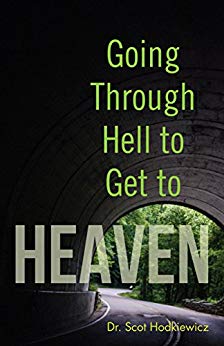
Going Through Hell to Get to Heaven is a memoir about love that moves from one person to another in the form of grace, and about a family that came to see the actions of ordinary people as angelic and divinely purposed. The ordeal and subsequent blessings that Scot and Mona have experienced can, hopefully, inspire others.
Going Through Hell to Get to Heaven by Dr. Scot Hodkiewicz won 1st Place in the CIBA 2017 Journey Awards for Narrative Non-Fiction.
The Goethe Book Awards recognize emerging new talent in post-1750s Historical Fiction. The Goethe Book Awards is a division of the Chanticleer International Book Awards (The CIBAs).
The Goethe Book Awards competition is named for Johann Wolfgang von Goethe who was born at the dawn of the new era of enlightenment on August 28, 1749.
Chanticleer International Book Awards is looking for the best books featuring Late Period Historical Fiction. Regency, Victorian,18th Century, 19th Century, 20th Century, World and other wars, history of non-western cultures, set after the 1750s, we will put them to the test and choose the best among them.
These titles have moved forward in the judging rounds from SLUSH pile to the 2019 Goethe Book Awards LONG LIST. These entries are now in competition for 2019 Goethe Shortlist. The ShortListers’ works will compete for the Semi-Finalists positions.Semi-Finalists will be announced and recognized at the CAC20 banquet and ceremony. The First Place Category Winners, along with the CIBA Division Grand Prize winners, will be selected from the 16 CIBA divisions Semi-Finalists. We will announce the 1st Place Category winners and Grand Prize Division Winners at the CIBAs Banquet and Ceremony on Saturday, April 18th, 2020 at the luxurious Hotel Bellwether in Bellingham, Wash.
These titles are in the running for the SHORT LIST of the 2019 Goethe Book Awards for post-1750s Historical Fiction.Good luck to all as your works move on to the next rounds of judging.
James Anderson O’Neal – Riley and the Great War
Deborah Lincoln – The Trace of a Bird
Vanda Writer – Paris, Adrift
Louella Bryant – Cowboy Code
Lori Swerda – Star-Spangled Scandal
Kari Bovee – Peccadillo at the Palace
Kari Bovee – Girl with a Gun
Kari Bovee – Grace in the Wings
PJ Devlin – Wissahickon Souls
John Hansen – Out of Necessity
John Hansen – Hard Times
Patricia Suprenant – Journey to the Isle of Devils
GS Johnston – Sweet Bitter Cane
Mike Van Horn – Neil Down: A Shot at Immortality
Lee Hutch – So Others May Live
Lucinda Elliot – The Peterloo Affair
Mike Jordan – The Runner
Lisa Braver Moss – SHRUG: A Novel
Melissa Koons – Orion’s Honor
Marina Osipova – How Dare The Birds Sing
Sandra Wagner-Wright – Two Coins: A Biographical Novel
J.G. Schwartz – The Pearl Harbor Conspiracy
Marilyn Pemberton – The Jewel Garden
Rebecca Rosenberg – The Secret Life of Mrs. London
Which of these works will move forward in the judging rounds for the 2019 Goethe Book Awards for post-1750s Historical Fiction?
The 16 divisions of the 2019 CIBAs’Grand Prize Winners and the Five First Place Category Position award winners along with recognizing the Semi-Finalists will be announced at theApril 18th, 2020 Chanticleer International Book Awards Annual Awards Gala,which takes place at the Chanticleer Authors Conference that will be held in Bellingham, Wash.
We are now accepting submissions into the 2020 Goethe Book Awards for post-1750s Historical Fiction. The deadline for submissions is June 30, 2020. The 2020 winners will be announced in April 2021.
Anyone who has fantasized about what it would be like to be a time traveler or have had a strong desire to put on a thinking cap then solve a puzzling murder might well find both of these wishes fulfilled vicariously through Keith Tittle’s début novel, Drawn Back.
Set in Portland, Oregon, this tale of greed, corruption, ruthless murder and love that spans many decades shifts back and forth between 1929 as the stock market crash approaches and the much-less calamitous year of 1991.
A dreadful murder takes place at the beginning of the novel to kick off the action in 1929; a preamble of what’s to come. Fast-forward to 1991 as Professor Patrick O’Connell is just beginning his tenure at Portland State’s history department, with a wage that’s not quite a living wage and a desire to find a place to live while he grades papers and contemplates his failed marriage. The answer comes sooner than expected when he meets the beautiful and charming Rachel Wirth, whose wily grandmother, Julia, insists that he move into her family home gratis instead of paying rent.
In his 10-Question Author Interview, Tittle admits that his approach to storytelling is strongly influenced by his love of movies from the 1930s and ‘40s – and a very good influence indeed. Tittle weaves a solid who-dun-it character-driven story, a multifaceted mystery incorporating elements of romance and time-travel. Despite the need for one more editorial pass, Drawn Back invites the readers to “…explore its characters’ motivations and morality in the darkest of circumstances.” A Matter of Justice, the author’s second title won the CIBA 2016 Clue Awards for Mystery and Suspense novels.
Unable to truly comprehend his newfound luck with these two remarkable women, O’Connell wanders about the otherwise empty house (both women live elsewhere) and literally steps back into the same dwelling 62 years earlier and becomes the sole witness of a well-planned murder. Then, by intervening with a critical piece of “placed” evidence, the wheels are set in motion for an incredible journey through time where any wrong move by the “guest” could have disastrous ramifications in the future yet to come.
Tittle delivers a most believable narrative that finds its focus around corporate greed, villains who are willing to do whatever it takes to “win,” and two women who are waiting for their hero to uncover the truth.
The question becomes, can our hero right the wrongs of the past without destroying the future? Readers will delight in the answers.
Welcome to Lyon, France, circa 1193. Battle-hardened veterans, returned from the Third Crusade, serve as loyal guards and spies for wealthy merchants. Some have crossed into the world of the bourgeoisie.
Across Europe, monarchs are restless, the Church is ruthless, and trade is flourishing, bringing in rare, sought-after commodities from faraway markets, and fueling cutthroat competition in the burgeoning economy.
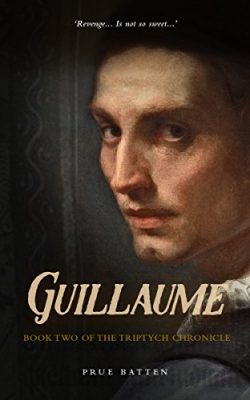
In Guillaume: Book Two of The Triptych Chronicle, Prue Batten reimagines the life of one such upwardly mobile trader/merchant who lives in this socio-political chrysalis and is unwittingly caught up in issues and events that will change the future.
Guillaume de Gisborne is an archer recently returned from the Third Crusade. He helps manage de Clochard, a small textile house struggling to survive after the death of its founder. When an arson fire threatens the property and merchandise of this already struggling business, Guillaume keeps watch over the premises and the prized, purple-dyed, velvet and fine wool fabric from Al-Andalus that is slated to go to the Holy Roman Emperor. During the night, he is attacked by strangers who are searching for something on the property.
Subsequently, Guillaume learns that a copy of the heretical Vaudès Bible, which the Church wants to destroy, may very well be hidden somewhere on the de Clochard premises. This is, perhaps, what the assailants were seeking.
Guillaume, assisted by Ariella Ben Simon, the beautiful Jewish daughter of a textile merchant in Venezia, and several of Sir Guy of Gisborne’s most trusted guards, seeks to find the book hoping to save it and return it to its rightful owners, the Poor Men of Lyon, proponents of the Vaudès’ dogma.
While working together, Guillaume and Ariella learn to understand, rely upon, and eventually love one another. They begin to plan their future—but Destiny has something else in mind.
After getting through the prologue and a long, (9,293 word) first chapter, the pace never slows. The amount and complexity of information included in chapter one may seem overwhelming, but the reward of gaining powerful knowledge that will enable the reader to relate to and understand Guillaume’s world is simply indispensable.
Overall, Batten’s rich sensory imagery, engaging characters, and authentic voice, combined with meticulous research and attention to detail add depth and dimension to a cleverly crafted, multi-layered plot. The writing is both gritty and lyrical, creating a moving, memorable story.
But wait! There’s more! Batten’s research notes at the end of the book are an absolute gift for history buffs and historical fiction fans.
Guillaume (The Triptych Chronicle, Book Two) by Prue Batten won 1st Place in the CIBA 2017 Chaucer Awards for Early Historical Fiction.
From page one, things are not going as planned on The Kafir Project, and author Lee Burvine has many more surprises in store before this undertaking ends. The action leaps off the page from beginning to the grand finale in this thought-provoking thriller. The villains are well-organized and highly motivated to stop the Project dead, as well as anyone who gets in their way.
Gevin Rees is a television science communicator, a celebrity who explains complex scientific discoveries and theories to television audiences. He interviews guests on specific topics and is surprised the world’s most celebrated and reclusive physicist, Edward Fischer, wants to meet with him. It’s even more curious because Fischer’s death in an explosion had been broadly reported. However, he stands before Gevin Rees and begins to tell a story of intrigue about a secret project on a pier along San Francisco Bay. The story is interrupted with gunfire. This time there is no doubt that Fischer is dead. Now on the run, Gevin Rees is a new target.
To solve this mystery, Fischer throws Rees a pack. The contents answer few questions and suggest new ones. Why did Fischer want Rees involved? Before this perilous journey ends, Rees will need to join forces with unexpected allies. One is a rogue agent; others are scientists. Even as a team is taxed to escape the persistent, elusive, evil people determined to stop them and Fischer’s project, Faraj, one of the antagonists declares, “We need the dark to appreciate the light.” His methods are very dark, indeed.
To have any hope to escape these people, Rees will need to employ all of his scientific knowledge, along with sharpening his wits and pushing his fervor beyond limits. But will these efforts be enough to discover the truth of the project? The core of worldwide belief systems is at stake – and a lot of money.
The author’s lifelong thirst to get to the bottom of things has culminated in The Kafir Project, his first novel, and the science behind the plot is beautifully shown through the characters, especially by the TV celebrity turned unexpected hero, Gevin Rees. The Kafir Project is an excellent work of fiction, packed with action and profound ideas that will linger long after the last page is read.
The Kafir Project by Lee Burvine won 1st Place in the CIBA 2017 Global Thriller Awards.
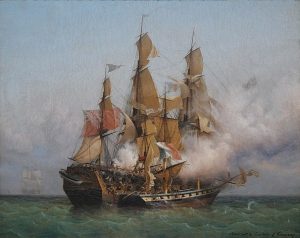
In the days when piracy was the number one concern for seafaring merchants, ships were built with one purpose in mind—to repel attacks from pirates. It was thought that a floating fortress, and a crew as ruthless as those they faced, could protect the cargo stashed in the cavernous holds.
Painting by Ambroise Louis Garneray
Bristling with cannons, the Spanish and English galleons were thought to be untakable. The pirates soon convinced them otherwise, but by the time news reached the merchant houses in both nations, ships had been lost or commandeered, and their own guns turned on newly arriving ships. Soon, the pirates had captured so many ships, their flotillas outnumbered those of their prey.
Human beings were treated and traded as cargo, just as gold or silk, sugar or tea. All were equally valued by pirates, as booty for gain.
The island of Jamaica is just one example of a place that was populated by the pirate trade. The proceeds of piracy were traded on the market until the pirated cargo could no longer be traced to the stolen goods.
Today, books are stolen, given a new title and a new cover, and then resold in the publishing industry’s market place.
Our book baby is all grown up, just waiting to be stolen away by nefarious means, and resold on some island (read market), not of our choosing. How can we, the merchant owner of our books, protect our damsel/damoiseau in distress? How can we keep the pirates from raiding our ships, and stealing our coin?
According to Investopedia “blockchain is a distributed, decentralized, public ledger.”
The block is made up of three distinct structures.
The first aspect is that the block stores information about transactions, such as the dollar amount of a purchase, and the date and time it was purchased. This information is recorded in a ledger contained within the block.
The second aspect is that the block records the ‘who’ of the transaction. It keeps a record of the purchaser as a digitally encrypted signature, which is a permanent entry on the ledger.
The third aspect is that the block records each transaction as a unique feature called a hash. Every transaction within the block has its own unique coding. No two are alike.
Why is this relevant to your damsel/damoiseau in distress, you ask?
The biggest risk factor, to the distribution of any form of electronic art, is piracy. That is the ability for that work to be stolen. The oceans of digital publishing are ripe with pirates, who are happy to steal any e-book at any time.
But they don’t even need to go that far. We practically invite the pirates to steal our work, any time we give away or sell anything on the internet because there is nothing protecting the digital rights of that book. A few words of copyright in a manuscript do nothing to prevent your work from being reproduced in any currently known format, anywhere on the planet.
Once that book is “out there” there is no getting it back. Bye, bye, sweet damsel! Dare I say it again? Not to be outdone, you send cease and desist emails to every site that has your book baby illegally uploaded for sale. Of course, they ignore you. The pirate’s code trumps all.
Blockchain.
Digitalizing your book into blocks of code, blockchain has the power to prevent your work from being stolen. That pirate ship on the horizon will smack into a reef, impossible to cross. They may try to lob a few cannon shots at your ship, to no avail.
Book Pirates be Foiled!
The only way to get to your book IS TO PAY FOR IT. Isn’t that wonderful? What a novel concept, actually being paid for your work.
“But…what will keep them from reselling it once they have a copy?” you ask.
Ah, good question. Because blockchain is an encrypted source file, your entire book is encrypted. To access that work, you must have a key, a token, to unlock it. But the token can only be used by the purchaser. It will not work for anyone else. Web-based, blockchain books are read in browsers. Currently, this means that an internet connection is required. The book is owned by the purchaser, but it still exists virtually.
A book published in blockchain cannot be copied, resold, or redistributed in any manner. It can only be read by the purchaser, using the token given to them on purchase.
Other advantages to blockchain include being able to create digital limited editions, with serial numbers attached to them to confirm they are truly limited additions. These unique books could contain anything from visual and audio art and files, interviews, etc. Anything that can be digitalized, could become part of this unique format.
So, a book in blockchain cannot ever be resold?
Ah, well that power is in your control. As the owner of the rights to distribution (by virtue of it being block chained) you can authorize a book to be resold, under rights and terms that you set. For example, let’s say that a customer bought a $50.00 limited edition from you. You could make it part of the blockchain code that resales are permitted, but that 50% of every resale comes to you. The blockchain, because of the unique coding attached to the original transaction, will know that it is that exact copy being resold and enforce the 50% deposit to your account when the transaction occurs.
If this is such a wonderful technology, why isn’t everyone using it?
Blockchain first came into being in 1991. As with all new technologies, it has to be tested and tried, before becoming mainstream. As it moves into its third decade of existence, the world of commerce is paying attention. Start-up companies, such as Bookchain, are cropping up and will be the wave of the future. As more and more of these types of companies appear in the market place, the retail organizations will be forced to adopt the technology.
I see pressure coming from the big five publishing houses, as they look for better ways to protect their investments.
Blockchain Could Put Authors At Center of Publishing Universe
The Alliance of Independent Authors (Chanticleer Reviews is a vetted partner member of ALLi) agrees:
“If this decentralized technology fulfills its promise, the outcome could be a creator-led publishing industry.
While indie authors, and the companies that serve them, are a growing presence and power in publishing, large corporate intermediaries such as Amazon still stand between authors and their readers and dominate the self-publishing marketplace. Blockchain tech may help to build the road that leads to true independence for self-publishers.” April 2018 – London Book Fair
Change comes with a cost, and the big retailers will be reluctant to embrace such technologies, as they make money off of the pirates as surely as those island ports of old. Change will have to be forced on them.
E-book piracy can be combated, we only need the sword of technology in hand and move forward.
Read the first two articles of this series by Susan Faw by clicking the links below:
Piracy—Not Just on the High Seas Part 1 of 3 by Susan Faw
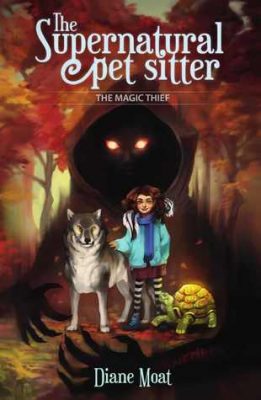
A talented and creative author, Diane Moat, presents a magical world hidden within a New England town where Witches, Warlocks, and Gnomes live together peacefully. That is until one day, something strange happens to the Familiars in the neighborhood. Someone or something had taken the magic from Frank the parrot a month previously, and now the same thing has happened to the tortoise King Arthur.
This is where Pepper Neely, pet sitter of the supernatural, comes in. Gnomes are magical people who can connect with supernatural creatures. Pepper has a unique aptness with her connection to animals, and she quickly became the neighborhood pet-sitter. With the help of her best friend and witch-in-training Luna, the two go against the well-meaning wishes of their parents to get to the bottom of what is happening to the Familiars. As usual, that is easier said than done when the Witches and Gnomes start to clash over the danger at hand. Pepper also discovers an ability that will change the meaning of what it is to be a Gnome.
Moat’s The Magic Thief is the first book in her The Supernatural Pet Sitter series. The story begins in the middle of things as Pepper is trying out a storm after checking on the ferret Familiar named Cranky. It doesn’t take long for it to discover that the story is very character-driven with a strong family dynamic at its heart.
Pepper Neely is a lovable character, and her pre-teen voice is decently portrayed in the novel. The way the story effortlessly welcomes readers into the Neely gnome family and their secret world of magic is captivating and delightful. Diane Moat leaves enough questions unanswered, setting up the next installment, and leaves enough loose ends open for the story to develop throughout the rest of the series.
Diane Moat’s The Supernatural Pet Sitter: The Magic Thief is a middle-grade novel perfect for the curious reader interested in the hidden magic that could be lurking in their own backyard.
The Supernatural Pet Sitter: The Magic Thief won 1st Place in the CIBA 2017 Gertrude Warner Awards for Middle-Grade Readers.
Blockchain is the foundation of a New Era of the Internet —
“Publishing is at the epicenter of digital disruption.” Paul Michelman, MIT & MIT Sloan.
Why is blockchain important for commerce and business (and, lest we forget, publishing is business)?
Because
It is a persistent, transparent, and its end goal is to cut down on middlemen, which is considered to be the new age of economics – Cryptoeconomics.
“Cryptoeconomics” is the practical science of building distributed systems, where properties of those systems are secured by financial incentives, and where the economic mechanisms are guaranteed by cryptography. It is the general term for the practice of designing and scaling blockchains like Ethereum and Bitcoin.
Bookchain by Scenarex utilizes Ethereum for its digital bookselling platform. We will circle back around to Bookchain and Ethereum. But first, join me as I explore blockchain to try to understand this technology that is shaping the publishing industry.
Blockchain is a type of internet network that runs on hundreds of thousands of computers worldwide. There are dozens of blockchain internet network platforms running 24/7 globally. And, yes, blockchain was invented to support bitcoin transactions. However, it is now being utilized for recording many different types of information.
As for real-world applications, here is one that validates blockchain technology commercial use:
Deloitte (a “Big Four” accounting organization) recently surveyed 1,000 companies across seven countries about integrating blockchain into their business operations. Their survey found that 34% already had a blockchain system in production today, while another 41% expected to deploy a blockchain application within the next 12 months. In addition, nearly 40% of the surveyed companies reported they would invest $5 million or more in blockchain in the coming year. – Investopedia
Blockchain is a digital ledger on all platforms. Blockchain apps act as a third party and allow us to trade one-on-one but on a global scale.
Arizona’s Electronic Transactions Act 2017
“‘Blockchain technology means distributed ledger technology that uses a distributed, decentralized, shared and replicated ledger, which may be public or private, permissioned or permissionless, or driven by tokenized crypto economics or tokenless. The data on the ledger is protected with cryptography, is immutable and auditable and provides an uncensored truth.”
It is decentralized. It isn’t controlled by any government or company.
As we prepare to head into the third decade of blockchain, it’s no longer a question of “if” legacy companies will catch on to the technology — it’s a question of “when.” – Investopedia
[ Editor’s Note: In 2020, just a half a year away, Facebook is planning on launching its own cryptocurrency, Libra, on its own blockchain platform called Calibra. Whether are not that platform will be decentralized is a concern—a major concern. Google is also planning on launching BigQuery – with its own cryptocurrency. ]
Reread:It is decentralized. It isn’t controlled by any government or company that is until Facebook and Google have their own platforms…Amazon can’t be far behind…
Are you with me so far…?
Blockchain = a block of digital information that is stored in a public database known as the chain.
Illustration from Blockchain Simply Explained
Each digital record is a “block.” Changes can only be made to the “block” by adding new information to the end that references previous transactions on that particular block. Each change is called a “hash.” Each block of information is added by a chain.
A “hash” is a unique fingerprint for each bit of added information to the chain of information (blocks)
Rubygarage.org
WHY, again, am I reading this article?
The goal of blockchain is to allow digital information to be recorded and distributed, but not edited (or hacked or pirated). This is what makes blockchain a natural for ebook distribution.
For our purposes, we are going to discuss Ethereum, the world’s leading programmable blockchain app.
Now to circle back around to Bookchain by Scenarex and Ethereum. Bookchain uses Ethererum for its digital bookselling platform.
COOL TIP > check out Eretheum just to see this new type of artwork called NFT (non-fungible token –NFTs also find potential use in digital art, by helping prove authenticity and ownership.) I don’t quite understand what it is, but the graphic is fun to watch as it morphs on the Ethereum.org site. Blockchain has given rise to this new form of graphics and art. And allows the creators to benefit from their works.
This logo joins together the artwork of five artists. You can see this artwork in motion at Eretheum.org @liliashka lead the art project.
The Ethereum community is the largest and most active blockchain community in the world. It includes core protocol developers, cryptoeconomic researchers, cypherpunks, mining organizations, ETH holders, app developers, ordinary users, anarchists, fortune 500 companies, and individuals.
There is no company or centralized organization that controls Ethereum. Ethereum is maintained and improved over time by a diverse global community of contributors who work on everything from the core protocol to consumer applications. This website, just like the rest of Ethereum, was built – and continues to be built – by a collection of people working together.
As of February 1, 2018, Ethereum was running on approximately 28,000 nodes (computers across the globe). That number has significantly increased in 2019.
Ethereum is a global, open-source platform for decentralized applications. On Ethereum, you can write code that controls digital value, runs exactly as programmed, and is accessible anywhere in the world.
Now, we can say that Ethereum is decentralized. It isn’t controlled by any government or company.
Ethereum is a foundation for a new era of the internet that utilizes blockchain technologies:
An internet where money and payments are built in.
An internet where users can own their data, and your apps don’t spy and steal from you.
An internet where everyone has access to an open financial system.
An internet built on neutral, open-access infrastructure, controlled by no company or person.
Are you still with me…?
“…attacks are further thwarted because the cost of changing the contents of old blocks is compounded by each new block that gets added to the chain. When a new block is made, it contains the hash of the one before it. Any changes in old blocks will result in invalid hashes for all subsequent blocks. In that lock analogy, it’s as though the design for the lock at the end of the chain depends on all the locks that came before it. So changing one lock in the middle of the blockchain means having to find new keys for every lock after it.” IEEE SPECTRUM
“Ensuring irreversibility becomes necessary only when you invite anyone and everyone to take part in the curation of a ledger.” This is why blockchain technology platforms run on tens of thousands of nodes and computers. The information is decentralized, thereby making it almost impossible to steal, alter, or lose.
Blockchain
Why authors and publishers should care about blockchain
Any information (this includes books, novellas, short stories, graphics, photos, transactions…) that can be digitized can be recorded using blockchain technology. This digitized record can be referenced through a ledger entry on the intended blockchain platform which decentralizes it over its thousands of network nodes. Any time the blockchain is accessed it is timestamped with another block of digitized information.
As an author, the blockchain provides a way for you to securely publish your book and keep control of your digital rights. It allows your published book to be treated more like a physical book, allowing your readers to own the digital book forever (as opposed to being allowed to checkout via Kindle).
How do I get my book published on a blockchain platform?
There are a couple of different companies out there that provide the front end support to get your book published on the blockchain.
Bookchain utilizes the Eretheum blockchain to create a brand-new platform bringing a refreshingly flexible way to publish and distribute ebooks, based on blockchain technology. Through smart contracts, the platform enables the configuration of the security, traceability, attribution, and distribution settings of an ebook.
The first four things to know and understand about the Bookchain platform are:
You do NOT need cryptocurrency (aka Bitcoin, etc.) to sign up
You will NOT be paid in cryptocurrency (unless you want to)
It is endorsed and underwritten by the Canada Media Fund, NRC, and the Canada Ministry of Economie.
It is secure!
Why are we so into Bookchain?
We became interested in Bookchain when one of OZMA Grand Prize winners, Susan Faw, informed us that she is now publishing on Bookchain because her books were pirated! Yes, pirated!
Read about how and what happened to her and her published works here (from her blog posts on Chanticleer Reviews):
Join us on the High SEAS to the New Territories of DIGITAL BOOK PUBLISHING
Sailing – making great time! Fair waves and following seas! All is good!
What are your experiences? What are your thoughts?
Do let us know!
Links to Resources Used and Quoted in this Article:
I have listed a few of the Youtube videos that I watched while trying to understand this new technology. They discuss what makes blockchain hard to hack and the concept of “consensus” that allows blockchain to exist. Stay tuned as we ride the waves of blockchain!

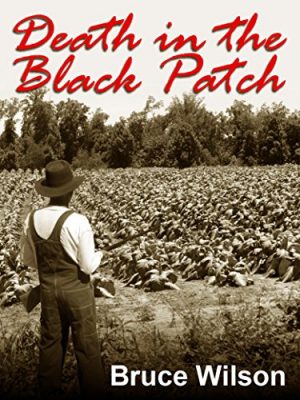
 Drawing on fact, fable and inherited lore, author Bruce Wilson has created an imaginative, at times unsettling view of upheaval in southern American history and its effects on local culture, economy and family ties.




 The Goethe Book Awards recognize emerging new talent in post-1750s Historical Fiction. The Goethe Book Awards is a division of the Chanticleer International Book Awards (The CIBAs).