A triumphant treasure in the bustling world of children’s literature, Heather Pallotta’s Wishes and Kisses is a work of art that will let every child who experiences it know that they are greatly loved and how magical they make the lives of the people around them.
In the world of Wishes and Kisses, we are all made of sunshine and love, wishes and kisses, and how our uniqueness makes us perfectly us. Children will learn that some days will bring warmth and wiggles and others they may feel down and not quite themselves, but that all of these feelings are okay. The story reminds children (and adults) to fly high and follow their dreams to the stars.
Heather Pallotta has been an artist since 1999 and was inspired to create children’s books by her children. She aims to teach confidence, love, uniqueness, and endless possibilities through her highly imaginative books.
It is beyond doubt that Wishes and Kisses was written with an abundance of love for her children by watching their growing imaginations and exploration of themselves and the world around them.
The illustrations, also drawn by the author, are simply stunning, beautifully reflecting the thoughts and feelings of the story itself. Parents and children will love these beautiful drawings and the uplifting message that will surely inspire the next generation of readers and artists.
Pallotta has other stories within the world of Wishes and Kisses to come, the first being Ruler of Daffodils.
Wishes and Kisses won 1st Place in the CIBA 2017 Little Peeps Awards for Children’s Literature and may be downloaded for free here.
Recognizing and Celebrating Indigenous Peoples Day and Discussing our Laramie Awards.
It’s October 11th, which in Bellingham, Wash. means it’s Indigenous People’s Day. We believe in recognizing the rich history and contributions of native peoples here in the Americas, and are always working to expand our knowledge and understanding. To that end, we would like to acknowledge that our company is located in downtown Bellingham which is the ancestral home of the Coast Salish Peoples who lived and still live here today. They have a strong connection with the Salish Sea—the marine ecosystem that spans the United States-Canada coastal waterways from Olympia, Wash. to Comox, British Columbia, Canada.
Coastal Salish Annual Tribal Journey on the Salish Sea. Approximately 100 canoes participate in the Potlatch.
There are more than 65 Tribes and First Nations who have lived here for tens of thousands of years. Primarily, the Lummi and the Nooksack Nations reside here in Whatcom County by the Salish Sea. Whatcom is Salish for “noisy water.”
The name Salish Sea was officially recognized by the United States in 2009 and Canada in 2010. Click here if you would like to know more about the Tribal Canoe Journeys: Paddle to Lummi
Members of the Lummi Tribe in the PNW
Indigenous People’s Day began to be celebrated as far back as 1991, with people suggesting it be celebrated as far back as 1977! Of course as most people know, the holiday was intentionally created to overlap, and in some places, replace Columbus Day. Why? History.com offers an answer:
Some may ask why replace Columbus Day with Indigenous Peoples’ Day? Activists have long argued that holidays, statues, and other memorials to Columbus sanitize his actions—which include the enslavement of Native Americans—while giving him credit for “discovering” a place where people already lived.
While there’s no denying that the bloody history of Columbus that has been sanitized throughout historical retellings, the original origin of Columbus Day was never meant to celebrate the brutalization of the people who lived on this side of the hemisphere. Within 60 years after Columbus landed, only a few hundred of what may have been 250,000 Taino were left on their island (currently known as the Dominican Republic in the Caribbean). History.com
The holiday originated as an annual celebration of Italian-American heritage in San Francisco in 1869. In 1934, at the request of the Knights of Columbus and New York City’s Italian community, President Franklin Delano Roosevelt declared the first national observance of Columbus Day. (Smithsonian Magazine)
President Franklin Delano Roosevelt
Of course, as we learn more, we always aim to improve and progress as a society and as a country, working for the betterment of all, we can make updates and changes to reflect history more accurately and remember those who have been wronged in the past. Toward that end, we’d like to take a look at our Laramie Awards.
Spotlight on Laramie Awards
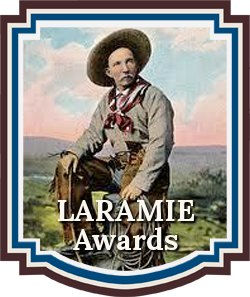
This artwork is from a 1907 postcard. The artist is unknown. The Laramie Awards recognize the best in Americana fiction.
The word Laramie has French origins, meaning The Leafy Grove. However, Kiffer named the Laramie Book Awards after Laramie, Wyoming when she lived just south of there when in Fort Collins, Colorado. Laramie was named for Jacques LaRamie, a French-Canadian trapper. He was one of the first Europeans to visit the area (1820s). He disappeared into the local mountain range. Laramie was founded in the 1860s as a “tent city” as a stopover on the Overland Stage Trail that was needed for the development of the first transcontinental railway.
In spite of having stores, houses, a school, and churches, Laramie was known for its rough frontier town lawlessness led by the town’s first marshal (Big Steve Long) who was a notorious gunman and a brutal bully who murdered dozens of Laramie’s people. It wasn’t until October 28, 1868 that some of the townspeople led by the county’s sheriff and fellow rancher, N.K. Boswell, fought back and lynched the marshal and his accomplices, thereby bringing some sort of law and order to Laramie.
It is also said that it was the women who tamed Wyoming.
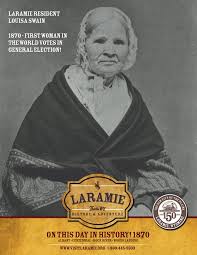
In 1869, Wyoming with Laramie leading the way, was the first legislature led entirely of men that empowered women with voting rights and to hold office. In March 1870, five Laramie women became the first women in the world to serve on a civil jury. It was a Laramie woman, Louisa Swain, who was the first woman to cast a legal, recognized vote in a United States general election on September 6, 1870.
In 1890, when Wyoming petitioned Congress to for statehood the U.S. Congress pushed back stating that Wyoming’s woman suffrage was obstacle and was delaying approval. The legislature, via a telegram from Joseph M. Carey (who later became governor of Wyoming), replied to the threat, “We will stay out of the Union a hundred years rather than come in without our women.” It was a very close vote in the U.S. Congress of 139 for – 127 against.
In 1890, Wyoming became the 44th state—with the women.
And those weren’t the only female firsts that took place in Wyoming. The first female governor was elected in Wyoming and the nation’s first woman to be appointed to public office was done so in South Pass City, Wyoming. In addition, the Equality State is home to the first female jurors, the world’s first female bailiff and the first town that was governed entirely by women.
Native Americans in their traditional attire holding American flag at the Lincoln Memorial building. STUNNING images of the indigenous Native Americans have been brought back to life through vivid colorization. The remarkable pictures show the group during the 1920s, with some of the leaders meeting with then American president, Calvin Coolidge, at the White House.
The Indian Citizenship Act still didn’t offer full protection of voting rights to Indians. As late as 1948, two states (Arizona and New Mexico) had laws that barred many American Indians from voting, and American Indians faced some of the same barriers as Blacks, until the passage of the Civil Rights Act of 1965, including Jim Crow-like tactics and poll taxes.
The last state to guarantee voting rights Native people was Utah in 1962.
The Voting Rights Act of 1965 was the most significant statutory change in the relationship between Federal and State governments in the area of voting since the Civil War. The act prohibited poll taxes, intimidation tactics, harassment, physical violence, or economic reprisals for voting in civil elections. OurDocuments.gov
Sadly, tragically, Laramie is also known for the inhuman murder of Matthew Shepard on October 12, 1998. It seems that bullying can still find cracks to rear its ugly head. Yet, once again the people of Laramie were not going to put up with it. Law and justice were served.
Americana Fiction
We recently changed the description of the Laramie Awards from “Western Fiction” which could mean a great many things, to “Americana Fiction.” A quick search for Western Fiction shows that it refers the American Old West that takes place anywhere from late 18th to the late 19th century. While this covers our categories of Pioneer and Civil War (the pioneer period is often referred to as 1760-1850 with the Civil War raging from 1861-1865). Also, great contemporary Western Fiction such as New York Time’s bestselling author and the basis for the hit Netflix series, Craig Johnson’s (a Wyoming author) Longmire Series.
And we can’t forget Jim Harrison’s works. You might be familiar with one of his stellar works—Legend’s of the Fall.
Legends of the Fall book cover before the film was made of it.
On the other hand, Americana Fiction is defined by Goodreads as “Novels that help tell the history, culture and folklore of what makes Americans uniquely American.” You can even see a list here of what they consider to be Americana Fiction, which really shows the wide, incredible expanse, that Americana Fiction and history can transcend, though we tend to consider it more of a historical genre than some of these incredible books are.
We made this change to promote a more accurate and inclusive representation of what we are accepting for the Laramie Awards.
So what are some excellent reads featuring indigenous identities that have already been vetted by Chanticleer you might enjoy? We’re glad you asked!
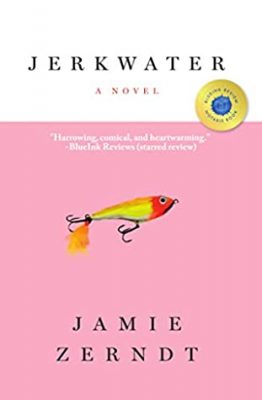
Jerkwater
By Jamie Zerndt
Somerset Award Winner
Three friends in Mercer, Wisconsin find ways to deal with their problems amid a racist town in Jamie Zerndt’s Jerkwater.
Shawna Reynolds’ life changed when her white stepdad murdered her Ojibwa mother. Now living with her Naan (grandmother), Shawna surrounds herself with those who make her feel most comfortable. Besides Naan, she clings to her horse Seven, her behind-the-scenes Ojibwa boyfriend Elmer, and two white friends: Kay O’Brien and her son Douglas. But racial tension cuts through the town of Mercer itself, galvanized by a fight over fishing rights.
Dr. Nerida Green travels across Australia, tending to struggling communities and connecting with her wife Mari—as well as the three spirits who Mari channels through her body, in Miki Mitayn’s climate-fiction novel The Conscious Virus: An Aedgar Wisdom Novel.
Nerida works sporadic jobs as a doctor, from the mining community of Newman to the small town of Fitzroy Crossing, and back east to a disappointing stint at a naturopathy clinic in Byron Bay. Between her working hours, Nerida speaks with M’Hoq Toq, the Native American medicine man, Bartgrinn the Celtic druid, and Aedgar, an ancient being of the Earth. Nerida asks the spirits for their opinions on topics as broad as climate change and as narrow as her personal matters, engaging them in deep conversation.
Wanders Far
By David Fitz-Gerald
Laramie Award Winner
An engaging history of ancient Native American peoples is brought to magical life by author David Fitz-Gerald.
In the early 1100s, in a region now known to us as the Adirondack Mountains of northern New York, a small band of tribal people is living in longhouses, growing crops, fishing, hunting, and enjoying certain rituals such as face and body painting, occasional migration for food survival, and even seasonal “vacations,” all while willingly obeying a simple form of governance with elements of basic democracy. In this tribe, we meet Wanders Far, a child who earns his nickname after showing a propensity to disappear and explore since he could walk. His mother, Bear Fat, is the recognized chieftainess of their group, mother of a large brood, one of whom is stolen as the book opens. Wanders Far would be considered an unusual child in any society, gifted with a highly accurate memory and the ability to visualize future events. He can also run like the wind, and with his love for travel, he is often the first to see and warn his people of danger, such as a cadre of warriors from a hostile tribe heading towards his home settlement.
Buck: Keeper of the Meadows
By Gloria Two-Feathers
In this engaging children’s tale by author Gloria Two-Feathers, a young colt named Buck will learn how to obey, how to defend, and how to strike out on his own.
The scene is set in the Great Plains, where a river named Minisose divides a sea of tall green prairie grass. Many animals call that grassland their home, and the most magnificent is the herd of wild horses led by a dark stallion named Plenty Coups and his chosen mate, the lovely cream-colored mare, Cloud. By tradition and instinct, Plenty Coups protects the herd from attackers, while Cloud leads them to safety.
When you’re ready,did you know that Chanticleer offers editorial services?We do and have been doing so since 2011.
Our professional editors are top-notch and are experts in the Chicago Manual of Style. They have and are working for the top publishing houses (TOR, McMillian, Thomas Mercer, Penguin Random House, Simon Schuster, etc.).
If you would like more information, we invite you to email Kiffer or Sharon at KBrown@ChantiReviews.com or SAnderson@ChantiReviews.com for more information, testimonials, and fees.
We work with a small number of exclusive clients who want to collaborate with our team of top-editors on an on-going basis.Contact us today!
Chanticleer Editorial Services also offers writing craft sessions and masterclasses. Sign up to find out where, when, and how sessions being held.
A great way to get started is with our manuscript evaluation service, with more information availablehere.
And we do editorial consultations for $75. Learn morehere.
If you’re confident in your book, consider submitting it for a Editorial Book Reviewhereor to one of our Chanticleer International Awardshere.
Also remember! Our 10th Anniversary Chanticleer Authors Conference (CAC22) will be April 7-10, 2022, where our 2021 CIBA winners will be announced. Space is limited and seats are already filling up, so sign up today! CAC22 and the CIBA Ceremonies will be hosted at the Hotel Bellwether in Beautiful Bellingham, Wash. Sign up and see the latest updates here!
Three friends in Mercer, Wisconsin find ways to deal with their problems amid a racist town in Jamie Zerndt’s Jerkwater.
Shawna Reynolds’ life changed when her white stepdad murdered her Ojibwa mother. Now living with her Naan (grandmother), Shawna surrounds herself with those who make her feel most comfortable. Besides Naan, she clings to her horse Seven, her behind-the-scenes Ojibwa boyfriend Elmer, and two white friends: Kay O’Brien and her son Douglas. But racial tension cuts through the town of Mercer itself, galvanized by a fight over fishing rights.
Soon after the death of her husband Norm, sixty-four-year-old Kay O’Brien learns that she nears the late stage of Alzheimer’s disease. Norm’s sudden demise shocks her and Douglas to the point that she withholds her recent diagnosis from him. Kay has a few church-lady friends, but feels closest to Shawna, spending time together drinking foul-tasting Manhattans. Shawna divulges that she’s been accepted into veterinary school, and in turn, Kay discloses her Alzheimer’s.
Douglas, who blames himself for his father’s death, takes over his dad’s unstable car repair business more out of guilt than aptitude. However, amongst the apparent doom and gloom of their lives, Shawna connects with animals, Douglas develops his art, and Kay still has enough wits about her to create positive change.
The three friends share something vital: they understand pain.
Each one struggles with their own unresolved issues: Shawna, anger over her mother’s death; Kay, health problems and the loss of her husband; and Douglas, caught between guilt and his desire to be an artist.
Jenna, a newbie who runs a hippish coffee house in town, takes an immediate interest in Douglas and his artwork. In the meantime, Kay discovers Norm’s poems written to a secret French love. But this upsetting news gets lost in the “Alzheimer” translation. She believes herself to be the secret love and takes off on Seven, babbling in nonsensical French. Although the situation is nothing less than strange, the friends have no idea that this bizarre moment will initiate a flurry of unforgettable and life-changing events.
Raconteur extraordinaire Jamie Zerndt produces a witty yet moving story of friendship.
Alternating his latest novel between three third-person narratives, Zerndt weaves in the local information about the Ojibwa and their constant fight with racist fishing rights in the highly-populated white town of Mercer, Wisconsin. Zerndt paints a convincing and visceral picture of emotion through his principal cast on many levels: low self-esteem, depression (leading to alcoholism), anger, and fear. His characters stay grounded, unremarkable, and relatable, especially Kay who struggles with the fact that she has no control of her mental state – something the older generation dreads.
Undoubtedly, sadness abounds from one page onward. But so does humor, love, and tenderness.
The humor arrives in darkness and sarcasm, as the characters face death and hate coming from a town dripping in racism. Sometimes, you have to laugh at pain in its face, and that’s precisely what Shawna, Kay, and Douglas do. Love unfolds awkwardly as an escape for Shawna and as a revelation for Douglas. Religion also comes into play as Kay bounces her thoughts of God between her relationship to the Catholic church, the church ladies she chums with, and a hippish priest who offers his services in an unorthodox way.
While chapters close on cliffhangers and tension builds with each character, Zerndt offers very little in the way of clues to the story’s apex. Instead, he uses the element of surprise, which allows readers to experience the depths of Shawna, Douglas, and Kay in ways they may not think possible.
Kudos to Zerndt for a brilliant literary work! Jerkwater is an absorbing read from beginning to end.
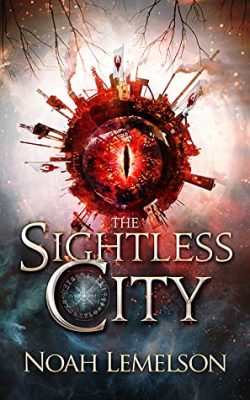
The city of Huile burns with trouble in Noah Lemelson’s dieselpunk novel The Sightless City.
Four years ago, the United Confederacy of the Citizens Resurgence defeated the Principate in a devastating war. Marcel Talwar lost his leg to that conflict but became a national hero for saving Huile. Now he’s settled down to work as a private detective. However, the schematics to a strange device throw his temporary calm into disarray.
Marcel relentlessly investigates the true nature of the documents and the death of their owner. His investigation robs him of all certainty, forcing him to question what he once thought he knew about his world, his role in the revolution. Especially troubling is his friendship with Lazarus Roache, a fellow hero and now the richest, most powerful man in town.
As a dieselpunk novel, The Sightless City embraces a more 20th Century feel of industrialization than Victorian steampunk.
Darkness saturates the world with unimaginable cruelties of forced labor camps and grim images of factories pumping out clouds of dark smoke – and people too terrified to ask what goes on within those walls. Magic joins this industrial world, where cities once floated above the earth, where “Engineers” have the “Knack” to refashion metal and other dense materials with their minds, and a mysterious red substance pumped out of the earth, called sangleum, serves as the city’s lifeblood and its source of wealth. Other darker powers include a drug derivative that can turn people into drones, subject to the commands of a single man.
Amongst this dense and complex world, Marcel’s investigation keeps the story centered, as he discovers the secrets of the documents while navigating industry and magic.
In the search for truth, Marcel meets Sylvaine, an Engineer who discovers that her Knack allows her to repair machines and build bombs with her mind. Many more characters boast strange tools and powers. The monk Kayip has long been at war with Roache, wielding a bracelet that can, by his thoughts, transforms into a broadsword or collapse back around his wrist. Meanwhile, the evil Verus keeps a patch over one eye, concealing not an eye socket but a window into an unimaginable dark universe.
Lemelson’s world-building hits the mark for an intricate and complex storyline.
Beginning a revolution will change everyone’s life. The battle sprawls, thanks in no small part to Marcel, Sylvaine, and Kayip, who form a partnership to bring down the malignant forces that enslave the city’s factory workers. Marcel’s investigation leads to a detailed, engaging dystopian novel.
In Peggy Sullivan’s award-winning book, The Moon and Star: Lessons From a Cat, readers learn how a charming, tiny white cat finds solace in her connection with the Moon as she goes through life’s challenges and changes.
Star lives happily with a tall girl and two other cats. She runs, dances, and hunts for goldfish in a backyard pond. But this mindful cat soon realizes that life is full of unpredictable circumstances. Though she moves to a college town and has new and fun experiences, Star feels sad when she loses a feline friend, even more so when the tall girl goes off on her adventures.
Luckily Star is a cat with an attraction to the Moon. Its magical glow helps the little cat gain a sense of calm. The peacefulness Star feels stays with her, regardless of changes in her life or surroundings. Though Star and the tall girl move many more times, this sensitive cat realizes the light of the Moon offers a unique sense of serenity wherever her journey takes her.
In the first story, Midnight and Moonlight, Sullivan focuses on friendship and differences.
In this next adventure, the author shows us positive and relatable life lessons explored through the eyes of our furry friends and shares them in a gentle and entertaining format. While it can be challenging to write for a young audience and tell a well-crafted story with little words, humor, and grace, all while relating a universal message, Sullivan has the knack. Her background and experience as a mental health counselor and child advocate make for a rich and holistic reading experience.
As in all of Sullivan’s Children’s books, the images match magnificently with the story.
Here the text is easily followed, and accompanying drawings feature the colorful antics of an adorable, big blue-eyed Star. Several images of this gentle little cat pondering a quiet respite beneath the night’s starry, moonlit sky are sure to help deliver an essential message to youngsters. Ultimately the Moon serves as Star’s sanctuary and ideally reveals to readers that small moments of comfort and joy surround us if we just take the time to look.
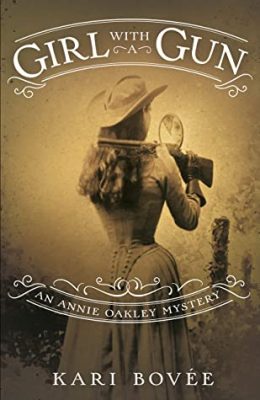
From humble beginnings in rural Ohio, fifteen-year-old Annie Oakley becomes a household name when she competes in a sharpshooting competition against the renowned marksman Frank Butler. Her life changes wildly from that day on in Kari Bovée’s mystery novel, Girl With a Gun: An Annie Oakley Mystery.
Colonel Cody, also known as Buffalo Bill, asks Annie Oakley to join the Wild West Show after the event. While reluctant to leave her family – who need her support – she can help them a lot more with an impressive salary. Annie becomes the new star of the traveling show.
Along with her beloved horse Buck, Annie settles into the Wild West Show lifestyle. She immediately befriends her tent-mate Kimi and her infant daughter Winona. When Kimi turns up dead soon after, Annie suspects that something more sinister than a tragic accident killed her. She begins investigating the matter herself when no one else will. As she looks into the murder, her horse Buck and others around the camp fall ill, and it seems like someone is trying to hurt Annie and her standing in the Wild West Show. Can she figure out who wants her gone and what happened to Kimi before the murderer can strike again?
Girl with a Gun brings readers right into its historical setting, with memorable figures like Buffalo Bill, Frank Butler, and of course the protagonist Annie Oakley. The real-life facts and chronology of Annie’s life change and move around for the sake of the story, as Kari Bovée adds to the historical fiction genre with a fun mystery series that reimagines the life of the talented sharpshooter.
Annie first appears as a loveable and relatable character, and her depth becomes clear as the story continues.
Fictional news headlines reflect the story’s events in exciting tones. These headlines add flavor to the drama and underlining mystery the characters face, and reflect the public’s opinion of the conflicts within the traveling Wild West Show.
Annie’s character defines the story around her. She cares deeply for her family and friends, and strives to protect them. Readers will get wrapped up in the trials and tribulations she faces at every turn, including a whirlwind romance.
Social media can feel like a scary thing, but if you work on a schedule and promise yourself a little time on it each week, it’ll grow before you know it.
Go from this>
To This>
YES, YOU CAN!
Social media and marketing can feel like such a pain, but remember, writing is essentially starting your own business, which means you have to manage your product and its image accordingly.
Most writers don’t write to market, but write because we are artists, yet, without doing some marketing, we miss out on big audience interactions.
The main thing here is that it isn’t a mystery, and it isn’t a secret. Social media is a long term place to be, so this will take start up energy, but, like Isaac Newton says, an object in motion stays in motion. Once you’re up and running, social media will be easier to manage, and the results only grow over time. The goal is to be authentic and a human being while keeping to some sort of schedule.
Note from Kiffer: Digital Marketing is all about “long-tail” strategy. Consumers no longer watch shows or read books the day they launch. We are all too busy. But eventually, we do get around to viewing the Netflix series that everyone is talking about or reading that book that intrigued you with its cover that you saw on your social media platform. Social Media posting is a corner stone of any book promotion strategy. Social Media helps to build awareness of your brand and titles.
Rinse and Repeat
Want more marketing tips? Check out this article written by Kiffer Brown and David Beaumier here!
1. Who are you Writing for?
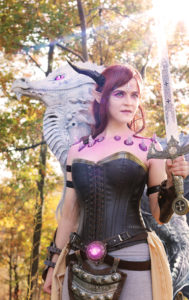
By the point you start marketing your book you should hopefully know who your audience is. Young Adult readers? Mystery lovers? Nature enthusiasts? This will all determine the kind of content you want to be sharing on social media. Elana A. Mugdan does a great job of this focusing her Twitter toward fantasy.
You can’t scroll through five posts without seeing a dragon! She also advertises to the Ace Community who, you guessed it, loves dragons! All that’s missing is cake!
Elana A. Mugdan
The next question to ask yourself is how many copies of this do you want to sell? If you’re looking for a smaller print run, maybe your focus on selling will only come in brief bursts rather than be something you link to regularly, and then once you’re out of books, you let your feed return to normal. But we at Chanticleer imagine you’re in this writing business for multiple books.
Once you figure out who you write for and how many people you hope to reach, that information will help guide what you put in your profile. Like your book cover, readers should be able to tell at a glance if your social media platform will appeal to them or not, so make sure you make it clear who your audience is.
2. Find a Consistent Voice and Theme
It helps if the voice for your social media matches or at least is adjacent to how you write for your novels.
If you are a fantasy writer it makes sense to share information about fantasy topics and images. Maybe you have faerie circle Sundays where you share beautiful photos of mushrooms. Whatever it is, go with it and let your work inform how you post. We’ll look at Avanti Centrae a little more later in this post, but you can see her posts Twitter here is a great example of keeping the focus on global thrillers. This will be important in all the following suggestions. The next thing to keep in mind is…
3. Keep a Social Media Calendar
Like any business, you want to have a schedule of some sort. The current top media organizations (it will change) are Twitter, Facebook, Instagram, and TikTok. Here are some good rules of thumb:
Twitter: post once a day with a focus on text and sometimes media.
Facebook: post twice a week with a balance between text and media.
Instagram: post twice a week with a focus on media. Even if you just want to do text, make it an image somehow.
TikTok: This one deserves to be separated out because it’s so easy to cross post onto other media platforms. It seems like posting twice a day, three times a week is probably a good starter for TikTok. Vary your video lengths, but remember, you want to keep people who approach your social media content focused on the reason that social media exists. TikTok is meant to be entertaining!
Since TikTok is the fastest growing social media platform and a significant number of Indie authorsWe have scheduled several sessions on TikTok for CAC 22.
This level of posting also fits well for the amount of attention the users for these sites give to their respective styles of media. Your posts don’t have to be radically different across platforms, but they should be tailored to the feel of each, Twitter being more of a slice of life, Facebook being a little more thoughtful and engaging, Instagram more focused on visual media, and TikTok focused on video.
Consider doing themed days, such as Selfie Saturday, Superhero Month, whatever will fit in with the voice and theme you believe will appeal to your audience. A theme also takes away some of the work of needing to decide what to post about from square one every day.
And be sure to use hashtags for your themes to expand your audience reach. Click here for our article on #Hashtags. Kiffer
Now, if none of these platforms work for you, there are plenty of others with their own recommendations to be researched. TikTok is the newest and shiniest, while Tumblr can work better for people who are more content driven and discomforted by Facebook and Twitter. We count Patreon as a social media since you can use it to connect with other creators, and it can be a good way to generate some passive income (though making a living on it is a whole other level). Likewise, YouTube can be a wonderful platform if you make videos. You can always “Go Live” on the original platforms mentioned, and we’ll talk about that later in this post.
4. Be a Human Being
Don’t be mistaken for a robot or a “bot”
The main goal of social media is to connect with other people. Don’t be afraid to be yourself. You can post pictures of yourself, your life, your pets (please post pet pictures), and even thoughts that are generally on your mind. Do you have any life questions you’ve been considering? Holiday plans that you want to share in order to hear about the plans other people have?
Going along with the idea of holidays, it’s okay to take social media breaks. Let your followers know when you step away, so they know not to expect a response. That also shows you’re a person and not a bot programmed to send out canned content.
One of our favorite authors who really puts herself into her posts is Janice Ellis, PhD. You can see her Twitter here, and you can see how her own work and passions are entangled throughout her posts. She does a great job sharing more content about her life than selling her work, which is a great way to reach people. No one wants to follow a one person advertising company that only tries to get you to buy their product.
Janice Ellis, Ph.D.
Take a little time, after your posting, the scroll through and be social with people. Scrolling to comment and react to people’s content only needs to last ten minutes at most. A little goes a long way, and with a few comments on posts that interest you, your friends and followers will remember that they’re in your thoughts, and then you’ll be in theirs. If some of their content really speaks to you, share it! And speaking of sharing…
5. Recommend Material
When you find something you love spread the joy! I still gush about Rob Slater’s Deserted Land series five years after reading it because I was so carried away by the way he brought a dystopian YA to life in a city I know and love, which I had never seen before. Whenever one of those “Post only 7 Titles of Books you Love” posts goes around, you can bet I share my favorite Chanticleer authors first and foremost.
Rob Slater
When you share material you like that’s in the genre you write, you’re also re-emphasizing the voice of your social media and letting that author’s audience know that they might like your work, too.
And it goes beyond just books. Products, photos, memes, these are all fun posts that let people see who you are and get to know you a little better. It helps clue people in to the world you are passionate about.
6. Create Shareable Content
This one can be a little tricky of all the suggestions so far because it’s not always clear what will do well. Here are a few examples:
Make a meme. These are images with text superimposed, usually with some relevant pop culture reference
Send out an author Newsletter
Write blogposts, either on your own website, on Medium, or for a friend’s website. Anything to increase your name recognition out on the web.
Create giveaways for your book
Announce a cover reveal for your book
Fundraisers can be great, too, but those typically work best only once you’ve already developed a solid platform. You want people to give you the greatest gift they have to offer: Their attention.
This content will ideally speak to your audience and be an effective way for you to communicate and interact with them. Think creatively about what you can share because chances are, you already have a good candidate. When it comes to shareable content and interviews, check out Avanti Centrae whose Twitter you can find here.
Avanti Centrae
7. #Hashtags
Another difficult concept to grasp is the mystery of hashtags. While we’ve all felt #blessed at some point, the important thing is to use hashtags that will actually stand out to your audience. The trickiest hashtags are the ones that you want to convey a sense of what you’re doing, for example #amwriting has over 2 million Google results while #writeratwork has just over ten thousand. It’s clear which one will find more engagement and will be searched more often.
If you aren’t sure what hashtag to use, look up a few of your favorite authors in your genre and make a list of what they’re using, and then check what’s most popular.
The easy side of hashtags is when you’re attending a specific event with a readymade hashtag. At the Chanticleer Author’s Conference, we use variations on #CAC followed by the year. This was #VCAC21 and next year will be #CAC22 because we are so hopeful that we will be able to have an in-person conference next year! Hashtags should be simple and easy to use. Our 10th Anniversary Chanticleer Authors Conference (CAC22) will happen LIVE at the Hotel Bellwether in beautiful Bellingham, Wash, April 7-10, 2022.
8. Be Live
Interact with people and let them into your life. Consider launching polls for your readers to be able to respond directly to you. These can be related to titles or what should happen next with a character. You are an active writer, and that means people can actively participate with you.
You can also “Go live” and post video of you interacting with readers in real time. Things you can do when you are live:
A Q&A session about your work, writing process, and the research that goes into your writing.
Introduce people to your pets
Read some of your work
Read someone else’s work that you recommend
Promote your books
Run a fundraiser or giveaway
Raise awareness about a subject you are passionate about.
John Green, Author of The Fault in Our Stars and many other books, even goes live when he signs the pages that are to be inserted in his upcoming books. He just chats casually with the camera to help the time pass.
9. Where Chanticleer Fits
When you have a victory, especially related to one of your books, you should crow about it! A Blue Ribbon for a First Place Category or Grand Prize win in one of our 24 contest divisions you can enter here? A positive Editorial Review which you can sign up for here? Digital badges from both of those? All of it can be posted on social media and your website to highlight the progress and recognition your book has earned.
There are millions of books being published, and you can take all of these steps and still get missed. But if you participate in a writing community with international reach and gain recognition with it, that can be one more step to better sales.
Remember, social media takes some up front work, but once it’s set and you’re on a schedule, it’s just another part of the writing career. You can make it work by putting in less than an hour a week once all the pieces are in place. Set your schedule and keep at it!
Writer’s Toolbox
Thank you for reading this Chanticleer Writer’s Toolbox article.
Remember! The Chanticleer Author’s Conference is coming up, April 7-10, 2022! Don’t miss out, register here!
Dr. Nerida Green travels across Australia, tending to struggling communities and connecting with her wife Mari – as well as the three spirits who Mari channels through her body, in Miki Mitayn’s climate-fiction novel The Conscious Virus: An Aedgar Wisdom Novel.
Nerida works sporadic jobs as a doctor, from the mining community of Newman to the small town of Fitzroy Crossing, and back east to a disappointing stint at a naturopathy clinic in Byron Bay. Between her working hours, Nerida speaks with M’Hoq Toq, the Native American medicine man, Bartgrinn the Celtic druid, and Aedgar, an ancient being of the Earth. Nerida asks the spirits for their opinions on topics as broad as climate change and as narrow as her personal matters, engaging them in deep conversation.
While Nerida and Mari travel, the Coronavirus makes its appearance on the world stage, and shortly after that, Australia. Nerida manages to find them a safe place to live through quarantine, but her role as a doctor weighs heavily on her as the pandemic picks up steam. She turns to the advice of her ephemeral friends, who at once soothe her heart and spark her worries.
The Conscious Virus tackles current global issues, both through Nerida’s personal experience and the wisdom of the spirits.
Climate Change hurts the vulnerable people whom Nerida cares for, and as the spirits tell her, disrupts the natural systems and energies of the planet. Covid-19 spreads amongst people who are profoundly unprepared for a pandemic, while the entities try to communicate the metaphysical nature of the pandemic.
All three spirits have distinct voices, filling their conversations with personality and the unique word-choice of people who haven’t walked the Earth in centuries. Their beliefs mesh with Nerida’s as often as they clash. She connects with them through their philosophy and deep thoughts on the world, but she struggles to understand their often very unscientific perspectives. How much of what they say is metaphorical, and how much is literal? Will Nerida side with the wisdom of the spirits or with the research and knowledge of her peers?
Between Nerida’s lengthy conversations with the spirits, she and Mari experience the beauty and difficulties of the material world. Mitayn paints Australia with beautiful descriptions, full of color and heat and smells. The world becomes tangible as Nerida walks and drives through it. Her life with Mari is a grounded and realistic one, concerned with whether the air conditioning will keep working, how they’re going to find a place to stay along their travels, and how they should treat each other to maintain a relationship of love and respect. They meet and reconnect with many interesting people, creating a collection of vignettes across their journey.
This story explores many facets of the modern world and its struggles.
The lives and work of Aboriginal people often take center stage, as Nerida – an Aboriginal woman herself – understands the unique challenges they face. Nerida, Mari, and the spirits tell an engaging and deeply thoughtful story about LGBT+ identity, racist systems, and how entire groups of people are pushed down by the interests of the rich and powerful. Mitayn takes none of these issues lightly but instead gives them the time and consideration that they deserve.
Jumping between past, present, and future, The Conscious Virus creates not just a compelling image of the modern world – but also of how the future might play out depending on whether people face their trials with wisdom and compassion – or something so pointless as greed.
This Chanticleer article is a little more personal than most. Normally we speak generally, but sometimes you can’t replace a good ol’ personal anecdote.
Haruki Murakami:“Writing a long novel is like survival training.”
Barbara Kingsolver: “I have to write hundreds of pages before I get to page one.”
Jodi Picoult: “You might not write well every day, but you can always edit a bad page. You can’t edit a blank page.”
Diane Gabaldon:“Writing is an active skill; the only way to learn is to do it, to actually sit down and write every day.”
With all this in mind, I want to talk here about my experience taking the advice of Rachel Aaron/Rachel Bach from her article “How I Went From 2,000 Words a Day to 10,000 Words a Day.” Whenever I see a new idea for improving writing, I try to play Peter Elbow’s “The Believing Game.” The Believing Game, in short, is an exercise where you ask yourself what would happen if you accepted a particular suggestion as true, and then practice acting as if it were true and seeing what happens as a result.
This man believes!
1. Track where you write.
This was the one I thought was the silliest. During a pandemic, I don’t write anywhere except my bedroom/office, the kitchen, or the living room. However, when I really pay attention to where I write best, I notice a few things.
First, I write well in groups, even if that’s just online at the Roost (Chanticleer’s Online Community) doing writing sprints with friends and the help of Sprinto. Generally, timers help me quite a bit in my writing, because they give me permission to ignore the rest of the world until the timer goes off.
Coffee Klatch Write In is held at the Roost on ZOOM. The next Write-Ins are currently scheduled for Tuesday mornings. However, any Roost member can set up a Write In group to accommodate their time zones—which is handy since Roost members live across North America and around the globe.
Check us out!
We meet up once a week to do some writing. Usually folks join, we chat about what we’re working on for 10-15 minutes, and then dive in to work! Light conversation and the Chat are excellent ways to check in.
Tuesday, Sept. 28, 2021 from 10 a.m. – Noon PST
Tuesday, Oct. 5, 2021 from 10 a.m. – Noon PST
Tuesday, Oct. 12, 2021 from 10 a.m. – Noon PST
I also found out, weirdly enough, that my most productive space is not my desk where I work from home and play videogames, but rather on my futon with plenty of pillows for back support using my laundry basket as a desk.
I don’t know what the magic is, but I really like working on this laundry basket. -DB
I have no idea what it is about these factors. Maybe it’s the giant stuffed pig that’s my quarantine companion, but that’s where I am happiest and most productive. The second-best place is at the dining room table with the roommate’s dog hanging out.
Maya Angelou passed away on May 28, 2014. She preferred writing lying down and leaning on one elbow.
Maya Lou Angelo rented hotel rooms for a few months at a time in her hometown. She would have the management move all of the paintings and decorations out of the room. Also, they were not allowed in to clean or straighten just in case she had thrown away piece of paper with writing on it that might later prove to be useful. Ms. Angelo said that she would head to around 6:30 in the morning and hang out there until about 2:30 then she would head home to edit. The hotel room was creating and writing only. She would average 10-12 pages of written material a day. She would then edit these pages down to three or four pages in the evening at her home.
“Nothing will work unless you do.” Maya Angelou
2. Track when you write.
This next suggestion helps you learn when you are most productive. I have always dreamed of being that person who wakes up at 5am, reads for two hours, writes about what I read for another two hours, and then eats breakfast and jumps into amazing creative work. It would help if I didn’t need at the very least thirty minutes to drag myself out of bed.
NaNoWriMo this year gave me a strong reset to my writing habits. Having the regular goals made me prioritize my work, and being in quarantine removed many of the distractions I usually have. The deep dive even gave me some great community locally and on The Roost that I’m still holding onto.
Things that I ask myself when tracking:
What Project am I working on?
When did I start?
When did I finish?
What was my general mood?
How many pages/words did I get through?
Where did I write?
Additional notes
Doing NaNoWriMo this last November, I’ve finally discovered that while I can sit down and do paid work at almost any time, I do my best creative writing between 8-11pm. This is tricky, because that’s when most people want to hang out, but I can usually make late afternoon work well, too. The times that don’t work for me?Anytime before 11am. I can always do brainstorm work, but if I want to do writing I’m happy with and make progress in a story, I need to set aside some time in the evening.
This isn’t so much how much time you make to write (though that can help). It’s also about how much writing you do in a particular amount of time. Generally, I write 250 words every 15 minutes. I also write about 250 words every 30 minutes. Depending on how I time myself, I come out with a different amount. Likewise, if Aaron/Bach (from the opening paragraph) sits down to write for only an hour, she writes about 500 words. However, if she sits down to write for 5 hours, she can manage 1500 words in that same hour! The amount of time we know we can get lost in the work affects us each differently.
Looking for more advice regarding what to do with your NaNoWriMo? See this article Chanticleer posted in November here.
3. What do you write on?
Rather than the material (desk, floor, laundry basket), this means more to the tools you use to write. Referring back to Aaron/Bach, I write different places for different things. When I first started at Chanticleer (and I still do), took and kept notes in a journal about how things work here. There are a lot of moving parts and “under the hood” technology here at Chanticleer. I’ve noticed that Kiffer carries around a small black notebook and old school small planning calender even though we use Google Calendar apps and the latest digital management apps (hat tip to Argus Brown) here at the home office of Chanticleer.
Using my journal is also handy for our weekly brainstorming meetings. I find that I can generate 7 “ideas” in ten minutes if I am utilizing my trusty journal instead of my laptop. Now, very little of a full article or project would come out this exercise. It’s just brainstorming and laying out my ideas some place where I can keep track of them until I can work on the details. But it works! I’ve noticed that I have much more trouble brainstorming on a computer where the cursor blinks at me with menace and mocking intent.
The mocking cursor and time flying by.
The other thing that drives me up the wall when trying to brainstorm on a computer is there are so many distractions. If I have an idea, I can focus in, but if I’m casting around for thoughts, I’m open to the world, and the internet adores it when I’m open to suggestion. Somehow social media rarely helps me generate ideas for any type of writing.
Now, of course, once I’m running with an idea, I love the speed that I can put words down and edit when I type rather than scribble. Plus, my writing is always legible on a computer.
4. Mood
You know how it is, you’re in a bad mood, you need to do your writing, you sit down to do the work, and you get maybe half what you usually do done. What if that’s a pattern that you can predict? For me, knowing that when I sit down and I’m grumpy that my roommates haven’t wiped down the counters after cooking spaghetti (my first thought always being there has been a murder in my house), or maybe someone has said something mean on social media (somehow social media always features as an obstacle to writing).
5. Where will the story go next?
EL Doctorow famously said, “Writing is like driving at night in the fog. You can only see as far as your headlights, but you can make the whole trip that way.”
While you probably have written down the broad strokes of what happens at the beginning, middle, and end of your story, it’s important to keep other ideas in mind.
I felt good seeing Aaron/Bach suggest this, as it’s been a longtime habit of mine to sketch out what I want to happen next after I bring a writing session to a close. Since I write late, often this is the point where I feel like I really need to sleep, I’ll do a brief summary of how I see the rest of the text going, and if any strong images come to mind, I’ll write those down as well, hoping to use them as the story goes on.
When I return and see those notes, I simply delete them as I write the scene it suggests, keeping my notes clean and easy to read for what comes next. With the images I can even copy and paste them directly into the work as the place I think they’ll fit best appears on the page.
6. What are you excited about in the story?
I just started editing the first draft of a novel I finished in October. One of the big critiques my writing group gives me is that the conflict doesn’t start soon enough, which I thought was ridiculous!
In the first chapter, my YA protagonist has the 3-person panel for his high school senior project possessed by a conduit of 100 dead souls who he has promised to guide from Limbo into Heaven! What could be more intense than that?!
However, in rereading the work with fresh eyes I notice that my characters eat. A lot.
Now, this is probably from my great love of all breakfast foods and missing going out to restaurants, but everyone in this book can’t get to any scenes because they’re too busy giving light exposition at The Old Spaghetti Factory. As I go through, I find myself skipping these scenes to get to the next on, which tells me that, yes, they are not exciting. If as the writer I don’t care about a scene, it needs to go. If there’s key information I feel like is in that scene, I write it down separately and keep an eye out for the right place to insert it, rather than dragging the reader through yet another pointless meal—even if I am craving a Dutch baby with powdered sugar, cinnamon, maple syrup, and fresh fruit. Maybe with a side of breakfast sausage. Mmm. And hmmm.
Dutch Baby with fruit and powdered sugar on it
7. Review your information
So, for me, what I’ve learned is that I write best in areas where I can be comfortable and don’t have easy access to videogames. I like having friends, either virtual, stuffed, or furry, because then I feel like I’m accountable to someone, even if they only want to listen to me brainstorm when I’m giving them pets.
I am officially an evening person. I love mornings for relaxing, watching the bay, drinking coffee, and making extravagant breakfasts. If you haven’t made yourself Spanish tortilla, it’s easier than you’d expect—give it a try.
A few times a week I need to set aside my evenings for creativity, and that means no Mandalorian with the roommates (sorry Baby Yoda) or virtual game night with friends. If they want to hang out, they can come co-work (write) with me.
I do my starting work in a journal of some sort, and then I do the writing work on a computer. Editing and marketing work also happen on computers, mostly out of necessity and the predominance of the internet.
I am gentle with myself when in a bad mood. Rather than lamenting that I couldn’t do as much as the day before or the week before, I remind myself that creativity is a process, and that even though I was in a bad mood I put in the time today, and that habit counts for more than any single day worth of word count.
I write best when I can work from notes that show me what scene I’m most drawn to write about next in my story. That lets me stay focused on excitement as I go through the work.
Finally, now that you can figure all this out for yourself, protect the things that let you write. They’re the loveliest tools you can give yourself.
8. Set goals
Nailed it
Ask yourself what your stretch goals are, and what goals are you confident you can meet. Go back to your goals periodically. Do they need to be adjusted for where you are in your w-i-p (work in progress). Editing requires a different focus than plotting. Plotting requires a different mind set than creating your characters or atmosphere.
What are your methods and writing habits?
We’d love to hear from you! What spurs you on? What trips you up?
Examine your own life to best see how you can maximize your own productivity and be the author you want to be!
Maybe this is getting something to the point where you can use one of our many Chanticleer services, from the Manuscript Overview, to the Editorial Book Review, to testing the mettle of your work in the Chanticleer Awards. Whatever goals you set, make sure that you keep your gaze on meeting them as you write!
Speaking of the Chanticleer Awards, did you know that we’ll be announcing the Finalists, First Place Winners, and Grand Prize Winners at our Tenth Anniversary Chanticleer Authors Conference (CAC22)? The CIBA Ceremonies will run in tandem with them from April 7-10, 2022! We’re optimistic we will be able to see you in person at the beautiful Hotel Bellwether here in Bellingham, WA.
Writer’s Toolbox
Thank you for reading this Chanticleer Writer’s Toolbox article.
International writer Randall Krzak addresses one of the world’s saddest ongoing tragedies in The Kurdish Connection, a thriller about the plight of the Kurdish people and a desperate plan to free them from their fate.
In a world awash with refugees, perhaps no greater tragedy exists than the ongoing fate of the Kurds of the Middle East, roughly 30 million sect members spread between Iraq, Iran, Syria, and Turkey. Connected by language, religion, and history, this group has no country to call their own. The Kurds have been the subject of several attempts by international agreements to help them create a haven, the most recent in northern Iraq’s no-fly zone. Meanwhile, all four host countries have ruthlessly suppressed Kurdish hopes and dreams politically and especially militarily.
Among the most vicious suppression efforts were those of the late Iraqi dictator Saddam Hussein, who used deadly sarin nerve gas against them, most notably in the village of Halabja, in which up to 5,000 Kurds perished and another 10,000 were wounded.
The Kurdish Connection takes us deep inside that struggle.
Two young Iraqi Kurds, Dersim and Ismet, scavengers by trade and refugees from Halabja with searing memories from their youth of Saddam’s gas attack, accidentally stumble on a large cache of sarin gas canisters leftover by Saddam’s army. The pair are stunned by the possibilities of what can be done with it. They, in turn, make their finding known to a group of Kurdish mullahs who find themselves torn by the possibilities of how the weapons can be used.
Eventually, they agree that the sarin gas might help them free a powerful mullah named Muhammed Baziyan, imprisoned for many years under tight security by the Turks. The Kurds believe that this one man could be the leader to pull them together and unite them as a single voice.
Meanwhile, half a world away, a new international counterterrorism group called Bedlam assembles in Washington D.C. to explore a rumor from on-the-ground intelligence that an Iraqi sarin gas cache exists. Its goal becomes a frantic effort to locate the canisters, disable or destroy them, and stop them from falling into the wrong hands.
With few intelligence assets on the ground, Bedlam assigns their operatives to travel to Turkey, Iraq, and Syria. Using various identities such as amateur archeologists, members of MSF (Médecins Sans Frontières/Doctors without Borders), and cultural tourists, they use their limited information plus sophisticated chemical detectors to try and locate the deadly cache.
At the same time, the mullahs make plans to use the gas to disrupt Turkish military forces and other pressure tactics, including kidnapping foreigners to show the world some of the brutal tactics used by military forces against Kurds. In the most recently reported event, they want to show the world how Syrian troops viciously put down a peaceful Kurdish demonstration over bakery prices, which the Syrian government claimed was an attack instigated by the Kurds.
The mullahs’ overall plan is to instigate several near-simultaneous attacks in Turkey to draw out Turkish military forces and disguise their main effort, to free the mullah Baziyan from his well-guarded Turkish prison. Using sarin gas to kill Turkish troops seems like a good plan, but no one wishes to harm civilians. Not everyone agrees with the deployment of sarin gas.
The action is set against the exotic, fairytale-like landscape of Capadoccia, Turkey, with its soaring natural towers, and Gobekli Tepi, an archeological dig of an ancient temple built 6,000 years before Stonehenge. Equipped with sophisticated chemical detectors, built James Bond-like into their gear, the Bedlam teams ready themselves for their mission. A further refinement of Bedlam’s plans is to substitute phony sarin containers for their more dangerous counterparts.
Randall Krzak delivers an exciting cat-and-mouse game between the Bedlam team, suspicious Kurds, and equally suspicious Turkish government spies.
The Kurdish Connection soars in the detailed accounts of towns and villages, the people there, and even the weaponry and vehicles used. Readers will find themselves in the middle of the action as the Kurds successfully bomb a Turkish oil field, terrorize a soccer stadium, and stage a murderous assault on the prison where the mullah is kept. Krzak takes us into the dank caves and sewers where the Bedlam teams go to locate and sabotage the horrific sarin canisters from being used by anyone.
Above all, The Kurdish Connection offers readers a compassionate look at one of the world’s most intractable social conflicts, wrapped in the pages of a thriller that will keep readers glued to its pages until the final sentence. The Kurdish Connection is the first book in Krzak’s Bedlam series. Please read our reviews of the following books by clicking on their titles: Dangerous Alliance and Carnage in Singapore.


 A triumphant treasure in the bustling world of children’s literature, Heather Pallotta’s Wishes and Kisses is a work of art that will let every child who experiences it know that they are greatly loved and how magical they make the lives of the people around them.







 Three friends in Mercer, Wisconsin find ways to deal with their problems amid a racist town in Jamie Zerndt’s Jerkwater.



 In Peggy Sullivan’s award-winning book, The Moon and Star: Lessons From a Cat, readers learn how a charming, tiny white cat finds solace in her connection with the Moon as she goes through life’s challenges and changes.




















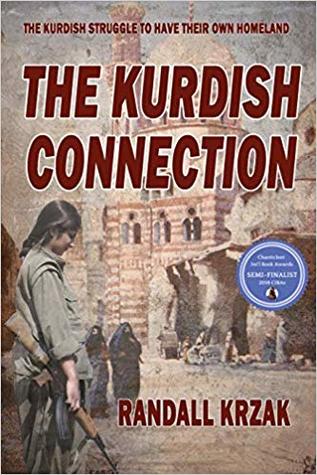
 International writer Randall Krzak addresses one of the world’s saddest ongoing tragedies in The Kurdish Connection, a thriller about the plight of the Kurdish people and a desperate plan to free them from their fate.