 Thank you so very much for this exciting news! I will be happy to share and to proudly display the badge! – Patricia Sands, author of The Secrets We Hide
Blog
-

Kerrin Margiano – Hearten 1st Place Winner- Author of Enjoy The Gift of Childhood
 I believed the 22nd of March would be a special day, but it has superseded even my expectations. I found out I am a finalist, so my book can reach more parents and grandparents and my grandson was born this morning! – Kerrin Margiano, author of Enjoy the Gift of Childhood
 -
D.V. Chernov- Author of Commissar: A Novel of Civil War Russia- Hemingway Finalist
 Thank you for this exciting news! I really appreciate all the hard work you and your team put into the awards! – D.V. Chernov, author of Commissar: A Novel of Civil War Russia
 -
E.E. Burke- Laramie Grand Prize Winner- Author of Tom Sawyer Returns

Thank you for all the hard work you put in. This is such a great contest, and the support you provide to authors is incredible. – E. E. Burke, Laramie Grand Prize Author of Tom Sawyer Returns
-
S.P. O’Farrell- Author of Simone LaFray and The Red Wolves of London- Gertrude Warner Finalist
 This is amazing news and has made my week. I’ll check out the conference information and your other services. Wow! What an honor. — Steven O’Farrell
 -
Larry Boucher
Laramie Semi-Finalist- Author of The Scout
I really enjoy the way Chanticleer keeps contestants apprised of their status during the contest and what level of achievement they’ve reached using your four-tier structure. Most other book award contests only post the winner and two to five finalists, leaving everyone else in the dark on how they actually did.
-
Tyler Drinkard- Author of Isolated Domain, on his Book Review
 That was quite an incredible review, and I appreciate the time and dedication so much! – Tyler Drinkard, author of Isolated Domain
 -
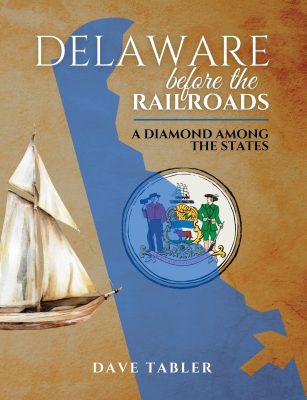
DELAWARE BEFORE The RAILROADS by Dave Tabler – U.S. History, State & Local History, U.S. Revolution & Founding
Delaware Before the Railroads by Dave Tabler presents a captivating visual tale of this tiny state, from 1638 to 1832, ranging between early colonial settlements and the aftermath of America’s Independence.
Delaware’s place in this seminal time of United States history is carefully illustrated through pictures with wonderful captions. Delaware Before the Railroads highlights the significant role played by Delaware in America’s creation, uncovering surprising historical details such as the origin of log houses, a heroic figure who thwarted the British invasion of Canada, and the intriguing connection with Captain Kidd.
The pictures and captions are highlighted by sidebar paragraphs that deliver more knowledge about what life was like for the Swedes and Dutch who settled near Delaware Bay. They found, for instance, a “new world” of seafood they didn’t recognize, such as the crabs they called “sea spiders.”
The book explores day-to-day details of this growing society. One fascinating – and unsettling – aspect is the nature of their medicine. They used tools for bloodletting, torturous-looking dental implements, and pharmaceutical ingredients such as benzine, peppermint oil, saffron, peppercorns, and even mercury! The specifics of how these tools were used will chill readers.
Delaware Before the Railroads balances these darker elements with more light-hearted moments in time as well, with one fun fact being that Delaware delegates ratified the US Constitution at The Golden Fleece Tavern in Dover, thus christening Delaware as “The First State.”
The best treasure of the book is in the “Notes on Photographs” section, to which the sidebar paragraphs direct the reader.
This section adds significant anecdotes and details that shed more light on the culture of the time. One discovers that the Swedish colonists named the first non-native settlement, Fort Christina, after the then 12-year-old Queen of Sweden. Or, that the early days of Delaware also gave rise to the iconic log cabin in America, as Swedish and Finnish colonists introduced the style to their new home.
These notes deliver excitement as well as excellent historical information. The famed privateer Captain Kidd once marauded in an area now called Kitts Hammock, one of the places he supposedly buried his treasure. Kidd also colluded with some Delawareans to sell stolen goods from an Indian Ocean takeover of a merchant ship, despite a colonial law forbidding the importation of any goods from the East Indies (due to pirates and privateers).
Pick up Delaware Before the Railroads to join the hunt for Captain Kidd’s buried treasure and learn other intriguing slices of Delaware’s past.

-
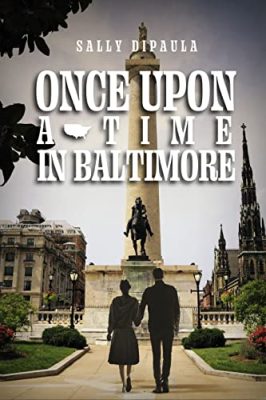
ONCE UPON A TIME In BALTIMORE by Sally DiPaula – Historical Fiction, Multi-Cultural, Family Saga
In Sally DiPaula’s Once Upon A Time In Baltimore, a young couple faces the pains and triumphs of life amidst the changing social mores and ever-present challenges of the 20th century.
Throughout decades, this story unfolds to reveal their relationships with extended family, and their lifetime commitment holding against the likes of marital strains, discrimination, war concerns, and health issues. Inevitably, there are moments of pondering about the choices they’ve made and worries over what the future holds.
As an Irish-American girl growing up in Baltimore, young Annie Finnerty suffered the loss of both a parent and sibling. Vince Parisi, the son of Italian immigrants who worked in the restaurant business, also weathered the heartfelt loss of a family member. When the two meet, their definite attraction soon leads Vince and Annie down the expected path of marriage and starting a family.
With the joining of the Italian Parisis and Annie’s Irish-Catholic Finnerty clan, DiPaula includes familiar details to distinguish the contrasting ethnicities.
While momentarily at odds in their courtship, in an attempt to reconcile, Vince delivers a chocolate Easter egg gift to Annie. Here Mrs. Finnerty questions its edibility, inferring that Italians are known to poison their enemies. And while Vince looks upon his Italian relatives as extended family, Annie insists on privacy and separation from them.
Whether family members who succumb to illness or sons going off to war, country club rejections or suspicions of infidelity, DiPaula fills these pages with emotional characters entangled in a bevy of themes from Love and loss, betrayal and heartache, to jealousy and fear.
Once Upon A Time In Baltimore holds many beautiful moments of family life, coupled with just the right amount of sudden and unexpected twists to pull the reader in.
Annie deals with panic attacks, frequently overwhelmed by the world around her, while Vince often voices his inner sense of feeling unappreciated. Along a marital route marked by bliss and blisters, separation and counseling help to heal their connection. In the final chapters, we see a contrast between contentment and loneliness. With friends and family of her generation passing, Annie doesn’t enjoy her left-behind Matriarchal status, waiting out her time and suffering from age-related concerns.
DiPaula delivers chapters in chronological order and maintains a steady pace. With an impressive timeline, the story sometimes jumps ahead, always providing a brief update on where characters are in their present life situations.
Extensive research went into the details of this century-spanning story.
From the descriptions of the involved process of starting up a car and the daily routine of running a restaurant, to the available cancer treatments for a key character stricken with the disease, DiPaula’s effort proves thorough and genuine.
Once Upon A Time In Baltimore is the kind of story that could seemingly be set anywhere. Amidst the joys and sorrows of blended families when a marriage takes place, we see a striving for The American Dream. For individuals who enjoy following emotional family sagas and the generational relationships that play out over many years, DiPaula delivers a rich-in-character, well-crafted, and entertaining novel.
-
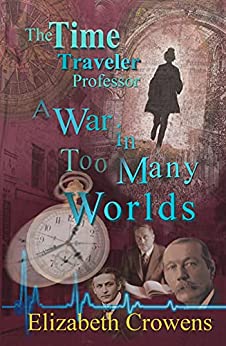
A WAR In TOO MANY WORLDS: The Time Traveler Professor, Book Three by Elizabeth Crowens – Time Travel, Science Fiction, Action & Adventure
 Musician-turned-time-traveler John Patrick Scott adds spy and saboteur to his resume while undercover in Germany in the final months of World War I, in A War in Too Many Worlds, the third installment of Elizabeth Crowen’s thrilling sci-fi series, The Time Traveler Professor.
Meanwhile, Scott’s once and future collaborator in psychic experiments, Sir Arthur Conan Doyle, is back in Britain sharing real time-travel adventures with the inventor of the fictional time machine, H.G. Wells.
Scott, after being wounded in the trenches, has finally been given an assignment in the Intelligence services. His extensive pre-war experience as a professor at the Conservancy of Music in Stuttgart, Germany, will do him good.
His assignment is to sabotage the waning German war effort through numerous false identities, while simultaneously mixing with high society to learn who is passing secrets from the Allies to the Central Powers.
Although frustrated by his sudden inability to travel through time, Scott has not lost any of his remaining powers. He is assisted in his secret work by many of the spirits haunting wartorn Berlin.
In Britain, Doyle and Wells undertake time travels of their own, to a past that seems to be more of a literary creation than a jaunt through time. They find the Island of Doctor Morbideux, a dangerous place filled with genetic experiments merging men with beasts, just as in Wells’ novel, The Island of Doctor Moreau. Morbideux appears to be a time-traveling Harry Houdini, unaware of his present life or his adversarial but friendly relationship with Doyle. The situation becomes increasingly perilous as it becomes clear that Doyle and Wells will be Morbideux’s next experimental subjects.
As the story slips between Scott’s undercover operations in Germany, and Doyle’s and Wells’ clandestine journey, this third book in the Time Traveler Professor series proves itself more complex than either of its predecessors.
Since the first two books, the war has changed Scott, leaving him older, sadder, more experienced, and more frustrated in equal measure. He takes greater and greater risks, and slips easily between chemically induced ecstasy and all too frequent despair, as danger mounts and loss surrounds him. Doyle’s and Wells’ adventures and misadventures, at least until they plumb the full depths of the island of Doctor Morbideaux, provide a bit of leavening to set against Scott’s increasing despond.
The overall story of the series continues to gain depth with a compelling pace, and the author recommends that readers enter this sprawling saga at its beginning in Silent Meridian. This book’s opening recap serves as an excellent refresher for readers who know the previous stories, but The Time Traveler Professor is a series like Outlander, where seemingly minor past – and future! – events and chance meetings may have vast implications for the ultimate fate of the protagonists and their world.
Ultimately, the adventure of The Time Traveler Professor, even if he cannot currently travel through time himself, still jumps in time and place, racing towards what is sure to be a wild ride of an ending in the projected final book in the series, The Story Beyond Time.