
Author: Virginia Herrick

  • An Editorial Review of “Foresight” by Deen Ferrell

    An Editorial Review of “Foresight” by Deen Ferrell

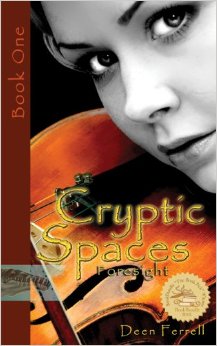
    Willoughby Von Brahmer hates high school, feels restless at home, and fumbles awkwardly around girls, yet is fascinated by the charismatic celebrity violinist his own age, Sydney Senoya. He seems like a pretty typical sixteen-year-old. But when the reader begins to untangle the mysterious web of Foresight, it becomes clear that Willoughby’s life is anything but typical. Foresight is Deen Ferrell’s artful and ambitious first Cryptic Spaces novel.

    Willoughby’s quasi-ordinary life begins to unravel during a routine visit to the barber. Not so ordinary, really: Willoughby is a math prodigy who at twelve solved The Riemann Hypothesis, a puzzle that had stumped mathematicians for centuries. His barber, Antonio Santanos Eldoro Chavez, has extraordinary expertise in architecture. All vestiges of routine evaporate when, during his haircut, Willoughby spies a string of glowing numbers suspended in the air in the corner of Antonio’s shop. Then, everything in the shop freezes except Willoughby himself and a skeletal-faced man appears, nods to Willoughby, and then just as quickly disappears leaving Willoughby shaken but intrigued.

    The story picks its way deliberately through Willoughby’s gradual discovery of a secret society of time travelers, Observations, Inc., apparently headed by the brilliant yet cryptic Hathaway Simon (H. S.), with the support of the enigmatic Sam, who Willoughby has known for years as his family’s chauffeur. Willoughby signs on to join a team of handpicked savants who will explore time itself, but soon learns that Observations, Inc. is not alone in the time-travel business – and their competitors are far less benign.

    The story kicks into high gear during Observations, Inc.’s initial team-building exercise on a “cruise” ship with unusual capabilities, where Willoughby and Antonio meet the talented and mercurial Sydney, as well as James Arthur, an aura-reading healer, and T. K., the cabin girl who, like Sam, is more than she seems. Before the cruise ship’s team embarks on their first mission, a gang of supernatural crooks stages a mutiny.

    Ferrell’s gifted descriptions, from Sydney’s music to the experience of time travel, bring the story to life. The cast of characters is deftly drawn and admirably diverse. Some younger readers may find the density of the plot daunting, but others will revel in the richness of the history and science brought to the subject of time travel and prognostication.

    As the Observation, Inc. team’s voyage of exploration becomes a battle for survival, Willoughby, Sydney and their friends realize they are bound together by more than curiosity. They need each other’s talents, commitment, and compassion if they are to get through time and space alive. Foresight is a rich and complex YA sci-fi story.

     Cryptic Spaces: Book One: Foresight earned  a First in Category position in the Dante Rossetti Awards for Young Adult Fiction, a division of Chanticleer Blue Ribbon Writing Competitions.
  • An Editorial Review of “All is Silence” by Robert L. Slater

    An Editorial Review of “All is Silence” by Robert L. Slater

    Well, not actual silence. Okay, there are spells of eerie quiet. But All Is Silence is quite lively, considering ninety- five percent of the Earth’s population is dead in the wake of a lightning-fast viral pandemic. Robert L. Slater’s suspenseful, sensitive debut novel takes a grim subject and characters who face disaster, and somehow creates a thought-provoking yet playful futuristic romp.

    Slater juxtaposes the tragic (a young girl singing at a loved one’s deathbed) with the darkly comic (hey! plenty of unused dishes – throw the dirty ones in the backyard!). He grabs our heartstrings even as he keeps us snorting with laughter at the probability that, yes, this is just what a group of random teens would do if suddenly thrust into this Apocalyptic world.

    Lizzie, a suicidal teenager whose mother dated jerks, starts the novel with a backlog of abuse and a chip on her shoulder the size of a concrete block. When the family members she loved to hate all die, she ventures into the deserted streets of her midsized Pacific Northwest hometown and begins liberating the neighbors’ pets and collecting cell phones. She discovers that not everyone has died: a few, like herself, are apparently immune, although just as big schmucks as ever. Others survived, but are only half there – the “dog people” – as confused, pathetic, and potentially dangerous as a pack of former pets turned feral.

    Devastated and lonely, Lizzie is ready to call it quits, but her final, desperate Facebook post brings childhood friend and would-be flame Zach to the rescue. The two discover their mutual friend Nevaeh has also survived and needs them. From here on out, the novel barely takes a breath as the threesome – with a growing ragtag band of misfits in tow – zooms from snowstorm to wildfire, from Oz-like techno geek to crazed kidnappers, in a cross-country quest to find a stranger from Lizzie’s past who might be the key to her future.

    Slater offers a sometimes humorous, sometimes incisive look at human nature, as Lizzie and her friends collide with transitional mini-societies that spring up in the wake of the disaster. Organic gardeners organize for survival in one place, while a paramilitary structure springs up to fill the vacuum in another – and everywhere, people are raiding Walmart for guns and ammo. Slater weaves in current global issues, as we realize with a start there’s no longer a need to worry about the human carbon footprint or issues of scarcity. “You mean all of a sudden there’s enough gas. And enough water,” Nev says. Zach adds: “Now a guy can shower you with diamonds after a quick trip to the jewelry store.”

    Slater’s cast of characters occasionally becomes unwieldy, particularly at the end of the book, as new people seem to be drawn in like lead filings to a magnet, while others are thrown off by the centrifugal force of the story’s swirling momentum. Some rough edges, such as punctuation goofs, plus a bit of a cliffhanger ending, may mar for some this otherwise absorbing and satisfying read.

    Bottom line: Slater draws us into a familiar-yet-drastically-changed world and makes us care about his cranky, vulnerable, sometimes-exasperating, always-engaging characters. His terrifyingly real dystopia reminds us that, really, the only choice for Lizzie, Zach, Nev, and all the rest of us, is to keep loving one another and find some way forward, even when our future is turned upside-down.

    All is Silence by Robert L. Slater earned a 1st in Dystopian Category in the highly competitive Dante Rossetti 2013 Awards for Young Adult Fiction, a division of the Chanticleer Writing Competitions.

    “All is Silence” is Book One in the “Deserted Lands” series by Robert L. Slater.


  • An Editorial Review of “Maiden’s Veil” by Lisa Costantino

    An Editorial Review of “Maiden’s Veil” by Lisa Costantino

    Lisa Costantino’s Maiden’s Veil is an entrancing tapestry of history, love, and sacrifice that spans the centuries from 1720 to modern times. The story exemplifies the psychological power that ancient rites have held and do hold over us, and the effects of these rites as they ripple through our consciousness or, more dangerously, our collective subconsciousness as they cross the barriers of time.

    Costantino deftly intertwines the stories of two star-crossed love affairs, building to a climax wherein the fates of all the four lovers are bound up together—making a seemingly chance encounter an event that will forever change their lives.

    A spirited and headstrong weaver’s daughter, Clarinda Asher is no fit match for Benjamin Keane, son of a prosperous merchant, even when they are paired as Maiden and King of their village’s May Day festival. However, it is when they are brought together to the circle of ancient standing stones to partake in a sacred fertility ritual that their lives truly begin to unravel.

    Three centuries later, Owen Calder, curator of the modern-day textile museum in England’s West Country, meets Jessamine Barlow, a traveling textile buyer from the U.S. Owen offers to take Jess to see the standing stones on the outskirts of the village. Unbeknownst to them, the circle’s power continues to resonate. Jess abruptly quits her corporate job to return to her first loves: weaving, and a pagan spirituality that echoes Clarinda’s faith. Owen longs to experience the more spiritual existence of his youth, one more in tune with nature, after having traded a life of poetry for “curatorial reports and funding proposals.”

    Costantino titled the story after the indigo veil that the virgin female must don during the pagan fertility ritual. But it is the natural beauty of the rural village that provides the crucial backdrop for both stories: Maiden’s Hill, where Clarinda is banished after her sacred tryst with Benjamin meets with disastrous results for the whole community; the River Guen that plays a fateful role in the tragedy; and the spring-fed pools where King and Maiden purify themselves—and where the two couples repeatedly return for strength to face their destinies, and bring life out of death, love out of sorrow.

    Maiden’s Veil was awarded 1st Place in the Women’s Fiction category, INDIE Awards, a division on the Chanticleer Blue Ribbon Awards 2013, for Costantino’s mesmerizing lyrical prose, her well-developed characters, and her compelling storytelling of a timeless and ancient theme.