Author: L Wilson Hunt

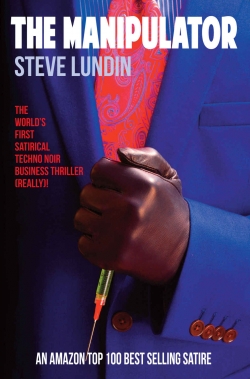
  • THE MANIPULATER by Steve Lundin, a near-future darkly humourous satire

    THE MANIPULATER by Steve Lundin, a near-future darkly humourous satire

    In the very near future, as portrayed in Steve Lundin’s darkly comic satire, The Manipulator, the marketing industry has taken over the world by turning it into a data-driven surveillance ruled technocracy. Jack Vance, Lundin’s protagonist, is the product of this high-tech environment that is socially and morally bankrupt. A smart and worldly guy, Jack prides himself in the kind of quick thinking that can keep him a nanosecond or two ahead of his enemies and competitors.

    Jack was on the fast track to becoming the brightest star in New York City’s media universe until a critical lapse in judgement crashes his career and his reputation. However, Jack’s back. This time in Chicago, with his own company and a plan.

    As a self-diagnosed sociopath, Jack will be the first to tell you that he’s more than qualified to tangle with the best of this brave new world’s hidden persuader elite. He lives to sell, to conjure up that next bigger and better promotion from which he can get a fix for his addiction to the thrill of closing a deal. And Jack has just taken on the ultimate deal. His new venture, Blowfish, is a winner-takes-all marketing firm run on the premise that the higher the risk the higher the return.

    Lundin, the author, draws from his background as a journalist and marketing expert to weave an ultra-contemporary and entertaining story of greed, excess, and the insatiable nature of the human condition. From Jack’s self-designed corporate “War Room” – a “Glen Garry Glen Ross” style employee think-tank where jobs are constantly on the line – to his drug and alcohol-induced decision-making processes, Jack is every inch the anti-hero that readers love to hate, but don’t. Think “Mad Men’s” Don Draper on Ritalin-enhanced premium vodka with an arsenal of the latest black-market techno gizmos, access to the freshly minted data, and, of course, while being smartly attired at all times.

    With his Blowfish team grinding numbers and probabilities in the background, Jack devises a scheme to launch their client’s mobile network onto the world stage by using the audience draw of the Super Bowl. In Jack’s mind, pitting the surefire new hit “Some Will Die,” a hyper-reality show– Jack’s brainchild – in which morbidly obese contestants sign on to lose half their body weight in a short period of time, or die trying–against the much “tamer” SuperBowl can’t miss. Or can it? It is a risky gambit that will either put Jack and his staff on the streets, or set them up for life,

    Yes, winners receive riches and fame, but it’s the losers, along with the show’s Russian task-master host, Vlad Berber, who provide the entertainment fodder for the show’s twisted audience.

    With a fast-paced story line and a rich cast of characters, this award-winning winning novel offers a uniquely hilarious, but scary, perspective on the how the businesses of public relations and marketing can take technology to its precipice to take advantage of a media addicted public. Lundin’s clever blending of fact and fiction alternately tempts and taunts the reader with Vlad’s prophetic question, “Are you comfortable with the edge?” Highly recommended.
  • BRAIN by Dermot Davis, a rare species of complete entertainment

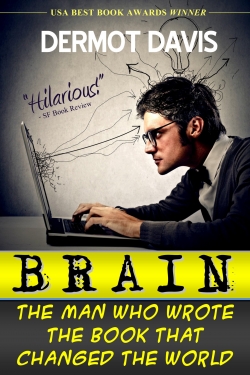
    BRAIN by Dermot Davis, a rare species of complete entertainment

    Daniel Waterstone has every intention of writing the Great American Novel, and in doing so, he is going to set the ignorant, crazy mass of modern readers straight on what constitutes great literature.  But, after two improbable, failed “masterpieces,” his publisher, the delightfully savvy Suzanne, has told him that success and recognition will best be served by his authoring a book that some of the “great-unwashed” might actually be interested in reading. Daniel likes the idea but is clueless about how to proceed.

    The product of coldly academic and overprotective parents, Daniel entered adulthood as a cynic with a dislike for people, a fear of women, and a conviction that everyone except him was crazy. He had such strong feelings of loneliness that he often thought of himself as an alien trapped on the wrong planet. Although highly-degreed in literature, the rigidly naïve Mr. Waterstone will soon learn that he is obligated to finish one final course: Life 101. And if he is willing to take his lessons, life just might have a little something up its sleeve for him.

    Daniel quickly finds a theme for the book that will liberate him from poverty and his sense of failure; he enters a bookstore where a flamboyant and somewhat other-worldly writer of self-help books is preaching his gospel to an enchanted crowd. When Daniel calls him out as an opportunistic fraud, the guru challenges him to engage in a “mind-meld” that will supposedly free Daniel from some of his hang-ups.

    Amused and seemingly unaffected, Daniel leaves the store cradling an idea for the book that will please the masses: he will write, under a pseudonym, a satire that exposes the pop-psychology industry for what he thinks it is: a total lie, an insult to crazy people done by crazy people. Ironically, his satire becomes the kind of blockbuster success that brings him riches and fame, but at a cost, as author Dermot Davis is happy to tell us all about in Brain: The Man Who Wrote the Book That Changed the World, his mystical and joyous tale of personal growth and fulfillment in the modern age.  

    “Crazy,” the word, the notion, the concept, is the spine from which flows the energy of  Davis’ often tongue-in-cheek fairy tale, its relevance grounded in the infinite variability of human  experience, and its ability to score a few points for emotion in the seemingly endless skirmish between skepticism and belief. Score more points for the stubborn and ineffective Daniel if he can revise the “me-versus-them” definition of “crazy” that has him strapped to the cheap seats of human experience.  

    And, could there be a better word than “crazy” to carry the torch of enlightenment into the shadows of our increasingly soul-less and programmed culture?  Probably not, at least in Davis’ jauntily addictive narrative, an arena in which he holds court with the majesty of an imaginative, accomplished humorist.

    I was not surprised to learn that the author is also a playwright, as his marvelously crafted characters and sets quickly acquire the kind of three-dimensional believability that one expects to encounter in a live theatrical performance or, according to my mind’s eye, a movie (complete with an endearingly haunting soundtrack and a reincarnated Jack Lemmon in the lead role!).

    Dermot Davis’ Brain is that rare species of complete entertainment that can be both deeply philosophical and buoyantly accessible. Laughs, suspense, intrigue, love, and a gentle thread of the paranormal are all there for you, gift-wrapped in a sweet mist of serendipity.  


  • TARNISHED HERO by Jim Gilliam, a military thriller

    TARNISHED HERO by Jim Gilliam, a military thriller

    Tim Kelly grew up in 1960s Galveston, Texas, a border city with a long history of being terrorized into lawlessness by drug cartels from Northern Mexico. He left home at the age of fourteen to escape the unacceptable behavior of a ne’er-do-well father. While conjuring up his street smarts, Kelly learned about the value of  choosing loyalty to friends over that of authority from a couple of highly disparate mentors: Rodolfo Guzman, a cartel leader, and Dave Holt, a local sheriff.  

    Kelly shouts the sixties mantra of “question authority” with the consequences-be-damned recklessness of a young man who will  be true to his heart, even if it lands him into chaos. Indeed, trouble will stick to him like maggots to a dismembered body in Jim Gilliam’s sweaty guns n’ ammo action thriller Tarnished Hero.

    As a Petty Officer in the United States Coast Guard, Kelly demonstrates his lack of respect for authority with extreme prejudice, enough to land him in a courts-martial. It is only with reference to his acts of bravery in Vietnam that his defenders are able to keep him out of prison.

    That will not be good enough for his accusers who, in a wink toward the military-industrial complex, decide to splice this knowledge of his grace under pressure into an offer that he cannot refuse: Kelly can walk free after completing the dangerous mission of infiltrating and destroying a drug cartel, that of Rodolfo Guzman, the man who had always been like a father to him. At the same time, Kelly’s fiancée is in a coma after becoming collateral damage in a brutal combat between the Campechee and Sineloa drug cartel.

    It is when Kelly accepts an open invitation to spend some time in Guzman’s drug palace in Northern Mexico that his code of “trusting friends first” will force him to face not only the dilemma of a loyalty to be divided between Guzman and Dave Holt, but also of being thrust into a senseless and bloody border war that has more than a few parallels to the Vietnam conflict. As such, Gilliam’s novel stands not only as a complex and intriguing “band of brothers” romp, but also as a reflection on the evils of unquestioned authority and corruption.

    Tarnished Hero is abundant with colorful heroes and villains. The author is deft at offering them various poses on his good-guy to bad-guy continuum and he paces his quick narrative with enough twists and surprises to sustain interest.  However, it is important to point out that this will be for most people a “guy” book, one that offers up the kind of violence and gore that its subject requires for credibility. Also, readers are warned that some female characters are portrayed as rather one-dimensional boy-toys, perhaps as a nod to that common stereotype of the era.

    That being said, Tarnished Hero is a thriller  that can more than holds its own as an engrossing entertainment for fans of the genre.

  • FIRE TRAP by Richard Mann, a mystery-thriller novel

    FIRE TRAP by Richard Mann, a mystery-thriller novel

    The biotech start-up Genetrix has been begging for a fourth round of funding from the venture capitalists at Hillberg in order to keep pace with well-funded rival, Roark, in a race to see who can put a breakthrough drug delivery system into the marketplace first.

    Just when the high-tech movers and shakers should have been positioning themselves for a taste of profit, the top research and development scientist at Genetrix dies in an absolutely epic explosion that shakes its headquarters in Silicon Valley.

    And that is the white hot intense opening of this clever whodunit. Was it murder or suicide? And who gets the insurance money after a heavily covered “key man” has died?  It is up to ace insurance investigator Randy Justice, who just opened his Justice Investigations office in Portland, Oregon to connect the dots and match wits with the hipster swells of the high-tech corporate elite.

    Randy’s pretty good, knows his own flaws, and can enjoy a scotch. He can handle tough corporate venture capitalists, and he can wrangle with his two feisty teenagers. Randy knows when to play his hunches and his sidekick, Arnie, keeps him focused.

    Randy moved to Portland because he just inherited his parents’ performance theater. He splits his time between a love of the theater and the thrill of chasing down bad guys. I found the author’s frequent glances into the world of the performing arts to be both charming and informative, and he seems to freely enjoy poking fun at the quirks of West Coast culture.

    In Fire Trap, first-time novelist Richard Mann dives fearlessly into the shark-infested waters of venture capitalists and high tech in this mystery-thriller. Mann juggles the complexities required of the successful whodunit with the sure-handed skill of a veteran mystery writer.

    Indeed, Mann seems to be completely at ease with the genre. He demonstrates a solid knowledge of his material, managing to massage potential deal breakers such as the mundane intricacies of policies and insurance investigation, along with forensic science, into Fire Trap’s tightly knitted plot without losing momentum or the white hot intensity of the narrative pace.

    Fire Trap is a totally satisfying mystery/thriller that, in spite of a few nods to the stereotypical, it thrills, amuses, and entertains. Randy Justice faces the deadly dynamics of the biotech corporate world while managing to squeeze a little theater culture and some romance into his life. Mann’s packing so much entertainment into the confines of a mere 206 pages is no less than a marvel—it’s a mystery! First-time novelist Richard Mann has hit one out of the park with this fascinating and uniquely clever whodunit.

    Reviewer’s Note: Fire Trap won First Place in the Clue Awards Private Eye Category for 2013.


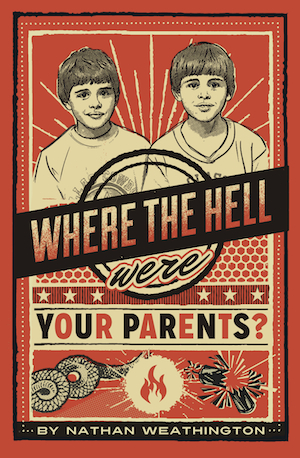
  • WHERE THE HELL WERE YOUR PARENTS? by Nathan Weathington

    WHERE THE HELL WERE YOUR PARENTS? by Nathan Weathington

    The folks in Bremen, Georgia will never forget 1979, the year the Weathington Boys came to town. The twin, sweet-looking seven-year-olds Nathan and Brian, take up residence with their parents in the Southern hamlet. Their father was the local high school’s football coach (in the South, practicality a priestly position) and their mother believed, apparently, that her boys could do no wrong.

    The Weathington mini-scofflaws and their pals quickly learned how to put the freedom of a long, hot summer to good use. And so begins, “Where the Hell Were Your Parents?” by Nathan Weathington

    Together, the Weathington Boys, tested the local limits of propriety and patience. The stories of their practical jokes are still repeated almost thirty years later in the author’s hometown as gospel truth. Plastic snakes and firecrackers quickly gave way to more outlandish and daring means of raining chaos with their ‘high stakes’ practical jokes. What would begin as a practical joke would have to be upgraded to the next level, as each new prank bore the responsibility of out-demolishing the previous one. Ah, this is definitely good ol’ boy humor. Indeed, the reader will only need to flip to page 58 to find a recipe for making a serviceable grenade from shotgun shells. And, fast-forward if you dare, to page 141 for directions into concocting the ultimate “sh*t bomb,” complete with authoritative help on selecting the proper level of viscosity for maximum effect. Mayhem and madness of epic proportions would ensue whenever Nathan and Brian, along with their partner-in-crime, Ray “Corndog” Womack, the kid who would drive the getaway car, would decide that things in the small town needed stirring up. If a TV show were to be made about these clever and delinquent boys, it would be a mash-up of “The Red Green Show,” “Mythbusters,” and “Dukes of Hazzard.”

    These outlandish hijinks are told by the author with stand-up candor, great witty humor and at least a tongue-in-cheek sense of self-deprecation. The scenes in which he, his brother Brian, and Corndog played out their ‘feral’ youth pranks have a palpable, you-are-there believability that will have you guffawing as you shake your head and wonder.

    And, yes, the author, Nathan Weathington swears the stories are the genuine original truth. You just can’t make some of this stuff up. When he would tell his wife about one of the infamous pranks, she would consistently ask him (and I quote the author), “Where the hell were your parents?” It is a question that he gets asked repeatedly by more folks than just his wife, hence the title of this hilarious work (as long as you weren’t on the receiving end of the pranks).

    Somehow, the boys did not end up in the county jail. Nathan graduated from Auburn with a Civil Engineering degree and a M.B.A. from Victoria University, B.C. Now the father of two young boys, Nathan also addresses another subject that he now takes as seriously as the pranks he used to pull back in the day: parenting. Embracing the nature versus nurture debate, he favors the former, as its laid-back parenting style being more in harmony with his “let ’em go out, get some cuts and bruises and learn about life” upbringing. As such, he is openly contemptuous of the current trend toward ‘helicopter parents’ who smother their offspring.

    In this book, his first, Nathan Weathington makes a good case for himself as a published writer and exceptional humorist, and I find most of his outspoken observations to be both substantive and relevant to the times. I’ll thank him now for some of the most gut-wrenchingly painful laughs I’ve ever had.

  • An Editorial Review of “Rhythm for Sale” by Grant Harper Reid, Ph.D.

    An Editorial Review of “Rhythm for Sale” by Grant Harper Reid, Ph.D.

    Grant Harper Reid’s  Rhythm for Sale  tells the rags-to-riches story of his grandfather Leonard Harper, an extraordinary entertainer who danced, choreographed and produced his way to stardom in the frenzied years of The Harlem Renaissance, only to be forgotten after the last curtain call of that culturally transforming and iconic chapter in the history of American Musical Theater. Mr. Harper is considered the father of cabaret.

    In this fascinating biography, Dr. Reid’s decades of careful research, has managed to polish nearly a century’s worth of neglect from the image of his grandfather, the remarkable Mr. Leonard Harper. Dr. Reid is eager and happy to share the knowledge that he accumulated about this particular time in American history.

    The book’s tempo is fast-paced as the author condenses an encyclopedic amount of events, entertainers, prohibition gangsters, and the birth of a new genre of show business into its mere 242 pages. The well-documented facts and events often tap dance across the page with a fury, perhaps suggestive of the pace at which Leonard Harper worked his craft: He would often be involved in several stage productions simultaneously!

    Reid tracks his Alabamian grandfather’s career that began at 10 years-old when he was forced to enter show business full-time when his father dies. It was from his father that Leonard was introduced to performing. Prior to his father’s passing, Harper sang in church and danced for appreciative smiles and pennies along side his father. It seemed that young Leonard Harper had a natural talent for entertaining and a passion to perform.

    Reid shares his grandfather’s journey from dancing in broken hob-nailed “tap” shoes to making the Southern Circuit via “country road walking,” to working in Vaudeville, to basement gin-joints, and on to legendary venues such as The Cotton Club and the Apollo Theater. Reid also lets his readers in on the darker side of the Harlem Renaissance, a time of racial segregation, political corruption, and cultural clash that was prevalent during this time period of American history.

    Indeed this book stands tall, not only as a biography but as a reliable document of an important slice of American history. Reid also shares some of the fabulous lost photographs that he uncovered while researching his phenomenal grandfather’s journey in this penetrating work that mirrors the psychology of a nation in transition—one preparing for the coming Civil Rights movement.

    Much of the book’s inner light comes from the author’s, Grant Harper Reid, own, often humorous, observations, supplemented by a simply delightful parade of the celebrities and gangsters with whom Leonard Harper rubbed elbows. However, Reid doesn’t shy away from the deeper underbelly of Harper and his generation—white, black, or mixed.

    Grant Harper Reid, the author himself, was carried on stage as a ‘New Year’s Baby’ at the Apollo Theater by singer Jackie Wilson. And he remembers being around entertainers and show biz as a matter of course when he was a child. Later, the author worked professionally as a location scout and/or crewed for at least 40 films such as Fame, Mississippi Burning, and Do the Right Thing (IMDb). Reid’s latest project is Rhythm for Sale (2013), the biography of his late grandfather, Leonard Harper who came from a life of meager means in Alabama to become one of the great contributors to art and culture in the U.S.

    Like Harper himself, his biography, Rhythm for Sale is a vigorous and highly entertaining read that will transport its reader. Highly recommended.

  • “Unforgiving, The Memoir of an Asperger Teen” by Margaret Jean Adam

    “Unforgiving, The Memoir of an Asperger Teen” by Margaret Jean Adam

    In Unforgiving, The Memoir of an Asperger Teen, Margaret Jean Adam chronicles her own struggles with growing up with Asperger’s Syndrome in the early sixties, decades before it would be officially recognized by the medical profession. One of the syndrome’s hallmark symptoms is a lack of the ability to understand the subtleties of non-verbal communication. Social cues such as body language and facial expressions are opaque to its victims, whose resultant awkward and seemingly inappropriate behavior can leave them feeling isolated and misunderstood.

    Life at the totally dysfunctional Adams’ home was strict and laborious, leaving the young Margaret Jean little time to retreat into the world of reading, writing and religious thought that had become her sanctuary of survival. She had also been molested by a family friend at the age of fourteen, but acknowledged that her parents would not believe her. Life with Asperger’s is not something that anyone wants, but for Margaret Jean this experience was exacerbated by being sexually abused.

    As a teen, Margaret Jean devoured Shakespeare, which led her to find dignity and recognition in acting. Role playing suited her strong persona and resonated harmoniously with the fantasies of her inner sanctum. And, from her will to succeed in a daunting world came her self-appointed directive of staying on the rocky path to becoming “the best-possible Margaret Jean.”

    The memoir’s brave narrative, an inviting mix of diary excerpts and personal reflection along with some of her own very moving poetry, offers a clear view into the workings of the Asperger mind. As such, it provides drama, humor and surprise to substantiate a good novel. But it is mostly an expression of the author’s desire to help others via a generous sharing of her own experiences, a project that she manages brilliantly. Unforgiving: the Memoir of an Asperger Teen celebrates the beauty and resiliency of the human spirit.

  • The Only Witness by Pamela Beason

    The Only Witness by Pamela Beason

    Seventeen-year-old Brittany Morgan’s infant daughter was taken from her car—an apparent kidnapping. Brittany’s young mind is quaking in attacks of hope, fear, guilt and desperation. Why would anyone take little Ivy from her? Where can Ivy be by now? Is she being held for ransom? Is she still alive?

    Detective Matt Finn hopes so. As a recent transplant from the mean streets of Chicago, where experience taught him to expect the worst, to the relative innocence of a small town in the Pacific Northwest, where everyone already has an Ivy-fate theory, he knows that this investigation is not going to go smoothly. His clue file is empty and the clock is his enemy. If only he could find a witness to the crime! Well, Dr. Grace McKenna over at the “Talking Hands Ranch” just left what she hopes was an anonymous tip that might be able to help the investigation. It seems that one of her charges witnessed the snatching of baby Ivy.

    In The Only Witness author Pamela Beason employs knowing doses of drama, humor, adventure and romance to polish her clever premise into a sparkling jewel; a friendly persuasion of plot and character development that maintains a high level of reader interest and fascination.

    Beason’s linguistic skills are evident in the often endearing scenes in which Dr. McKenna is patiently trying to coax some useful testimony from the agitated Neema who has a story to tell. Neema is the endearing gorilla that Dr. McKenna is teaching sign language to at Talking Hands Ranch. She is a dangerously strong and potentially aggressive “witness” with the IQ and attention span of a human five-year-old. Nevertheless, Neema knows how to negotiate for a banana and steal your heart while doing it.

    Beason manages to plunge deeply into the hearts and minds of her main characters without creating any interruption of narrative flow. Brittany Morgan’s teen angst, Matt Finn’s dealing with his wife leaving him as he adjusts to being a cop in a rural town, Grace McKenna’s worries about the future of her underfunded project, Neema’s feverish need to communicate: all intriguingly support and contribute to the smart pace of Beason’s hip and socially relevant who-done-it. Indeed the author has a good time taking well-aimed shots at some of the peculiarities of our priority-challenged culture.

    The Only Witness is a marvel of story-telling. Pamela Beason’s novel is one of those rare gems that is intelligent and informative but also embracing and charmingly accessible. The Only Witness is the Grand Prize Award winner of Chanticleer Book Reviews Blue Ribbon Novel Contest.

    5 Star Best Book Chanticleer Reviews round silver sticker

  • NOWHERE ELSE TO GO by Judith Kirscht – Contemporary, Literary Fiction

    NOWHERE ELSE TO GO by Judith Kirscht – Contemporary, Literary Fiction

    It’s the fall of 1968 and America is in the throes of rapid social change and cultural upheaval. Martin Luther King has just been assassinated and body bags filled with 18-year-olds boys are coming back from Vietnam at an alarming rate.  Political unrest and race riots are turning cities into war zones while suburbanites try to buffer themselves against the tumultuous times.

    Nowhere Else to Go by Judith Kirscht masterfully explores these momentous national issues by humanizing them on a personal scale in the small Midwestern college town of Norton Bluffs. The intransigence of the ruling suburbanite whites along with their fears meet head on with the anxieties of the disadvantaged blacks in the halls of education—where the effects of racial polarization are most profoundly felt and magnified in small towns.

    Principal Cassie Daniels, of Red River Junior High School, relentlessly tries to carry on classes, school dances and basketball games even as she encounters the shrapnel from these social upheavals in her beloved school, in her marriage, in her relationship with her two school-aged sons, and within her professional relationships.

    Principal Daniels and the RRJH faculty have already endured the difficulties brought on by racial integration and bussing.  But just when they thought that they had made it past the worst and even came out somewhat ahead with a new wing of classrooms, the Board of Education has more in store for RRJH. It seems that with a bit of “redistricting,”  Red River Junior High, due to its location on the edge of town, can serve as a buffer zone between disadvantaged, mostly black, neighborhoods and those of the affluent white ones.

    The hoped-for, by the town’s politicians, result from this redistricting maneuver is to return a sense of “normalcy” to the town of Norton Bluffs along with the prevention of any violence like last year’s riots at the high school.  And if the redistricting isn’t enough to throw RRJH into a tailspin, The School Board is dictating to use RRJH as a social experiment laboratory for testing some educational “new-think” concepts.  Fresh new teachers have been hired by the School Board for RRJH –and this is where things start to get really interesting.  These new teachers’ tutor in ‘advanced school room theory’ is Principal Cassie Daniels’ husband.  Ben Daniels is an ivory tower burnout hoping to put a new polish on his tarnished idealistic proclivities.  He’s already selected the feisty Louisa Norton as his favorite protégé.

    Principal Daniels can’t help but worry that the escalating racial tensions in her schoolrooms will erupt into violence.  Can she keep her divided faculty members on the same page?  Will those wide-eyed kids from the Flats be able to make “the jump” from the safety of their old elementary school into the open-jawed terrors of junior high?  And just what are Ben and the confrontational Louisa really up to?

    If Cassie Daniels is the strength of the author’s energetic narrative, the teenage students are its pulse, a Greek chorus chanting under the noisy howl of the games adults play.  As expected, a great deal of this novel is devoted to these adolescents’ emotional responses. Particularly endearing are Kirscht’s portrayals of how the kids try to cope with a world that they are too young to understand. Kirscht does an excellent job telling her story from many perspectives.

    No Where Else to Go is a tenacious read that captures the grittiness of the undertow of racism and prejudice.  However, some may find the first several pages a little hard to follow as you are taken instantly into the fray of the battle, but if you hang on, you will find this dense novel to be fast-paced and hard to put down.  I heartily recommend Nowhere Else to Go as a tightly woven and insistently engaging novel about racial prejudice and the blackboard jungle of the 1960s.

  • Murder One by Robert Dugoni

    Murder One by Robert Dugoni

    In Murder One, lawyer turned novelist, Robert Dugoni has conjured up an intense page-turner that deftly mixes drama, mystery and suspense that will keep you guessing until its final pages.  Dugoni’s vivid characters in his novel are marvelously believable, as are the Seattle locales that are described. (more…)