Author: L. Costantino

  • An Editorial Review of “The Immortal Game” by Joannah Miley

    An Editorial Review of “The Immortal Game” by Joannah Miley

    Love bursts forth like Athena from the head of Zeus after a shy college student meets Ash, a guy who plays chess at the local bookstore. Ruby, a quiet pre-med student struggling with her coursework at a university in Portland, Oregon, hangs out at Athenaeum Books to study and indulge in the barista’s irresistible ambrosia bars. When handsome Ash challenges her to a game of chess, she demurs. She has work to do, and chess stirs memories of her late father, a medic killed in the war. Ruby wants to follow in his footsteps, but she finds it hard going.

    She finally accepts the undefeated Ash’s challenge to play. When Ruby checks his king, Ash is baffled and is insistent to discover how she beat him. The aloof Ash finds himself attracted to Ruby’s intelligence, natural allure, and lack of guile. Although Ruby embodies all of these attributes, she doesn’t seem to know it. Their friendship blooms. Against her usual caution, Ruby accepts Ash’s compelling dares of outdoor adventures that push her beyond her comfort zone, and these experiences change her in an indefinable way. She’s finding courage and she is falling in love with Ash. He reciprocates and begins to open up to Ruby.

    Now it is Ruby who is baffled. Ash has a first-hand way of talking about historical events, and he has wounds that mysteriously appear and then strangely disappear as quickly. Also puzzling is his relationship to Sage, the barista and owner, and Langston, an aloof poet who also frequents the bookstore. When Ash finally reveals his true identity—he not only looks like a Greek god, he is one—Ruby hesitates, but not for long. After all, Ash—now Ares, the god of war—has promised that their marriage will stop all wars on Earth. Already peace is ensuing as Ares’ obsession for war is replaced by his love for Ruby.

    Ares transports Ruby to Olympus, where he declares his love for the mortal Ruby and they petition Zeus to allow them to marry. It is here that the story’s rapid unfolding and unveiling of secrets is taken to a new level when Ruby is introduced to the various gods and nymphs and the opulent splendor of their homes and adornments. Here Miley has created an intriguingly flawed Olympus, one where vainglory and selfishness prevail; where Zeus is lecherous, Apollo scornful, Persephone apathetic. She makes these characters and their interactions come alive on the page.

    The story gathers speed when Ruby discovers that Zeus has forbidden the gods from meddling in the affairs of mortals or with mortals, for that matter. Zeus sets about thwarting Ruby’s marriage to Ares by going back to his old ways—he starts making deals with the other immortals. The immortals intervene, once again, in mortal affairs and stirring up the ages-old status quo amongst themselves. Before long, mankind becomes the expendable pawn in the immortals’ plots and schemes as the immortals form alliances for dominance of Mount Olympus.

    It is up to Ash and Ruby to save mankind and to restore order. Their quest takes them to Tartarus, a sunless abyss, where they encounter ordeals and the most fantastical creatures from Greek mythology: Charon and Cerebus, Chimera and the fifty-headed Hecatoncheires. The heroes’ ordeals are suspenseful and their journey adventurous as they experience challenges that lead to a thoughtfully crafted conclusion. This reviewer is looking forward to reading Miley’s next work in the End Game series.

    Adults, new and otherwise, will be entertained with Ruby’s experiences as she negotiates the intertwined worlds of mortals and immortals. Miley takes you from Portland, Oregon in a war-torn future to opulent Mount Olympus to the darkest halls of Hades as she keeps you turning the pages in this entertaining novel that successfully intertwines ancient Greek mythology with a contemporary story line that has just the right amount of romance, action, and adventure.

    A mythic twist on New Adult college romance and a rousing tale of personal courage, The Immortal Game has deservedly earned a place as a First in Category in the Dante Rossetti Awards for Young Adult Fiction 2013, a division of Chanticleer Writing Competitions.


  • An Editorial Review of “A Simple Soul” by Vadim Babenko

    An Editorial Review of “A Simple Soul” by Vadim Babenko

    In this character-driven novel that delves deeply into the psyches of six flawed individuals seeking life’s meaning in post-Soviet Moscow, the most enigmatic character is Russia itself.

    A Simple Soul begins apparently as a romantic endeavor that turns into an enthralling perilous thriller with plot twists, humor, and retribution.

    Russian-born Babenko’s novel, A Simple Soul, is filled with souls who are anything but simple. They are bored workers and wily entrepreneurs, all hardened to the murky world of Russian commerce, rampant corruption, and the decay of society. Yet each one seeks an elusive truth—happiness, love, the meaning of life. Elizaveta sees herself as a cold Venus, breaking the hearts of the men she dates, only to leap at marrying her long-ago love, Timofey, whose proposal has shady underpinnings. Alexander, her spurned lover, finds contentment in collecting words of wisdom, then loses it to despair. Seeking “his true mission,” Nicolai Kramskoy plans to steal and doctor a historical document to “prove” a connection to folk hero Pugachev, which links him to American Frank White Jr., who’s pursuing Pugachev’s alleged treasure map, along with a connection to his own Russian roots. Eventually joining them is Andrei, Nicolai’s old friend and a writer struggling to find confidence and purpose in his work.

    For much of this complex story, plot is relegated to the background as internal monologues become the focus. Personal histories and meandering thought processes draw the reader into a compelling maze of metaphysics and social commentary. Each character’s life is beset by small mysteries: Elizaveta finds mysterious symbols; Frank studies star signs; even Nicolai, the most cynical of all, once ran a business called the Astro-Occult Parlor. He observes that “people here were too fond of prophets, oracles, soothsayers, and magicians of all kinds,” but it becomes easy to see why even he is drawn to peering into the future.

    One could argue that Babenko’s characters all carry the same voice: intelligent, cynical, questioning, opinionated. What separates them is where that voice takes them: on personal journeys of soul-searching analysis, perhaps best exemplified in Nikolai’s comment while traveling by train:

    “Any country could be proud of its limitless vastness. Any except this one: people here don’t know how to be proud of anything, and perhaps they never did. Where there’s a lot of space, there’s free will and farsightedness, but there’s also no respite and an eternal restlessness, which results in universal sadness.”

    Such observations show the author’s skill in portraying the depths of functional loneliness.

    As Elizaveta sums up:

    “I don’t need this – riddles, higher powers. … – could the issue be with me? Do I have an overly simple soul?”

    After delving into the heart and mind of this postmodern Russian, the answer can only be, not in the least.  A Simple Soul transcends genres and time as its characters move across the vast lands of Russia and its ever-changing socio-economic landscape. Prepare to be transported.

    Vadim Babenko, who has a doctorate in physics from the Moscow Institute of Physics and Technology, has published six books, three are novels.  A Simple Soul was nominated for Russia’s most prestigious literary awards: The Big Book Awards (the Russian equivalent of the Booker Awards) and the Russian Bestseller Awards. His stories are complex with many subtle philosophical questions and dilemmas.  His prestige is sure to follow in North America as well.

     [fusion_builder_container hundred_percent=”yes” overflow=”visible”][fusion_builder_row][fusion_builder_column type=”1_1″ background_position=”left top” background_color=”” border_size=”” border_color=”” border_style=”solid” spacing=”yes” background_image=”” background_repeat=”no-repeat” padding=”” margin_top=”0px” margin_bottom=”0px” class=”” id=”” animation_type=”” animation_speed=”0.3″ animation_direction=”left” hide_on_mobile=”no” center_content=”no” min_height=”none”][Reviewer’s Note:  I found A Simple Soul a fascinating and entertaining read. I am fortunate to have been introduced to Babenko’s masterful works as they are still relatively unknown in North America. ]

     [/fusion_builder_column][/fusion_builder_row][/fusion_builder_container]

  • An Editorial Review of “Darklight II: Conflagration” by John Wells

    Five years after the publication of the military sci-fi thriller Darklight I: The Substance of Shadows, comes the second installment in the series, Darklight II: Conflagration,  the continuation of the conflicts between human and Matarin rebels and the genocidal Cren Empire.

    The stakes have considerably risen since mathematician and rebel fighter Crash Tyson first encountered the billions-year-old Cren Empire in the battle against the equally ancient ESOG Empire. The remaining freedom fighters seek a new sanctuary where they can rebuild their fleet and enhance the Spatial Exclusion Wave technology that Tyson created. They find safe haven with the Skarr, a species that had battled the Luin—the telepathic race controlling the Cren Empire—many eons ago.

    The Skarr hold an advantage: the Luin believe them extinct, along with the Sargen and the Valm, two species that had fought alongside the Skarr. Tyson, however, has the distinct disadvantage of being the Cren Empire’s sole focus, with his capture worth the destruction of billions of their own warriors.

    What warrants such galactic wastage? Tyson is the Progenitor Being, the model human that P-Quan, the Cren governor, created as an experiment in accelerating human genetic evolution in order to generate someone capable of solving The Great Problem.  It is with this experiment that Wells compels us to consider the purpose of sentient life in the Universe. The nature of that problem serves as a teaser until late in the game, when the conflict escalates into a war of multi-dimensional magnitude.

    The depiction of intergalactic war and its futuristic weaponry is where author Wells excels. The astrophysics and engineering of such advanced technology is at once mind-boggling and wholly believable. As E.E. Smith’s works (1890 – 1965) that explored the universe outside of our solar system with fictional technologies, extra-dimensional beings, and time travel before NASA, string theory, or the Hubble Telescope, the Darklight series take readers beyond  the confines of the known universe and into mind-boggling technologies that venture into multi-dimensional applications of  universal cataclysmic potential.

    Warfare comprises much of the story, with telepathic and directed-energy combat filling the gaps between massive, planet-destroying battles. Brisk pacing keeps readers enthralled as other ancient species join the fight, and each apparent victory sees a new threat emerge—none more so than the thousand-mile-long rift in space created by the increasingly powerful weaponry used on both sides.

    Wells explores the connection of life with the ultimate fate of the universe itself and sentient life’s connection to that fate in his Darklight series.  When the godlike being that dwells on the other side of the rift raises the stakes to an unfathomable level, the stage is set for the next Darklight installment.

    If you enjoy E.E. Smith’s space operas that influenced the first generation of computer war games, and (some say) the authors of Earthlight, Star Wars, Babylon 5, and Superman, then venture forth into the Darklight series to expand your universe.

  • An Editorial Review of “Artemis Rising” by Cheri Lasota

    Rendered with a lush and lyrical touch, this Y/A historical fantasy depicts the romantic yearnings of two innocent lovers, both dedicated to and trapped by the belief that they embody tragic figures from myth and legend.

    Born of a pagan mother and a strict Catholic father, fifteen-year-old Eva Maré learns the hard way that when the two religions clash, catastrophic results follow. Aboard a ship bound for the Azores, Eva undertakes a ritual to transfer the role of Arethusa, a sea nymph dedicated to Artemis, from mother to daughter. But instead of the Goddess’s blessing, hell’s own fury is unleashed. The ship crashes into the volcanic face of Ilhéu das Cabras, though not before Diogo Cheia, a marquês’s son possessed by his desire for Eva, displays his wrath over her rejection.

    Eva, now Arethusa, regains consciousness on the Azorean island of Terceira, surrounded by the flotsam of the shipwreck that took the lives of her parents and nearly everyone else on board. Badly wounded and rendered mute by an act of violence she cannot remember, she is rescued by a beautiful young man, who takes her to the orphanage in Angra do Heroísmo, where he lives. There Arethusa is healed, but it won’t be long before she discovers Diogo survived as well.

    Thus begins the ages-old tale of two men fighting over the woman they both love. But this is no ordinary triangle: Diogo believes himself heir to the role of Alpheus, the river god to whom, in Greek mythology, Arethusa is bound for eternity. To complicate matters, Tristão Vazante, Arethusa’s rescuer, had been led to believe he is the embodiment of the Cornish knight Tristan and that Arethusa is his Isolde.

    This well-written and crisply paced novel mixes the two myths: one Greek, the other of the canon of Arthurian literature. It’s possible the author intended the two disparate myths to represent the clash between paganism and Christianity—and the way the main characters eventually reconcile their religious conflicts—but one is distorted to emphasize evil, while the other is less a Christian morality play than a medieval tale of courtly love.

    However, the sweetly chaste passion of Tristan and Arethusa carries the day, along with the Azorean setting, with its seaports and beaches, caves and cities, all wonderfully evoked and enhanced by a sprinkling of Portuguese expressions. An early scene, when Arethusa dreams between life and death after the shipwreck, is a sensory feast. The inevitable showdown between Arethusa’s two suitors challenges the traditional endings of the two myths in a way that is as anticipated as it is satisfying. Readers who enjoy being swept away in romantic fantasy will not be disappointed.

    Artemis Rising by Cheri Lasota was awarded First Place in the Mythological Category, The Cygnus Awards 2013. The Cygnus Awards is a division of Chanticleer Book Reviews Blue Ribbon Writing Competitions.

  • An Editorial Review of “Deadly Addiction” by Kristine Cayne

    An Editorial Review of “Deadly Addiction” by Kristine Cayne

    Deadly Addiction  captures the devastating effects of poverty and substance abuse on a First Nations community while portraying the love affair of one tribal member determined to help his people.

    Tribal cop Rémi Whitedeer, last seen as a supporting character in Deadly Obsession (Book 1), takes center stage in this romantic suspense tale set on the fictional Blackriver First Nation Reserve near Montréal.

    Since the tribal police force’s disbandment for corruption, Rémi has been supporting himself as a counselor and first responder, but he sees little reward, particularly in the constant battle against drug and alcohol abuse. An even bigger threat to the Iroquois community is the conflict between the tribe’s traditionalists—the militant Guardians and the moderate Defenders—which quickly blows up when the provincial police department hires Sergeant Alyssa Morgan to head a task force to determine the best method of policing the reserve.

    Her appealing blond looks belying a soul hardened by her last undercover assignment, Alyssa attracts both suspicion and lust from various male tribal members. But no one more so than Rémi, whose inability to keep his distance from the beautiful outsider earns him derision from detractors already scornful of his mixed racial heritage. When the two are partnered on the task force, their mutual attraction mirrors a shared hatred for drug dealers.

    However, before the inevitable showdown between the factions comes to pass, Rémi and Alyssa each must come to terms with life changing choices.

    As Rémi and Alyssa delve deeper into the vortex of drugs and corruption—and into their inflamed passions, rendered hot and sexy—the reader immerses deeper into life on the rez and the conflict between maintaining tradition and surviving in the modern world.

    As brutally violent as it is flirtatious, this novel offers readers a realistic glimpse of contemporary life on a First Nations reserve. The story is populated by wonderfully realized characters.

    Deadly Addiction was awarded first place in the Romantic Suspense category in Chanticleer Book Reviews’ 2012 INDIE Awards. It is the second installment in Cayne’s steamy and suspenseful Deadly Vices series.

  • “Family Bonds” by Kate Vale

    “Family Bonds” by Kate Vale

    In this sweet and wholesome tale of true love, two college students must endure a gauntlet of family confrontations and secrets that test their belief in each other before they emerge smiling. It wasn’t easy.

    Chet Barton returned to his hometown in Washington State, riding in on a bad reputation that included womanizing, drinking, a slew of speeding tickets, and a disgraceful incident that impelled him to quit college after his junior year. When he attends his high school’s five-year reunion, he meets an unusual young woman: not-so-plain Jane Collins, who is not in the least swept away by his too-good looks and flirty charm. Naturally, he’s intrigued by her indifference, and after a few tentative coffee dates, he becomes highly motivated to continue reforming his wild ways.

    Jane, however, remains leery of his past. Raised by a mother who drank to cope with past abuses until her death at age 44, along with her late stepfather and Bert, her tenant and beloved father figure, inexperienced Jane is wary of all men, whose physicality frightens her. But Chet—ironically, given his past behavior—is different from the few other men she’s dated. Determined to not frighten her away, he is thoughtful, courteous, and above all, in control of his amorous impulses. Their courtship is old-fashioned and chaste, and they seem headed toward bliss.

    But obstacles arise, primarily in the form of Chet’s father Richard, a cruel and faithless man whose past misdeeds far eclipse those of his younger son. He isn’t above physical abuse, but when he verbally attacks Jane upon meeting her, the family dysfunction escalates. Jane and Chet continue to alternate dates—dinner and a movie—with cooling-off periods, until Bert’s illness forces them to consider their post-college plans.

    Then Jane discovers a shocking fact in her mother’s diary, one that has drastic implications for their future. Every strand of DNA that bonds both families together is tested as secrets begin to tumble out and life-changing decisions are made. The outcome, though predictable, comes with a kicker revelation that smooths the path to true love, and not just for Jane and Chet.

    Family Bonds is a bighearted tale with an old-school, if at times, ingenuous sensibility. This is your mother’s romance novel, and aficionados of traditional love stories will find that refreshing.

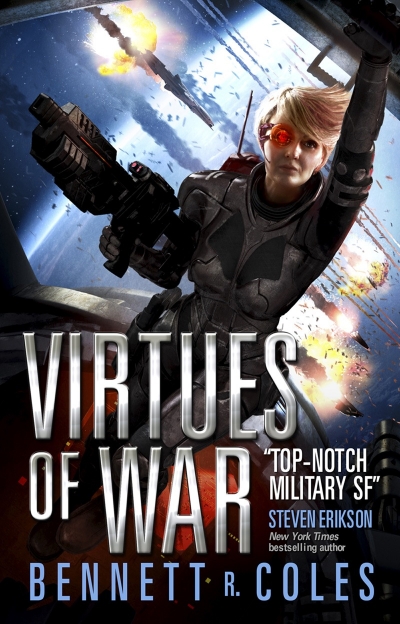
  • Virtues of War by Bennett R. Coles

    Virtues of War by Bennett R. Coles

    A sci-fi thriller of physical and psychological combat, Virtues of War sends readers hurtling through space to find that our warlike nature has survived intact into the 26th century. This is no Star Trek mission of exploration, and there are no aliens: only long-established colonies in the Centauri system rebelling against Terran rule. Humankind’s technological evolution may have continued at breakneck speed, but social evolution has yet to catch up.

    Lt. Katja Emmes, fast-attack strike leader of the small but pivotal warship Rapier, leads her troops into a hot zone on Cerberus—a minor operation to target a Centauri spy. It’s her first mission, and it leads to her first kill. It also leads to a full-on war between Terran Astral Forces and Centauri’s colonies which, despite an outwardly peaceful existence, have developed robotic killing machines far beyond Terran expectations.

    Thus begins a narrative of nonstop action, swift pacing, and near-constant tension. Drops from space through planetary atmosphere are vicarious thrill rides that get the reader’s heart pumping, and battle scenes are wrought with suspense.

    The author, Bennett R. Coles, an officer with plus 15-years experience in the Canadian Navy, demonstrates a crisp writing style, an impressive knowledge of military tactics and techno jargon, and an imagination crossed with a study of physics that has produced believable weaponry and space travel of the future.

    Although action is clearly his strong suit, Coles has created an engaging set of characters. Katja Emmes has a chip on her shoulder placed by a cold-hearted father, and she’s constantly trying to prove herself against his Army bias. Lt. Cdr. Thomas Kane, Rapier’s captain, has a big heart, but he’s easily swayed by the promise of promotion and even more so by the scheming, power-hungry Lt. Charity “Breeze” Brisebois, a vixen of a villain. And sub-lieutenant Jack Mallory, whose disfigurement early on fails to dampen his sunny optimism, enjoys a steady climb in respect as his superior intellect transcends his boyish charm.

    The Astral Forces are filled with assorted men and women at every level of rank, and each, though briefly drawn, are clear individuals. War may still be ever-present in a society that is now intergalactic, but at least equality between the sexes has been achieved.

    Well into the story, exemplary soldier Katja ponders the incredible civilian death toll and the necessity of war. It is a potential turning point, and she nearly takes the next step into a desire for peace that one hopes could resound throughout humankind. But, luckily for Virtues of War readers, this is the first in a series, and such a step will take many more battles—both military and societal—before that possibility can be achieved.

    Virtues of War has earned the Cygnus Awards 2013 GRAND 2013-CygnusPRIZE for SciFi and Speculative Fiction Category,  a division of the Chanticleer Book Reviews Novel Competitions.

  • Nardi Point by Nancy LaPonzina

    Nardi Point by Nancy LaPonzina

    Love among the ruins: in this case, an archaeological dig at a new subdivision in North Raleigh, where rolling pastures and woodsy farms are giving way to housing developments such as Nardi Point. Here Laurinda Elliot and her live-in fiancé, Dan Riser, plan to buy a home and start a family—or at least, that is Laurinda’s intention, even as she watches Dan once again run “away from her gentle attempts to grow their lives.” Still, she presses on, seeing a family as the missing piece to her otherwise successful life: a high-level IT position, a silver Porsche and designer wardrobe, beauty to spare.

    Those pieces begin to break apart when Laurinda visits the construction site at Nardi Point with her closest friend. A highly sensitive Reiki practitioner, Leyla Jo Piper pokes around in the red-clay mud where Laurinda’s house will soon be built and finds pottery shards.  A vision of a Native American woman carrying an earthen pot, plus a flashback to her own orphaned childhood, drives her to contact the State Archaeology Office.

    Colson Mitchell, the construction company’s handsome supervisor, reacts differently. He’s aware of the scorched-earth mentality of his employer, but he’s also concerned that standing up to him could mean losing his job, causing hardship for the love of his life: three-year-old daughter Annabel. Initially, he fights the two women’s increasing concern about building on what may have been a camp or burial site for the area’s ancient peoples, but as his feelings for Laurinda intensify, he finds his own ethics in conflict.

    Dan, the brilliant technology geek Laurinda is living with, on the other hand, sees no conflict in taking the path of least resistance or being opportunistic when situations present themselves—especially those that he thinks will improve his social standing. And being with Laurinda has certainly improved his social standing. This pattern of over-riding selfishness soon has him leading a double-life.

    Once Leyla Jo engages Dr. Hal Jared, state archaeologist, in the pottery find, the richness of the narrative deepens. The author spent time as an archaeology office volunteer, and her knowledge shows: the details of the meticulous work of unearthing and classifying artifacts, along with the struggle between building for the future and learning from the past, makes for a fascinating read, and the discoveries play perfectly against the uncovering of Leyla Jo’s family history, which ultimately explains her visions.

    Nardi Point develops into a lovely, nuanced tale with the layers of relationships uncovered like strata of earth, revealing harsh truths and personal epiphanies. In the end, the pieces of Laurinda’s life finally fit together like the ceramic shards that touched off her journey, and from this vessel pours love and fulfillment.

    Nardi Point was awarded a First Place Blue Ribbon for Contemporary Women’s Fiction, Romance Category in Chanticleer Book Reviews’ 2012 Published Novels contest.

  • Look For Me by Janet Shawgo

    Look For Me by Janet Shawgo

    A lantern, a medicine pouch, and a bell to stop the gunfire: That was all nurses took into the Civil War battlefields as they sought out injured men, boys, and women disguised as men. Among them is Sarah Bowen, a young healer from Georgia, whose use of herbal medicine brings her scorn from most field doctors even as it saves countless lives.

    Look For Me begins with young, affluent New York-er Samuel White, who has just embarked on his career as a war correspondent. Through an early incident between their fathers, he is also Sarah’s longtime pen pal.

    Meanwhile, Mack, a teenage girl traveling as a boy, delivers a letter from the youngest Bowen son to the family farm, lingering long enough to be tutored by Sarah and to fall in love with brother James before leaving to pursue her goal of becoming a Confederate spy. Soon after her departure, a band of traveling nurses comes looking for the local healer, and it doesn’t take much persuading for Sarah to realize her destiny. This is when all of the primary story-lines begin to intersect.

    It is with this wagonload of women that the story comes fully to life. Ruby Belle and Maud bring a boisterous energy that infuses the story with attitude, while the more fragile Leona and Emma embody the particular tolls that warfare takes on women.

    As the nurses set up makeshift hospitals in abandoned houses near the battle sites, Sarah gains confidence in her skills as she also gains the terrible knowledge of carnage. What the reader gains is an understanding not only of the medicinal uses of native plants, but of the women’s incredible resourcefulness. The homes of families killed by opposing troops are scoured for food, blankets, and clothing to use for bandages; root cellars and herb gardens replenish ever-dwindling supplies; while coffee and tobacco become particularly valuable to trade with soldiers for battle information, or with moonshiners for alcohol and barrels to fill with clean water. Here the author’s own background as a traveling nurse brings an earnest authenticity to the narrative.

    In short time, Samuel discovers the value of these “women who travel in war,” and the series he writes about them takes form alongside both his battle reports and his attempt to uncover the story of the Night Walker, the elusive spy who slips in and out of battle scenes and his own life. As the war concludes amid tragic losses, broken families are reunited and promises are kept beyond the grave.

    Told with both compassion and restraint, Shawgo’s Look For Me enlightens us by uncovering the critical roles women played in the Civil War: as soldiers, as spies, and, most importantly, as healers. Look For Me is a gripping well-researched and well-told Civil War story of espionage,  the battlefields’ terrible tolls, of healing wounds and timeless love.

    Look For Me by Janet Shawgo is a First Place  Blue Ribbon Award winning novel for Historical Fiction in Chanticleer Book Reviews Published Novels writing competition 2012.

  • The Inn at Little Bend by Bobbi Groover

    Hardship has followed Grayson Ridge, a motherless girl named for the orphanage that took her in, from the moment she fought for her first breath. At fifteen, fearing she’s killed the man who “adopted” her as slave labor, Grayson bolts into the wilderness, where she steals clothes and cuts her hair to become River, a homeless boy on the run. Rescued from vicious vagabonds by a kinder, gentler drifter, River attaches to taciturn Drake Somerset—temporarily, she thinks, but their history has only just begun.

    What follows is a story of false identities, gender bending, and impassioned—if at times confused—love; Shakespeare’s As You Like It served up romance-style. Grayson’s many personae end up in classic predicaments, some truly horrifying and many nearly fatal, and she and Drake spend a good amount of time patching up each other’s wounds. That is, when they’re not challenging, exasperating, tormenting, and misinterpreting each other. The author has a fine ear for natural, quick-witted dialogue, and it’s one of the pleasures gleaned from reading this well-crafted tale.

    Ms. Groover has structured her narrative against backdrops that move effortlessly from Virginia’s plantations to the West and back again, fashioning her framework with details that are as unobtrusive as they are knowledgeable. The love story is rather refreshingly old-school: this is no thin plot on which to hang a string of bedroom romps.  Instead, it is the untangling of Grayson and Drake’s many masquerades and misunderstandings that intrigue the reader, although each character’s passions are given plenty of consideration—and yes, heat.

    Despite the quintessential American settings and psyches, a whiff of “Jane Eyre” blows through: the orphanage and the search for home; the young and moral woman resurrecting the heart and soul of a man who has closed himself off in tormented guilt; the themes of forgiveness and conscience over passion. What is decidedly different: the raw, almost desperate feistiness of River, the abundant humor, and the wonderful secondary character of Aggie, whose unrequited love for Drake never stops her from being Grayson’s friend and mentor.

    The Inn at Little Bend won first place in Chanticleer Book Reviews’ Published Novels Romance Western-Mystery category.