Anyone who reads your manuscript or book, even a chapter at a time, is an AER.
You should know the name of each and everyone your AERs along with how to communicate with them.
Is your AER on Twitter, Facebook, Google+ ?
Does your AER have a blog? If so, comment on it. Subscribe to it.
AERs do NOT have to buy your book. However, they must read your work even if it is a chapter at a time.
If you give your manuscript/book to an AER, they should expect to give you some kind of feedback about it. Make this as easy as possible for the AER.
When you receive this feedback, whether it is good, bad, or indifferent, you must be “insanely appreciative” of it.
Your AERs may receive your work a chapter at a time or all at once. Beta Readers make the very best AERs and they require special handling.
Interact with your AERs on FaceBook, Twitter, Google+, blog posts, websites, etc. and, most importantly, in person if possible. Nothing beats face time—not even FaceBook.
Reward your AERs for being evangelical about your work!
Remember, Acquired Early Readers help authors build their networks—online and off.
Next post will be about how to build your AER base and increase your number of AERs along with more on the care and feeding of AERs.
How to go about finding AERs (Acquired Early Readers)?
The Sales Curve of Your Book will Follow the AER Curve.
Conversely, Do Not Confuse Book Sales with AERs.
AERs (Acquired Early Readers) may be:
Beta readers
Other Finalists in writing competitions that you competed in
Critique partners
Book reviewers,
Manuscript evaluators
Writing group members
Friends & family
Those who would take a special interest in your story-line–your niche markets.
How to determine your niche markets?
Is your amateur sleuth a real estate agent, a hospital administrator, or a chef?
Does your protagonist always diet? Does he love wine? Does she knit? Does she travel, research, teach, or strips at a dance club?
After you determine your niche markets, then begin building relationships with the people who are in them. Share advice and tips, ask questions, attend meetings and gatherings. Members of your niche markets are potential AERs.
Next post will be on the Care and Feeding of AERs.
Each week we will go into more detail of the “hows” and “wheres” to acquire more Readers for your books…. stay tuned!
Books sales take off because the author makes them take off.
Treat your new title as a new business product that you want to take off. Taking off requires energy as it does with a plane, starting a car, or launching a business. Lots of energy.
Many authors are adamant that if they write the ‘great novel’ that people will find it, buy it and read it just because it is a great novel.
However, as successful entrepreneurs know, buyers just don’t “discover” your new products. Launching a new product takes strategy, time, and lots of energy. An author with a new title is launching a new product—whether or not the author is traditionally published or self-published.
Traditionally published means that the author has found a venture capitalist, so to speak, to help share the costs of creating a new product—taking a manuscript and then creating a new published book. The author has usually put in the sweat equity of creating the work. The publisher determines if that the work is worth investing into. Self-published authors take on all the costs and risks of creating a published book.
Premise: Each new novel is a new product that needs to be launched.
Even if your work is picked up by a publisher, you still have the primary responsibility of launching your novel (unless you are in the top two percent of all authors).
There are 2 Rules that you must learn to successfully launch a a new book:
Rule #1: You cannot wait for Readers to come to you. You have to go and get them one by one.
You, Author, must be aggressive in “Early Reader Acquisition.” Venture capitalists call this “early user acquisition.” You cannot expect potential Readers to discover your new book just as you would not expect a potential buyer to discover a new product. You must do whatever it takes to get those first Readers.
I hear three reasons why Authors are not going out there and acquiring Readers:
I’m shy. I’m an introvert. I don’t like networking. It takes meeting people one on one. You don’t have to get on stage to build readership.
I’d rather be writing. Who wouldn’t? Pounding the streets hawking your product is hard work.
I don’t have time. What would you think of a business owner who doesn’t make time to get clients or customers?
To succeed (aka get paid) for your writing, you must acquire Readers. Period. There is no other way around it. Acquired Early Readers, or AERs, are an integral piece to your book’s marketing plan.
To find AERs, you must spend at least thirty percent (minimally) of your time marketing your book even as you are writing it. You must prepare for the launching of your your book on a daily, consistent basis. No matter where you are in the publishing process, start acquiring your early readers as soon as possible.
Rule # 2. Cherish your Early Readers. Show them how much you appreciate them. Be over the top.
Be “insanely appreciative,” as Steve Jobs would say, of your Acquired Early Readers. Translated this means that your AERs should have an “insanely great experience” for taking the time to read your new book.
My next post will be about how to find AERs.
NOTE to AUTHORS: I will go into more and more details about this topic in a series of articles over the next several months. Please expect approximately one article a week along with homework assignments.
I am writing this series in response to the many authors who have written well crafted and compelling works, but are not increasing their number of readers or of book sales. Several of these authors have been contracted by legacy publishers. Others by small presses and, yet, many others are self-published. All are true entrepreneurs in this new era of publishing. I hope to pass on sales and marketing techniques that are tried and true in the business arena to authors who are trying to launch their works and their careers. [/fusion_builder_column][/fusion_builder_row][/fusion_builder_container]
Granddad’s House is a contemporary romance that will captivate you and have you wanting more.
While Granddad’s House stands on its own, you will find Vale’s characters so engaging that you will want to know more about them. Good thing that author Kate Vale has written (so far) four books in the On Geneva Shores series, which take place in the small Pacific Northwest town of Evergreen, Wash.
The story begins as we meet attractive redheaded Olivia Brown, of Brown Family Realty, conducting an open house. The handsome Southern architect named Beauregard Elias James is touring it on behalf of a client who wants to turn it into a B&B. Of course, Olivia knows not to reveal to him that the historic house is her family home, but, she does! Why, she asks herself, did she break one of her own rules with this incorrigible man with awesome green eyes? The family real estate business is central to the story line and that is where the author Vale’s real life expertise as a realtor along with the many awkward situations that they find themselves is seamlessly integrated into the adept writing.
Granddad’s House is an engaging read from page one that will make you laugh and cry as author Kate Vale portrays life’s struggles and conundrums with poignancy and touching honesty that rings true.
Vale’s writing captures germane issues that women face in today’s world: being torn about decisions made between life for oneself and the caring for a beloved elder who has dementia, the strife of feeling the need to be in at least three places at one time, the far reaching effects of the Middle East Conflict, along with the emotional bonds of family and friends, and the myriad of tugs that women must face as they navigate modern life’s complexities.
If you want to get to know characters who embrace contemporary challenges with integrity and passion, then look no further than Kate Vale’s novels for a book about love and loss, friendship and family ties, and finding happiness. Granddad’s House is an exemplary example of Vale’s encouraging and fortifying stories. While her writing is inspiriting, it does cross over to sensuousness in order for readers to identify with the issues we deal with in confronting our own sexuality in our daily lives.
Kate Vale’s relevant women’s fiction story lines, believable characters and spot-on romantic flair assure that we will be hearing great things about this talented up-and-coming contemporary women’s fiction romance author.
On Geneva Shores series by Kate Vale
Family Bonds starts the Geneva Shores series with Book 1. How can a couple overcome their families’ dark secrets and disparate backgrounds?
Granddad’s House is Book 2 of Geneva Shores. Love transcends and gives hope.
Just Friends, Book 3 we follow the blossoming love of Olivia’s best friend, Sally, and Beau’s brother, Paul, a returning wounded soldier from Afghanistan.
Choices, Book 4 — look for our review! Can Sam, a long-time bachelor, commit himself to marriage and kids –especially when the kids propose the idea?
Craig Johnson’s well-honed and crafted Walt Longmire mysteries are engaging page-turners that are as fresh and raw as they are multi-layered and nuanced. Furthermore, Johnson doesn’t back down from the socio-economical issues taking place in today’s West and bringing them to a roaring boil.
Johnson’s mysteries keep us turning the pages, but as we do, he gives us glimpses into the contemporary west, the people who live with the imposing presence of the looming Rocky Mountains, and the undercurrents of modern technology, and social ills. Dichotomies abound with cowboys on horseback with I-phones, raging snowstorms and the futility of technology in their midst, western machismo and the women with balls enough to stand up to it.
As you read Johnson’s works, he will divulge his characters’ souls to you. We learn, bit by bit, about their weaknesses, their wounds, and their paths that led them to inhabit this remote corner of America. We also share in their triumphs and victories — even if it is small as an ice cold Ranier beer after a day of driving dusty roads.
The “Walt Longmire Mysteries” series explores our world and our psyches with their imagery, symbolism, mythological archetypes and spiritualism. He does this without stereo-typing or rehashing old cliches, but with spot-on dialogue, engaging characters, and complex suspenseful plot-building. And that is what makes the reading of the Walt Longmire mystery series so very addictive.
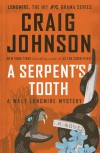
We root for Walt Longmire because he fights the good fights that must be fought–no matter what the costs are to him. In “A Serpent’s Tooth,” Walt must deal with a splinter group of a renegade polygamy group of Latter Day Saints who have built quite the arsenal of weapons and an old vendetta that crosses time-lines and cartels. How Craig Johnson interlaces water rights in the West, Shakespeare, physics, Lost boys, flying saucers, Lamanites, corsages, L.D.S., slow car chases, “My Friend, Flicka,” and the C.I.A. into a fast-paced, suspenseful novel is truly a testimonial to his storytelling ability.
“A Serpent’s Tooth” by Craig Johnson earns five stars from Chanticleer Book Reviews. Find yourself mesmerized by a great storyteller! Be forewarned: You will not be able to stop at just one Walt Longmire mystery. [fusion_builder_container hundred_percent=”yes” overflow=”visible”][fusion_builder_row][fusion_builder_column type=”1_1″ background_position=”left top” background_color=”” border_size=”” border_color=”” border_style=”solid” spacing=”yes” background_image=”” background_repeat=”no-repeat” padding=”” margin_top=”0px” margin_bottom=”0px” class=”” id=”” animation_type=”” animation_speed=”0.3″ animation_direction=”left” hide_on_mobile=”no” center_content=”no” min_height=”none”][Reviewer’s note: Not since reading Jim Harrison’s works have I encountered writings that are so satisfying to read.][/fusion_builder_column][/fusion_builder_row][/fusion_builder_container]
Ninety percent of all searches on the Internet are performed on Google; 900,000,000 unique visitors per month as of March 13, 2013. That is nine hundred million per month and growing.
If you want your books to be found (or your services, products), you must rank within the first three pages of Google searches. To optimize your SEO ranking, you will need to understand how to obtain all the “Google Goodness” that you can muster and that means you need to be on Google +.
What is Google +
Google + is a Social Media Platform such as FaceBook, Twitter, YouTube.
Google + is the fastest growing social media platform. It has surpassed Twitter and YouTube in percentage of global internet use and is rapidly gaining on FaceBook, which is number 1. (Forbes, Jan. 26, 2013).
As of January 2013, Google + had 343 million users; FaceBook had 693 million users.
Why should you add yet another social media platform to your author platform?
How does Google+ effect you? It directly affects your search engine optimization. If you don’t use it, it will lower your ranking. If you do use it, it will raise it.
Google + usage ranks significantly in Google’s SEO equations for getting your site or information to the top of the Google Search pages food chain. To put this in a different way, Google has the advantage and will have it for the foreseeable future. Google has a successful track record, deep pockets, and creates the technology platform that delivers social media. ‘Nuff said. Google owns the playing field, the game itself, and pays the players.
Google + Social Media Platform has the staying power of Google behind it along with sophisticated technology and ability to interconnect “The Internet of Things” in ways that we can’t even imagine. Google+ is not an experiment. It has top Google priority and that means if you are serious about your SEO ranking, Google + needs to be your top priority social media promotional tool.
Okay, so now you understand a little more about why you shouldn’t dismiss Google+ as the next MySpace or just another social media platform. But what can Google+ do for you?
You can create longer conversations, share more thoughts & info, which in turn helps you build relationships with people who you might not have otherwise met–such as new readers.
And then there are the Google+ Hang-outs for group meetings, live discussions, or demonstrations. Hangouts are great for panel discussions, too. More about that later.
What Authors Should Know about Editing and Editors:
Editing—you know your book requires it. But, where to start?
An introduction to the StrangeWorld of Editing and the Beasts Who Inhabit It.”
Did you know that there are several types of editing? One size does not fit all.
Developmental Editing
Developmental editors are the top level of the editor beasts. This is because of the abstract and creative thinking required at the concept level of writing a work. Developmental editing is considered to be the most expensive type of editing.
Developmental editing consists of:
Taking a rough idea or proposal and developing it to a final manuscript that will move to the substantive editing level.
Taking a manuscript that is chaotic, but has a potential idea within it, and applying order to the chaos.
Coaching. Developmental editors are considered to be coaches for writers. The writer has an idea. The developmental editor coaxes the writer to develop it and make it compelling.
Almost as acting as a literary agent. Publishing houses will assign developmental editors to non-writers who they believe have market potential (such as celebrities, the latest diet creator, etc). Some developmental editors will invest time into writers who are “diamonds in the rough” via business partnerships.
Always keeping the Reader/Audience in mind (visit our link about finding audience). Developmental editors hone everything in the manuscript to that particular reader audience: voice, word choice, pacing, point of view, dialogue, setting, and so forth.
Finding literary agents, publishers, distribution and warehousing systems for the work-in-progress.
However, most fiction works should start with a manuscript overview or a manuscript evaluation.
Substantive Editing – Manuscript Overview
Substantive editing looks at the big overall picture of the manuscript. This type of editing is generally what is needed when the authors say, “It just needs a quick look.” However, that is rarely the case. If you find that your requested manuscript keeps getting rejected, you may find that it requires substantive editing to take it to the next level and to overcome slush reader obstacles.
Reading the work in its entirety before any editorial changes are suggested.
Checking for consistency in voice, characterization, plot holes, shifts in point-of-view, pacing, sub-plots, story arc (or lack thereof), and other items that may cause readers to stumble.
Moving chapters or sections to improve the flow of the story-line.
Ensuring that the author’s “world construct” holds.
Taking a completed manuscript to the next level of storytelling.
Changing characters to make them more like-able, or more despicable or just more interesting to readers.
Click here for more detailed information about Chanticleer’s manuscript overviews and evaluations.
Line Editing
Content Editing is “apple polishing” the entire manuscript line by line. Sections are no longer being moved about, plot-holes have been filled, characterizations are formed, and setting details worked out.
Line Editing consists of:
Line-by-line editing for tone, tightening of phrases to “leave the boring bits out,” looking for dead sentence construction, passive voice, removal of unnecessary modifiers, and point-of-view lapses.
Re-organization of the work at the paragraph, section, and chapter levels if needed.
Maintaining the author’s voice while improving the sentence structure that will move the story forward.
Ensuring the continuity of the story line. Removing any obstacles that would make the Reader stumble.
Moving the story and its readers along from one chapter to the next.
Most authors think that their works are ready for the Content/Copy Editing phase when their works could be made more competitive with substantive editing.
Style Sheets and Continuity Notebooks or Story Bibles
Each work of fiction deserves a Style Sheet. This is the tool that a Copy Editor will need to edit a work. The Style Sheet tracks the spelling of names, Physical attributes, whether to use British Standard English or American Standard English, metric measurements or US Standard System of measuring, magical constructs, character backgrounds, locations, timing,—all the little details that allow your reader to become fully immersed into your story.
Continuity Notebooks or Story Bibles include everything from the attributes of the characters to the placement of buildings in the world. It covers the timeline and storylines from book to book, along with the rules of the world. Like building a house, an author needs to include the correct nuts and bolts as needed to plan the best possible design of the world she is creating. And, yes, even pantzers need to do this at some point before typing The End.
If you want to pitch your book for a TV series or film or gaming, you will need to create a story bible. Screenwriters depend on it and so should serious authors. The story bible holds all of the tiny pieces of information such as cultural phrases, potential plotting ideas, dialogue, emotions, memories, does the character like dry wines or takes her bourbon neat, coffee black or macchiatos only, and a myriad of other ideas or details. And then there or the locations, timelines, character details, … The entire film and gaming industry runs on Story Bibles.
And, yes, there are editors for Story Bibles. The most successful authors have them and swear by them. Story Bible Editors allow authors more time for creativity and for writing.
Copy editing is what most writers think of when they hear the word “edit.” It is a very mechanical process that ensures that the publishing standards that readers have come to expect and appreciate are met.
Copy Editing consists of:
Fact checking –especially with historical fiction.
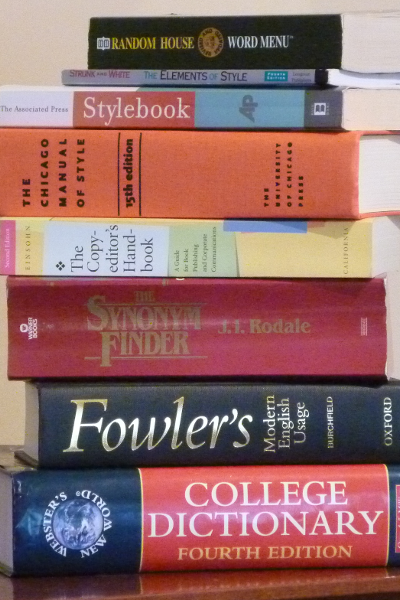
Imposing the rules of the style guide that is required for the type of work (Chicago Manual of Style, AP Style Guide, etc.) and whether British Standard English or American Standard English is used for the galley.
Checking against the Style Sheet or Story Bible/Continuity Notebook
Correcting faulty spelling, grammar and punctuation.
Standardization of linguistics (i.e.: Elf language, French slang, or Klingon) throughout the work.
Correcting misused words.
Using the correct spelling, hyphenation, numerals, and capitalization.
Parallel structuring of headings, chapter titles, and sequencing.
Checking for triteness, unnecessary uses of jargon, and clichés while keeping the author’s voice.
Proof-Reading
Proof-reading is best conducted by a “cold read.” This means that the proof-reader has not seen the work. A cold read makes it harder for the proof-reader to “fill in” any gaps or “auto-correct” the text. Writers should never perform the final proof on their own works. Fresh eyes are advised. It is practically impossible to proof your own work.
Proof-reading consists of:
Marking the typeset (whether digital or press) word for word against the final approved and edited manuscript.
Checking one more time for correct usage of dialogue quotation marks and punctuation.
Checking one more time for typos, double words such as: he he, or wrong word usage such as: sew, so.
Proofing the galley on different types of digital press software platform to ensure that it “translates” correctly and glitches are dealt with for each e-pub platform.
Checking for word spacing, paragraphing, “orphans and widows” (words and/or a sentence that appear by themselves on a page all alone), hyphenation and incorrect word breaks.
Re-checking for mislabeling, miss-numbering of pages (this happens all the time), and sequencing of chapters, prologues, epilogues, and glossaries.
Advanced Reader Copies (ARCs)
After the first proof-reading is typically when Advanced Reader Copies are printed (or PDF files created). These are typically given out for reviews – peer, editorial, and for the trade, Beta Readers (who are great at catching whatever slips through the first proofing), used for pre-orders, and for book shows.
Final Proofing (using feedback from ARCs)
FORMATTING
Formatting for print and for e-pubs are two different animals. Formatting for print is a different process than formatting for e-pubs. Trust me, it is.
PUBLISHING
After proofing the formatting for digital books and for printing, then the work is ready to be PUBLISHED!
BUT BEFORE PUBLISHING – make sure that you have the work’s alphabet soup ready to go —
ISBN’s (different for print, digital, audio, etc.)
BISAC codes
SEO
Keywords
Tagging
Works that you would like your work to be shelved with (for association – digitally)
The Final Word
Each type of editing has its specialists. Each level of editing becomes more focused on the details until the absolute final proof-reading for publication.
Editing professor Carolyn Dale explains the different types of editing services like this:
If you were remodeling your house you would not expect a sheet rocker to install plumbing, or an architect to hang sheet rock, or an electrician to create cabinetry, or the painter to create working plans. However, you would expect them to be able to communicate with each other, schedule the work that needs to be done, and, ultimately, deliver a finished product with which you will be satisfied. It is the same with editorial services.
Editing–every work needs it.
Our next post will be about how to determine the type of editorial services that your work requires and how to select an editor or editorial services company.
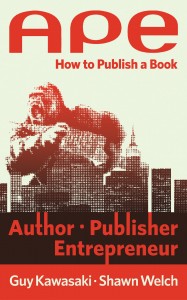
APE is the how-to compendium for today’s self-publishers.
Authors will find APE an indispensable resource. Guy Kawasaki passes along his publishing experience in his “no-shitake,” but affable manner. Imagine having an extremely successful uncle in the publishing biz who also has a tech-wizard pal (co-author Shawn Welch) of digital publishing magic. Fortunately for us, this dynamic duo decided to share their publishing know-how.
APE’s premise is that publishing is a parallel process “that requires simultaneous progress along multiple fronts.” Hence, self-publishers are challenged with how to: market, brand, design, promote, publish, distribute, and finance a book–all at the same time. Oh, and don’t forget the time required for actually writing the book. Indisputably, each self-publisher is an: Author, Publisher and Entrepreneur.
Reading APE is like taking a condensed survey course in publishing; it addresses the range of topics that authors must know about self-publishing. APE covers aspects from the existential question of “Should I write a book?” to advice on how to create foreign language versions of your book, to guerrilla marketing techniques, and ideas for financing.
Traditional publishers have long prided themselves on their art form and on their discernment abilities. Readers have come to expect and appreciate their expertise. APE’s tactics and techniques will enable self-published authors to deliver to readers books that will meet these time-honored and well-justified expectations.
Kawasaki and Welch challenge self-publishers to take up the mantle of “artisanal publishing”—where authors who love their craft must dedicate the time and resources to “control every aspect of the process from beginning to end.” If authors engage this philosophy, their books should have a much improved chance on separating themselves apart from the chaff of the expected two million new titles that are expected to hit the English language market in 2013.
APE admonishes that self-publishing isn’t easy or a way to get rich quick. But if you want a realistic, tactical, and, relatively, slim (300-pages) self-publishing guide that is profuse with handy resources and links (which actually work—this reviewer checked them) on how to do it right, then APE is the go-to guide for you.
An additional remark from the reviewer:
APE should be on every author’s desk or e-reader right along with The Chicago Manual of Style and The Copy-editor’s Handbook. As with the latter guides, it is one that you will refer to often as you find your way in today’s era of the Wild, Wild West of Publishing. It also addresses the particular formatting hurdles that non-fiction writers must clear when self-publishing.
It is our pleasure and honor to announce the FINALISTS of the Round One and Two of Chanticleer Book Reviews & Media Blue Ribbon Awards for Unpublished Manuscripts, 2012. The next rounds will determine the First Place Category Winners.
The purpose of this CBR Blue Ribbon Awards contest is to recognize outstanding works of Un-published Manuscripts. These works could not be under a publishing contract at the time of entry into the contest. Works that have been accepted by agents but are not under contract are allowed to enter the CBR Unpublished Manuscripts Contest.
Entry Deadline for the Manuscript Division was September 30, 2012. Announcement of Finalist posted on November 26, 2012.
Finalists for Unpublished Manuscripts Writing Contest by Chanticleer Book Reviews
Drum-roll please…
Mainstream/Contemporary/Womens Fiction
The Cannibals on Easy Street by Frank Faso
Rain Shine Secrets by Alice T. Robb
The Crone Clones by Alice T. Robb
Vanessa’s Curve of Mind by Kirk Smith
Historical Fiction
Lick Creek by Deborah Lincoln
The Jossing Affair by J.L. Oakley
Mystery Suspense/Thriller and Cozy Mystery
Shadow Gamesby Jeanette-Marie Mirich
Corporate Insanityby Tom Pors
New Smyrna Swing by D.D. Queens
Made in China by Mark Reutlinger
Mrs. Kaplan in the Soup; The Matzoh Ball of Death by Mark Reutlinger
Murder Strikes a Pose, A Downward Dog Mystery by Tracy Weber
First Place Categorical Titles will be announced before January 31st, 2013.







 It is our pleasure and honor to announce the FINALISTS of the Round One and Two of Chanticleer Book Reviews & Media Blue Ribbon Awards for Unpublished Manuscripts, 2012. The next rounds will determine the First Place Category Winners.
 “Writing is a design, often a portrait, nearly always a revelation.” –Colette