
Author: J Kirscht

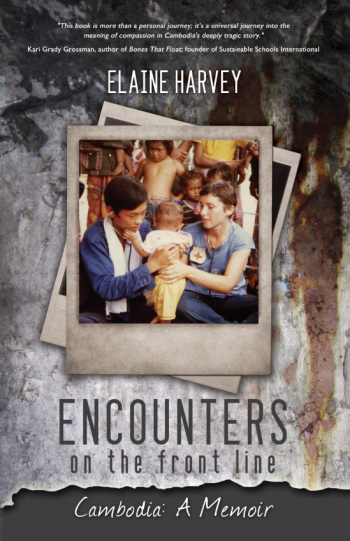
  • ENCOUNTERS on the FRONT LINE: CAMBODIA: a MEMOIR by Elaine Harvey

    ENCOUNTERS on the FRONT LINE: CAMBODIA: a MEMOIR by Elaine Harvey

    Encounters on the Front Line is the journey of a Canadian Red Cross nurse who, after traveling in far off reaches of Asia and Africa, finds herself in a refugee camp on Cambodia’s Thai border, in the midst of the war between the Vietnamese and Cambodia’s brutal Khmer Rouge.

    The encounter with the front line becomes a life journey told in three books: her experience in a refugee camp in 1980, a pilgrimage back in 2007-2008 in an effort to reconnect, and a third journey two years later as a mature woman and writer, seeking to pull together the experience that has marked her so deeply.

    The courage and resilience of the Cambodians survivors who serve with her, their beauty in the midst of the horrendous conditions shine through, even as the camp itself becomes torn by war. Harvey draws a vivid picture of contrasts: the abysmal conditions of the camp with the green of the surrounding rice fields, the terrors of the Pol Pot regime with the loyal gentleness of the individual Cambodians who serve with her. Photos increase the reader’s intimacy with these people, as does the poetry that runs through the book.

    Harvey’s return trips to reconnect and unravel the mystery of the land become a more personal search. It is again focused on people, both Cambodian and expats from around the world who have found their life’s work in Cambodia. The second visit focuses on an orphanage, Wat Opot, where she serves, and its American founder. The price of conflict is brought home by the stories of these tragic leftover of war—the children. In a land where poverty and conflict overwhelm, many find peace in Buddhism. Harvey finds that her greatest service lies in the healing touch.

    The honesty of this memoir—Harvey’s conflicting reactions to the filth and vermin—give it an authenticity that is refreshing. The third book in particular, we feel her frustration and grief at her failure to re-establish the personal connections of the first encounter. If it has any defect it is that the first book, given its subject matter, has a tension and intensity the other two do not.  And the personal search of the latter two is, that some readers may find it to be, at times, repetitive as the author reexamines her encounters. Life has moved on beyond her reach, and the intimacy and immediacy of war relationships cannot be reestablished. There is a large quotient of sadness in this last visit, and a once friend tells her that it is a mistake to cling too long.

    This is a very well written memoir and an intimate picture of a Southeast Asia  and its people. Readers will find their horizons broadened by Harvey as she shares her encounters as one who has served in the far reaches of the Third World, grown to love its people, then sought to give the experiences meaning. Harvey’s poetry and photographs add both variety and depth to the work, as they further the reader’s connection to the memoir beyond the power of prose.

  • An Editorial Review of “Coming Home” by Gloria Javillonar Palileo

    An Editorial Review of “Coming Home” by Gloria Javillonar Palileo

    Coming Home, by Gloria Javillonar Palileo, brings vividly to life the plight of the American born non-white people, and particularly those of mixed blood, who must find a place to exist between diverse cultures. The acute pain of this dilemma is faced by millions of children whose parents are immigrants to North American culture. Palileo is well qualified to enlighten readers about the particular struggle of identity and of the need to fit in that many first generation Americans must grapple as she herself is an immigrant.

    Inspired by the experiences of the children that she and her husband adopted from the Philippines, Coming Home is a story that needs telling.

    Juan de la Cruz, an American-born twelve-year-old with Filipino parents who immigrated. He suffers from the racist barbs of school bullies who call him a “chink,” and then discovers his friends also do not consider him an American. However, Juan likes to go to the mall, play video games, and hang out like his peers. He doesn’t see himself as different. However, some of his classmates do since they don’t quite know where to place him since he isn’t white; he isn’t black. It is here when Palileo broaches the subject of generational racism as the children who mock Juan are picking up their opinions and derogatory name-calling from somewhere. Is it inherent in the culture? Do the children pick it up from their parents? Is it peer pressure?

    The conflict between identities is increased by his parents—his father welcomes being in America, his mother wants to return to the Philippines. She believes her son will never be accepted as an American. Juan, desperate to be an American, insists on being called “John,” asks his mother for plastic surgery on his nose, and, finally asks to be circumcised—a request that causes further crisis in the family.

    When Mrs. de la Cruz decides to take “John” for a visit to the Philippines, Juan decides he will become Filipino, tan himself and begins learning Tagalong. He soon discovers, however, that his Filipino cousins consider him very much an American. Though they take him on their adventures and include him in their games, the poverty and strange customs of his parents’ homeland, plus tales of circumcision practices of the past, convince Juan that he wants to come home to America. It isn’t until he is home that he realizes he, after all, belongs to his family and that is where “home” is for him.

    The book also gives an interesting insight into history and customs of the Philippines, a culture seeking to rid itself of the influence of hundreds of years under oppressive Spanish rule. Coming Home focuses on the effects that a history of oppression and racism could have when it zooms in on one little first generation American boy and his immigrant parents. Those who are intrigued by the story’s backstory of Philippine history may find Palileo’s latest work titled The Indios of great interest.