Author: D Beaumier

  • How to Use Book Awards to Promote Your Books – Book Marketing Tips by David Beaumier & Kiffer Brown

    How to Use Book Awards to Promote Your Books – Book Marketing Tips by David Beaumier & Kiffer Brown

    The days of publishers handling all an author’s marketing are looking like a thing of the past, even for traditionally published authors. This means you need to take control of your own marketing strategy for your books’ promotions.

    To begin, list off the places where you imagine people will see information about your book(s). We have some ideas, but you know your community best so trust your expertise there. It’s safe to say you will need to at least look in these places:

    • Your Website!
    • Your Social Media Platforms (that point back to your website — not a selling platform)
    • A Cross-Promotion platform that you share with other authors
    • Bookchain.ca, Amazon, Barnes & Noble, Apple, Kobo, PublishDrive, and as many selling platforms as possible to create streams of revenue/royalties.
    • Independent Bookstores and Retail Outlets (many Chanticleerians join with garden shops, wineries, gift shops, toy stores, etc.) to  sell their books.

    Local Bookstores

    Your local bookstores deserves special attention. There are always loyal readers with a strong preference to shop local, so take some time to show those stores extra love.

    • Shelf-talkers for point of sale displays
    • Small posters (free standing and  flat for windows and bulletin boards
    • Shiny book stickers work! – They make your  books stand out on the shelf.
    • Bookmarks with your WEBSITE and Social Media Handles and your Covers — ask if you may insert them in your books.
    • Make plans to participate in virtual author events – most indie booksellers are hosting these with great success
    • THEN you promote your events every where! (Social Media, email blasts, website, posters, etc.)

    Now let’s put those together for some general recommendations (remember, your situation is unique, so if this advice clearly needs an adjustment for you, go for it).

    [Editor’s Note: David Beaumier has worked with Village Books (Bellingham’s local Independent Bookstore) for several years before rejoining the Chanticleer Team after completing his Master Degree in English, so he knows what he is talking about with how to increase sales at local bookstores.]

    How to Make Your Website More Effective in Promoting Your Books

    We recommend that your website has a tab for Reviews and Awards, in addition to a tab for your books. It can also be good to include your shelf talker blurb after that to showcase a strong hook to bring your reader in. Then, from your Book tab, lead them to your review from there so they can see you have a strong digital base already built up with accolades from an independent and respected reviewer. These nods to your success tell the reader that your book is worthwhile and make it stand out from the thousands of other books they’ll come across.

    Website Checklist

    • Tab for Reviews and Awards
    • Books Tab for more information with links to wear to purchase
    • Feature Your Digital Badges
    • Sign up Page for Announcements, Freebies, Bonuses, Short Stories, News, and Beta Readership Opportunities
    • If your books are available at indie bookstores, or other retail outlets — list where they are and give links!
    • Questions For and How To Connect with Book Clubs (remember — virtual gives you a wider audience span and the benefit of  no travel expenses)

    You can feature your digital sticker in proximity to an image of your cover in both places. It can also be good to include your shelf talker blurb after that to showcase a strong hook to bring your reader in. Then, from your Book tab, lead them to your review from there so they can see you have a strong digital base already built up with accolades from an independent and respected reviewer. These nods to your success tell the reader that your book is worthwhile and make it stand out from the thousands of other books they’ll come across.

    Marketing packages can include an ARC, any swag you have (bookmarks, buttons, wrist bands, quarter sheet advertisements), a one page Sell Sheet (aka a  write up of your book) which should mention your awards and positive reviews (including excerpts). On websites where your book is sold, you can populate their editorial review section of the site with your Chanticleer Editorial Book Review.

    Village Books, Bellingham, Wash. all aglow!

    Village Books at night. A brick cornerstone of the community with light pouring out the windows when it gets to be dark at 4 p.m. Our very own local, Bellingham bookstore. Local bookstores are key for selling your book! 

    That’s David up in the upper left hand corner sans grad school mustache.

    Check to see if they have a regular advertising publication or newsletter and ask about including your review or your shelf talker in it (depending on space). Ask if you can post shelf talkers at their store and what the specifications for talkers are through their store.
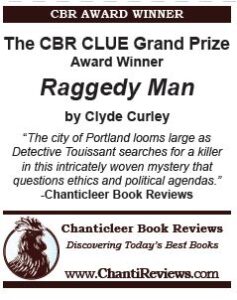
    Chanticleer Shelf talker
    Shelf Talkers sell Wine and Books! They work!

    If a bookstore team member says they love the genre you write in, you can even offer them a free copy of your book and ask if they can do a write up for you. They have an abundance of riches when it comes to free books, but they don’t have a personal connection with every author. Only offer if they seem interested. Generally, do remember to always be kind to bookstore employees. They are the people who hand sell your book the most after you.

    If the bookstore does do raffles on sale event days, or if you are having a socially distanced author event perhaps the staff can  offer your swag such lavender sachets to each attendee or purchaser (as Gail Noble Sanderson does with The Lavender Meuse Trilogy or Kizzie Jones offers with coloring sheets for her Tall Tale of Dachsunds children’s book series).

    Here is what Kizzie Jones is doing for her foreign book editions:

    Plan events with your ribbon front and center — even if it is virtual — have your well-earned Chanticleer Blue Ribbon placed where it can be seen — another subtle way of stating that you are an award-winning author without having to say so yourself in your virtual presentation.
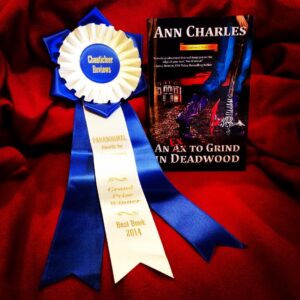
    Chanticleer Award for Best Novels

    People know what a blue ribbon means, and it’s a great way to start a conversation about your book. Events are for more than just your local bookstore, but any stores near where you live or other places you think your story might resonate. Ask yourself if you might know special interest groups that would want to read your work that deals with zookeeping, financial advising, or a classic thriller. Reach out and add these places to your tour stops–yes even virtual tours—all small businesses are looking for ways to create virtual events to keep existing customers and find new ones.. Bookstore websites often run reading and writing groups that might connect to the genre you work in, and they love to have published authors stop by to chat with them.

    But what about “virtual events” at your local bookstore? 

    If  this means bookmarks, buttons, stickers, quarter sheets, and remember to put in your winning status and/or a blurb from your review as applicable and as makes sense for fitting the information onto the material. These swag items are a great way to keep the book in people’s mind. Bookstores can drop all of these into customer’s bags, which can really pay off in sales! Especially if the purchase was instigated by a virtual event. These items let your readers know that they are special to YOU! Be sure to invite them to visit your website because you offer readers special prizes and raffles and other fun stuff to readers who subscribed.

    Always be gracious with anyone who might sell or buy your work at an event. There’s no crowd too small, even if it’s just a bookstore employee—remember, that person will hand sell your book and be your representative to customers in the store. 

    The short version of this, as with all the best advice, is to have a plan, reach out to your local community that provides built-in support, and always be kind and gracious to those around you.

    Tweet us @ChantiReviews on Twitter to let us know how you used your marketing materials and award from Chanticleer to help generate interest in your book. We will share and LIKE and Comment.

    Promote your wins by showing off your digital badges (Semi-Finalist, Finalist, First Place, or Grand Prize), book stickers, and reviews!

    Now to start preparing for the HOLIDAY SEASON – Stay tuned for Tips and Tools for Increasing Holiday Book Sales.

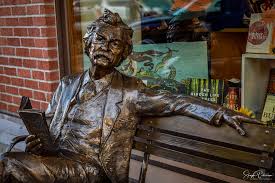
     

  • The MARK TWAIN Book Awards for Satire and Allegorical Fiction – a New Fiction Division in the Chanticleer Int’l Book Awards

    You might say we like Samuel L. Clemens, better known as Mark Twain, just a little bit here in Bellingham. We only put a statue of him right out front of our flagship local bookstore Village Books.

    Samuel Clemons writing as Mark Twain statue in front of Village Books, Fairhaven (Bellingham, Wash.)

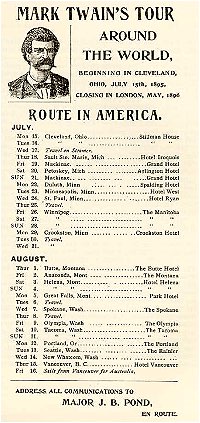
    But why? Well, Bellingham was one of the stops on his world tour to inspire himself to write and hopefully pay off some of the massive debt he had accrued from bad business investments. The tour proved to be successful: 122 shows in 71 cities around the world.

    An old report listing some of Mark Twain's world tour locations

    Editor’s Note: Here is a fascinating article from Time Magazine by Richard Zacks titled The 19th-Century Start-Ups That Cost Mark Twain His Fortune.

    Twain came to Bellingham (aka Fairhaven currently –  aka at that time as New Whatcom) in August of 1895 , and he lectured under smoky skies (they had a fire season that summer, too).   

    The fires caused the visit to Whatcom County to look like it wasn’t going to work out, as he arrived to see a spare audience, and unfriendly skies. Just read the description written by his manager, Major JD Pond: 

    Wednesday, August 14th, Seattle to Whatcom.   

    “Marks” cold is getting worse (the first cold he ever had). He worried and fretted all day; two swearing fits under his breath, with a short interval between them, they lasted from our arrival in town until he went to sleep after midnight. It was with great difficulty that he got through the lecture. The crowd, which kept stringing in at long intervals until half-past nine, made him so nervous that he left the stage for a time. I thought he was ill, and rushed back of the scenes, only to meet him in a white rage. He looked daggers at me, and remarked: 

    “You’ll never play a trick like this on me again. Look at that audience. It isnt half in yet.” 

    I explained that many of the people came from long distances, and that the cars ran only every half hour, the entire country on fire causing delays, and that was why the last installment came so late. He cooled down and went at it again. He captured the crowd. He had a good time and an encore, and was obliged to give an additional story. 

    And his trip had the added effect of reinvigorating his writing and his bank account, both vital for him. Luckily, with prohibition twenty years down the line, he managed to find some liquor and cigars to round out the successful night at what is now Sycamore Square, just down the road from where he was staying.  

    As a well-known humorist, Mark Twain employed satire to gently rib his audience and point out inconsistencies in the world as it appeared then, such as when Huck wonders why he would go to Hell for helping his friend Jim escape slavery.

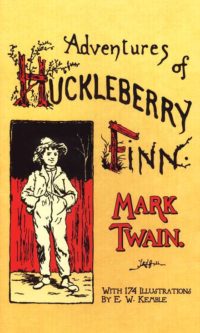
    A yellow cover with red lettering of Mark Twain's Huckleberry Finn with a young boy on the cover.

    One of Twain’s more well-known sayings is “Better to remain silent and thought a fool than to open one’s mouth & remove all doubt.” 

    BRAND NEW  FOR 2020

     The Mark Twain Book Awards

    for Satirical and Allegorical Fiction

    Mark Twain Awards

    With our Somerset Awards having grown beyond capacity with literary fiction and satire, we decided to name the new division for satire and allegory for  Mark Twain, for both his excellence in writing and our connection to him here in Bellingham. And, of course for his excellent works in satire and allegory.

    • The incomparable The Adventures of Huckleberry Finn
    • The Adventures of Tom Sawyer
    • A Connecticut Yankee in King Arthur’s Court
    • The Innocents Abroad

    Modern Satire examples:

    • Matt Groening – The Simpsons, Futurama
    • David Sedaris – Naked, Me Talk Pretty One Day
    • Chuck Palahniuk – Fight Club
    • Douglas Adams – The Hitchhiker’s Guide to the Galaxy
    • Kurt Vonnegut – Slaughterhouse-Five
    • Evelyn Waugh – Brideshead Revisited

    Allegory examples

    • Chaucer’s The Canterbury Tales
    • George Orwell – Animal Farm, Nineteen Eighty-Four 
    • L. Frank Baum’s – The Wonderful Wizard of Oz
    • Arthur Miller – The Crucible
    • C.S. Lewis – The Chronicles of Narnia

    If your work is literary or contemporary, but not quite satire or allegory, check out our Somerset Awards! 


    HOW DO YOU HAVE YOUR BOOKS RECOGNIZED? Submit them to the Chanticleer International Book Awards – Click here for more information about The CIBAs!  

    The last day to submit your work is November 30, 2018. We invite you to join us, to tell us your stories, and to find out who will take home the prize ribbons at CAC21 in April. 

     As our deadline draws near, don’t miss this opportunity to earn the distinction your literary novel deserves!  Enter today! 


    The MARK TWAIN Book Awards for Satirical  and Allegorical fiction is a division of the Chanticleer International Book Awards – the CIBAs. 

    ENTER NOW! 

    Don’t delay! Enter today! 

  • An Editorial Review of “Cornered” by Alan Brenham

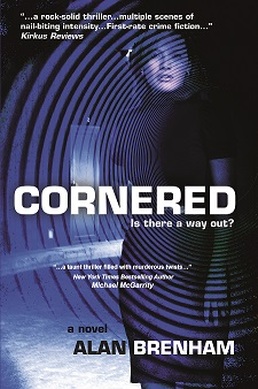
    An Editorial Review of “Cornered” by Alan Brenham

    Detective Matt Brady of the Temple City police is up to his eyeballs with work. He has too many kidnapped women, no leads, and the chief of police is breathing down his neck with reminders of how the last time he worked a case like this, a woman died. As the kidnappers are always ten steps ahead, it’s looking like the time has come to hand the case off to the FBI, which would end Brady’s chance at redemption. So begins Alan Brenham’s detective novel, Cornered.

    Burt Smith and his henchmen, Weaver and Chiles, appear to be more than a match for Detective Brady at the start of the novel. The villains are loose-cannons, capable of anything, but they still have their own personal lives to deal with. Smith is attempting to escape an unhappy marriage, hounded left and right by his ex-wife, while Weaver and Chiles are cons trying to put their lives back together. It would be easy for the reader to feel sympathetic for them, if they didn’t spend their spare time committing heinous criminal acts. The focus on all the characters, not just the protagonists, is what sets Brenham’s story apart.

    The development of characters who would usually go unnoticed in other stories adds dimension to the novel. Brenham gives the reader an opportunity to connect with a little old woman yelling at Chiles and Weaver as they speed by her house, and to join Brady in reviling his least favorite detective who never shuts up. In giving the story that extra bit of depth though, Detective Brady and his romantic interest, a veterinarian named Tracy Rogers, lose a bit of the development they could have received in exchange for a fast and furious read.

    Since the reader knows from the get go who the villains are, the overriding theme is how far is too far for the detective to use his position to thwart the villains’ next attempt and what the reasons are for the kidnappings. Meanwhile, the clock is ticking; Brady’s ex-girlfriend has gone all “Fatal Attraction” on him; and anyone involved in any way with the kidnappings—innocents, hit men, criminals, good guys, or opportunists are all in the crosshairs.

    The switch between so many characters, whom the reader knows decently, keeps the excitement burning in the ever present question of what happens next. Moments where the reader expects to loathe the antagonists can elicit sympathy, where other scenes show their irredeemable qualities in vicious detail. The question of who will be saved and who will die, who will cut a deal and who will stick it out to the end, drives the story keeping the pages rapidly turning.

    Cornered is definitely a story that moves against the grain. The reader spends equal time with villains and heroes, making the story focus more on the people than the criminal acts being committed. The tension Brenham builds through the switching of viewpoints creates a novel that commands the reader’s interest, along with giving unique perspectives of the individuals involved.

    Cornered, Alan Brenham’s thriller novel is a winner and we look forward to reading more from this criminal law attorney and former law enforcement officer turned author.

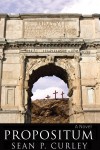
  • An Editorial Review of “Propositum” by Sean Curley

    An Editorial Review of “Propositum” by Sean Curley

    Many know the story of how Jesus Christ came and founded Christianity through the death, resurrection, and crucifixion, but do we know the full story, now millennia old? Sean Curley’s story, Propositum, unfolds to answer this question in a book that is part historical text and part political subversion. Caesars rise and fall by the decisions made by Proculus and Maximus, two great minds who subtly guide the ebb and flow of the Senate and the most powerful voices in Rome, just barely ahead of the crumbling empire.
    The Roman Empire is no longer a Republic; it is failing. Since the death of Augustus Caesar, each of his successors has proven weaker, feeble-minded, and unable to rise to the governance of the former Republic. Proculus, a former senator cannot bear to see his country fall into an inevitable civil war with Judea. His solution is to gather Saul, a young man who admires the senator greatly, his military friend Maximus, and Maximus’ daughter Curia. Each character carries a vital aspect of the plan to fruition. The plan? Create a way for gentiles (non-Jews) to be converted to Judaism without the need for the Jewish laws. Through uniting the two huge groups, Proculus and his allies seek to create a stronger Rome, unified by law and religion.

    The book is well-researched, with each Caesar a nod to history, the knowledge of Jewish communities most akin to Christianity, and Curley’s biblical information shows the clever way religion can be reinvented. The history will put some readers in the mind of the Book of Kings, or, for those less biblically versed, in the dusty classroom where they first had the classics explained to them. While for some, this will distract from the story, the historical distance emphasizes the parallel distance Proculus and Maximus feel from their goals. The disconnection from the reality of their actions proves highly effective as the book progresses.

    Curley plays the long game in the set-up for this book, just like Proculus with his propositum. Antioch is the setting for part one, focusing on Saul and Proculus developing this plan. Saul is the least informed member of the conspiracy, the Jew needed to spread the new religion, and who can be controlled and influenced by his Roman counterparts. Maximus doesn’t receive a proper introduction until Proculus’ first journey to Rome, where he proves himself as a respected and stalwart soldier, with more contacts than you can shake a stick at.

    Curia and Saul (who eventually changes his name to Paul), are two of the most interesting characters, as they are brought into the plan, Curia with full knowledge that a potential war between Judea and the Roman Empire might be just what is needed to solidify the sympathy of the Roman people with the Jews, and Paul none-the-wiser for his efforts. Curia and Paul are linked by Curia’s role as the eyes, ears, and center of the plan in Rome. Without her, Paul’s church of Christianity would wilt and wither, but Paul still cannot bring himself to reconcile one simple aspect of Curia’s personality: she is a woman. Paul’s sexism is often a point of tension between the rest of the group and the proselytizer.

    Most interesting is that this book makes no claim about the validity of religion. There are true believers in these pages who follow the teachings of Jesus Christ. There are visions, there are miracles, but the line between fact and fiction, between belief and self-deception is so blurred that this is a book with many interpretations. Its merit lies in the momentum of the plans, that once started, cannot stop. All of which is aided by Curley’s knowledge of the subject, which highlight and showcase subtlety well in his book. A worthwhile read.

    5 Stars! Best Book Chanticleer Book Reviews

  • An Editorial Review of “Fathers House” by C. Edward Baldwin

    An Editorial Review of “Fathers House” by C. Edward Baldwin

    Fathers House by C. Edward Baldwin is written for an uncommon reader: the thoughtful thrill-seeker. Often times the grotesque scenes are juxtaposed with people simply living life, dealing with paperwork, or stuck on a stagnate case they don’t understand. The villain’s motivations of power and control are clearly presented, and the number one antagonist holds at least one insanity card in his hand. The push and pull of villains in the shadows gives the reader a sense that the main characters lack free will and are rudderless. All these elements make this an engrossing novel, but some may find the horrific-ness of some of the scenes difficult to read.

    Fathers House centers on the dealings of a crime syndicate and its infiltration at all levels of what seems like a pleasant, law-abiding city in the South. The reader is quickly introduced to Fathers House, a halfway home for delinquent and orphaned youth in Duraleigh, N.C.

    Baldwin introduces a large cast of characters who will weave the plot twists and turns in his opening chapters.  Reading the first few chapters that set-up the story may be daunting, but do read on.  However, once the reader pushes through, the story picks up pace while the tension ratchets up at breakneck speed.

    Our protagonist is Ben Lovison, an assistant district attorney who is touted as a community role model, in part due to his humble beginnings as an orphan in Fathers House and a shining example of Mayo Fathers’ community work. Lovison, who was abandoned by his father, is now an expecting father of twins. The reader receives brief flashes of what Lovision tries to expect parenthood to be like without the benefit of parents to emulate except for Mayo Fathers.  Fatherhood in one way or another is a central theme throughout the work.

    The plot initially focuses on Lovison’s investigation of Cain Simmons, a teenage rapper at Fathers House indicted in the murder of another young man.  Lovison is half detective, half lawyer, and more than competent at his job. But after Cain’s apparent suicide, Lovison begins wandering without direction, unsure now that he has no one to prosecute.

    The narrative slides between adults working for Fathers Disciples, adults supposedly working for the good of society, adults working for the law, and finally the children who are at their mercy.  Each character is trapped in a world where no one is trustworthy once their illusions are shattered.

    Ben Lovison’s world is crushed as he discovers the dark truth behind his boyhood foster home, his mother’s murder, and the disappearance of his own father.  As the novel continues, it becomes clear that it is not about any one character, but the effects the Fathers Disciples have on those whose lives they try to control and wield power over.

    The Fathers Disciples’ development as a crime syndicate works well. The disciples decide which youths they will use for the syndicate and which are the ones who will go out into the world as Lovison did, thereby, keeping up the façade for Mayo Fathers, the owner of the house and its hidden torture chamber. Lovison somehow stays on the Fathers Disciples’ radar as a potential threat, but they deem Lovison as just a fly on the wall.

    The twists and turns of Fathers House will satisfy readers who find non-obvious connections connecting devilishly amusing. Juxtaposition of the bribery, murders, and power plays against Baldwin’s subliminal questioning of free will and what really drives all of our lives is not highlighted in an initial reading, but in the undercurrent subtext. This is yet another example of how Baldwin’s story engages the reader in unexpected ways. Parts like the end, which will not satisfy all readers (blink and you will miss it), are balanced by a well thought-out story arc, and the slow reveal of the darkness everyone is capable of holding in their secret heart.

    Fathers House is a bloody and suspenseful debut thriller by C. Edward Baldwin that deals with the brutal undercurrents of crime in modern society.

  • An Editorial Review of “Without Consent” by Bev Irwin

    An Editorial Review of “Without Consent” by Bev Irwin

    Bev Irwin immediately introduces her serial killer in Without Consent by having him carve out the kidney of a conscious woman. Irwin deftly interlaces Doctor Claire Valincourt, Detective Gerry Rosko, the numerous victims, and the killer himself in this descriptive medical-thriller.

    Dr. Claire Valincourt’s world changes after she finds the first body of a spree of killings, and she struggles to face death and horror outside of the sanitized environment of hospitals. Heading up the investigation is Detective Rosko, the surprisingly clement police officer who sparks with Valincourt from the moment they first shake hands. Their growing relationship is dogged by death and danger.

    Irwin presents a wide cast of memorable characters in Without Consent. From a charismatic sketch artist, to reporters that just don’t know when to quit, Irwin organizes the plot so that not a strand is out of place, and most everything dovetails. The terror of Rosko and Doctor Valincourt surrounded by suspects, one of whom is a brutal murderer, gives their lives a level of tension that could be cut with a scalpel.

    Suspense devotees will appreciate the details revealed about the killer’s inner workings. The foreshadowing at the beginning also points to Rosko and Valincourt being thrown together, and with each missing kidney, their romance blossoms against recent personal wounds and professional instinct. The effect could be considered comical if it was not for the constant threat of a brutal death looming over their shoulders.

    The story takes on even more of a sense of urgency as Rosko realizes the athletic brunettes who are piling up, sans one kidney, look suspiciously like Valincourt. The murders begin to be personal and move closer to home as they slide into the social circle of both characters. They fight and scrape to stay alive while closing in on the killer.

    Without Consent’s strengths are highlighted in its multifaceted characters. Valincourt, despite severe trauma in her past, rarely is a damsel in distress, and Rosko isn’t just a stereotypical detective, but has a gentle side and a solid presence that serves as a sea of calm in all the chaos.

    The journey into the killer’s mind always leaves the reader feeling unclean. Each point of progression fits logically when presented by a deranged, methodical man. Occasionally, the extra knowledge held by the reader sends shivers down the spine as the police cannot manage to see or prevent disaster before it happens.

    With each kidney the killer takes, he becomes more confident and certain that his path is the right one, while Rosko and Valincourt become more determined to discover any information on how to stop him.

    Despite some heavy foreshadowing, Without Consent will have you reading to the end. And, as in this case, knowing increases the pleasure of each tiny reveal that is carved out with Irwin’s razor sharp writing…like finding the perfect kidney at the end of a long day.


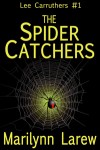
  • An Editorial Review of “Spider Catchers” by Marilynn Larew

    An Editorial Review of “Spider Catchers” by Marilynn Larew

    Lee Carruthers is sent to Fez, Morocco to find out what became of Alicia Harmon, a CIA analyst who has gone missing while investigating a potential new source of terrorist funds. So begins The Spider Catchers, Marilynn Larew’s first novel that deals with the battle between the CIA and terrorism.

    Carruthers bemoans receiving the new mission so quickly after just returning from Baghdad. However, she heads back into the field without much persuasion. Once in Fez, she meets with a hostile reception. Each answer she finds only leads to more questions as to why Harmon believes an untouchable Islamic politician is funding a new group of terrorists. Carruthers is methodical in the way she follows each lead, always taking the next logical path.

    While several characters play only incidental bit roles, Larew works hard to ensure between bombings and stakeouts that Carruthers’ important contacts are emphasized. Still, certain characters are sometimes lost in her sea of informants. The plot never falters, even when Alicia Harmon’s motivations are completely obscure to both Carruthers and the reader. The world is real with none of the antiseptic frequently found to ease the burden that comes with reading about terrorism.

    Readers who love a clandestine novel will be pleased with the way Larew weaves her mystery. She allows Lee Carruthers to gather hints and suspicions, but keeps the overarching web of conspiracy shrouded as she builds the tension. A dash of romance coupled with a healthy splash of righteous anger, and The Spider Catchers carries itself quite well. As Carruthers closes in on what Harmon is investigating, the attacks on her become more frequent. She has only a few trusted contacts to rely on, the majority of whom can only be trusted as long as she can pay them.

    The relentless determination with which Carruthers pursues her problems drives The Spider Catchers. Balancing between someone who wants out of Agency life, and someone who cannot stand the atrocities around her, Carruthers focuses on the task at hand with an impressive single-mindedness and a sharp tongue that leaves conservative Moroccans white-knuckled.

    The investigation into a CIA operation, and the suspicion between clandestine agencies places the reader in the same whirlwind of confusion Carruthers deals with on a regular basis. Each clue frustrates and worries the reader as much as it does her. Only in certain moments, as she narrates safely from the future, does Carruthers drop hints and foreshadows. Occasionally the glimpses of the future feel heavy handed, but in most cases they skillfully guide the reader to see clues that might otherwise be missed.

    The Spider Catchers works well within its spy-thriller genre, always maintaining the mystery of what happened to Alicia Harmon at the forefront. The slow clicking into place of all the pieces is a delight, and Carruthers oblivious attitude towards her own nature makes her quite the narrator. This book was a solid read, and the onset of a sequel is cause for excitement.