The First in a Series of Articles on Writing a Book Series
Writing a series of books and writing a novel are similar processes, though of course the series, as you may expect, is on a much grander scale.
A series is an excellent choice for a writer because you keep your readers! It’s always easier to maintain a connection with people who have already decided to read, not only your book, but a book in the same world!
Let’s begin by talking about different types of Book Series
Two Variations for Book Series
There are essentially two types of book series out there. One is the Finite Series, and the other is the Infinite Series.
Finite Series
These Series have a story arc that expands beyond one book, and each one relates directly to the one before or after it. Examples of this are N.K. Jemisin’s The Broken Earth Series or Jim Butcher’s The Dresden Files. Series can be as short as two books or as many as twenty-three, but the main thing is that the order they come in is highly recommended to best understand the plot.
This is a group of books set in a universe, but where each book can stand alone and be read in any order. Examples are Anne McCaffery’s Dragonriders of Pern or Terry Pratchett’s Discworld series. For the most part, these books will follow the same rules of the universe between volumes, just as a finite series would.
These also are called an anthologized series as I learned in a discussion about writing craft with Chanticleer Editorial Assistant Scott Taylor during our Roost book group meeting discussing Save the Cat! Writes a Novel. They happen often if someone just decides they enjoy continuing to write in an established world with established characters –David
Honorable Mention
Terry Brooks’ Shannara series is both finite and infinite! He has finite quartets and trilogies that all take place in an infinite series universe. You can read each finite mini-series in the universal infinite series in whatever order you want, and they all offer hints about the other books.
Did you know? Series don’t need to be italicized while writing them! Only book titles require it.
The Overlap
Obviously the key here is that both of these are series. A series will always have central themes that overlap across books, and what happens in one book will affect the world at large, even if the books can be read as stand alones. Even in an infinite series, characters will have cameos, such as the character of Death in Pratchett’s Discworld universe.
It’s recommended that in an infinite series each story has a strong, independent story to help it stand apart from the other books set in that universe, but even in a finite series, it’s important that each book avoids being too repetitive. The concern about repetition is important to keep in mind, though many successful series often rely heavily on repetition to help the reader orient themselves to a familiar landscape. For example, in The Dresden Files, almost every book follows this pattern:
Harry hears of a strange mystery that’s way beyond his ability to comprehend
Then he finds a simpler mystery, one he can manage, or so he thinks.
His team assembles slowly over the course of the book, Thomas the vampire, Murphy the cop, Michael the knight, and John the mobster.
The simple mystery turns out to be much bigger. Harry is defeated and ready to give up.
Suddenly Harry understands the bigger mystery by solving a key point in the smaller mystery.
Day is saved.
Hint about how the day wasn’t totally saved.
Paul Blackthorne as Harry Dresden holding Bob the Skull
Likewise, Terry Brooks often follows the character pattern of making sure there’s someone with the fabled Shannara bloodline, that person receives help from someone who is a bit of a nomad, a druid is introduced, and then we have a couple more magical characters who help out the heroes.
When you’re ready,did you know that Chanticleer offers editorial services?We do and have been doing so since 2011.
Our professional editors are top-notch and are experts in the Chicago Manual of Style. They have and are working for the top publishing houses (TOR, McMillian, Thomas Mercer, Penguin Random House, Simon Schuster, etc.).
If you would like more information, we invite you to email Kiffer or Sharon at KBrown@ChantiReviews.com or SAnderson@ChantiReviews.com for more information, testimonials, and fees.
We work with a small number of exclusive clients who want to collaborate with our team of top-editors on an on-going basis.Contact us today!
Chanticleer Editorial Services also offers writing craft sessions and masterclasses. Sign up to find out where, when, and how sessions being held.
A great way to get started is with our manuscript evaluation service, with more information availablehere.
And we do editorial consultations for $75. Learn morehere.
If you’re confident in your book, consider submitting it for a Editorial Book Reviewhereor to one of our Chanticleer International Awardshere.
Our 10th Anniversary Chanticleer Authors Conference (CAC22) will be June 23-26, 2022, where our 2021 CIBA winners will be announced. Space is limited and seats are already filling up, so sign up today! CAC22 and the CIBA Ceremonies will be hosted at the Hotel Bellwether in Beautiful Bellingham, Wash. Sign up and see the latest updates here!
Writer’s Toolbox
Thank you for reading this Chanticleer Writer’s Toolbox article.
Chanticleer’s new Division for 20th Century Wartime Fiction: The Hemingway Awards
The US fought five wars during the 1900s: World War I, World War II, the Korean War, the Vietnam War, and the Gulf War.
Many of us have deep connections to these wars built into our family trees and history of military service. It’s no surprise that there are so many stories that delve into wartime fiction that we needed to create a new category for it this last year.
Why Hemingway?
Young Hemingway
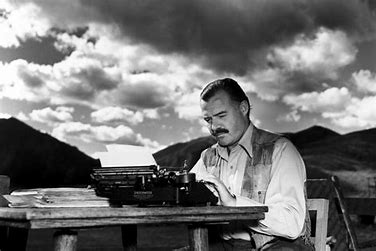
Ernest Hemingway was one of the defining voices of his generation, especially in relation to The Great War where so many had to reconcile their lives as they were with the horrors of war they had experienced.
“When you go to war as a boy you have a great illusion of immortality. Other people get killed; not you… Then when you are badly wounded the first time you lose that illusion and you know it can happen to you.” (read more here)
While it’s well-known that Hemingway served in WWI and was honored for his bravery by the Italian government as an American Red Cross worker, it is less known that when Hemingway returned to post-war Europe he became a respected war correspondent. His grandson, Seán Hemingway describes the author’s reporting as “written in a new style of reporting that told the public about every facet of the war, especially, and most important, its effects on the common man, woman, and child.”
For those of you who know little about one of the most prolific war writers on the 20th century, he’s well worth a read, and shockingly modern in his thought. He was an early anti-fascist, being one of the first to decry Benito Mussolini.
For all that Hemingway can dazzle and impress, there is another view of him.
He was selfish and egomaniacal, a faithless husband and a treacherous friend. He drank too much, he brawled and bragged too much, he was a thankless son and, at times, a negligent father. He was also a great writer.
Hemingway’s writing is reported to be the thing that he held above all else. More than his wives or the children he had, his writing and author platform always came first.
Beyond that, his criticism of other works is scalding and harsh, beyond what anyone would reasonably consider helpful. This flies in direct contrast to a quote from LitHub where Hemingway opens up about the experience of being a new author, trying to break into the literary world:
“The rejection slip is very hard to take on an empty stomach,” Hemingway later told a friend. “There were times when I’d sit at that old wooden table and read one of those cold slips that had been attached to a story I had loved and worked on very hard and believed in, and I couldn’t help crying.”
We all know that he was published, many times:
The Torrents of Spring (1926)
The Sun Also Rises (1926)
A Farewell to Arms (1929)
Death in the Afternoon (1932)
Green Hills of Africa (1935)
To Have and Have Not (1937)
For Whom the Bell Tolls (1940)
Across the River and into the Trees (1950)
The Old Man and the Sea (1952)
A Moveable Feast (1964)
Now we’d like to dive into some of the best books we’ve reviewed at Chanticleer with a focus on Wartime Fiction in the 20th Century.
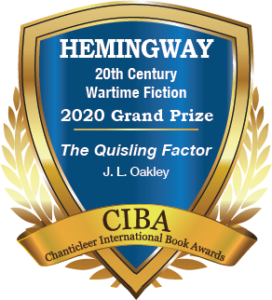
The QUISLING FACTOR By J. L. Oakley Grand Prize Winner in Hemingway Awards
During World War II “quisling” became a byword for a particular type of traitor, one who not only betrays their own country but also actively collaborates with the invaders. The origin of the term was taken from an actual person, a Norwegian named Vidkun Quisling, who didn’t merely cooperate with the Nazis but actually headed a collaborationist regime in his own country.
The Quisling Factor takes place in the immediate post-war period, as the Nuremberg Trials are gearing up in Germany. Norway is conducting its own post-war legal purge of collaborators at all levels of government.
HEART of the FEW By Jon Duncan First Place Winner in Hemingway Awards
It is said that all is fair in love and war. In this wartime historical romance, young love is put to the ultimate test, and the love of family is strained to the breaking point. During World War II, the occupants of a ravaged England understand that all can be lost in a moment’s hesitation or in a hasty decision. Here, love is under attack by enemies seen and unseen. It’s the uncommon courage of many and theHeart of the Fewthat can hope to turn the fate of England during these dark days.
Passion drives both sides in this wartime mystery/thriller about people who are determined to make a difference in the outcome of World War II. Like all powerful forces, passion has two sides. It’s a wondrous and beautiful emotion when applied to good purpose, but it becomes horrific and deadly when twisted and corrupt. The question author Jon Duncan asks amidst all the turmoil, treachery, death and desolation of war is: can love find a way?
The ACK-ACK GIRL (Love and War #1) By Chris Karlsen
Chris Karlsen’s new work,The Ack-Ack Girl, is the first in her World War II series, Love and War, and serves up plenty of story on both sides of that equation in its portrayal of Ava Armstrong, the “Ack-Ack” girl of the title. And what a story it is!
Bombs are dropping on London in the heat and fire of the infamous Blitz. Shells are falling, as are the buildings that surround them, while fires spring up in the wake of the bombs that never seem to end. But when they finally stop, Ava and her friends are determined to get their loved ones somewhere safe and to find a way to serve up some revenge on the Germans.
WHERE EAGLES NEVER FLEW By Helena P. Schrader First Place Winner in Hemingway Awards
The Royal Air Force struggles for control of the British sky, facing down the daunting numbers of Luftwaffe aircraft across the English Channel. At the forefront of these battles, the Royal Air Force’s young pilots fight to survive under mounting pressure and deadly German Messerschmitts.
Where Eagles Never Flew follows the Battle of Britain as squadrons of the RAF must make do with undertrained pilots and little sleep if they want any chance at repelling the Luftwaffe bombing raids that become more and more frequent as the battle rages on. Operations rooms plot and direct the paths of aircraft, with members of the WAAF—Women’s Auxiliary Air Force—fielding waves of communications to and from the skies. Robert “Robin” Priestman flies on the front lines, dedicated to the fight despite weeks of unending tension and the great challenge of keeping his squadron awake and alive despite sortie after sortie.
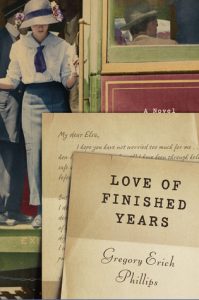
An immigrant’s journey, a forbidden love, a war to end all wars collide on the pages of a beautifully written historical fiction, Love of Finished Years by Gregory Erich Phillips.
At twelve years of age, Elsa Schuller carries no expectations when she reaches Ellis Island in 1905. In fact, she has no idea why her father insists on leaving Germany for this supposed Land of Opportunity. Riddled with nothing less than challenges and hardship working in the sweatshops in lower Manhattan, Elsa’s only ray of hope is learning how to read and write English.
When you’re ready,did you know that Chanticleer offers editorial services?We do and have been doing so since 2011.
Our professional editors are top-notch and are experts in the Chicago Manual of Style. They have and are working for the top publishing houses (TOR, McMillian, Thomas Mercer, Penguin Random House, Simon Schuster, etc.).
If you would like more information, we invite you to email Kiffer or Sharon at KBrown@ChantiReviews.com or SAnderson@ChantiReviews.com for more information, testimonials, and fees.
We work with a small number of exclusive clients who want to collaborate with our team of top-editors on an on-going basis.Contact us today!
Chanticleer Editorial Services also offers writing craft sessions and masterclasses. Sign up to find out where, when, and how sessions being held.
A great way to get started is with our manuscript evaluation service, with more information availablehere.
And we do editorial consultations for $75. Learn more here.
If you’re confident in your book, consider submitting it for a Editorial Book Reviewhereor to one of our Chanticleer International Awardshere.
And remember! Our 10th Anniversary Chanticleer Authors Conference (CAC22) will be April 7-10, 2022, where our 2021 CIBA winners will be announced. Space is limited and seats are already filling up, so sign up today! CAC22 and the CIBA Ceremonies will be hosted at the Hotel Bellwether in Beautiful Bellingham, Wash. Sign up and see the latest updates here!
Writer’s Toolbox
Thank you for reading this Chanticleer Spotlight article.
You’re handing your precious book over to a beta reader to see if it’s worthwhile, ready, perhaps, for a Chanticleer Book Review or to be entered into the Chanticleer Int’l Book Awards. They look at you over the cover that you worked so many long hours on with your designer and say with all the authority of fate: “I just don’t think your main character is very likeable,” they say. “Can’t you make them more likeable? All characters should be likeable.”
Are your grumpy readers right?
Writer, they are wrong
You can of course have an unlikeable main character! If they were only willing to read for ten minutes though, you may have a more difficult problem on your hands than whether or not your character is someone they want to be friends with. Some of the most compelling characters in literature aren’t someone I’d want to share a hotel room with anytime soon.
We can sleep in separate bedrooms. Really, it’s okay.
The key isn’t to worry about whether or not your protagonist is “likeable” (which is a tricky word to define), but about whether or not they are interesting.
Are the actions they take moving the plot forward while engaging the reader at the same time? Those two things must be true of anything that happens in your story.
Manuscript Overviews and Editing
Now, if the majority of your readers are coming back to you and letting you know these early drafts aren’t working, we highly recommend a Manuscript Overview.A manuscript overview (MOV) is a broad overview of your manuscript – what’s working and what isn’t from all aspects of your story: structure, plot, pacing, character development, dialogue, etc. We are here to offer our guidance on what you need next. Save time and money by honing your work before you begin the editorial process.
Here, we’ll go through a few basic checks to make sure that your character is compelling.
On Writing Compelling Characters
There are a few questions you’ll want to ask to see if your complex character is someone who will grab your reader’s attention.
What is the Status Quo your character inhabits?
What is your character’s Desire?
How does the Conflict impede the character’s Desire?
Speaking of Secondary Characters, Severus Snape, Professor of Potions from the Harry Potter series is a prime example of uncompelling compelling character.
Severus Snape
Status Quo
This is the classic way you engage readers with your story. The story is introduced, and something happens to break the status quo. One story where this jumps to mind is Neal Stephenson’s Seveneves. With cannibalism and the end of the world, there’s no lack of unlikeable characters in this book, but all the characters rivet your attention.
Seveneves begins with the moon blowing up. Well, more accurately, with it being split into four pieces. Up until the catalyst (the breaking of the status quo), the four chunks of the moon are a point of fascination, friendly enough to have one chunk named “The Bean.” Then the status quo changes when one of the moon chunks hits another and they start to fragment even more. This gives all the characters a goal to work for: Save the Human Race. Having a strong focus for your characters will help readers empathize with them and want to know what’s happening.
Our favorite editor Jessica Morrell has an excellent article detailing even more ways to stir up trouble for your characters here.
Character Desire
Similar to the breaking of the status quo, your characters will all want something different out of the world you’ve written them in. Of course, like the breaking of the status quo, this problem won’t be easy for them to solve.
Tom Ellis as Lucifer from Netflix
There are two common methods of frustrating your character’s ability to achieve their desire. The first is simply to make it difficult to do. Anything that takes a lot of work and will make them struggle. The other excellent choice is to have them try to solve the wrong thing. So often characters misunderstand what will make them happy or they struggle to find the correct solution to their problem. By having them do the wrong thing, the reader will be able to enjoy a much more interesting story than an unlikeable person succeeding at everything they do and never growing or developing.
Cats
Who doesn’t love cats? We love cats at Chanticleer, that’s for sure!
The newest additions to the Chanticleer family: Tiefen and Biscuit at 15-weeks-old
Now the connection between cats and what to do with your unlikeable character might not be immediately clear, and it might sometimes be a metaphor rather than an actual cat. The tried and true advice is you have a character who might be a little rough around the edges save a cat early on in the story. This shows that, despite their flaws, they do care about the world around them, and they will help a creature in need. Of course, this doesn’t have to be a literal cat, but it’s something sweet the character chooses to do without being pressured.
For those of you in The Roost, Chanticleer’s online community, you know that we have been reading SAVE THE CAT, WRITES a NOVEL by Jessica Brody (based on the screenwriting books by Blake Snyder) in our Writing Craft Book Group. There is even a reading guide by Chanticleer’s David Beaumier uploaded to the activity feed.
The opposite can happen too! In Lower Decks, the irreverent Star Trek cartoon that’s currently playing on Paramount+, Beckett Mariner kills a holographic character to establish herself as the villain in a fantasy program she designed.
Beckett Mariner as Vindicta in “Crisis Point” from Star Trek Lower Decks
It’s fairly easy to flip through the first pages of your book to see if there’s a cat who your narrator can save in the early pages of your work, and then see if you can find a few beta readers to poll on their feelings.
To consider more of the timing and development of plot in relation to your characters, review this article here.
“There’s no such thing as writer’s block or plotter’s block. There’s only perfectionist’s block.” Jessica Brody
Go forth and write!
When you’re ready,did you know that Chanticleer offers editorial services?We do and have been doing so since 2011.
Our professional editors are top-notch and are experts in the Chicago Manual of Style. They have and are working for the top publishing houses (TOR, McMillian, Thomas Mercer, Penguin Random House, Simon Schuster, etc.).
If you would like more information, we invite you to email Kiffer or Sharon at KBrown@ChantiReviews.com or SAnderson@ChantiReviews.com for more information, testimonials, and fees.
We work with a small number of exclusive clients who want to collaborate with our team of top-editors on an on-going basis.Contact us today!
Chanticleer Editorial Services also offers writing craft sessions and masterclasses. Sign up to find out where, when, and how sessions being held.
A great way to get started is with our manuscript evaluation service, with more information availablehere.
And we do editorial consultations for $75. Learn morehere.
If you’re confident in your book, consider submitting it for a Editorial Book Reviewhereor to one of our Chanticleer International Awardshere.
Also remember! Our 10th Anniversary Chanticleer Authors Conference (CAC22) will be April 7-10, 2022, where our 2021 CIBA winners will be announced. Space is limited and seats are already filling up, so sign up today! CAC22 and the CIBA Ceremonies will be hosted at the Hotel Bellwether in Beautiful Bellingham, Wash. Sign up and see the latest updates here!
Writer’s Toolbox
Thank you for reading this Chanticleer Writer’s Toolbox article.
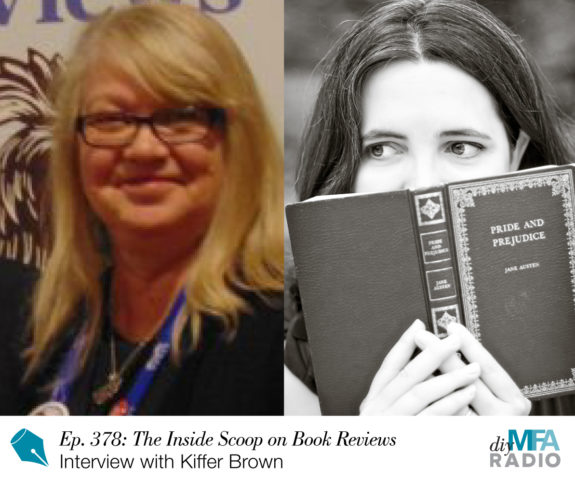
If you haven’t heard the news, Kiffer was interviewed on DIY MFA where she and Gabriela Pereira discuss
Why now is the best time to be an author
The difference between a write-up and a review
The Four Types of Reviews
How advance reviews help to promote your book
When you should start sending your book out for reviews
Plus, Kiffer’s #1 Tip for Writers
You can listen to the full interview on Chanticleer’s under the hood technology that gets increases the digital footprint of each book review published on Chanticleer’s website here or wherever you get your podcasts. Kiffer also gives quick and easy tips about how to get more “Amazon Love” to your book’s Amazon selling page. Below is a quick synopsis of the interview, but tune in to get the full scoop!
So what does all this mean? We have the inside scoop!
The Best Time to be an Author
With millions of books being published every year, it’s harder for an author to be noticed than ever! So why is now the best time to be an author?
Simply put, the number of resources available to authors now are greater than ever before. Not only can Chanticleer help you navigate this vast ocean of publishing, but we provide many of the tools directly. A brief list of our formidable resources are:
Overwhelmed? You can always email us at info@ChantiReviews.com for assistance, or message us directly on Facebook. Of course, one of our primary services is the Editorial Review.
A Write-Up vs A Review
The proof is in the pudding for write-ups vs reviews. A write-up, as said on Merriam-Webster is a review that is intended to be “flattering.” While there’s nothing wrong with one of these, readers will wisely be wary of them as they have a biased tone. By contrast, Editorial Reviews are unbiased and objective, referring to what a text specifically does or does not do – it focuses on the quality of the work. Editorial Reviews are an excellent way for readers to gauge their actual interest in a book, instead of having to read between the lines to see if it’s actually something they’ll enjoy. Both happen and can help with book sales, but an Editorial Review will be more versatile. Let’s dig into that!
The Four Types of Review
Editorial Reviews
These reviews are unbiased and objective, the standard by which readers measure if they’ll want to read a book or not. Chanticleer Editorial Reviews are a professional avenue for your book to be fairly assessed and get people talking about it! We keep up with the latest in Search Engine Optimization technology to maximize the digital footprint of our clients, including cross-posting across social media.
Chanticleer’s Marketing Kits are given to authors whose books receive a 4 or 5-star CBR review.Our kits include personalized Shelf Talkers you can use wherever your print book is sold, as well as samples of our silver-foil Book Review stickers designed to catch readers’ attention.
Typically, the best time to begin submitting your work for an Editorial Review is when you reach the proofing stage. Your reviewer will understand that the book is approaching its final form, and that minor changes will still be made. Your book will be evaluated, not on minor typographical errors, but on how well you’ve realized your story.
Reader Reviews
Close kin of the write-up, these are the kinds of reviews you’ll find everyone on Amazon and Goodreads letting you know how someone who read the book liked it. While some are helpful and provide real insight on the book, many are just a rating from 1-5, and the information relating to your book varies. You can’t be sure this reader is in your audience, even if they read your book! There’s no denying that reader reviews help your book do well, and it’s more of a question of quantity over quality, but they’re tricky to maneuver and guarantee.
Peer Review
One of the most difficult reviews to obtain is that of the peer review, or, as it’s commonly known, the book blurb. This describes an author or someone else in your circle of influence who readers will listen to. J.D. Barker, a regular presenter at The Chanticleer Authors Conference, has networked to have Stephen King blurb his thriller novels, and you can believe that King’s readers sit up an pay attention to that!
Circle of Influence is how Kiffer describes those who surround you that can directly contribute to your success as an author. If you aren’t sure who your circle includes, try writing down ten people who you know you can turn to for advice or support. Each year, you’ll want to grow this circle by another ten people. Kiffer and Sharon Anderson wrote an excellent article about this that you can read here.
JD Barker presented at CAC19 and VCAC21!
While you will, of course, reach out to authors on your level, it’s always good to have a few authors who are doing better than you blurb your book. Obviously, writers at the top of their game will be inundated with blurb requests, so be gentle and patient when asking, even if you never hear back.
The Manuscript Overview
This one is always unexpected, because a review of your manuscript doesn’t come after your book is done (or close to it). However, Kiffer recommends that you do a Manuscript overview around the second of third draft of your book. It’s before you’ve paid someone to painstakingly line edit and proofread your book, but after you feel comfortable with knowing the core of the story, and you know the ideas you want to convey are on the paper. That’s when you’re ready for your overview.
A manuscript overview (MOV) is a broad overview of your manuscript – what’s working and what isn’t from all aspects of your story: structure, plot, pacing, character development, dialogue, etc. Chanticleer can offer guidance on what you need next. Using a manuscript overview before you begin the editorial process will not only save you money in terms of editorial services down the road, but it also will save you time by clarifying where you are in writing your story right now.
Now that we’ve covered the four types of reviews, let’s continue to dig deeper into how you can use your Editorial Reviews
How Advance Reviews Can Support Your Book
So often when authors receive their Editorial Review, instead of inspiration lighting up the night sky telling them what to do next, there’s a strange buzzing sound that surely isn’t dread and uncertainty.
It’s okay! Of course, you’ll want to test bits of your Editorial Review as blurb material for you book. Feel free to be selective and grab multiple sound bites that you like to describe your book. Workshop them with friends and fellow writers in your circle of influence. For the other potential blurbs, you can use those on Amazon, Goodreads, Barnes Noble, and Kobo. Each one of those places has a special location for Editorial Reviews that the author can upload. The reason you use different quotes from you review for these is so that readers who come across your book on multiple platforms have something new to read in each spot. Editorial Reviews used in this way can really help drive presales.
If your book hasn’t been published yet, but is a manuscript that you are sending to agents and publishers, then the Editorial Review can still be used in the same way to market it to those you query regarding your book.
The other big thing is link to your review! Adding links on blog posts and websites increase your SEO rating, and having your digital footprints over a wide path with help readers come across your book online.
When Should you Solicit Reviews?
At least six months in advance. In times where shipping is not being impacted by a global pandemic, it takes about two weeks to receive a shipment of books. And that’s in the best case scenario. Remember, even if all you have left to do is proofreading, your book will still have the following to go through before it can go to print:
Interior Formatting
Cover Design
Proof Copies
The interior formatting and cover design time varies greatly, and the time it takes to receive a galley or proof of your book will be another two weeks for shipping. Six moths will be the minimum amount of time you’ll want to make sure the blurb can appear somewhere on your book and then will be sent out in marketing packages. Bestselling books are often sent out a year or more in advance to receive reviews.
The book is a wonderful tool for someone interested in an MFA, but sitting on the fence. It walks you through the essentials of what an MFA program provides, and the dives into how to create a similar situation, while providing craft tips on par with the latest advice from top-tier editors. Highly Recommended!
Seating is Limited. The esteemed WRITER Magazine (founded in 1887) has repeatedly recognized the Chanticleer Authors Conference as one of the best conferences to attend and participate in for North America.
Join us for our 10th annual conference and discover why!
Recognizing and Celebrating Indigenous Peoples Day and Discussing our Laramie Awards.
It’s October 11th, which in Bellingham, Wash. means it’s Indigenous People’s Day. We believe in recognizing the rich history and contributions of native peoples here in the Americas, and are always working to expand our knowledge and understanding. To that end, we would like to acknowledge that our company is located in downtown Bellingham which is the ancestral home of the Coast Salish Peoples who lived and still live here today. They have a strong connection with the Salish Sea—the marine ecosystem that spans the United States-Canada coastal waterways from Olympia, Wash. to Comox, British Columbia, Canada.
Coastal Salish Annual Tribal Journey on the Salish Sea. Approximately 100 canoes participate in the Potlatch.
There are more than 65 Tribes and First Nations who have lived here for tens of thousands of years. Primarily, the Lummi and the Nooksack Nations reside here in Whatcom County by the Salish Sea. Whatcom is Salish for “noisy water.”
The name Salish Sea was officially recognized by the United States in 2009 and Canada in 2010. Click here if you would like to know more about the Tribal Canoe Journeys: Paddle to Lummi
Members of the Lummi Tribe in the PNW
Indigenous People’s Day began to be celebrated as far back as 1991, with people suggesting it be celebrated as far back as 1977! Of course as most people know, the holiday was intentionally created to overlap, and in some places, replace Columbus Day. Why? History.com offers an answer:
Some may ask why replace Columbus Day with Indigenous Peoples’ Day? Activists have long argued that holidays, statues, and other memorials to Columbus sanitize his actions—which include the enslavement of Native Americans—while giving him credit for “discovering” a place where people already lived.
While there’s no denying that the bloody history of Columbus that has been sanitized throughout historical retellings, the original origin of Columbus Day was never meant to celebrate the brutalization of the people who lived on this side of the hemisphere. Within 60 years after Columbus landed, only a few hundred of what may have been 250,000 Taino were left on their island (currently known as the Dominican Republic in the Caribbean). History.com
The holiday originated as an annual celebration of Italian-American heritage in San Francisco in 1869. In 1934, at the request of the Knights of Columbus and New York City’s Italian community, President Franklin Delano Roosevelt declared the first national observance of Columbus Day. (Smithsonian Magazine)
President Franklin Delano Roosevelt
Of course, as we learn more, we always aim to improve and progress as a society and as a country, working for the betterment of all, we can make updates and changes to reflect history more accurately and remember those who have been wronged in the past. Toward that end, we’d like to take a look at our Laramie Awards.
Spotlight on Laramie Awards
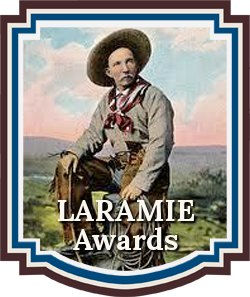
This artwork is from a 1907 postcard. The artist is unknown. The Laramie Awards recognize the best in Americana fiction.
The word Laramie has French origins, meaning The Leafy Grove. However, Kiffer named the Laramie Book Awards after Laramie, Wyoming when she lived just south of there when in Fort Collins, Colorado. Laramie was named for Jacques LaRamie, a French-Canadian trapper. He was one of the first Europeans to visit the area (1820s). He disappeared into the local mountain range. Laramie was founded in the 1860s as a “tent city” as a stopover on the Overland Stage Trail that was needed for the development of the first transcontinental railway.
In spite of having stores, houses, a school, and churches, Laramie was known for its rough frontier town lawlessness led by the town’s first marshal (Big Steve Long) who was a notorious gunman and a brutal bully who murdered dozens of Laramie’s people. It wasn’t until October 28, 1868 that some of the townspeople led by the county’s sheriff and fellow rancher, N.K. Boswell, fought back and lynched the marshal and his accomplices, thereby bringing some sort of law and order to Laramie.
It is also said that it was the women who tamed Wyoming.
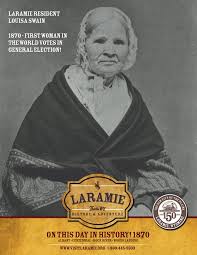
In 1869, Wyoming with Laramie leading the way, was the first legislature led entirely of men that empowered women with voting rights and to hold office. In March 1870, five Laramie women became the first women in the world to serve on a civil jury. It was a Laramie woman, Louisa Swain, who was the first woman to cast a legal, recognized vote in a United States general election on September 6, 1870.
In 1890, when Wyoming petitioned Congress to for statehood the U.S. Congress pushed back stating that Wyoming’s woman suffrage was obstacle and was delaying approval. The legislature, via a telegram from Joseph M. Carey (who later became governor of Wyoming), replied to the threat, “We will stay out of the Union a hundred years rather than come in without our women.” It was a very close vote in the U.S. Congress of 139 for – 127 against.
In 1890, Wyoming became the 44th state—with the women.
And those weren’t the only female firsts that took place in Wyoming. The first female governor was elected in Wyoming and the nation’s first woman to be appointed to public office was done so in South Pass City, Wyoming. In addition, the Equality State is home to the first female jurors, the world’s first female bailiff and the first town that was governed entirely by women.
Native Americans in their traditional attire holding American flag at the Lincoln Memorial building. STUNNING images of the indigenous Native Americans have been brought back to life through vivid colorization. The remarkable pictures show the group during the 1920s, with some of the leaders meeting with then American president, Calvin Coolidge, at the White House.
The Indian Citizenship Act still didn’t offer full protection of voting rights to Indians. As late as 1948, two states (Arizona and New Mexico) had laws that barred many American Indians from voting, and American Indians faced some of the same barriers as Blacks, until the passage of the Civil Rights Act of 1965, including Jim Crow-like tactics and poll taxes.
The last state to guarantee voting rights Native people was Utah in 1962.
The Voting Rights Act of 1965 was the most significant statutory change in the relationship between Federal and State governments in the area of voting since the Civil War. The act prohibited poll taxes, intimidation tactics, harassment, physical violence, or economic reprisals for voting in civil elections. OurDocuments.gov
Sadly, tragically, Laramie is also known for the inhuman murder of Matthew Shepard on October 12, 1998. It seems that bullying can still find cracks to rear its ugly head. Yet, once again the people of Laramie were not going to put up with it. Law and justice were served.
Americana Fiction
We recently changed the description of the Laramie Awards from “Western Fiction” which could mean a great many things, to “Americana Fiction.” A quick search for Western Fiction shows that it refers the American Old West that takes place anywhere from late 18th to the late 19th century. While this covers our categories of Pioneer and Civil War (the pioneer period is often referred to as 1760-1850 with the Civil War raging from 1861-1865). Also, great contemporary Western Fiction such as New York Time’s bestselling author and the basis for the hit Netflix series, Craig Johnson’s (a Wyoming author) Longmire Series.
And we can’t forget Jim Harrison’s works. You might be familiar with one of his stellar works—Legend’s of the Fall.
Legends of the Fall book cover before the film was made of it.
On the other hand, Americana Fiction is defined by Goodreads as “Novels that help tell the history, culture and folklore of what makes Americans uniquely American.” You can even see a list here of what they consider to be Americana Fiction, which really shows the wide, incredible expanse, that Americana Fiction and history can transcend, though we tend to consider it more of a historical genre than some of these incredible books are.
We made this change to promote a more accurate and inclusive representation of what we are accepting for the Laramie Awards.
So what are some excellent reads featuring indigenous identities that have already been vetted by Chanticleer you might enjoy? We’re glad you asked!
Jerkwater
By Jamie Zerndt
Somerset Award Winner
Three friends in Mercer, Wisconsin find ways to deal with their problems amid a racist town in Jamie Zerndt’s Jerkwater.
Shawna Reynolds’ life changed when her white stepdad murdered her Ojibwa mother. Now living with her Naan (grandmother), Shawna surrounds herself with those who make her feel most comfortable. Besides Naan, she clings to her horse Seven, her behind-the-scenes Ojibwa boyfriend Elmer, and two white friends: Kay O’Brien and her son Douglas. But racial tension cuts through the town of Mercer itself, galvanized by a fight over fishing rights.
Dr. Nerida Green travels across Australia, tending to struggling communities and connecting with her wife Mari—as well as the three spirits who Mari channels through her body, in Miki Mitayn’s climate-fiction novel The Conscious Virus: An Aedgar Wisdom Novel.
Nerida works sporadic jobs as a doctor, from the mining community of Newman to the small town of Fitzroy Crossing, and back east to a disappointing stint at a naturopathy clinic in Byron Bay. Between her working hours, Nerida speaks with M’Hoq Toq, the Native American medicine man, Bartgrinn the Celtic druid, and Aedgar, an ancient being of the Earth. Nerida asks the spirits for their opinions on topics as broad as climate change and as narrow as her personal matters, engaging them in deep conversation.
Wanders Far
By David Fitz-Gerald
Laramie Award Winner
An engaging history of ancient Native American peoples is brought to magical life by author David Fitz-Gerald.
In the early 1100s, in a region now known to us as the Adirondack Mountains of northern New York, a small band of tribal people is living in longhouses, growing crops, fishing, hunting, and enjoying certain rituals such as face and body painting, occasional migration for food survival, and even seasonal “vacations,” all while willingly obeying a simple form of governance with elements of basic democracy. In this tribe, we meet Wanders Far, a child who earns his nickname after showing a propensity to disappear and explore since he could walk. His mother, Bear Fat, is the recognized chieftainess of their group, mother of a large brood, one of whom is stolen as the book opens. Wanders Far would be considered an unusual child in any society, gifted with a highly accurate memory and the ability to visualize future events. He can also run like the wind, and with his love for travel, he is often the first to see and warn his people of danger, such as a cadre of warriors from a hostile tribe heading towards his home settlement.
Buck: Keeper of the Meadows
By Gloria Two-Feathers
In this engaging children’s tale by author Gloria Two-Feathers, a young colt named Buck will learn how to obey, how to defend, and how to strike out on his own.
The scene is set in the Great Plains, where a river named Minisose divides a sea of tall green prairie grass. Many animals call that grassland their home, and the most magnificent is the herd of wild horses led by a dark stallion named Plenty Coups and his chosen mate, the lovely cream-colored mare, Cloud. By tradition and instinct, Plenty Coups protects the herd from attackers, while Cloud leads them to safety.
When you’re ready,did you know that Chanticleer offers editorial services?We do and have been doing so since 2011.
Our professional editors are top-notch and are experts in the Chicago Manual of Style. They have and are working for the top publishing houses (TOR, McMillian, Thomas Mercer, Penguin Random House, Simon Schuster, etc.).
If you would like more information, we invite you to email Kiffer or Sharon at KBrown@ChantiReviews.com or SAnderson@ChantiReviews.com for more information, testimonials, and fees.
We work with a small number of exclusive clients who want to collaborate with our team of top-editors on an on-going basis.Contact us today!
Chanticleer Editorial Services also offers writing craft sessions and masterclasses. Sign up to find out where, when, and how sessions being held.
A great way to get started is with our manuscript evaluation service, with more information availablehere.
And we do editorial consultations for $75. Learn morehere.
If you’re confident in your book, consider submitting it for a Editorial Book Reviewhereor to one of our Chanticleer International Awardshere.
Also remember! Our 10th Anniversary Chanticleer Authors Conference (CAC22) will be April 7-10, 2022, where our 2021 CIBA winners will be announced. Space is limited and seats are already filling up, so sign up today! CAC22 and the CIBA Ceremonies will be hosted at the Hotel Bellwether in Beautiful Bellingham, Wash. Sign up and see the latest updates here!
Social media can feel like a scary thing, but if you work on a schedule and promise yourself a little time on it each week, it’ll grow before you know it.
Go from this>
To This>
YES, YOU CAN!
Social media and marketing can feel like such a pain, but remember, writing is essentially starting your own business, which means you have to manage your product and its image accordingly.
Most writers don’t write to market, but write because we are artists, yet, without doing some marketing, we miss out on big audience interactions.
The main thing here is that it isn’t a mystery, and it isn’t a secret. Social media is a long term place to be, so this will take start up energy, but, like Isaac Newton says, an object in motion stays in motion. Once you’re up and running, social media will be easier to manage, and the results only grow over time. The goal is to be authentic and a human being while keeping to some sort of schedule.
Note from Kiffer: Digital Marketing is all about “long-tail” strategy. Consumers no longer watch shows or read books the day they launch. We are all too busy. But eventually, we do get around to viewing the Netflix series that everyone is talking about or reading that book that intrigued you with its cover that you saw on your social media platform. Social Media posting is a corner stone of any book promotion strategy. Social Media helps to build awareness of your brand and titles.
Rinse and Repeat
Want more marketing tips? Check out this article written by Kiffer Brown and David Beaumier here!
1. Who are you Writing for?
By the point you start marketing your book you should hopefully know who your audience is. Young Adult readers? Mystery lovers? Nature enthusiasts? This will all determine the kind of content you want to be sharing on social media. Elana A. Mugdan does a great job of this focusing her Twitter toward fantasy.
You can’t scroll through five posts without seeing a dragon! She also advertises to the Ace Community who, you guessed it, loves dragons! All that’s missing is cake!
Elana A. Mugdan
The next question to ask yourself is how many copies of this do you want to sell? If you’re looking for a smaller print run, maybe your focus on selling will only come in brief bursts rather than be something you link to regularly, and then once you’re out of books, you let your feed return to normal. But we at Chanticleer imagine you’re in this writing business for multiple books.
Once you figure out who you write for and how many people you hope to reach, that information will help guide what you put in your profile. Like your book cover, readers should be able to tell at a glance if your social media platform will appeal to them or not, so make sure you make it clear who your audience is.
2. Find a Consistent Voice and Theme
It helps if the voice for your social media matches or at least is adjacent to how you write for your novels.
If you are a fantasy writer it makes sense to share information about fantasy topics and images. Maybe you have faerie circle Sundays where you share beautiful photos of mushrooms. Whatever it is, go with it and let your work inform how you post. We’ll look at Avanti Centrae a little more later in this post, but you can see her posts Twitter here is a great example of keeping the focus on global thrillers. This will be important in all the following suggestions. The next thing to keep in mind is…
3. Keep a Social Media Calendar
Like any business, you want to have a schedule of some sort. The current top media organizations (it will change) are Twitter, Facebook, Instagram, and TikTok. Here are some good rules of thumb:
Twitter: post once a day with a focus on text and sometimes media.
Facebook: post twice a week with a balance between text and media.
Instagram: post twice a week with a focus on media. Even if you just want to do text, make it an image somehow.
TikTok: This one deserves to be separated out because it’s so easy to cross post onto other media platforms. It seems like posting twice a day, three times a week is probably a good starter for TikTok. Vary your video lengths, but remember, you want to keep people who approach your social media content focused on the reason that social media exists. TikTok is meant to be entertaining!
Since TikTok is the fastest growing social media platform and a significant number of Indie authorsWe have scheduled several sessions on TikTok for CAC 22.
This level of posting also fits well for the amount of attention the users for these sites give to their respective styles of media. Your posts don’t have to be radically different across platforms, but they should be tailored to the feel of each, Twitter being more of a slice of life, Facebook being a little more thoughtful and engaging, Instagram more focused on visual media, and TikTok focused on video.
Consider doing themed days, such as Selfie Saturday, Superhero Month, whatever will fit in with the voice and theme you believe will appeal to your audience. A theme also takes away some of the work of needing to decide what to post about from square one every day.
And be sure to use hashtags for your themes to expand your audience reach. Click here for our article on #Hashtags. Kiffer
Now, if none of these platforms work for you, there are plenty of others with their own recommendations to be researched. TikTok is the newest and shiniest, while Tumblr can work better for people who are more content driven and discomforted by Facebook and Twitter. We count Patreon as a social media since you can use it to connect with other creators, and it can be a good way to generate some passive income (though making a living on it is a whole other level). Likewise, YouTube can be a wonderful platform if you make videos. You can always “Go Live” on the original platforms mentioned, and we’ll talk about that later in this post.
4. Be a Human Being
Don’t be mistaken for a robot or a “bot”
The main goal of social media is to connect with other people. Don’t be afraid to be yourself. You can post pictures of yourself, your life, your pets (please post pet pictures), and even thoughts that are generally on your mind. Do you have any life questions you’ve been considering? Holiday plans that you want to share in order to hear about the plans other people have?
Going along with the idea of holidays, it’s okay to take social media breaks. Let your followers know when you step away, so they know not to expect a response. That also shows you’re a person and not a bot programmed to send out canned content.
One of our favorite authors who really puts herself into her posts is Janice Ellis, PhD. You can see her Twitter here, and you can see how her own work and passions are entangled throughout her posts. She does a great job sharing more content about her life than selling her work, which is a great way to reach people. No one wants to follow a one person advertising company that only tries to get you to buy their product.
Janice Ellis, Ph.D.
Take a little time, after your posting, the scroll through and be social with people. Scrolling to comment and react to people’s content only needs to last ten minutes at most. A little goes a long way, and with a few comments on posts that interest you, your friends and followers will remember that they’re in your thoughts, and then you’ll be in theirs. If some of their content really speaks to you, share it! And speaking of sharing…
5. Recommend Material
When you find something you love spread the joy! I still gush about Rob Slater’s Deserted Land series five years after reading it because I was so carried away by the way he brought a dystopian YA to life in a city I know and love, which I had never seen before. Whenever one of those “Post only 7 Titles of Books you Love” posts goes around, you can bet I share my favorite Chanticleer authors first and foremost.
Rob Slater
When you share material you like that’s in the genre you write, you’re also re-emphasizing the voice of your social media and letting that author’s audience know that they might like your work, too.
And it goes beyond just books. Products, photos, memes, these are all fun posts that let people see who you are and get to know you a little better. It helps clue people in to the world you are passionate about.
6. Create Shareable Content
This one can be a little tricky of all the suggestions so far because it’s not always clear what will do well. Here are a few examples:
Make a meme. These are images with text superimposed, usually with some relevant pop culture reference
Send out an author Newsletter
Write blogposts, either on your own website, on Medium, or for a friend’s website. Anything to increase your name recognition out on the web.
Create giveaways for your book
Announce a cover reveal for your book
Fundraisers can be great, too, but those typically work best only once you’ve already developed a solid platform. You want people to give you the greatest gift they have to offer: Their attention.
This content will ideally speak to your audience and be an effective way for you to communicate and interact with them. Think creatively about what you can share because chances are, you already have a good candidate. When it comes to shareable content and interviews, check out Avanti Centrae whose Twitter you can find here.
Avanti Centrae
7. #Hashtags
Another difficult concept to grasp is the mystery of hashtags. While we’ve all felt #blessed at some point, the important thing is to use hashtags that will actually stand out to your audience. The trickiest hashtags are the ones that you want to convey a sense of what you’re doing, for example #amwriting has over 2 million Google results while #writeratwork has just over ten thousand. It’s clear which one will find more engagement and will be searched more often.
If you aren’t sure what hashtag to use, look up a few of your favorite authors in your genre and make a list of what they’re using, and then check what’s most popular.
The easy side of hashtags is when you’re attending a specific event with a readymade hashtag. At the Chanticleer Author’s Conference, we use variations on #CAC followed by the year. This was #VCAC21 and next year will be #CAC22 because we are so hopeful that we will be able to have an in-person conference next year! Hashtags should be simple and easy to use. Our 10th Anniversary Chanticleer Authors Conference (CAC22) will happen LIVE at the Hotel Bellwether in beautiful Bellingham, Wash, April 7-10, 2022.
8. Be Live
Interact with people and let them into your life. Consider launching polls for your readers to be able to respond directly to you. These can be related to titles or what should happen next with a character. You are an active writer, and that means people can actively participate with you.
You can also “Go live” and post video of you interacting with readers in real time. Things you can do when you are live:
A Q&A session about your work, writing process, and the research that goes into your writing.
Introduce people to your pets
Read some of your work
Read someone else’s work that you recommend
Promote your books
Run a fundraiser or giveaway
Raise awareness about a subject you are passionate about.
John Green, Author of The Fault in Our Stars and many other books, even goes live when he signs the pages that are to be inserted in his upcoming books. He just chats casually with the camera to help the time pass.
9. Where Chanticleer Fits
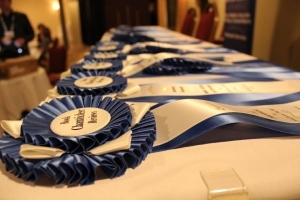
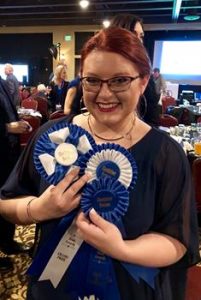
When you have a victory, especially related to one of your books, you should crow about it! A Blue Ribbon for a First Place Category or Grand Prize win in one of our 24 contest divisions you can enter here? A positive Editorial Review which you can sign up for here? Digital badges from both of those? All of it can be posted on social media and your website to highlight the progress and recognition your book has earned.
There are millions of books being published, and you can take all of these steps and still get missed. But if you participate in a writing community with international reach and gain recognition with it, that can be one more step to better sales.
Remember, social media takes some up front work, but once it’s set and you’re on a schedule, it’s just another part of the writing career. You can make it work by putting in less than an hour a week once all the pieces are in place. Set your schedule and keep at it!
Writer’s Toolbox
Thank you for reading this Chanticleer Writer’s Toolbox article.
Remember! The Chanticleer Author’s Conference is coming up, April 7-10, 2022! Don’t miss out, register here!
This Chanticleer article is a little more personal than most. Normally we speak generally, but sometimes you can’t replace a good ol’ personal anecdote.
Haruki Murakami:“Writing a long novel is like survival training.”
Barbara Kingsolver: “I have to write hundreds of pages before I get to page one.”
Jodi Picoult: “You might not write well every day, but you can always edit a bad page. You can’t edit a blank page.”
Diane Gabaldon:“Writing is an active skill; the only way to learn is to do it, to actually sit down and write every day.”
With all this in mind, I want to talk here about my experience taking the advice of Rachel Aaron/Rachel Bach from her article “How I Went From 2,000 Words a Day to 10,000 Words a Day.” Whenever I see a new idea for improving writing, I try to play Peter Elbow’s “The Believing Game.” The Believing Game, in short, is an exercise where you ask yourself what would happen if you accepted a particular suggestion as true, and then practice acting as if it were true and seeing what happens as a result.
This man believes!
1. Track where you write.
This was the one I thought was the silliest. During a pandemic, I don’t write anywhere except my bedroom/office, the kitchen, or the living room. However, when I really pay attention to where I write best, I notice a few things.
First, I write well in groups, even if that’s just online at the Roost (Chanticleer’s Online Community) doing writing sprints with friends and the help of Sprinto. Generally, timers help me quite a bit in my writing, because they give me permission to ignore the rest of the world until the timer goes off.
Coffee Klatch Write In is held at the Roost on ZOOM. The next Write-Ins are currently scheduled for Tuesday mornings. However, any Roost member can set up a Write In group to accommodate their time zones—which is handy since Roost members live across North America and around the globe.
Check us out!
We meet up once a week to do some writing. Usually folks join, we chat about what we’re working on for 10-15 minutes, and then dive in to work! Light conversation and the Chat are excellent ways to check in.
Tuesday, Sept. 28, 2021 from 10 a.m. – Noon PST
Tuesday, Oct. 5, 2021 from 10 a.m. – Noon PST
Tuesday, Oct. 12, 2021 from 10 a.m. – Noon PST
I also found out, weirdly enough, that my most productive space is not my desk where I work from home and play videogames, but rather on my futon with plenty of pillows for back support using my laundry basket as a desk.
I don’t know what the magic is, but I really like working on this laundry basket. -DB
I have no idea what it is about these factors. Maybe it’s the giant stuffed pig that’s my quarantine companion, but that’s where I am happiest and most productive. The second-best place is at the dining room table with the roommate’s dog hanging out.
Maya Angelou passed away on May 28, 2014. She preferred writing lying down and leaning on one elbow.
Maya Lou Angelo rented hotel rooms for a few months at a time in her hometown. She would have the management move all of the paintings and decorations out of the room. Also, they were not allowed in to clean or straighten just in case she had thrown away piece of paper with writing on it that might later prove to be useful. Ms. Angelo said that she would head to around 6:30 in the morning and hang out there until about 2:30 then she would head home to edit. The hotel room was creating and writing only. She would average 10-12 pages of written material a day. She would then edit these pages down to three or four pages in the evening at her home.
“Nothing will work unless you do.” Maya Angelou
2. Track when you write.
This next suggestion helps you learn when you are most productive. I have always dreamed of being that person who wakes up at 5am, reads for two hours, writes about what I read for another two hours, and then eats breakfast and jumps into amazing creative work. It would help if I didn’t need at the very least thirty minutes to drag myself out of bed.
NaNoWriMo this year gave me a strong reset to my writing habits. Having the regular goals made me prioritize my work, and being in quarantine removed many of the distractions I usually have. The deep dive even gave me some great community locally and on The Roost that I’m still holding onto.
Things that I ask myself when tracking:
What Project am I working on?
When did I start?
When did I finish?
What was my general mood?
How many pages/words did I get through?
Where did I write?
Additional notes
Doing NaNoWriMo this last November, I’ve finally discovered that while I can sit down and do paid work at almost any time, I do my best creative writing between 8-11pm. This is tricky, because that’s when most people want to hang out, but I can usually make late afternoon work well, too. The times that don’t work for me?Anytime before 11am. I can always do brainstorm work, but if I want to do writing I’m happy with and make progress in a story, I need to set aside some time in the evening.
This isn’t so much how much time you make to write (though that can help). It’s also about how much writing you do in a particular amount of time. Generally, I write 250 words every 15 minutes. I also write about 250 words every 30 minutes. Depending on how I time myself, I come out with a different amount. Likewise, if Aaron/Bach (from the opening paragraph) sits down to write for only an hour, she writes about 500 words. However, if she sits down to write for 5 hours, she can manage 1500 words in that same hour! The amount of time we know we can get lost in the work affects us each differently.
Looking for more advice regarding what to do with your NaNoWriMo? See this article Chanticleer posted in November here.
3. What do you write on?
Rather than the material (desk, floor, laundry basket), this means more to the tools you use to write. Referring back to Aaron/Bach, I write different places for different things. When I first started at Chanticleer (and I still do), took and kept notes in a journal about how things work here. There are a lot of moving parts and “under the hood” technology here at Chanticleer. I’ve noticed that Kiffer carries around a small black notebook and old school small planning calender even though we use Google Calendar apps and the latest digital management apps (hat tip to Argus Brown) here at the home office of Chanticleer.
Using my journal is also handy for our weekly brainstorming meetings. I find that I can generate 7 “ideas” in ten minutes if I am utilizing my trusty journal instead of my laptop. Now, very little of a full article or project would come out this exercise. It’s just brainstorming and laying out my ideas some place where I can keep track of them until I can work on the details. But it works! I’ve noticed that I have much more trouble brainstorming on a computer where the cursor blinks at me with menace and mocking intent.
The mocking cursor and time flying by.
The other thing that drives me up the wall when trying to brainstorm on a computer is there are so many distractions. If I have an idea, I can focus in, but if I’m casting around for thoughts, I’m open to the world, and the internet adores it when I’m open to suggestion. Somehow social media rarely helps me generate ideas for any type of writing.
Now, of course, once I’m running with an idea, I love the speed that I can put words down and edit when I type rather than scribble. Plus, my writing is always legible on a computer.
4. Mood
You know how it is, you’re in a bad mood, you need to do your writing, you sit down to do the work, and you get maybe half what you usually do done. What if that’s a pattern that you can predict? For me, knowing that when I sit down and I’m grumpy that my roommates haven’t wiped down the counters after cooking spaghetti (my first thought always being there has been a murder in my house), or maybe someone has said something mean on social media (somehow social media always features as an obstacle to writing).
5. Where will the story go next?
EL Doctorow famously said, “Writing is like driving at night in the fog. You can only see as far as your headlights, but you can make the whole trip that way.”
While you probably have written down the broad strokes of what happens at the beginning, middle, and end of your story, it’s important to keep other ideas in mind.
I felt good seeing Aaron/Bach suggest this, as it’s been a longtime habit of mine to sketch out what I want to happen next after I bring a writing session to a close. Since I write late, often this is the point where I feel like I really need to sleep, I’ll do a brief summary of how I see the rest of the text going, and if any strong images come to mind, I’ll write those down as well, hoping to use them as the story goes on.
When I return and see those notes, I simply delete them as I write the scene it suggests, keeping my notes clean and easy to read for what comes next. With the images I can even copy and paste them directly into the work as the place I think they’ll fit best appears on the page.
6. What are you excited about in the story?
I just started editing the first draft of a novel I finished in October. One of the big critiques my writing group gives me is that the conflict doesn’t start soon enough, which I thought was ridiculous!
In the first chapter, my YA protagonist has the 3-person panel for his high school senior project possessed by a conduit of 100 dead souls who he has promised to guide from Limbo into Heaven! What could be more intense than that?!
However, in rereading the work with fresh eyes I notice that my characters eat. A lot.
Now, this is probably from my great love of all breakfast foods and missing going out to restaurants, but everyone in this book can’t get to any scenes because they’re too busy giving light exposition at The Old Spaghetti Factory. As I go through, I find myself skipping these scenes to get to the next on, which tells me that, yes, they are not exciting. If as the writer I don’t care about a scene, it needs to go. If there’s key information I feel like is in that scene, I write it down separately and keep an eye out for the right place to insert it, rather than dragging the reader through yet another pointless meal—even if I am craving a Dutch baby with powdered sugar, cinnamon, maple syrup, and fresh fruit. Maybe with a side of breakfast sausage. Mmm. And hmmm.
Dutch Baby with fruit and powdered sugar on it
7. Review your information
So, for me, what I’ve learned is that I write best in areas where I can be comfortable and don’t have easy access to videogames. I like having friends, either virtual, stuffed, or furry, because then I feel like I’m accountable to someone, even if they only want to listen to me brainstorm when I’m giving them pets.
I am officially an evening person. I love mornings for relaxing, watching the bay, drinking coffee, and making extravagant breakfasts. If you haven’t made yourself Spanish tortilla, it’s easier than you’d expect—give it a try.
A few times a week I need to set aside my evenings for creativity, and that means no Mandalorian with the roommates (sorry Baby Yoda) or virtual game night with friends. If they want to hang out, they can come co-work (write) with me.
I do my starting work in a journal of some sort, and then I do the writing work on a computer. Editing and marketing work also happen on computers, mostly out of necessity and the predominance of the internet.
I am gentle with myself when in a bad mood. Rather than lamenting that I couldn’t do as much as the day before or the week before, I remind myself that creativity is a process, and that even though I was in a bad mood I put in the time today, and that habit counts for more than any single day worth of word count.
I write best when I can work from notes that show me what scene I’m most drawn to write about next in my story. That lets me stay focused on excitement as I go through the work.
Finally, now that you can figure all this out for yourself, protect the things that let you write. They’re the loveliest tools you can give yourself.
8. Set goals
Nailed it
Ask yourself what your stretch goals are, and what goals are you confident you can meet. Go back to your goals periodically. Do they need to be adjusted for where you are in your w-i-p (work in progress). Editing requires a different focus than plotting. Plotting requires a different mind set than creating your characters or atmosphere.
What are your methods and writing habits?
We’d love to hear from you! What spurs you on? What trips you up?
Examine your own life to best see how you can maximize your own productivity and be the author you want to be!
Maybe this is getting something to the point where you can use one of our many Chanticleer services, from the Manuscript Overview, to the Editorial Book Review, to testing the mettle of your work in the Chanticleer Awards. Whatever goals you set, make sure that you keep your gaze on meeting them as you write!
Speaking of the Chanticleer Awards, did you know that we’ll be announcing the Finalists, First Place Winners, and Grand Prize Winners at our Tenth Anniversary Chanticleer Authors Conference (CAC22)? The CIBA Ceremonies will run in tandem with them from April 7-10, 2022! We’re optimistic we will be able to see you in person at the beautiful Hotel Bellwether here in Bellingham, WA.
Writer’s Toolbox
Thank you for reading this Chanticleer Writer’s Toolbox article.
Yom Kippur is coming up soon for our Jewish friends around the world.
As a gentile, I learned a lot in putting this article together, and I understand how much more there is to learn! Links will be included for further reading from all of our sources below!
One particularly useful site was Chabad.org, which says:
Yom Kippur is the holiest day of the year, when we are closest to G-d and to the essence of our souls. Yom Kippur means “Day of Atonement,” as the verse states, “For on this day He will forgive you, to purify you, that you be cleansed from all your sins before G-d.”
Many readers may know the events of the first Yom Kippur, but not realize the connection. Tradition states that the first Yom Kippur happened after the Israelites’ exodus from Egypt when God gave Moses the Ten Commandments at Mt. Sinai. When Moses came down from the mountain, he found his people worshipping a golden calf, and he broke the tablets in a rage. When the people saw the error of their ways, Moses returned to the mountain and returned with two more tablets and God’s forgiveness.
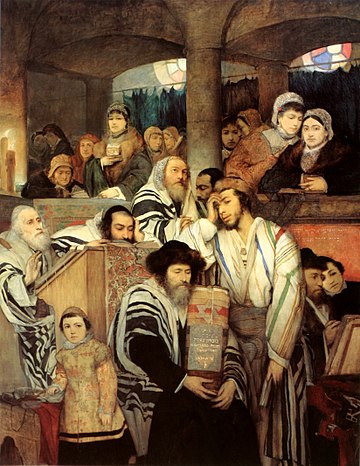
Jews Praying in the Synagogue on Yom Kippur, by Maurycy Gottlieb (1878)
Yom Kippur translates as “the Day of Atonement”
[I]t marks the culmination of the 10 Days of Awe, a period of introspection and repentance that follows Rosh Hashanah, the Jewish New Year. Read more here.
Many people will fast for 26 hours, and, being a holiday of asking for forgiveness, it’s not very common to hear “Happy Yom Kippur!” This article from USA Today explains that the traditional greeting is “G’mar chatima tova,” which means “may you be sealed in the Book of Life.”
The “ch” sound in “chatima” is not pronounced like the English word “chat.” Instead, it should sound more like guttural utterance from the throat, like a backwards snore, because it comes from the Hebrew letter Chet. “G’mar hatima tov” is also acceptable to say.
You can always also just say “Have an easy fast” or “have a good year” since the Jewish New Year has just started.
Breaking the Fast after Yom Kipper
Yom Kippur is the tenth day of the seventh month according to the Hebrew Calendar. It is also known as the “Sabbath of Sabbaths.” Yom Kippur has five prayer services that include the public and private confessions of sins and guilt with atonement and repentance. Along with the prayers is asking others for forgiveness, and give to charity and those in need.
This year, Yom Kippur is sunset of September 15th, until nightfall on September 16th, 2021. Food and drink are refrained from during this time for fasting. Fasting for 26 hours begins at sunset for all males over the age of thirteen and females over the age of twelve. It may be waived for certain medical conditions. It is tradition to eat one large meal on the afternoon of Yom Kippur and then to break the fast with a large feast to celebrate in the evening of the day after. After the last Yom Kippur service, most will return home for a joyous meal, which focuses largely on comfort foods often associated with breakfast like blintzes, noodle pudding, and other baked goods.
White is the traditional color worn on Yom Kippur. The Shofar, held above, is sounded at the beginning of Rash Hashanah and the end of Yom Kippur
Now we want to take the time to celebrate some of the books that highlight some aspect of the Jewish experience that we’ve reviewed.
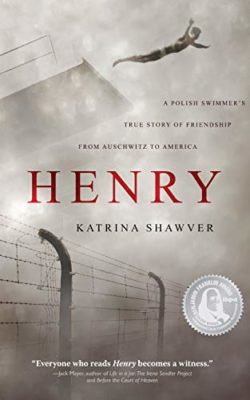
HENRY: A Polish Swimmer’s True Story of Friendship from Auschwitz to America
By Katrina Shawver
First Place Winner in Journey Awards
Katrina Shawver, a journalist for a Phoenix newspaper, was seeking a story for her weekly column. She had heard from a friend that a Holocaust survivor named Henry Zguda and his American wife, Nancy, lived in Phoenix. She called Zguda and was invited to come to his home, only a few blocks from her own. Shawver quickly bonded with both Henry and Nancy. Then she and Henry decided to have a series of weekly interviews, which she would draw on for her column and, later, for a book—this biography.
The horror story of Henry Zguda, a Catholic Pole born and raised in Krakow, Poland, begins with Henry walking down the street toward the YMCA for swim practice in 1942. A Gestapo car screeches to a stop beside him. Two men leap out, arrest Henry on the spot, throw him into the car, and take him to prison. After several days of torture, a practice used by the Gestapo to obtain information (of which Henry had little), he is taken to the train station and shoved into a cattle car so filled with people that it is impossible to do anything but stand, shoulder to shoulder. The door is slammed shut, and the train pulls out of the station. Henry has no idea what fate awaits him.
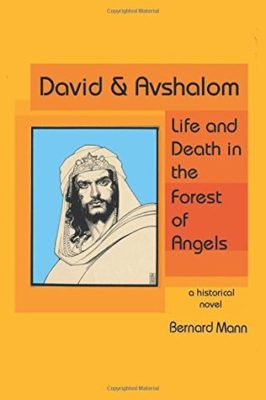
DAVID and AVSHALOM: Life and Death in the Forest of Angels
By Bernard Mann
First Place Winner in Chaucer Awards
Debut novelist Bernard Mann has diligently researched a wide-ranging saga centered on the life, loves, songs, and struggles of King David, a central figure in the Old Testament and author of the Book of Psalms.
The tale begins at a crucial stage of David’s life as he is escaping the wrath of King Saul. Once a father-figure to the former shepherd boy, Saul’s view of David sours when the majority of his subjects begin to revere David over him. David flees with a small band of loyal stalwarts. He is still a fast friend to Saul’s son and likely successor, Jonathan, and is married to Saul’s daughter Maacah. Moreover, he still holds fast to his faith in God and continues to compose poems and songs in praise of Him. When both Saul and Jonathan perish in battle, David takes up the struggle, amasses an army, receives the crown, and seizes the city of Jerusalem, making it the seat of Israelite power.
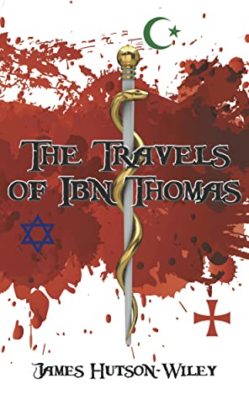
In an ancient world split in three by religion, a conflicted young man seeks the truth about his past and builds his future in this colorful panorama created by author James Hutson-Wiley.
Ibn Thomas, the book’s narrator, taken from his boyhood home In Aegyptus after his father and mother disappeared, lives in a monastery where he is mocked for his name and his knowledge of Arabic. At age 12, the monks send him from England to Salerno, Italy, where he will study medicine, supported, he learns, by considerable wealth to which he is heir from the commercial activities of his father, a trader in Al-Sukkar, or sugar, considered a precious commodity at the time.
A FEMALE DOCTOR in the CIVIL WAR
By Richard Alan
First Place Winner in Laramie Awards
Imagine a fearless, hard-as-nails contract surgeon hired by the Union Army who often works 48-hour shifts in battlefield medical tents amputating limbs, healing previously inoperable gut wounds, sewing up children’s hare lips, and diagnosing what we now call PTSD as critical in military patient care as patching physically wounded bodies.
A native of the Pacific Northwest, Dr. AbbyKaplan stands six feet tall and exchanges her dresses for breeches, totes a gun on her hip, engages in military defensive maneuvers, and is wounded multiple times for her efforts. Dr. Kaplan takes no guff from anyone and uses the language of soldiers appropriate to the situation. In a time when men are in charge and women are not, she wins the respect of her male colleagues in the most gruesome medical cases, winning over even those who could not fathom a woman examining a man’s most private parts.
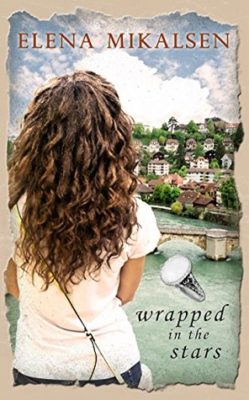
WRAPPED in the STARS
By Elena Mikalsen
First Place Winner in Chatelaine Awards
Maya Radelis has spent the last seven months running from herself. After the death of a patient, she abandons her pediatric residency in New York City for the jungles of Guatemala and the Family Health Volunteers Mission. However, after exhausting her six-month leave, she still cannot bring herself to return to New York. Instead, Maya ends up in Edinburgh, Scotland, where fate intervenes.
In a small antique shop, an inscribed ring somehow “calls” to her. Unwilling to part with it, Maya purchases the ring and traces its history. She has seven days before she must return to the university and face the consequences of her absence, as well as the investigation of her patient’s death. Fearing she will no longer be allowed to pursue a medical career and dreading the meeting where her fate will be revealed. Maya wants to make the most of her search for the ring’s previous owner, especially after she begins to have strange dreams and memory-like episodes of the woman she thinks owned the ring. Enlisting the help of Pauline, her French friend, she traces an odd, twisting path through Paris then Bern, Switzerland. The more she discovers, the more she begins to question her destiny.
YISHAR KOACH: FORWARD with STRENGTH
By Susan Lynn Sloan
YisharKoach:ForwardwithStrengthshares the account of a man who was entrusted with inspiring some of these precious few orphans to find strength and hope after experiencing tremendous loss. At Aglasterhausen, a United Nations school for WWII orphans, Fred Fragner took on the mantle of principal and teacher at the school—a daunting responsibility for most, but not for Fragner—a fighter of the Nazi regime who was shot, captured, and interrogated by the Gestapo and then imprisoned for five years in Buchenwald Concentration Camp.
The life of this most remarkable man of integrity and altruism was inspiration for Susan Sloan to write Fragner’s biography—a five year project that she undertook with great passion after being introduced to him at a café in Bellingham, Washington. Sloan researched transcripts of lectures and speeches made by Fragner, she refers to newspaper clippings and documents about him, listened to audio and video tapes, and interviewed many who knew him as mentor, coach, friend, family member, and teacher. Most importantly, Sloan had access to Fragner’s own scrapbook about Aglasterhausen that vividly tells how “the children gave him his life back” as he tried to help restore theirs.
When you’re ready,did you know that Chanticleer offers editorial services?We do and have been doing so since 2011.
Our professional editors are top-notch and are experts in the Chicago Manual of Style. They have and are working for the top publishing houses (TOR, McMillian, Thomas Mercer, Penguin Random House, Simon Schuster, etc.).
If you would like more information, we invite you to email Kiffer or Sharon at KBrown@ChantiReviews.com or SAnderson@ChantiReviews.com for more information, testimonials, and fees.
We work with a small number of exclusive clients who want to collaborate with our team of top-editors on an on-going basis.Contact us today!
Chanticleer Editorial Services also offers writing craft sessions and masterclasses. Sign up to find out where, when, and how sessions being held.
A great way to get started is with our manuscript evaluation service, with more information availablehere.
And we do editorial consultations for $75. Learn morehere.
If you’re confident in your book, consider submitting it for a Editorial Book Reviewhereor to one of our Chanticleer International Awardshere.
Also remember! Our 10th Anniversary Chanticleer Authors Conference (CAC22) will be April 7-10, 2022, where our 2021 CIBA winners will be announced. CAC22 and the CIBA Ceremonies will be hosted at the Hotel Bellwether in Beautiful Bellingham, Wash. See the latest updates here!
Hello Chanticleerians and we hope you are enjoying your Three Day Weekend for Labor Day!
For many of us who write, it’s a full time job on top of the day job we already have. And, as writing is a full time business, we deserve a little recognition for all the work we put in on top of any other labor we already do. Let’s look at the history of Labor Day and some stories that remind us how far we’ve come, and others that show us possibly how far we may be able to go!
First off, while Grover Cleveland officially signed Labor Day into law in 1894, people aren’t sure if it was Peter McGuire or Matthew Maguire, the cofounder of the American Federation of Labor and a secretary of the Central Labor Union respectively, who actually began the holiday. While there are more Maguires there than in the new Spiderman movie, there is no confusion on why Labor Day started. You can learn more from the Department of Labor here.
While Tobey Maguire was a great Spiderman, that’s not who were talking about here.
Labor Day is a celebration of the achievements, both social and economic, of workers in the United States. The holiday recognizes the contributions these workers make to the nation’s prosperity and well-being. Now, more than ever, it’s clear that our essential workers deserve recognition, celebration, and a thriving wage.
In describing the need for Labor Day, History.com says:
People of all ages, particularly the very poor and recent immigrants, often faced extremely unsafe working conditions, with insufficient access to fresh air, sanitary facilities and breaks.
Remembering Labor Day is a great way to remind ourselves that conditions can always be better for workers across the board.
The Ferengi Rom facing down his brother Quark and forming a union in Star Trek: Deep Space Nine’s episode “Bar Association”
When we think of the history of labor in this country, ways people can make a difference right now, and where we might be going, there’s a whole world of books that opens up to us! Here are just a few that we recommend!
Working Fiction
Infants of the Brush By A.M. Watson
A little boy is sold into an apprenticeship as a chimney sweep in eighteenth-century London, and soon learns the horrors of that profession.
Six-year-old Egan lost his father from an accident at sea, and now, may lose his little sister from illness. The only way his penniless mother can save her daughter is to sell Egan into an apprenticeship in order to purchase medicine. As a small boy, he will make an ideal “broomer;” a businessman named Armory gladly takes Egan into the fold. Under Armory’s absolute dictatorship he will sleep with other wretched boys on soot sacks, eat gruel, get bloody beatings for the slightest infraction, and risk his life almost daily.
The Selah Branch By Ted Neill
First Place Winner in Cygnus Awards
The Selah Branchcombines two surprising stories into one enthralling whole.
It begins with a ripped from the headlines feel, diving deeply into issues of race, class, poverty, and hopelessness in Selah Branch, WV. A town whose brighter future of uplift, integration, opportunity, and prosperity was wiped out one summer night in 1953 when a chemical explosion destroyed the promising university town and replaced it with a hazardous waste site. Like Chernobyl, only with a smaller footprint and chemical residue substituting for nuclear waste. But just as deadly.
The story views Selah Branch through the eyes of Kenia Dezy, an African-American public health student on a summer practicum. She’s to determine if a simple app can steer people towards healthier food choices and better health outcomes in a town empty of jobs, filled with poverty and hopelessness, marooned in the middle of a food desert.
Beyond Balancing the Books By George Marino, CPA, CFP
George Marino, a practicing CPA and Mindfulness Coach, explores the possibilities for sustainable positivity in one’s work-life through mindfulness principles and practices in his new book,Beyond Balancing the Books: Sheer Mindfulness for Professionals in Work and Life.
It would be difficult to find a profession more fraught with detail, deadlines, and distress than a typical CPA. Applying to that particular realm the idea of mindful meditation is a challenge that author Marino has taken on because it is a process he has lived. He opens his book by comparing two CPAs and their approaches to life and work-life.
Thomas Wideman, the author of this dynamic self-help manual,Welfare Cheese to Fine Caviar: How to Achieve Your Dreams Despite Your Upbringing, rose from poverty and dismay to a life of security and personal achievement through techniques he shares with readers who can incorporate them into their own life plans.
Wideman came from an impoverished African American family wracked by confusion, chaos, and, at times, criminality. His mother had three sons by three fathers, and he would come to know his own father only peripherally, eventually learning that the man murdered people and subsequently died in prison. The boy grew up in tough neighborhoods and ate “welfare cheese” (a block of pre-sliced heavy American cheese that supposedly melted well). Every month, making ends meet became more and more difficult. In an early chapter of this finely woven chronology, we see him taking food from trains parked along the railroad tracks and running from the authorities. In this, as in each new chapter, he speaks of confronting severe issues and finding ways to resolve them. In the case of the theft and other childhood incidents of fighting, experiencing bullies, and battling racism, he speaks of making up his mind that “my circumstances need not be my limitation.”
A colorful fable resonates with contrasting modalities of mysticism and social action, exploring how culture and religion can separate us or bind us together.
Narada is a traveler and a stranger when he first meets the lovely Hohete and her people in the ancient city of Ja’Usu. Given water, food, and shelter by Hohete’s family, Narada is sharply questioned by village elders who are stymied by his forthright statement that he is a representative of a deity named The Great Mystery. So they conspire to remake him as a storyteller, to reduce his power and profit from his talent for spinning yarns by selling refreshments to his audience.
Have a great story about workers and overcoming adversity?
When you’re ready,did you know that Chanticleer offers editorial services?We do and have been doing so since 2011.
Our professional editors are top-notch and are experts in the Chicago Manual of Style. They have and are working for the top publishing houses (TOR, McMillian, Thomas Mercer, Penguin Random House, Simon Schuster, etc.).
If you would like more information, we invite you to email Kiffer or Sharon at KBrown@ChantiReviews.com or SAnderson@ChantiReviews.com for more information, testimonials, and fees.
We work with a small number of exclusive clients who want to collaborate with our team of top-editors on an on-going basis.Contact us today!
Chanticleer Editorial Services also offers writing craft sessions and masterclasses. Sign up to find out where, when, and how sessions being held.
A great way to get started is with our manuscript evaluation service, with more information availablehere.
And we do editorial consultations for $75. Learn morehere.
If you’re confident in your book, consider submitting it for a Editorial Book Reviewhereor to one of our Chanticleer International Awardshere.
Also remember! Our 10th Anniversary Chanticleer Authors Conference (CAC22) will be April 7-10, 2022, where our 2021 CIBA winners will be announced. CAC22 and the CIBA Ceremonies will be hosted at the Hotel Bellwether in Beautiful Bellingham, Wash. See the latest updates here!
Structure, Conflict, & Beats — Bringing it All Together
Conflict is key to any story. Even if the stakes are low and the show is purportedly about nothing, like in Seinfeld, the characters are motivated and pushed through new changes. As writers continually produce work, we are always revisiting the ways in which we understand writing.
The Cast of Seinfeld – A Series about Nothing
One of the newest, most popular writing craft books is Jessica Brody’s Save the Cat! Writes a Novel, which promises to be the last book you’ll ever need for novel writing, but one can never have too many books, especially on craft.
At Chanticleer, We Love to See Story Come to Life
The biggest feedback we give to authors in our Awards or for our Editorial Reviews is that, while the story was well-written and error-free, there was not much actual story that happened in it. For that reason, we always recommend that authors commit to a Manuscript Overview to make sure they’re heading in the right direction with their Work in Progress. Read more about those here.
So We’re Talking About Dialogue Beats Here?
If you’re interested in making your dialogue sing, that’s wonderful, and we recommend you do work to make sure all that interstitial tissue in your book is doing what it needs to do, but this toolbox article will focus on the overarching structure questions in terms of beats. If you’re interested in reading more about dialogue mechanics this article here from Margie Lawson has some great suggestions on language and beats!
Beats not beets!
We Are Talking About Conflict
Conflict is the engine that motivates a book. It doesn’t need to be zombies coming to destroy the world, but it has to be your main character’s desire for change (which often isn’t really their true desire at the start of the story). What we’re going to look at here is the way characters are motivated and approach the ending theme as they move through the book.
Save the Cat really shines in the way it points out that characters are often given the answer to all their life’s troubles early on, but they resist it throughout the story. One great example is Benjamin Sisko at the start of Star Trek: DS9.
When Sisko arrives on Deep Space Nine to take command of the station, all he wants is to keep running from the past with his son Jake. He doesn’t realize that this assignment is the beginning of his journey to healing from the terrible trauma of losing his wife two years ago. All the tools are there for him to create a home where he is, but he doesn’t understand this until maybe Season 5 of the show, and by that point, his desires have totally morphed in response to the environment he found himself in.
Captain Benjamin Sisko of Deep Space Nine (of the Star Trek Universe)
As Sisko moves from season to season, we see each point of growth and story structure as beats from which he grows and changes.
Story Structure as Beats
First off, what are beats?
Think about white space in a sketch for a painting. All the lines that make up the body of the work are the dialogue of your piece–it gives the plot, characters, and conflict a structure to work within. The beats are the color that fills it in, showing the reader a complete picture of what’s taking place. As you write, ask yourself if you’re better at overwriting and then trimming back or underwriting and fleshing out. Play to your strengths for your first draft, and then come back ready to adjust for any areas you know you’ll be weak.
Worth Repeating
As you write, ask yourself if you’re better at overwriting and then trimming back or underwriting and fleshing out. Play to your strengths for your first draft, and then come back ready to adjust for any areas you know you’ll be weak. David B.
Let’s look at the overall structure of a book
Let’s start out with Save the Cat. In this book, Brody breaks out most plots to follow the following Structure:
Opening Image
Theme Stated
Catalyst
Break into 2
B Story
Midpoint
All is Lost
Break into 3
Final Image
Each of these big sections is subdivided into categories based on how many scenes move it forward, which are further defined as multi-scene beats or single scene beats. Some of them are obvious, like the Opening Image and Closing Image tend to be a single scene beat where we get in and fulfill that need for the writing, and then get out. While most of these make sense just by glancing at them (or you can figure out that Catalyst is another way of saying The Inciting Incident), here’s a quick guide to some of the wonkier names from Save the Cat.
Break Into 2 & Break Into 3
This refers to Acts 2 and 3 of your story. Brody focuses on the 3 Act structure for novel writing, which does fit the majority of work out there. For differing ideas on how to structure a book, be sure to check out our article here.
The focus for the Break Into parts is on marking a clear delineation between your Acts. An example Brody uses is Jane Eyre, with Act I being her mistreatment and time at school, Act II being her role as governess for Mr. Rochester, and Act III being her escape from St. John and return to Mr. Rochester as an independent woman.
B Story
Often the introduction of B Story introduces the character who will help your protagonist learn the theme or lesson that they will need in order to grow properly by the end of the story. They are a helper-character who represents the new world of Act II that your main character enters. Keeping with Jane Eyre, Mr. Rochester is a foil to Jane’s meekness that forces her to stand up for herself and push back against his rude brashness, pushing her to change.
Mia Wasikowska and Michael Fassbender in the 2011 Jane Eyre film – Charlotte Bronte 1847
Clear as Mud?
Rather than write out all of Save the Cat, Jessica Brody has already mostly done it for you here. And Brody isn’t alone in having great ideas of how to look at the intersection of conflict and structure!
Click on the link above to read more about Brody’s 15 Beats of Story Telling. We are not affiliates of Brody or Wolf 359, but we are passionate about sharing the best tools with Chanticleerians. Kiffer
There is a wonderful breakdown of story structure that is quite similar written by Gabriel Urbina to describe the story structure for the brilliant SciFi podcast Wolf 359, written by Urbina, Sarah Shachat, and Zach Valenti. You can read his breakdown of the story structure here and learn more about Wolf 359 here.
Our own Jessica Morrell, of course, has a brilliant take on Story that focuses more on different aspects such as character, structure, and plot which can be found here.
Beat Sheets Will Meet You Where You Are
The great thing about this tool is you can use it to plot out the work you’re planning or to analyze the work that you have. Brody’s cheat sheet linked above even offers general percentages on how long each section of the Save the Cat structure should take. Remember that different genres have different typical lengths, and keep those lengths in mind as your write and plot. And, as always, the work is yours; these are just guidelines, not hard and fast rules for success.
Chanticleer Editorial Services – when you are ready
Did you know that Chanticleer offers editorial services?We do and have been doing so since 2011.
Tools of the Editing Trade
Our professional editors are top-notch and are experts in the Chicago Manual of Style. They have and are working for the top publishing houses (TOR, McMillian, Thomas Mercer, Penguin Random House, Simon Schuster, etc.).
If you would like more information, we invite you to email Kiffer or Sharon at KBrown@ChantiReviews.com or SAnderson@ChantiReviews.com for more information, testimonials, and fees.
We work with a small number of exclusive clients who want to collaborate with our team of top editors on an ongoing basis.Contact us today!
Chanticleer Editorial Services also offers writing craft sessions and masterclasses. Sign up to find out where, when, and how sessions being held.