Credibility: Our awards spotlight and guide readers to extraordinary writing. We are partnered with or recommended by ALLi, IBPA, Reedsy, and Book Award Pro.
Prestige: Whether it’s the Blue Ribbons, the Author Interview, or the Book Reviews, even advancing partway through a Book Award Program shows readers and publishing experts that you’re doing right by your book when it comes to marketing.
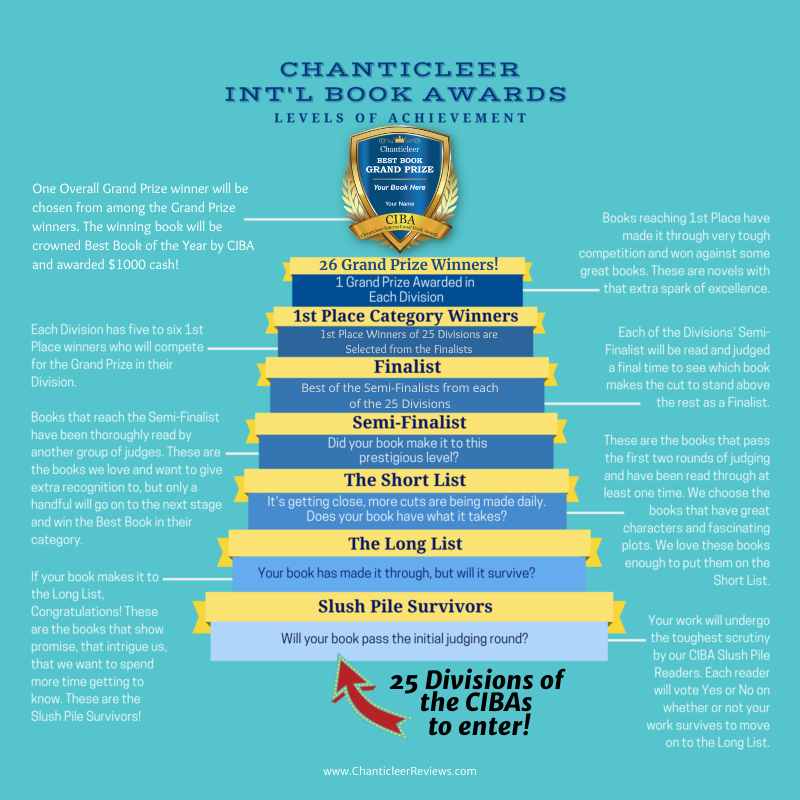
Support: The CIBAs are run by human beings, and we’re here for you. Each time you advance in our Tiers of Achievement, your name and book title are promoted on our high-traffic website, across social media, and in our newsletter.
Not necessarily! Our webmaster works strange hours. If you don’t see the deadline updated on our website for 2024, the division is still open and you can still make it. If it has changed, please reach out to info@ChantiReviews.com and we may be able to sneak you in, but the good news is…
The webmaster emerges to update the Awards date! Run!
We are accepting entries into the 2024 Chanticleer International Book Awards Program.
The winners of the 2023 CIBAs will be announced on April 20, 2024.
The winners of the 2024 CIBAs will be announced in April 2025.
As always, a big thank you to all our readers, judges, staff, and the authors who make the CIBAs possible! The Book Awards are a labor of love, and we are so grateful every day to be able to Discover Today’s Best Books!
Jennifer entered Mr. Hostler’s home, finding herself in an empty white room.
“Where’s your furniture?” she asked.
Mr. Hostler cocked a brow. “You don’t need chairs to talk, Ms. Trent.”
White Room Syndrome is an ominous name for a common problem in prose writing: the characters are acting, talking, and moving the story forward, but all in a scene that hasn’t been set through description. They’re in an empty white void. Despite the name, a literal white room is not required.
Chances are good you’ve seen White Room Syndrome at some point in your own writing, where an old friend’s attic, the car of a speeding train, or even the great outdoors aren’t described to the reader beyond those broad descriptions.
So, how do you paint a scene? Well, you can’t include every single detail about the locations your characters go to, not without sacrificing any hope of good pacing – or readers finishing your book. So, I’m going to go over five critical lenses you can use to figure out which aspects of a setting are most valuable to the story: The lenses of clarity, character, tone, imagination, and pacing.
First, the lens of clarity; you must construct the world to seem cohesive.
“Then where am I supposed to put this?” Jennifer demanded, shaking her sodden umbrella.
Mr. Hostler took it from her. “First, you ought to close it. You certainly don’t need any more bad luck. And, where else would it go?” He set it carefully in the umbrella stand.
“Hey! Where did that come from–”
“Why, it’s always been there. We live in a rainy city after all,” Mr. Hostler said.
Oh that’s where I left that!
Without a scene set in your reader’s mind, the actions of your characters will be harder to imagine, and immersion will suffer. Description bears much of the responsibility for maintaining continuity in your story, both at a small scale and a large one.
Focus on the specifics of your setting.
If your story is set in a desert town, then perhaps a room is filled with the hum of air conditioning, while sunlight bathes everything near the windows.
These small details will become part of your readers’ gestalt image of this town and its environment. So, rather than having a character comment on the heat of their city, you can simply let the dry stretch of sand, pitcher of ice water on the table, or faint smell of sweat comment on it instead. What an average person’s house looks, sounds, and smells like can tell you a lot about a town, from weather to economics to culture.
Building the world, piece by piece
On the smaller scale, try to describe important details for the actions of the coming scene.
If someone is going to lunge across their desk, then take a moment to describe that desk as the scene opens on the room around it. What’s going to fall and clatter to the floor? If one of your characters is worn down after a long day of work, about to have an argument with their inconsiderate partner, you might describe the car in the driveway that one of them will later angrily drive off in. Remember the principle of setup and payoff: willing suspension of disbelief thrives when important details are established before they come into action.
Not all details should be practical building blocks for the beats of a scene. As much as they can reveal the world itself, so can they reveal the people within it.
Consider next the lens of character
A description of a woman with butterflies in her stomach, of possibility in a beautiful world:
Pink crocuses beckon to the first rays of sunlight, eager on the riverbank. Marie’s fingers explored the spirals and stripes of the railing. To where did they all lead? On the far end of the bridge, a wooden board creaked faintly beneath Rona’s familiar blue boots as she stopped a few feet away. She seemed to belong on the bridge’s rising arch. Cool, piney air filled Marie’s chest.
You could fall in love here
A description of a woman who’s probably going to go missing in about two pages:
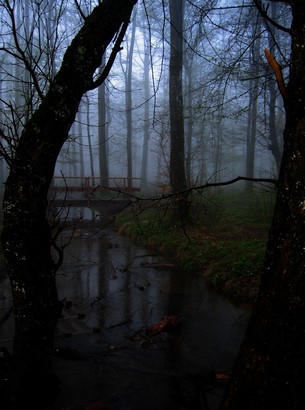
Dark green roots slithered out from the riverbank, disappearing beneath murk and silt. Marie’s every step was interrogated by the stark light of dawn. She traced the spirals of the wooden railing, but her fingers never quite escaped the splintery prodding of their coils. A sharp whine cut through the air, and Marie’s eyes darted up to find Rona, standing not but a few feet from her. Those heavy boots, sagging jacket, and long, flat hair all seemed to whisper that only a few old planks separated Marie from the sinking grip of the river.
Not a place to go walking alone
Because of the tone set by these descriptions, the conversation between these characters will have a strong foundation, with words that would otherwise mean very little now being heavy with implication (for better or for worse). Choose those details which tighten tension and keep your readers excited to see how this scene plays out.
This is a great time to employ sensory description beyond sight and sound. Yeasty baking bread, the calloused fingers of mountain wind on exposed skin, a disappointingly-unsweet taste of fresh cherry sap – details like these put your readers into the bodies of your characters, a powerful tool for establishing the emotional shade of a scene.
To spark imagination, use a lens of specificity
Find the balance of trusting your reader and showing them your world.
It’s not just a sunny day – the sun sears white even the empty sky around it. What can you describe in ten words that says a thousand about your setting? What could your character have on their desk that shows the fear seeded deep in their bones? How should the light fall in the old church, to make clear that something is very, very wrong in this town? These evocative details act as foundations, allowing readers to fill in the empty space without even realizing they’re doing it.
Give them enough of a groundwork to understand how a location feels, show them the striking details, but don’t spell out every mundane element of someone’s kitchen.
No hard and fast rules
These lenses aren’t requirements for every scene, especially as you’re drafting (consider this article by Michelle Rene on Write Fast, Edit Slow.) Lenses are useful tools for when you’re editing your work, thinking about what each line of description is supposed to do for your story.
Does it accomplish its goal?
Would something else be stronger in its place?
Could combine two lines into a single, more evocative one?
If you don’t know what color to paint your white room, try these lenses, and see what they can show you about the walls of your story.
Chanticleer Editorial Services – when you are ready
Did you know that Chanticleer offers editorial services?
We do and have been doing so since 2011.
Tools of the Editing Trade
Our professional editors are top-notch and are experts in the Chicago Manual of Style. They have and are working for the top publishing houses (TOR, McMillian, Thomas Mercer, Penguin Random House, Simon Schuster, etc.).
If you would like more information, we invite you to email Kiffer or Sharon at KBrown@ChantiReviews.com or SAnderson@ChantiReviews.com for more information, testimonials, and fees.
We work with a small number of exclusive clients who want to collaborate with our team of top-editors on an on-going basis.Contact us today!
Chanticleer Editorial Services also offers writing craft sessions and masterclasses. Sign up to find out where, when, and how sessions being held.
Thank you for reading this ENCORE Chanticleer Writer’s Toolbox article.
Scott Taylor – Editorial Assistant
Scott has worked as a book editor since 2020, with a BA in English & Writing from The Evergreen State College.
He facilitates a small writing critique group, and serves as an editor on the biennial anthology The Writer’s Corner. Scott’s book reviews feature on the Chanticleer Book Reviews website. His own writing centers on speculative and surreal fiction, from sci-fi & fantasy to magical realism, and has been published in the HamLit literary journal.
Beyond working on novels and short stories, Scott explores other media and modes of narrative, such as playwriting, tabletop game design, and music composition. He finds moving from one medium to another offers inspiration that feeds back into his prose work.
You have until September 30th to share your Tale of the Unknown with us and enter the 2023 CIBAs!
Chanticleer International Book Awards (the CIBAs) is looking for the best books Paranormal books featuring magic, the supernatural, weird otherworldly stories, superhumans (ex. Jessica Jones, Wonder Woman), magical beings & supernatural entities (ex. Harry Potter), vampires & werewolves (ex. Twilight), angels & demons, fairies & mythological beings, and magical systems.
Let’s celebrate the past winners and visit the Hall of Fame for the Paranormal Awards!
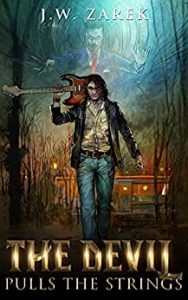
The Devil Pulls The Strings By J.W. Zarek
The protagonist and all-around decent guy, Boone Daniels, is in a heap of hurt in JW Zarek’s new Young Adult novel, The Devil Pulls the Strings.
One would think being plagued by an evil spirit wendigo since age six would be enough inconvenience to last a lifetime, but when Boone jousts with his best bud at a Ren Faire and accidentally deals a mortal blow, the hurt he experiences suddenly lands on a sliding scale of 1 to 1 million. And Boone Daniels becomes a millionaire, so to speak.
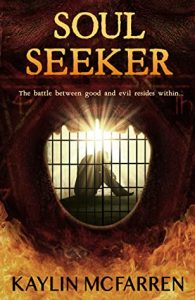
The realms of demons and angels clash, as the possibility of romance, plunges the beings of Hell into chaos. Kaylin McFarren’s Soul Seeker follows the otherworldly set as they flee for their lives, uncover millennia-old secrets about one another, and face the possibility of love in a very dangerous world.
But first, the demon, Crighton, wreaks havoc on his human target, a man named Poe, devastating the man and his family. You could say, Crighton’s at home collecting wicked souls for his boss, Lucifer. His villain persona is put into question when he meets the angel, Ariel. At first, Crighton believes the angelic Ariel would make an excellent prize for the prince of darkness, as the demon is well aware that his master adores ruining pretty things. However, when an undeniable attraction emerges between them, they wrestle with each other, pitting strength against strength. Beware any who would do anything to tear these two apart—that would spell certain death.
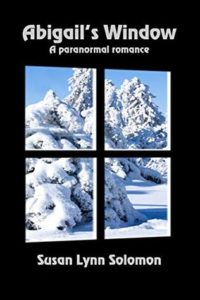
Katy Novacs is haunted, both by her past and the laughing specter that reminds her of it. When her friends bring her to Niagara-on-the-Lake in the hopes of lifting her spirits, she finds that their inn has a ghost of its own who has a tale that might save her.
Katy comes to the Niagara Inn in a mire of sorrow, fear, and trauma. Though her friends try to help her move forward with her life, to fall in love and open herself up to other people again, Katy’s stay at the inn only seems to drain her further. Both she and her friends question her sanity as she becomes certain that she’s sharing a room with the spirit of a dead woman, but when Abigail eventually reveals herself, it is to tell Katy a story that she needs to hear—that of Abigail’s life.
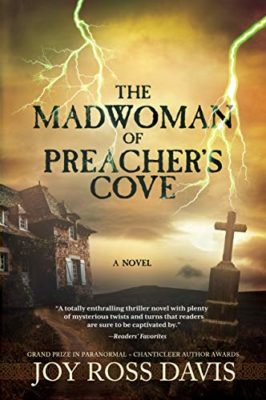
Award-winning author, Joy Ross Davis’ latest work, The Madwoman of Preacher’s Cove, ventures beyond the paranormal into the surreal. Like Medusa on a bad hair day, the lives of characters are intertwined and twisted in a snaky snarl of conflicting human desires, terrifying inexplicable events, and the lingering afterlives of ancient, supernatural beings.
Davis gifts us with a 21st-century legend, replete with mythological themes and creatures, and snippets of folklore and superstition melded with documented vagaries of weather, obscure herpetology, and creates a mystical potion worthy of Circe. In other words, Davis gives us a thrilling read!
Rumors about suspicious deaths have put Preacher’s Cove, Alabama, a small, historic town notorious for powerful, killer storms, on the map. Hap Murray, Huntsville’s Channel 12 field reporter, with family ties to the Cove, arrives in town on assignment, armed with only limited knowledge of the town’s history of inexplicable deaths. The rumors speculate that the local pastor may be involved.
A fascinating story with well-written characters that will keep the pages turning!
Now that you’re set on your next reads, what are you waiting for? The only way to join this amazing list of Paranormal Winners is to submit today!
Those who submit and advance will have the chance to win the Overall Grand Prize of the CIBAs and $1000!
Are you a Chanticleer Author who has some good news to share? Let us know! We’re always looking for a reason to crow about Chanticleerians! Reach out with your news to info@ChantiReviews.com
You have until September 30th to share your novel with us and enter the 2023 CIBAs!
Suspenseful stories filled with mystery have long held readers captive with their intricate plotting, enigmatic clues, and the tantalizing challenge of solving a puzzle or unraveling a crime. In these tales, protagonists are not just characters; they are the enigmatic detectives, the astute investigators, and the relentless truth-seekers who navigate a labyrinth of secrets, lies, and suspense. It’s a world where protagonists, inspired by the likes of Sherlock Holmes, navigate a web of mysteries, facing danger and moral quandaries with each step. From classic mysteries to contemporary thrillers, this genre captivates readers of all ages, drawing them into a labyrinth of secrets, where the ultimate reward is the satisfaction of solving the puzzle and the exhilaration of the chase.
If you are ready to unveil your next adventure, submit to the Clue Awards!
Lets take a moment to celebrate the Hall of Fame for the Grand Prize Winners of the Clue Awards!
The Vines
By Shelley Nolden
Shelley Nolden’s debut novel, The Vines, embraces multiple genres as it chills, fascinates, and horrifies, from historical and magical realism to fantasy and horror.
Nolden has melded fanaticism, medical anomalies, and the frailties of human behavior together with a historic setting, creating a narrative Kudzu vine that grows rapidly and spares nothing in its path. This particular vine consists of two main branches that intertwine, bridging time and linking parallel realities, one past, one present.
The Gettler men of Long Island, New York have shepherded a secret medical research project for generations, with the exception of Finn, the youngest man in the family.
Detective Rudyard Bloodstone is facing the most bizarre crime spree of his career as a copper on the Victorian streets of London. Someone is using a poisonous Cape cobra as a weapon.
What begins as a simple robbery scheme turns deadly when a wealthy businessman is killed via cobra attack, the crimes go from strange to deadly. Rudyard (Ruddy) and his partner, Archie Holcomb, have few clues and no idea what would cause such a change in the criminal’s behavior.
When the criminal returns to the estate and attacks the victim’s daughter, Ruddy’s suspicions are confirmed.
Famed marine biologist and researcher Claudia Rawlings is presumed dead. When Claudia’s research vessel goes down, her daughter Riley goes on a desperate search to discover what happened, eventually turning to Dagger Eastin, co-owner of Hunters and Seekers a marine salvage business. Dagger soon realize this isn’t a simple search and reclaim mission when someone takes a shot at him during an exploratory dive with Riley.
Former Navy SEALs, Dagger, and his partners Kaleb LaSalle and Stone Garrison are the definitions of relentless, and they quickly become embroiled in the investigation that has caught the attention of some very influential people, all seeking Claudia’s important research. And while Riley learns that her mother has left behind clues to her missing research, the Hunters and Seekers pull out all the stops to help and protect her. The wild scavenger hunt sends Dagger and Riley on a trip to discover the truth, but Russian spies, big oil cronies, and psychopathic hitmen lurk around every corner.
California Son, the second installment in the Liam Sol Mystery series by Timothy Burgess, presents another action-packed mystery for protagonist Liam Sol to solve. Honorably discharged after his tour of duty in Vietnam, Liam returns to his primarily Hispanic neighborhood of Baja La Bolsa, a coastal town near LA, California, where trouble finds him.
In his role as a journalist, Liam takes interest in the daily pleas of a Hispanic mother to find her son’s murderer, pleas that the mostly white La Bolsa Police seem to ignore. After an article he writes in hopes of renewing interest in the case appears in La Bolsa Tribune, the mother is found dead in her apartment. No stranger to death or violence, Liam soon finds himself on the personal side of a hunt for the killer of not only the son but also the mother.
The Review of the most recent winner is forthcoming.
Now that you’re set on your next reads, what are you waiting for? The only way to join this amazing list of Clue Winners is to submit today!
Those who submit and advance will have the chance to win the Overall Grand Prize of the CIBAs and $1000!
Are you a Chanticleer Author who has some good news to share? Let us know! We’re always looking for a reason to crow about Chanticleerians! Reach out with your news to info@ChantiReviews.com
Crossing the Ford by Gail Hertzog opens in classic Western fashion: a train rolls in, carrying a stranger. Twenty-five-year-old Ruby knows, when she sees “that little lady” get off the train, that life in her rural Nevada town will never be the same.
Until this moment, Ruby’s children and her no-good husband have claimed most of her time and energy. But she gets to know Kenna, the red-headed stranger — and finds herself irrevocably changed in the process.
Hertzog weaves a rich tapestry of the post-Civil War West. Her characters inhabit a world that’s lush and bleak by turns, vivid with details of a landscape that shifts with the seasons, from giving to unforgiving. A thread of magical realism creeps in so subtly readers may hardly notice it at first. By the end, though, this book stands as a testament to how mystical and inscrutable the twists and turns of life can be.
The book is punctuated with vintage-style illustrations and even recipes, which tie in nicely with the plot and help readers immerse themselves in the moment in history.
Kenna soon introduces Ruby to new ways of looking at the world: ideals of feminine independence, the joy of luxury, and even using magic to bend life to your will.
Kenna comes from privilege and mystique, with a Scottish Highland heritage steeped in witchcraft – a stark contrast to Ruby’s bleak past. By turns, Ruby finds Kenna intimidating, frustrating, and awe-inspiring. They strike up a close friendship as the seasons turn.
The novel’s intrigue grows from early on, as Ruby and Kenna hold secrets from each other while holding each other dear. And then there’s Valentine: the local man that Kenna captivates, and Ruby desires from afar (and sometimes, from too close). With the addition of Ruby’s wayward, abusive husband, a tense love square emerges, and it’s not always clear what shape the characters’ lives will end up in. Even Valentine has secrets of his own.
As Crossing the Ford progresses, everyone’s secrets start to catch up to them, while every event is tinted with Kenna’s magic and mythology.
The mood sways from joyful to tragic and back again, from sensitive and compelling depictions of the abuse Ruby endures from her husband, to the life she builds in spite of it with Kenna and Valentine’s help.
This story maintains a confessional quality, as Ruby speaks directly to the mysterious character introduced in the prologue, setting up a satisfying reveal at the end. Over time, Ruby goes from passive observer to active anti-heroine, working to determine her own fate (and sometimes others’ too.) Readers get a deep look at the challenges she’s faced in life, so that when she starts making choices that seem brutal, we can understand her reasons. The action slows for a bit in the middle, but it’s a brief pause, carried by a strong sense of place and Ruby’s compelling voice. You can hear her accent in every word, that of a poorly-educated woman in the rural West, set against the fine and proper language of her best friend Kenna.
Crossing the Ford makes deft use of moral gray areas, as those areas seem to grow bigger with each page.
At first, the narrative raises questions about good motherhood and marital loyalty, but later, ponders questions of life and death. Ruby finds herself forced to answer: Is it ever justifiable to kill? Is it ever justifiable to forgive a killer? These issues ring of truth, as Hertzog paints a clear picture of the perils and quandaries faced by folks in the harsh landscape of the post-Civil War West. In the end, it turns out that everyone has something to run from, but not everyone will escape their fate.
This book is an excellent choice for lovers of historical fiction, complex female characters, and anything with a witchy bent. It shies away from easy answers, instead crafting a portrait of people and places whose outward beauty belies flaws, threats, and hard secrets. The ending is so tragic that it almost feels unsatisfying at first. Hertzog has given us such relatable, compelling characters that readers are left wanting more for them. Yet there’s a deeper truth to this narrative: magic may be real, but it doesn’t always work in one’s favor.
The characters in Crossing the Ford may not get the ending they want, but they just might get the ending they deserve.
Seeking to “fill his vessel with the truth,” young Ashe Stevens joins his friends on a thrilling adventure beyond the safety of his comfortable American life to chase stardom in Beirut, Lebanon.
Leaving behind a raucous life of plenty in Hollywood – complete with hot dates, popularity, and financial success – to the unknown of the Middle East teaches Ashe to prioritize his values and beliefs. But nothing could prepare him for what’s coming next.
Journey with Ashe and his friends as they bring the rapper 50 Cent to Beirut, the “Paris of the Middle East.” Along the way, Ashe dates not one, but two drop-dead gorgeous billionaires and falls head over heels for a blonde beauty to whom he promises to devote his life. But just as business is booming and true love reaches the height of bliss, the Israeli military bombs their beautiful city, “weaving a tapestry of death all over the night sky.” The team barely makes it out with their lives in a harrowing escape, leaving their love and livelihoods behind.
Before disaster hits, Ashe reevaluates his life in Beirut, slowly beginning the necessary work of “finding his circus,” drawing on the lessons of his friend and mentor, Roger Henderson.
Loosening his confidence in the United States’ supreme power and security, prioritizing loyalty and love over wealth, and expanding the horizons of his cultural imagination allow him to find safety in himself and accept the reality of the disaster that “washes away his elaborate dreams.”
Just as Ashe develops over the course of his life-changing adventure, those around him unfold with intricate depth. Readers will find themselves sympathizing, loving, protesting, and falling apart as they unspool each person’s threads. Personalities such as the eccentric Danny, the wise Roger Henderson, and the lovable criminal Marwan shape a colorful narrative that feels as real as flesh.
The narrative does tend to prioritize the complexity of its male characters over that of the women. Women’s personalities go unexplored and tied inextricably to the narrative-shaping men who either love or resent them. Ashe complains about his new rich date waiting for him in the car, and his friends exert a patriarchal command over the women in their lives: “‘Make sure you look hot tonight, Sana,’” says Danny to his girlfriend, “‘Okay, my love. I would never disappoint you,’” she meekly replies.
Even so, the memoir’s rhythm of adventure will sustain readers’ devoted attention.
Each chapter heading offers a curious epigraph, which slowly merges together with the others as pieces of a puzzle. Silky smooth transitions lose readers in the vivid imagery and fast-paced movement of the story, such as the “blazing-white sunshine amid the clusters of cars, repetitious horn sounds and the loud chatter of the city.” Ashe navigating the rich culture of Beirut and its new social rules immerses readers in the magic of travel and its potential to deepen the soul.
Overall, Lost in Beirut is a romping adventure full of love, war, and sacrifice.
Religious division, the mysteries of love and lust, hidden secrets of political violence, loss and recovery, and life-like characters pull readers beneath the surface tension of the page. As Ashe reflects on his experience in theater class: “We all look the same, leaving the phantom zone. Lost in our own bodies.” In the same way, Lost in Beirut will lose readers in its trance-like narrative where beauty and ruin melt into each other in a seamless dream-turned-nightmare.
You have until September 30th to share your Story with us and enter the 2023 CIBAs!
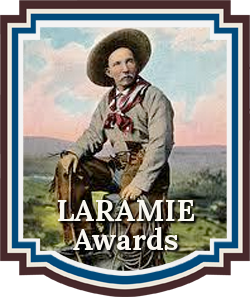
Charles M. Russell painted the cowboy seen on Chanticleer’s very own Laramie contest badge. It is one of many such paintings he did that encompassed the Old American Wild West. An advocate for the Native Americans, Charles M. Russell also helped establish a reservation in Montana for the Chippewa people.
Lets take a look at the Grand Prize Winners of the Laramie Awards!
Tom Sawyer Returns By E.E. Burke Laramie Grand Prize
Tom Sawyer Returns is the second book in The New Adventures series by author E.E. Burke.
Readers join a now grown up and far more independent Becky Thatcher as she maneuvers her complicated life in Civil War era Mississippi. Tom has long since left, and Becky is engaged to Union Captain Alfred Temple, who offers her all the safety and security she needs in such uncertain times. But does she love him? Actually love him?
Becky soon discovers that her heart may have other plans.
Trouble The Water By Rebecca Dwight Bruff
Overall Grand Prize Winner
Robert Smalls’ life should have been one for the history books.
Smalls was born a slave in Beaufort, South Carolina, in 1839. When the first shots of the Civil War were fired upon Fort Sumter, Smalls was an experienced helmsman aboard a small cargo ship plying the coastal waters of South Carolina and the neighboring states. Once the war broke out, he found himself working to support a cause that kept him, his wife, and their children locked in chattel slavery.
But in a daring escapade that fell somewhere between a raid and a rescue, Smalls planned, with the help of his fellow crew members (also slaves) aboard the CSS Planter, to abscond with the ship, its cargo of munitions taken from Fort Sumter, and bring their families. The plan was to sail the ship as though its white officers were still on board, pretending to be carrying out their orders—at least until the ship was out of the reach of Fort Sumter’s guns.
Seven Aprils By Eileen Charbonneau
Laramie Grand Prize
Disguised gender identities, warfare, and thwarted romance all play a role in this many-layered novel, Seven Aprils, by award-winning fiction author Eileen Charbonneau.
When Tess Barton, a hardscrabble farm girl, saves the life of a man attacked by a panther, she and he little realize how fated this encounter will prove. Ryder Cole, the man she saved, moves on, pursuing a medical career just as the United States seems destined for war. Intrepid Tess will move on, too, when she learns that her widower father sells her in matrimony to an old, brutish shopkeeper. A wise crone cuts Tess’s hair and garbs her in men’s attire. Reborn as Tom Boyde, who will soon, strangely, meet up with Ryder and become one of his “men,” conscripted into Lincoln’s armies. Tess/Tom shows promise as a medical assistant with some undeniable cooking skills, and together with two other conscripts, they make the team in the Union’s army hospital units.
Blood Moon A Captives Tale By Ruth Hull Chatlien
Laramie Grand Prize
Ruth Hull Chatlien’s historical novel Blood Moon: A Captive’s Tale shines a light on two worlds trying to coexist in the 1860s Minnesota, that of Westward Expansion and white settlers, and that of the complex network of Sioux tribes dealing with starvation and disease. We follow her protagonist, Mrs. Sarah Wakefield, as she is thrust unwillingly into the midst of the Indian Wars.
Based loosely on the life of real captive, Sarah Wakefield, Chatlien explores both sides of this conflict, through the eyes of our terrified hero, who does what she must to save her life and the lives of her two small children. The first-person narrative in present tense places us in the thick of Wakefield’s narrow escapes, and the presence of the constant threats to her and her children.
Reviews for the 2022 Laramie Awards are to come, but you can see the full list of winners here!
Now that you’re set on your next reads, what are you waiting for? The only way to join this amazing list of Laramie Winners is to submit today!
Those who submit and advance will have the chance to win the Overall Grand Prize of the CIBAs and $1000!
Are you a Chanticleer Author who has some good news to share? Let us know! We’re always looking for a reason to crow about Chanticleerians! Reach out with your news to info@ChantiReviews.com
The Cygnus Book Awards recognize emerging new talent and outstanding works in the genre of Science Fiction, Steampunk, Alternative History, and Speculative Fiction. The Cygnus Awards is a genre division of Chanticleer International Book Awards and Novel Competitions (The CIBAs).
Chanticleer International Book Awards is looking for the best books featuring space, time travel, life on other planets, parallel universes, alternate reality, and all the science, technology, major social or environmental changes of the future that author imaginations can dream up for the CYGNUS Book Awards division. Hard Science Fiction, Soft Science Fiction, Apocalyptic Fiction, Cyberpunk, Time Travel, Genetic Modification, Aliens, Super Humans, Interplanetary Travel, Climate-Fiction, and Settlers on the Galactic Frontier, Dystopian, our judges from across North America and the U.K. will put them to the test and choose the best among them.
These titles have moved forward in the judging rounds from all 2023 CYGNUS Science Fiction Long List to the 2023 Cygnus Book Awards Short List. These entries are now in competition for the 2023 Cygnus Semi-Finalists. The Semi-Finalists will compete for the Finalist positions. FINALISTS will be recognized at the Chanticleer Authors Conference, CAC24.
These titles are in the running for the SEMI-FINALISTS of the 2023 Cygnus Book Awards novel competition for Science Fiction!
Join us in cheering on the following authors and their works!
S.W. Lawrence, MD – Climate Dragon
Andrew P. Blaber – Fallow
Lou Dischler – The Rising
E.T. Gunnarsson – Abandon Us
E.T. Gunnarsson – Remember Us
Arnie Benn – The Intrepid: Dawn Of The Interstellar Age
J.L. Birchwood – The Southron Deception
Alexandra Almeida – Unanimity
S.G. Blaise – Proud Pada
Tamar Anolic – The Fledgling’s Inferno
Diane Lilli – The Last Invention
William X. Adams – Polters
N. John Williams – In the Shadow of Humanity: A Novel
Julia Tvardovskaya – Identifiable
Gareth Worthington – Dark Dweller
J.D. Clason – Salvation
K.M. Messina – Gemja – The Message
Lucia Dolan – Power Surge
R. R. Corvi – The Brangus Rebellion
Amber Kirkpatrick – Unleashed
Michael Simon – Extinction
J. Wint – The Prism Effect
Timothy S. Johnston – The Shadow of War
Howard Berk and Peter Berk – TimeLock
Jeanne Hull Godfroy – Midgard
Jamie Eubanks – Hall of Skulls
Rob Brownell – Invention Is a Mother
Dylan McFadyen – Oblivion’s Cloak
Donald Firesmith – Hell Holes: A Slave’s Revenge
Stu Jones – The Zone: A Cyberpunk Thriller
John Blossom – The Last Football Player
Nikki Kallio – Finding the Bones: Stories & A Novella
Sarena Straus – ReInception
Tyler Drinkard – Isolated Domain
Melissa Gowdy Baldwin – The Marriage Wars: Book One
Good luck to all as your works move on to the next rounds of judging.
PROMOTING OUR AUTHORS!
This post has been posted on the Chanticleer Facebook Page. We try to tag all authors listed here in the FB post. However, for FB to allow us to tag an author, that author must LIKE our page and Follow Chanticleer Reviews. FB rules — not ours.
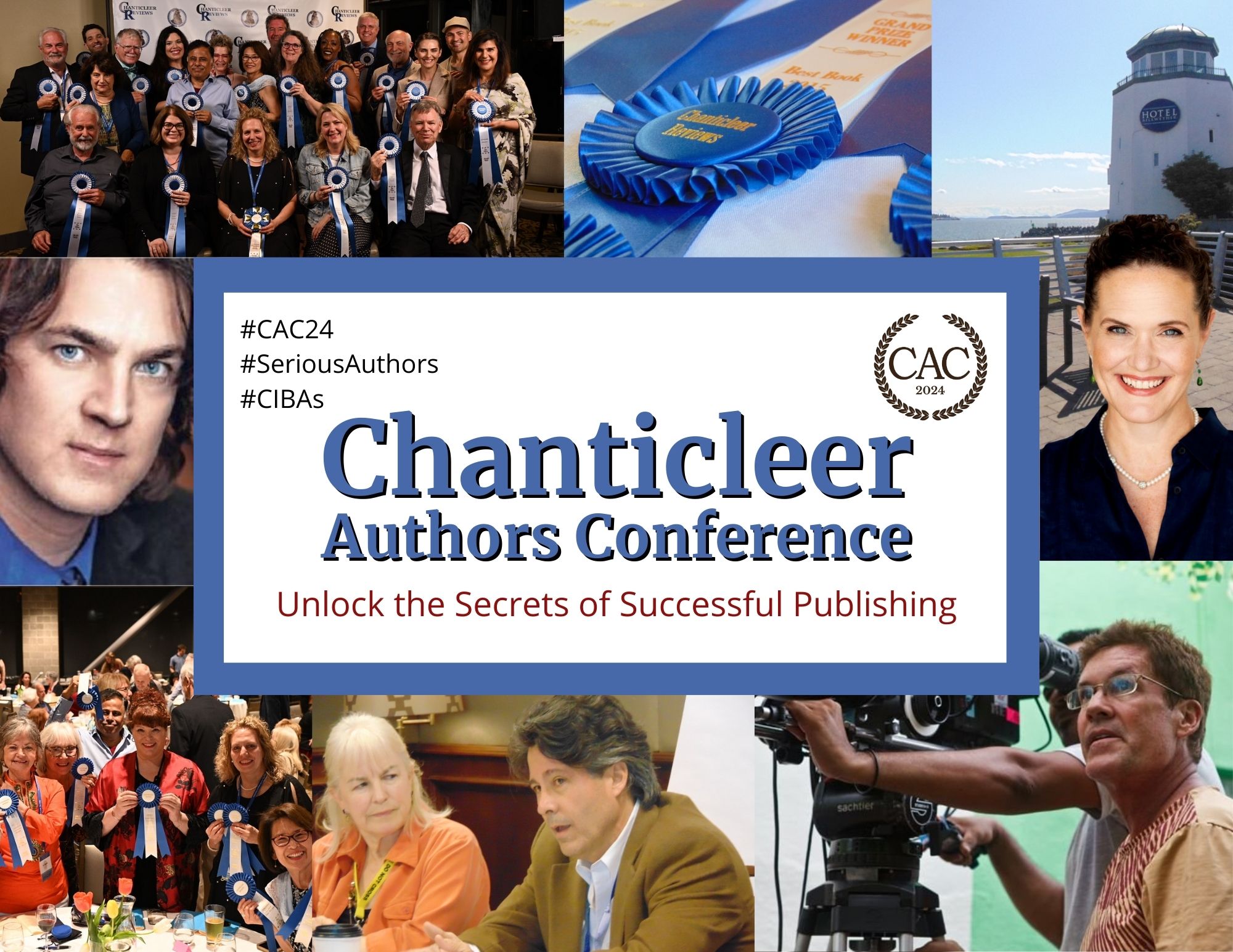
Seating is Limited. The esteemed WRITER Magazine (founded in 1887) has repeatedly recognized the Chanticleer Authors Conference as one of the best conferences to attend and participate in for North America.
“The toughest job you’ll ever love.” That was the original slogan for the Peace Corps, one that Christine Herbert found to be wholly true, as she shows in The Color of the Elephant, a journal of her time serving in Zambia from 2004 to 2006.
This is a story about the journey rather than the destination. After all, the destination of any posting with the Peace Corps is the place you first came from, hopefully leaving something positive behind, and having changed and been changed by the experience.
For the author, her experience was that of a muzungu, a word synonymous in southern, central, or eastern African countries with foreigners such as Peace Corps volunteers and Doctors without Borders.
Christine Herbert came to Zambia as a ‘stranger in a strange land’, with the intent to change herself – to break out of her identity as a self-described ‘goody-goody’.
She resisted her family’s best efforts to convince her to stay on a safe and sane path. Volunteering for the Peace Corps, going to Africa for 27 months in the immediate wake of 9/11 was neither.
In her early 30s, a bit older than the usual Peace Corps volunteer, she knew that she wasn’t there to save anyone or anything – except quite possibly herself. The reader walks beside Herbert as she is made and broken over and over again in a tale equal parts heartwarming and heartbreaking. Her experiences, for at least a little while, take her out of her white, privileged, American mindset and put her feet into the sandals of a world where community is everything.
Herbert does an excellent job of carrying readers on a startling, eye-opening, and life-changing journey.
The author did not undertake this journey for the adventure of it all, because the point was not to return to her old normal life. She sought to change her perspective on what normal can and should be.
Serving in the Peace Corps, that “toughest job you’ll ever love” has been a dream for many more people than have undertaken the actual journey. Any reader who dreamed that dream will be given a glimpse into the challenges of the job and just how much love – of friends, found family, newfound homes, and meaningful work – lay at its heart.
Luna, the second book in Strider S.R. Klusman’s YA Rhone and Stone Series, follows Rhone and his alien partner Stone as they develop a ship that can sail through the air.
The two train to become agents for the Office of Public Recrimination, urged to join by their friend – and now boss – Aundrea. Rhone struggles through training with the help of his trusty partner, but a much more difficult test remains before them – their first assignment.
Aundrea sends them to Corgy, a port town, without explaining their mission. But it doesn’t take long for Rhone to encounter troubles from shore and sea alike.
He and Stone meet Mayor Dugan, who takes an instant dislike for Rhone, posing as a wealthy merchant’s son. But it’s his front, designed so by the ladies of the OPR, and commands a great deal of respect and authority from the locals, if not Bella. Sometimes it’s difficult not to forget his actual purpose for being at Corgy. As an agent of the OPR, he must solve the town’s greatest problem, a rash of pirate attacks on Corgy’s vital ocean-borne trade; if they continue, Corgy won’t survive.
But to fix anything in Corgy, Rhone will need help.
The roguish Captain Black tests Rhone’s sea legs on the Backwater Mistress. Rhone passes the test of rough waters – barely – and garners the good captain’s respect.
He also meets the beautiful Bella, a waitress at The Common House in Corgy. Though he’s smitten with her, Rhone is on a mission, and ends up frustrating her with mixed messages.
Bella responds to him with a fiery personality, but Rhone finds her passion to be as enthralling as it is unpredictable. As he gets to know her, he helps Bella find her place in a society that tries to smother her drive for independence.
She wants to prove that she is as good as any man. And, when Rhone comes up with the idea to hunt Corgy’s pirates from the air, Bella has her chance to do so.
Rhone takes Bella’s opinions and advice as they design a unique kind of ship. Aviation is unknown to this world, but the trio – Rhone, Stone, and Bella – design and pilot their first prototype, named Bo, a hot-air balloon made from a whale’s bladder. While a proof-of-concept, Bo doesn’t last long, and they’ll need a much greater ship to take down the dangerous pirates.
Stone provides immense scientific knowledge, Rhone the training in sailing he received from Captain Black, and Bella a knowledge of materials and the resources of Corgy. Between them, they turn an awkward and dangerous balloon into a vessel worthy of the sky.
Joining with Captain Black, the three plan to stop the pirates in their tracks – despite the great danger.
Tense and descriptively rich action scenes will keep readers turning page after page to find out if Rhone and Bella will survive their flight in an experimental craft – relying on the work of their own minds and hands.
Klusman’s masterful storytelling takes this second book in the Rhone and Stone series to the next level. Readers who have not read the first book will have no problem following this story, but will eagerly go back to join Rhone’s first adventure. Rhone and Stone make a fabulous team, sharing thoughts and trust as they claw their way out of danger time after time.
This book is a five-star read and a great adventure. Readers will be chomping at the bit for book three!