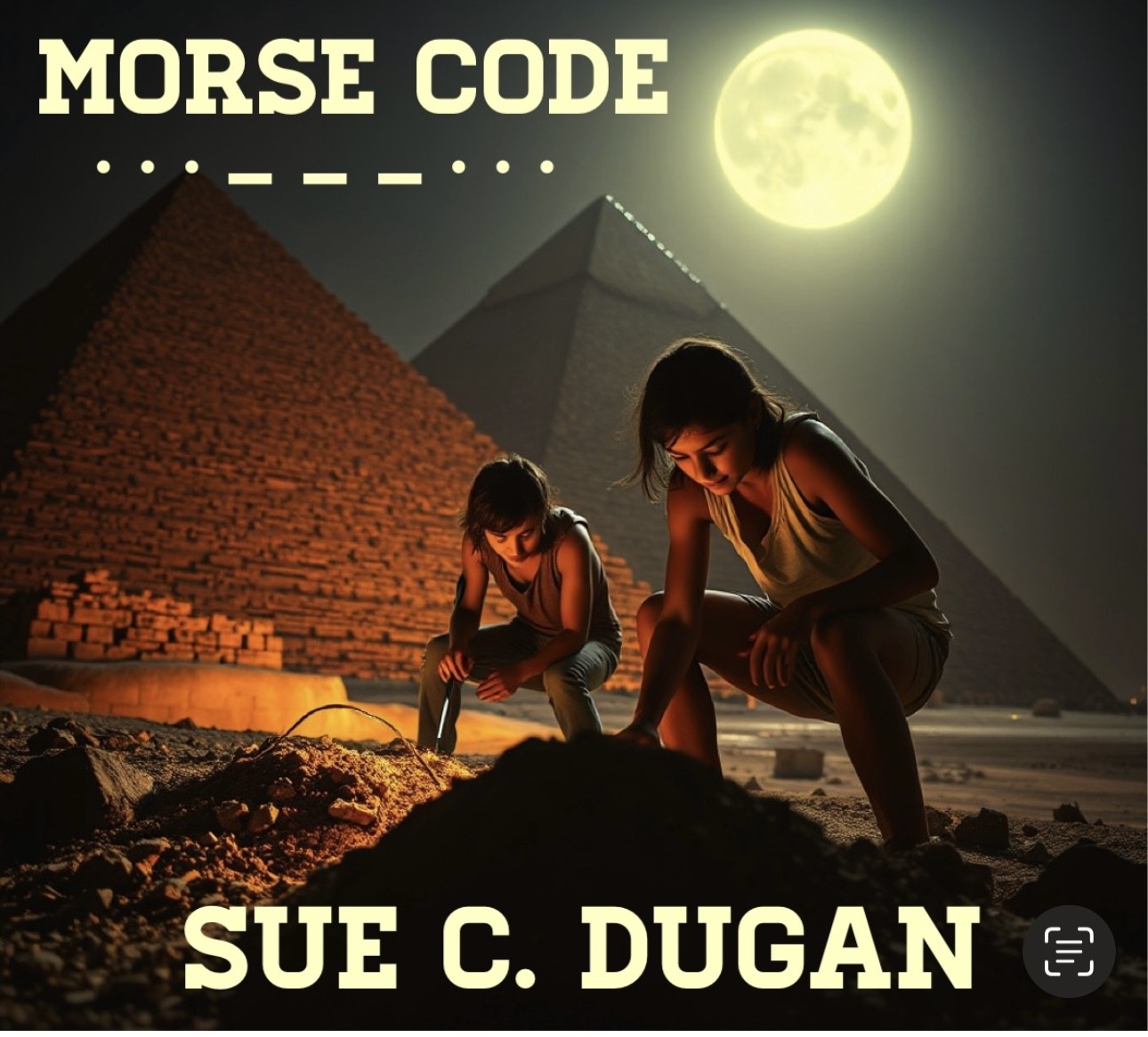
Morse Code, the third book in Sue C. Dugan’s the Land, Sea, and Air series, plunges readers into double-layered intrigue. It’s a riot of sleuthing, history, and time itself at play.
At one end of the story, young British twins Dot and Dash Foxshire encounter three peculiar strangers around their parents’ archaeological dig in 1921’s Guatemala. Oddly overdressed for the jungle, the newcomers reveal they had just survived both the shipwrecks of the Titanic in 1912 and the S.S. Austria in 1858 (see Book One: Save Our Ships).
Meanwhile, Morse Code picks up where Book Two: Mayday left off. Jessie, her father, and Ben make it home from a remote island in the past, unaware that Prince, a man native to that island, has secretly stowed away with them into the future.
His presence in 2016 quickly attracts the government’s attention; a linguist studies Prince in quarantine and grows fascinated with his hybrid system of gestures and speech, identifying it as an extinct Mayan language. Having safely arrived home in 2016’s Florida, Jessie seeks guidance from Roberto, an attractive boy at her school whose knowledge of time-space travel gives Jessie a new theory about where Prince really came from.
Jessie persuades the linguist to travel back into the Guatemalan jungle and return Prince to his home—with her older brother, Phil, acting as reluctant chaperone. However, their expedition takes an unexpected turn when an earthquake in Guatemala hurls Jessie and Prince into 1921, where they cross paths with Dot, Dash, and the Titanic trio.
The delight of Morse Code lies in its willingness to let two plots collide head-on, embracing historical what-ifs with a sense of childlike wonder.
As the mismatched group assembles a chronology of their overlapping stories, Jessie recalls Roberto mentioning that Albert Einstein would be in 1921’s New York City. If anyone can help untangle the mysteries of time, it’s him. With the Foxshire family’s help, the crew sets its sights on unraveling the mystery at the heart of their travels.
Much like the Magic Tree House series, Morse Code, Book Three of the Land, Sea, and Air series by Sue C. Dugan, balances whimsy with a little history lesson, respecting the complexities of its ideas while keeping a brisk pace toward another suspenseful cliff-hanger. Middle-grade readers eager to puzzle out myths and mysteries lost to time will find Morse Code, along with the series as a whole, both rewarding and wildly entertaining.
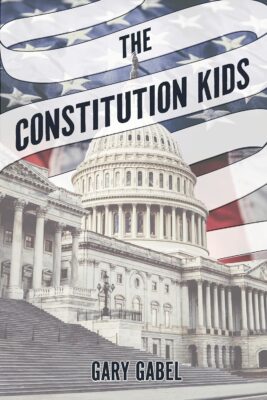
The Constitution Kids by Gary Gabel aims to make learning the United States Constitution not only easy, but fun, too!
Plenty of adults in the US—even well-educated ones—have a limited knowledge of what’s in the US Constitution. Children and teens are even less likely to know much about the country’s foundational set of laws. That dense legal document, plus its 27 amendments, doesn’t exactly make for peaceful bedtime reading. Still, the Constitution helps explain how the US is meant to function, and what’s happened when that functioning breaks down. While it’s aimed at younger readers, adults can also get a worthwhile education from picking up this book.
At just under 200 pages, The Constitution Kids is appropriately short and approachable. However, it’s also comprehensive in its examination of the Constitution and its every amendment.
Some of the most interesting sections deal with lesser-known amendments, which readers may not be familiar with. For example, in the 1960s, the 24th amendment banned poll taxes in elections after a successful push by John F. Kennedy’s administration. Before the adoption of that amendment, people often had to pay to vote, which was a major barrier to equity.
Gabel recounts the reason for the 24th amendment in vivid, memorable prose. He shares how poll taxes were often used to block Black Americans from voting and even connects this history to ongoing issues now. “Although this amendment made a big difference, even today states get involved with various strategies to reduce minority turnout at elections.” (pg. 166)
Gabel cleverly employs historic figures as characters who recount how the Constitution and every amendment came to be, and why they matter.
The Constitution Kids centers on three American high schoolers who go looking for information about the Constitution. In the process, they discover a magical library book, from which these historical characters emerge and take them on journeys into the past. Famous people like Benjamin Franklin and John F. Kennedy, as well as lesser-known figures like Quaker suffragette Alice Paul, guide the “Constitution kids” through American history.
The Constitution Kids doesn’t read like a typical, plot-driven novel with vivid descriptions of the settings and events as they unfold, but this simple style of storytelling excels in highlighting the core information. The historical figures explain different constitutional arguments with a quick and focused pace.
We follow the kids through their favorite activities as they learn about the Constitution, like browsing the library, ice skating, and a bit of teenage rebellion, but the book’s not really about the kids themselves—it’s about what they learn. Teachers could easily use chapters of The Constitution Kids in a school lesson plan.
The greatest strength of Gary Gabel’s The Constitution Kids is its use as a reference guide. The Constitution takes center stage rather than active scenes of character development. When a certain amendment pops up in the news, or when historical curiosity strikes, this book is an excellent source of information on constitutional issues. Many families, whether with kids in the house or not, would find The Constitution Kids a valuable addition to their bookshelves.
The Chatelaine Book Awards recognize emerging new talent and outstanding works in the genre of Romance and Women’s Fiction. The Chatelaine Awards is a genre division of Chanticleer International Book Awards and Novel Competitions (The CIBAs).
Chanticleer International Book Awards is looking for the best new books featuring romantic themes and adventures of the heart, historical love affairs, perhaps a little steamy romance, and stories that appeal especially to fans of affairs of the heart to compete in the Chatelaine Book Awards (the CIBAs). We will put them to the test and choose the best among them.
These titles have moved forward in the first look rounds from all 2025 CHATELAINE entries to the 2025 Chatelaine Book Awards LONG LIST. These entries are now in competition for the 2025 Chatelaine Short List. The Short Listers will compete for the Semi-Finalists positions. FINALISTS will be chosen from the Semi-Finalists and recognized at the Chanticleer Authors Conference, CAC26.
We will announce the 1st Place Category winners and Grand Prize Division Winners at the CIBAs Banquet and Ceremony on Saturday, April 18th, 2026 in beautiful Bellingham, WA sponsored by the 2026Chanticleer Authors Conference.
These titles are in the running for the SHORT LIST of the 2025 Chatelaine Book Awards novel competition for Romance and Women’s Fiction!
Join us in cheering on the following authors and their works!
Allison G. Smith – New Tenant
Amanda Nelson & Lisa-Marie Potter – Just What the Doctor Hired
Ann Dunbar – Áine’s Salvation
Anne M. Beggs – By Arrow and Sword: Book Two Dahlquin Series
Antonia Gavrihel – Back to One: Take 4 Slating Magic Hour
Charlene Tess & Judi Thompson – Angel’s Heart
Crystal Charlotte Cc Lane – Kevin and Katherine in the Next Lifetime
Crystal Charlotte Cc Lane – Shilpa’s Blue Crayon
D.J. Pratt – Prima Nocta: A Mystical Quest for Love
E.L. Deards – The Lavender Blade
Elizabeth Conte – Chosen Mistress
Emily A. Myers – You Can Feel It in the Silence
Eve M Riley – The Escape
Eve M Riley – The Game
Hanna Park – The Scald Crow
Jerry Madden – Steel Valley: Coming of Age in the Ohio Valley in the 1960s a Love Story
Jourdana Webber – Unconventionally Elle
Kathleen Brehony – The Third Act
Kim Gottlieb-Walker – Lenswoman in Love
Kinsey Wiseman – The Election
Lizzie Jenks – Devil in Our Hearts
Louisa West – Gwen Lee and the Trident of Poseidon
Patrick E. Craig – When the Hummingbirds Danced in the Honeysuckle Sky
Rhone Atleshen – Gaslight
S.E. Beathan – Nothing Lost
S.E. Reichert – No Words After I Love You
S.G. Blaise – Eldryan Elders
Sharon Shipley – December and Mae
Shawn Hays and Stephen Hays – What Light Was
Sue C. Dugan – Forever Ever Always
Susan Bagby – Sweet Ridge Hearts
Susan W. Green – Crystal Lake Christmas
Tammy Mannersly – A Garland at Bitterbark Creek
Tasha Zima – The Making of a Storm
Tatiana Mcclintock – Boyband Love Escapades
Tina Sloan – Chasing Czars
Tori Ross – Baked and Burned
Wanda Penalver Bevan – The Rains of Wishton
PROMOTING OUR AUTHORS!
This post has been posted on the Chanticleer Facebook Page. We try to tag all authors listed here in the Facebook post. However, it is easier for us to tag authors when they have Liked and Followed us on Facebook.
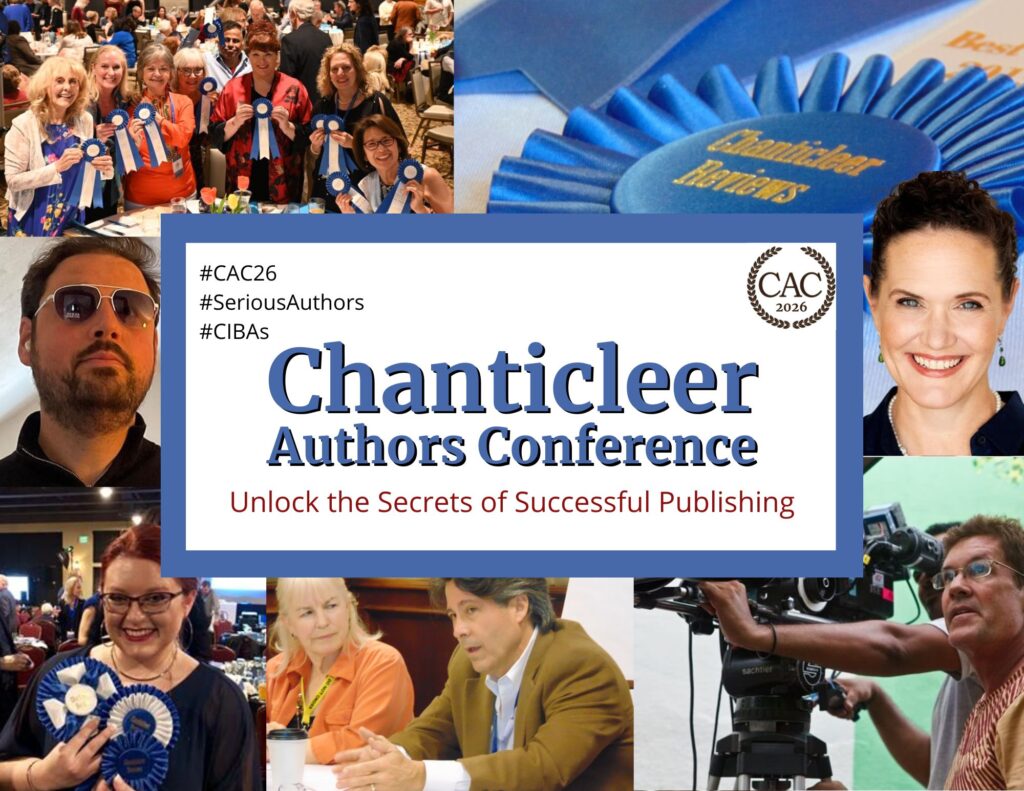
Seating is Limited. The esteemed WRITER Magazine (founded in 1887) has repeatedly recognized the Chanticleer Authors Conference as one of the best conferences to attend and participate in for North America.
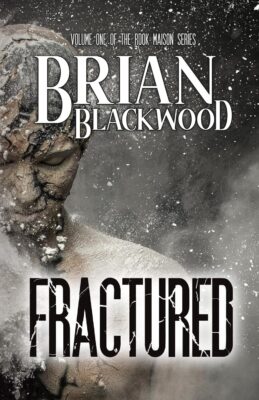
A genre defying debut, Fractured by Brian Blackwood tells the story of Rook Maison, who sustains his life by ripping out peoples’ souls to steal their bodies for himself. This unique ability comes with one cataclysmic side effect. Each time Rook replaces a soul, those souls—and Rook’s own—become increasingly fractured.
The forces of Heaven and Hell rely on a carefully maintained balance, and Rook has pushed that balance to a breaking point.
Originally a Catholic monk during the emergence and upheaval of Lutheranism, Rook has become increasingly disillusioned towards his religion and the purpose of his endless mercurial life. As the centuries passed by, Rook became a shell of who he once was, doing anything and taking whatever bodies necessary to continue his existence.
Rook grew hellbent on finding every scrap of information about his mysterious origins. But now, with a target on his back, Rook must decide if finding the truth is worth destroying the worlds of the living and the dead.
Fractured will entice those who root for the morally grey and antiheroes, as Rook Maison is a deeply interesting example.
Readers experience him in many different forms, from his devout beginnings and guilt-ridden conscience at having to take soul to a villainous disregard for the lives of others in favor of selfish survival. The plot jumps around in time as it reveals Rook’s backstory, building a sense of mystery and foreboding.
Some chapters focus on the perspective of the Angels, a fascinating angle on the story as they join with Hell to stop the fabric of the universe from being destroyed.
Placing Fractured within one genre would not do it justice. Its blend of urban fantasy, historical fiction, horror, and religion creates something unique and exciting for a variety of readers.
Brian Blackwood’s background in theory and screenwriting shines through his cinematic prose.
Illustrations at the beginning of each chapter set the tone for the pages that follow and piques interest in the central mystery that is Rook Maison.
A thought-provoking wild ride, Brian Blackwood’s Fractured is not to be missed. It asks complex questions through a well-developed character while providing the entertainment of a time-traveling adventure. An excellent choice for fans of urban fantasy, historical thrillers, and gothic religious horror. Rook Maison is one hell of a force to be reckoned with.
The Instruction and Insight Book Awards recognize emerging new talent and outstanding works in the genre of Guides and Self- Help Non-Fiction. The I&I Book Awards is a genre division of Chanticleer International Book Awards and Novel Competitions (CIBAs).
Chanticleer International Book Awards is looking for the best books featuring HOW-TO, Guidance, Travel Guides, Cookbooks, Instruction, Insight, Self-Help, and more.
These titles have moved forward in the judging rounds from all 2025 I&I Non-Fiction entries to the 2025 I&I Book Awards LONG LIST. Entries below are now in competition for the I&I Short List. The Short Listers will compete for the Semi-Finalist positions. Finalists will be selected from the Semi-Finalists. All FINALISTS will be recognized at the Chanticleer Authors Conference (CAC26).
The First Place Category Winners, along with the CIBA Division Grand Prize winners, will be selected from the 25 CIBA divisions’ Finalists.
We will announce the 1st Place Category winners and Grand Prize Division Winners at the CIBAs Banquet and Ceremony on Saturday, April 18th, 2025 in beautiful Bellingham, WA at the Bellingham Yacht Club sponsored by the 2025Chanticleer Authors Conference.
These titles are in the running for the SHORT LIST of the 2025 I&I Book Awards novel competition for Guiding and How-to Non-Fiction!
Join us in celebrating the Long List authors and their works in the 2025 CIBAs.
Albert Jung – What’s Your Name
Alejandra Acuña – Stones, Flowers, and Lessons Learned
Ana María López Jimeno – Vademecum of English: a Complete Reference Guide for Teachers and Learners
Andrew Cooper – The Ethical Imperative: Leading with Conscience To Shape the Future of Business
Ashlee Piper – No New Things
Darryl Arrington, PhD – Epilogue: Now We Rise Above the Trafficking Experience
Dawn Madelon Barclay – Vacations Can Be Murder: a True Crime Lover’s Travel Guide To New England
Evan M. Butterfield – Copyright for Creatives: a Practical Guide To Copyright Law for Creative People Who Make Stuff
Hanna Hasl-Kelchner, Mba Jd – Seeking Fairness at Work: Cracking the New Code of Greater Employee Engagement Retention Satisfaction
Holly Thorton – The Hardest Help: Supporting a Loved One Through Addiction
Jack Wolf – Critical Thinking for Go-Getters
Jerome Puryear – The Art of Thinking: Critically with Clarity for Optimal Health Your Longevity Is Determined by How You Think
Judy Taylor – Magpie Times Marshmallow World
Kathleen Lockyer – Wild Inside: How Nature Protects Your Child’s Mental Health and Restores Yours
Leslie Bains – Birds, Monarch Butterflies, and Short Hikes in the Santa Barbara Area
Luella Goethals – Resonance Chakra Balance and the Law of Attraction
Léonie Rosenstiel – They’re Coming for Your Elders and Your Inheritance: Ways To Protect Your Family Mitigate the Damage and Change the System
Stephen Rue – Must: Becoming the Person You Are Meant To Be
Tak Salmastyan – The Life’s Theater: Book One: Echoes That Suffocate, Art and Essays
Tissa Richards – Rethinking Resilience: Fueling Your Competitive Advantage
Tony Jeton Selimi – Climb Greater Heights
Good luck to all as your works move on to the next rounds of judging.
PROMOTING OUR AUTHORS!
This post has been posted on the Chanticleer Facebook Page. We try to tag all authors listed here in the Facebook post. However, it is easier for us to tag authors when they have Liked and Followed us on Facebook.
Seating is Limited. The esteemed WRITER Magazine (founded in 1887) has repeatedly recognized the Chanticleer Authors Conference as one of the best conferences to attend and participate in for North America.
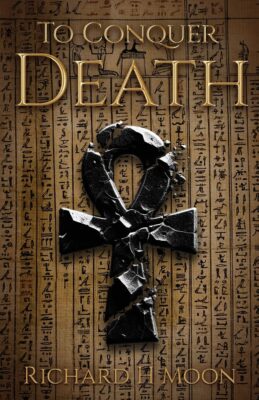
To Conquer Death by Richard H. Moon follows brothers Koshei and Tyfon—and Doryah, a barbarian woman—on a mythic quest across ancient Egypt and beyond, to a place where Egyptian myths come to life and rouse the dead. To restore balance to their world, the trio may have to sacrifice everything from their homes to their very souls.
From the very first page, this story is built on love and loss. Koshei and Tyfon—mere children at the time—face the prospect of life without their beloved father after his body is returned to them from war wrapped in linen. Doryah lost her mother, and the funeral leaves the grieving daughter with the impression that only flames can subdue the dead when they attempt to rise again.
The brothers, now young men, have followed in their father’s footsteps as warriors and joined the army. Supposed invaders have come from across the Great Green Sea, but after the battle they are discovered to be refugees rather than aggressors. Among them is Doryah, who warns Koshei and Tyfon that they have fled a dark and ancient force that can bring corpses back to life. At Pharoah’s command, the three lead an expedition back across the sea to Achea, through abandoned communities, until finally they reach a frozen wasteland. An army of the dead awaits them, along with a god whose games mortals have very little hope of winning.
Moon’s descriptions of the ancient lands these characters traverse, as well as the cultures and customs they practice and encounter, anchor this story to history. From this solid foundation, the mystical and supernatural elements thrive.
Even without any prior knowledge of ancient Egyptian hierarchies and social conventions, readers will easily immerse themselves in the story and learn as they go. Moon makes a point to include information such as how the Egyptian New Kingdom’s civil calendar was structured and how the Nile’s annual flood cycles determined the seasons, ensuring historic authenticity beneath the rich world-building.
The dynamic cast imbues large, otherworldly conflicts with a myriad of human personality.
Where Koshei is measured and almost always perfectly in control, Tyfon has grown up to become more reckless. Their relationship is relatable despite the distinct challenges they must undergo. Doryah contributes unique, equally developed perspectives to round out the narrative. While the story takes place in the ancient world, like many historical novels they often utilize more modern turns of phrase when speaking to one another, the characters work hand in hand with the supernatural setting to weave a suspenseful plot.
Combining the scope of epic fantasy with intimate personal conflicts, Richard H. Moon’s To Conquer Death tells a timeless story of characters who face insurmountable trials, endure profound loss, and forge bonds that outlast even death itself.
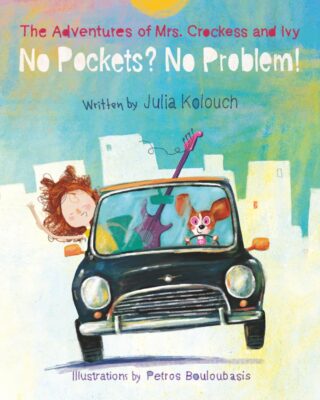
The Adventures of Mrs. Crockess and Ivy: No Pockets? No Problem! by Julia Kolouch, illustrated by Petros Bouloubasis, is a wacky tale of innovative solutions to one of life’s greatest struggles: pockets!
A joyful lesson in problem-solving and independence, this is the perfect story for young readers who want to do things all by themselves. They’ll want to hear it over and over again—and then learn how to read it on their own.
The adored Briggs’ family dog, Mrs. Crockess, is a snuggly reading partner to Mrs. Briggs, an extra hand (or paw) in the kitchen to Mr. Briggs, and a rock n’ roll bandmate, slushy enjoyer, and flower-picker to her best friend, little Ivy Briggs. Together, Ivy and Mrs. Crockess are a force to be reckoned with.
When a string on Ivy’s guitar breaks in the middle of their jam session, they have to rush to the music store so they can keep rocking out. But—oh no! Mrs. Crockess lacks an essential item for their mission: a pocket!
Without a pocket, she can’t hold her money, her keys, her phone, her map, her bone, or her lip balm. The best friends put their noggins together to come up with a creative solution to the pocket problem. But when that idea falls through, they need another… and another … and another … and another! They only have until the music store closes to come up with the perfect solution.
Tag along with lovable Ivy and fantastic Mrs. Crockess as they learn to solve big problems with lots of love, silliness, and patience for each other.
Packed with Petros Bouloubasis’s colorful illustrations and goofy details, No Pockets? No Problem! will make kids laugh out loud and ask important questions like: “Why does a dog need lip balm?” “What kind of word is “Phwump’?” and, “How in the world does a dog play the drums?”
Inspired by stories imagined by her 3-year-old niece, No Pockets? No Problem! by Julia Kolouch will have kids and adults alike wondering what in the world Ivy and Mrs. Crockess will do next.
The Mind & Spirit Book Awards recognize emerging new talent and outstanding works in the genre of Spirituality and Enlightenment Non-Fiction. The Mind & Spirit Book Awards is a genre division of Chanticleer International Book Awards and Novel Competitions (CIBAs).
Chanticleer International Book Awards is looking for the best books featuring Spirituality, Enlightenment, Self-Help, Mindfulness, Well-being, Meditation, Energy, and more.
These titles have moved forward in the judging rounds from all 2025 Mind & Spiri Non-Fiction entries to the 2025 Mind & Spirit Book Awards LONG LIST. Entries below are now in competition for 2025 Mind & Spirit Short List. The Short Listers will compete for the Semi-Finalist positions. Finalists will be selected from the Semi-Finalists. All FINALISTS will be announced and recognized at the Chanticleer Authors Conference (CAC26).
The First Place Category Winners, along with the CIBA Division Grand Prize winners, will be selected from the 28 CIBA divisions’ Finalists.
We will announce the 1st Place Category winners and Grand Prize Division Winners at the CIBAs Banquet and Ceremony on Saturday, April 18th, 2026 in beautiful Bellingham, WA sponsored by the 2026Chanticleer Authors Conference.
These titles are in the running for the SHORT LIST of the 2025 Mind & Spirit Book Awards novel competition for Spirituality and Enlightenment Non-Fiction!
Join us in celebrating the Long List authors and their works in the 2025 CIBAs.
Amy L. Bernstein – Wrangling the Doubt Monster: Fighting Fears Finding Inspiration
Andy Becker – “Grandy Let’s Play!”: Reflections on the Joy Blessings and Wonder of Grandparenting
Andy Chaleff – Dying To Live: Finding Life’s Meaning Through Death
Anne Jeppesen – When Life Came Knocking
Charlotte Swift – Glow Up: Self-Love and Spirituality for Teens
Cheryl Lynn – Washing the Inside of the Cup: My Journey of Walking in the Spirit
D. H. Hutton – Drums of a Distant Tribe: a Son’s Message From the Great Beyond
Danielly Kaufmann – The Age of Digital Spirit
Diane Marie Taylor – I’m on Assignment: an Alternative View of Past Lives, the Impact on Our Current Lives, Soul Mates, World History, and the Akashic Records
G.W. Evans – Heaven’s Hill: Meeting Your Loved Ones on the Other Side
Dr. James Manning – Deeply Human the Science and Soul of Emotional Healing
J.D. Pincus Ph.d. – The Emotionally Agile: Brain Mastering the 12 Emotional Needs That Drive Us
Julianna Lindsey – Radiant Longevity a Physician’s Protocol for Living Your Best Life
Keith and Erin Ramachandran – Mental Health, Strong Marriage
Lara Sanderson – Mātrikā’s Muse: a Journey To Awakening Through the Senses
Linda A. Lavid – Personal Archetypes for Stress Relief: a Holistic Guide
Marie-Eve Dawood – Jesus Shrank My Dating Pool: Holding Out for a Godly Man When It Feels Like You’ve Missed the Boat
Marti Tote – A Whisper in the Wings
Natalie Saar – Becoming 1 Better: 100 Simple Changes To Improve Your Life 1 at a Time
Paul O’Neill – Letters To a Young Teacher: Wisdom for Those Who Guide Others
Rev. Robyn Accetturo, Lcsw – I Am the Reluctant Messiah and So Are You
Stavo Mustang Craft – Auto Antenna: an Enchanted Guide To Santa Fe & Vague Blueprint To the Cosmos
Terri Harford – New Body, Old Soul
Timeout A. Taumu – The Magnificence of the 3
Tyrone Polastri – Dancing on the Edge: Moving Through Life with Power, Dignity, and Effectiveness
Good luck to all as your works move on to the next rounds of judging.
PROMOTING OUR AUTHORS!
This post has been posted on the Chanticleer Facebook Page. We try to tag all authors listed here in the Facebook post. However, it is easier for us to tag authors when they have Liked and Followed us on Facebook.
Seating is Limited. The esteemed WRITER Magazine (founded in 1887) has repeatedly recognized the Chanticleer Authors Conference as one of the best conferences to attend and participate in for North America.
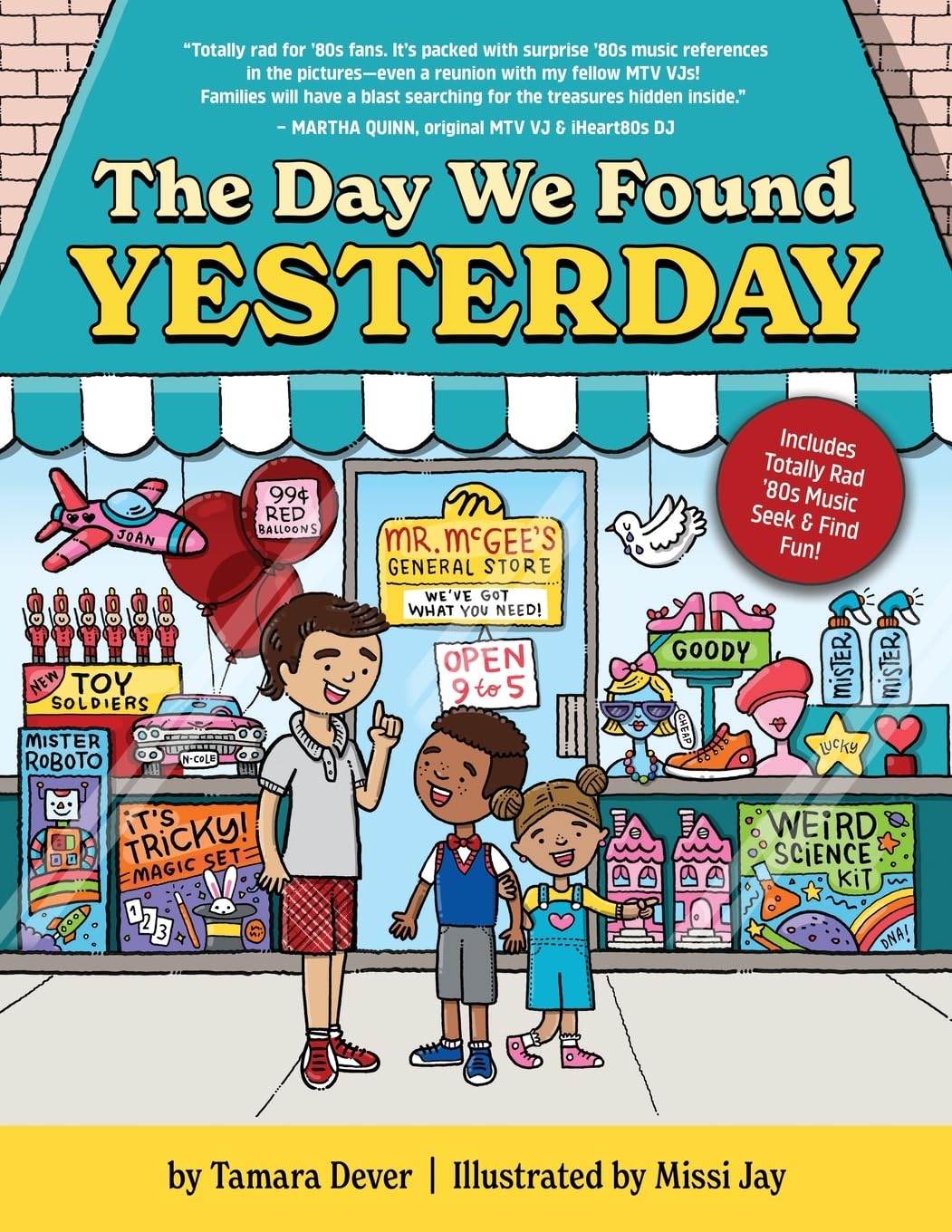
Tamara Dever’s The Day We Found Yesterday is a blast from the past, a picture book for both young readers and nostalgic GenXers to experience the ’80s. Dazzling funky illustrations with 500+ music references will catch anyone’s eye and instantly transport readers back to the days of “I want my MTV!”
Eileen, Mickey and Eddie love their grandparents, Nana and Papa. When they overhear them grieving something special they lost long ago, the grandkids set out on a mission in their grandparents’ hometown to find it. They visit their grandparents’ friends at their local businesses, hoping that one of them will have the answer to the question of the missing treasure.
Their journey quickly turns into a time-traveling adventure as they gather stories of their grandparents’ ’80s childhoods from the friends and family who watched them grow up.
The shops are covered with ’80s music callbacks, like “Karma” the Chameleon in the pet store, the travel agency slogan, “On the Road Again,” and a reminder on the doctor’s office wall that “every breath you take keeps lungs healthy.”
Each page of The Day We Found Yesterday, illustrated by Missi Jay, is a universe of detail.
Colorful signs and carefully hidden objects cover every inch, inviting children to pore over the pages, pick out favorite illustrations, and giggle over silly puns. New readers will find ’80s slang like “atomic” and “funky” to be an exciting challenge!
Once the kids’ adventure has come to an end, there’s more to explore at the back of the book.
Young readers can treasure hunt through the pages for tiny items like bells and hamsters. Meanwhile, adults can search for references to songs, artists, and even spot cameos from ’80s celebrities like Corey Hart, Debbie Gibson, and the lead singers of Men Without Hats, A Flock of Seagulls, and Led Zeppelin’s Robert Plant. Mark Goodman, Nina Blackwood, Alan Hunter, and Martha Quinn also show up in colorful images as the original MTV VJs.
The Day We Found Yesterday by Tamara Dever opens opportunities for children to learn more about their parents’ and grandparents’ lives, sparking connection beyond generational boundaries in a fun, colorful adventure. This is a story that will last through the decades!
On Veterans Day, we pause to honor those who served and the stories they leave behind. These narratives serve as a connection between those who serve and those who they protect.
Every veteran’s story carries weight beyond the individual experience. These accounts are heirlooms passed down through families and shared across communities. They help us understand what happened and what it means when they come back. .
From Kiffer: Remembering Billy Wayne Flynn
Billy Wayne Flynn at West Point Academy. He was killed in Vietnam January 23, 1967.
My first cousin, Billy Wayne Flynn, graduated from West Point Academy. He was killed in Vietnam on January 23, 1967, among the first 100 Americans to die in that conflict.
Featured Voices: Veterans Who Wrote Their Stories
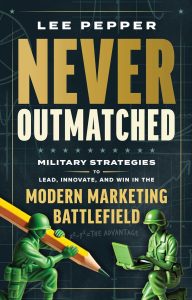
NEVER OUTMATCHED By Lee Pepper
Part leadership manual, part tactical playbook, Never Outmatched: Military Strategies to Lead, Innovate, and Win in the Modern Marketing Battlefield by Lee Pepper blends military wisdom and modern insight into sharp, grounded business guidance.
Pepper draws heavily from his dual experience as an army officer and a high-level marketing executive, offering more than just inspiration. Never Outmatched is a practical, story-driven guide that borrows from the discipline, mindset, and adaptability of military strategy.
Lee Pepper distills years of hard-won experience into a collection of mental models designed to help leaders act decisively even when the odds feel stacked against them or the path ahead unclear. Strategies like “Commander’s Intent” teach you how to lead with vision while empowering your team to move independently. “Force Multiplication” shows how to get more from the people and tools you already have, and “War-Gaming” helps you anticipate problems before they hit.
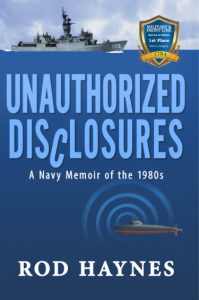
Rod Haynes’s memoir Unauthorized Disclosures: A Navy Memoir of the 1980s portrays military life without filter, transcending glamorous and heroic images to explore the daily struggles, leadership challenges, emotional battles, and personal growth during his decade of military service.
We first meet Rod as a young man trying to navigate a directionless civilian life. The burdens of unemployment, fractured family relationships, and an identity crisis lead him to a chance encounter in Seattle with ‘Space Case’, an eccentric, troubled, yet honest character. The relationship offers a glimpse at rock bottom—which Rod fears most.
Rod decides to join the Navy because he needs employment.
In A Grand Pause: A Novel on May 14, 1945, the USS Randolph, Kamikazes, and the Greatest Air-Sea Rescue by Gary Santos, readers board the US Naval aircraft carrier alongside its crewmen as World War II’s Pacific Theater reaches a critical point.
This compelling novel opens with a startling description of the US Navy caught in the bloodiest and longest battle in its history. Through a wide cast of characters, from sailors to pilots, officers to the deck crew, everyone plays a vital role in keeping the USS Randolph running amidst the most heated naval combat of World War II.
Santos writes every moment of these nightmarish battles with intensity and authenticity.
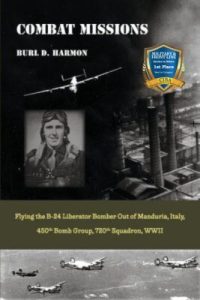
Sometimes, a close and personal story can reveal the true weight of major historical events. Combat Missions, a memoir from WWII veteran Burl D. Harmon, achieves this by detailing how Europe’s vicious aerial battles shape a young boy’s entry to manhood.
On December 7, 1941, Harmon is summoned to his high school’s auditorium to hear President Roosevelt proclaim it as, “a day which will live in infamy…” Soon after, his draft notice arrives. Harmon’s junior college studies and work at the local Rexall drug store are put on hold as he joins the vast flood of young American men and women conscripted into military service. Leaving his small Iowa town and a family mostly sheltered from the grim realities of the outside world, he travels to New York City with people from every imaginable background.
With no prior mechanical experience, he works diligently to become a flight engineer, training to master a lexicon of manual tasks and learn the intricacies of air-to-air combat amidst bombing runs. His training takes him even farther from home, to Detroit, Lorado, Texas, Puerto Rico, and even Cuba.
There was an average of 17.6 veteran suicides per day in 2019 (VA Mental Health)
Firearms were used in 70% of veteran suicide in 2019 (Stars and Stripes)
Suicide Risk of veterans is almost double what it is for the general population (VA Public Health)
The greatest difference in suicide rates between veterans and nonveterans is among those ages 18–34 (Rand Corporation)
The largest number of veterans who die by suicide are between 55 and 74 years old. (Rand Corporation)
25% of all veterans have a service connected disability (Military.com)
41% of all post 9/11 veterans have a service connected disability (Military.com)
These statistics remind us that honoring veterans means more than parades and ceremonies. It means supporting them through the invisible wounds that persist long after service ends, and ensuring their stories are heard and preserved.
The Red Badge Project, founded by actor Tom Skerritt, uses the creative process of storytelling to help wounded warriors rebuild their sense of purpose and individuality. For those struggling with PTSD, anxiety, and depression, believing in the value of their story and finding means to communicate it represents a struggle of heroic proportions.
Supporting Veterans Who Write
At Chanticleer, we’ve had the honor of reviewing outstanding novels and narrative nonfiction written by veterans whose stories enlighten, remind, empathize, and create better understanding of military service.
All of us at Chanticleer have family members who have served, making Veterans Day particularly meaningful to us. We encourage you to take time today to remember the veterans in your life and to seek out their stories—whether through conversation, literature, or simply quiet reflection.
Do you have a book with a military theme that deserves to be discovered?
Chanticleer Editorial Reviews are optimized to maximize your digital footprint, helping readers find your important stories. Our reviews provide professional validation that honors the work veterans put into sharing their experiences.
Submitting to the Chanticleer International Book Awards is also a powerful way to get your military story discovered. For Non-Fiction we have the Military & Front Line Awards and for Fiction we have the Hemingway Awards for 20th and 21st Century Wartime Fiction.
Thank you to all who have served, to the families who supported them, and to those who preserve their stories for generations to come.
Veterans Day: A celebration to honor America’s veterans for their patriotism, love of country, and willingness to serve and sacrifice for the common good, and to protect our democracy.


 The Instruction and Insight Book Awards recognize emerging new talent and outstanding works in the genre of Guides and Self- Help Non-Fiction. The I&I Book Awards is a genre division of Chanticleer International Book Awards and Novel Competitions (CIBAs).
 The Mind & Spirit Book Awards recognize emerging new talent and outstanding works in the genre of Spirituality and Enlightenment Non-Fiction. The Mind & Spirit Book Awards is a genre division of Chanticleer International Book Awards and Novel Competitions (CIBAs).