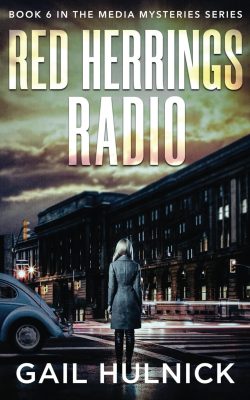

From its very first page, Red Herrings Radio, from Gail Hulnick’s Media Mysteries series, evokes the classic mystery novels of days gone by. We meet protagonist Lillian on September 7, 1964, in the pre-dawn hours as she heads to work. The early shift at a bustling radio station may seem like excitement enough, but soon Lillian’s faced with unexpected and unpleasant thrills: there’s a dead body at work, and it’s one of her best friends.
Red Herrings Radio uses many elements of classic mystery, even down to the noir lighting of the early-morning streets. Yet it also diverges from mystery-novel tradition in interesting ways.
Unlike many older mystery books, it has not only a female sleuth, but a focus on the challenges and barriers faced by a woman in the 1960s. The book is studded with authentic period details, from Beatles mania and folk music to the Royal Tour and the World’s Fair. It also doesn’t shy away from the weightier topics of the era. As Lillian investigates Susan’s death, she finds herself grappling with looming issues like abortion and gender equality. Author Gail Hulnick gives these issues their due complexity, painting a realistic picture of the 1960s as an era of global change and growing pains.
Red Herrings Radio also breaks from mystery tradition by featuring a reluctant and inexperienced sleuth. Lillian’s no cop, though she’s certainly willing to work with the police if it’ll help her get answers about Susan’s untimely end. She doesn’t like being mixed up in the drama of investigating what’s starting to look like a murder. Still, her sense of duty to Susan’s memory overcomes her reluctance. When everyone else seems to be giving up on finding the answer, Lillian never quite lets go of hope.
The search takes Lillian to unexpected places and introduces her to unusual suspects. The doctor is hiding something, and the professor and ex-boyfriend too. Now her coworker is suddenly acting suspicious. Red Herrings Radio lives up to its name as it introduces a growing list of suspects, each with complex motivations. The more Lillian learns about Susan’s life, the stranger things get. As it turns out, her close friend wasn’t really that close after all. Did Susan’s own secrets lead to her murder?
Alongside the mystery, this is also a tale of female friendship.
Lillian starts enlisting her and Susan’s mutual friends in the investigation but starts to feel resentful as she learns she’s been left out of Susan’s major life events. Susan even had a mysterious new boyfriend who Lillian didn’t know about. As she navigates both betrayal and loss, Lillian must grow through these challenges. For her, forgiving the friends who’ve apparently shut her out is almost as big a challenge as the unofficial murder investigation.
Along the way, Lillian’s career grows too. She deftly navigates barriers at work, beginning to outshine her more-experienced colleagues and landing choice reporting assignments. Readers get a fascinating inside look at the 1960s media industry.
As the radio station sends Lillian to exciting places like the New York World’s Fair, she sneaks in opportunities to continue sleuthing. Cold War tensions are running high, and the appearance of several stern and mysterious Russians further complicates Lillian’s investigation. She has countless leads, but no certainty. Though she finds a helpful police officer who’s willing to listen, she has little to offer him. In the end, Lillian must face the fact that she cares more about the investigation than anyone else, even the professionals.
Maybe it’s because she saw Susan’s lifeless body that morning at work. Maybe it’s a desire to redeem her place in a circle of friends who have grown apart. Whatever it is, Lillian can’t quite bring herself to let go.
This book moves fast. While there are points where it would have been nice to slow the action and delve deeper into Lillian’s complex life, Red Herrings Radio rewards its readers well in the end. When things look most hopeless for her investigation, the novel takes an unexpected leap.
Lillian’s answers don’t come when she wants them to, but through patience, attention, and a willingness to forgive, she at last has a chance to put the pieces together. What she discovers is shocking, yet strangely inspiring: solving the mystery also reveals something crucial about Susan’s character. Red Herrings Radio by Gail Hulnick is an excellent read for anyone looking for approachable thrills, unexpected twists, and an intelligent lens on history and human connection.
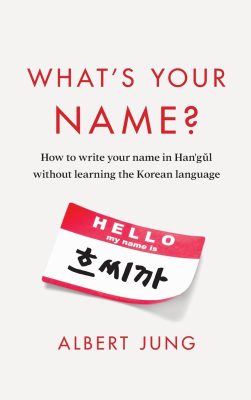
Albert Jung’s What’s Your Name?, subtitled How to Write Your Name in Han’gŭl Without Learning the Korean Language, is more than a primer for learning how to write in the Han’gŭl script — it’s a study of the evolution of the Korean writing system and, through it, the history of Korea itself.
What’s Your Name? offers a crash course in how to write your name in Han’gŭl for anyone who attends international conferences, hosts Korean exchange students, or simply has Korean speakers in their social sphere. Although the reader quickly plunges into the components of the Han’gŭl alphabet, Jung suggests a light read for the basics, and a comprehensive read for those seeking a deeper understanding of Han’gŭl and its evolution.
From absolute beginners to linguistics scholars and students, readers will find valuable reference material and guidance for practice in this extensive text.
Roughly half the book is made up of alphabetical diagrams, charts, examples, and comparisons, along with illustrations of the five main vocal organs used to pronounce the sounds and how to position them. Tables list common names and Han’gŭl characters side by side with their counterparts in English, French, German, Spanish, and Russian.
At the end of each section, Jung includes a handy pop quiz. These will help readers to cement the information for each letter of the Han’gŭl alphabet and build the confidence to forge ahead.
Here’s a brief look at the fundamentals: The vocal organs — molar, tongue, lip, tooth, throat — create top, middle, and bottom sounds, each of which are represented by symbols. Where the top sound symbol represents the shape and movement of the vocal part used, the middle sound symbol describes the sound’s quality: deep, flat, or shallow. Bottom sounds serve to stop the middle sound, either abruptly or slowly. Put together, the three sound symbols create a single character. Repeating this process for each letter in your name, you can transcribe it into Han’gŭl.
After mastering the top, middle, and bottom sounds, the reader moves into an intermediate stage to learn sounds that are more difficult to convey, such as r, l, th, v, f, sh, j, ch, and z, as well as pair letters which combine to make a single bottom sound.
Once readers get the hang of the modern script, they can move on – and back in time – to the earliest form of Han’gŭl, created in the 15th century by King Sejong the Great.
This version incorporated more sound letters, many of which don’t appear in the modern script, and differences with those letters that did survive the centuries are nuanced and subtle. Readers who want to delve deeper into the subject will find tables that show comparisons of names using the 15th-century script with those in modern Han’gŭl. Jung charts the fascinating development between these two forms.
Responding to the intricacies of both the original and the modern writing system, Jung presents the concept of a potential third form: Multiverse Han’gŭl, in which the best of both old and new are combined with global and cultural influences.
The last section of the book expands beyond a focus on linguistics, as Jung contextualizes the founding of Han’gŭl by sharing beautiful woodblock prints of correspondence and other texts, with translations provided.
This section could easily feature in an art history or anthropology class, or a course on the history of Korean literature. Within this section, the footnotes reveal the timeline of the script’s evolution through peeks into the country’s past, including politics, diplomacy, trade, and evangelism, each of which added its own influence to the Korean writing system.
What’s Your Name? by Albert Jung is a comprehensive guide for novices and intermediaries to not only learn how to write their name in Han’gŭl, but to also gain an appreciation for the evolution of a language and a culture that has withstood the test of time.
A Huge Congratulations to all of the Chanticleer Int’l Book Awards (CIBAs) Shorts, Series, and CCDA Finalists!
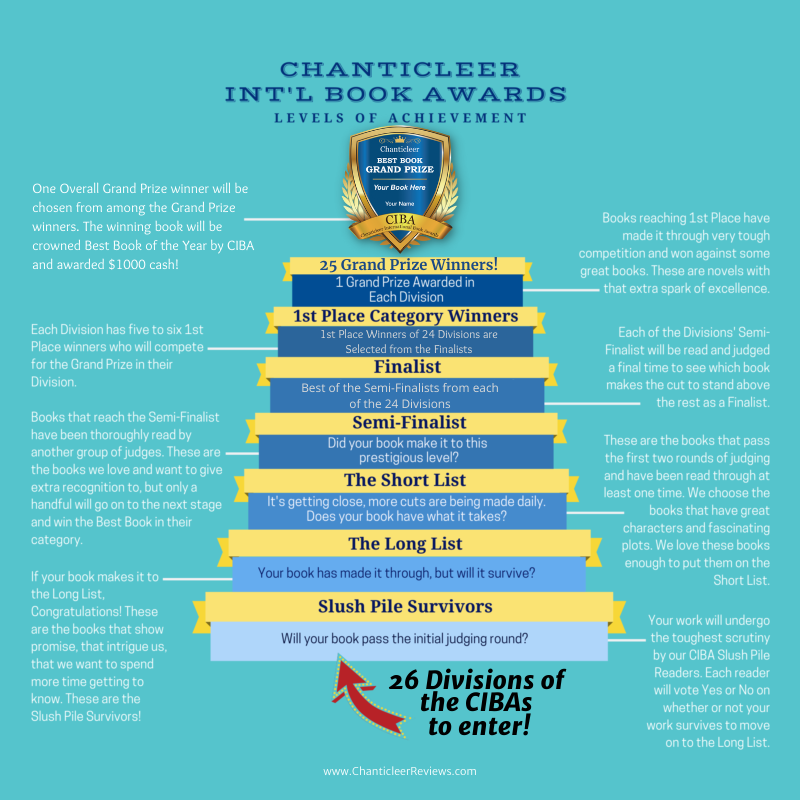
Every tier of the CIBAs is an important one, though few manage to rise this far in the ranks.
For our Shorts and Series Authors, this post has links to all of the Finalist Awards for the 3 CIBA Division Lists we have for Longform work like collections, anthologies, and novellas; Short Prose like Short Stories and Essays; and Series. We will have a separate post for Fiction and Non-Fiction.
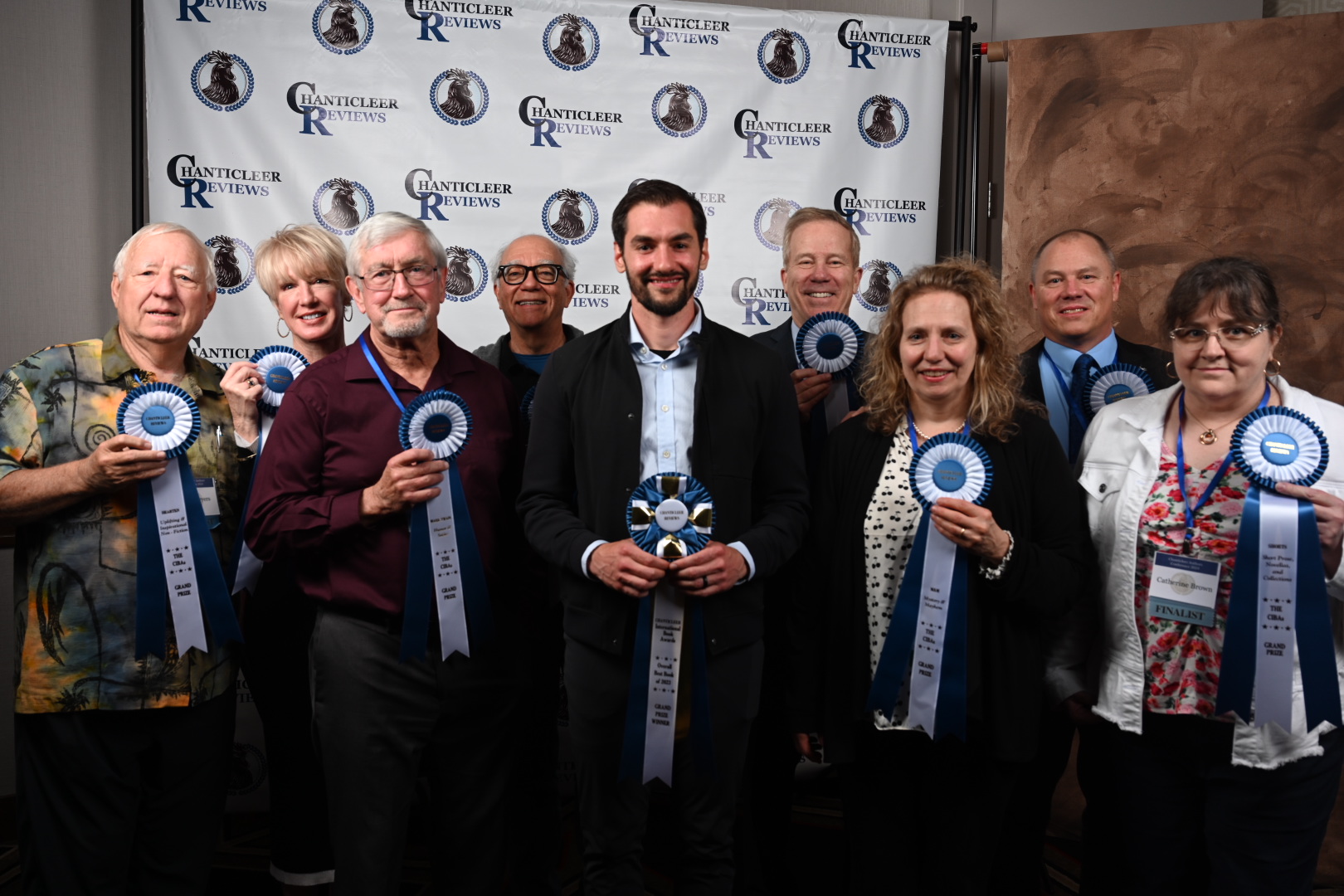
All Finalists in attendance will be recognized at the Chanticleer Authors Conference, and we will announce the Winners at the CIBAs Ceremonies on Saturday, April 5th at the Chanticleer Banquet. We can’t express how excited we are to be able to do this in person with our fully vaccinated and boosted staff in a healthy metro area.
Now let’s take a step back and look at where we came from to make this happen.
The remaining tiers are the First Place Winner, the Grand Prize Winners, and finally, the coveted Overall Grand Prize Winners. The Overall Grand Prize Winner takes home the $1000 and more! See the Book Award details here.
Now, presenting the links to the CCDAs, Series, and Short Awards Finalists
The Official 2024 CIBA Lists of the First Place and Grand Prize Winners for all Divisions of the CIBAs will start to be posted after April 8th, 2025.
We have badges available starting with the Short List. If you need a digital badge reflecting your tier level, please email info@ChantiReviews.com with your division and rank, and we will send you one as soon as possible.
The 2023 CIBA Grand Prize Winners!
The Annual Chanticleer Authors Conference is April 3-6, 2025
Make sure your Award gets the attention it deserves on Goodreads.com
In the Librarian Manual on Goodreads, you can go to your Book Edit Page — Literary Awards.
You want to list the Award for Chanticleer International Book Awards (CIBA) Winners, and be sure to include the year and what place you received. For example:
The year Long List, Short List, Semi-Finalist, or Finalist.
Note from Goodreads: “To add a new award or edit an existing award, you’ll need help from one of our volunteer librarians or a staff member.” For assistance, post in the Goodreads Librarians Group.
Always double check that you’ve written everything correctly before posting it. The search function for Awards on Goodreads is both case and punctuation sensitive.
Remember, you don’t have to be present to win, but it sure is a lot more fun!
The esteemed WRITER Magazine (founded in 1887) has repeatedly recognized the Chanticleer Authors Conference as one of the best conferences to attend and participate in for North America.
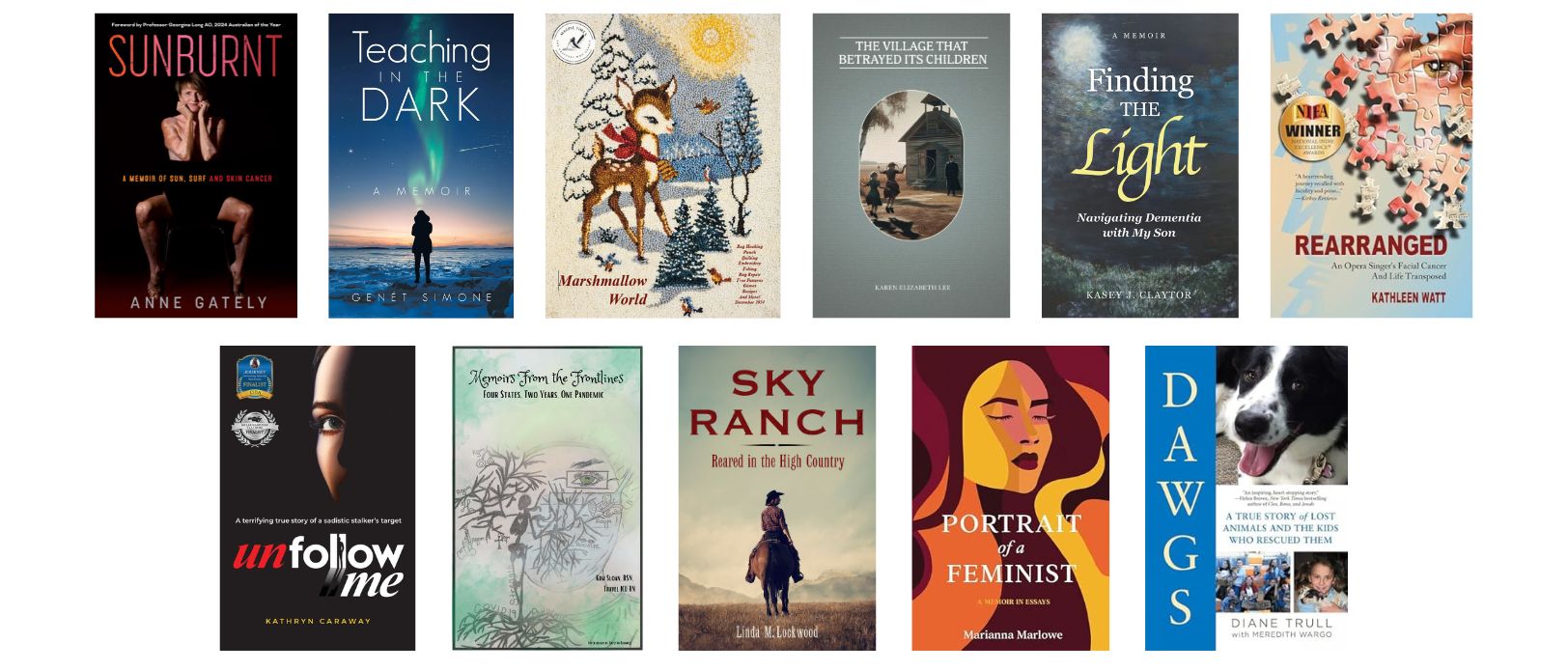
Three Cheers for for the CIBAs 2024 Non-Fiction Book Awards Finalists!
Every tier of the CIBAs is an important one, though few manage to rise this far in the ranks.
For our Non-Fiction Authors, this post has links to all of the Finalist Awards for the 7 CIBA Divisions we have for Non-Fiction. We will have a separate post for Fiction and one more post for the Shorts Awards and Series Awards.
Now let’s take a step back and look at where we came from to make this happen.
The remaining tiers are the First Place Winner, the Grand Prize Winners, and finally, the coveted Overall Grand Prize Winners. The Overall Grand Prize Winner takes home the $1000 and more! See the Book Award details here.
Now, presenting the links to the Non-Fiction Awards Finalists
The Official 2024 CIBA Lists of the First Place and Grand Prize Winners for all Divisions of the CIBAs will start to be posted after April 8th, 2025.
We have badges available starting with the Short List. If you need a digital badge reflecting your tier level, please email info@ChantiReviews.com with your division and rank, and we will send you one as soon as possible.
The 2023 CIBA Grand Prize Winners!
The Annual Chanticleer Authors Conference is April 3-6, 2025
Make sure your Award gets the attention it deserves on Goodreads.com
In the Librarian Manual on Goodreads, you can go to your Book Edit Page — Literary Awards.
You want to list the Award for Chanticleer International Book Awards (CIBA) Winners, and be sure to include the year and what place you received. For example:
The year Long List, Short List, Semi-Finalist, or Finalist.
Note from Goodreads: “To add a new award or edit an existing award, you’ll need help from one of our volunteer librarians or a staff member.” For assistance, post in the Goodreads Librarians Group.
Always double check that you’ve written everything correctly before posting it. The search function for Awards on Goodreads is both case and punctuation sensitive.
Remember, you don’t have to be present to win, but it sure is a lot more fun!
The esteemed WRITER Magazine (founded in 1887) has repeatedly recognized the Chanticleer Authors Conference as one of the best conferences to attend and participate in for North America.
Give a huge round of applause to all of the Chanticleer Int’l Book Awards (CIBAs) Finalists!
Every tier of the CIBAs is an important one, though few manage to rise this far in the ranks.
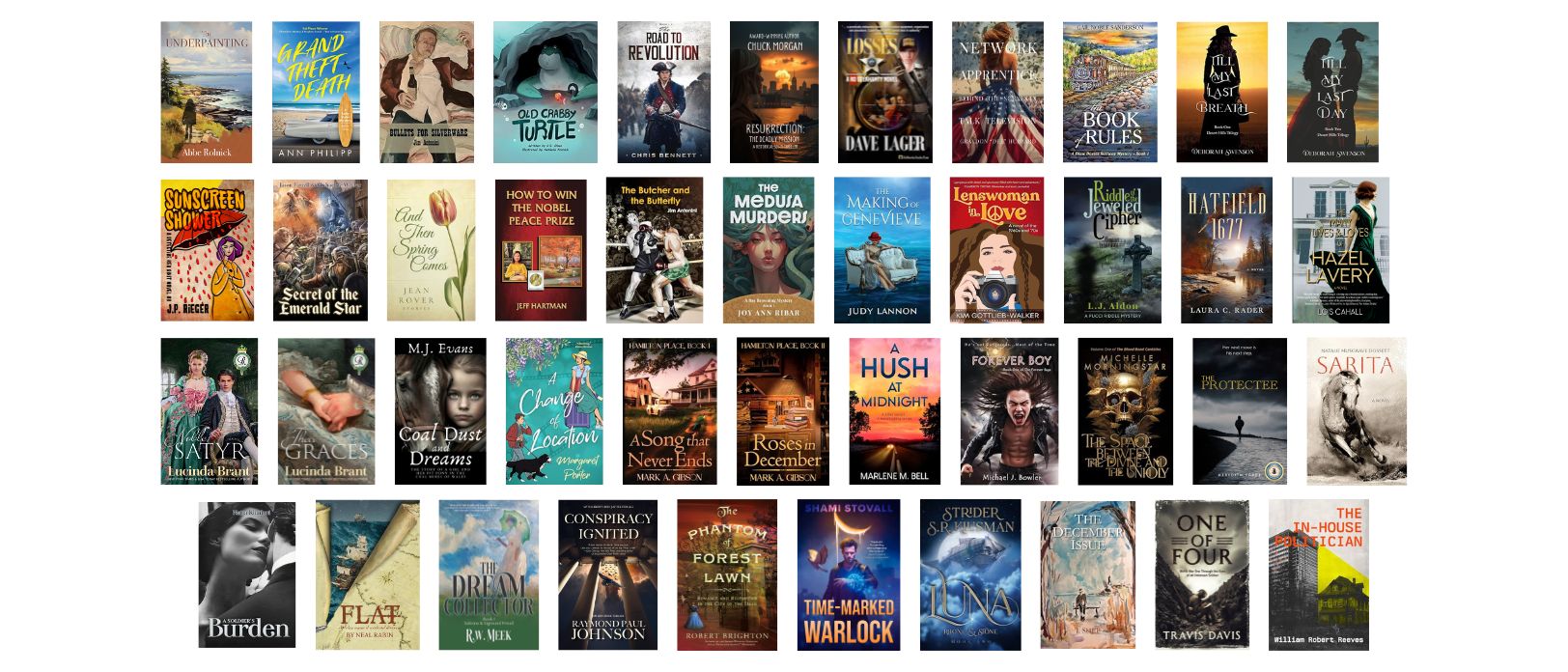
For our Fiction Authors, this post has links to all of the Finalist Awards for the CIBA Divisions we have for fiction. We will have a separate post for Non-Fiction and one more post for the Shorts Awards and Series Awards where you can find all the 2024 Finalists!
All Finalists in attendance will be recognized at the Chanticleer Authors Conference, and we will announce the Winners at the CIBAs Ceremonies on Saturday, April 5th at the Chanticleer Banquet. Banquet Only Tickets will open soon, and a limited number will be available!
Now let’s take a step back and look at where we came from to make this happen.
The remaining tiers are the First Place Winner, the Grand Prize Winners, and finally, the coveted Overall Grand Prize Winners. The Overall Grand Prize Winner takes home the $1000 and more! See the Book Award details here.
Now, presenting the links to the Fiction Awards Finalists
The Official 2024 CIBA Lists of the First Place and Grand Prize Winners for all Divisions of the CIBAs will start to be posted starting on Wednesday, April 9th, 2025.
We have badges available starting with the Short List. If you need a digital badge reflecting your tier level, please email info@ChantiReviews.com with your division and rank, and we will send you one as soon as possible.
The 2023 CIBA Grand Prize Winners!
The Annual Chanticleer Authors Conference is April 3-6, 2025
Make sure your Award gets the attention it deserves on Goodreads.com
In the Librarian Manual on Goodreads, you can go to your Book Edit Page — Literary Awards.
You want to list the Award for Chanticleer International Book Awards (CIBA) Winners, and be sure to include the year and what place you received. For example:
The year Long List, Short List, Semi-Finalist, or Finalist.
Note from Goodreads: “To add a new award or edit an existing award, you’ll need help from one of our volunteer librarians or a staff member.” For assistance, post in the Goodreads Librarians Group.
Always double check that you’ve written everything correctly before posting it. The search function for Awards on Goodreads is both case and punctuation sensitive.
Remember, you don’t have to be present to win, but it sure is a lot more fun!
The esteemed WRITER Magazine (founded in 1887) has repeatedly recognized the Chanticleer Authors Conference as one of the best conferences to attend and participate in for North America.
Sister Butterfly from Mike Mirabella’s Carla Stories shares the crucial message that communication comes in many forms. Even for those who struggle to be understood, connection is always possible.
Told through song lyrics and charming illustrations, a young girl with Down Syndrome on a walk through a verdant garden. Eventually, they encounter a group of other kids, who come to see the flightless blue butterfly she has found.
True to its title, this book creates a lyrical parallel between the little girl and the butterfly.
Both the girl and the butterfly use unique ways to interact with the world that make them easy to be overlooked. The butterfly must walk on the ground and is only found because the girl searches a quiet corner of the garden. In turn, her “secret world is hidden in the silence of her eyes.” When the other kids take an interest in what she has found, they find she’s happy to show them her special butterfly friend.
Illustrator Amy O’Hanlon’s pastel drawings perfectly match the tone and meaning of the heartfelt lyrics.
Double-page spreads of a vibrant garden fill this book. The characters are largely rendered in soft hues, with their eyes and the world around them standing out in a rainbow of brilliant color. A matching shade of blue emphasizes the bond between the little girl and the butterfly, standing out brightly among the greenery. The beautiful composition of shapes and colors on each page makes Sister Butterfly a treat to read.
Sister Butterfly contains the poetic lyrics of a song of the same name, written by author and musician Mike Mirabella about his daughter Carla, who like the little girl in the book, also lived with Down Syndrome. This provides him with a unique insight into the little girl’s special world.
The book comes with a download of a recording of Sister Butterfly, as well as sheet music for anyone– child or adult– who wants to learn the song themselves. The format of this book would make it easy for young children to try singing along and contains a bonus song, I Am So Like You, also by Mike Mirabella.
With its touching message of empathy, gorgeous illustrations, and an invitation to explore its inspired music, Sister Butterfly makes for an excellent read that can be enjoyed by both the young and the young at heart.
Spring Cleaning includes Hardware, Software, and Password Management
While many of us look to closets and drawers we store things we never expect to see again, there are few who think about the hidden corners of our technology where dust, dirt, and crummy things (like destructive viruses) can live in wait for their turn to take down our work. We’ll help you with best practices for keeping your passwords and technological life in tip-top shape!
A clean sweep for your computer is a must-do for authors
Every writer should start off the year knowing their work is protected and their work tools are ready and able to take on the job of creating the worlds we imagine. So, in the spirit of getting ready to meet those 2025 writing goals, we offer these tips on the cleaning and maintenance of your equipment.
Your computer needs your loving care, too!
Computers are arguably the most important tool in our toolbox. It stores your intellectual property, aids in transforming words from your brain into little alphabet letters that add up to a story. For most of us, our computers enable us to create what we love most—books and stories!
Whether it is a desktop, laptop, pad, or your own Mad Maxx creation of technologies (like Argus’s), your computer deserves a little bit of attention.
Computer Care for Authors and Publishers
We often forget how important it is to maintain a clean computer on the inside and outside, even if our desk and the surrounding area is spotless. Here are a few tips to get you started. And, yes, this is your annual reminder!
1. Clean your keyboard
If you don’t want to be like the person in this XKCD comic, you might want to clean your keyboard. Luckily, this is an easy task you can do once a week. Or at least once a year…
Ewwww!!
Wipe it down with a slightly damp microfiber cloth, dry it with a different cloth, and then use a disinfectant wipe or a cloth just damp with rubbing alcohol to finish it out (do not use bleach!). It is probably best to do this when your computer and keyboard are unplugged because keyboards are actually quite delicate inside.
Gross stuff under the keycaps? Maintenance will prevent your computer keyboard from getting to this state.
Also, turn your keyboard or laptop upside down and give it a gentle shake or two about once a week. Gentle being the operative word. You may be surprised to see what falls out of it.
Especially if you have a cat for an intern. Here’s looking at you, Janet Oakley!
Janet’s intern, Kinky Boots, hard at work.
We’ve even seen Argus vacuum his keyboards. But, that is up to you.
Really consider giving this a try. Your keyboard will feel cleaner. All the bits of dust and crumbs of food you’ve learned to ignore will be gone, and it will be such a pleasant experience for your hands.
Clean your screen
We’ve all had that experience of editing and suddenly an errant apostrophe or period appears where there ought not to be one. We click on it to edit it, but something about the way it appears doesn’t quite make sense, and then we can’t delete it from the page. That’s when it clicks. The screen is just dirty.
To clean it, a microfiber cloth is always the recommendation. Always dab any cleaning solution (Windex and/or a little bit of mild soap and water are recommended but check before trying anything else!) onto the cloth, not directly on the screen itself.
Password Management
Over 353 million passwords are hacked in 2023, according to Statista, and this number has continues to grow substantially each year.
The concept of a healthy mind, healthy body can be applied to healthy software, healthy hardware, too. Now that you have a clean machine, make sure you have a good password system. While two-factor authentication (such as when you need to type in a code from your phone or email as well) can seem like a hassle but is also another key factor in security. For reliable password managers, see the following.
We use these here at Chanticleer—but use caution and be prepared!
Using numbers, characters, and upper and lower cases matters when it comes to password security.
Make sure the password you decide on for your managers is something that is memorable to YOU. The only other person who should have it is your estate executor or life partner or someone that you would trust with your bank accounts and credit cards.
If you happen to momentarily forget your master password, because someone was talking to you while you were creating it – you will need to start over. There is no way to recover your account, unless you happen to find the random piece of paper you scribbled your master password on… Experience is a cruel teacher…
IMPORTANT: DO NOT USE THE SAME PASSWORD for your business/work accounts and your personal household accounts or publishing accounts. This is how hackers can take people down by infiltrating a business password—harder to do, but they have access to so many personal accounts because so many people use the same password for home and personal accounts.
After hearing from several authors whose computers were hacked, bank accounts taken over, ransomware remotely installed, and other malicious activity that drained their credit card balances and credit ratings, and stole their intellectual property (as in books – published and unpublished), we suggest you go directly to a password manager. Do not go another day without a password manager!
You can do it! There are several excellent password managers that are FREE or as little as $36 per year.
For more information here are three links to articles about password managers from reliable sources:
Here is a link from CNet on the Best Password Manager companies
[Note from Editor: Do NOT proceed to this step until you have your Password Manager project all sorted out. ]
As we barrel forward into the future, there’s so much in our cache that this has become a bigger and bigger project. Luckily, PC Mag has a great article about how to clear your cache on any browser. While this can be a little tricky to navigate, it can be worth it for the faster computer speed. PC Mag also focuses on the security risks of the cache, but chances are most of us don’t have to worry too much about those.
WHY SHOULD YOU CLEAR YOUR CACHE from COOKIES?
This is called “Browser Hygiene.” Really.
Browsers tend to hold onto information and like a clogged drain, after a while, it will slow down the speed and performance of your computer. Where your browser holds onto this information is in its “cache.”
A computer’s cache (pronounced ‘cash’) is also where websites that you visit implement their “cookies”—that bread crumb trail that rambles through the internet linking your computer to the websites you visit. Each and every website uses cookies—even yours is guilty of it. It is the nature of the internet…
Have you ever had this happen to you?
“I don’t see the change. You said you updated on your web page.”
That is because your computer is storing and showing you the previous cache of the website it stored in its cache. You aren’t seeing the latest and greatest of the website you are revisiting, but rather a “shadow” of it.
To see the latest version of a website or webpost, you will probably have to clear your computer’s cache, which will delete cookies at the same time.
Each computer and browser has a different system, so we advise you to search on your browser (i.e. Google it) on how to clear the cache for your particular system.
Also, you can decide how much of the cache you want to clear. All of it? Only the cookies? Save the passwords? Clear the passwords? (the reason to do #2 Password Management first). It is probably a good idea to clean the password cache at least once a year. But remember that you will need to do a fresh login for each website that you visit. See #2 Password Management.
We clear our caches here at Chanticleer at least every three months or as needed to access new data from websites that we visit.
More info:
Remember all that fuss about Data Privacy back in May 2018? Cache and Cookies are what that was and is all about. Here is a handy link to Chanticleer’s blog post about it. Are you ready for the GDPR? (General Data Protection Regulation)
Virus Protection
What are the odds of becoming a victim of a cyber attack? One in Five
Any highly rated anti-virus and anti-malware program will update itself on a daily basis for latest hacking techniques, Trojan horses, phishing methods, ransomware, adware, spyware, and worms (I shudder to think about this one), and other malicious activity. This is different than updating the program itself. Is your antivirus program a couple of years old? If so, time to do some research.
Again, we’re going to turn to the experts here and look at CNET’s best Windows antivirus Protection. A good antivirus keeps your computer running in top shape, and it keeps your data and writing easy to access for yourself, so you don’t end up like one of the characters in Neal Stephenson’sReamde who end up with all their files locked away by ransomware.
Now for some potentially bad news.Ifmalware has made it into your computer, you will need to have it professionally removed or contact the family and friends computer geek to save your computer and your sanity. If you are computer handy, then you have probably already taken steps to rid your computer of it.
The scary thing about malware is that once it has infiltrated your computer, it may be hard to detect even by anti-virus protection. That is how sneaky and underhanded malware can be.
Some symptoms that your computer may be infected with malware:
Your computer is slowing down
Your computer crashes more often or “locks up”
Your friends and contacts receive strange messages from you
Suddenly you do not have any storage space available
Your homepage changed itself without you changing it.
PUPs show up. These are Potentially Unwanted Programs that have infiltrated your system when you give your consent to install additional tools on your computer. We think “barnacles” would be a better name.
Make sure that your computer (and smart phone) has the latest anti-virus and anti-malware programs protecting it.
Now for some definite good news!
Highly rated by independent and professional reviewers of Anti-Virus and Anti-Malware programs are available from free to $59 a year. A small price for piece of mind.
Don’t think that it can’t happen to your computer. Computer viruses and malware are prevalent and widespread. Once they find a home, they tend to go systemic in a very sly and under-the-radar kind of way. Your screen will not flash or start posting pictures of Moriarty when your computer has been invaded. Today’s hacks tend to be silent but deadly.
That’s what we want you to see! That you are safe!
Back up your files
Anything that you’d have trouble replacing, it’s worth backing up. There are several places like One Drive, Dropbox, or Google Drive that will let you store files for free, up to a certain point. Luckily, external hard drives are getting cheaper all the time, and you can always do both. Whenever one of my free online drives fills up, I move anything I’m not currently using onto my external hard drive. I also make sure to periodically back up my writing.
This is such a great fear of mine that on my fire list (list of things that I need to grab immediately in case of fire) I have my external hard drive above everything else. I’m sure if you aren’t someone who has lost data, you know people who have, and I dearly hope you never have to worry about that.
Cyber Threats STOPS with each of US!
Once your computer and files are all protected, you’ll be free to write without any anxiety hanging over your head. Like cleaning and maintaining most things, a routine means you only need to do a little work when the time comes to get everything squared away.
We hope these were handy reminders. Everybody gets busy and can easily procrastinate about taking care of these mundane but vital tasks. We certainly do!
If there is something we should add to this blog post or you have an experience that you would like to share or a question that you would like to ask about the cleaning and maintenance of your writing tools, please contact us at Chanticleer@ChantiReviews.com
We’d love to hear from you!
Thank you for joining us and please stay tuned for the next Business and Marketing Tools and Tips for Writers Article!
Thank you for joining us for this Writer’s Toolbox Article!
Writer’s Toolbox
Thank you for reading this Chanticleer Writer Resolutions article.
Our Annual Chanticleer Authors Conference (CAC25) will be April 3-6, 2025, where our 2024 CIBA winners will be announced. Space is limited and seats are already filling up, so sign up today! CAC25 and the CIBA Ceremonies will be hosted at the Bellingham Yacht Club Event Center located on the shore of beautiful Squalicum Harbor in Bellingham, WA.
Lorelei the Lorelei seeks a best friend and to figure out what makes her truly special, all on her first day of public school. In Lorelei the Lorelei: The First of Many Firsts by Kristen J. Anderson, young Lorelei finds that not everything is as she expected.
After anxiously waiting for her dad and baby brother J.J. to get ready, and armed with the wisdom of her Mee-maw, Lorelei strides into Hillside Elementary School. She shows off her eclectic fashion and discovers that even a teacher named ‘Miss Grim’ can be welcoming. At first, Lorelei’s plans are coming together. She’s certain that Adeline, a girl who shares her exuberant nature, will be her best friend.
But Lorelei butts heads with Emily, aka “Hands” given her impatience to be called on. As a student of ballet and future sugary-cereal-advertisement star, Emily has little patience for Lorelei taking the spotlight.
As a newcomer to public school, Lorelei has to navigate this conflict while learning new schedules, rules, and terms. But she keeps her heart and mind open, even when she doesn’t quite understand all of her new classmates.
Anderson captures a childlike view of the world in her prose.
Lorelei sees the end of summer as a portend for the first snows of winter—and the hot chocolate to come along with it. While she holds strong opinions, Lorelei is quick to consider new ideas and come up with explanations for why things are a certain way. Anderson’s written voice builds on the natural humor found in Lorelei’s excitable perspective, making this book immediately approachable for young readers.
Lorelei herself is a relatable figure for many kids as she deals with the nervousness of a new experience.
As much as school might excite her, Lorelei often gets anxious and has to use breathing techniques to keep her asthma from flaring up. Lorelei the Lorelei will help young readers face their own ‘firsts’, as Lorelei herself deals with unexpected problems.
Throughout the book, Lorelei becomes a good role model for kids starting school or trying to make new friends.
Like anyone, Lorelei can get annoyed at her family’s antics, but the love and familiarity between them is always clear to see. She’s a good sister to J.J. and carries her kind nature into the classroom. By standing up for other kids when they get picked on or left out of the group, Lorelei shows the importance of making space for others. Her classmates return that kindness, supporting Lorelei even when her messy bangs escape from her hairband.
Lorelei ultimately learns not to make assumptions about people before she gets to know them, and that not everyone’s had the same experiences as her. In fact, she finds that her classmates have interesting stories of their own to tell. And, while understanding someone who annoys her is harder to do, especially after getting into an argument, Lorelei tries to empathize with Emily rather than become playground enemies for good.
Illustrator Audrey Suau perfectly matches the tone of the story with a cheerful picture for each chapter.
Little details, like Lorelei’s unique outfit, pop from the background. The characters are distinct and show their personalities in image and writing alike. Even bigfoot himself makes a cameo—at least, in the woodland of Lorelei’s imagination.
Young readers will find a welcoming tale and valuable lesson in Lorelei the Lorelei.
Lorelei embraces each new activity whether she was prepared for it or not, leaping in with an excitement that readers will share. She might not quite know what makes her unique by the end of the day, but she certainly makes her new friends feel special. After all, every kid could use a good friend on the first day of school.
CIBA 2023 Grand Prize award-winning Author Kevin Miller sat down for a 10-Question Interview with Chanticleer!
Recently, Chanticleer had the pleasure of speaking with Kevin Miller, former US Navy fighter pilot and author of The Silver Waterfall. Miller takes readers into the cockpit of the world’s most powerful military aircraft in his four book series, Raven One. Miller’s award-winning fictional account of the Battle of Midway, The Silver Waterfall, took home the 2023 Hemingway Grand Prize for Military Fiction. Miller is an expert in combat air battles and literacy advocate and I know you’ll enjoy learning more about him and his thrilling novels!
Here’s what we talked about:
Chanticleer: Your specialized military knowledge is the subject of your writing. Tell us a little about yourself. What led you to write about the Battle of Midway?
Miller: In a previous life I was a career Navy fighter pilot, with most of my time in the F/A-18 Hornet. To viewers of TOP GUN and TOP GUN II… yep, I did that. My career took me to command a carrier-based fighter squadron that I led in combat. Wrapping it up at the Pentagon, I retired with the rank of captain after serving 24 years, logging over 3,600 hours and 1,000 carrier landings on numerous extended deployments.
At my retirement ceremony a fellow aviator suggested that I write a book, a suggestion I immediately waved off. Undeterred, he pressed me – hard – and told me that I have stories. Later I gave it some thought. Yes, I do have sea stories, and a passion to answer the question I was asked so often when people found out what I did for a living; Wow! What is that like? Having no idea where to start or what writing entailed, I figured why not? At least my manuscript could be something for the kids. So, months later in the summer of 2005 I began writing what would become Raven One.
Before I wrote the first sentence, I had never considered writing a novel, considering it something that mere mortals could never attain. The discipline! As I wrote – seat of the pants – a story formed, and after fits and starts (setting it aside in frustration for months then picking it back up and writing in a flurry of activity) I finished Raven One in late 2009… and knew that I had something.
Querying literary agents to represent me, despite the encouragement of many to keep writing, proved a failure. However, Kindle Direct Publishing was coming into its own, and publishing as an independent author became more attractive with each rejection from “New York.” Networking led me to fellow aviation thriller author George Galdorisi, who led me to his micro-publisher and military thriller author Jeff Edwards of Stealth Books which is now Braveship Books. Under their guidance, Raven One was published in the summer of 2014. The novel peaked at #29 in all of Amazon by the spring of 2015.
Chanticleer: That’s a huge journey and a familiar one for many. Was there a point where you realized you had become an author?
Miller: Yes, holding that first copy of Raven One in my hands was a special moment. I wrote – and published! – a novel! But it was weeks later as the novel gained a following that I noticed the comments in the review section. The glowing reviews were from strangers who loved the book – comparing the writing to Clancy and Coonts – and encouraged me to write more. Soon I heard from my friends, many of them former squadron mates who know how to give and receive honest feedback. They were blown away by the story and how I told it, and they met me at gatherings with copies for me to sign. Gratifying! And that’s when I knew Raven One was not a one-off, and that I had to keep writing
Chanticleer: That’s wonderful! Likewise, your Chanticleer award winner, The SilverWaterfall, is a great story full of action, suspense, history, and so much more. Can you talk more about your relationship with your genre?
Miller: Writers typically write what they know about, so for me the military action-adventure genre is a natural. My Raven One series novels are military technothrillers, a genre first made popular by Tom Clancy. They are found in War Fiction, War and Military Action, Sea Stories, Sea Adventures, and the like. Amazon allows authors great specificity in genre selection, and I could probably keep my latest novel High End as a perennial #1 in an Authentic and Contemporary Carrier Aviation Fiction Above the Arctic Circle genre but playing games like that is not for me as I want my books to compete and earn their accolades honestly. That said, I often see romance books in War Fiction when the only “war” part is that the love story is set in a wartime setting. We know why authors do this; all’s fair in love and war.
The Silver Waterfall: A Novel of the Battle of Midway, for which I was honored to receive the 2023 Chanticleer Hemingway Award, is pure historical fiction. To me, historical fiction provides the human emotion to a true event without changing any of the facts of that event, such as Shaara’s Pulitzer-winning masterpiece The Killer Angels. Our novels put the reader there, amid the real men who fought these battles, giving these historical figures voice as to what they experienced. Some historical fiction authors are too loose with facts and invent facts, even going so far as to impugn the reputations of the real men who were there. I could not live with myself if I did that, especially for an event like Midway, already full of drama and amazing chance.
Just won the CIBA Grand Prize in the Hemingway/Military Fiction division!
Chanticleer: We’re always astounded at the commitment to veracity of our historical fiction authors. The amount of research that goes into that is incredible. For your own writing day, how do you stay on track to finish your books?
Miller: Stephen King says that 1,000 words of writing is a good day of writing. If I get to a break in the story and stop for the day at 950 or 875 words I don’t beat myself up, but 1K per day works, especially if you have other activities (I do business consulting and teach middle school history) to fill your day. Promotion is part of my writing workday, as of course is research for my type of technical and historical writing.
Outlining? Yes and no. I have one in my head and follow it, but because it’s not written down, I can ride along on those magical moments when my writing takes me someplace I had never expected. The Silver Waterfall involved a historic event that has been written about extensively and that I knew well, but even in that novel I could “ride” when the muse took me to a new place when describing the human experience of a known historic event.
As Stephen King suggests, I’m one of those who writes and sets it aside for a few weeks to germinate, then prints it out to go over it with a pen to fix/improve. Several cycles: read it “fresh” after several months and you’ll unearth little gems to spice it up and rough patches you missed to sand and polish.
Chanticleer: You’ve talked a bit about Tom Clancy and Stephen Coonts as comp titles for your work earlier on, but which authors do you for inspiration, advice, or just because you like their work?
Miller:
Herman Wouk
Wouk is an absolute badass of a writer, from his unflinching views of human nature to his superb research of his subject. As a Midway historian with a carrier aviation background, Wouk – who was an officer but not an aviator in WWII – wrote passages in War and Remembrance about the carrier pilots at Midway that impress me not only by their accuracy in flying the airplane but their human emotions in the middle of deadly aerial combat. His fictional German historical commentator von Roon – a brilliant character – gives context to the history the characters are living inside. The Caine Mutiny is a masterpiece in human conflict and the unfairness of life. Wouk puts you inside the mind of a three-dimensional character like no one else.
Michael Shaara
Many are not familiar with this name from 50 years ago, who at the time received a Pulitzer for The Killer Angels, the classic historical fiction novel of the Battle of Gettysburg. Shaara – who was an Army veteran but not a noted Gettysburg historian – brought Lee, Longstreet, Chamberlain and Pickett to life without changing any facts of the battle, giving the reader the honest insights and impassioned pleas of the real men who fought at Gettysburg as to how they should deal with the enemy across the field. Shaara was 100% my inspiration for The Silver Waterfall. As the country was recovering from its Vietnam War trauma, The Killer Angels was not successful when published in the mid 1970’s. Shaara did not live to see it adapted into the movie Gettysburg and the commercial success Angels has subsequently received. Another of his works was published posthumously and adapted into a movie: For the Love of The Game.
Captain Edward L. Beach
Ned Beach was a WWII submariner who after the war and while still on active duty wrote the novel Run Silent, Run Deep, an immediate hit with post-war audiences that was adapted into a movie starring Clark Gable. The story is of conflict inside the control room of the submarine between two officers who each want the same woman back home but must cooperate to lead the crew against the enemy above them. This human tension centered in pride is a feature of all my novels. Beach wrote more novels including Dust on the Sea and Cold is the Sea, both to critical acclaim. During this time, he was given command of the nuclear submarine Triton that circumnavigated the world while submerged, an incredible feat in the day. Sadly – and not surprisingly to this naval officer – Beach was not selected for promotion to admiral as the higher ups were jealous of his fame and considered his creative pursuits unseemly.
I write in his third-person style, calling my protagonist by his last name while placing the reader on the bridge of a ship or in the cockpit of an airplane as it really is, and expecting the reader to keep up.
Pat Conroy
Pat Conroy grabs you and does not let you go with the raw human power of his writing. Just wow. Like all the greats, he is honest – and fearless. Known best for The Prince of Tides and Beach Music, for me as an aviator, The Great Santini will always be my favorite. However, it is far from a military technothriller. It is a human story as all of his are about the reality of the most sinful of the deadly sins, pride. The Lords of Discipline is another unforgettable work which, like Santini, is more memoir than fiction. Pat Conroy had a rough upbringing, and as they say in sports, left it all on the field in his writing, holding nothing back. Just wow.
Khalid Hosseini
I’ve never visited or even flown over Afghanistan – my time in the fleet was before that – but I have been there thanks to the writing of Khalid Hosseini. Like millions of readers, I too was enthralled by The Kite Runner and his sequel A Thousand Splendid Suns. Hosseini’s vivid descriptions of place, the detail, and of course his insights of human nature and the fascinating culture of Afghanistan – both lovely and horrifying – are unforgettable. He explained Afghanistan to foreign readers in a no-nonsense style, unapologetic and fresh. We recoil at the cruelty and betrayal – I cannot believe they treat their fellow human beings like this! – but turn the page anyway as Hosseini assures us, yes, they do. I seek to describe and explain my former world with verbal images like Hosseini did his.
Chanticleer: That is an amazing personal canon to draw from. Do you also enjoy craft books, and do you have any you would recommend?
Miller: The classic Bird by Bird by Ann Lamott was enjoyable, but Stephen King’s On Writing, Pat Conroy’s My Writing Life, and especially Steven Pressfield’s Do the Work and Nobody Wants to Read Your Sh*t were each helpful to me and I would recommend them to anyone who writes creatively. People often ask me for my insights as they prepare to write a book. I explain that writing, at the bestselling and award-winning level, is hard, hard work and there’s no escaping it. While I cannot explain how I write – I just let it rip! – these giants have written helpful guides. Enjoy.
Chanticleer: While most people think of writing as a solitary activity, we often find it has far reaching impacts. How has being an author affected your involvement in the community?
Miller: Author implies authority, and I am an authority on the Battle of Midway, now recognized by all in my circle because of the success of my historical fiction novel. Two years ago, I spoke at a gathering of all the U.S. Navy admirals in naval aviation about the lessons of the battle, lessons they can use today, and next year I’ll speak at a large event to commemorate the battle. Because I am also connected to today’s fleet, my Raven One series novels are prescient for today, especially my last two that involve China and Russia, and I’m often invited to give talks at Rotary Clubs and veterans groups to educate the public about the need for strong sea services. Publicity earned from the CIBA recognition of The Silver Waterfall cemented my position as an authority on Midway.
Chanticleer: That’s incredible! Becoming an expert of such an important historical event is really quite an accomplishment! And we at Chanticleer are very happy to know your CIBA award has helped to bring more attention to the Battle of Midway and your wonderful novel. Are there any activities you are involved in that improve or promote literacy?
Miller: I teach middle school history at the honors level, one day per week. My honors students are above average readers, and during the semester I assign reading. The novels Around the World in 80 Days for 6th grade geography, and The Red Badge of Courage in 8th grade U.S. history are examples, and after they complete the reading, I have them write essays about them in class. They grumble of course, but where else will they read these classics of literature?
Chanticleer: Being a teacher is such a gift to the future. Thank you for doing that work. Your students sound lucky to have you. If we can bend your ear for us for a teachable moment, what are some marketing tips that you would recommend to our authors?
Miller: My publisher says there is nothing like writing a new book to sell your current one, however paid FB and Amazon ads work, as do email lists. Promo stacking with services such as Amazon, BookBub, Robin Reads, ENT and others is an effective strategy. While I’ve snagged three BookBub featured deals (all for Raven One) I’m still struggling with breaking the code on what works (regarding Canva creatives) for BookBub advertising. Posting on social media almost daily about my flying days and sometimes me with my book is effective; Chanticleer author D.D. Black does this very well on Instagram. So does Tony Selimi, who says authors must get famous to get a larger audience. Get a Facebook business page with others on social media to gain follows. LinkedIn is good, Pinterest during the Christmas gift giving season, and, of course, email. Recommend investing in KDP Rocket, and David Gaughran is a superb follow for indie writers on all aspects of publishing and promoting.
Chanticleer: That is a wealth of excellent information for authors. What about for readers, what help can readers be to authors?
Miller: Receiving a kind email from a reader is gratifying, and I always write back thanking them, and then ask them to leave a review. WE all know and crave the social proof of reviews, but my sense is that only 1-2% of readers leave one. Wish that Amazon allowed us to thank them when they do. Passing the word of course is nice of readers. Word-of-mouth advertising can’t be beat. Then there’s good old-fashioned encouragement. Writing as we know is hard drudgery, and for me the end-product is what drives me, not any joy or “rush” in the act of writing. Doing the work as Pressfield says and producing something that people can appreciate today and decades from now is my “why.” Thank you to the readers, known and unknown to me personally, who have encouraged that.
Retired U.S. Navy Captain Kevin Miller graduated from the University of Mississippi and was designated a Naval Aviator in August 1983. He flew the A-7E Corsair II and FA-18C Hornet operationally and commanded a deployed strike-fighter squadron. He finished his career in the Pentagon serving on the staff of the Secretary of the Navy, retiring in 2005.
After leaving the service Kevin was employed as an associate at two Washington DC defense consulting firms, then as a not-for-profit executive, and today is the Owner/Principal of MPK Defense Consulting. He is also the Best-Selling and Award-Winning author of the Raven One military action-adventure series and the historical fiction novel The Silver Waterfall: A Novel of the Battle of Midway that was awarded the 2023 CIBA Hemingway Award for excellence in 20th Century Wartime Fiction.
Kevin lives in Pensacola, Florida and is working on his next novel. Find out more about Kevin and his novels on his website.
Frozen Conquest by Randall Krzak is a thrilling and intense conflict between the cold of Antarctica and the blazing ambition of those seeking global control, fusing the issues of power, greed, and survival into a high-stakes adventure.
The icy edge of Antarctica serves as the center of a sinister organization, Diablo Corps. The ruthless leader, Walter Brown, threatens global mayhem if his aspirations for power are not met. With technological efficiency and the ability to disrupt critical infrastructure, Diablo Corps is poised to leverage its capabilities against the G7. Soon, an anonymous climate-related warning is sent out, with events such as the hacking of the London metal exchange proving to authorities the true weight of that threat.
Such dire actions demand an immediate answer. A classified team of specialists is called upon to gather at Ramstein Air Base. With naturally skilled leader Craig, sharp and observant Evelyn, and the humor and humility of Rufus and August, the promising recruits form the Bedlam Quick Reaction Force (QRF) and venture out into the peril of a frozen land.
On another canvas of the story, the scientific research vessel RV Aquavit is tasked with conducting climate change studies in Antarctica. Courageous climatologist Carine and the Scandinavian Protection Agency (SPA) parallel the QRF as heroes pitched against the demons perpetuating world chaos. Dodging obstacles around every corner, they take on not only corporate greed and environmental exploitation but also treacherous sabotage.
Themes of unchecked power and betrayal lie deep in the narrative.
The characters resist and even turn on former allies, reflecting how tyranny often creates conflict between those who submit and those who rebel. A broader struggle between morality and ambition builds on these ideas, such as in Brown’s use of environmental concerns as a facade for cyber terrorism. With grandiose goals of reshaping the global system and addressing climate change, Brown personifies the darker side of ambition blinding one to ethical considerations.
Real-life debates on corporate greenwashing and genuine intentions find space through the fictional discourse.
Brown hijacks environmental concerns to seek profit and power. His intentions, appearing to be rooted in environmental activism, ultimately turn an altruistic cause into a danger to global geopolitical stability and humanity. While characters like Brown’s assistant, Chris, embody the moral drive of humanity against powerful evil forces, the story also suggests the importance of aligning individual efforts with collective action and systemic solutions.
Krzak weaves a complex web of action and cutting-edge technological intrigue, balancing quick, fast-paced scenes with cliffhangers and slower introspective sequences. With its atmospheric writing, Frozen Conquest caters to the readership of dark, intense settings.
Frozen Conquest by Randall Krzak is a story wrapped in the undercurrents of greed, treachery, resistance, and resilience of the human spirit. It warns how the river of ambition, without the banks of morality to guide it, can flood and destroy everything in its path.