Author: chanti

  • SHORT LIST for the GERTRUDE WARNER Book Awards for Middle Grade Fiction

    SHORT LIST for the GERTRUDE WARNER Book Awards for Middle Grade Fiction

    gertrude warner awards 2015The GERTRUDE WARNER  Writing Competition recognizes emerging new talent and outstanding works in the genre of  Middle Grade Chapter Books. The GERTRUDE WARNER  Awards is a division of Chanticleer International Writing Competitions.

    More than $30,000.00 dollars worth of cash and prizes will be awarded to Chanticleer Book Reviews 2016 writing competition winners!

    The Gertrude Warner Awards FIRST IN CATEGORY sub-genres  are:  Contemporary Middle Grade, Science Fiction and/or Fantasy, Mysteries, Historical, and Adventure.

    The following titles will compete for the FIRST IN CATEGORY Positions and Book Awards Packages.

    NOTE: This is the Official SHORT LIST  of the Gertrude  Warner 2016 Semi -Finalists.

    Chanticleer Short List

    The The Semi-Finalists Authors and Titles of Works that have made it to the Short-list of the Gertrude Warner Middle Grade Chapter Book 2016 Writing Contest are:

    • Mike Hartner – I, Mary
    • Tom & Nancy Wise – Life On Base: Quantico Cave
    • Heather Gardam – Life on the Farm
    • Beth Bacon – Almost Impossible
    • Robert Karr – Zoe and the Cat from Mars
    • Donna Patton and Emily Chase Smith – Saddle Up!
    • Kimberly Clair – Amelia Moss and the Secret Islands Agency
    • Geoff Griffin – Brooklyn Bat Boy
    • Lizzi Wolf – Ice-Bear Island
    • Jennifer Voigt Kaplan – Crushing The Red Flowers
    • Suzanne de Montigny –The Shadow of the Unicorn II: The Deception
    • Mary Follin – ETHYR
    • Tara Ellis – The Mystery of Hollow Inn
    • Alan Sproles and Lizanne Southgate – The Train from Outer Space

    The Gertrude Warner 2016 Semi-Finalists will compete for the Gertrude Warner First-in-Category Positions. 

    All Semi-Finalists in attendance will receive high visibility along with special badges to wear during the Chanticleer Authors Conference and Awards Gala and will be recognized at the awards ceremony.

    As always, please do not hesitate to contact us with any questions, concerns, or suggestions at Info@ChantiReviews.com.

    Good Luck to all of the 2016 Gertrude Warner Semi- Finalists as they compete for the coveted First Place Category  positions.

    The Gertrude Warner Grand Prize Winner and First Place Category Winners will be announced along with recognition of the Short Listed authors in attendance at the April 1st, 2017 Chanticleer Annual Awards Gala, which takes place on the last evening of the Chanticleer Authors Conference that will be held in Bellingham, Wash.

    We are now accepting submissions into the 2017 Gertrude Warner Awards writing competition. The deadline for 2016 submissions was  May 31st, 2016. We are now accepting submissions into the 2017 Gertrude Warner Children’s Chapter Book writing competition. Please click here for more information. 

  • Western Fiction SHORT LIST for the 2016 LARAMIE AWARDS

    Western Fiction SHORT LIST for the 2016 LARAMIE AWARDS

    Western Pioneeer Civil War Fiction AwardThe LARAMIE Awards Writing Competition recognizes emerging new talent and outstanding works in the genres of  Western Fiction, Prairie & Pioneer Fiction, and Civil War Fiction. The Laramie Awards is a division of Chanticleer International Novel Writing Competitions.

    More than $30,000.00 dollars worth of cash and prizes will be awarded to Chanticleer Book Reviews 2016 writing competition winners at the Chanticleer Authors Conference April 1, 2017!

    The Laramie Awards FIRST IN CATEGORY sub-genres  are:

    • Western Romance
    • Adventure/Caper
    • Classic
    • Civil War/Prairie/Pioneer
    • Contemporary Western
    • Western Young Adult

    This is the OFFICIAL LIST of Semi-Finalists Authors and their  Titles of Works that have made it to the SHORT LIST for Laramie 2016 Novel Writing Contest.

    The following titles will compete for the 2016 Laramie First Place Category Positions:

    • T.M. Hinton – The Judas Steer
    • Dorothy Wiley – Frontier Gift of Love
    • Jacquie Rogers – Hot Work in Fry Pan Gulch (Honey Beaulieu – Man Hunter #1)
    • Sara Dahmen – Becoming Doctor Kinney
    • Barbara Salvatore – Big Horse Woman
    • Scott Eldon Swapp – Clevenger Gold: The True Story of Murder and Unfound Treasure
    • Harlan Hague – A Place for Mei Lin
    • Ken Farmer & Buck Stienke – Bass and the Lady
    • David Selcer – Lincoln’s Hat
    • Ashley E Sweeney – Eliza Waite
    • Jared McVay – Stranger On A Black Stallion
    • Jeffrey Price – Improbable Fortunes
    • Lynda J Cox – Seize the Flame
    • Ronald E. Yates – Finding Billy Battles
    • Miantae Metcalf McConnell – Deliverance, Mary Fields, First African American Woman Star Route Mail Carrier in the United State
    • Julia Robb – The Captive Boy
    • Juliette Douglas – Perfume, Powder, and Lead: Holy Sisters
    • Bert Entwistle – The Taylor Legacy
    • David G. Rasmussen – The Man Who Moiled for Gold

    The Laramie Semi-Finalists will compete for the First In Category Positions. First Place Category Book Award winners will automatically be entered into the Laramie GRAND PRIZE AWARD competition, which has a cash prize of $200 dollars. The CBR Grand Prize Genre Winners will compete for the CBR Overall Grand Prize for Best Book and its $1,000 purse.   

    • All Short Listers will receive high visibility along with special badges to wear during the Chanticleer Authors Conference and Awards Gala.

    As always, please do not hesitate to contact us with any questions, concerns, or suggestions at Info@ChantiReviews.com. 

    Congratulations to the Finalists in this fiercely competitive contest! 

    Good Luck to all of the Laramie Semi-Finalists as they compete for the coveted First Place Category  positions.

    The Laramie Grand Prize Winner and the First Place Category winners will be announced and recognized at the April 1, 2017 Chanticleer Writing Contests Annual Awards Gala, which takes place on the last evening of the Chanticleer Authors Conference that will be held in Bellingham, Wash. 

    We are now accepting submissions into the 2017 Laramie Awards writing competitions for Western Fiction. Please click here for more information or to enter the contests.

  • Rhythm and Cadence and Beats, Oh Yes! by Margie Lawson – Taking Your Writing to the Next Level

    Rhythm and Cadence and Beats, Oh Yes! by Margie Lawson – Taking Your Writing to the Next Level

    Rhythm Cadence and Beats
    Note from Kiffer Brown:  Margie Lawson is a psychologist-turned-editor. She uses her psychological expertise to analyze more passages and chapters than most people read in ten lifetimes. She developed deep editing techniques that help writers add power to each paragraph.

    Reading a book with flat-lined cadence is like watching a movie on mute. – Margie Lawson


    Most writers know about the power of rhythm and cadence and beats. But most don’t use that power in every sentence.

    A compelling cadence is more than varying sentence lengths. More than using ­­­­­standalone words.

    A compelling cadence carries power on the page. It propels readers through paragraphs and passages and pages.

    Read your work out loud, with feeling, and you’ll hear what beats work well, and what beats are missing.

    Many rhetorical devices are cadence-driven. Knowing which rhetorical devices boost cadence, pick up pace, make the read imperative, and 947 more cool things, loads your writing toolbox with super-powered tools.

    Check out these cadence-driven examples.

    The Ones We Trust, Kimberly Belle, Award-Winning MIRA Author, Multi-Margie-Grad
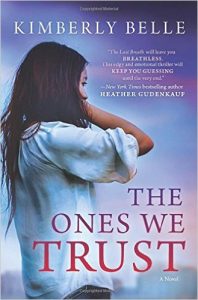
    1. Gabe’s good looks are real and rugged and raw, and now that I’ve seen both brothers up close, I’d choose Gabe over Zach any day.

    RD Combo: Polysyndeton (multiple conjunctions, no punctuation) and Alliteration

    2. The silence that spins out lasts forever. It’s the kind of silence that wraps around you like a shroud, the kind that turns the air thick and solid, the kind that makes you want to hear the answer as much as you dread it.

    Kimberly Belle could have written: The room went silent.

    I’m glad she decided to empower that emotionally-loaded scene dynamic.

    Rhetorical Devices: Amplification (silence) and anaphora (the kind, the kind, the kind)

    3. My heart races and my skin tingles and my blood pressure explodes like a grenade.

    Rhetorical Devices: Three visceral responses are powered with polysyndeton (multiple conjunctions, no punctuation) and a simile.

    The Blessing of No, Megan Menard, Multi-Margie-Grad

    1. Luke had a machine-gun laugh that fired about every third word.
    1. I picked up a French fry. It was a slender blonde, tall and weepy. I named the fry Tanya and chomped off its head.

    Those examples carry interest and power and are perfectly cadenced. The second example uses a metaphor and structural parallelism. It reveals a truth in a humor hit that could make us laugh or cry.

    Test of Faith, Christa Allan, Award-Winning Author, Multi-Margie-Grad 
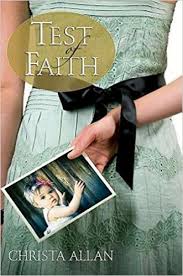
    1. “If. Faith. Can. Come. Live. With Me?” I heaved every word out of my brain and into my mouth. I felt like someone regaining consciousness in an unfamiliar room or house or life.

    Christa Allan stylized that dialogue by using a Period. Infused. Sentence. That’s what I named it. Her dialogue cue is amplified, amplified, amplified stellar.
    She used an RD combo in the last sentence: polysyndeton and zeugma.

    What’s zeugma?

    I’ll SHOW not TELL. I know you’ll get it.

    My teaching-zeugma sentence:

    Margie grabbed her purse, her keys, and her steely resolve.

    You got it!

    This 2-point version is an example of zeugma too:

    Margie grabbed her purse and her steely resolve.

    Now you know the rhetorical device zeugma.

    1. This dinner was the Indy 500 version of returning to the track after a pit stop, except that the finish line was Logan, and there was only one first place.

    Ah… Metaphors and power words and hope all themed, propelled by a compelling cadence.

    Red-Headed Stepchild, Jaye Wells, USA Today Bestseller
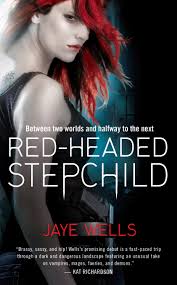
    Jaye Wells wrote this paragraph when she was in a full day workshop I taught for Dallas Area Romance Authors in 2007. I asked all the participants to write an example of anaphora.

    Anaphora — Repeating a word or phrase at the beginning of three or more successive phrases or clauses or sentences. The first three must be in a row.

    The paragraph she wrote in class became the first paragraph in the first chapter of Red-Headed Stepchild, her debut Urban Fantasy.

    Digging graves is hell on a manicure, but I was taught good vampires clean up after every meal. So I ignored the chipped onyx polish. I ignored the dirt caked under my nails. I ignored my palms, rubbed raw and blistering. And when a snapping twig announced David’s arrival, I ignored him too.

    Deep Edit Analysis:

    Anaphora: I ignored, I ignored, I ignored, I ignored

    Three Humor Hits:

      • Digging graves is hell on a manicure
      • good vampires clean up after every meal
      • I ignored him too

    Power Words — Words that carry psychological power: graves, hell, vampires, clean up, ignored, ignored, dirt, ignored, raw, blistering, arrival, ignored him

    What does the reader learn in those 53 words?

    1. She’s digging a grave. We can infer she killed someone.
    2. She’s a vampire.
    3. She gets manicures.
    4. She’s Goth.
    5. She’s been digging that grave for a while.

    She’s not concerned about David catching her digging a grave.

    In that one short, opening paragraph, Jaye Wells deepened characterization, shared a strong and fun voice, and made the reader want to read more. That’s smart writing. The kind that impresses agents and editors and readers and reviewers.

    Every example in this blog carries a compelling cadence. That pleasing cadence speaks to the reader’s subconscious. Cadence has the same impact on the reader that a movie sound track has on a viewer.

    Read the first sentence of this blog OUT LOUD:

                Reading a book with flat-lined cadence is like watching a movie on mute.

    Do you hear those perfect beats?

    I could have written:

                It is critical to pay attention to cadence.

    No cadence-driven power.

    Deep Editing Caveat:  Most of the examples I shared in this blog were amplified. I’m not suggesting that every sentence should be powered up, or made special in some way. That would be gag-ifying

    Not a word. But it carries the punch I wanted to share.

    We need plain writing. Writing that does it’s job without any amplification.

    We need fun, quirky, deep, stylistic, and tug-your-heart writing too.

    I teach writers how to add psychological power to their writing in hundreds of ways. No hype. No hyperbole. I’m just sharing what I do.

    I teach writers how to empower emotions.

    • How to avoid clichés and clichéd phrasing.
    • How to write fresh faces and voices and visceral responses.
    • How to use advanced stimulus-response patterns.
    • How to use my Four Levels of Powering Up Emotion. How to have the right emotional intensity in the right place.
    • How to create emotional authenticity on the page. How a character can act in an out-of-character way, and get the reader to buy it.
    • How to use six rhetorical devices to finesse backstory. Succinct, un-skimmable, beautifully cadenced backstory.
    • How to use my 20 Point Checklist for Openings, my 15 Point Checklist for Endings, my 12 Visceral Rules for Fiction Writers, my 10 Gems for Not Writing Your Mama’s Character Descriptions, and more.
    • How to deep edit analyze your scenes. I developed The EDITS System so writers can see what’s working, what’s not working, and what’s missing.

    I used to teach college. Graduate level psychology courses. I back up every teaching point with plenty of examples from a variety of genres.

    I shared a few of the twenty rhetorical devices I teach fiction writers here. I’ll cover all twenty in about 75 minutes in my full day master class. Some, like polysyndeton (…photographed and bagged and carried away…, The Last Breath, Kimberly Belle) may be new to you, but they’re easy to learn, and use. Handouts help.

    I’m looking forward to having fun in my Master Class on March 30. Join me, and you’ll leave with deep editing tips and techniques that will add power to your WIP.
    FIND OUT HOW TO ENTER Margie Lawson’s Contest to WIN a LECTURE PACKET by clicking here!

  • Deep Editing Power with Margie Lawson, CAC17 Master Class Presenter, Editor, and International Speaker

    Deep Editing Power with Margie Lawson, CAC17 Master Class Presenter, Editor, and International Speaker

    Have you registered for our #CAC17 Master Class yet?
    Margie Lawson will present a full day Master Class on March 30th, the day before the conference. Make sure to plan to come early for this special session and REGISTER NOW.
    Enrollment is limited, and seats are starting to fill up.
    Margie has presented over a 150 full day master classes in the U.S., Canada, Australia, and New Zealand. Writers credit her innovative deep editing approaches with taking their writing to publication, awards, and bestseller lists.

    Margie took time out of her busy schedule (teaching around the world) to write a guest post on some of the topics she will cover in the #CAC17 full day Master Class.

    Do you have a question, a comment, or an editing experience to share? Post a comment and you have TWO CHANCES to WIN a lecture packet! 

    Scroll down below the related posts, and you’ll see the comments section.


    Rhythm and Cadence and Beats, Oh Yes!

    By Margie Lawson Editor, International Presenter

    Reading a book with flat-lined cadence is like watching a movie on mute.

    Most writers know about the power of rhythm and cadence and beats. But most don’t use that power in every sentence.

    A compelling cadence is more than varying sentence lengths. More than using ­­­­­standalone words.

    A compelling cadence carries power on the page. It propels readers through paragraphs and passages and pages.

    Read your work out loud, with feeling, and you’ll hear what beats work well, and what beats are missing.

    Many rhetorical devices are cadence-driven. Knowing which rhetorical devices boost cadence, pick up pace, make the read imperative, and 947 more cool things, loads your writing toolbox with super-powered tools.

    Check out these cadence-driven examples.

    The Ones We Trust, Kimberly Belle, Award-Winning MIRA Author, Multi-Margie-Grad

    1. Gabe’s good looks are real and rugged and raw, and now that I’ve seen both brothers up close, I’d choose Gabe over Zach any day.

    RD Combo: Polysyndeton (multiple conjunctions, no punctuation) and Alliteration

    2. The silence that spins out lasts forever. It’s the kind of silence that wraps around you like a shroud, the kind that turns the air thick and solid, the kind that makes you want to hear the answer as much as you dread it.

    Kimberly Belle could have written: The room went silent.

    I’m glad she decided to empower that emotionally-loaded scene dynamic.

    Rhetorical Devices: Amplification (silence) and anaphora (the kind, the kind, the kind)

    3. My heart races and my skin tingles and my blood pressure explodes like a grenade.

    Rhetorical Devices: Three visceral responses are powered with polysyndeton (multiple conjunctions, no punctuation) and a simile.

    The Blessing of No, Megan Menard, Multi-Margie-Grad

    1. Luke had a machine-gun laugh that fired about every third word.
    1. I picked up a French fry. It was a slender blonde, tall and weepy. I named the fry Tanya and chomped off its head.

    Those examples carry interest and power and are perfectly cadenced. The second example uses a metaphor and structural parallelism. It reveals a truth in a humor hit that could make us laugh or cry.

    Test of Faith, Christa Allan, Award-Winning Author, Multi-Margie-Grad 

    1. “If. Faith. Can. Come. Live. With Me?” I heaved every word out of my brain and into my mouth. I felt like someone regaining consciousness in an unfamiliar room or house or life.

    Christa Allan stylized that dialogue by using a Period. Infused. Sentence. That’s what I named it. Her dialogue cue is amplified, amplified, amplified stellar.
    She used an RD combo in the last sentence: polysyndeton and zeugma.

    What’s zeugma?

    I’ll SHOW not TELL. I know you’ll get it.

    My teaching-zeugma sentence:

    Margie grabbed her purse, her keys, and her steely resolve.

    You got it!

    This 2-point version is an example of zeugma too:

    Margie grabbed her purse and her steely resolve.

    Now you know the rhetorical device zeugma.

    1. This dinner was the Indy 500 version of returning to the track after a pit stop, except that the finish line was Logan, and there was only one first place.

    Ah… Metaphors and power words and hope all themed, propelled by a compelling cadence.

    Red-Headed Stepchild, Jaye Wells, USA Today Bestseller

    Jaye Wells wrote this paragraph when she was in a full day workshop I taught for Dallas Area Romance Authors in 2007. I asked all the participants to write an example of anaphora.

    Anaphora — Repeating a word or phrase at the beginning of three or more successive phrases or clauses or sentences. The first three must be in a row.

    The paragraph she wrote in class became the first paragraph in the first chapter of Red-Headed Stepchild, her debut Urban Fantasy.

    Digging graves is hell on a manicure, but I was taught good vampires clean up after every meal. So I ignored the chipped onyx polish. I ignored the dirt caked under my nails. I ignored my palms, rubbed raw and blistering. And when a snapping twig announced David’s arrival, I ignored him too.

    Deep Edit Analysis:

    Anaphora: I ignored, I ignored, I ignored, I ignored

    Three Humor Hits:

      • Digging graves is hell on a manicure
      • good vampires clean up after every meal
      • I ignored him too

    Power Words — Words that carry psychological power: graves, hell, vampires, clean up, ignored, ignored, dirt, ignored, raw, blistering, arrival, ignored him

    What does the reader learn in those 53 words?

    1. She’s digging a grave. We can infer she killed someone.
    2. She’s a vampire.
    3. She gets manicures.
    4. She’s Goth.
    5. She’s been digging that grave for a while.

    She’s not concerned about David catching her digging a grave.

    In that one short, opening paragraph, Jaye Wells deepened characterization, shared a strong and fun voice, and made the reader want to read more. That’s smart writing. The kind that impresses agents and editors and readers and reviewers.

    Every example in this blog carries a compelling cadence. That pleasing cadence speaks to the reader’s subconscious. Cadence has the same impact on the reader that a movie sound track has on a viewer.

    Read the first sentence of this blog OUT LOUD:

                Reading a book with flat-lined cadence is like watching a movie on mute.

    Do you hear those perfect beats?

    I could have written:

                It is critical to pay attention to cadence.

    No cadence-driven power.

    Deep Editing Caveat:  Most of the examples I shared in this blog were amplified. I’m not suggesting that every sentence should be powered up, or made special in some way. That would be gagifying. 

    Not a word. But it carries the punch I wanted to share.

    We need plain writing. Writing that does its job without any amplification.

    We need fun, quirky, deep, stylistic, and tug-your-heart writing too.

    I teach writers how to add psychological power to their writing in hundreds of ways. No hype. No hyperbole. I’m just sharing what I do.

    I’m a psychologist-turned-editor. I used my psychological expertise to analyze more passages and chapters than most people read in ten lifetimes. I developed deep editing techniques that help writers add power to each paragraph.

    I teach writers how to empower emotions.

    How to avoid clichés and clichéd phrasing.

    How to write fresh faces and voices and visceral responses.

    How to use advanced stimulus-response patterns.

    How to use my Four Levels of Powering Up Emotion. How to have the right emotional intensity in the right place.

    How to create emotional authenticity on the page. How a character can act in an out-of-character way, and get the reader to buy it.

    How to use six rhetorical devices to finesse backstory. Succinct, unskimmable, beautifully cadenced backstory.

    How to use my 20 Point Checklist for Openings, my 15 Point Checklist for Endings, my 12 Visceral Rules for Fiction Writers, my 10 Gems for Not Writing Your Mama’s Character Descriptions, and more.

    How to deep edit analyze your scenes. I developed The EDITS System so writers can see what’s working, what’s not working, and what’s missing.

    I created seven online courses for writers:

    1. Empowering Characters’ Emotions
    2. Deep Editing, Rhetorical Devices, and More
    3. Writing Body Language and Dialogue Cues Like a Psychologist
    4. Defeat Self-Defeating Behaviors
    5. A Deep Editing Guide to Make Your Openings Pop
    6. Visceral Rules: Beyond Hammering Hearts
    7. Fab 30: Advanced Deep Editing, A Master Class

    The first four classes each have 250+ pages of lectures. The next three classes have 180 – 230 pages of lectures.

    I used to teach college. Graduate level psychology courses. I back up every teaching point with plenty of examples from a variety of genres.

    I shared a few of the twenty rhetorical devices I teach fiction writers here. I’ll cover all twenty in about 75 minutes in my full day master class. Some, like polysyndeton (…photographed and bagged and carried away…, The Last Breath, Kimberly Belle) may be new to you, but they’re easy to learn, and use. Handouts help.

    I’m looking forward to having fun in my Master Class on March 30. Join me, and you’ll leave with deep editing tips and techniques that will add power to your WIP.


    About Margie

    Margie Lawson —editor, and international presenter – teaches writers how to use her psychologically-based editing systems and deep editing techniques to create page-turners.

    Margie has presented over a hundred fifty full day master classes in the U.S., Canada, Australia, and New Zealand. Writers credit her innovative deep editing approaches with taking their writing to publication, awards, and bestseller lists.

    Margie developed seven online courses she teaches through Lawson Writer’s Academy on her website. LWA has over 30 instructors and offers five courses most months.

    Margie also teaches fifteen 5-day Immersion Master Classes a year. Enrollment is limited to seven. In 2017 she’s teaching Immersions in Atlanta, Denver, Dallas, Amarillo, Calgary, Washington D.C., and in Melbourne, Sydney, Brisbane, Coffs Harbour, Canberra, and Hobart, Australia.

    What’s the Buzz? 

    Randy Ingermanson, Ph. D., award-winning author of Writing Fiction for Dummies:

    In the twenty years I’ve been writing fiction, two teachers have astounded me with their insights and taught me something radically new: Dwight Swain and Margie Lawson. Margie taught me new ways to empower my writing.

    Melanie Milburne, USA Today Bestseller

    I had 40 books published before I met Margie Lawson. It wasn’t until I started using her deep editing techniques that I won several writing awards. I have a library of how-to books, but none top Margie’s expertise.

    Laura Drake, RITA Winner, The Sweet Spot

    When I took my first Margie Lawson class, the paradigm shift I experienced was more like an earthquake — I saw everything differently. I took more of her classes and I got a three book deal with Grand Central. A few months later I got a contract for a fourth book. Several months after that, I got contracted for three more books! I sold seven books in fifteen months—before my first book was released. I have Margie to thank for teaching me how to deep edit to get power on every page.

    Allison Brennan, NYT Bestseller:

    Margie Lawson, a brilliant psychologist, teaches a class on editing that, ahem, truly tested me. She uses color-coding to dissect writing in order to empower your stories. I learned from Margie how to fix my prose. I think about her editing system and techniques, ways to add power, finding the emotional key of the scene. I use her lessons to add power to my writing.

    Romily Bernard, RITA Winner, Find Me

    Your classes (both online and at the Georgia writing conference) changed my life!! My YA debut sold in a three-book, pre-empt to Harper Collins. Phoebe was so very complimentary about the way I render emotion and tension on the page and I know I have you to thank!

    Alex Ratcliff, Daphne Finalist

    Margie’s online courses and Immersion Master Class have strapped me into a skill-building machine for writers. With her help, in one year I moved from a can’t-write-a-fresh-line beginner to a Daphne finalist. Wow!

    Karin Tabke, Bestselling author

    I had so many epiphany moments Saturday my head was twitching. It’s still twitching! I wish I had attended Margie’s Empowering Characters’ Emotions master class earlier. My writing is stronger, more vivid, more emotional. The effects of the workshop were immediate. I highly recommend if you have the opportunity to take Margie’s workshop in person, do it.

    Colleen Coble, CEO of ACFW and Bestselling author

    “The workshop I went to last month was the best I’ve ever been to, bar none. And I’ve been to plenty. Margie’s workshop was so awesome, I’m going over my notes from what she taught before I start my next book. She’s a genius, pure and simple.”

    Elizabeth Essex, RITA Finalist, The Danger of Desire

    I’ve attended one of Margie’s all-day seminars, taken all her online classes; attended her workshops at RWA conferences, flown to Colorado to attend her four-day Immersion class, and hosted an Immersion class in Dallas. Margie taught me to challenge and push myself to make the hard changes from the first page of a manuscript until the very last. Working with Margie, you’ll have the tools to make every single word count.

    Comment Contest Details

    Post a comment and you have TWO CHANCES to WIN a lecture packet!

    You’ll win the lectures (250+ pages) from one of Margie Lawson’s online courses listed here:

    1. Empowering Characters’ Emotions
    1. Deep Editing, Rhetorical Devices, and More
    1. Writing Body Language and Dialogue Cues Like a Psychologist

    The drawings will be Sunday, Feb. 5th, 8:00 PM Mountain Time.  

    Drawing reschedule due to SUPERBOWL! Time extended until Thursday, Feb. 9, 2017 at 6 p.m. PST.

    The winners names will be posted here.

    See you on the blog!

    KEEP SCROLLING DOWN UNTIL YOU GET TO THE COMMENTS SECTION ON THIS PAGE (the place to leave your comments for Margie’s  contest).  

    All smiles…………….Margie

  • CHATELAINE Book Awards for ROMANCE Novels – the 2016 SHORT LIST

    CHATELAINE Book Awards for ROMANCE Novels – the 2016 SHORT LIST

    Romance Fiction AwardThe CHATELAINE Writing Competition Book Awards recognize emerging new talent and outstanding works in the genres of  Romantic Fiction and Women’s Fiction. The Chatelaine Awards is a division of Chanticleer International Novel Writing Competitions.
    More than $30,000.00 dollars worth of cash and prizes will be awarded to Chanticleer Book Reviews 2016 writing competition winners at the Chanticleer Authors Conference April 1, 2017!

    The Chatelaine Awards FIRST IN CATEGORY sub-genres  are:

    • Contemporary Romance
    • Historical Romance
    • Adventure & Suspense
    • Romantic Steamy/Sensual (Not Erotic)
    • Inspirational/Restorative

    The following Semi-Finalists will compete FIRST IN CATEGORY Positions and Book Awards Packages.

    This is the OFFICIAL SHORT LIST of SEMI-FINALISTS of the 2016 CHATELAINE Novel Writing Competition & Book Awards.

    • Regan Walker – The Refuge: An Inspirational Novel of Scotland
    • Nicola Italia – Love in the Valley of the Kings
    • Vicki Volden – Both
    • M A Clarke Scott – The Art of Enchantment
    • F. E. Greene – The Never List (Love Across Londons)
    • Lucy Carol – Stiff Competition
    • Ashlinn Craven – Building Mr. Darcy 
    • Diana Forbes – Mistress Suffragette
    • Nicole Evelina – Been Searching for You
    • Darby Karchut – Stone’s Heart
    • Lucinda Brant – Dair Devil: A Georgian Historical Romance #2
    • Gail Avery Halverson – The Boundary Stone
    • Dorothy Wiley – The Beauty of Love
    • Toby Neal – Somewhere in St. Thomas 
    • Kate James – When the Right One Comes Along #2
    • Kate James – When Love Matters Most
    • Jayne Castel – The Breaking Dawn
    • Gillian M. Mercurio –Kisimba
    • Karen Fitzpatrick – After the Rain
    • Laura W. Chance – To Cornwall, with Love
    • Susan Boles – Fated Love
    • P. A. Estelle – Hannah: Bride of Iowa
    • Elise K. Ackers – One For the Road
    • Rebecca Lochlann – The Sixth Labyrinth
    • Nate Gagon – Breaking Dad

    IF your name is on this list, please follow us on Twitter (@ChantiReviews)  and LIKE and Comment on our Facebook page so that we can tag you in our announcements.

    https://www.facebook.com/chantireviews/

    This list is the Official Posting of the 2016 Chatelaine Semi-Finalists who have made the SHORT LIST for the 2016 Chatelaine Awards.  Good luck to all in one of our most competitive novel competitions!

    The Chatelaine Semi-Finalists will compete for the Chatelaine Awards First In Category Positions, which consists of Four Judging Rounds.  First Place Category Book Award winners will automatically be entered into the Chatelaine GRAND PRIZE AWARD competition, which has a cash prize of $200 or $500 dollars in editorial services. The CBR Grand Prize Genre Winners will compete for the CBR Overall Grand Prize for Best Book and its $1,000 purse.   

    • All Short-Listed Authors will receive high visibility along with special badges to wear during the Chanticleer Authors Conference 2017 and Awards Gala. Register now for CAC17 to be there when your name is called!
    • Digital book award stickers for on-line promotion
    • Adhesive book stickers
    • Shelf-talkers and other promotional items
    • Promotion in on-line media

    As always, please do not hesitate to contact us with any questions, concerns, or suggestions at Info@ChantiReviews.com. 

    Congratulations to the Semi-Finalists in this fiercely competitive contest! 


    If your name is on this list, be sure to check out: 7 Things to do if you are a finalist or winner in the Chanticleer International Writing Competitions on our Winner Circle page.

    The Chatelaine First Place Category Winners and Grand Prize Winner will be announced at the April 1, 2017 Chanticleer Writing Contests Annual Awards Gala, which takes place on the last evening of the Chanticleer Authors Conference that will be held in Bellingham, Wash. Register now for CAC17 to be there when your name is called and accept your blue ribbon on our stage.

    We are now accepting submissions into the 2017 Chatelaine Awards writing competitions for Romantic Fiction. Enter the 2017 Chatelaine Awards Today! 

  • High Touch Marketing: The Secret Sauce of Book Promotion by Susan Colleen Browne, CAC17 Presenter

    High Touch Marketing: The Secret Sauce of Book Promotion by Susan Colleen Browne, CAC17 Presenter

    Susan Colleen Brown, Writing instructor and author will be teaching at CAC17 and took a little time out of her busy schedule to tell us more about the session she will be teaching:

    High Touch Marketing in a Digital World – As technology migrates into more aspects of our lives, forging personal connections with readers is crucial to an author’s success. In this session, we’ll discuss high-touch approaches and incorporating them into your marketing efforts. We’ll explore authors’ communities and how you can enhance your book events. We’ll also brainstorm ways to bring more of a personal touch to online interactions and look at authors who have mastered high-touch outreach. 

    Register for CAC17 NOW!


    Have you been riding the social media book promotion train without getting much traction? Maybe it’s time to try “high-touch” marketing strategies—making real-world connections to share your book.

    I first heard about high-touch marketing from Chanticleer’s fearless leader, Kiffer Brown, at one of her talks to a local writers’ group. Coined by Tesla CEO and game-changing thinker Elon Musk, the phrase “high touch” has taken on a new resonance as the publishing industry continues to shift and evolve more rapidly than ever. So how can we leverage high-touch to our advantage?

    When I published my first book, a backyard farming/follow your dreams memoir, face-to-face, hands-on reaching out was standard: visiting and/or phoning bookstores and libraries, lining up lots of author talks and events, getting into print media and distributing hard copy marketing materials. These venues took lots of time, energy, and money, but they were effective!

    Two years later, publishing my second book, I was dealing with a different genre (women’s commercial fiction) and an entirely new publishing landscape. With the exploding popularity of ebooks, who needed all that promotional heavy lifting? Even unknown authors could release a good story with a halfway decent cover online, and voila! Ebook sales happened organically! Several glorious years passed in which ebook sales overall rose steadily. All you had to do was sit back and let the good times roll while you worked on your next book.

    As they say, all good things must come to an end. The last two years or so, the publishing world has taken another ground-shifting turn. Authors are now releasing their books into a market flooded with titles, and reaching out to consumers inundated with entertainment choices. Social media content continues to explode. Tried and true marketing strategies are losing effectiveness as authors scramble to find the next magic book-promotion pill.

    So, how do we authors distinguish ourselves, our brands and our books in this crowded marketplace? Refocusing on high-touch tools, whether online or off—might be the “special sauce” you’re looking for! In the CAC17 session I’m leading, “High Touch Marketing in a Digital World,” we’ll share and discuss both face-to-face and digital marketing venues, how to cross-pollinate the two, and how high touch can help you negotiate the publishing industry’s ever-changing new normal.

    I look forward to meeting you at the Chanticleer Author’s Conference 2017!


    About Susan

    Susan Colleen Browne weaves her love of Ireland and her passion for country living into her Village of Ballydara series, novels and stories of love, friendship and family set in the Irish countryside. She’s also the author of an award-winning memoir, Little Farm in the Foothills, as well as the Morgan Carey fantasy-adventure series for tweens. A community college creative writing instructor, Susan runs a mini-farm in the foothills of the Pacific Northwest. Coming up: Book 4 of the Ballydara series, and a sequel to Little Farm in the Foothills!

    Register for CAC17 NOW!

  • The 2016 PARANORMAL Book Awards FINALISTS List

    The 2016 PARANORMAL Book Awards FINALISTS List

    Paranormal Fiction AwardsThe Paranormal Awards Writing Competition recognizes emerging new talent and outstanding works in the genre of  Supernatural Fiction. The Paranormal Awards is a division of Chanticleer International Novel Writing Competitions.

    More than $30,000.00 dollars worth of cash and prizes will be awarded to Chanticleer Book Reviews 2016 writing competition winners at the Chanticleer Authors Conference April 1, 2017!

    The Paranormal Awards FIRST IN CATEGORY sub-genres  are:

    • Paranormal Romance
    • Urban/Edgy
    • Magical Beings & Creatures and Magical Systems
    • Supernatural Powers
    • Adventure/Mystery/Thriller
    • Paranormal

    OFFICIAL LISTING of the 2016 Paranormal Writing Competition’s Finalists:

    The following titles will compete for the Semi-Finalists SHORT LIST, and then the FIRST IN CATEGORY Positions and Awards Packages.

    • John D Trudel – Raven’s Redemption
    • Angella Cormier & Pierre C Arseneault – Oakwood Island 
    • Derek Swannson – Crash Gordon and the Illuminati Underground
    • Patricia Mason – The Mercury Papers
    • B. K. Smith – Laina and the Vamp
    • Alex E. Carey – Fire’s Love 
    • Jessie Kwak – Shifting Borders
    • Ian M. Smith – Trace
    • Arjay Lewis – The Muse
    • Lydia Staggs – Shamar
    • Janet K. Shawgo – Archidamus
    • Joanne Jaytanie – Corralling Kenzie
    • Eliott McKay – The Aureate Spectacles
    • Matt Kilby – The Road Cain Walks 
    • A.M. Manay – She Dies at the End
    • Francine Paino – Two Wolves Dancing
    • Lisa Voisin – The Warrior Prophet
    • Carl S. Plumer – Shadows of Death
    • Carl S. Plumer – Zombie Ever After 
    • Harper L. Jameson – The Spirit
    • Ben Sharpton – 2nd Sight
    • Elizabeth Crowens – Silent Meridian
    • Christopher Leibig – Almost Mortal
    • S.T. Holmes – Creole Moon: The Betrayal 
    • Israfel Sivad – The Adversary’s Good News
    • Colleen Golden – The Well

    As always, please do not hesitate to contact us with any questions, concerns, or suggestions at Info@ChantiReviews.com. 


    Congratulations to the Finalists!  

    Good Luck to all of the Paranormal Finalists as they compete for the coveted SHORT LIST  positions.

    The PARANORMAL Grand Prize Winner and the First Place Category winners will be announced and recognized at the April 1, 2017 Chanticleer Writing Contests Annual Awards Gala, which takes place on the last evening of the Chanticleer Authors Conference that will be held in Bellingham, Wash. 

    We are now accepting submissions into the 2017 Paranormal Awards writing competitions for Paranormal Fiction. Please click here for more information or to enter the contests.

  • HISTORICAL FICTION Post-1750s – 2016 GOETHE Awards SHORT LIST

    HISTORICAL FICTION Post-1750s – 2016 GOETHE Awards SHORT LIST

    Post 1750s Historical Fiction AwardThe Goethe Novel Writing Competition recognizes emerging new talent and outstanding works in the genre of post-1750s Historical Fiction. The Goethe Awards is a division of Chanticleer International Novel Writing Competitions.

    More than $30,000.00 dollars worth of cash and prizes are awarded to Chanticleer Book Reviews 2016 writing competition winners at the Chanticleer Authors Conference April 1, 2017!

    Because we received an unprecedented amount of entries for the 2015 Chaucer Awards we divided the writing competition into two separate awards for 2016: The Chaucer Awards for pre-1750’s historical fiction and the Goethe Awards for post-1750 historical fiction.  We have moved entries that are post 1750 to the 2016 Goethe Awards tracking and judging rounds.

    This is the Official Semi-Finalists List of the Authors and Titles of Works that have made it to the Short-List of the Goethe 2016 Novel Writing Contest.

    The Goethe Awards FIRST IN CATEGORY sub-genres are: Regency, Victorian, 1700s/1800s, Turn of the Century, 20th Century, World Wars and Other Wars, World/International History post-1750, and U.S. History.

    Chanticleer Short List

    The following Semi-Finalists titles will compete for the FIRST IN CATEGORY Positions and Book Awards Packages in the 2016 Goethe Book Awards:

    • Carrie Kwiatkowski – Running Before the Wind
    • Amy Wolf – The Misses Bronte’s Establishment
    • Linda Cardillo – The Boat House Cafe
    • Elizabeth Crowens – Silent Meridian
    • J.L. Oakley – The Jossing Affair
    • Duncan Stewart – In Their Finest Hour
    • Darryl Wimberley – A Seeping Wound
    • A.B. Michaels – The Depth of Beauty
    • Michael Sheahan – The Sean
    • Vanda – Juliana
    • S. Thomas Bailey – Blind Faith-The Gauntlet Runner
    • Connie Hertzberg Mayo – The Island of Worthy Boys
    • Carol M. Cram – A Woman of Note
    • Teresa Healy Janssen – The Ways of Water
    • Eleanor Webster – No Conventional Miss
    • C.T. Wells – The Kingdom of the Air
    • Ivan Light – Deadly Secret of the Lusitania
    • Darryl Wimberley – Paul Bunyan
    • Tom Glenn – The Last of the Annamese
    • M.C. Nelson – Chrysalis: A Novel
    • Brigitte Goldstein – Death of a Diva–From Berlin to Broadway
    • David Selcer – Lincoln’s Hat 
    • Lucinda Brant – Deadly Affair: A Georgian Historical Mystery

    The Goethe Semi-Finalists will compete for the Goethe Awards First In Category Positions, which consists of Four Judging Rounds.  First Place Category Book Award winners will automatically be entered into the Goethe GRAND PRIZE AWARD competition, which has a cash prize of $200. The CBR Grand Prize Genre Winners will compete for the CBR Overall Grand Prize for Best Book and its $1,000 purse.   

    • All Semi-Finalists Award Winners will receive high visibility along with special badges to wear during the Chanticleer Authors Conference and Awards Gala.
    • Digital book award stickers for on-line promotion
    • Adhesive book stickers
    • Shelf-talkers and other promotional items
    • Promotion in on-line media

    As always, please do not hesitate to contact us  at Info@ChantiReviews.com with any questions, concerns, or suggestions.

    Congratulations to the Goethe Finalists in this fiercely competitive contest! 

    Good Luck to all the Goethe Semi-Finalists as they compete for the coveted First Place Category  positions.

    The 2016 Goethe Grand Prize Winner and First Place Category Winners will be announced at the April 1st,  2017 Chanticleer Writing Contests Annual Awards Gala, which takes place on the last evening of the Chanticleer Authors Conference to be held in Bellingham, Wash. 

    We are now accepting submissions for the 2017 Chaucer Awards and the Goethe Awards writing competitions for Historical Fiction. Please click here for more information or to enter the contests.

  • HISTORICAL FICTION Novels – The SHORT-LIST for the 2016 CHAUCER BOOK AWARDS (Semi-Finalists)

    HISTORICAL FICTION Novels – The SHORT-LIST for the 2016 CHAUCER BOOK AWARDS (Semi-Finalists)

    Pre 1750 Historical Fiction AwardThe CHAUCER Writing Competition recognizes emerging new talent and outstanding works in the genre of pre-1750s Historical Fiction. The Chaucer Awards is a division of Chanticleer International Novel Writing Competitions.
    More than $30,000.00 dollars worth of cash and prizes will be awarded to Chanticleer Book Reviews 2016 writing competition winners at the Chanticleer Authors Conference April 1, 2017!

    Because we received an unprecedented amount of entries for the 2015 Chaucer Awards we divided the writing competition into two separate awards for 2016: The Chaucer Awards for pre-1750’s historical fiction and the Goethe Awards for post-1750 historical fiction.  We have moved entries that are post 1750 to the 2016 Goethe Awards tracking and judging rounds.

    This is the Official Semi-Finalists List of the Authors and Titles of Works that have been SHORT-LISTED for the Chaucer 2016 Novel Writing Contest.

    NOTE: This list is COMPLETE as of January 28, 2017.

    The Chaucer Awards FIRST IN CATEGORY sub-genres  are:  Pre-Historical Fiction, Ancient Historical Fiction, World/International History (non-western culture historical fiction), Americas-Historical Fiction Pre-1750s, Dark Ages/Medieval, Renaissance, and Elizabethan/Tudor 1600’s.

    Chanticleer Short List

    The following Short-Listed titles will compete for the 5 First Place Category Positions and Awards Packages.

    • Hana Samek Norton – The Serpent’s Crown: A Novel of Medieval Cyprus
    • Kate Braithwaite – Charlatan
    • Sandra Vasoli – Truth Endures: Je Anne Boleyn Book Two #2
    • Lorraine Buck – The Last Rosary
    • Gina M. Bright – 1381: The Forgotten Revolt
    • H.J. Reynolds – A Treachery of Spies
    • Michal Strutin – Judging Noa: a Biblical Woman’s Journey
    • Lilian Gafni – The New World: Flower from Castile
    • Catherine T Wilson and Catherine A Wilson – The Gilded Crown
    • Bruce Gardner – Hope of Ages Past
    • Helena P. Schrader – Envoy of Jerusalem: – Balian d’Ibelin and the Third Crusade
    • Gail Avery Halverson – The Boundary Stone
    • Carol Cram – The Towers of Tuscany 
    • James Conroyd Martin – The Boy Who Wanted Wings

    These Chaucer Semi-Finalists will compete for the Chaucer Awards First In Category Positions, which consists of Four Judging Rounds.  First Place Category Book Award winners will automatically be entered into the Chaucer GRAND PRIZE AWARD competition, which has a cash prize of $200. The CBR Grand Prize Genre Winners will compete for the CBR Overall Grand Prize for Best Book and its $1,000 purse.   

    • All Short-Listed authors who attend #CAC17 will be recognized on stage at the awards ceremony and will receive high visibility along with special badges to wear during the Chanticleer Authors Conference and Awards Gala.

    As always, please do not hesitate to contact us with any questions, concerns, or suggestions at Info@ChantiReviews.com. 

    Congratulations to the all the 2016 Chaucer Finalists.  

    Good Luck to all of the Chaucer Semi-Finalists as they compete for the First Place Category positions.

    First In Category announcements will be made at the Awards Ceremony. The Chaucer Grand Prize Winner and First Place Category Winners will be announced at the April 1st,  2017 Chanticleer Writing Contests Annual Awards Gala, which takes place on the last evening of the Chanticleer Authors Conference that will be held in Bellingham, Wash. 

    We are now accepting submissions into the 2017 Chaucer Awards and the Goethe Awards writing competitions for Historical Fiction. Please click here for more information or to enter the contests.

  • Jumpstart your author career at CAC17 with Wendy Delaney & Jacquie Rogers

    Jumpstart your author career at CAC17 with Wendy Delaney & Jacquie Rogers

    We have a LOT of terrific sessions planned for CAC17, and we are still adding more. One of those amazing sessions will be:

    Author Career Plan Boot CampThere is so much more to being an author than just writing a book. In Career Plan Boot Camp, Jacquie & Wendy share their experience as authors who have “been there,” and provide ten “must have” tips to help emerging writers learn how to create a professional writer’s platform and grow their writing careers. Wendy Delaney & Jacquie Rogers.

    Jacquie and Wendy are both authors of multiple book series’ (between the two of them, they have over 2 dozen books!), with twenty years of experience in the business of being authors. They’re also veteran Chanticleer Award winners and know how to use awards, ribbons, book stickers, reviews, and all kinds of things you never even considered before, as TOOLS to enhance their success as authors.

    We asked them to tell us a little bit more about their upcoming session at CAC17 and they took some time to give fill us in.


    Chanticleer: Hi guys, what inspired you to create the session Author Career Plan Boot Camp?

    Wendy & Jacquie: A good share of us started this writing gig with a great story in mind, but had no idea what being an author actually meant.

    Chanticleer: What is the reality? Lay it on us.

    Wendy & Jacquie: The average book sells fewer than 200 copies. [This] intrepid writer has spent $1,000 on editing, cover fees, and pre-publication promotion to sell 200 copies (remember, that’s average—many books don’t sell that many), and of those probably 25 went to family and friends. How does this pencil out? At the entry level pricing of $2.99, gross receipts would be $598. Of that, Amazon pays out 70% so the book would net $419.60, leaving a net loss of $581.40. None of us want to be that writer—but without a solid platform, we are.

    Chanticleer: A lot of people assume that a book with average sales is just an average story, they believe that a really good story will sell itself. What do you think about that?

    Wendy & Jacquie: Writing a good story isn’t enough. Essential, but not enough. Polishing the manuscript isn’t enough. Hiring the best editor and cover artist are not enough. All those things are vitally important, of course, but unless a writer has built a solid platform, potential readers will likely never see this fantastic book.

    Chanticleer: What is your advice for authors who want to have better than average book sales?

    Wendy & Jacquie: Focus on success. You can achieve your dream!  With some hard thinking to build an organized and targeted author platform, your book won’t be flailing in those sub-200 numbers. Come to [our session at] the Chanticleer Authors Conference and learn how from two authors who’ve spent nearly twenty years perfecting their writing and building their platforms, Wendy Delaney and Jacquie Rogers.


    Award-winning writer Jacquie Rogers is author of eleven novels, including five books in the Hearts of Owyhee series, two books in the Honey Beaulieu – Man Hunter series, and others. She’s published over a dozen short stories and novellas in three genres.  Under the house name Ford Fargo, she writes for the Western Fictioneers Wolf Creek series.  She co-wrote Nail It! The Secret to Building a Fiction Writer’s Platform, and Growing Your Audience: Workbook for Published, Unpublished, and Under-published Writers.

    Wendy Delaney writes fun-filled cozy mysteries and is the award-winning author of the Working Stiffs Mystery series. Like her human lie detector sleuth, Wendy loves to bake, so when she’s not killing off story people she can be found on her treadmill, working off the calories from her latest culinary adventure. Wendy makes her home in the Seattle area with the love of her life and is a proud grandma.