The Journey Book Awards recognize emerging new talent and outstanding works in the genre of Narrative Non-Fiction and Memoir. The Journey Book Awards is a genre division of Chanticleer International Book Awards and Novel Competitions (CIBAs).
Chanticleer International Book Awards is looking for the best books featuring true stories about adventures, life events, unique experiences, travel, personal journeys, global enlightenment, and more. We will put books about true and inspiring stories to the test and choose the best among them.
These titles have moved forward in the judging rounds from SLUSH pile to the 2019 JOURNEY Book Awards LONG LIST. These entries are now in competition for 2019 JOURNEY Shortlist. The Short Listers will for the Quarter-Finalists positions. Semi-Finalists will be selected from the Quarter-Finalists. The SemiFinalists will compete for the limited First Place Category Winners in the final rounds of judging. The Semi-Finalists and the First Place Category Winners, along with the division grand prize winners, will be announced at the CIBAs Banquet and Ceremony on Saturday, April 18th, 2020 at the luxurious Hotel Bellwether in Bellingham, Wash.
These titles are in the running for the SHORT LIST of the 2019 JOURNEY Book Awards for Narrative Non-Fiction
Good luck to all as your works move on the next rounds of judging.
Susan Murphy – Toppled World
Barbara Clarke – The Opposite of Hate: A Memoir
Charles C McCormack – Hatching Charlie: A Quest for Happiness and Meaning
Eva Doherty Gremmert – Our Time To Dance
Charles C McCormack – Hatching Charlie: A Quest for Happiness and Meaning
Rod Baker – I Need My Yacht by Friday – True Tales from the Boat Repair Yard
Lisa Dailey – Square Up
Tracee Dunblazier – Heal Your Soul History- Activate the True Power of Your Shadow
Juliet Cutler – Among the Maasai
Tyler R Grindstaff – Room To Roam
Chris Register – Conversations With US – GreatLakes States
Rebecca Faye Smith Galli – Rethinking Possible: A Memoir of Resilience
Kate Kaufmann – Do You Have Kids? Life When the Answer is No
Linda Gartz – Redlined: A Memoir of Race, Change, and Fractured Community in 1960s Chicago
Anna Carner – Blossom ~ The Wild Ambassador of Tewksbury
Anthony Delauney – Owning the Dash
Maya Castro – The Bubble: Everything I Learned as a Target of the Political, and Often Corrupt, World of Youth Sports
J. Bronson Haley – The Depth of Grace: Finding Hope at Rock Bottom
Ted Sheppard/T.S. Lewis – The Why of War: An Unorthodox Soldier’s Memoirs
Nikki West – The Odyssey of the Chameleon
Jean-Philippe Soul? – Dancing With Death: An Epic and Inspiring Travel Adventure
Julie MacNeil – The 50-Year Secret
David A. Bossert – Kem Weber: Mid-Century Furniture Designs for The Disney Studios
Nina Norstrom – Not a Blueprint It’s the Shoe Prints that Matter / A Journey Through Toxic Relationships
Gordon Cross, Robert Fowler, Ted Neill – Finding St. Lo: A Memoir of War & Family
Ted Neill – Two Years of Wonder
Anthony Suarez – Politically Indicted: The Real Story Behind the Jersey Sting
Julie L. Seely – Skinny House -A Memoir of Family
Francisco Silva – The Crossroads of Europe: Home Beneath our Feet
Dena Moes – The Buddha Sat Right Here: A Family Odyssey Through India and Nepal
Ryan M. Chukuske – Bigfoot 200: Because, You Know, Why the #@&% Not?
Laureen Pittman – The Lies That Bind: An Adoptee’s Journey Through Rejection, Redirection, DNA, and Discovery
Nancy Canyon – STRUCK: A Memoir
Carol E. Anderson – You Can’t Buy Love Like That: Growing Up Gay in the Sixties
Patrick Hogan – Silent Spring – Deadly Autumn of the Vietnam War
Donna Hill – Yes, The World Is Round
Andy Chaleff – The Last Letter
Christie Musso Bruce – Hope Knows Your Name
John Egenes – Man & Horse: The Long Ride Across America
Whitney Ellenby – Autism Uncensored: Pulling Back the Curtain
Paula Forget – Guided to the Higher Realms: a Personal Journey of Ascension through Meditation
Lance Brewer – Back Story Alaska
John Hoyte – Persistence of Light
David Wienir – Amsterdam Exposed
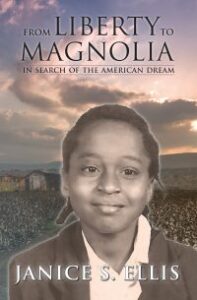
Congratulations to Janice S. Ellis, Ph.d. whose work From Liberty to Magnolia: In Search of the American Dream took home the Grand Prize for the 2018 JOURNEY Book Awards
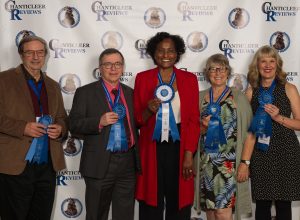
Journey Award Winners from Left to Right, Dennis Clausen, Sean Dwyer, Grand Prize winner Janice Ellis, Cheryl Hughes Musick, Kayce Stevens Hughlett
The Cygnus Book Awards recognize emerging new talent and outstanding works in the genre of Science Fiction, Steampunk, Alternative History, and Speculative Fiction. The Cygnus Awards is a genre division of Chanticleer International Book Awards and Novel Competitions (CIBA).
Chanticleer International Book Awards is looking for the best books featuring space, time travel, life on other planets, parallel universes, alternate reality, and all the science, technology, major social or environmental changes of the future that author imaginations can dream up. Hard Science Fiction, Soft Science Fiction, Apocalyptic Fiction, Cyberpunk, Time Travel, Genetic Modification, Aliens, Super Humans, Interplanetary Travel, and Settlers on the Galactic Frontier, Dystopian, our judges from across North America and the U.K. will put them to the test and choose the best among them.
CYGNUS Book Awards Alumni – The Stakes Are Out of This World!
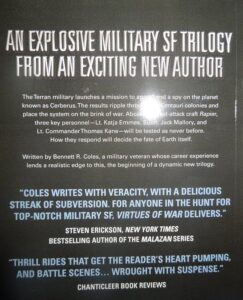
Bennett R. Coles, a CYGNUS Grand Prize award winner for VIRTUES OF WAR, his debut novel, landed a sweet 3 book deal from Titan UK and he has just landed another from Harper Collins Voyager for his science fiction works.
Bennett Coles CYGNUS Grand Prize for VIRTUES of WAR (2013)
We love having the CYGNUS awards and Chanticleer quotes on the covers! #justsaying
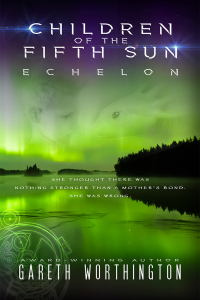
CYGNUS 1st Place Winners CHILDREN of the FIFTH SUN and IT TAKES DEATH to REACH a STAR by Gareth Worthington and Stu Jones were picked up by VESUVIAN Media Group.
Please email us about your work’s progress! We love to brag about CYGNUS Award-Winning Science Fiction
These titles have moved forward in the judging rounds from SLUSH pile to the 2019 Cygnus Book Awards LONG LIST. These entries are now in competition for 2019 Cygnus Shortlist. The Short Listers will compete for the Quarter-Finalist positions. The Quarter Finalist works will compete for the Semi-Finalists positions. Semi-Finalists will be announced and recognized at the CAC20 banquet and ceremony. The First Place Category Winners, along with the CIBA Division Grand Prize winners, will be selected from the 16 CIBA divisions Semi-Finalists. We will announce the 1st Place Category winners and Grand Prize Division Winners at the CIBAs Banquet and Ceremony on Saturday, April 18th, 2020 at the luxurious Hotel Bellwether in Bellingham, Wash.
These titles are in the running for the SHORT LIST of the 2019 Cygnus Book Awards novel competition for Science Fiction!
Good luck to all as your works move on the next rounds of judging.
Lawrence Brown – David: Savakerrva, Vol. 1
Mart Sander – The Goddess Of the Devil
Jim Cronin – Aeon Rises
William X. Adams – Intelligent Things
Erick Mars & Mike Wood – A Legacy of Wrath
Richard Mann – Purpose
Brett A. Lawrence – Shadow Seers
Callie Smith and Maura Smith – Fort Snow
Andrew Lucas McIlroy – Earthling
Charis Himeda – CRISPR Evolution
Paul Ian Cross – The Lights of Time
Jenn Lees – Stolen Time: Community Chronicles Book 2
Robert M. Kerns – It Ain’t Over…
J. I. Rogers – The Korpes Agenda
D. D. Wolf – Orchids Ablaze
Bryan K. Prosek – Paradoxal
William T. Kenny – The Conscious Whole
Alison Lyke – Forever People
Paul Werner – Mustang Bettie
V.L. Arias – The Expiration Date
Adam Boostrom – Athena’s Choice
Monica Harte – San Francisco
Jay Ashkinos – Hypergiant – Compendium One
Rey Clark – Titan Code: Dawn of Genesis
Trever Bierschbach – Embers of Liberty
Tim Cole – Insynnium
Sandra J. Jackson – Playing in the Rain
Samuel Winburn – Ten Directions
Grace Goodwin – Rogue Cyborg
J. Steven Young – Trumpery Resistance
Robert Sells – Revelations
Ken Hart – It was a Small Affair
Jacques St-Malo – Cognition
Timothy S. Johnston – The War Beneath
Thomas McDaniel – Rekindled
John Bowie – The Houses of the Curious
Shami Stovall – Star Marque Rising
D G Lamb – The Deepest Cut (Driven to the Hilt Book 1)
Terry Persun – BIOMASS Rewind
N. Matthias Moore – CLOUD 9
Darrell Lee – The Apotheosis
William X. Adams – Reluctant Android
David C. Crowther – City of Drowned Angels
Stephen Martino – The Final Reality
K.N. Salustro – Light Runner
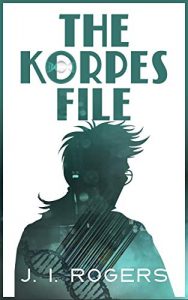
Congratulations to J. I. ROGERS for the KORPES FILE taking home the 2018 CYGNUS Book Awards Grand Prize Ribbon
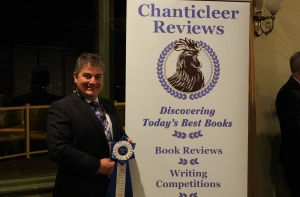
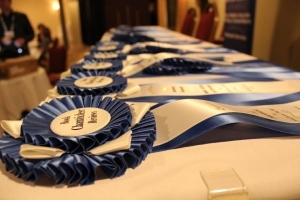
All Semi-Finalists will receive high visibility along with special ribbons to wear during the Chanticleer Authors Conference and Awards Gala.
As always, please do not hesitate to contact us with any questions, concerns, or suggestions at Info@ChantiReviews.com.
The CYGNUS Grand Prize Winner and the Five First Place Category Position award winners along with the Semi-Finalists will be announced at theApril 18th, 2020 Chanticleer International Book Awards Annual Awards Gala,which takes place at the Chanticleer Authors Conference that will be held in Bellingham, Wash.
We are now accepting submissions into the 2020 CYGNUS Awards writing competition. The deadline for submissions is April 30th, 2020. The winners will be announced in April 2021.
Mystery & Mayhem Book Awards Grand Prize winner Michelle Cox graciously shares her writing life and knowledge with us along with some hot marketing tips and tools! Read on!
“When I finally decided to try writing, the creativity within me, that divine essence, finally found its true home. I’m happiest when I’m creating, and I hope I can keep writing for a long time.” – Michelle Cox
Michelle Cox, award-winning author, at work in her writing lair
Chanticleer: Thanks for coming by, Michelle. Tell us what genre best describes your work? And, what led you to write in this genre?
Cox: Well, that’s a great question! I usually at least place as a semi-finalist in three different categories at the Chanticleer awards, for example, so that should be a pretty good indication.
My series is set during the 1930s in Chicago, so that qualifies it to be historical fiction, but it’s also mystery and romance. I guess “romantic-suspense” would be the best way to describe the series, but without the bare-chested guys on the cover.
They always say to write what you would want to read, and this is it! I set the series set in my favorite era; added a little bit of mystery, a little bit of romance; flavored it with the haves- and the have-nots of the era, as well as a touch of the English aristocracy; and then stocked it with lots of characters and subplots weaving in and out . . . sheer heaven!
Chanticleer: And that’s why we love you and your books! What do you do when you’re not writing? Tells us a little about your hobbies.
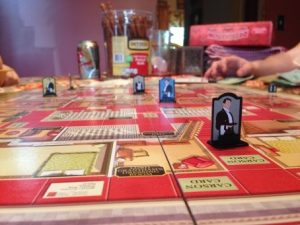
Cox: I no longer have any! I used to have hobbies before writing took over my life. If I do have a few minutes here and there, I still love to garden and bake, but my real love, however, is board games. I’m a fanatic and have become a sort of a collector now.
Playing games with Michelle Cox! Did the butler do it?
Chanti: That sounds like a lot of fun! So, how do you approach your writing day?
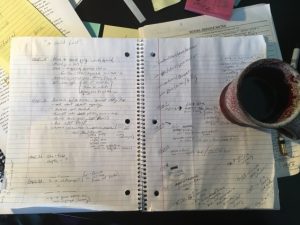
Cox: As soon as my kids get on the bus at 6:50 am, I make my second cup of coffee and sit down at my desk. I’m not allowed to do any social media, though I do always do a quick email check to see, you know, if I won the Pulitzer or something (it’s always no), and then I start working on whatever manuscript I’m currently on. My brain is its crispest early in the morning, so I have to use that time for the work that takes the most concentration. There’s something to be said about productivity when you know you only have a limited time to write. There’s no room for writer’s block or procrastination. When you know you only have so much time, you have a way of just sitting down and doing it.
When I reach whatever my writing goal is for that day, I spend the next five to seven hours (until the kids come home) doing marketing and PR—anything from writing the blog or the newsletter or articles or interviews, taping podcasts, setting up events, answering email, attending to social media, etc. It’s really a full-time job, though, sadly, the actual writing, the part I love, is the part I get to spend the least on.
Chanti: Marketing pays off, right? Name five of your favorite authors and describe how they influence your work.
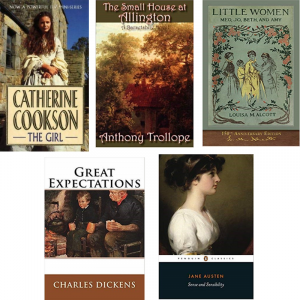
Cox: My series is known for the plethora of rich characters scattered throughout and the big saga-like plots. I was definitely influenced in this by my early favorites: Louisa May Alcott, Catherine Cookson, and Charles Dickens. My other two favorites would be Anthony Trollope and Jane Austin for their subtlety in character and their overall ability to use language so beautifully.
Chanti: I cannot argue with your choices. These are delicious authors – and novels!
I know you gave us a snapshot of your work-day earlier, but could you give us your best marketing tips, what’s worked to sell more books, gain notoriety, and expand your literary footprint.
Cox: Wow! That’s a great question, but so hard to answer. All marketing is pretty elusive, isn’t it? It’s a constant process of throwing things at the wall and seeing what sticks. It’s also important to remember that what works for one person, might not work for everyone. It’s not an exact science. If it were, we’d all be rich!
But, in general, here are some good marketing tips that I have found to work:
Try to figure out where your readers are. Most of my readers, for example, are on Facebook, so that’s where I spend most of my social media time.
Think of yourself as a brand and try to match your posts accordingly. I post things about myself or the book or writing, but mostly old recipes, period drama news, or old stories from the past (which constitute my blog). Also, I’m very careful never to post anything religious or political. This is a business, and the more you see yourself that way and follow basic business protocols, the more successful you’ll be.
Try to build your newsletter list by offering a freebie (such as free story, writing tips, a webinar, a prequel). Personally, I do it by running contests with really big prize packages. I make sure to state that the contest winner will be picked only from my newsletter subscribers. I pay a designer to create a beautiful graphic of the prizes, post it on FB, and then boost the post. Not only does this get me a lot of new subscribers (sometimes up to 1,000!), but it exposes the series to new readers as well!
Build your network. Join online author groups (I am part of a fabulous private FB group organized by my publisher, She Writes Press. We all share ideas, marketing tips, and offer support and advice, especially to the newer authors just coming on board. It’s a collective wealth of information.) or real-world groups in your area. Don’t be jealous of the success of others, but help each other as much as possible. As my publisher, Brooke Warner has said, “There’s room for everyone at the table.”
Show up at other authors events, write reviews, help promote whenever possible. Go to conferences to meet not just readers, but other authors who can potentially help you. Remember that you are a business, and you need to do work within your community to begin standing out.
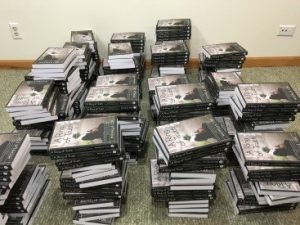
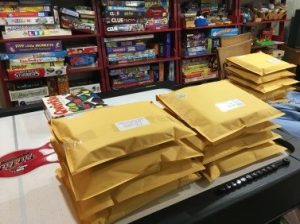
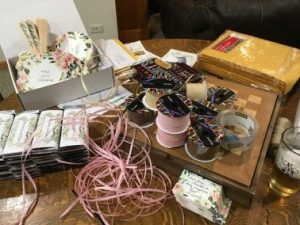
For example, my publisher and I overprinted Book 2 of my series, so, as per my contract, when the first year of publication had passed, I was faced with having to pay a storage fee for these extra books (a couple of thousand), have them shipped to my garage, or have them destroyed. I decided, instead, to send them to libraries and conference organizers. It was a lot of work and expense, but it got my book into the hands of hundreds, if not thousands, of potential readers, and hopefully, they’ll come back for more and buy the rest of the series. You have to be willing to take risks.
Also in this category would be to try to get a Bookbub deal, which, as we all know is really tough. Again, for Book 2 of the series, we submitted four times, trying to get a deal with the book being priced at .99 cents. I finally decided to offer it for free, and we cleverly put a buy link to book 3 at the end of Book 2. Bookbub then offered me a deal, and I had over 55,000 downloads in one day! Hopefully, a lot of those people will go on to buy Book 3 at full price.
Lastly, if the first book of your series is free, either permanently or occasionally, you can join Book Funnel, in which you “bundle” your book with others of a similar genre with each author promoting the bundle to their social network, which exposes your series to a whole new crop of readers. Readers are able to download your free book in exchange for their email address. So not only are you getting readers hooked on your series (hopefully!), but you’re building your subscriber/newsletter list.
Chanti: You could teach a Master Class on this at CAC20! Let’s chat about this later.
Chanti: What are you working on now? What can we look forward to seeing next from you?
Cox: Book 5 of the series is currently in production and scheduled to be released in Spring 2020. I said I was going to take a break from the series after that, but I admit, I’ve already started sketching out Book 6 – I can’t help it!
But what’s really exciting is a new stand-alone novel, The Love You Take, that I wrote, also based partially on a true story and set in Chicago in the 1930s. It’s a really fabulous book if I do say so, about a “backward” girl who has to go and live at a home for “bad girls” after she unwittingly becomes pregnant. I’m currently querying agents for it.
Chanti: Sounds intriguing. Please keep us updated. Who’s the perfect reader for your book?
Cox: Though some men enjoy my books, the primary audience is women. Anyone who loves Downton Abbey;Upstairs, Downstairs;Miss Fisher’s Murder Mysteries, the old black and white films, like The Thin Man . . . basically any period drama or old movie . . . will love my series. I can’t tell you how many people have written to me to tell me that the series is so visual, that reading it was like watching a movie. It’s delightful escapism; people tell me all the time they feel like they’ve been transported back in time after reading them.
Chanti: I know that’s why we read your books #delightful! What is the most important thing a reader can do for an author?
Cox: Tell a friend! Research shows that the number one thing that influences people to buy books is word-of-mouth. If you like a book, recommend it to friends or your book club. The second best thing is to write a review! People seem wary of doing this, telling me that they’re nervous about what to write.
“Nonsense!” I say.
A review can be one sentence: “This was a great book; I enjoyed it!”
There. Done.
You don’t have to go into a lengthy reworking of the synopsis (why do people do this?) or delve into symbolism or themes or whatever. Just give your one-sentence opinion!
Chanti: I’ve been telling my non-writing friends this for years… Do you ever experience writer’s block? What do you do to overcome it?
Cox: Not really! I have a lot of story ideas in my head, and thus I usually have the opposite problem. This is where outlining can really help. If you have a pretty weighty outline sketched out, then when you sit down to write each day, you pretty much already know what you’re supposed to write that day. Likewise, I enjoy taking an evening walk (or I try to, anyway!), during which I think about tomorrow’s chapter and what needs to go into it. Sometimes I even voice record if I have a really good idea or some strands of dialog. There’s something about walking—moving the legs back and forth, back and forth—that seems to stimulate something in the brain. They say that Dickens used to walk the streets of London for hours in the wee hours of the night. Now I know why!
Chanti: Time to reflect and let your mind wander. Movement really does help with this. What excites you most about writing?
Cox: Creating something out of nothing. I’ve always been a really creative person. Looking back, I see now that I’ve always been striving to create, and for a long time it took on many different forms. As a kid, I was always trying to illustrate Louisa May Alcott’s books or write little fan fiction stories based on Jo March. As I got older, it took the form of gardening and decorating the house, and then baking and then creating elaborate kids’ birthday party invitations! When I finally decided to try writing (long story), the creativity within me, that divine essence, finally found its true home. I’m happiest when I’m creating, and I hope I can keep writing for a long time.
Chanti: We hope you do, too, Michelle. What a fabulous interview! Thank you for sharing your story with us.
Speaking of sharing, if you like what you’ve read, please “like, comment, and share!” Sharing is caring, baby!
The CIBA Grand Prize Winners
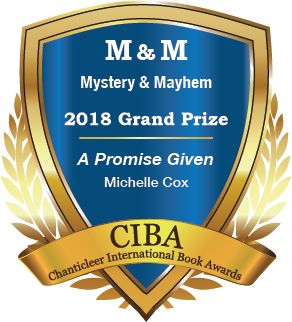
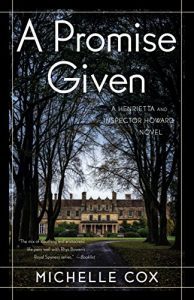
Michelle Cox is a multi-award-winning author who recently spent some time with us at CAC19. This year was particularly special because Michelle won the CIBA 2018 Grand Prize for Mystery & Mayhem Awards!
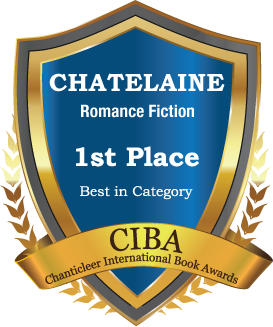
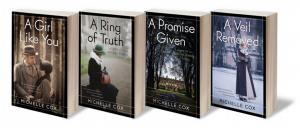
and took 1st Place in the Chatelaine Awards for Romantic Fiction – both awards are in honor of her book, A Promise Given. We will probably never stop celebrating this – it’s just too much fun!
To find out what Michelle’s up to next, Find and Follow her here:
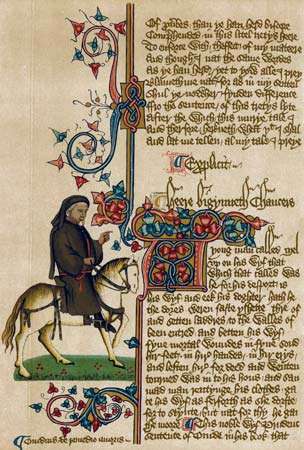
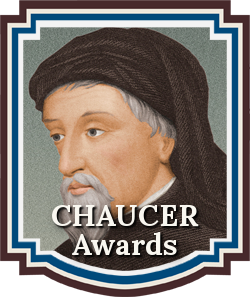
We titled the Chanticleer International Book Awards (CIBAs) division for Pre-1750s Historical Fiction the Chaucer Awards, after the English poet and author of the Canterbury Tales.
Chaucer’s The Canterbury Tales is considered one of the greatest works in the English language. It was among the first non-secular books written in Middle English to be printed.
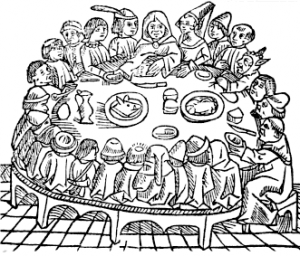
A woodcut from William Caxton’s second edition 0f the Canterbury Tales printed in 1483
The framing device for the collection of stories is a pilgrimage to the shrine of Thomas à Becket in Canterbury, Kent. The 30 pilgrims who undertake the journey gather at the Tabard Inn in Southwark, across the Thames from London. They agree to engage in a storytelling contest as they travel, and Harry Bailly, host of the Tabard, serves as master of ceremonies for the contest. Most of the pilgrims are introduced by vivid brief sketches in the “General Prologue.” Interspersed between the 24 tales are short dramatic scenes (called links) presenting lively exchanges, usually involving the host and one or more of the pilgrims. Chaucer did not complete the full plan for his book: the return journey from Canterbury is not included, and some of the pilgrims do not tell stories.
The use of a pilgrimage as the framing device enabled Chaucer to bring together people from many walks of life: knight, prioress, monk; merchant, man of law, franklin, scholarly clerk; miller, reeve, pardoner; wife of Bath and many others. The multiplicity of social types, as well as the device of the storytelling contest itself, allowed presentation of a highly varied collection of literary genres: religious legend, courtly romance, racy fabliau, saint’s life, allegorical tale, beast fable, medieval sermon, alchemical account, and, at times, mixtures of these genres.
The stories and links together offer complex depictions of the pilgrims, while, at the same time, the tales present remarkable examples of short narratives in verse, plus two expositions in prose. The pilgrimage, which in medieval practice combined a fundamentally religious purpose with the secular benefit of a spring vacation, made possible extended consideration of the relationship between the pleasures and vices of this world and the spiritual aspirations for the next.
Source: The Brittanica Encyclopedia
The Canterbury Tales consists of the General Prologue that sets the story and 24 tales and ends with “Chaucer’s Retractions” (probably a CYA (cover your a&@) move on his part).
Some interesting tidbits about Geoffrey Chaucer
born c. 1342/43 probably in London. He died on October 25, 1400
his father was an important London vintner
His family’s finances were derived from wine and leather
Chaucer spoke Middle English and was fluent in French, Latin, and Italian
He guided diplomatic missions across the continent of Europe for ten years where he discovered the works of Dante, Petrarch, and Boccaccio whose The Decameron had a profound influence on Chaucer’s later works
He married well as his wife received an annuity from the queen consort of Edward III
His remains are interred in the Westminster Abbey
Kiffer Brown, the founder of Chanticleer Reviews, was introduced to Geoffrey Chaucer’s Canterbury Tales when she was studying medieval history at university. If you press her on the matter, she will confess that she and her classmates read the work in Old English (of which she is very proud to have done). And yes, she is fond of The Decameron by Boccaccio. Don’t be surprised if one of the next division of the Chanticleer International Book Awards is named after Boccaccio.
Want to be a winner next year? The deadline to submit your book for the Chaucer awards is June 30, 2019. Enter here!
Grand Prize and First Place Winners for 2019 will be announced on April 18, 2020.
Any entries received on or after June 30, 2019, will be entered into the 2020 Chaucer Book Awards. The Grand Prize and First Place for 2020 CIBA winners will be held on April 17, 2021.
As our deadline draws near, don’t miss this opportunity to earn the distinction your historical fiction readers deserves! Enter today!
The CHAUCER Book Awards is a division of the Chanticleer International Book Awards – the CIBAs.
The 2019 winners will be announced at the CIBA Awards Ceremony on April 18, 2020, that will take place during the 2020 Chanticleer Authors Conference. All Semi-Finalists and First Place category winners will be recognized, the first place winners will be whisked up on stage to receive their custom ribbon and wait to see who among them will take home the Grand Prize. It’s an exciting evening of dinner, networking, and celebrations!
Sailing along – making great time! Fair waves and following seas! All is good!
Your book baby is still alive and has weathered its first month on the rough seas of self-publishing. The holds of your ship are taking on coin. The sky is blue, the waves choppy, and for the most part you have beat back the sharks.
You got this, right?
Month two arrives, and the crest of the wave you have been sailing vanishes. Your sales drop. You attempt to prop up those sales by spending some of that hard-earned gold in the hold, on flags to fly atop your central mast. Surely everyone will see your flag and flock to it, to buy your book baby.
Month two expires and with it, your sales. Your ship takes on water and sinks, as it sails over the sixty-day new release cliff, leaving you with one oar on a shrinking raft.
Sharks are everywhere!
This close-up view of the seas shows you the truth. The sharks were swimming below the surface and already made off with the coin that should have been tumbling into your sea chests. Your book has been pirated, and no one is paying attention to the wildly flapping flag, tied to the peak of your tattered sales. (See what I did there? 😊)
Before you sink into obscurity you try one last time, to stopper the holes sliced into the deck by the shark’s fins. You throw money at every advertising platform you have ever heard, spending the last of your once-shiny piles of gold to prop up your sales. Not to be outdone, you send cease and desist emails to every site that has your book baby illegally uploaded for sale. Of course, they ignore you. The pirate’s code trumps all.
Nothing you do can save you. You decide to ignore the pirates because there is nothing you can do about it.
Depressing, eh?
There must be a better way, right?
What can a lonely self-published author do to prevent the theft of their hard work, and sink the pirate ships before they can even toss a grappling hook into your manuscript?
Are you ready to hear about one possible future for publishing?
Then read on.
Cryptocurrency. Let’s break down that term.
According to Dictionary.com, “Crypto” comes from the Greek word Kryptos, which means “secret, or hidden.” The English language derives the word ‘crypt’ from this root word.
The word “currency” has a wider range of definitions, which all help to illustrate its meaning. “something that is used as a medium of exchange; money,” and “the fact or quality of being widely accepted and circulated from person to person,” and the British dictionary also defines it as “the act of being passed from person to person.”
Cryptocurrency is a hidden form of exchange, defined as “a digital currency or decentralized system of exchange that uses advanced cryptography for security.” Simply put, cryptocurrency is a hidden form of currency that is able to be passed from person to person in complete security.
“But wait,” you say, “cryptocurrency isn’t coin. It isn’t even touchable. It exists only in cyberspace. How does that work?”
I am so glad you asked.
The beauty of a cryptocurrency universe is that the pirates can’t get to it.
It’s not floating around in some bank (ship’s hold), waiting to be stolen by a card skimmer or password bot, nor is it in grandma’s safe bolted to the basement floor, or held in an investment firm’s dubious clutches, where sticky fingers skim coin all too often.
Cryptocurrency is held virtually and is not in any one place. The currency itself is decentralized and encrypted. There is no Fort Knox to break into. There is no place to send a trojan horse, to sneak behind the secure walls.
Instead, the currency is distributed in code bits across servers located around the world. At last count, the number of cryptocurrency servers numbered over twenty thousand.
Cryptocurrency is riding the wild seas of any startup, but there is no doubt that it is here to stay.
As the currency gains in popularity and is adopted by more and more companies, it will become one more way to pay for goods and services in this digital age. I dare say that in time, it will become the currency to which all “paper” forms of currency are tied. It will become the central pillar to which all regional currencies are pegged like the USD is used for now. But no nation wants to be tied to another nation’s rise and fall, for their own currency values. Anyone outside of the United States understands this point of pain.
And payments made with cryptocurrency are more secure than any form of payment we presently use. No one can steal the currency as it is not laying around to be stolen. Transactions are secure because they are undertaken by large mathematical calculations that only computers can solve.
What does this mean for you, as an author, you ask?
It means, that in the near future, cryptocurrency will be a way of digitally selling and receiving payment for our books, that cannot be corrupted or stolen by an outside party.
But wait, what about the books themselves? They can still be stolen, right?
…. And that is the perfect segue to the last article in this series by Susan Faw:
“Chaining Piracy: How To Save Your Damsel / Damoiseau In Distress”
In fiction there’s a hierarchy when it comes to characters: the protagonist, antagonist, secondary characters, minor, walk-on, and stock characters. Let’s focus more on minor characters, shall we? Writers who neglect minor characters are neglecting essential ingredients to their works. It would be like omitting garlic or oregano from pasta sauce or cumin from a pot of chili.
Minor characters, like secondary characters, operate in a strictly supporting role.
They are rarely viewpoint characters.
Don’t take up a lot of ‘stage time’ and readers generally don’t care about them a lot.
Do not have a subplot.
This means they’re usually ‘flat’ that is, they won’t change over the course of the story and they’re not fully dimensional. (There are exceptions to this.)
Just a pinch makes all the difference!
HOWEVER: Minor characters add color, verve, spice, eccentricity.
Make things happen, help advance the plot.
Establish the setting.
Provide insights or information about major characters. Without secondary and minor characters the protagonist would be isolated.
Prove that the protagonist has grown or changed.
Support the mood or atmosphere in a scene.
Breathe life into the story.
Disprove stereotypes.
Support themes.
Examples:
To Kill a Mockingbird: Heck Tate, Calpurnia, Judge John Taylor, Miss Maudie Atkinson, Dolphus Raymond
A Christmas Carol:Tiny Tim, Belle, Scrooge’s former fiance, Fred, Scrooge’s nephew, Fezziwig
Harry Potter series:Colin Creevey, Katie Bell, Pansy Parkinson, Padmil & Parvati Patil, Neville Longbottom, Cho Chang (to name but a few)
Hunger Games series:Madge Undersee, Katniss’ friend who gave her the mockingjay pin, Caesar Flickerman the television host, Effie Trinket, the District 12 escort, other tributes–Cato, Thresh, Clove, Foxface, Glimmer, Marvel, (Rue is a secondary character)
A few more tips:
While a minor character can be quirky or sexy, he or she shouldn’t distract readers from the main events and characters. Generally, the more you tell your reader about a minor character, the more you elevate his or her importance.
Use minor characters for humor or breathers in the story.
Minor characters should complete the story, create verisimilitude.
Give them a ‘job’ to do, such as a witness in a crime novel. In The Hunger Games, Marvel, the tribute from District 1 kills Rue with a spear through her stomach. Later Katniss kills him. Although she’s already taken out several competitors, she is now a hunter, not the hunted, a significant shift in the story.
Emulate J.K. Rowling and Charles Dickens and grant your minor characters silly, memorable, or suggestive names. As in Martin Chuzzlewit and Sophronia Akershem, and Uncle Pumblechook.
Use minor characters to reveal class, ethnicity, culture, and the milieu of the story world.
A poignant example from Shawshank Redemption
Don’t be afraid to give them a poignant role or to motivate another character as Brooks does in Shawshank Redemption. Poor Brook is elderly when he’s paroled from Shawshank. Problem was, he didn’t have the youth or skills to cope on the outside and ends up hanging himself. He serves as Red’s ‘anti-mentor’ in the story. Later, when Red the narrator is also paroled after spending years in prison, readers and movie viewers are reminded of Brooks’ fate. Will Red follow him?
Tolkien reveals volumes about his Middle Earth with the different minor characters and their kind in Lord of the Rings.
Examples of Lord of the Rings’ Minor Characters that come to mind are:
Barliman Butterbur, a man of Bree and a forgetful innkeeper where Gandalf frequented
Shagrat, an Uruk orc (role of villain)
Haldir, Elf of Lothlorien – He spoke the Common Tongue fluently so he was able to communicate with the Fellowship and to learn of their loss of Gandalf.
Rosie Cotton, a hobbit who patiently awaited Samwise Gamgee’s return to the Shire
Ugluk, a villain who was a leader of the Uruk-hai scouts and trusted servant of the evil wizard Saruman
Theodred, Prince of Rohan – a nobleman of birth and bravery
Goldberry, a female who embodied the spirit of Nature
Notice that I didn’t need to use images for LOTR minor characters; their names practically describes them and their roles.
If you are a fan of George R.R. Martin’s The Song of Fire and Ice series, you are well aware of his use of minor characters to move his series forward.
Stop back by for Part Two — Minor Characters – The Spice of Fiction from the Writers’ Toolbox Series
Writer’s Toolbox Series
Keep writing, keep dreaming, have heart. Jessica
Jessica Morrell is a top-tier developmental editor and a contributor to Chanticleer Reviews Media and to the Writer’s Digest magazine. She teaches Master Writing Craft Classes at the Chanticleer Authors Conference that is held annually along with teaching at Chanticleer writing workshops that are held throughout the year.
Did you know that Chanticleer offers editorial services?We do and have been doing so since 2011.
And our professional editors are top-notch and are experts in the Chicago Manual of Style. They have and are working for the top publishing houses (TOR, McMillian, Thomas Mercer, Penguin Random House, etc.) and elite indie presses.
We work with a small number of exclusive clients who want to collaborate with top-editors on an on-going basis.
Contact us today! If you would like more information, we invite you to email Kiffer or Sharon at KBrown@ChantiReviews.com or SAnderson@ChantiReviews.com
(This is a three article series exploring the ever-expanding issue of book piracy.)
It is every fledgling author’s dream to see their book published. The time spent writing and rewriting, editing and polishing your book, are unpaid months and in some cases, yearsof toil, never to be recovered.
Release day cannot come quick enough, whether you are independently publishing, or are on a more traditional path. The day your book goes live is akin to a wedding day, or the birth of a child, a momentous, long anticipated date that greeted with joy.
Sending your book baby out into the world is a perilous event. This child of your brain is set adrift on retail rafts, in the hope that it won’t drown, and sink into obscurity. You think that drowning is the worst thing that can happen, that no one will notice your novel and that it will disappear from view.
Actually, the worst thing that can happen is that your book is a runaway success—at least with how the publishing industry is currently structured.
You see, that ocean is full of sharks. The sharks of the publishing ocean will plagiarize your work. They will copy it and stuff it into books that they create, and slap a cover on it and upload it to Amazon, stealing your words and your income. But plagiarism has always existed in the world. They do get caught and the books are taken down.
Worse than the sharks are the pirates. Flying international flags of privilege and self-aggrandizement, these modern-day pilferers go far beyond nibbling at your work. Cruising the waters to see what rafts have popular cargo, they pounce on those books fortunate enough to be successful. They outright steal your book baby, stuffing the loot into storefronts of their own, without a penny of that work being returned to the author and/or publisher.
According to a recent article of The Guardian: “All this is exhausting for authors, but it could be devastating for readers, too. Harris, a representative of the SoA who speaks passionately on behalf of authors, knows several who have lost contracts because piracy drove down their sales to an unsustainable level. The most vulnerable authors are those who write series: when book one does well, but book two is heavily pirated, book three could end up dead in the water. Midlist authors and those who barely scrape a living are also at risk. “These people mistakenly think they’re sticking it to the man,” Harris says. “They’re not; they’re sticking it to the little people, the people who are struggling … and they don’t care.”
And the numbers of illegal downloads of pirated ebooks are staggering.
The website GoodEreader states: “Pirate websites received 300 billion visitors last year and ebooks represent a small, but growing segment. Digimarc and Nielsen conducted a recent study that reveals 41% of all adult e-book pirates are aged between 18 and 29 but perhaps surprisingly, 47% fall into the 30 to 44-year-old bracket. The remaining 13% are aged 45 or up. There are also some surprises when it comes to pirates’ income. Cost is often cited as a factor when justifying downloading for free, and this study counters that the average household income that downloads books the most range from $60,000 and $99,000.”
“Ebook piracy is not just popular in the United States, but is a global problem,” according to the Intellectual Property Office. Their latest study of online copyright infringement finds that “seventeen percent of ebooks read online in the UK are pirated – around 4m books. According to research by Dutch firm GfK, only 10% of all German ebooks on devices were actually paid for, with most of the digital books being pirated. On average, an e-reader in the Netherlands holds on average 117 ebooks. Out of that total, 11 were bought at legitimate websites. The remaining books were pirated at file-sharing sites or through Torrent sites. Ninety-two percent of ebook readers in Russia obtained their books illegally downloading the materials.”
I bet you are not feeling so cozy over your amazingly successful book launch now, are you? But this series of articles is not meant to be discouraging.—
In fact, there are promising signs for the future of e-book publishing. In this swiftly changing digital age, you can stay one step ahead of the pirates, with some careful planning. In the next article, we will explore ways to protect your digital copyright, and budding technologies you need in your arsenal, to help protect you, and your book baby from pirates.
Many writers struggle to create vibrant and complex secondary characters. After all, complicated main characters are hard enough to create. Memorable secondary characters, however, can make or break a story. Think about Yoda (Star Wars), Pippin (LOTR), Jane Bennet (Pride and Prejudice), Thomas Pullings (the Aubrey – Maturin series by Patrick O’Brian), and …
Jane Bennet – Pride and PrejudiceThomas Pullings of the Aubrey-Maturin Patrick O’ Brian series
I always view secondary characters as a measuring stick for a writer’s prowess. Jessica
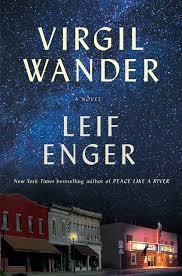
Here’s a vivid example of a memorable secondary character from Leif Enger’s beautifulVirgil Wander.
His name is Rune–so here’s a simple trick, give your characters resonant names.
In this case, rune has mystical, mysterious associations. The day after the protagonist Virgil survives a car accident in the opening moments of the story he walks to the waterfront of the forbidding, ever-changing Lake Superior. Enger is introducing an oft-used device: a mysterious Stranger comes to town.
I ended up at the waterfront. It’s not as though there’s any other destination in Greenstone. The truth is that I moved here largely because of the inland sea. I’d always felt peaceful around it–a naive response give it fearsome temper, but who could resist that wide throw of horizon, the columns of morning steam? And the sound of a continual tectonic bass line. In a northeast gale this pounding adds a layer of friction to every conversation in town.
At the foot of the city pier stood a threadbare stranger. He had eight-day whiskers and fisherman hands, a pipe in his mouth like a mariner in a fable, and a question in his eyes. A rolled-up paper kite was tucked under his arm–I could see bold swatches of paint on it.
There was always a kite in the picture with Rune, as it turned out.
He watched me. He carried an atmosphere of dispersing confusion, as though he were coming awake. “Do you live in this place?” he inquired.
I nodded.
“Is there are motor hotel? There used to be a motor hotel. I don’t remember where.”
His voice was high, with a rhythmic inflection like short smooth waves. For some reason it gave me a lift. He had a hundred merry crinkles at his eyes and long-haul sadness in his shoulders.
“Not anymore–not exactly.” If I’d had more words, I’d have described Greenstone’s last operational motel, the Voyageur, a peeling L-shaped heap with scraggy whirlwinds of litter roaming the parking lot. Though technically “open,” the Voyageur is always full, its rooms permanently occupied by the ower’s grown children who failed to rise on the outside.
“Oh well,” he said,shaking himself like a terrier. He peered round at the Slake International taconite plant, a looming vast trapezoid which had signified bustling growth in the 1950s and lingering decline ever since. Its few tiny windows were whitewashed or broken; its majestic ore dock rose out of the water on eighty-foot pilings and cast a black-boned reflection across the harbor. No ship had loaded her in so long that saplings and ferns grew wild on the planking. We had a little forest up there. I looked at the kite scrolled under his arm. He’d picked the wrong day for that, be then he looked like a man who could wait.
He said, “You here a long time?”
“Twenty-five years.”
At this something changed in him. He acquired an edge. Before I’d have said he looked like many a good-natured pensioner making do without a pension. Now in front of my eyes he seemed to intensify.
“Twenty-five years? Perhaps you knew my son. He lived here. Right in this town,” he added looking round himself, as though giving structure to a still-new idea.
“Is that right. What’s his name?”
The old man ignored the question. He pulled a kitchen match from his pocket, thumbnailed it, and relit his pipe, which let me tell you held the most fragrant tobacco–brisk autumn cedar and coffee and orange peel. A few sharp puffs brought it crackling and he held it up to watch smoke drift off the bowl. The smoke ghosted straight up and hung there undecided.
Writer’s Toolbox
Did you notice how this small scene multi-tasks?
Techniques to borrow:
Sharply observed first impressions (carried an atmosphere of dispersing confusion as though coming awake, a good-natured pensioner making do without a pension, looked like a man who could wait)
Props (kite and tobacco, kitchen match, pipe)
Smells (tobacco)
Iconic or mythic comparisons (rune, mariner in a fable)
Indelible physical features: (fisherman’s hands, question in his eyes, a hundred merry crinkles as this eyes and a long-haul sadness to his shoulders)
Here’s a tip: When you need to describe a character or objects or setting ask yourself what does this remind me of?
As you walk around your world, really notice your surroundings and ask yourself the same question.
The next post will be about noticing and nurturing your imaginings with paying attention to small details with a novelist’s eye.
Until then, Keep writing, keep dreaming, have heart. Jessica
Jessica Morrell is a top-tier developmental editor and a contributor to Chanticleer Reviews Media and to the Writer’s Digest magazine. She teaches Master Writing Craft Classes at the Chanticleer Authors Conference that is held annually along with teaching at Chanticleer writing workshops that are held throughout the year.
A Chanticleer Reviews – Writer’s Toolbox blog post on Character Development by Jessica Page Morrell
Did you know that Chanticleer offers editorial services?We do and have been doing so since 2011.
And our professional editors are top-notch and are experts in the Chicago Manual of Style. They have and are working for the top publishing houses (TOR, McMillian, Thomas Mercer, Penguin Random House, etc.) and elite indie presses.
We work with a small number of exclusive clients who want to collaborate with top-editors on an on-going basis.
Contact us today! If you would like more information, we invite you to email Kiffer or Sharon at KBrown@ChantiReviews.com or SAnderson@ChantiReviews.com
When a character is introduced in a story he or she needs to make a strong impression. (Walk-on and minor characters are sometimes the exceptions.) This means when you create characters after you make decisions about physical appearance and their essential role in the story, then start refining his or her essence and key personality traits. Some of the decisions about your character will happen without you making decisions because characters have a way of emerging and evolving in our deeper consciousness.
Fiction equals characters.
Characters make us care, worry, empathize.
Characters need to be knowable.
No matter your process, it’s crucial to nail a character’s humanity and complexity on the page. And to nail his or her essence from the first breath he/she takes in your story.
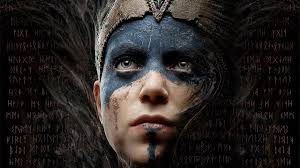
Senua’s Sacrifice: Hellblade
Within the personality spectrum, there are endless possibilities. There are also layers to one’s personality, and it seems to me that the inner layers are a character’s essence.
Let’s list some possibilities: quiet, serious, boisterous, buoyant, innocent, worldly, full of laughter, cautious, always ready for adventure. Let’s consider other options: practical, frivolous, introverted, extroverted, questioning, plays by the rules, respects the status quo, rebellious, rigid, creative, uptight, light-hearted.
Samwise Gamgee – LOTR
Virgil Wander
I recently read Leif Enger latest beautiful novel, Virgil Wander. It’s now number one on my Top 10 Favorite Novels of All-time list. One thing I like best about Enger’s stories is that he creates fascinating and sometimes oddball characters you’ve never met before and will never forget. He toes the line between creating ordinary-extraordinary story people you want to spend a lifetime with.
And while complicated, they’re knowable They typically face uncommon, vexing problems and dilemmas and seem as human as my next-door neighbor. Virgil Wander, the protagonist of this wending tale, is no exception. I don’t want to give away too much, but he starts the story with a head injury and owns a failing theater in a small town.
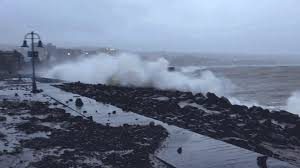
The failingtown is perched on the ever-changing and blustery Lake Superior and skies, wind, and storms play a big role in the story. If you’ve never visited Lake Superior, the largest body of fresh water on the planet, it’s a primal, massive inland sea.
One of the many moods of Lake Superior
Toss in a pipe-smoking, kite-flying Norwegian, a mysterious prodigal son millionaire, a missing baseball player, several boys who need a father, and a local handyman on a downward arc. The setting is tightly woven into all aspects of the tale, but it’s the characters who will live in me forever.
Here’s an example of how Enger introduces a character, the aforementioned missing ballplayer, while capturing his essence and adding to the mystery of his disappearance:Most people knew about Alec Sandstrom, or thought they knew, could be traced to a silken Sports Illustrated article published on the anniversary of his death.
The magazine’s expenditure of four thousand words on a failed minor-league pitcher testifies to Alec’s magnetism. In two seasons of small-time baseball, Alec was often compared to eccentric Detroit phenom Mark Fyrich, who is remembered for speaking aloud to the ball itself as though recommending a flight path. Alec didn’t talk to baseballs–his quirk adored by fans of the Duluth-Superior Dukes, was to break out laughing during games. Anything could set him off: an elegant nab by the second baseman, a plastic bag wobbling like a jellyfish across the diamond, a clever heckle directed at himself. His merriment was unhitched from his success. Sometimes he laughed softly while leaning in for signs. His fastball was a blur, its location rarely predictable even to himself. Sprinting on-field to start the game, limbs flailing inelegantly, Alec always seemed sure his time had arrived.
“Reality wasn’t strictly his deal,” Beeman recalled. “My God he was fun to watch.”
Engaging as Alec could be, he’d never have received the elegiac Sports Illustrated treatment had he not strapped himself into a small plane at dawn, lifted off in a light westerly, and banked over Lake Superior never to return.
Untethered from his success.Sigh. Pardon me while I indulge in writer’s envy. As you can tell, Alec is an original. And notice how his essence isjoyful? Stay tuned, I’m going to reveal a few more of his characters’ essence in an upcoming post.
Keep writing, keep dreaming, have heart. Jessica
Jessica Page Morrell
Jessica Morrell is a top-tier developmental editor and a contributor to Chanticleer Reviews Media and to the Writer’s Digest magazine. She teaches Master Writing Craft Classes at the Chanticleer Authors Conference that is held annually along with teaching at Chanticleer writing workshops that are held throughout the year.
Did you know that Chanticleer offers editorial services?We do and have been doing so since 2011.
And our professional editors are top-notch and are experts in the Chicago Manual of Style. They have and are working for the top publishing houses (TOR, McMillian, Thomas Mercer, Penguin Random House, etc.) and elite indie presses.
We work with a small number of exclusive clients who want to collaborate with top-editors on an on-going basis.
Contact us today! If you would like more information, we invite you to email Kiffer or Sharon at KBrown@ChantiReviews.com or SAnderson@ChantiReviews.com
A Chanticleer Reviews – Writer’s Toolbox blog post on Character Development by Jessica Page Morrell
Declutttering sentences give me the same thrill that Marie Kondo (author of The Life Changing Magic of Tidying Up) experiences when she organizes sock drawers or attacks a kitchen’s junk drawer. I believe she calls this feeling “sparking joy.” Not only do I want sentences to be grammatically correct, but I want to make sure that every word counts toward moving the story forward. And that definitely sparks joy in me.
The Ubiquitous Junk Drawer
Most of us use go-to words that aren’t necessary to tell the story. We use them out of habit or laziness, or because no one has pointed out that you don’t need them. In the spirit of writing clean, crisp, and intelligently here’s a reminder about words you usually don’t need.
Declutter Your Sentences by Eliminating These Junk Words
Breathing, deep breaths, barely breathing, inhaling, exhaling, and other lung movements. Many writers of all levels reveal their characters’ emotions and reactions using their breath, lack of breath, breathlessness, or as their main method of reacting and showing emotion. “I took a deep breath” is a phrase I’ve seen so often it’s a cliche. Unless a character has the breath knocked out of him or is in the midst of childbirth, avoid focusing on breathing as your main means to create emotion. Instead collect a variety of mannerisms, reactions, gestures, and body language individual to each character.
Down or up. As in Rachel sat down. Now Rachel can collapse into a chair, or sidle into an empty seat in a dark theater, or ease onto a sofa, or flump onto a bed. Sit and sat means a person is lowering himself or herself. As in down. More accurately sit means supporting your weight on your buttocks.
Question your use of up. It seems so innocent, doesn’t it? Blithe stood up. Stood means up because standing means a person is upright, supporting himself on his feet. Denzel stood, joining the screaming fans. Also, do not write grabbed up; grabbed suffices. Avoid appending up to spoke, hurry, lift, climb, and rose.
Really. I mean really? Do you need it? Is the weather really cold or is it frigid or dangerously cold?
Really?
Literallymeans exactly as described or in a literal or strict sense. It does not mean quite, actually or really. Wrong: I was so mad I was literally shaking like a leaf and red-faced. Or, I was so terrified I literally jumped out of my skin. Or, Her death literally brought me to my knees. Better: The playoffs were watched by literally millions of fans.
Basically, essentially, obviously, basically, totally.Hint: question every adverb you use with an -ly ending because many are so overused they’ve become meaningless. However, the larger issue is many people sow these words into their stories without understanding their correct meanings mostly to maximize or intensify. Over time many adverbs have become meaningless.Basicallymeans at a basic level or fundamental sense, not almost or mostly.Essentiallymeans the essence of something or in an essential manner, not almost or often. Practicallymeans in a practical manner not almost or mostly.Totallymeans completely, in every part, not really.
Just. No, I’m not just kidding. Too many of us (guilt-hand raised) use this one out of habit.
Moments. I’ve read manuscripts where characters pause or think or kiss for only a momenthundreds of times throughout the story. There are plenty of ways to describe brief actions or thoughts.
That. If a sentence works without that, ditch it. Easy, right?
Suddenly. Because if you’re reading fiction you assume that actions, twists, and surprises will happen abruptly. They are devices used to increase tension and suspense. No need to announce it.
Hopefullydoesn’t mean ‘I hope.’ But it might convince an editor you’re not the wordnik he or she wants to work with.
A note from Kiffer: A handy tool to help you recognize if these egregious junk words have infiltrated your manuscript is the “Find and Replace” tool that can be found in WORD or other word processors. This tool finds and highlights specific words so that you can replace if needed to insure that every word counts.
Chanticleer’s Writer’s Toolbox Series
Jessica Page Morrell
Jessica Morrell is a top-tier developmental editor and a contributor to Writer’s Digest magazine, and she teaches Master Writing Craft Classes at the Chanticleer Authors Conference that is held annually along with teaching at Chanticleer writing workshops.
Keep writing, keep dreaming, have heart. Jessica Morrell



 We are now accepting submissions into the 2020 CYGNUS Awards writing competition. The deadline for submissions is April 30th, 2020. The winners will be announced in April 2021.



 For example, my publisher and I overprinted Book 2 of my series, so, as per my contract, when the first year of publication had passed, I was faced with having to pay a storage fee for these extra books (a couple of thousand), have them shipped to my garage, or have them destroyed. I decided, instead, to send them to libraries and conference organizers. It was a lot of work and expense, but it got my book into the hands of hundreds, if not thousands, of potential readers, and hopefully, they’ll come back for more and buy the rest of the series. You have to be willing to take risks.