The Laramie Book Awards recognize emerging new talent and outstanding works in the Americana / Western, Pioneer, Civil War, Frontier, and First Nations Novels. The Laramie Book Awards is a division of the Chanticleer International Book Awards.
Chanticleer Book Reviews is looking for the best books featuring cowboys, the wild west, pioneering, civil war, and early North American History, we will put them to the test and choose the best among them.
These titles have moved forward in the judging rounds from SLUSH pile to the 2019 Laramie Book Awards LONG LIST and have now progressed to the 2019 SHORTLIST. The ShortListers’ works will compete for the Semi-Finalists positions. Semi-Finalists will be announced and recognized at the CAC20 banquet and ceremony. The First Place Category Winners, along with the CIBA Division Grand Prize winners, will be selected from the 16 CIBA divisions Semi-Finalists. We will announce the 1st Place Category winners and Grand Prize Division Winners at the CIBAs Banquet and Ceremony on Saturday, April 18th, 2020 at the luxurious Hotel Bellwether in Bellingham, Wash.
These titles are in the running for the SHORT LIST of the 2019 LARAMIE Book Awards for Western Fiction. Good luck to all as your works move on to the next rounds of judging.
Bert Entwistle – Leftover Soldiers – Life on the Western Frontier
E. Alan Fleischauer – Rescued
Rhonda Frankhouser – Escape from Ruby’s Ranch
Kit Sergeant – Underground: Traitors and Spies in Lincoln’s War
J. R. Collins – Spirit of the Rabbit Place
Gerald L. Guy – Chasing Gold
John West – Marshallville
Lynwood Kelly – The Gamble: Lost Treasures
David Fitz-Gerald – Wanders Far-An Unlikely Hero’s Journey
Hayley Stone – Make Me No Grave: A Weird West Novel
Gerald L. Guy – Chasing the Past
John Hansen – The Outfit
Eileen Charbonneau – Seven Aprils
Donna L.H. Smith – Meghan’s Choice
Juliette Douglas – Bed of Conspiracy
Nina Romano – The Girl Who Loved Cayo Bradley
Donna L.H. Smith – Meghan’s Choice
Mike H. Mizrahi – The Unnamed Girl (The Woodard Chronicles)
Suanne Schafer – A Different Kind of Fire
Which of these works will move forward in the judging rounds for the 2019 LARAMIE Book Awards for Western Fiction?
The 16 divisions of the 2019 CIBAs’Grand Prize Winners and the Five First Place Category Position award winners along with recognizing the Semi-Finalists will be announced at theApril 18th, 2020 Chanticleer International Book Awards Annual Awards Gala,which takes place at the Chanticleer Authors Conference that will be held in Bellingham, Wash.
We are now accepting submissions into the 2020 LARAMIE Book Awards for pre-1750s Western Fiction. The deadline for submissions is July 30, 2020. The 2020 winners will be announced in April 2021.
As always, please contact us at Chanticleer@ChantiReviews.com with any questions, concerns, or suggestions!
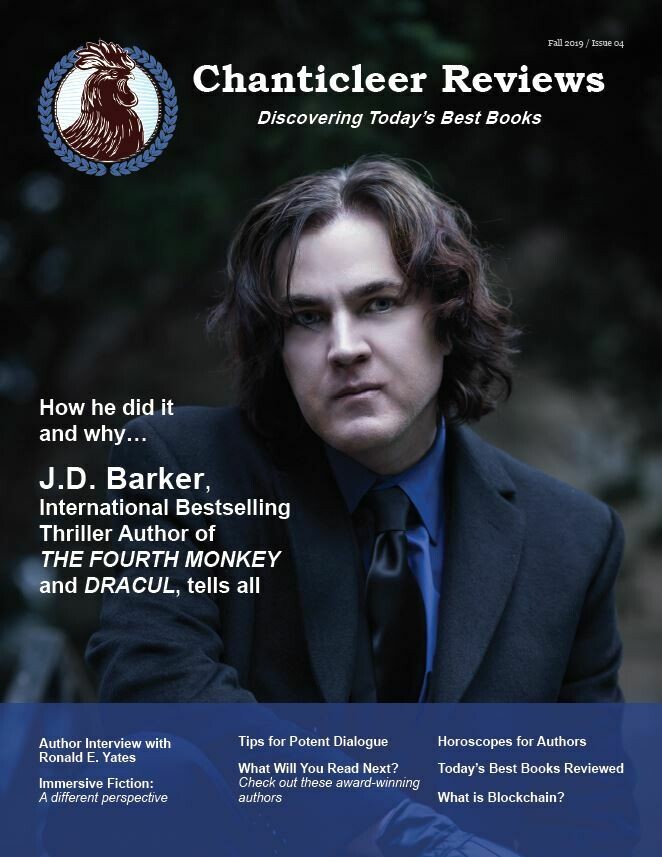
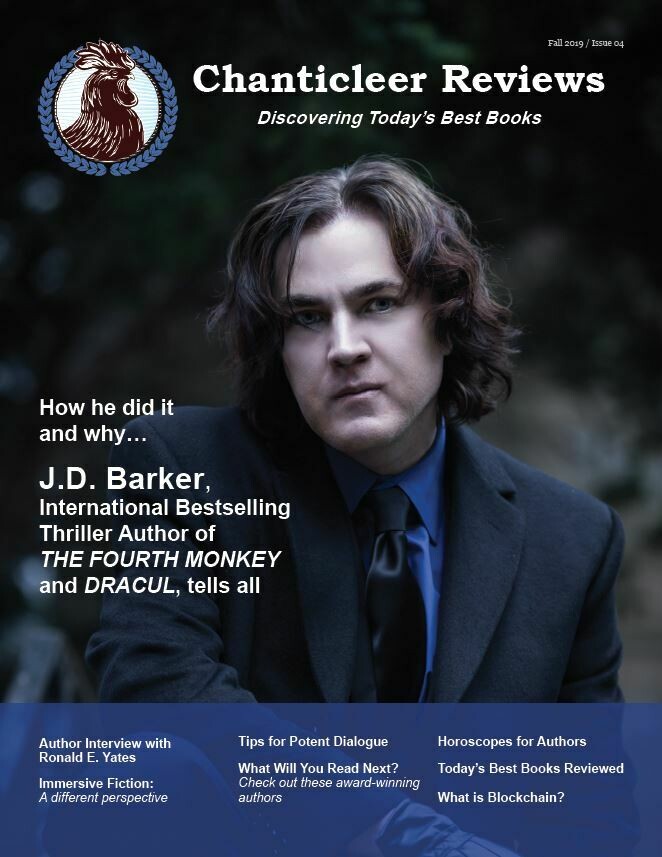
We are excited (thrilled to be truthful) to announce that the Chanticleer Reviews magazine Fall Issue 2019 has been printed and available for purchase in print and digital e-zine!
The first reviews are of the magazine are in!
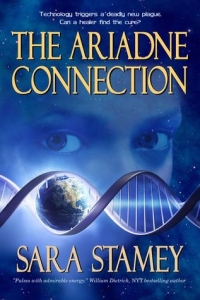
“The new glossy Chanticleer Reviews magazine looks great—keep up the great work!” – Sarah Stamey, author of the award-winning Ariadne Connection.
“I just got my copies [Chanticleer Reviews magazine] today. They are fantastic!” –Peter Greene, author of The Adventures of Jonathan Moore historical fiction series.
“Ah, I think I am going to cry. Thank you. The review of The Jøssing Affair is amazing! Merci bien.” – J. L. Oakley, award-winning author of historical fiction.
“The magazine looks great!” – J.D. Barker, Master of Suspense and international best-selling author of the Fourth Monkee Thriller series
“I got my magazines…the magazine looks great!” – Ron Yates, CIBA Grand Prize winner for his Bill Battles series and Dean of the College of Media and Professor Emeritus of Journalism at the University of Illinois.
“This is so exciting to see the Chanticleer review of The Last Outrageous Woman in print in such a gorgeous magazine. Thank you! – Jessica H. Stone
The magazine is a glossy full vivid color publication that is locally printed here in Washington State with the latest in printing technology.
The Fall Issue features:
A “tells all” interview with J.D. Barker, the international bestselling suspense author
Tips for Potent Dialogue by Jessica Page Morrell, Top-tiered Editor
Horoscopes for Authors by Carolyn Leeper
Photos from Chanticleer Authors Conference 2019
Showcasing of the 2018 CIBA Grand Prize Winners and First Place Winners for all 16 divisions
An in-depth interview with Ronald Yates, a former foreign correspondent for theChicago Tribuneand Professor Emeritus of Journalism at the University of Illinois where he was also the Dean of the College of Media and 2018 CIBA Grand Prize winner for Best Book (and series), The Billy Battles series.
BEST INTRODUCTORY DEAL – Subscribe for ALL FOUR ISSUES (the current Fall Issue, Winter, Spring, and Summer issues) and you will also receive the digital access codes for each of the quarterly e-zines for only $48 dollars – including postage for shipping within the USA and remember FREE access to the digital editions.
We will email you the code once we receive your annual subscription order for $48 for 4 quarterly issues starting with FALL 2019 (The special introductory rate includes postage within the USA and Free Digital Downloads).
Don’t miss an issue! Fall, Winter, Spring, and Summer issues of the Chanticleer Reviews magazine! Subscribe today!
This introductory offer will end soon…Don’t delay!
Each issue of the Chanticleer Reviews Quarterly magazine will have a section dedicated to the Chanticleer Author Event Calendar! Each event listed will also be promoted on Facebook and Twitter prior to the listed event date.
These special ad rates are for Chanticleer AUTHORS only so they can promote their:
Books & Author Brand
Launch Dates of Titles
Author Events & Book Signings
Virtual Social Media Events
Promotions and Sales Events for Titles
New Releases with COVER and Order Info
Non-profit Book Events Participation
Sneak Previews
The Author Event ads in the magazine are 1/6 of a page and Horizontal Format 4.75” w x 2.25” h and may include covers, logo, or graphic. Full Color.
These Author Event Calendar Spots are $50 without links in the digital format or $75 with links in the Digital Format. The spots are limited. Don’t Delay.
Get Your Chanticleer Reviews magazine in time for the Holidays!
You know you want one for your coffee table, your writing lair, and buy five copies for your mother (hat-tip to Dr. Hook and the Medicine Show’s “Cover of the Rolling Stone”).
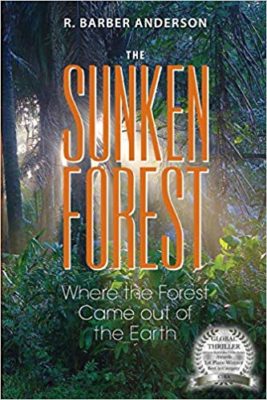
American timber company, NTI, flies over a remote area of the Congo with sophisticated instrumentation. Data shows an immense, deep depression in the jungle floor, a giant caldera from an extinct volcano. Despite the depth of the crater, the canopy level above remains constant and gives no clue of what lies below. To NTI, this could be an indication of tropical hardwoods beneath, potentially the size of mature redwoods. To the indigenous tribes, the sunken forest is a forbidden zone guarded by a legendary black devil who brings sure death to trespassers.
NTI sends a group in to explore and determine if their data is correct, that what lies beneath is an untapped bonanza of timber. The group persuades a few local tribe members to guide them. They make it to the edge of the caldera and are never heard from again. When the tribal guides return home, they suffer banishment for showing strangers the way to the forbidden zone.
Zora de Rycken, an outdoor adventurer with exceptional jungle survival skills and Special Forces training, is enlisted to guide NTI scientist Carver Hayden to discover the fate of the first group and to complete their unfinished mission.
Once in their expedition staging area in Brazzaville, Congo, the second NTI team encounters an unscrupulous Russian billionaire, Oleg Levkov, with a timber company of his own. Though it would seem they are in competition, Oleg assures them his only interest is in the legendary black devil. Oleg is a big game hunter with a fascination for big cats. He is sure through his own research that the black devil is a giant black lion no one has seen before, and he wants to be the first to kill one.
When the NTI team arrives at their basecamp, the nearest open ground in the vicinity of the caldera big enough to land a helicopter, and the starting point for the previous NTI team, Oleg is already there. Oleg’s team has secured a native guide, Ngiome. Oleg’s helicopter departs just as the NTI team arrives, and Zora is sure she sees members of Ngiome’s tribe aboard. Has Oleg kidnapped these people to secure Ngiome’s services?
One thing is certain, no matter which company wins the timber rights to The Sunken Forest, the result will be the same. Pristine jungle unlike any in the world will be laid waste leaving nothing but an empty muddy scar on the Congo.
Barber Anderson weaves a captivating tale that lays out the consequences of Industrial greed and conservation set against a thrilling backdrop of jungle, violence, and sex.
The clock is ticking… you’re working on a deadline while your husband is across town, picking up the kids. You’ve taken the day off and gone to the cabin. You have to write that last chapter … the one that will get your work noticed, like J.D. Barker or Stephen King kind of noticed.
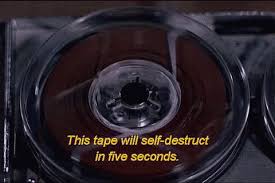
Then the inexplicable happens, as you type in the very last line and hit return, your screen goes black. You reach to plug in your computer, but it’s already plugged in… You jiggle the cords. You hit ESC. You hit RETURN. You unplug the thing and plug it back in again. Nothing. You do a hard reset…
This time the screen powers on and a thin line travels across the middle of it. Then words appear…
Don’t let this happen to you! Turn in your High-Stakes Thriller, your Chillers, your multiple Killers for a chance at the prize! But one thing is certain, if you don’t enter, you won’t have a chance of winning!
We also had Cybertech Thrillers and Political Thrillers such as John Trudel’sRaven’s Resurrectionand the Raven’s Series.
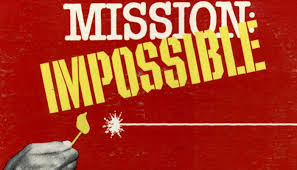
Here’s your assignment, if you choose to accept it…
Submit your Thrillers in the following categories by November 30, 2019, for a chance to bring home a First in Category WIN the 2019 CIBAs in Global Thrillers – or a Grand Prize – or maybe even the Overall Grand Prize!
If you are partaking in NaNoWriMo, then you have made past the halfway mark by now. Congratulations!
We hope that this article will provide prompting to spur you on to the finish line!
The best fiction touches the deep layers in us. A writer achieves this effect by embedding dozens of techniques into his or her story. – Jessica P. Morrell
Dramatic Question
Compelling fiction is based on a single, powerful question that must be answered by the story climax.
This question will be dramatized chiefly via action in a series of events or scenes.
Examples:
If you are writing a romance, the question always involves whether the couple will resolve their differences and declare their love.
In a mystery the dramatic question might be will Detective Smith find the serial killer in time to prevent another senseless death?
In The Old Man and Sea, the dramatic question is will Santiago catch the big fish and thus restore his pride and reputation?
Assignments:
What is the dramatic question in Harry Potter and the Sorcerer’s Stone?
What is the dramatic question in Stephanie Myers’ Twilight Saga?
An intimate world isn’t created by merely piling on details.
It means your story world has the resonance of childhood memories, the vividness of a dream, and the power of a movie.
An intimate, simmering world is filled in with shadows and corners and dogs and ice cubes and the sounds and smells of a dryer humming on wash day and a car blaring past, with pop music shaking the windows. These details lend it authority, potency, and a palpable physical existence.
Diana Gabaldon’s The Outlander Series simmering details make this time-travel, fantasy, horror, science fiction extremely believable and immersive fiction.
Outlander — Diana Gabaldon’s details make for immersive fiction
An intimate story takes us to a specific place and coaxes us to remain there. An intimate story is lifelike and feels as real and complicated as the world the reader inhabits. When he finishes the final pages, and leaves the story world, he should feel the satisfaction of the ending, but also a huge sense of loss. Like a friend has moved to another town just when the friendship had reached a level of closeness and trust. – Jessica P. Morrell
Characters Built from Dominant Traits
Create main characters with dominant and unforgettable traits as a foundation of personality.
These traits will be showcased in the story events, will help him achieve or fail at goals, and will make the story person consistent.
For example, Sherlock Holmes’ dominant traits are that he is analytical, Bohemian, opinionated and intelligent. These traits are showcased in every story he appears in along with secondary and contrasting traits. When the character first appears in the first scene, he arrives in the story with his dominant traits intact.
Outlander’s Claire and Jamie.
Lord of the Rings‘ Gandolf
Lisa Wingate’s Before We Were Yours’ villain Georgia Tann
The Witcher by Andrzej Sapkowski
Emotional Need
The protagonists and main characters are people with baggage and emotional needs stemming from their pasts. These needs, coupled with motivation cause characters to act as they do.
For example, in Silence of the Lambs Clarisse Starling is propelled by childhood traumas to both succeed and heal the wounds caused by the death of her father.
Robert Dugoni’s Tracy Crosswhite in his The Tracy Crosswhite series.
Significance
The storyline focuses on the most significant events in the protagonist’s life.
Example: Robert Dugoni’s Tracy Crosswhite searches for the killer of her sister in his The Tracy Crosswhite series.
Craig Johnson’s Longmire series – Sheriff Walt Longmire whose wife was murdered.
Motivation Entwined with Backstory
Motivation, the why? of fiction, is at the heart of every scene, fueling your character’s desires and driving him to accomplish goals.
Motivation provides a solid foundation for the often complicated reasons for your character’s behaviors choices, actions, and blunders.
Motivating factors provide trajectories for character development, as a character’s past inevitably intersects with his present.
Your character’s motivations must be in sync with his core personality traits and realistically linked to goals so that readers can take on these goals as their own.
Desire
Desire is the lifeblood of fictional characters.
Not only do your characters want something, but they also must want something badly.
You can bestow on your character flaming red hair, an endearing, crooked grin and a penchant for chocolate and noir movies, but if she doesn’t want something badly, she’s merely a prop in your story, not a driving force. But if she wants to win the Miss Florida contest, take over her boss’ job, or become the first female shortstop for the Atlanta Braves, then you’ve got a character who will make things happen and a story that will be propelled by desire.
The Ring from Lord of the Rings is a perfect example of a symbol of desire on so many different levels.
Frodo and The Ring – LOTR by J.R.R. Tolkein
Threat
Fiction is based on a series of threatening changes inflicted on the protagonist.
In many stories, these threats force him or her to change or act in ways he or she needs to change or act.
Often too, what the protagonist fears most is what is showcased in a novel or short story. It can be fear of losing his family, job, or health with a dreaded outcome.
Fear of losing to a threat or threats provide interest, action, and conflict.
Causality
Events in fiction are never random or unconnected. They are always linked by causality with one event causing more events later in the story, which in turn causes complications, which cause more events, which cause bad decisions, etc.
A fictional character doesn’t arrive at easy decisions or choices.
Instead, he is burdened by difficult or impossible choices, particularly moral choices, that often make him doubt himself and question his actions.
Inner conflict works in tandem with outer conflict—a physical obstacle, villain or antagonist–to make the story more involving, dramatic, and events more meaningful.
Complications
A story builds and deepens by adding complications, twists, reversals, and surprises that add tension and forward motion.
Plots don’t follow a straight path. Instead, there are zigzags, dead ends, and sidetracks.
Complications create obstacles and conflict, cause decisions to be made, paths to be chosen.
My favorite complication is one from Notting Hill when Spike is standing outside in his underwear strutting around with the paparazzi going wild for a peek at Anna Scott. How could Anna and William ever expect that complication?
A complication from Notting Hill – the film.
Midpoint Reversal
The middle of a novel comprises more than half its length.
At about the midpoint of most novels, a dramatic reversal occurs. The hunter becomes the hunted; a second murder occurs proving the detective has been wrong in his suspicions; a former lover arrives in town to complicate a budding romance.
This reversal keeps the middle from bogging down and becoming predictable and also breathes new life and often a new direction into the story.
Satisfying Ending
Every story needs an ending that satisfies the reader while concluding the plot.
A satisfying ending does not have to be “happy” or victorious or riding off into the sunset.
The final scenes, when the tensions are red hot and the character has reached a point of no return, must deliver drama, emotion, yet a logical conclusion.
This is not to suggest that every plot ends with a shoot-out or physical confrontation.
Some endings are quieter, more thoughtful. Some endings are ambivalent, some a dramatic or a violent clash of wills.
However, there is always a sense that all the forces that have been operating in your story world have finally come to a head and the protagonist’s world is forever changed.
We are cheering you on to the Finish Line! You can do it!
Jessica Page Morrell
Keep writing, keep dreaming, have heart. Jessica
Jessica Morrell is a top-tier developmental editor and a contributor to Chanticleer Reviews Media and to the Writer’s Digest magazine. She teaches Master Writing Craft Classes at the Chanticleer Authors Conference that is held annually along with teaching at Chanticleer writing workshops that are held throughout the year.
Kiffer Brown
Keep creating magic! Kiffer
Kathryn (Kiffer) Brown is CEO and co-founder of Chanticleer Reviews and Chanticleer Int’l Book Awards (The CIBAs) thatDiscover Today’s Best Books. She founded Chanticleer Reviews in 2010 to help authors to unlock the secrets of successful publishing and to enhance book discoverability. She is also a scout for select literary agencies, publishing houses, and entertainment producers.
Chanticleer Editorial Services – when you are ready
Did you know that Chanticleer offers editorial services? We do and have been doing so since 2011.
Tools of the Editing Trade
Our professional editors are top-notch and are experts in the Chicago Manual of Style. They have and are working for the top publishing houses (TOR, McMillian, Thomas Mercer, Penguin Random House, Simon Schuster, etc.).
If you would like more information, we invite you to email Kiffer or Sharon at KBrown@ChantiReviews.com or SAnderson@ChantiReviews.com for more information, testimonials, and fees.
We work with a small number of exclusive clients who want to collaborate with our team of top-editors on an on-going basis.Contact us today!
Chanticleer Editorial Services also offers writing craft sessions and masterclasses. Sign up to find out where, when, and how sessions being held.
The GERTRUDE WARNER Book Awards recognize emerging new talent and outstanding works in the genre of middle-grade readers, fiction and non-fiction, that compel children to read and explore. The Gertrude Warner Book Awards is a division of the Chanticleer International Book Awards (CIBAs).
Named in honor of the author of the quintessential children’s series – The Boxcar Children, Gertrude Warner.
Chanticleer International Book Awards is looking for the best books featuring stories of all shapes and sizes written to an audience between the ages of about eight to twelve. Science Fiction, Fantasy, Mystery, Paranormal, Historical, Adventure we will put them to the test and choose the best Middle-Grade Books among them.
These titles have moved forward in the judging rounds from SLUSH pile to the 2019 Gertrude Warner Book Awards LONG LIST and now have progressed to the 2019 SHORTLIST. The Short Listers will compete for the Semi-Finalists positions. The Semi-Finalists will be announced and recognized at the CAC20 banquet and ceremony. The First Place Category Winners, along with the CIBA Division Grand Prize winners, will be selected from the 16 CIBA divisions Semi-Finalists. We will announce the 1st Place Category winners and Grand Prize Division Winners at the CIBAs Banquet and Ceremony on Saturday, April 18th, 2020 at the luxurious Hotel Bellwether in Bellingham, Wash.
These titles have been Shortlisted for the 2019 Gertrude Warner Book Awards for Middle-Grade Fiction
Carolyn Watkins – The Knock…a collection of childhood memories
Joyce Major – The Orangutan Rescue Gang
Nancy McDonald – Boy from Berlin
Veronica Myers – Flight of Maldar
B.L. Smith – Bert Mintenko and the Serious Business
B.L. Smith – Bert Mintenko and the Minor Misdemeanors
Mobi Warren – The Bee Maker
Amber L. Wyss – Phoenix Rising
Wendy Leighton-Porter – The Shadow of the Tudor Rose
Sue Bough – Norman Snodgrass Saves the Green Planet
Kit Bakke – Dancing on the Edge
M.J. Evans – PINTO!
M.J. Evans – The Stone of Wisdom – Book 4 of the Centaur Chronicles
Beth Stickley – Tarnation’s Gate
Lis Anna-Langston – Maya Loop
Lexi Rees – Eternal Seas
Catherine Mallette – Don’t Ask Me
Wendy Leighton-Porter – The Shadow of the Volcano
Diane Rios – Return of the Evening Star
C.R. Stewart – Britfield and the Lost Crown
Kay M. Bates’ – ‘B’ is for Baylee
Alexander Usher – Katie Hope: Blood Bonds
Susan Brown – Sammy and the Devil Dog
Wendy Leighton-Porter – The Shadow of the Pyramid
Rey Clark – Legends of the Vale
L.S. Barron – Harper T and the Timewave
Maria Ashworth – SUSHI KITTY
Gregory Saur – Diving Catch
Liana Gardner – 7th Grade Revolution
Liana Gardner – The Journal of Angela Ashby
L.M. Kemp – Skye’s Journey
Trayner Bane – Windhollow and the Axe Breaker (Windhollows, Book 3)
Leanne M. Pankuch – Dragon’s Truth
Alex Paul – The Valley of Death, Book 5, Arken Freeth and the Adventure of the Neanderthals
Which of these works will move forward in the judging rounds for the 2019 Gertrude Warner Book Awards for Middle-Grade Readers?
These titles are in the running for the Semi-Finalists positions of the 2019 Gertrude Warner Book Awards for Middle-Grade Readers.
Good luck to all as your works move on to the next rounds of judging.
The 16 divisions of the 2019 CIBAs’Grand Prize Winners and the Five First Place Category Position award winners along with recognizing the Semi-Finalists will be announced at theApril 18th, 2020 Chanticleer International Book Awards Annual Awards Gala,which takes place at the Chanticleer Authors Conference that will be held in Bellingham, Wash.
We are now accepting submissions into the 2020 Gertrude Warner Awards Book Awards. The deadline for submissions is May 30th, 2020. The winners will be announced in April 2021.
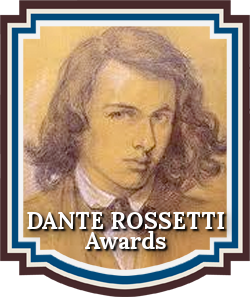
The Dante Rossetti Book Awards recognize emerging new talent and outstanding works in Young Adult Fiction. The Dante Rossetti Book Awards is a genre division of the Chanticleer International Book Awards (#CIBAs).
Named in honor of the British poet & painter Dante Gabriel Rossetti who founded the Pre-Ralphaelite Brotherhood in 1848.
Chanticleer International Book Awards is looking for the best books featuring stories of all shapes and sizes written to an audience between the ages of about twelve to eighteen (imaginary or real). Science Fiction, Fantasy, Dystopian, Mystery, Paranormal, Historical, Romance, Literary, we will put them to the test to discover the best.
These titles have moved forward in the judging rounds from SLUSH pile to the 2019 Dante Rossetti Book Awards LONG LIST and now have progressed to the 2019 SHORTLIST.
Congratulations to the 2019 Dante Rossetti Shortlisters!
Navya Sarikonda – The Enchanters’ Child
J.A. Roth – When The Bee Stings
Veronica Myers – Winter’s Progeny
Zachary Ryan – High School Queens
Julieanne Lynch – Beneath the Lighthouse
Jacinta Jade – Change of Darkness
Kelly Watt – The India Diaries: Book One Tiger’s Rock
J. Taylor Baker – The Cardorian Complex
Glen Sobey – No Fences in Alaska
Jan Von Schleh – But Not Forever
Michelle Rene – Manufactured Witches
Nancy Thorne – Victorian Town
Ted Neill – Jamhuri, Njambi & Fighting Zombies
A. Cort Sinnes – Quicksilver
Leslea Wahl – Where You Lead
C.R. Stewart – Britfield and the Lost Crown
Susan Brown – Twelve
J.T. Blossom – The Tunes of Lenore
James M Roberts – The Crossroads of Logan Michaels
Sandra L Rostirolla – Cecilia Futuris
Kristina Bak – Nowever
Zachry Wheeler – Max and the Multiverse
V. A. Givens – Sealed with a Twist
Tom Edwards – The Honourable Catherine
Michael Bialys – The Chronicles of the Virago: Book I The Novus
David Patneaude – Fast Backward
John Middleton – Dillion & The Curse of Arminius
Good luck to all!
Which of these works will move forward in the judging rounds for the 2019 Dante Rossetti Book Awards for Young Adult Fiction?
These entries are now in competition for 2019 Dante Rossetti Semi-Finalists positions. Semi-Finalists will be announced and recognized at the CAC20 banquet and ceremony. The First Place Category Winners, along with the CIBA Division Grand Prize winners, will be selected from the 16 CIBA divisions Semi-Finalists. We will announce the 1st Place Category winners and Grand Prize Division Winners at the CIBAs Banquet and Ceremony on Saturday, April 18th, 2020 at the luxurious Hotel Bellwether in Bellingham, Wash.
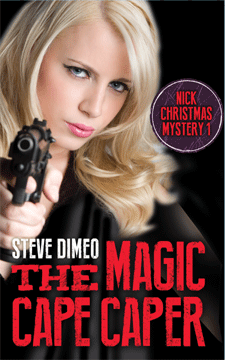
A lighthearted, modern reimagining of the classic dime detective novel, The Magic Cape Caper is an assemblage of fun pop culture references in a contemporary setting.
A former police detective, and a newly licensed private eye, Nick Christmas is hired by Mrs. James, the wife of scientist and inventor of an invisibility device, Dr. Bert James. She refuses to believe the conclusions of the police who believe Dr. Bert is dead after an apparent kidnapping. With no other cases and a dwindling case-flow, Nick and his young “Girl Friday” receptionist Miranda “Randi” Degrotti accept the challenge to get to the bottom of what is going on.
A former English teacher, Author Steve Dimeo keeps a very lighthearted and upbeat tone throughout the novel which makes for a rather easy read. But, he also makes use of a sophisticated vocabulary that will have most of us crack open a few dictionaries.
The natural chemistry between Nick and Randi is one of the more entertaining qualities of The Magic Cape Caper. It will likely be a defining presence in future installments of the series. As individual characters, they struggle to branch away from being classic characterizations. Nick is the wise-cracking detective and middle-aged male who can’t help but fixate on the female body; while his beguiling Girl Friday, Randi, “the blonde bombshell” surprises Nick with her ability to be a tough and intelligent woman.
For those seeking a fun and lighthearted private-eye stories (Moonlighting and Castle fans take notice), The Magic Cape Caper delivers.
Pop-culture references from past generations permeate the work. When Nick makes these, it is a positive and endearing character trait. However, perhaps the author should reconsider having the younger characters render the same references when they are clearly out of context unless they are immersed in it as a sub-culture, which could happen if the backstory was woven in. In the thinly veiled crime/romantic comedy PI series, Castle, this was done with aplomb with the episode on Steampunk Culture (Punked).
In almost every chapter, the literary form of the male gaze is prevalent. Frequently, Nick has to take note of what Randi is wearing and how attractive it makes her look. It is even canon within the novel that Nick hired her because of her looks and how he could use them to his advantage in investigations, while her education and other skills were a surprising bonus.
The Magic Cape Caper has a lot of heart, and the series has the potential to develop characters that become a favorite for devotees of smart but goofy and fun “detective” series that have a touch of romance in the air.
The CLUE Book Awards recognize emerging new talent and outstanding works in the genre of Suspense and Thriller Fiction. The Clue Book Awards is a division of the Chanticleer International Book Awards (The #CIBAs).
Chanticleer International Book Awards is seeking the best books featuring suspense, thrilling adventure, detective work, private eye, police procedural, and crime-solving, we will put them to the test to discover the best! (For lighter-hearted Mystery and Classic Cozy Mysteries please check out our Mystery & Mayhem Awards).
These works have survived the infamous slush pile and have advanced to the 2019 CLUE Book Awards Long List. They will compete in the next rounds of judging for the CLUE 2019 Short List.
Good luck to all!
J.J. Clarke – Dared to Return
Richard Conrath – Blood Moon Rising
RIP Converse – Maelstrom Part One
Harold Benjamin – Phase III
L. J. Martin – The Blue Pearl
Nancy Adair – RABYA
J.P. Kenna – Joel Emmanuel
J.P. Kenna – Toward a Terrible Freedom
Timothy S. Johnston – The Savage Deeps
Tracey Pepper – Dead On Arrival
Lonna Enox – Untold Agony
Stephen F. Frost – The Alaskan Alibi
Nanci Rathbun – Honor Kills
Russell Heath – Rinn’s Crossing
Bert Entwistle – Murder in the Dell
John W Feist – Blind Trust
Liese Sherwood-Fabre – The Adventure of the Murdered Midwife
Marian Exall – A Splintered Step
Joanne Jaytanie – Salvaging Truth, Hunters & Seekers, Book 1
Ronald Lamont – Smoke and Mirrors
Carl Roberts – The Trial of Connor Padget
Nick Mancuso – Fever
Edgar Swamp – Amber Hollow
Steve Dimeo – The Magic Cape Caper
Janet K. Shawgo – Legacy of Lies
Maureen Joyce Connolly – Little Lovely Things
T.K. Ambers – A Fox in the Fold
Deborah Serani – The Ninth Session
Ken Oder – The Judas Murders
Melodie Hernandez – Forgotten Rage
Chris Norbury – Straight River
Jode Millman – The Midnight Call
Barbara Brett – Secret Agenda
Barb Warner Deane – And Then There Was You
Ken Malovos – Sweet Justice
Mary Adler – Shadowed by Death: An Oliver Wright WWII Mystery
Matt Witten – The Necklace
Matt Witten – Free For All
V. & D. Povall – Jackal in the Mirror
E. L. Diamond – The Wolf of God
Carl Vonderau – Murderabilia
M. J. Simms-Maddox – Mystery in Harare
Courtney Leigh Pahlke – Life Force Preserve
Michelle Cox – A Veil Removed
Kevin G. Chapman – Righteous Assassin: A Mike Stoneman Thriller
Kaylin McFarren – High Flying
Wally Duff – bada-BOOM!
Alexandrea Weis and Lucas Astor – Death by the River
Joni M Fisher – West of Famous
D. J. Adamson – Let Her Go
Kirk Millson – Serpents of Old
Lori A. Witt – Incel
Thomas Galvin – The Auction
Sonny Kruger – Killing Set In Motion
D. J. Adamson – At the Edge of No Return
Which of these works will advance?
The excitement continues to build for the 2019 CIBAs!
These titles have moved forward in the judging rounds from SLUSH pile to the 2019 CLUE Book Awards LONG LIST. These entries are now in competition for 2019 CLUE Shortlist. The ShortListers’ works will compete for the Semi-Finalists positions.Semi-Finalists will be announced and recognized at the CAC20 banquet and ceremony. The First Place Category Winners, along with the CIBA Division Grand Prize winners, will be selected from the 16 CIBA divisions Semi-Finalists. We will announce the 1st Place Category winners and Grand Prize Division Winners at the CIBAs Banquet and Ceremony on Saturday, April 18th, 2020 at the luxurious Hotel Bellwether in Bellingham, Wash.
The 16 divisions of the 2019 CIBAs’Grand Prize Winners and the Five First Place Category Position award winners along with recognizing the Semi-Finalists will be announced at theApril 18th, 2020 Chanticleer International Book Awards Annual Awards Gala,which takes place at the Chanticleer Authors Conference that will be held in Bellingham, Wash.
Register today for the 2020 Chanticleer Authors Conference and the 2019 CIBA ceremony and banquet that will be held in Bellingham, Wash. at the luxury waterfront Hotel Bellwether, April 17 – 19, 2020. Seating is limited. Reservations are required.
I wrote the first draft of my award-winning historical novel,Hour Glass, in sixteen days.You read that correctly—sixteen days. My experimental novella,Tattoo, was written in about three weeks. Both have been released in 2018.
Though I am intensely proud of this accomplishment, I’m not telling you this to brag. I’m telling you that you can do this, too.
“Sit down every day to write. Even if you don’t want to. A little every day.” – Michelle Rene
Sounds like a line you’ve heard before, right? Yeah, me too. It’s not that this is bad advice. Far from it. Many people find this the best way for them to consistently write draft after draft. But if you really want to knock that rough draft out of the park, I’m going to ask you to kick that notion to the curb.
I’m not magical; I’m a binge writer, and none of the ideas in this article are uniquely mine. Most of them are exercises I’ve stolen from other writers. I used to be just like you because I was led to believe novels should take years to write. I would write a chapter, go back and edit it, and then proceed to the next one. A first draft took me over a year to complete.
It wasn’t until I decided I really needed to finish my novel, I Once Knew Vincent, that I decided to shove my face in the cold, scary, deep end of the writing ocean. I went away to a writer’s retreat and forced myself to write as much as I could every day. I wrote the lion’s share of that book in six days, and those chapters were by far the best in the book.
Why is that?
Isn’t it counterintuitive that the chapters written in a whirlwind of typing be the best? I’m glad you asked, nebulous reader voice in my head. Let’s delve into that.
Why Write This Fast?
Nothing kills a book faster than never finishing that initial draft. A malaise sets in, often slowing a writer down to a crawl while they chip away over a long time and often give up entirely.
“Will I ever finish this book?” the writer asks, (fists raised to the sky for dramatic effect).
Maybe. Maybe not. That first draft is possible if you pick yourself up by your metaphorical bootstraps and do the work every day, but a large percentage of writers never cross the finish line. What a shame that is!
Strangely, there is a raw emotion that comes from writing something so fast you don’t have time to noodle it to death.
How excited are you when you first start fleshing out a story? How amazing does it feel to start naming your characters and setting up their scenes in your mind? Fan-freaking-tastic!
This is because you are in the beginning of abook affair.
Writing a book is like having a relationship. In the beginning, it’s like a honeymoon! You feel all the emotions. Love and pain and excitement and lust. Well, okay. Maybe not lust. Paper cuts hurt, so let’s not go there.
“Writing a book is like starting a new relationship.” Michelle Rene
The point is the first draft should be all elation and honeymoon. Leave the nitty-gritty for your fifteenth edited draft. You don’t want to be sitting in a rocking chair with your first draft complaining about how much he snores before you even get to edit. Taking years to write that first draft can land you in complacency town before you cross the finish line. Pour your heart and soul into the rough draft with reckless abandon.
“Pour your heart and soul into the rough draft with reckless abandon.”– Michelle Rene
“But nothing good can come from my sloppy first draft if I write it in a few weeks,” says the nebulous reader voice in my head that’s starting to sound whiny.
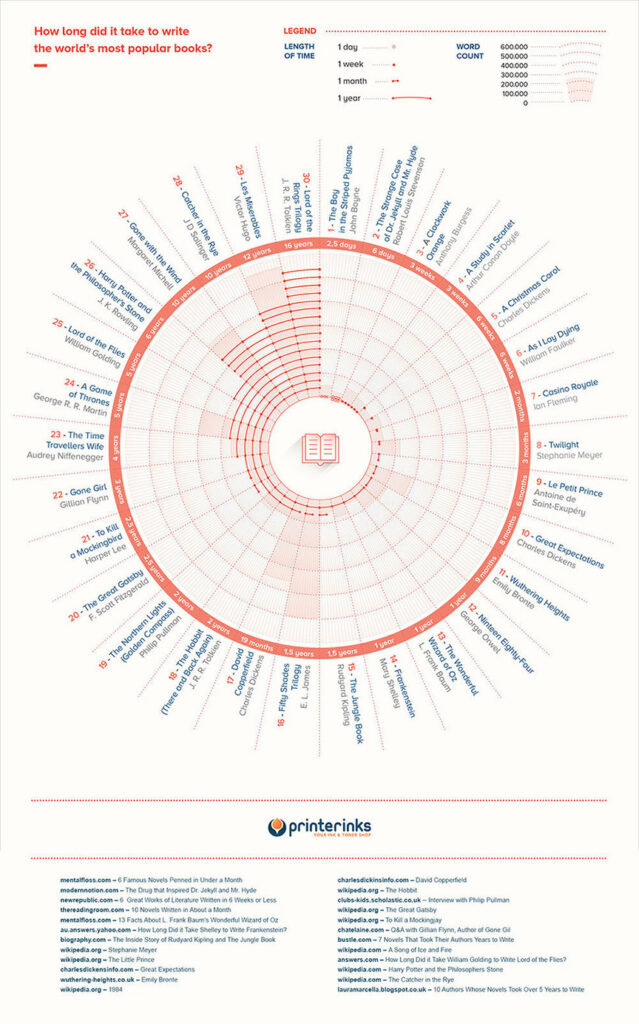
Please refer to the infographic below. It lists some of the most popular books and how long it took the writer to finish them. WhileLord of The Ringstook a whopping sixteen years to complete (no shocker there), I’d like to direct your attention to roughly a quarter of the chart that indicates books written under three months. If theBoy in the Striped Pajamaswas written in two and a half days, you can write something of quality in four weeks.
How Do I Start?
Let’s begin with talking about the snarky, three-hundred-pound elephant in the back of your mind. Your inner editor. We are going to bind and gag that jerk, and it may take fifty shades worth of rope because it’s three-hundred pounds and takes up a lot of headspace.
Sara Bale, an extremely prolific romance writer, has similar advice for your would-be-elephant editor.
“I think the biggest mistake an author makes when writing a rough draft is stopping and rereading/editing their work. The key is to keep moving forward and get the whole story out. Know the beginning and the ending. If you have those elements, the rest is easy.”
Sara Bale
“The key is to keep moving forward and get the whole story our.” Sara Bale
The passionate ideas come when the critic in our mind is silenced.
Your visceral idea is key, and I will not accept the old “I don’t know what to write about” excuse. You are here to pour your heart and soul into a story. If you are having a hard time with inspiration, here’s a handy dandy exercise to help that I stole from a writer’s workshop I attended.
Sit down with a piece of paper and a pen. Yes, a real piece of paper and pen. No cheating with keyboards. I know, I know. Your handwriting is horrible because all you do is type now. My handwriting looks like a serial killer’s ransom note, so I totally understand, but stick with me.
Next, set a timer for ninety seconds.
Hit start, write the first thing that comes to your mind and don’t stop until that timer goes off. No contemplating it. No editing your idea and wondering if Stephen King has already done it. He probably has. Just write, no excuses, for the whole ninety seconds.
Go ahead… I’ll wait…
You back? Okay. I’m not a betting woman, but I would put money on what you wrote was pretty damn good.
Whether or not that is the idea you run with doesn’t matter. It’s an exercise to get the creative juices flowing. Use that. Build your characters. Plot the story fast and loose. Fall in love with your story. Get down and dirty in that honeymoon phase…but not literally because remember the paper cuts. We talked about that.
And finally, outline! For the love of all that is holy, outline your story! Do not do this flying by the seat of your pants. That is a sure-fire way to crash and burn. It doesn’t need to be an in-depth outline. On the contrary, keep that pretty loosey-goosey, too.
My outlines are often little more than a few sentences for each chapter.
Time Management
Okay, you have your outline, your idea, and your story. Let’s do this. The clock begins when you type “Chapter One” or “Prologue” if you want to be fancy. Let’s use NaNoWriMo (National Write a Novel in a Month) rules as I find these to be the best guidelines: 50,000 words in four weeks.
So four weeks. That’s your mission.
Select a four-week span of time in your life that you can devote to writing. Don’t sabotage yourself by doing this during a family vacation or when it’s the busy season at work. Choose a month that will allow you some time to devote to this endeavor because it is important.
For that month, give up on being the best mom, husband, wife, etc. Let your family know that this is going to be what you are doing for this month, and they can have you back after it’s over. The laundry can wait. Order in food. Maybe shower because, well, hygiene.
Editor’s Note: I totally agree with Michelle. November can be an impossible time for many because of increased work demands, family demands for the approaching holidays, the doldrums due to shorter and shorter days. The main thing is to pick a time that works for you. It can be NaFebWriMo if you have to put in overtime starting in November for the holiday season, or NaJulyWriMo – if you are a teacher. Find a time period that works for you and stick with it! Put it on your calendar. Alert your friends and family.
I highly, highly, highly recommend you track your progress. Doing a rough draft during NaNoWriMo is a great idea. This happens in November, and the organization sets you up for a win. You have a word tracker, writer friends to cheer you on, and helpful articles when you get stuck. If November is not a good month for you, try a program like WriteTrack. It will help you keep up with your progress.
Insider secret: Don’t shoot for the minimum goal. If your tracker says you need to write 2,000 words that day, shoot for 3,000 or 4,000. It’s easy to fall behind only doing the bare minimum; but if you’re always ahead, you have a little breathing room.
The Black Hole of the Internet
Can someone say distractions? Turn those notifications off! Set your phone to do not disturb except for emergencies. Hang a banner on your doorknob with a picture of Gandalf saying, “Thou shall not pass!” Get away from the addicting vacuum of social media. It will be there when you get back.
“That’s all well and good if you are writing something you just made up, but what about people who need to research their content?” asks nebulous reader voice again.
WithHour Glass, I wrote a historical fiction novel about Calamity Jane. There was definitely some research involved there. I did as much as I could before the writing began, mainly broad stroke things: dates, places, and a few good details relevant to the story. Nothing more.
Research is the most unassuming trap in writing. You’re on a good writing jag, everything is flowing, and then you hit a spot where you need the name of a city or a date or a vocabulary word. You have to have that accurate information, right? So you switch to the internet and start researching. Well, that first page on a website leads you to another, which leads you to Facebook; and then before you know it, it’s been three hours, and you lost your momentum.
Broad stroke your research before you start; but while you’re writing, don’t research. If you need the name of a city, don’t go looking. Just write something like, “He rode into the sunset hoping his horse knew the way to {insert city name}.” Get the story down, and go back in later to fill in those brackets.
Write your story from the heart and with passion. Research and accuracy can be added later.
The Middle Stick
It’s right around the 30,000-word mark that this happens. The Middle Stick is what I call the point where your initial enthusiasm begins to wane, and your progress gets sluggish. What began as “yay, I’m writing a book” turns into “I don’t know if I can do this.” It happens to everyone.
This is where participating in programs like NaNoWriMo can be helpful. Having other writers in the same place can be encouraging, and they can hold you accountable. If you aren’t doing NaNoWriMo, I suggest getting a group of like-minded author friends to do this together. This is also where writing ahead of your minimum word count helps because The Middle Stick will almost certainly slow you down.
Here are some other helpful tips.
Try that writing something in ninety seconds exercise I mentioned earlier to get inspiration.
Go out of your comfort zone and experience something related to your book. For example, if you are writing a western, go see a rodeo. Get away from your computer.
Multi-award winning author, Janet Shawgo, has this to say about immersing yourself in your research outside the page when she was researching her book,Look For Me, set in the Civil War. “What helped me was putting feet on the ground at Gettysburg to get a feel of the area, what my characters saw, what they heard. To try on costumes true to that era. I walked some of the roads soldiers did in Virginia. If at all possible, put yourself there.”
Janet Shawgo Won the Chatelaine Grand Prize
Switch up your chapters. This is where outlining really helps you. If you are hitting a wall writing chapter thirteen, jump forward and write chapter twenty. Sure, you’ll have to go back to that chapter eventually, but this helps you jump over that block and continue to get your word count in.
I wroteTattooentirely this way. It’s made of seven parts of a story told chronologically backward. I didn’t write any of those parts in order. Not one. Yet, I still managed to piece them together in the end.
Just keep moving. The momentum will pick back up. You can do this.
Hurray! You Did It!
Out of breath and exhausted, you crossed that finish line. You did it! Rejoice! I told you you could do it!
Go celebrate. Treat yourself to a fancy dinner. Toast your deed with some friends. Eat a whole chocolate cake. I don’t care. Party it up because you managed to do what the vast majority of humans on this planet cannot do. Most people never dream about writing a book. Fewer attempt it. Only a small fraction actually finish a draft.
You are spectacular.
Now, put the book aside for at least a month (more like two). You will eventually go back and edit. You will fill in those empty brackets. You will allow that annoying three-hundred-pound editor elephant back into your life. But not right now. That’s for another day.
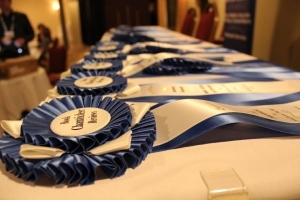
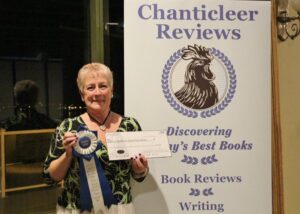
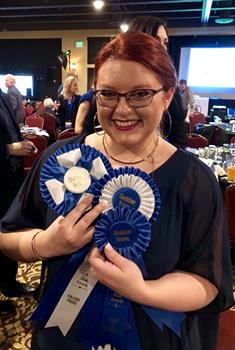
Michelle Rene and her Chanticleer Grand Prize Ribbons
Michelle Rene, the author of this blog post, is a creative advocate and the author of a number of published works of science fiction, historical fiction, humor, and everything in-between.
She has won indie awards for her historical fiction novel,I Once Knew Vincent. Her latest historical novel,Hour Glass, won the Chanticleer International Book Awards Grand Prize for Best Book. It was released on February 20th to rave reviews from Chanticleer, Kirkus and Publishers Weekly. Her experimental novella,Tattoo, was released on March 7th.
When not writing, she is a professional artist and self-described an all-around odd person. She lives as the only female, writing in her little closet, with her husband, son, and ungrateful cat in Dallas, Texas.
A special thanks go out to the authorsSara BaleandJanet Shawgofor contributing their writing expertise to help others.
Chanticleer Editorial Services – when you are ready
Did you know that Chanticleer offers editorial services?We do and have been doing so since 2011.
Tools of the Editing Trade
Our professional editors are top-notch and are experts in the Chicago Manual of Style. They have and are working for the top publishing houses (TOR, McMillian, Thomas Mercer, Penguin Random House, Simon Schuster, etc.).
If you would like more information, we invite you to email Kiffer or Sharon at KBrown@ChantiReviews.com or SAnderson@ChantiReviews.com for more information, testimonials, and fees.
We work with a small number of exclusive clients who want to collaborate with our team of top-editors on an on-going basis.Contact us today!
Chanticleer Editorial Services also offers writing craft sessions and masterclasses. Sign up to find out where, when, and how sessions being held.

 The Laramie Book Awards recognize emerging new talent and outstanding works in the Americana / Western, Pioneer, Civil War, Frontier, and First Nations Novels. The Laramie Book Awards is a division of the Chanticleer International Book Awards.



 The clock is ticking… you’re working on a deadline while your husband is across town, picking up the kids. You’ve taken the day off and gone to the cabin. You have to write that last chapter … the one that will get your work noticed, like