In a future Los Angeles, a terrorist group called the Stay Ready Soldiers (SRS) has declared war on seemingly everyone. The city is on the verge of martial law, with political and corporate corruption everywhere in a city all but collapsed. Anti-establishment groups roam L.A. with advanced weaponry virtually matching the powers of the federal government. People in endless numbers, both good guys and bad guys, are blown to bits throughout the novel with the blood and violence found in the most-venal video games. Yet, themes of systemic injustice come to bear in the experiences and emotions of the central cast of characters while facing daunting opposition to their cause.
In a country described by the media in the book as being on the verge of collapse, with issues including unemployment, crime, healthcare, education, immigration, and climate change quickly eroding, viewers are asked to decide whether the SRS is either a force of freedom fighters or domestic terrorists. Which are they? You get a chance to choose as the book opens with a bloody attack on a police unit by two SRS soldiers, Geronimo and Kali, who are as close as a love interest as any two people in the book.
The pair must keep their wits (and guns) about them to cross the dilapidated streets of a neglected stretch of L.A., meeting with allies in the fight for justice and change. They face hired killers and the U.S. government’s agents, as well as crises of faith and the threat of a conspiracy that could overturn their very mission.
A Night in Babylon is full of larger-than-life action scenes in which bullets fly, fires burn, and explosions rock the night. From the beginning of the book, this action sets up the stakes: the Stay Ready Soldiers’ lives hang in the balance of one night, as they hunt and are hunted. The narrative flows in and out, taking the reader smoothly from tense scenes to calm and emotionally intimate ones, and back to the action yet again. There’s time to breathe with this story, but the sense of danger is never far away. The action takes surprising turns within the various firefights, and though sometimes there isn’t enough time spent setting up details that become important later in the scene, the well-paced prose keeps the fights exciting.
The LAPD and U.S. federal agents are the distinct villains, painted as more than just cruel individuals but as part of a massive unjust system that shoves people of color down, especially in cities like Los Angeles. A Night in Babylon shows abuses of power like those that exist in the real world, and even though the action scenes are extravagant, the violence and injustice that drives the SRS are drawn from reality. The story critiques not only how authority reacts to resistance against violence with a heightening of violence, but also how authorities can exploit unstable times and places to expand their power and control over people.
Viewing this novel strictly as violence porn would be a mistake. Woven into it are dystopian themes that are now inescapably part of today’s America taken to extremes. At the same time, it does not shrink from asking questions about the nature of today’s violence. Embedded in the story are questions about the role of corporations in bed with the government. What do we really know, the book asks, about the intertwined interests of politicians and corporations? Questions like these used to be relegated to comic books and/or the Internet’s dark side. With credible news reports on similar issues in today’s headlines in newspapers and on T.V., it is undoubtedly fair games for novels such as this one to take these discussions into literature and let readers decide their relevance.
What is A Night in Babylon ultimately trying to say? Is it entertainment, a political tract, or a warning? The cynicism expressed in this relatively short novel is too blatant to ignore, but it does not seem to cut to the left or the right. In that sense, it is a Rorschach test for readers to determine its point of view. Whichever way readers respond, it’s a book that is hard to ignore.
Elements of successful fiction layer and fold back in on each other to create resonance, nuance, subtext, and undercurrents of great storytelling. – Kiffer Brown
In this enlightening and instructional blog post by top-tiered editor and one of Chanticleer’s exceptional Master Writing Craft teachers, Jessica Morrell, will expand on the following components of exceptional fiction.
Elements of Successful Fiction
The Dramatic Question
An Intimate Simmering World
Characters Built from Dominant Traits
Emotional Needs
Significance
Motivation Entwined with Backstory
Desire
Threat
Causality
Inner Conflict
Midpoint Reversal
Satisfying Ending
Dramatic Question
Compelling fiction is based on a single, powerful question that must be answered by the story climax. This question will be dramatized chiefly via action in a series of events or scenes. If you are writing a romance, the question always involves whether the couple will resolve their differences and declare their love. In a mystery the dramatic question might be will Detective Smith find the serial killer in time to prevent another senseless death? InThe Old Man and Sea, the dramatic question is will Santiago catch the big fish and thus restore his pride and reputation?
An Intimate, Simmering World
An intimate world isn’t created by merely piling on details. It means your story world has the resonance of childhood memories, the vividness of a dream, and the power of a movie. It’s filled in with shadows and corners and dogs and ice cubes and the sounds and smells of a dryer humming on wash day and a car blaring past, rock and roll music shaking the windows. Details lend your story authority, potency, and a palpable physical existence.
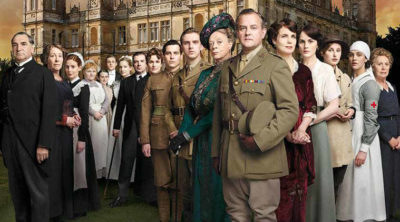
Downton Abbey by Julian Fellowes — definitely an “intimate simmering world”
An intimate story takes us to a specific place and coaxes us to remain there. An intimate story is lifelike and feels as real and complicated as the world the reader inhabits. When a reader finishes the final pages and leaves the story world, the reader should feel the satisfaction of the ending, but also a huge sense of loss. Much like a friend has moved to another town just when the friendship had reached a level of closeness and trust.
Characters Built from Dominant Traits
Create main characters with dominant and unforgettable traits as a foundation of personality. These traits will be showcased in the story events, will help him achieve or fail at goals, and will make the story person consistent. For example, Sherlock Holmes’ dominant traits are that he is analytical, Bohemian, opinionated, and intelligent. These traits are showcased in every story he appears in along with secondary and contrasting traits. When the character first appears in the first scene, the character should arrive in the story with dominant traits intact.
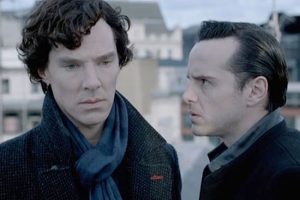
Sherlock Holmes and Jim Moriaty – enduring characters since 1892.
Emotional Needs
Protagonists and the main characters are people with baggage and emotional needs stemming from their pasts. These needs, coupled with motivation, cause characters to act as they do. For example, inSilence of the LambsClarisse Starling is propelled by childhood traumas to both succeed and heal the wounds caused by the death of her father.
The EXPANSE by James S.A. Corey went from a Sci-Fi book series to one of Amazon’s top video series. One reason is that the characters have some major emotional baggage.
Significance
The storyline focuses on the most significant events in the protagonist’s life.
Kiffer’s Note: As we were taught in journalism school, this is the “So what?” that our professors would continuously ask us. What were, are, and will be the significant events? Your story will show the “why and how.” Make your readers care. Make your readers interested and keep them caring.
Crazy Rich Asians by Kevin Kwan – 3 Perspectives Cubed makes for a complex story.
Motivation Entwined with Backstory
Motivation, the why?of fiction, is at the heart of every scene, fueling your character’s desires and driving him to accomplish goals. It provides a solid foundation for the often complicated reasons for your character’s behaviors choices, actions, and blunders. Motivating factors provide trajectories for character development, as a character’s past inevitably intersects with his present. Your character’s motivations must be in sync with his core personality traits and realistically linked to goals so that readers can take on these goals as their own.
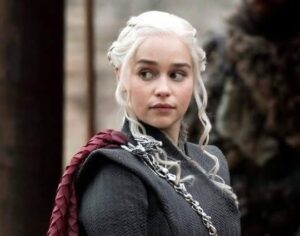
See The Expanse SciFi series above. It said to be the current Game of Thrones of TV series streaming.
Names convey emotional baggage and foreshadowing
Desire
Desire is the lifeblood of fictional characters. Not only do your characters want something, but they also want something badly. Santiago, inThe Old Man and the Sea desperately wants to restore his reputation and also wants his friendship and partnership with the boy to resume. And in the lonely hours when he is far out at sea, desperately struggling to hang on to the fish and fighting off sharks, we see his fierce desire acted out and the price he pays for it.
The classic A League of Their Own – to be rebooted on Amazon 2021
You can bestow on your character flaming red hair, an endearing, crooked grin, and a penchant for chocolate and noir movies, but if she doesn’t want something badly, she’s merely a prop in your story, not a driving force. But if she wants to win the Miss Florida contest, take over her boss’ job, or become the first female shortstop for the Atlanta Braves, then you’ve got a character who will make things happen and a story that will be propelled by desire.
Threat
Fiction is based on a series of threatening changes inflicted on the protagonist. In many stories, these threats force him or her to change or act in ways he or she needs to change or act. Often too, what the protagonist fears most is what is showcased in a novel or short story. It can be fear of losing his family, job, or health with this dreaded outcome providing interest, action, and conflict.
The Martian by Andy Weir – one big ticking clock on so many different levels.
Causality
Events in fiction are never random or unconnected. They are always linked by causality with one event causing more events later in the story, which in turn causes complications, which cause more events, which cause bad decisions, etc.
Causality – the physics of writing
Inner Conflict
A fictional character doesn’t arrive at easy decisions or choices. Instead, he is burdened by difficult or impossible choices, particularly moral choices, that often make him doubt himself and question his actions. Inner conflict works in tandem with outer conflict—a physical obstacle, villain, or antagonist–to make the story more involving, dramatic, and events more meaningful.
Complications A story builds and deepens by adding complications, twists, reversals, and surprises that add tension and forward motion. Plots don’t follow a straight path, instead, there are zigzags, dead ends, and sidetracks. Complications create obstacles and conflict, cause decisions to be made, paths to be chosen.
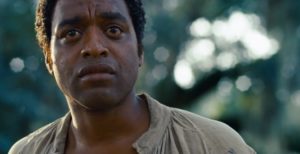
12 Years A Slave – based on the memoir of Solomon Northrup, published in 1854
Midpoint Reversal
The middle of a novel comprises more than half its length. At about the midpoint of most novels, a dramatic reversal occurs. The hunter becomes the hunted; a second murder occurs proving the detective has been wrong in his suspicions; a former lover arrives in town to complicate a budding romance. This reversal keeps the middle from bogging down and becoming predictable and also breathes new life and often a new direction into the story.
Mid-point Reversal of Bride and Prejudice, an adaptation of Jane Austen’s Pride and Prejudice. Published in 1813, it is still relevant.
Satisfying Ending
Every story needs an ending that satisfies the reader while concluding the plot. The final scenes, when the tensions are red hot and the character has reached a point of no return, must deliver drama, emotion, yet a logical conclusion. This is not to suggest that every plot ends with a shoot-out or physical confrontation because some endings are quieter, more thoughtful. Some endings are ambivalent, some a dramatic or a violent clash of wills. But there is always a sense that all the forces that have been operating in your story world have finally come to a head and the protagonist’s world is forever changed.
Below is a scene from The Martian that heralds that maybe—just maybe—our protagonist may make it home—alive. It is a fun and creatively acted scene. What a scene stealer! – Kiffer Brown
A reversal of fortune in The Martian by Andy Weir
The end is just the beginning…
A Note from the Editor: A satisfying ending is one of the top, if not the top, reasons why books go viral and what will make your reader want to read your next work. Make sure that the you put as much effort in to a satisfying ending as you do into your opening hook. Kiffer Brown
I hope that you found the visual examples enlightening. Determining and then searching for my favorite ones was fun! – Kiffer
Jessica Page Morrell
Jessica Page Morrell is a top-tier developmental editor for books and screenplays. Her articles have appeared in Writer’s Digest and The Writer magazines. She is known for explaining the hows and whys of what makes for excellent writing and for sharing very clear examples that examine the technical aspects of writing that emphasizes layering and subtext. Her books on writing craft are considered “a must have” for any serious writer’s toolkit.
Jessica will teachMaster Craft Writing Classesat theChanticleer Authors Conference VIRTUAL Conference that will be held from Tuesday, Sept 8 – Sunday, Sept. 13, 2020. She will present sessions and Master Classes on September 17, & 18, 2020 in conjunction with the virtual conference. She and Kiffer will also host a fun kaffeeklatch for Word Nerds at VCAC20.
Did you know that Chanticleer offers editorial services?We do and have been doing so since 2011.
And that our professional editors are top-notch and are experts in theChicago Manual of Style.They have and are working for the top publishing houses (TOR, Macmillan, Thomas Mercer, Penguin Random House, etc.) and award-winning independent presses. If you would like more information, we invite you to email Kiffer or Sharon at KBrown@ChantiReviews.com or SAnderson@ChantiReviews.com.
We work with a small number of exclusive clients who want to collaborate with our team of top-editors on an on-going basis. Contact us today!
Writer’s Toolbox
Thank you for reading this Chanticleer Writer’s Toolbox encore edition article.
We encourage you to stay in contact with each other and with us during this stint of practicing physical distancing to prevent the spread of COVID-19 — especially at this time of re-opening.
Let us know how you are doing, what is going on where you live, how are you progressing on your writing projects.
I invite each of you to join us atThe Roost– a private online Chanticleer Community for writers and authors and publishing professionals. You are welcome to email me for more info also.
We are active onFacebook,Twitter, and Instagram. You can find us by using our social media handle @ChantiReviews
Minimize physical contact! Maximize social connecting!
Be well. Stay safe. Keep writing! Keep Creating! Kiffer
Chanticleer Book Reviews is seeking today’s best books featuring romantic themes and adventures of the heart, historical love affairs, perhaps a little steamy romance, we will put them to the test and choose the best among them.
Find out more about the stunning beauty that Dante Rossetti painted, Jane Morris, at the end of this blog post.
Do you have a romance novel or manuscript ready for readers?
Do you want to see how it stands up to others in its category?
Then don’t delay! The CHATELAINE Book Awards division is accepting submissions from both recently published and complete manuscripts in romance and romantic fiction. But this year we’ve moved our deadline – to keep you on your toes!
The new deadline for the Chatelaine Awards is AUGUST31, 2020!
That’s right, the last day for submissions into the 2020 Chatelaine Book Awards is August 31, 2020. So, if you love Piña Coladas – and getting caught in the rain… I mean, if you like writing about those things, and other things having to do with matters of the heart, including these:
Insiders’ Tip: Other genre divisions of the Chanticleer International Book Awards have romance categories as well. Multiple submissions of the same work to a variety of CIBA writing competitions divisions are accepted. Check out our divisions here.
Please join us in congratulating and reading these top works in this diverse range of all reads Chatelaine: Romance, Chick-Lit, Women’s Fiction, Inspirational, Suspenseful, and, of course, Steamy and Sensual in the
CHATELAINE HALL of FAME!
Jane Austen Inspired:Pulse and Prejudice by Colette Saucier
Paranormal:Crimson Flamesby Ashley Robertson
Christian Inspirational Romance: Chasing Charlieby C. M. Newman
Restorative: A Path through the Gardenby Nancy LaPonzina
Classic Bodice Ripper:To Dare the Duke of Dangerfieldby Bronwen Evans
Who will win the CHATELAINE Book Awards Blue Ribbons for 2020?
The judging rounds will commence in August! Submit your works today!
The last day for submissions into the 2020 Chatelaine Book Awards is August 31, 2020. Winners will be announced at our CAC21 conference – scheduled for April
And remember our Insiders’ Tip: Other genre divisions of the Chanticleer International Book Awards have romance categories as well. Multiple submissions of the same work to a variety of CIBA writing competitions divisions are accepted. Check it out here!
A little information about the Chatelaine Book Awards icon:
We feel that Dante Gabriel Rossetti’s Pre-Raphaelite painting of Jane Morris (muse and wife of William Morris) in aBlue Silk Dress captures the many moods of the Chatelaine division of the Chanticleer International Book Awards. Jane Morris (nee Jane Burden—little is known about her childhood but that it was poor and deprived) was known for her keen intelligence. William Morris fell in love with her when she sat for him as a model. She was privately tutored to become a gentleman’s wife upon their engagement. It is said that she was the inspiration for George Bernard Shaw’s character Eliza Dolittle of My Fair Lady fame. The Blue Silk Dress was painted in 1868 by Rossetti and it currently resides in the Society for Antiquaries of London. She was 29 when Rossetti painted it. Rossetti and Jane Morris became closely attached until his death in 1882. To read more about the fascinating Jane Morris, click on this Wikipedia page.
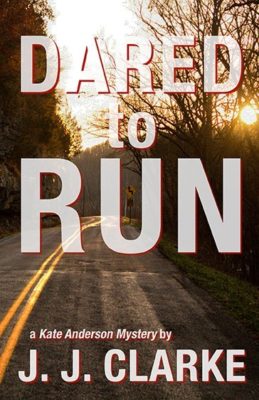
In this stirring whodunit by writer J. J. Clarke, a young woman flees from an evil-minded stalker and finds herself in an underground of female supporters who know how to protect her.
Kate Anderson is tough – tough enough to work in law enforcement and use a gun if she has to, but she is being pursued by a man named O’Dell who has her number – and may have her cornered. O’Dell is crafty, determined, and never loses sight of his prey.
Only a few people know about Kate’s dilemma – a former workmate, her new boss, and the grandfather who took her in (and taught her to stand up for herself) after the accidental death of her parents long ago. With some unusual advice and training from a women’s consortium that includes Dennis/Denise and a big, protective dog named Sic’em, Kate feels safe most of the day but knows that at night, her stalker is out there somewhere, watching and waiting. When her grandfather is threatened, all her strategies fall apart. O’Dell is found dead, and she has no choice but to flee. Luckily she now has the backup of experienced, similarly maltreated women who work in tandem to whisk her out of the state, give her a new name, new home, and new purpose. It is only when an old friend passes away that Kate realizes she has to go back home, no matter what the consequences.
Clarke writes this thriller novel like she was born to the task, inventively including in her lively cast of characters a cadre of Dolly Parton lookalikes and some very fierce nuns. She allows her heroine to be both a dead-on shootist and a first-rate pie chef. The men in her wildly twisting story are equally complex, from Dennis/Denise to the kindly granddad who may have a few scurrilous skeletons in his closet. All these freaks, friends, and feisty females will show Kate their true colors when push comes to shove.
With action on every page and a gift for conveying disturbing realities, Clarke quickly sweeps the reader into Kate’s perils, showing her leading lady’s strengths, bravado, and resilience. In fact, Clarke’s professional background in law enforcement gives her work extra punch, from inside knowledge of police procedure to the punchy dialogue. Readers will surely enjoy all members of the ensemble, from nuns to hard-boiled cops.
Dared to Run is the first book in the Kate Anderson Mystery series, Dared to Return is the second. Clarke weaves her magic in this new must-read series for women seeking to be, as Kate’s grandfather says, “fiercer and smarter” – and for anyone who likes gritty mysteries with a keep-you-guessing-until-the-very-end. Dared to Run is currently a CIBA 2019 CLUE FINALIST for Suspense/Thriller Fiction. Recommended!
Welcome to our SPOTLIGHT on LARAMIE Book Awards, the stories that stick!
The Laramie Book Awards recognize emerging new talent and outstanding works in the Americana / Western, Pioneer, Civil War, Frontier, and First Nations Novels. The Laramie Book Awards is a division of the Chanticleer International Book Awards.
Charles M. Russell painted the cowboy scene on Chanticleer’s very own Laramie Book Awards badge. It is one of many such paintings he did that encompassed the Old American Wild West. He was an advocate for the Northern Plains Indians. Charles M. Russell also helped establish a reservation in Montana for the Chippewa people.
*More interesting facts about Laramie, Wyoming, and its historical icons are immediately after the Laramie Hall of Fame listing below. A fun read!
The Laramie Book Awards for American Western Fiction Hall of Fame First Place and Grand Prize winners!
Want to be a winner next year? The deadline to submit your book for the 2020 Laramie awards is July 31, 2020. Enter here!
Grand Prize and First Place Winners for 2019 will be announced during our Virtual Conference in early September 2020.
Any entries received on or after July 31, 2020, will be entered into the 2021 Laramie Book Awards. The Grand Prize and First Place for 2020 CIBA winners will be held on April 17, 2021.
As our deadline draws near, don’t miss this opportunity to earn the distinction your American Western readers deserve! Enter today!
The LARAMIE Book Awards is a division of the Chanticleer International Book Awards – the CIBAs.
The 2020 winners will be announced at the CIBA Awards Ceremony, which will take place during the 2020 Live/Online Chanticleer Authors Conference. All Semi-Finalists and First Place category winners will be recognized, the first place winners will be virtually whisked up on “stage” to receive their custom ribbon and wait to see who among them will take home the Grand Prize. Covid19 has made our celebrations a bit different this year, but we still will celebrate!
As always, please do not hesitate to contact us with questions, concerns, or suggestions at Chanticleer@ChantiReviews.com
[20] McDougall, Walt, “Pictures in the Papers,” American Mercury, 6:21 (September 1925), 72.
What’s a Laramie?
We thought you’d never ask!
We titled the Chanticleer International Book Awards (CIBAs) division for Western American Fiction and all things that gather around the campfire singing a lonesome tune, the Laramie Awards, after the county and city in Wyoming. You know the one, tucked into the lower right-hand corner of the state between the Snowy Mountain Range and the Laramie Mountain Range.
Yes, but why Laramie?
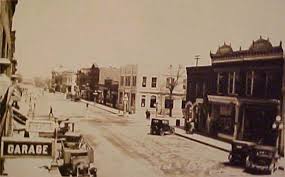
The small outpost was changed almost overnight when the Union Pacific Railroad moved their “Hell on Wheels” tent town from Cheyenne, Wyoming to Laramie after building the rails over the Sherman Summit at an elevation of 8,200 feet all the way to Laramie on May 4, 1868. Lawlessness and the Wild West ruled in Laramie. Luckily, “Hell on Wheels” moved on West as more track was laid down.
But where did that name Laramie come from?
Laramie was named after Jacque LaRamie, a French or French-Canadian trapper who disappeared in the mountain range that was later named for him in the early 1810s. LaRamie was one of the first Europeans to visit the area. Laramie is a French name much like DuBois, Wyoming. And, yes, it is pronounced Doo – Boys (and NOT Du Bwai).
There are several reasons we chose Laramie for our iconic Americana Book Awards. For us, and those in the know, Laramie, Wyoming immediately calls to mind the image of a Wild West town filled with rough-and-tumble cowboys. At one point, the only law in Laramie was “lawlessness. Wild Bill Hickok was even known to visit from time to time.
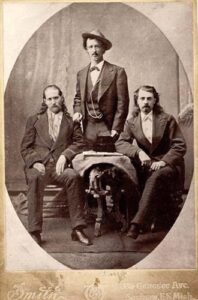
Here’s a picture of the man, himself, on the left with his friends, Texas Jack Omohundro (center), and Buffalo Bill Cody on the right.
Butch Cassidy and the Wild Bunch robbed trains and passengers with the first recorded train robbery taking place on June 2, 1899 in Wyoming. Butch was known to be very polite and dislike violence.
But that’s not the only reason we chose Laramie.
And, yes, there is yet one more reason we love Laramie!
The WOMEN!
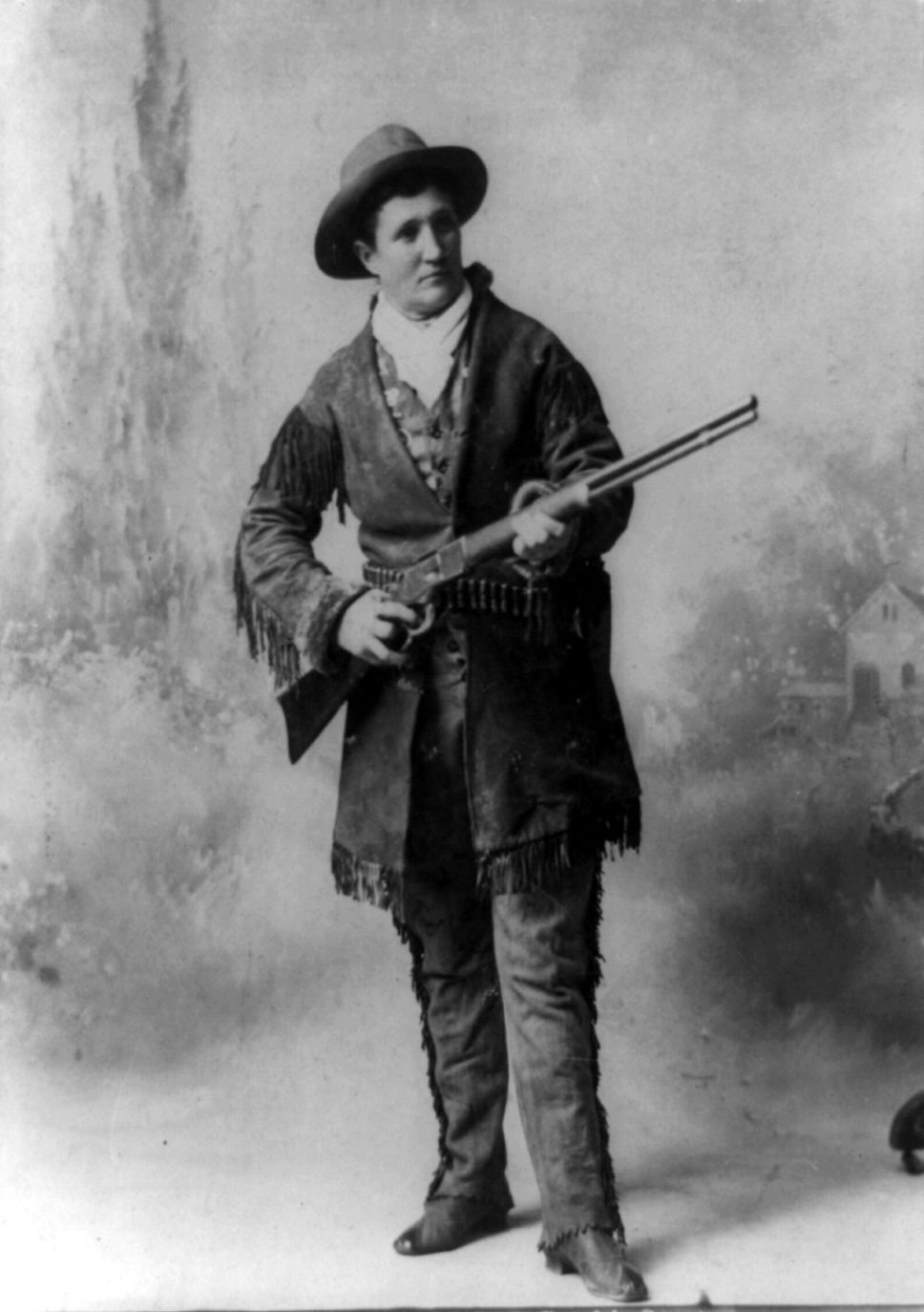
Calamity Jane hails from Laramie, Wyoming – a skilled sharpshooter who was born to a gambler and a prostitute. She cared for her five younger siblings in Utah before traveling on to Wyoming in search of a better life. There she found work as a dance hall girl and then as a prostitute at Fort Laramie. It was there that she reinvented herself by wearing buckskins and dressing like a man. She was also known for her swearing and hard-drinking ways, but Calamity Jane was also known even more for her kind heart and helping folks out of calamities–thus her nickname.
Calamity Jane — She was the inspiration for Michelle Rene’s HOURGLASS novel.
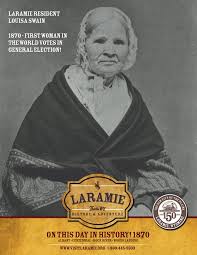
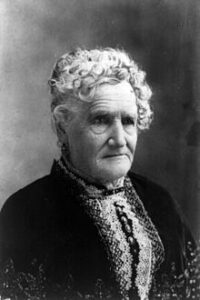
While the men were wrestling in the streets and shooting up the place, it was really the women who brought civilization to Laramie and Wyoming Territory. They established the first school in 1869, served on a formal jury in the Spring of 1870, and were the first to gain the vote; which is exactly what Louisa Swain and 92 of her friends did on September 6, 1870 –150 years ago!
Louisa Swain, the first woman to cast a ballot and she did it in Laramie, Wyoming!
Louisa Swain – she was made of stern stuff!
Early in the morning on September 6, 1870 in Laramie, Wyoming Louisa Swain became the first woman in the world to cast a ballot under democratically enacted laws granting women equal political rights with men. In the fall of 2008, 138 years later, the U.S. Congress passes a resolution proclaiming September 6th as “Louisa Swain Day” in recognition of this historic event.The Louisa Swain Foundation
In 1870, Esther Hobart Morris (59 years old) became the first female Justice of the Peace. She served in South Pass City, Wyoming, which is to the northwest of Laramie.
Esther Morris, first female Justice of the Peace — Wyoming
Esther Morris “to pettifoggers she showed no mercy.” Wyoming Tribune
The Union’s first all-female jury was assembled in Wyoming in 1870.
Later, in 1894, Estelle Reel Meyer became Superintendent of Public Instruction, the country’s first female statewide elected official.
And the grand coup d’etat was when in 1889 when Wyoming vied for statehood—and refused to join the Union if the laws giving equality to women were not upheld, telling Congress (which wanted the suffrage law rescinded) via telegram,
“We will remain out of the Union 100 years rather than come in without the women.”
Wyoming is also the first state in the USA to allow women to own property and sign legal documents.
In 1910, Mary Godat Bellamy became the first woman to be elected to the Wyoming Legislature. Two other western states, Colorado and Idaho, elected women legislators in 1895 and 1899, respectively. Wyoming was third in the nation.
Quotes are from the Smithsonian Magazine
Read more: https://www.smithsonianmag.com/travel/women-voting-wyoming-150-years-here-how-state-celebrating-180971263/#6UKzMfMeCQsmbIIQ.99
Give the gift of Smithsonian magazine for only $12! http://bit.ly/1cGUiGv
Follow us: @SmithsonianMag on Twitter
The SOMERSET Book Awards recognize emerging talent and outstanding works in the genre of Literary, Contemporary, and Satire Fiction. The Somerset Book Awards is a genre division of the Chanticleer International Book Awards (The CIBAs).
Chanticleer International Book Awards is looking for the best books featuring contemporary stories, literary themes, adventure, satire, humor, magic realism or women and family themes. These books have advanced to the next judging rounds. The best will advance. Which titles will be declared as winners of the prestigious Somerset Book Awards?
Editor’s Note: Some works have been moved to the new 2020 Mark Twain Book Awards for Satirical and Allegorical Fiction. This new division is in response to the request from the Chanticleer International Book Awards judges to acknowledge the many outstanding works that were entered into the Somerset Book Awards that should have their own division in which to compete. The Mark Twain Book Awards recognize outstanding Satire, Humor, Political Ideology, Parody, Allegory/Fable works.
So without further ado, please join us in cheering on the following authors whose works have advanced to the premier FINALIST Level of Achievement in the Somerset Book Awards for Literary, Contemporary, and of the I & I Book Awards for Instructional and Insightful Non-Fiction.
Congratulations to the Somerset Book Awards Finalists!
Beth Burgmeyer –The Broken Road
Judith Kirscht –End of the Race
R. Barber Anderson –The Sunken Forest, Where the Forest Came out of the Earth
Domenick Venezia –Liberator Legacy Book 1
Donna LeClair –The Proprietor of the Theatre of Life
Bob Holt –Firebird
Dd Jaseron –Wheelboys
Santiago Xaman –After Olympus
Sara Stamey –Pause
Patricia Averbach –Resurrecting Rain
Maggie St. Claire –Martha
Lisa Reddick –The Same River
Nick Mancuso –Fever
Jeanne McWilliams Blasberg –The Nine
Claire Fullerton –Little Tea
Linda Bledsoe –Through the Needle’s Eye
Carl Roberts–The Trial of Connor Padget
Patrick Finegan –Cooperative Lives
Mike Murphey –Section Road
Jamie Zerndt –Jerkwater
Prue Batten –Passage
Joanne Jaytanie –Salvaging Truth, Hunters & Seekers, Book 1
Congratulations to all! Good Luck to all as your works compete for the First Place Category positions.
The I & I Book Awards recognize emerging talent and outstanding works in non-fiction for instruction, guidance, self-help, how-to, and insight. The I & I Book Awards is a division of the Chanticleer International Book Awards (The CIBAs).
Chanticleer International Book Awards is looking for the best books featuring HOW-TO, Guidance, Travel Guides, Cookbooks, Instruction, Insight, Self-Help, and more.This books have been put to the test and the best will advance to be declared winners of the prestigious I & I Book Awards.
Editor’s Note: Some works have been moved to the new non-fiction division titled the Nellie Bly Book Awards. This new division is in response to the request from the Chanticleer International Book Awards judges to acknowledge the many outstanding works that were entered into the Instruction & Insight Book Awards and the Journey Book Awards for Narrative Non-fiction. The Nellie Bly Book Awards recognize outstanding journalistic works and investigative pieces. After reviewing the comments from the judges along with their suggestions, we decided to recognize these works and create a more fitting division in the CIBAs — the Nellie Bly Book Awards. We will also transition a works of the spiritual nature into another new division for the 2020’s titled the Mind & Spirit Book Awards.
So without further ado, please join us in cheering on the following authors whose works comprise the FINALISTS of the I & I Book Awards for Instructional and Insightful Non-Fiction.
Congratulations to the I & I Book Awards Finalists!
Marcus Kirsch –The Wicked Company
Rob Davis –What Goes Around Comes Around – A Guide To How Life REALLY Works
Corinne Miller Schaff –Art For All Ages: Reignite Your Artistic Self
Jennifer R. Karchmer –A Proofreading Companion: Tips, Tools & Strategies for the Professional Proofreader
Donald M. Rattner –My Creative Space: How to Design Your Home to Stimulate Ideas and Spark Innovation, 48 Science-based Techniques
Donna Cameron –A Year of Living Kindly: Choices That Will Change Your Life and the World Around You
Carole Bumpus –Searching for Family and Traditions at the French Table, Book One, Savoring the Olde Ways Series
Margaret A Hellyer –A Home on the South Fork
Ellen Notbohm –Ten Things Every Child with Autism Wishes You Knew
Nancy J. Cohen — A Bad Hair Day Cookbook
Lisa Boucher –Raising The Bottom: Making Mindful Choices in a Drinking Culture
Tikiri Herath –Your Rebel Dreams: Discover Your Purpose and Passions to Power Up Your Life
Brad Borkan and David Hirzel –When Your Life Depends on It: Extreme Decision Making Lessons from the Antarctic
Ryan M. Chukuske – Bigfoot 200: Because, You Know, Why the #@&% Not?
David A. Bossert – Kem Weber: Mid-Century Furniture Designs for The Disney Studios Design
The judges are going to have some tough choices to make with these powerhouse entries!
Good luck to all as these works compete to for the First Place Category Positions for the I & I Book Awards!
The coveted First Place Category Winners of the 2019 I & I Book Awards will be selected from the Finalists in the final rounds of judging. The First Place Category Winners will be announced at the VIRTUAL Chanticleer Awards Ceremonies, which is hosted by the Chanticleer Authors Conference.
The First Place Category winners will automatically be entered into the I & I GRAND PRIZE AWARD competition. The 17 CBR Grand Prize Genre Winners will compete for the CBR Overall Grand Prize for Best Book and its $1,000 purse. First Place Category and Grand Prize Awards will be announced and recognized at the Chanticleer Awards Ceremonies that will be held VIRTUALLY during the six days of Tuesday, Sept. 8 – Sunday, Sept. 13th, 2020. Hosted by theChanticleer Authors Conference.
Sometimes we all need reminders to keep us on track and focused while writing. We hope that you will find these tips handy.
Make certain that a major crisis, reversal or twist occurs at the midpoint to send the story skittering in a new direction and creating new motivation for the protagonist.
Kiffer: It doesn’t matter if you are writing a lighthearted romance or a thriller or middle-grade fiction, keeping your readers guessing will keep them entertained and turning the pages.
Make certain that your protagonist is struggling with internal conflict as well as external conflict.
Kiffer: Jessica has contributed some excellent posts on creating complicated protagonists. See links below.
The reader’s first glimpse of the protagonist should evoke sympathy.
Kiffer: Think of Celie of The Color Purple, Harry Potter, Tom Ripley in the The Talented Mr. Ripley, James Bond in Casino Royale, Anne Shirley of Anne of Green Gables, Dana of Kindred, Katniss in the Hunger Games, Bella Swan in Twilight.
The Cupboard Under the Stairs Artwork by Jim Kay, Illustrator for the Harry Potter series.
Base fiction around a single dramatic question.
Kiffer: This will become your log-line or pitch. See link below.
Remember always that you are a storyteller first. Stories are not merely about issues or themes. Fiction is about how threatening events affect fictional people.
While a storyline requires a series of crises, surprises and reversals, do not use violence, sex, sin, gore, or murder to enliven a sagging plot.
Kiffer: This is known as lazy writing in the publishing biz. Don’t ever let yourself get labeled as a “lazy writer” by taking the easy way out.
Don’t launch a story with too many characters for the readers to track in the opening.
Kiffer: This is something that we see often when evaluating manuscripts–too many story lines cramped into one work when they should be divided out into a series or other story arcs.
Keep dialect to a minimum and don’t write it without thorough research or intimate knowledge.
Dialogue immediately reveals a writer’s skills. Use it sparingly and effectively by understanding that it is inherently dramatic. Avoid long sections of endless dialogue. Also avoid long sections where there is no dialogue. Eliminate mundane exchanges and repetitions. Limit using dialogue to reveal backstory. Keep attributions short.
Remember that the opening has much to accomplish including establishing the voice, viewpoint, tone, and pacing.
Kiffer: Most readers will determine if they want to invest time in reading a work by the opening.
Characters are revealed while acting, talking, making choices and decisions. People are what they do.
Make certain that there is a visual element on every page.
Kiffer: Scenes that are void of sensory input have a writing craft problem known as “white room” syndrome. White room syndrome is where the characters float around the scene without visuals, noise, smells, atmosphere, or tactile experiences. There is nothing to anchor the reader into the scene.
Create a vibrant and quirky cast of secondary and minor characters to enliven the story and reveal several sides of the protagonist.
Don’t start major edits or rewrites until you finish your first draft.
Kiffer: As award-winning author Michelle Rene advises: “Pour your heart and soul into the rough draft with reckless abandon.” In other words, don’t start nitpicking and ripping into your work until you have a story idea that is fully formed. Let yourself be creative! Get the story down and then go back to fill in the blanks or to do research. Enjoy the creativity of following in love with your story and characters.
Head Over Heels in Love with Your Story Idea!
Each major character has an agenda and purpose.
Avoid problems being solved by another character or force of nature.
Kiffer: Avoid Deux Ex Machina (aka dragons, lottery winnings, Prince Charming, etc.). However, there are few times when it works (these tend to be in works that explore the human psyche) such as in the Wizard of Oz when it was all a dream for Dorothy or in Shakespearean works that tend incorporate human psyche archetypes.
Beware of digressions that follow your interests or research, not the story. Rein yourself in.
Kiffer: This means that you should not use all that research that you gathered. However, all that research could become subtext and subtle undercurrents of your story. Use research as you would spice—as needed. Just because you have it (research/spice) doesn’t mean that you should use it all. #justsaying
Nothing should happen at random, all fiction is causal. Fiction is storytelling.
Structure scenes around scene goals and opposition to these goals.
Kiffer: This is the story current—imagine that your story is a river. Does it flow straight at a constant speed? Or does it bend and twist so that the readers do not know what is just around the corner? Does it have eddies? Does it have turbulence caused by huge obstacles to overcome? Does it run deep? Or shallow? Or both? Shallows can be very dangerous…
Keep writing, keep dreaming, have heart. Jessica
Keep creating magic! Kiffer
Chanticleer’s Writer’s Toolbox
Handy Links to More Chanticleer Writers Toolbox Series blog posts
Jessica Page Morrell is a top-tier developmental editor for books and screenplays. Her articles have appeared in Writer’s Digest and The Writer magazines. She is known for explaining the hows and whys of what makes for excellent writing and for sharing very clear examples that examine the technical aspects of writing that emphases layering and subtext. Her books on writing craft are considered “a must have” for any serious writer’s toolkit.
Jessica will teach theMaster Craft Writing Classesat theChanticleer Authors Conference VIRTUAL Conference that will be held from Tuesday, Sept 8 – Sunday, Sept. 13, 2020. She will present sessions and Master Classes during the conference. She and Kiffer will also host a fun kaffeeklatch for Word Nerds at CAC20.
Did you know that Chanticleer offers editorial services?We do and have been doing so since 2011.
And that our professional editors are top-notch and are experts in theChicago Manual of Style.They have and are working for the top publishing houses (TOR, Macmillan, Thomas Mercer, Penguin Random House, etc.) and award-winning independent presses. If you would like more information, we invite you to email Kiffer or Sharon at KBrown@ChantiReviews.com or SAnderson@ChantiReviews.com.
The Nellie Bly Book Awards is a new division of the Chanticleer International Book Awards for Non-Fiction Works. The Nellie Bly Book Awards recognizes journalistic works and investigative pieces.
Nellie Bly is the the pseudonym of Elizabeth Cochran. She was born May 5, 1864 at the end of the American Civil War and the beginning of the cross-country railway systems. She died January 27, 1922. She was an American journalist who was known for her ingenuity and concern for others. She was instrumental in the Suffragist Movement in the U.S.A. reporting on the events and the vagaries that women suffered in their struggle for the right to vote.
Women were finally granted the right to vote after decades of protest, civil disobedience, marches, lectures, and lobbying on August 18, 1920—only one hundred years ago. And Bly was there to report on it and interview prominent individuals who lead the movement such as Susan B. Anthony and others.
Nellie Bly began her career by responding to a newspaper article titled ” What Girls Are Good For” (apparently not much from the article). The editor was impressed by her angry rebuttal that he gave her her first job at a newspaper.
Bly then began writing articles exposing the working girls of Pittsburgh, the living conditions of slums, sweatshops, the immigrant experience, and more stories on the human condition in the US during the “Robber Baron” era of the late 1800s. She also traveled to Mexico in 1886-1887 where she reported on the corruption of the Mexican government and the horrible conditions of the poor. Her sharply critical articles of Mexican officials caused her expulsion from the country.
What Nellie Bly is most famous for is her expose on the deplorable conditions and the horrific treatment of patients at an insane asylum by feigning insanity and having herself committed. This 23-year-old was institutionalized for 10 days. It took quite a posse of layers from the New York World paper to have her released. Her exposé lead to vast improvements in the asylums. An added note, is that many of the “patients” were there because they were immigrants and could not understand what was being said and could not communicate.
However, we should not forget how incredibly difficult it was for Bly to find work. She had to rely on her wits and had to take chances with her very life and limb and her reputation to pursue a journalistic career. Bly is known to be a pioneer in her field and she is credited with launching what is now known as investigative journalism and undercover journalism.
So without further ado, please join us in cheering on the following authors whose works comprise the FINALISTS of the first Nellie Bly Book Awards for Journalistic Non-Fiction.
Congratulations to the Nellie Bly Book Awards Finalists!
T.S. Lewis – The Why of War: An Unorthodox Soldier’s Memoirs
Maya Castro – The Bubble: Everything I Learned as a Target of the Political, and Often Corrupt, World of Youth Sports
Judy Bebelaar and Ron Cabral – And Then They Were Gone: Teenagers of Peoples Temple from High School to Jonestown
Ted Neill – Two Years of Wonder
Anthony Suarez – Politically Indicted: The Real Story Behind the Jersey Sting
Janice S. Ellis, Ph.D. – Shaping Public Opinion: How Real Advocacy Journalism Should Be Practiced
John Egenes – Man & Horse: The Long Ride Across America
Patrick Hogan – Silent Spring – Deadly Autumn of the Vietnam War
Gordon Cross, Robert Fowler, Ted Neill – Finding St. Lo: A Memoir of War & Family
John Hoyte – Persistence of Light
This new division is in response to the request from the Chanticleer International Book Awards judges to acknowledge the many outstanding works that were entered into the Instruction & Insight Book Awards and the Journey Book Awards for Narrative Non-fiction. After reviewing the comments from the judges along with their suggestions, we decided to recognize these works and create a more fitting division in the CIBAs that recognizes investigative and long form journalism.
Congratulations to the Semi-finalists whose works have advanced to the Premier Finalists Level of Achievement in the 2019 CIBAs!
The 16 divisions of the 2019 CIBAs’ Grand Prize Winners, the First Place Category Position Award Winners, and all Finalists and Semi-Finalists will be recognized at the postponed (due to the Covid-19 pandemic) 2020 Chanticleer International Book Awards Annual Gala, now re-scheduled for September.
Join us at theChanticleer Authors Conferenceat the luxurious Hotel Bellwether in Bellingham, Wash. or VIRTUALLY via ZOOM (more info to come!)
Use our link above to register now for this exciting event!
We are now accepting submissions into the 2020 Nellie Bly Book Awards. The deadline for submissions is November 30, 2020. The winners will be announced in April 2021.
Welcome to the SPOTLIGHT on post-1750 Historical Fiction novels… in other words,
Welcome to the GOETHE Book Awards!
Why do we like Johann Wolfgang von Goethe so very much? It’s simple! He’s the guy who wrapped up everything we believe in with this simple sentence:
“Whatever you can do or dream, you can begin it. Boldness has genius, power, and magic in it.” – Goethe
Of course, this was also said about Goethe (Super Goethe by Ferdinand Mount) that “…[his] company could be exhausting. One minute he would be reciting Scottish ballads, quoting long snatches from Voltaire, or declaiming a love poem he had just made up; the next, he would be smashing the crockery or climbing the Brocken mountain through the fog.”
So…, moving on… Goethe was also a very cool guy. In his lifetime, he saw the beginning of the Industrial Revolution in 1750 through Mary Shelley’s publishing of Frankenstein in 1818 – and everything in between! Check out the list of what happened during those nearly seventy decades at the end of this post – you will be A-Mazed!
Now, Welcome to the GOETHE Hall of Fame!
We wish to congratulate 2018’s Goethe Book Awards Grand Prize Winner –
Billy Battles is as dear and fascinating a literary friend as I have ever encountered. I learned much about American and international history, and you will too if you read any or all of the books. Each is an independent work, but if read in relation to the others, the reader experiences that all too rare sense of complete transport to another world, one fully realized in these pages because the storytelling is so skillful and thoroughly captivating. Trust me; you’ll want to read all three volumes. Chanticleer Reviewer’s Note
Mr. Ronald Yates not only won Grand Prize in the CIBAs 2018 GOETHE Awards – he won OVERALL GRAND PRIZE!
To learn more about Ronald E. Yates, please click here.
Congratulations to the 2018 Goethe Book Awards First Place Category Winners!
Submit your manuscript or recently released Historical Fiction (post-1750s) to the Chanticleer International Book Awards!
Want to be a winner next year? The deadline to submit your book for the Goethe Awards is June 30, 2020.Enter here!
Grand Prize and First Place Winners for 2019 will be announced during our 2020 conference, #CAC20.
The Grand Prize and First Place for 2020 CIBA winners will be held on April 17, 2021.
Any entries received on or after June 30, 2020, will be entered into the 2021 Goethe Book Awards that will be announced in April 2022.
As our deadline draws near, don’t miss this opportunity to earn the distinction your historical fiction deserves! Enter today!
The GOETHE Book Awards is a division of the Chanticleer International Book Awards – the CIBAs.
The 2020 winners will be announced at the CIBA Awards Ceremony during #CAC20. All Semi-Finalists and First Place category winners will be recognized, the first-place winners will be whisked up on stage to receive their custom ribbon and wait to see who among them will take home the Grand Prize. It’s an exciting evening of dinner, networking, and celebrations!
Goethe
Some events that occurred during Goethe’s lifetime:
1750 – The Industrial Revolution began in England
1756 – Wolfgang Amadeus Mozart was born in Salzburg Austria
1761 – The problem of calculating longitude while at sea was solved by John Harrison
1765 – James Watts perfects the steam engine
1770 – Ludwig van Beethoven was born in Bonn, Germany
1774 – Goethe’s romantic novel, The Sorrows of Young Werther, propels him into European fame
1774 – Goethe’s play Gotz von Berlichingen, a definitive work of Sturm und Drang premiers in Berlin
1776 – America’s 13 Colonies declare independence from England. Battles ensue.
1776 – Adam Smith publishes the Wealth of Nations (the foundation of the modern theory of economics)
1776 – The Boulton and Watt steam engines were put to use ushering in the Industrial Revolution
1783 – The Hot Air Balloon was invented by the Montgolfier brothers in France.
1786 – Le Nozze di Figaro by Mozart premiered in Vienna
1789 – George Washington is elected the first president of the United States of America
1780 – Antoine Lavoisier discovers the Law of Conservation of Mass
1789 – The French Revolution started in Bastille
1791 – Thomas Paine publishes The Rights of Man 1792 – Napoleon begins his march to conquer Europe
1799 – Rosetta Stone discovered in Egypt
1802 – Beethoven created and performed The Moonlight Sonata 1802 – A child’s workday is limited to twelve hours per day by the British parliament when they pass their first Factory Act
1804 – Napoleon has himself proclaimed Emperor of France
1808 – Atomic Theory paper published by John Dalton
1811 – Italian chemist Amedeo Avogadro publishes a hypothesis, about the number of molecules in gases, that becomes known as Avogadro’s Law
1811 – Jane Austen’s Sense and Sensibility was published anonymously. It was critically well-received
1814 – Steam-driven printing press was invented which allowed newspapers to become more common
1818 – Mary Shelley publishes Frankenstein 1832 – Goethe’s Faust, Parts 1 & 2 are published posthumously (March 22, 1832)
In 1830, Eugene Delacroix created Liberty Leading the People to epitomize the French Revolution. The movement officially began with the Storming of the Bastille on July 14, 1789, a day that is still celebrated in France. The French people were rebelling against the extreme wealth of the French royal family who overtaxed and underpaid the people of France to the point where they could not even feed themselves and had nothing to lose by going to battle. They were starving to death. The uprising of 1830 was featured in Victor Hugo’s Les Miserables (1862)
Claude-Michel Schönberg and Alain Boublil’s (1980s) musical can look at Delacroix’sLiberty Leading the Peopleand hear the lyrics of the song that serves as a call to revolution:
Do you hear the people sing? Singing a song of angry men? It is the music of a people. Who will not be slaves again.
Liberty Leading the People by Eugene Delacroix, 1830. On display at the Lourve, Paris.