Oriana Leckert is the Director of Publishing & Comics Outreach at Kickstarter
Photo Credit Lauren Renner
Oriana Leckert helps creators bring a marvelous array of literary projects to life. She’s written and edited for Vice, MTV News, Slate, Hyperallergic, Gothamist, Atlas Obscura, and many more. Her first book, Brooklyn Spaces: 50 Hubs of Culture and Creativity (Monacelli, 2015), grew out of a multi-year project chronicling the rise and fall of under-the-radar creative places across New York City. Follow her at @orianabklyn on Twitter/Instagram.
Kickstarter Fundraising is an excellent way to make money off your book before you publish. Avoid the pitfalls and mistakes early users make by coming to Oriana’s session! You can learn more here.
Still thinking about registering for the 10th Anniversary Chanticleer Authors Conference?
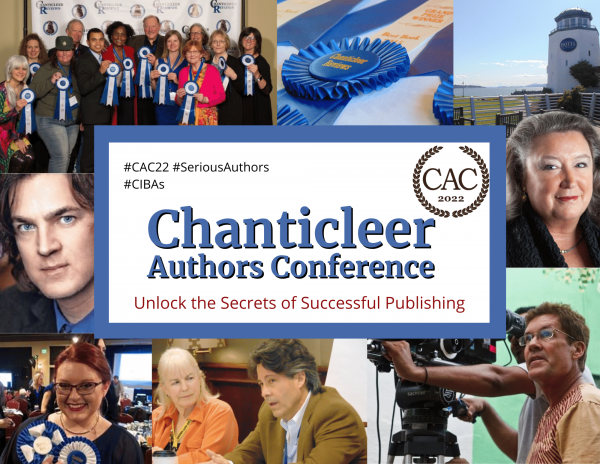
We have a stellar line up of speakers for CAC22, with options to attend in person and virtually. Find out why The Writer Magazine (founded in 1887) has repeatedly recognized the Chanticleer Authors Conference as one of the best conferences to attend and participate in for North America. Join us June 23-26, 2022 at the beautiful Hotel Bellwether in Bellingham, WA.
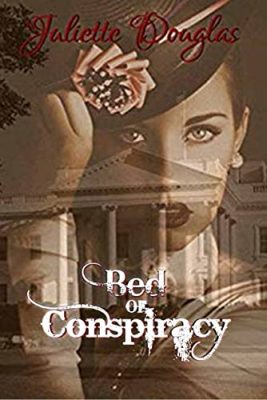
Growing up alone on the streets of Saint Louis in the mid-1870s, nineteen-year-old Samantha Davis has had to fight for everything.
When she rescues Colonel Brady from armed attackers, she isn’t trying to be a hero or land a dangerous new job, but the moment Brady sees her deadly aim and unparalleled courage, he knows he’s found his new undercover agent. Brady has been tasked with infiltrating the KGC, the Knights of the Golden Circle, a group of Southern sympathizers hellbent on bringing down the government in a Confederate uprising.
Brady believes Sam will be the perfect partner for Ross Cooper, a veteran agent who spends his off-time as a trail boss in Kansas. However, Ross is less than thrilled with Brady’s choice of the untrained, bad-tempered girl. Despite his misgivings, Ross agrees to team-up with Sam, and the two go undercover as Jim and Virginia Van Meter, a newlywed couple from South Carolina visiting Washington. After being introduced to Adam Mundy, the leader of this cell of the KGC, Ross (aka Jim) agrees to use his shipping business to help the Confederate cause.
The plot to rise again also means an assassination attempt on President Grant, and Ross must find a way to stop the uprising or see the president killed. Meanwhile, Sam is intent on doing her own investigation. Between the KGC and Sam’s hairbrain attempts, Ross has his hands full. On top of that, the longer the two play the happy couple, the more complicated their feelings become. As the conspiracy heats up so does their relationship, and the two must fight their feelings and the men plotting to plunge Washington into chaos.
The star of this novel is the courageous protagonist, Sam Davis.
From the first introduction, Sam bursts onto the scene with fire and gusto. At her young age and in this time period, she should be husband-seeking in layers of petticoats and ribbons. Instead, suspenders and pants are her wardrobe of choice, and finding a husband has never entered her mind. Even though she sometimes second-guesses her new role as the first female secret agent in this newly formed agency, Sam refuses to quit and give up her obligation to a man who plucked her off the streets. Keeping her ragged nails covered with gloves and hiding her omnipresent boots become her priority when she playacts as Ginny Van Meter.
Even when she must don the garb of a spy, Sam refuses to give up who she really is, and thank goodness she doesn’t! Repeatedly her heroics save the day. Her decidedly unladylike behavior is just what the colonel needs to foil the KGC. This girl is far from the “sit and wait” mentality of many of her contemporary compatriots. From riding into a cowboy camp armed with only her six-shooter and a letter from Colonel Brady to being arrested for trespassing, Sam flourishes on action. At times, Sam is reckless without forethought to what her actions will mean for Ross and his plan to slowly infiltrate the group. With her “peppered” language and the gun hidden in her silk handbags, Sam’s irreverence and fearlessness are endearing while her sass will keep the reader thoroughly entertained.
The historical context and references within the novel provide insight into a turbulent time in American history.
The novel’s focus on the Knights of the Golden Circle sheds light on a nearly forgotten society of Confederate sympathizers, a group with infamous members such as outlaws Jesse and Frank James and assassin John Wilkes Booth. Interweaving the truth into a fictional tale is often a daunting and confusing task, but this book seamlessly does exactly that.
While characters like Adam Mundy are fictitious, the object behind the KGC, overthrowing a government battered by the Civil War and Reconstruction, was a very real threat. Their refusal to acknowledge Lee’s surrender at Appomattox even ten plus years later could easily have created world-changing events. Ross and Sam’s involvement in this fictional assassination attempt on President Grant is a tale that could have been both possible while making an engrossing story. The action is non-stop with believable support characters adding to this captivating plot.
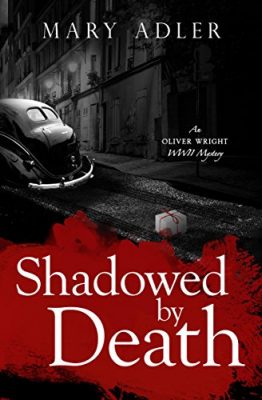
In Shadowed by Death, the second novel in writer Mary Adler’s World War II mystery series, we’re taken back to America in the forties, and to a time when human kindness and human soullessness battled for the soul of the world.

Homicide detective Oliver Wright, a Marine wounded in the Pacific and his service dog, Harley, are back home in the San Francisco Bay area. Despite recovering from a nearly shattered leg, the military calls on Wright to investigate the near-fatal battering of Irina, a young woman found bruised and beaten on a local military base. The assignment leads to an equally complex assignment, protecting Sophia Nirenska, a Polish Jew whose life’s mission is to raise American awareness of the atrocities committed by Russia against her countrymen. She also proselytizes aiding orphaned Jewish children strewn across the world after the war is over.
Someone is trying to shut her up, at minimum, or kill her. Wright is given the task of protecting her at all costs. It’s not easy. Sophia is a survivor of the Nazi’s unrelenting attacks against Warsaw and a severe critic of Russia’s unacknowledged attacks against her countrymen. She is also uncompromising about being self-sufficient after having survived the horrors of the Warsaw ghetto and the disintegration of her family.
The question is who wants her dead the most: anti-Semites, Nazis, or Russians? Protecting her is no easy job.
Harley, Wright’s military-trained service dog, becomes a major player in his master’s twin investigations, both protecting Wright and helping to track down the people who are trying to hurt her.
More than just a thriller, this novel seemingly has a mission to educate 21st Century readers about some aspects of World War II that few may be familiar with. While the Holocaust is well known, the Russians capture and massacre of thousands of Poles at Katyn is less so. It took modern scholarship to prove Russia did it, not the Nazis. The dogged resistance of the U.S. to take in more Jews during the war years becomes part of the book’s informational side. Readers are given a detailed description of the bureaucratic quagmire that made emigration of European Jews here virtually impossible despite knowledge of the atrocities being committed against them.
These and other facts are expertly interwoven into the narrative as Wright tries to get to the bottom of who wants Sophia and Irina dead, and why.
In many ways, Wright becomes a surrogate for most Americans who never experienced the full impact of the war in Europe. As one character says, in part, “We must think of [these refugees] as having brought their own justice system with them, and for the duration, we will suspend ours where they are concerned… The communists who infiltrate the Polish underground inform on them to the Gestapo. The Poles who survive will be killed or imprisoned when Russia takes over Poland. [Those who] betrayed the resistance for years… will be the cause of suffering for even more years to come. We can only imagine how many people were tortured and killed because of [them], and how many more will be.”
Shadowed by Death is a powerful inventive thriller and a provocative look into some chilling aspects of World War II that have lost none of their relevance in today’s explosive international political climate. Highly recommended.
Memorial Day: Honoring Those Who Have Lost Their Lives in Service to Our Nation
In the U.S.A., Memorial Day, originally called Decoration Day, is a day of remembrance of those who died in service to their country. The holiday was officially proclaimed in 1868 to honor Union and Confederate soldiers who loss their lives in the Civil War.
The latest historical research has the Civil War death toll at 850,000. This number has surpassed all the other wars the U.S.A. has fought in combined. The population was estimated to be approximately 31 million (not counting Native Americans or Blacks).
This translates roughly to one out of ten white males of service age (ten-years-old to mid-forties) died as a result of the Civil War with the younger males incurring the biggest loss of life. [History.com]
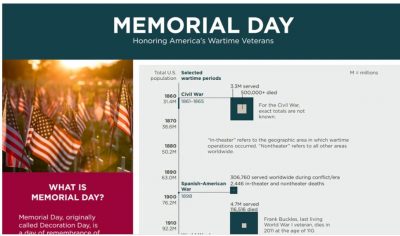
Click here to access the U.S. Census Memorial Day Infographic for more information and the complete infographic.
The important takeaway from this graphic is that all other wars, skirmishes, conflicts, and battles that the US has been involved with combined, none have taken the toll that the the war that took place on the U.S. soil—the Civil War—has. Period.
Civil War Death Toll: 850,000 deaths (latest research)
All Other US Military Involvements since 1870s until 2020: 707,081 deaths
Memorial Day is one of three official US Holidays to honor those who serve or who have served in the Armed Forces. To help keep them in order, those three holidays are:
Memorial Day, a federal holiday, is observed the last Monday in May, honors those who have lost their lives in action in service to our nation.
Veterans Day, a federal holiday, that is observed every year on November 11th to honor all those who have served in the Armed Forces.
Armed Forces Day is a celebration day that honors all active and former personnel across the six branches of the United States military. It is celebrated on the third Saturday of every May. This year’s was on May 21, 2022.
As any of you know, the head and founder of Chanticleer Book Reviews, Kiffer Brown is a self-described military brat. Her father, brother, nephews, and cousins have served in the military. Recognizing and honoring the service of those in the Armed Forces is a longstanding tradition for her and her family.
National Moment of Remembrance
On Memorial Day, remember that there is a National Moment of Remembrance. To honor the moment, pause for one minute at 3 p.m. at your local time, and remember those who have died in service to this nation.
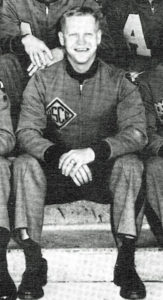
2nd Lt Billy Wayne Flynn, U.S. Army. West Point Graduate
Second Lieutenant Billy Wayne Flynn was killed in action, Vietnam, January 23, 1967. He was 24 years old. Billy Wayne gave to me a book of poetry from his studies at West Point before he left for Viet Nam. He was my cousin. It was my first book of poetry and has his notes. I was in fourth grade. I still have it and treasure it. – Kiffer
We’ve been waiting for a long time to do something more to recognize those who served.
The Military and Front Line Book Awards
Every year we receive several non-fiction books that deal with serving in the military or some other frontline capacity in service to our nation. This year the number and quality of submissions was great enough that we are excited to announce the new division that recognizes work focusing on those in Military or Front Line Service.
The new Division honors the following Non-Fiction Narratives:
Military and Armed Forces Service Narratives
Medical Stories focused on Nurses, Doctors, Health Care Workers, and other Essential Workers
Stories of Community Service Workers such as Firefighters and Police
CARE, Peace Corps, Red Cross, Doctors Without Borders, and other service organizations
Work in Agencies that serve their Community and Government
Families of those who serve in these Community Roles
Interesting to Note and Why We Honor Our Military and Front Line Heroes:
To put the Covid Pandemic (2020 to Current Day – 26 months) into perspective: the USA Covid Fatalities are more than 1 million (1,004,726 as per John Hopkins University & Medicine (May 28, 2022). Additionally, the USA has the highest fatality rate per capita (accounting for population) from Covid than any other first world country on the planet.
The USA loss more people in 26 months to Covid than in all military involvements since the 1870s. And with those losses, the death toll includes first-line responders: nurses, doctors, health workers, caretakers, emergency responders, and health care workers.
The 1918 Flu Pandemic that spread worldwide in 1918 – 1919 took more than 675,000 lives in the U.S.A. So many physicians and nurses were called into military service for World War I that able-bodied persons were asked to take medical training to offer aid in fighting the epidemic.
Red Cross Volunteers – The 1918 Flu Pandemic
The Military and Front Line Awards will be a Division for the 2023 CIBAs. Get your work ready now, and the deadline to submit will likely be in the late fall. You can see the 2021 Finalists for the Military and Front Line Book Awards here.
Keep Telling Stories – They Are Needed!
We are always honored to be trusted with any book at Chanticleer. It is a pleasure to be able to highlight these stories in particular with their own division.
“Patriotism is supporting your country all the time, and your government when it deserves it.“–Mark Twain
“How important it is for us to recognize and celebrate our heroes and she-roes!” –Maya Angelou
“A hero is someone who has given his or her life to something bigger than oneself.” —Joseph Campbell
The esteemed WRITER Magazine (founded in 1887) has repeatedly recognized the Chanticleer Authors Conference as one of the best conferences to attend and participate in for North America.
Featuring: International Best Selling Author Cathy Ace along with experts in the business and marketing and promotion for authors from Kickstarter to Hindenburg.
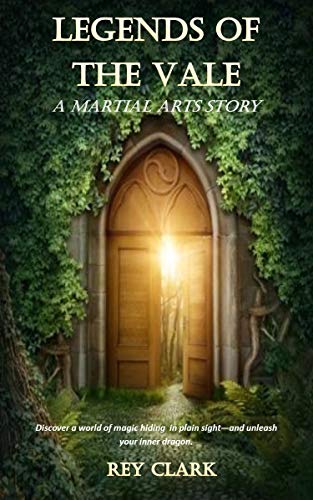
The magical creatures of the Vale are being destroyed, in Rey Clark’s fantasy adventure novel, Legends of the Vale.

The Cursed Queen, an elf bent on controlling all magic, is wreaking havoc on the inhabitants of this formerly peaceful, beautiful world co-existing parallel to normal life on Earth. As a woodland fairy, Robyn Greywink isn’t able to do much because of his small size; however, because of his father’s dying command, Robyn finds himself responsible for the last dragon, the final defense against the queen’s power. In a last ditch effort to protect the unhatched egg, Robyn sends it through a portal into a forest on Earth.
Before Robyn can retrieve and move the egg, it is found by Allison Doyle, a fifth grader who has no knowledge of the secret world around her. After the egg hatches to reveal a tiny purple and green dragon, she is Awakened to magic and quickly becomes Izzy’s protector. She and Robyn are determined to return the hatchling to the Vale.
After enlisting the help of her friend Vanessa, the three embark on a journey into a magical realm, but at every turn, they are pursued by the Hunter, the Cursed Queen’s chief assassin. When Allison discovers she has a much bigger role in the fate of the Vale, she must find the courage to face an enemy with the power to destroy anyone – or anything – standing in her way.
Determination and perseverance to duty are two major themes shining through the adventure within this novel.
Robyn, a creature so tiny he has no real power beyond the magical dust he carries, is given what seems to be an unattainable and insurmountable challenge. His father gave his life to secure the dragon egg after watching the Cursed Queen and her elven army kill the only adult dragons left in the Vale by sealing their power within the jewel of her sword, Death Striker.
Knowing he has no hope of defeating such a foe himself, he sends the egg to Earth then follows it, entering a foreign land with only the limited dust he is carrying. He refuses to give up on the dragon baby nor give up the mission given to him by his dying father. Robin knows he cannot dishonor his father’s memory by taking the cowardly way out and abandoning the egg. There’s no time to mourn or even think of the danger he now finds himself in because he cannot let the egg hatch in a place without magic. He must Awaken Allison and convince her to help him return the dragon to the Vale.
Allison is just a girl starting a new school year.
She thinks she has no unusual abilities or talents, but as a student of Kuk Sool, a Korean martial art, she is a warrior within her soul. Allison and Vanessa defend the tiny dragon against trolls and goblins before even entering the Vale. She goes from facing school bullies to a deadly Hunter overnight, and she takes all of this in stride, never allowing her uncertainty or fear keep her from a duty she acknowledges as her own from the first moment Izzy looks at her.
The dragon chooses Allison as his protector because he sees her inner strength. Upon arrival in the Vale, she soon learns she has been chosen not just to protect Izzy but to save the entire world. It is her job to overthrow and defeat the queen who has terrorized all of the creatures in the Vale. She cannot let her doubts stop her from helping everyone under the tyranny of the Cursed Queen, her Hunter, or her army.
The world of the Vale is so well-crafted that the reader will immediately feel immersed in a cursed land.
From trolls who turn to stone in sunlight to enchanted buildings that defend those inside, the fantasy-building is thorough and wonderful. Readers will find themselves seamlessly immersed in a world totally different from their own, and while the worlds built in high fantasy can often be difficult to understand, the rules of the Vale are accessible and understandable for young readers, who will find themselves facing all manner of creatures. They will feel just as Awoken as Allison and will revel in their discoveries.
In true Lord of the Rings fashion, this fantasy adventure will send readers spinning through a world of adventure and magic.
A scientific thriller by Jacques St-Malo, Cognition draws from a variety of sources – from Middle East royals to Asians, corporate tycoons from the US and UK to the Chinese and US administrations – to create a canvas as broad and fascinating as the philosophical and moral speculations it presents.
Cognition moves along in the span of a few decades, with its many facets of people in search of the child entrusted with the full capability of germinal-choice technology – to finish off the exclusive child before its countrymen could claim the genius mind for themselves. Meanwhile, an agitation based on the rage of those denied this germline manipulation is being waged against the richly endowed children of the privileged. The tug-of-war between the several factions throughout the book, each with their own set of interests and ideologies, creates numerous opportunities for philosophical debates among these genetically engineered children, educating the reader on the many ramifications of genetic manipulation that results in mental and physical enhancement.
Upon the fall of the last monarch’s regime in Turkey, the royal child prince is taken away to a foreign land to live with his mother’s maidservant for safety of life.
The Chinese Code Seagull is under operation to locate the child entrusted with the full Prometheus module —alpha and beta complement. Ethan, the sought-after child, is growing up away from his regal life and knowledge of real identity as a housekeeper’s son in the home of billionaire business mogul Bruce Taylor. Valerie Taylor, Bruce’s daughter, is another ‘extra somatic’ or genetically tailored child whose fate intersects with Ethan’s. Their course is eventually altered by the gap in their familial genealogy.
Driven by resentment against privileged for the lack of opportunities, Connor Dashaw becomes a rolling force in populist Aamon Wade’s political party fighting against germ line-treatment, which is only affordable by the rich.
All the big players in the novel – political, business, and administration – enact a cat-and mouse game to get grip of a clue puzzle to gain greater power. The collision of many motives results in a chain reaction that consumes everyone in its radar – those seeking a countermeasure to humanity’s predetermined DNA on the one hand, and arbitrariness on the other.
The novel explores, through the psyches of three children, the feeling of estrangement.
Ethan and Connor, in their own ways, embody the estrangement: one is a prince who is oblivious of his identity, while the other is socially deprived of prospects. Ethan feels at ease in the peaceful seclusion of tycoon Taylor’s historic palace-like property. However, his position as a servant’s son stings him, and he considers it humiliating to spend his life “tending to another’s leisure.” Connor, on the other hand, becomes a staunch supporter of political ideology against extrasomatics. The feeling of not belonging returns to Ethan, along with genetically modified Valerie, when they do not find friends or partners who share their “eccentric” views.
Each chapter of the story begins with a quote and introspection about the topic of the chapter.
The author’s tone is upbeat and open about his various philosophies as well as current technologies, which demonstrates his extensive knowledge and necessitates thought. A subtle critical tone accompanies the ardent tone: there is an occasional commentary on the human urge to exert control over others and his own fate, however unethical it may be.
Cognition mixes a wealth of material – from science and technology to business and philosophy, and politics – to create an enthralling fiction about modern evolution. A heavy-read that requires time and consideration, Cognition will especially appeal to tech nerds due to the abundance of scientific discussion that it presents.
“Children understand that ‘once upon a time’ refers not only – not even primarily – to the past, but to the impalpable regions of the present, the deeper places inside us where princes and dragons, wizards and talking birds, impassable roads, impossible tasks, and happy endings have always existed, alive and bursting with psychic power.” ~ Stephen Mitchell
From the first must-be-transporting words to the shattering conclusion, readers demand layers of fantastical invention. It all begins with a captivating opening salvo.
“Once upon a time” or “A long, long time ago” makes a promise to your readers. Open these pages and you’ve been wrested from your 21st century sphere. You are about to enter a kind of dream world, encounter wonderment, and find age-old conflicts wearing fantastical guises.
While fantasy is untethered from our current world, as in real life, don’t make promises you cannot keep. You’ve got to deliver an adventure so potent it invades the reader’s senses and alters his or her heartrate. Your adventure needs a diverse cast, a clash of titans, and the wondrous–dragons soaring overhead, ancient spells and curses, night walkers, or battles fought over lands or pride or brute necessity.
Khal Drugo – Game of Thrones
Opening sentences are everything
They start the whole transporting apparatus to assure readers they’ve landed in a faraway time and place. Amid a world of richly embroidered textures, sights, tastes, smells, and sounds all while entanglements with a fascinating cast of characters are underway. A world that has a carefully built history, scenes unfolding in distinct reality replete with atmosphere, tension and mood.
Is Your Opening Delivering:
Characters tossed off balance somehow by a force outside themselves.
A nettling question emerges that demands answers.
Something is amiss. The opening acts typically create threats. Humans are biologically programed to respond to threat, but will go along for the ride anyway. Because, after all, the threat is long ago and far away.
Introduce story people we’ll never meet in the real world. Story people we just can’t quit. People we can follow up close. So close we can hear their laughter or scorn, smell the stink from their terror, or experience what has lit their fierce desires.
Readers need to care about who is threatened. Some aspect of the main characters need to be identifiable, possibly pitiful, worrying, or vexing. Has life already handed your protagonist near-starving rations or brutality? Or has a royal family member longed to escape to an ordinary life?
No matter if dreaded, or later regretted, a choice must be made. {Excuse the almost-rhyme.”}
Note from Kiffer: This is where I paused to reread the opening lines of A Song of Fire and Ice by George R. R. Martin, Pride and Prejudice by Jane Austen, and The Flight Attendant by Chris Bohjalian. Yes, each one delivered!
“Perfect words in perfect places”
Which brings us to oh-so important first lines with those perfect words. Let’s forget about first person or third person for now.
Start with a powerful moment.
Don’t be afraid to startle the reader.
Always create a mood and perhaps a stirring dread.
As in these examples:
“The island of Gont, a single mountain that lifts its peak above the storm-racked Northeast Sea, is famous for wizards.” Ursula K. Leguinn,A Wizard of Earthsea
“Logen plunged through the forest, bare feet slipping and sliding on the wet earth, the slush, the wet pine needles, breath rasping in his chest, blood thumping in his chest. He stumbled and sprawled onto his side, nearly cut his chest open with his own axe, lay there panting, peering through the shadowy forest.” Joe Ambercrombie, The Blade Itself
“The children were playing while Holston climbed to his death; he could hear them squealing as only happy children do.” Hugh Howey, Wool
“Sometimes, I fear I’m not the hero everyone thinks I am.” Brandon Sandborne,Mistborn:The FinalEmpire
“When Lilia was four years old, her mother filled a shallow dish with her blood and fed it to the boars that patrolled the thorned fence.” Kameron Hurley,The Mirror Empire
Something is surely amiss, right? I’m especially struck by the opening ofThe Blade Itselfbecause I’ve hiked many a wet forest living here in the Pacific Northwest. But not barefoot. Never barefoot.
And what is a felling night?Feeding a child’s blood to boars? Shiver. Make that an icy shiver.
I need to know more, don’t you?
Take care. Have heart. Jessica
Jessica Page Morrell
Jessica Morrell is a top-tier developmental editor and a contributor to Chanticleer Reviews Media and to the Writer’s Digest magazine. She teaches Master Writing Craft Classes along with sessions at the Chanticleer Authors Conference that is held annually along with teaching at Chanticleer writing workshops that are held throughout the year.
Jessica Morrell’s Classes and Workshops at CAC22
June 23 – 26, 2022 at the Hotel Bellwether, Bellingham, Wash.
You can register for her Master Writing Class here – Using Film Techniques for Writers
Using Film Techniques for Fiction Writers– Camera angles, method acting for getting into a character’s pov, and creating subtext and tight dialogue
Your Brain on Writing
Captivating Co-Starsthat add depth to your work-in-progress
Leda Morley has just discovered she stands between the world and total devastation in Alison Levy’s second book, Blue Flame.
As a gatekeeper, Leda is descended from a long line of women responsible for keeping Apep, a chaos daemon, from devouring the sun and spinning the world – at least the Notan dimension – into complete oblivion. After barely escaping the a terrifying journey to the world of Arcana, Leda has decided to learn everything she can about these alternate dimensions and the rules controlling them. Rachel Wilde, a collector in charge of sending defective daemons back home for repair, has agreed to allow Leda to shadow her on her job in order to collect as much data as possible. However, both Leda and Rachel get more than they bargain for when they investigate a market already familiar to Rachel.
Naji El Sayed, the young son of the owners, has accidentally brought a Djinn into the Notan world, and the creature is bent on revenge and attempting to murder Naji’s mother. Rachel worries she won’t be able to help the family at all until she finds help in an unlikely place, a formerly homeless oracle. Bach Chesterfield spent six months living under a bridge and raging against the images constantly bombarding him until Rachel rescued him and moved him into her house, but will this unlikely hero have the courage to step up before it’s too late?
Bach is truly a shining character in this novel. In this second installment of the series, the reader will see his backstory and his personality come forward.
Having spent the last six months living under a bridge with other homeless people, Bach is terrified of “normal” life. He knows it would be incredibly easy to slip back into his previous life of obliviousness, but he refuses to do that. With the help of Simon Morley, Leda’s brother, he is painstakingly attempting to rebuild his shattered existence and overwhelmed mind from the wealthy parents who disowned him to the partner who kept his belongings and moved on.
Seeing the past, present, and future of most people and creatures he meets has left Bach consumed and imprisoned within his own gift, but his resiliency to retake his life is touching. Even though he knows it’s impossible, he would help every person on the planet if he could, and he insists on giving back to those who helped him along the way, going so far as to track down a fellow homeless man who acted as his protector and giving him the information he needs to find the daughter who desperately wants to find him.
When he must confront the Djinn, he finds a strength he never knew he possessed and even manages to bring forward the “humanity” within the being. Bach’s role in the plot cannot be undervalued and promises to be one of prominence within future installments.
Leda and Rachel present an intriguing dichotomy. The women share a few similarities, yet their differences really highlight the unique world-building within the novel.
The work of these women is one such area. While Leda loves learning about diverse cultures and has a voracious thirst for customs and language, she hates her job working for an administrator at a local museum. Her boss is lazy, often requiring her to perform his duties then complaining when the quality suffers following her near-death kidnapping and subsequent injury. She detests the harassment and sexualization she feels within her workplace and longs for the kind of world where that would never happen – a world like Arcana.
In Rachel’s matriarchal society, a woman would never experience such an insult. She has a much more equalized workplace, but she, unlike Leda, has no love for what she does. Five years into her eight-year length of service, Rachel wants out. She dreams of returning to her family’s farm. Though she answers Leda’s myriad questions, she’s often confused by Leda’s conflicting emotions so different from her own background.
Faith is, perhaps, the biggest and most significant difference. Leda struggles to reconcile her Christian upbringing where demons and angels hold supernatural posts with Rachel’s dogmatic practical explanation of inter-dimensional creatures malfunctioning on Earth’s plane. Though she sees the daemon in action, she cannot believe the stories she remembers so fondly are make-believe. Rachel cannot see them as anything but broken creatures needing help. However, while their discrepancies leave Leda with questions, her faith, interestingly, doesn’t diminish.
The Daemon Collecting Series is a great spin on an age-old stereotype. It’s fun, engaging characters will create a fantastical journey without leaving the very world surrounding us.
A Huge Congratulations to all of the Chanticleer Int’l Book Awards (CIBAs) Finalists!
Every tier of the CIBAs is an important one, though few manage to rise this far in the ranks.
For our Shorts and Series Authors, this post has links to all of the Finalist Awards for the 3 CIBA Division Lists we have for Collected Shorts, Individual Shorts, and Series. We will have a separate post for Fiction and Non-Fiction.
All Finalists in attendance will be recognized at the Chanticleer Authors Conference, and we will announce the Winners at the CIBAs Ceremonies on Saturday, June 25th at the Chanticleer Banquet. We can’t express how excited we are to be able to do this in person with our fully vaccinated and boosted staff in a healthy metro area.
Now let’s take a step back and look at where we came from to make this happen.
The remaining tiers are the First Place Winner, the Grand Prize Winners, and finally, the coveted Overall Grand Prize Winners. The Overall Grand Prize Winner takes home the $1000 and more! See the Book Award details here.
Now, presenting the links to the Non-Fiction Awards Finalists
We have badges available starting with the Short List. If you need a digital badge reflecting your tier level, please email info@ChantiReviews.com with your division and rank, and we will send you one as soon as possible.
The 10th Anniversary Chanticleer Authors Conference is June 23-26, 2022
Make sure your Award gets the attention it deserves on Goodreads.com
In the Librarian Manual on Goodreads, you can go to your Book Edit Page — Literary Awards.
You want to list the Award for Chanticleer International Book Awards (CIBA) Winners, and be sure to include the year and what place you received. For example:
The year Long List, Short List, Semi-Finalist, or Finalist.
Note from Goodreads: “To add a new award or edit an existing award, you’ll need help from one of our volunteer librarians or a staff member.” For assistance, post in the Goodreads Librarians Group.
Always double check that you’ve written everything correctly before posting it. The search function for Awards on Goodreads is both case and punctuation sensitive.
The Overall Grand Prize Winner for the 2020 CIBAs was Rebeca Dwight Bruff’s book Trouble the Water
This year we introduced the Non-Fiction Division for Military and Front Line Book Awards. These books focus on Narrative Non-Fiction that highlights the lives of service members, medical workers, and generally those who engage in public service. This is a division we’ve been waiting to launch for years, and we felt this was the year to make it happen. While we still are updating our site for this division, all 24 of our other CIBAs are now accepting entries for 2022.
Remember, you don’t have to be present to win, but it sure is a lot more fun! The CIBAs Ceremonies will also be livestreamed for those who can’t attend in person. Information about how to watch will be sent out by the week of the Conference to all finalists.
The esteemed WRITER Magazine (founded in 1887) has repeatedly recognized the Chanticleer Authors Conference as one of the best conferences to attend and participate in for North America.
Featuring: International Best Selling Author Cathy Ace along with experts in the business and marketing and promotion for authors from Kickstarter to Hindenburg.
Prison from Inside Out: One Man’s Journey from a Life Sentence to Freedom is an illuminating chronicle that tells the story of a man who not only survived the stoniest soil but used his experiences to thrive as a human being.
This arresting memoir is essentially a road trip of William ‘Mecca’ Elmore, a man with a tumultuous childhood, growing up in a neighborhood chock full of social problems. It is in this environment that Elmore is involved in a crime that consequently leads to his arrest and trial. The story builds upon his incarceration in various correctional facilities, his experiences, his release through a Mutual Agreement Parole Program, and his eventual redemption.
The story is documented by Susan Simone and includes accounts from Elmore’s sister, his mother, friends, and cellmates giving this memoir an all-round picture of prison life for those behind bars and those they leave behind to go and serve their sentences. Often, due to years of incarceration, former convicts face a hard time, at times life-threatening, making a reentry into society and sometimes returning to a life of crime. This tapestry brings out the redeeming value of human beings by giving hope to this group through its honest account and how he managed to survive after release.
At turns, heartbreaking, cheerful, and inspiring, Elmore’s memoir glides in deep awareness.
His perceptible emotional voice, ever-present in the narrative, pulls back the curtain to reveal the harsh realities of prison life, the sometimes indelible effect of solitary confinement, the politics that revolve around prison, and the determination to keep one’s head up amidst the chaos. The text is not potentially traumatizing nor does it ignore some of the inadequacies of the US penal system, but rather seeks to educate in a hopeful way about the true possibility of starting anew.
The text opens a door to a much-needed discussion on the need to have prison reforms that guide prisoners on a path of transformation and staying crime-free upon returning to society rather than crushing their hope and resolve to change. William’s courage along with his family’s to tell their stories without acrimony will go a long way in offering hope to many who feel sidestepped and forgotten.
The book winds up towards a ruminative ending that sees Elmore, Bessie, and Cheryl primarily reflect on Elmore’s past incarceration giving the book a heartfelt conclusion.
The book integrates vintage photographs along with captions inviting the audience further into the story. Candid and insightful, it stands among the world’s most moving testimonies of the profound value of literature.
Ultimately, Prison from the Inside Out: One Man’s Journey from a Life Sentence to Freedom by Susan Simone and William Elmore is a beacon of hope for those who have passed through the prison system and a necessary read for legislators, police officers, and all who work with the penal system.