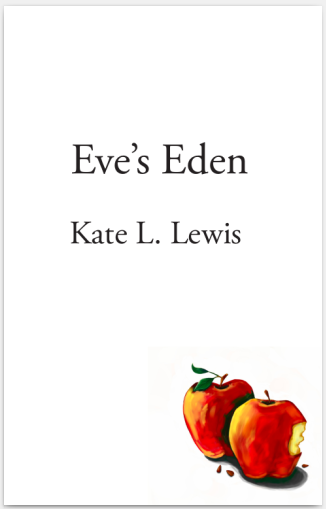
Eve’s Eden by Kate L. Lewis is a novelette, rich in tone and relevant to today’s audiences.
When Shelly Hart left for the Vanguard Drama House and Social Club, she expected an evening of theatrical entertainment. She was not expecting a protest. Muscling her way through the sign-toting, shouting crowd, Shelly witnesses hostilities toward the playwright, Fran Miller. After Shelly has found her seat inside and Miller steps out and onto the stage, Shelly sees why. With her controversial retelling of the traditional Adam and Eve story, Fran shows the struggle many women experience as she questions the role women play in a misogynistic society.
The theme within this short work is complex.
Misogyny and belonging seem paradoxical bedfellows; however, the two work together to create an engaging focus of the novelette. In an almost memoiric fashion, Fran Miller, the author of the play Eve’s Eden, takes center stage to recount her troubled personal experience with both. Some of her earliest memories are religious in nature. She learned at a young age that questioning the staunch beliefs of her community would lead to heartache.
When Fran finds it far-fetched that Eve, the first female, could be responsible for bringing all sin into the world, she is severely disciplined. She feels this was her first introduction to misogyny and cannot understand how people, especially women, can be punished perpetually for something she finds questionable. However, she learns to hide these feelings, and later, she even justifies the world, which represses her by saying these times are only temporary “bubbles” that will pass.
Fran refuses to believe what she has been taught – that people deserve the terrible things which happen to them – and moves past her abusive marriage and the sexual harassment in her workplace to find her voice by writing her play.
Many women will see themselves within her narrative, her struggles to be a woman in a male-dominated world, and her journey to belonging.
The Vanguard Drama House and Social Club is a place for all. Though some in this small city don’t like its “left-leaning tendencies,” criticism of the theater is rare, and Shelly finds her first visit a defining moment. It is here that she feels and understands the founder’s intent. P.T. Curtis brought his dream to fruition as a tribute to the many traveling shows of his youth. He built the theater and club as a place for free thinkers, a refuge where all could openly express themselves. No play was ever turned down based on content, and each generation after him held to the same beliefs.
Such a place is a beautiful idea, and it’s little wonder so many find it comforting. Eve’s Eden is a perfect read for those who love a unique storytelling approach and who enjoy the theatre.
We have a spectacular line-up of experts in marketing, book publicity, and publishing for the 2018 Chanticleer Authors Conference!
Hashtag: #CAC18 #BeyondStory
Special Guests:
Robert Scott Steindorff: Beyond the Book — Entertainment, Film, and TV
Robert Scott Steindorff is an American film and television producer who is known for adapting literary works into film works. He works with some of the top people in the entertainment industry such as Natalie Portman, Nicole Kidman, Matthew McConaughey, Ewan McGregor, Robert Downey Jr., Scarlett Johansson, Jon Favreau, John Leguizamo, Will Farrell, Jack Black, and others.
Scott has produced Chef, Jane Got A Gun, Las Vegas and Empire Falls (TV Series), The Human Stain, Love in the Time of Cholera, and other works.
Michele Miron, Editor for Press Publications wrote that “When producer Scott Steindorff buys rights to a book, there’s a good chance that story will show up on the big screen.” She continues to report that “he makes two to three movies each year.”
Known as Hollywood’s bookman – Scott has chosen the books from these authors to adapt into movies include Philip Roth, Richard Russo,Gabriel Garcia Marquez,T.C. Boyle, Nicholas Sparks, as well as Michael Connelly’sThe Lincoln Lawyer and Mikhail Bulgakov’sMaster and Margarita.
Special Topics – Scott Steindorff with Daine Sillan – Beyond the Book
The Art of Developing Books to Film
Deconstructing a Novel into Three Acts
The Dangerous Task of Turning Beloved Bestsellers into Film or TV
The Hook in a Book
Special Event
On Word, a Chanticleer Reviews video series installment with Scott Steindorff.
Join Scott in an Actor’s Studio-style Interview with Daine Sillan for the Chanticleer Reviews video series, On Word. Friday, April 20th at 1:oo in the afternoon immediately after lunch.
KaffeeKlatsch: Q & A, Friday, immediately following the On Word session.
Jessica Page Morrell: Writing Craft Sessions that Will Take Your Work to the Next Level
Jessica Page Morrell
Each year we offer writing craft sessions from the best editors and authors in the publishing industry. This year we are excited to announce that we have Jessica Page Morrell as the teacher of the Master Writing Class Sessions.
Jessica understands both sides of the editorial desk–as a highly-sought after developmental editor and an author. Her work also appears in multiple anthologies and The Writer and Writer’s Digest magazines. She is known for explaining the hows and whys of what makes for excellent writing and for sharing very clear examples that examines the technical aspects of writing that emphases layering and subtext. Her books on writing craft are considered “a must have” for any serious writer’s toolkit.
CAC18 Writing Craft Sessions and Workshops presented by Jessica Page Morrell
Learning from the Greats(SED),Sunday, 9:30 am-12:30 pm,Admiral: 3-hour Morning Master Writing Class:
Although writers can feel inundated by all the writing advice available in our current times; dissecting, reflecting, and even emulating great writers can be a powerful tool. It’s especially helpful to study the best in the genre you write in. This workshop teaches writers how to deconstruct and analyze elements of craft. It will demonstrate how to study the balance of narrative and dialogue; how POV shifts in an ensemble cast; how figurative and descriptive language are used in varying kinds of scenes; how pace and action are entwined; the benefits of first and third-person viewpoint, and the subtle variations of each. In this workshop, we’ll discuss the techniques used by a variety of authors including Alice Munro, Raymond Carver, Ernest Hemingway, Elmore Leonard, Marilyn Robinson, Ray Bradbury, Anne Patchett, and others. We’ll also cover work habits, language, and sentence potency, and we’ll synthesize the best commandments on writing from the best and brightest.
The Anchor Scenes of Fiction (SED),Sunday, 1:30-4:30 pm,Admiral: 3-hour Afternoon Master Writing Class
The task of a novelist or screenwriter is to tell a story so riveting that it will hold a reader’s attention for hundreds of pages or a viewer’s attention for several hours in a theater. This requires an intimate knowledge of your characters and thorough understanding of plot, the sequence of events that take readers from beginning to end. Your structure will reveal the protagonist’s struggles to solve problems and achieve goals. This, in turn, brings emotions to life and explains the importance of what a character is trying to achieve and what stands in his way.These events won’t hang together without a compelling structure that underlies the whole—the essential scenes that every story needs to create drive, tension, conflict, climax, and resolution. We’ll illustrate and come to understand the anchor scenes needed in fiction and film: Inciting Incident, First Plot Point, and Mid-point Reversal, Point of No Return, Darknight of the Soul, Climax, and Resolution. We’ll discuss how the protagonist stars in these scenes, how they’re emotionally-charged, build the plot, and illustrate character growth.
Subtext: The Quiet River Beneath the Story(SED), Saturday, 2:00-3:50 pm, Compass: 1.5 hours hands-on session. For most writers subtext is the most elusive of all writing techniques. However, life is often lived between the lines, and scenes often simmer with the unspoken beneath dialogue and action. In this workshop, subtext will be explained with examples from various genres. We’ll also discuss nonverbal communication and how to render it onto the page and how to hint at lies and secrets in scenes so that dialogue scenes are enhanced. We’ll cover how metaphor and visual clues create subtext. Mostly we’ll investigate all the ways to insert subtext—the unspoken, innuendo, gestures, pauses, misdirection, colors, clothing, setting details—in other words, the nuanced moments that are not directly represented.
KaffeeKlatsch (SED): Informal Q & A – Simple Steps to Solve Story Problems, Saturday, 9:00-9:50 am, Ballroom.
Ann Charles: Creating Die-Hard Fans with Relationship Marketing and Growing Your Fan Base
Ann Charles, USA Bestselling Author
We are super excited to have Ann Charles, the award-winning author of the USA Today Best-Selling Deadwood Mystery Series to present at CAC18 and to keynote. Ann writes multiple award-winning mystery series that are splashed with humor, spice, suspense, action-adventure, and whatever else sounds fun. Her books garner thousands of Amazon reviews and are the Top-Rated #1 Kindle Bestseller Women Sleuth Mysteries.
Ann will share her proven and tried marketing secrets to creating, building, maintaining, and growing an enthusiastic fanbase. www.AnnCharles.com
CAC18 Workshops and Presentation Topics by Ann Charles:
Ann Charles is the CAC18 KEYNOTE PRESENTER for SATURDAY’S LUNCHEON
How to Create Die-hard Fans through Relationship Marketing (MPP), Saturday, 2:00-3:50 pm, workshop, Admiral: There are many ways to find and entice readers, but keeping them as part of your long-term readership base is tricky. Years ago, Ann made the choice to focus much of her non-writing energy on Relationship Marketing, fostering reader loyalty rather than taking the one-time-sale mentality. In this workshop, she’ll explain 5 W’s of Relationship Marketing: WHAT it is, WHY it’s important, WHERE you can develop career-beneficial contacts, WHO benefits from this style of marketing, and WHY this marketing method can be effective. Join Ann and learn the effective techniques of reaching your audience.
Growing Your Audience (MPP), Sunday, 10:30-12:30 pm, workshop, Ballroom:For Published or Unpublished Authors The publishing industry is morphing every day, and the internet brings a new dimension to the concept of audience. Together, these changes merge into a vastly different and exciting concept of marketing. The shotgun approach to finding your audience worked for decades, but this technique becomes more expensive and less viable with each passing month. The bad news: no one will find your readers for you. The good news: you have more options than ever in history to build your own fan base. In this interactive class, we’ll explore these options and send you on your way to building your own tribe of diehard fans. This class will help you pinpoint your audience—find the readers who want to buy your book—so you can tailor your marketing and promotion techniques to them and stop wasting time and money.The publishing industry is morphing every day, and the internet brings a new dimension to the concept of audience. Together, these changes merge into a vastly different and exciting concept of marketing. Find your readers! Ann Charles and Jacquie Rogers
Building a World One Book at a Time (MPP), Saturday, 9:00-9:50 am, Admiral:Many readers love crossover books and characters. Creating one world that encompasses multiple series offers a familiarity even though the setting, style, and series are different. For authors, it not only helps to sell backlist books but can also create die-hard fans for life. In this presentation, Ann will explain some of the ways she has used to create crossover elements within her three on-going series. Diane Garland will join Ann and discuss the various ways her role as a World Keeper plays with Ann’s series building. One world that encompasses multiple series offers a familiarity even though the setting, style, and series are different. Diane Garland and Ann Charles
Working with a World Building Editor(MPP), Sunday, 1:30-2:30 pm, Ballroom:Building a world takes a lot of planning. Readers are smart, so you need all the help you can get making sure your world follows the rules you create along the way. For authors, previous threads and rules can become hazy by book 3 or 4 in a series. In this workshop, Ann and Diane will talk about ways they work as a team to make sure each book in an ongoing series stays true to the world the readers know and love. Ann Charles and Diane Garland
Writer’s Life (WL), Friday, 4:10-5:00 pm, Admiral:Living Vicariously through Fiction:Have you ever wondered where authors find the information needed to write stories about historical setting, character careers, or true events from the past, and how they incorporate it all into a single story or series? In this presentation, Ann and Jacquie will discuss how difficult it can be to live vicariously through fiction, and how important it is to be as accurate as possible. Jacquie Rogers and Ann Charles
Lake Perriguey: Copyrights, Trademarks, and Intellectual Property
We want to extend a special welcome to Lake Perriguey, attorney, to the 2018 Chanticleer Authors Conference. Lake’s company, Law Works, LLC, handles all aspects of copyright and trademark law, with experience before the Trademark Trial and Appeals Board and the US Copyright Office and multiple cases in the United States District Court. These matters include the initial registration of copyrights and trademarks and claims and defenses of copyright infringement and trademark infringement.
Lake Perriguey owns Law Works LLC, a full-service law firm in downtown Portland which focuses on civil rights, employment, injury, and copyright litigation. Lake brought the lawsuit to the courts that established marriage equality for gay and lesbian Oregonians as well as the first successful action for non-binary legal recognition in the United States. Lake has represented authors and publishers in contract negotiations and in federal court litigation regarding copyrights. Law Works, LLC is based out of Portland, Oregon.
CAC18 Workshops and Presentation Topics by Lake Perriguey, Attorney:
Copyright 101 and the Publishing Contract in our Digital Age: An Intellectual Property Primer (CTIP), Friday, 9:10-10:00 am, Compass and Saturday, 9:00-9:50 am, Boardroom: A primer coupled with some tips on common terms in publishing contracts that should be considered given the worldwide market and the ease of digital distribution.
Reversion Rights Consideration (CTIP) will be discussed in the above sessions.
KaffeeKlatsch – Quick Coffee with Lake (CTIP): 10-minute session with Lake. *Sign-up at the Chanticleer Desk in the Ballroom* **Session Times are Strickly Enforced** ***Spaces are limited***
Dawn Groves: Online Presence, Content Development, and Communications Consultant
Dawn Groves
Dawn Groves is a professional consultant who specializes in Online Platform Analysis and Email Marketing. She critiques and advises clients regarding online presence, usability, and analytics. She is a pro at WordPress development and designs Social Media strategies for specialized entities. She also manages email/newsletter campaigns and on-going content development. Dawn is also a consultant with Einblau & Associates where she trains and consults on workflow productivity, workplace communications, energy and time management, team building and stress management.
CAC18 Workshops and Presentations by Dawn Groves:
How to Create a Book Trailer on a Budget (MPP), Saturday, 1:00-1:50 pm, Admiral:
The reason why book trailers are important in today’s market.
The five characteristics that make a great book trailer.
A tutorial you can use build your own book trailer.
A clickable list of the reference tools you’ll need including several free online resources.
How to Write Online Content that People Will Actually Read (MPP), Saturday, 9:00-9:50 am, Compass:
Enjoy an hour of solid, practical advice based on the most current online behavior research and industry trends
How to get past “content fatigue”
The most important difference between online content and hard copy. (It’s not what you think.)
Eight rules essential to the production of content that’s appealing as well as engaging
A clickable list of fantastic online resources and tools for developing content.
Beth Bacon: Effective and Proven Techniques to Increase Your Book Sales
Beth Bacon
Beth Bacon is an award-winning author of books for young readers includingThe Book No One Wants To Read,I Hate Reading, Blank Space, andThe Worst Book Ever.Her awards include the Library Media Connection Editor’s Choice Award, the Candlewick Award for Picture Book Writing, and the Marion Dane Bauer Award for Middle-Grade Writing. She has an MFA in Writing For Children and Young Adults from Vermont College of Fine Arts. She is available for school readings, contact her at www.bethbaconauthor.com.
CAC18 Workshops and Presentations by Beth Bacon:
6 No-Cost Things To Do Today to Increase Your Sales on Amazon Tomorrow (STS), Friday, 10:10-11:00 am, Compass, and Saturday, 10:00-10:50 am, Admiral: Is your bookselling as well as it could on Amazon? Do you want to increase your sales without paying a penny in advertising? All you’ve got to do is think about the Amazon search engine. In this session, author Beth Bacon shares six specific steps you can take to optimize your selling experience on Amazon.
Discover The Keywords For Selling Your Book: A Hands-On Workshop (STS), Saturday, 1:00-1:50 pm, Compass: Learn the technique professionals use to produce a list of words that connect bestselling books with actual readers. The right keywords lead your ideal audience directly to your book. But the most effective keywords often aren’t the first ones you think of. In this workshop, author Beth Bacon will guide you through a clear, methodical process for discovering the search terms that real readers actually use to discover books like yours.
KaffeeKlatch (STS), Saturday, 2:00-2:50 pm, Ballroom: Beth shares her experience in digital marketing to help you understand the way Amazon thinks so you can take advantage of the processes that are built into the world’s largest bookstore. An informal Q & A session.
Daine Sillan Isaacs: Film/TV Producer and Executive Creative Director, Luna Design, and founding partner of SillanPaceBrown Publishing + Production + Agency
Daine Sillan
Daine Sillan Isaacs brings more than two decades of experience in film and television industries as an executive film producer, president of production for Don Johnson Productions at Universal and Paramount pictures, president of development and production for Green Moon Productions where she produced films for Antonio Banderas and Emma Thompson.
Diane is also the executive creative director of Luna Design: Design & Branding, Content Strategy, Experimental Marketing, Web & App Development, Photo & Video Production. Clients include Bunker Media, Microsoft China, BLUEPRINT NYC, Prime Pictures, and others. She and Kiffer Brown co-founded SillanPaceBrown Publishing + Production, LLC.
CAC18 Workshops and Presentations by Daine Sillan:
Special Sessions with Scott Steindorff (H&E):Friday Luncheon, 12:00-2:00 pm in the Ballroom: An insightful conversation with Scott Steindorff, an A-list Hollywood producer who fearlessly adapts many of our favorite books to the big and home screen. Think The Actor’s Studio with James Lipton, we will walk through the process of book to film – how to discover the property, negotiate the rights, recruit financiers, attach talent, develop the script, on set produce and edit the film, and, the most important step- how to ultimately market the project. It’s a long and arduous journey and it takes a person with a lot of passion and multi-talents, like Scott, to pull it off.
The Pitch & Loglines (H&E), Saturday, 3:00-3:50 pm, Boardroom. Also Sunday, 9:30-10:30 am and 2:30-3:30 pm, Ballroom: Pitching your book begins with the elevator test where you only have 30 seconds (or 33 words) to express your story, tone, genre, character, setting, and twist. If you successfully generate a spark of interest before the doors open, you have to be ready for the next step. Authors, who have freedom of words in space, often struggle to distill their storyline, present a clear snapshot of their protagonist/antagonist, set up the main challenge and build to a climax in a concise and potent way. It literally takes a new mindset and, well, practice. Pitches that seem to just roll out in conversation and completely draw you in are usually the ones the author has diligently refined and practiced. Let’s look at the best practices for pitching your book!
Author vs. Screenwriter: A Producers POV (H&E), Saturday, 1:00-1:50 pm, Boardroom: Story is story! Writing is writing!…right? Not entirely true. Book writing is actually a completely different approach to storytelling than screenwriting. It may be the same story but it is executed in two unique disciplines, requires distinct skill sets, and will be experienced in different ways. Many authors feel they could simply write a script version of their novel, and while a great adaptation may happen, it is never simple.
Nuts and Bolts, Q & A Wrap-Up Sunday, 3:30-4:30 pm, BallroomDaine Sillan andKiffer Brown
Presenters & Panelists
Craig Anderson: Thriller Author, and Editor & Reviewer for Chanticleer Reviews
Craig Anderson
Craig Anderson served for twenty-six years in the US Air Force, completed an MFA in Creative Writing for Fiction, and a Graduate Certificate in the Teaching of Writing. He is a professional book reviewer, manuscript evaluator, mentor, and book editor for nonfiction and multiple fiction genres with Chanticleer Reviews and Editorial Services.An avid writer, he’s authored the forthcoming thrillerGrabbed and Gone.He, his wife, and five large dogs dwell in Eastern Washington State.
Special Topics:
Using Sight and Sound to Revise Your Work (SED), Saturday, 11:00-11:50 am, Boardroom: Fresh off the Chanticleer Blog, Craig will go into depth and walk us through some tried and true editing hacks that will have you sailing through your stack of dreaded W.I.P.
Panel: MOV/ Editorial Panel (SED) (WL), Saturday, 4:00-4:50 pm, Compass: This panel will walk you through the MOV process from the point of view of the author and the editor. Grab onto your seats – this will be fun! Craig Anderson, Editor, will moderate Sara Dahmen, Lawrence Verigin, John Yarrow, and Vijay Lakshman
Pamela Beason: Award-Winning Mystery, YA Author, and Private investigator
Pamela Beason
Pamela Beason is a private investigator by day and a YA and Mystery author by night. She slays in both her chosen professions.
She’s also pretty good at marketing her books online. Don’t miss her joined class with James Wells on how to get your books promoted on the elusive and exclusive BookBub.
Special Topics:
Successful E-Book Marketing 102: BookBub Declassified, Saturday, 4-4:50 pm, Admiral: How to get your books promoted on the elusive and exclusive BookBub, Pam Beason and James Wells
Using Non-fiction to Sell Fiction and Fiction to Sell Non-fiction: Saturday, 11:00-11:50 am,Admiral, Pam Beason,Kiffer Brown and Sara Dahmen
Kaffeeklatsch — Creating a Series, Friday, 3:10-4:00 pm, Ballroom.
Sara Dahmen: Author & Entrepreneur
Sara Dahmen
Sara Dahmenis a metalsmith of vintage and modern kitchenware in tin, copper, and iron. Her debut novel, Doctor Kinney’s Housekeeper, won the Laramie Award Grand Prize for Western Historical Fiction and inspired House Copper & Housekeeper Crockery – American-made cookware. She has published over 100 articles as a contributing editor for multiple magazines, book blogs, review blogs, spoke at TEDx Rapid City at the Historical Writers of America inaugural conference in Williamsburg VA, and has co-chaired the Port Washington Literary Festival since its inception. Prior to her writing gigs, Sara was a print, radio and TV producer in Milwaukee and owns and has operated a nationally award-winning event planning company since 2006. When not writing or sewing authentic clothing for reenactments, she can be found hitting tin and copper at her apprenticeship with a master smith, reading The Economist and reference books, or playing with her three young children.
Special Topics
Panel (MPP) (STS), Tips for Commanding Attention in a Crowded Room, Saturday, 10:00-10:50 am, Compass: Special appearances require special preparation! Janet Shawgo, Joan Acklin, and Janet Oakley and Sara Dahmen
Using Non-fiction to Sell Fiction and Fiction to Sell Non-fiction: Saturday, 11:00-11:50 am,Admiral, Sarah Dahmen, Kiffer Brown, Pam Beason
Panel: MOV/ Editorial Panel (SED) (WL), Saturday, 4:00-4:50 pm, Compass: This panel will walk you through the MOV process from the point of view of the author and the editor. Grab onto your seats – this will be fun! Craig Anderson, Editor, will moderate Sara Dahmen, Lawrence Verigin, John Yarrow, and Vijay Lakshman
Diane Garland: Continuity Specialist for Fiction Series
Diane Garland
Diane specializes in the world of continuity editing, a systematic way of cataloging all the little-known facts in a book series. USA Today bestselling author, Ann Charles, amongst others, count on her attention to detail and her organizational skills to keep their series on track and their fans coming back. Visit her website at www.YourWorldKeeper.com
Special Topics
Building a World One Book at a Time (SED):Saturday, 9:00-9:50 am, Admiral: Many readers love crossover books and characters. Creating one world that encompasses multiple series offers a familiarity even though the setting, style, and series are different. For authors, it not only helps to sell backlist books but can also create die-hard fans for life. In this presentation, Ann will explain some of the ways she has used to create crossover elements within her three on-going series. Diane Garland will join Ann and discuss the various ways her role as a World Keeper plays with Ann’s series building. One world that encompasses multiple series offers a familiarity even though the setting, style, and series are different. Diane Garland and Ann Charles
Working with a World Building Editor (SED), Sunday, 1:30-2:30 pm, Ballroom: Building a world takes a lot of planning. Readers are smart, so you need all the help you can get making sure your world follows the rules you create along the way. For authors, previous threads and rules can become hazy by book 3 or 4 in a series. In this workshop, Ann and Diane will talk about ways they work as a team to make sure each book in an ongoing series stays true to the world the readers know and love. Diane Garland and Ann Charles
Kim Hornsby: Amazon #1 Bestselling Paranormal/Suspense Novelist
Kim Hornsby
Kim Hornsby is a Bestselling Suspense Author, having shared space on the top five bestseller list with J.D. Robb, Stephen King, and Nicolas Sparks. Also, a screenwriter and movie producer, her DREAM JUMPER series is optioned for film with the first movie, The Dream Jumper’s Promise now in development with 5 x 5 Media. Where she once juggled teaching scuba diving with singing at Maui convention shows, she now juggles writing suspense novels and scripts that will transfer to the screen with contacting actors to read her script.
Special Topics
Page to Screen: Adapting your Novel to a Script (SED), Saturday, 4:00-4:50 pm, Boardroom:
Hollywood LOVES book adaptations.
Have you thought about adapting your book to a screenplay but didn’t know where to start?
Learn how to boil down a story to the key scenes to transfer to a script format. Guaranteed pain-free, you’ll learn a method of finding the essence of the story and building on that. Learn the 3-Act structure, script formatting, dialogue, slug lines, and lean narrative. As a sales tool, you are that much closer to your dream of seeing your book on the screen with a script in hand. Find out enough to get you started.
Ever wondered what Kindle Worlds is and how it might help you? Kindle Scout? Matchbook? Kindle Unlimited? The Lending Library? Kim and Janet will outline the many offerings Amazon has for authors and publishers so you can make an intelligent choice on what works for your books. Janet Oakley and Kim Hornsby
KaffeeKlatsch (H&E) (STS) (MPP), Friday, 4:10-5:00 pm, Ballroom:How My Work Got Optioned for a Film.
Wendy Kendall: Podcaster, Mystery Author, Social Media Maven & Chanticleer Review & Editing Team
Wendy Kendall is Podcaster, Mystery Author, Editor, Book Reviewer and highly sought after Social Media Educator. She specializes in her love of Mystery and all things related to a crime scene.
Wendy Kendall
Special Topics:
Smart Social Media (STS) (MPP), Friday, 4:10-5:00 pm, Compass, and Saturday, 10:00-10:50 am, Boardroom: Learn the advantages of different modes of social media, and the ways to select a mix that effectively establishes a productive social media presence. Then apply what you’ve learned to design your personalized social media plan. The presentation will be filled with specific how-to’s, resources and examples.
Targeting Mystery Readers and Industry Professionals (STS) (MPP), Saturday, 2:00-2:50 pm, Boardroom: The book-selling industry has parsed mystery into so many variations it’s hard to keep track of them: hard-boiled or soft-boiled PI, cozy or traditional, paranormal, suspense, legal, historical, police procedural . . . and some mysteries are a conglomeration of these. This presentation teaches you what you need to know about what you’re writing so that you can write effectively, pitch successfully, and sell it to the right agent or target market. We’ll also cover how reader expectations differ among the variations of mystery, suspense and thriller fiction, something every writer needs to know.
Vijay Lakshman: Co-Creator of the revolutionary video game Elder Scrolls and author of the award-winning Mythborn Fantasy series.
Vijay Lakshman
VJ joined Bethesda Softworks as an Executive Producer and Lead Designer, with a vision to create a new and exciting digital role-playing game system. This resulted in the creation of, The Elder Scrolls franchise, re-envisioning the fantasy role-playing genre and redefining its reach and popularity. The Elder Scrolls and its subsequent iterations like Skyrim quickly became and remains the world’s definitive role-playing games, enjoyed by hundreds of millions of fans. VJ’s is responsible for more than eighty-five well known digital entertainment properties, which have garnered over $1B in lifetime sales.
While completing the Mythborn saga, a rich and exciting new fantasy series where dreams become reality, he is also working diligently on the design for a ground-breaking new interactive video game, a television pilot, and a graphic novel, all to complement the world of Mythborn and the characters within.
Special Topics
Story Development and Gaming: The Conversion of Mythborn to a Video Game (H&E) (MPP), Friday, 10:10-11 am, Admiral: Vijay will walk us through what it takes to move from A to Z along the gaming trail, what the Industry is looking for, and the platform necessary to develop a successful game and a large fan base. Vijay Lakshman
SciFi and Fantasy Panel Friday 3:10-4:00 pm,Admiral: Vijay Lakshman, Pamela LePage, Alex Paul, and John Yarrow. Moderated by James Wells.
Panel: MOV/ Editorial Panel (SED) (WL), Saturday, 4:00-4:50 pm, Compass: This panel will walk you through the MOV process from the point of view of the author and the editor. Grab onto your seats – this will be fun! Craig Anderson, Editor, will moderate Sara Dahmen, Lawrence Verigin, John Yarrow, and Vijay Lakshman
Janet Oakley: Award-Winning Author and Historian
J.L. Oakley
J. L. Oakley writes historical fiction that spans the mid-19th century to WW II with characters standing up for something in their own time and place. She is an award-winning author and a recipient of the 2013 Bellingham Mayor’s Arts Award; the 2013 Chanticleer Grand Prize; the 2014 First Place Chaucer Award; an Everybody Reads and Bellingham. When not writing, she demonstrates 19th-century folkways in the schools and at San Juan Island National Park. She also has a cat who thinks she’s editing.Read pick and the 2015 WILLA Silver Award,Pulpwood Queen Book Club 2016 backlist pick for February 2016.
Special Topics: Amazon and Historical Fiction Promotions
Amazon Demystified (PPD), Friday, 2:00-3:00 pm, Admiral: Ever wondered what Kindle Worlds is and how it might help you? Kindle Scout? Matchbook? Kindle Unlimited? The Lending Library? Kim and Janet will outline the many offerings Amazon has for authors and publishers so you can make an intelligent choice on what works for your books. Janet Oakley and Kim Hornsby
Panel (MPP) (STS): Tips for Commanding Attention in a Crowded Room, Saturday, 10:00-10:50 am, Compass: Special appearances require special preparation! Janet Shawgo, Joan Acklin, and Sara Dahmen
Jacquie Rogers: Award-Winning Author
Jacquie Rogers
Award-winning writer Jacquie Rogers is the author of eleven novels, including five books in the Hearts of Owyhee series, two books in the Honey Beaulieu – Man Hunter series, and others. She’s published over a dozen short stories and novellas in three genres. Under the house name Ford Fargo, she writes for the Western Fictioneers Wolf Creek series. She co-wrote Nail It! The Secret to Building a Fiction Writer’s Platform, and Growing Your Audience: Workbook for Published, Unpublished, and Under-published Writers.
Special Topics
Writer’s Life (WL), Friday, 4:10-5:00 pm Admiral: A lively discussion with Ann Charles: Living Vicariously through Fiction. Have you ever wondered where authors find the information needed to write stories about historical setting, character careers, or true events from the past, and how they incorporate it all into a single story or series? In this presentation, Ann and Jacquie will discuss how difficult it can be to live vicariously through fiction, and how important it is to be as accurate as possible. Jacquie Rogers and Ann Charles
Growing Your Audience (MPP), Sunday, 10:30-12:30 pm, Workshop, Ballroom:For Published or Unpublished Authors The publishing industry is morphing every day, and the internet brings a new dimension to the concept of audience. Together, these changes merge into a vastly different and exciting concept of marketing. The shotgun approach to finding your audience worked for decades, but this technique becomes more expensive and less viable with each passing month. The bad news: no one will find your readers for you. The good news: you have more options than ever in history to build your own fan base. In this interactive class, we’ll explore these options and send you on your way to building your own tribe of diehard fans. This class will help you pinpoint your audience—find the readers who want to buy your book—so you can tailor your marketing and promotion techniques to them and stop wasting time and money.The publishing industry is morphing every day, and the internet brings a new dimension to the concept of audience. Together, these changes merge into a vastly different and exciting concept of marketing. Find your readers! Ann Charles and Jacquie Rogers
Janet K. Shawgo: Award-Winning Author, Travel Nurse
Janet K. Shawgo
Janet Shawgo lives in Galveston Texas but over her twenty plus years as a travel nurse, her life has crossed the United States. Being a nurse for over thirty-three years most of those in Labor and Delivery has assisted in her writing. She starting writing in 2009 and has five books published to date.
Her Look for Me series has some thirty awards and acknowledgments. Janet has added some interest to her stories from her own travels. Research and actually putting feet on the ground brings her stories so vividly to life.
Special Topics
What Do Books, Grocery Stores, Vineyards, & Bars Have in Common with Your Book? (STS) (MPP), Saturday, 11:00-11:50 am, Compass: Find out how to sell more outside the bookstore.
Everyone Loves a Winner (STS), Friday, 3:10-4:00 pm, Compass: How Book Contests help sell and promote your books.
Tips for Commanding Attention in a Crowded Selling Space, Saturday, 10:00-10:50 am, Compass: Special appearances require special preparation! Janet Oakley, Joan Acklin, Sara Dahmen and Janet Shawgo
Allison Vrbova: Building Your Author Brand Through Effective Content Marketing
Allison Vrbova
As marketing communication professional with a Master’s Degree in creative writing, Allison is a storyteller at heart. That’s why she spent the past decade helping tech startups, innovative small businesses and social profit companies create brand loyalty through compelling content. She has written about everything from drones and IoT applications, to mission-centered food products.
In 2016, Allison’s goal is to rid the world of poor-quality content, one blog post at a time.
CAC18 Workshops and Presentations by Allison Vrbova:
Build Your Brand Through Effective Marketing Content (MPP), Friday, 9:10-10am, Admiral’s Room: She will also discuss identifying your target audience and gearing content for your specific goals.
KaffeeKlatsch (MPP), Friday, 10:10-11:00 am, Ballroom: Tips on developing and identifying your audience – today!
Build Your Brand Through Effective Marketing Content (MPP), Friday, 2:00-3:00 pm, Compass: Allison will focus on ways that authors can connect with potential readers and build personal brand awareness through blogs, videos, social media, email marketing, and other content strategies.
James R. Wells: Contributor to the Daily Kos Page and Whatcom Watch, and Scifi Award-Winning Novelist
James R. Wells
James writes about climate and environmental topics. In his day job, he designs information systems that http://www.thegreatsymmetry.com/support energy efficiency programs for utilities and others who work to save gigawatt-hours every year, reducing costs and emissions. The Great Symmetry, his Cygnus Grand Prize award-winning novel, is set is set three hundred years in the future, it casts a sharp eye on issues of the 21stcentury. What is the boundary between a genuine info-terrorist – who releases a secret in order to cause harm – with someone who simply reveals an inconvenient fact about a government or a company? What are the acceptable lines defining the relationships between corporations, government, and individuals? When someone appears to agree to a loss of freedom, is that consent in fact given freely?
Special Topics
Successful E-book Marketing 101 (STS), Friday, 11:10-12 pm, Admiral: This is always a popular session on strategies, search engine, BookBub and more. Learn how to build a successful campaign, ride the wave to greater sales, and reach wider audiences.
Panel: Science Fiction & Fantasy, Moderator (SED), Friday, 3:10-4:00 pm, Admiral: Alex Paul, Vijay Lakshman, John Yarrow, and Pamela Le Page with James Wells, moderator.
Successful E-Book Marketing 102: BookBub DeclassifiedSaturday 4-4:50 pm, Admiral: How to get your books promoted on the elusive and exclusive BookBub. Pam Beason and James Wells
John Yarrow: He’s published magazine articles and a script adaption that was produced and aired on National Public Radio
John Yarrow
John Yarrow is an award-winning author with two books up for book awards this year at the Chanticleer conference: The Future’s Dark Past in the Cygnus Sci-Fi contest and The Recombinant Theory has been ShortListed in the highly competitive Global Thriller contest. His latest book, The Future’s Dark Past, launched this winter to rave reviews and can be found on Amazon, Barnes and Nobles, and iBooks.
John infuses his storytelling with insightful observations and humorous wit from his experiences as a technology expert in the corporate world, graduate school professor, secondary educator/sports coach, and dedicated family man. He is fascinated with the struggles of an enduring humanity and futuristic world-building which compels him to create inconceivable, yet believable scenarios. A life-long Texan, he dreams as big as he writes.
SPECIAL TOPICS:
Death by a Thousand Edits (SED) (WL), Friday, 11:10-12:00 pm, Compass: An encompassing look at the editing process for serious writers and some basic editing tips to help streamline and improve your writing craft. This is a session on the editing process and how to survive it.
Panel: Science Fiction & Fantasy, Friday, 3:10-4:oo pm,Admiral. Vijay Lakshman, Pamela LePage, Alex Paul, and John Yarrow. Moderated by James Wells
Panel: MOV/ Editorial Panel (SED) (WL), Saturday, 4:00-4:50 pm, Compass: This panel will walk you through the MOV process from the point of view of the author and the editor. Grab onto your seats – this will be fun! Craig Anderson, Editor, will moderate, Sara Dahmen, Lawrence Verigin, John Yarrow, and Vijay Lakshman
… Kiffer Brown
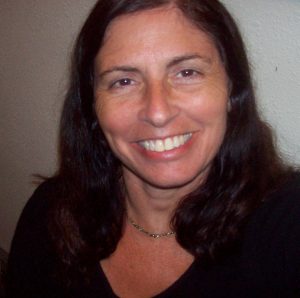
Kiffer is the founder of Chanticleer Book Reviews and International Writing Competitions, LLC. She is also a partner in SillanPaceBrown Publishing + Production LLC, which specializes in curating books with the potential to become fully actualized intellectual properties.
Her addiction is finding sparkling gems that will become tomorrow’s bestsellers. She is known for her instinct in picking winners. She also acts as an independent acquisitions editor for publishers and entertainment companies. Kiffer is known for her marketing talent and networking skills. She truly loves what she does and her passion shows!
Special Topics
Booksellers Confidential (MPP),Saturday, 3:00-3:50 pm, Ballroom: Are you brave enough to have your book cover critiqued?
Panels 1 & 2 Moderator:
Using Non-fiction to Sell Fiction and Fiction to Sell Non-fiction, Saturday, 11:00-11:50 am, Admiral. Kiffer Brown, Pam Beason and Sara Dahmen
Nuts and Bolts, Q & A Wrap-Up Sunday, 3:30-4:30 pm, Ballroom. Kiffer Brown andDaine Sillan
Defense lawyer Joe Turner encounters and defends the worst that Oakland, California has to offer in T.L. Bequette’s mystery novel, Blood Perfect.
Turner promises to join the ranks of other beloved protagonists in mystery novels. He carries a cynical and hard-boiled approach to the realities of life and his work. Blood Perfect has some elements of Scottish Noir; the protagonist’s personal crises weave into the main plot. He has a personal reason for defending the accused and debilitating flashbacks from a childhood trauma. His struggles engender in him a strong sense of right and wrong.
Turner’s college girl-buddy, the object of his unrequited lust, hooks him into a case that seems to defy logic. Alston Walker, a middle-aged black man with an unforgettable ugly face stands accused of stabbing Jefferson Beauregard Devaney, a middle-aged white man, after an argument over rent. Seventy dollars. Alston has an alibi and Devaney has no reason to lie. But why would Devaney accuse the wrong person?
This mystery hasn’t yet shown all its parts.
P.I. Chuck Argenal, an aging deadhead with a penchant for flip-flops and cargo shorts, and Deputy District Attorney Matt Eisner, an old friend of Turner’s deceased father, join his posse. They can prove Walker’s innocence. But when he learns the fraudulent truth of their key witness, Joe must report it—the verdict cannot stand. Yet, in his gut, he believes whole-heartedly in Walker’s innocence. He drives hard to discover who truly attacked Devaney. That truth arrives with an epiphany that may change his life forever.
Different voices tell this story in a sometimes-non-linear chronology. The complex characters will engage readers as much as the questions of the mystery itself. Their yarns within yarns conceal and reveal their personalities and their part to play in the case.
The murder of his father has haunted Joe since he was twelve years old.
He suffers troubling flashbacks throughout the story, adding an intriguing dimension to his character. In fact, the finale holds a final twist regarding the “who” in the whodunit leaving readers ready for more.
T.L. Bequette masterfully builds his series, creating growth in his characters through each novel. Combining supreme character building and a fast-paced mystery with enough twists and red herrings, readers won’t be able to set the book down until the final page.
In short, Joe Turner is well on the way to becoming a fixture in contemporary mystery fiction.
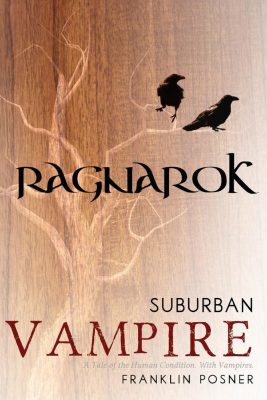
Franklin Posner gives readers an adventurous dark urban fantasy filled to the brim with vampires, werewolves, black-eyed kids, and even Sasquatches in his novel Suburban Vampire Ragnarok.
Here is a fully realized underworld of vampire factions and governments along with ancient organizations tasked with keeping track of the paranormal.
The story opens in the past, with Scott Campbell’s father capturing a German bunker during World War II. This section is reminiscent of F. Paul Wilson’s The Keep and Saving Private Ryan with a little taste of Indiana Jones. After they find a handful of mysterious artifacts, the story then jumps forward a generation to Scott, the suburban vampire working in tech support in the Pacific Northwest.
Scott’s life is complicated. Between a recent divorce, living with his widowed mother, and working for an over-controlling boss he has plenty to deal with.
On top of that, he is a vampire who must suppress the urge to feed on human blood.
Something sinister stirs behind the scenes of the vampire political world. Jack, the vampire who turned Scott against his will in hopes of using him in a diabolical coup, still has followers hidden in the vampire government. As Elizabeth and Jeremiah, vampire enforcers, hunt down the last of Jack’s sirelings and try to root out someone embedded within the vampire council, Scott falls deeper into the machinations of an evil plot and must fight to protect those he cares for.
Posner explores themes of coming to terms with a new life.
Scott’s life has changed drastically in many ways, and becoming a vampire is only one of them. After his divorce, his mother is encouraging him to get back out there and see new people.
Scott does slip a few times, but he learns from his mistakes and the guilt they bring him. He also learns to trust those who still want to be part of his life, even when they know the monster that he has become. He knows that to be near him is dangerous, but, ultimately, it is their choice.
There are a few spots where the tone of the story becomes a little too light in contrast to the tension of the scene, but the story and drama behind that tension are strong.
Readers will marvel at the fully realized world presented in this book.
The political complexity of the many organizations, governments, and agencies make for exciting power plays and relationships. Plus, readers will delight with the handful of cryptids who play roles, both small and large, throughout.
Readers hungry for vampires with intricate and grounded struggles will be pleased with Franklin Posner’s twisty tale of supernatural creatures in a modern world.
Vacationers from all walks of life converge on Portofino II-317C, South Carolina, a quaint blue beach house, in Pierce Koslosky Jr.’s short story collection, A Week at Surfside Beach.
From May 30th-December 26th each group of people comes to stay one week at a time, to forget their cares of the big city, to work, to celebrate, or to simply get away. Surfside Beach has much to show them, including temperamental weather.
The small town itself offers a charming supermarket where fishing supplies, whoopie pies, and local southern favorites can be found. The Christmas vacationers, the final of the thirteen beach house renters, struggle to find a tree in time; a real tree simply wouldn’t allow enough space for the family to sleep, and the fake tree would cost too much. But they find arts and crafts supplies in town, to fashion a paper Christmas tree during a day of rainy weather.
We all know that during vacations there are disagreements, lover spats, lessons learned, stolen kisses, and many other moments for a reader to see through the eyes of the characters at Surfside Beach.
The house itself exists in the real world, as does the town of Surfside Beach. Koslosky purchased the actual house after Hurricane Hugo hit the coast of South Carolina. The short stories connect the characters through this realistic setting.
These thirteen stories are rich with emotion and relationships. Even in just one tale, two families quarrel over a better view, a better beach house, an entrée item at dinner, their kids fighting, and a lack of parental approval of the feuding families’ son/daughter Romeo and Juliet hidden romance. Human compassion shines through these conflicts, such as in a later story where a father shows his son kindness and understanding when a gang of locals leads him astray, presenting a strong faith in humanity.
Koslosky creates a believable work of fiction which flows from story to story, recreating a well-known setting of a beach house, the characters playing out a reminder that while nothing is perfect even in paradise, nothing needs to be perfect.
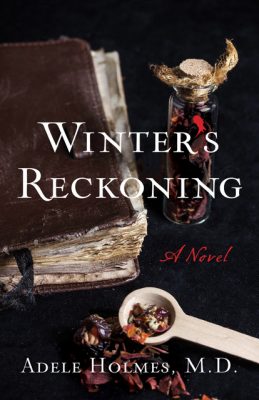
In Winter’s Reckoning by Adele Holmes, a mercurial new pastor in town threatens the families of two women.
Welcome to 1917. A time of suspenders for men and, in the cities, bloomers for women. Horse-drawn wagons range the landscape, stoves burn wood, and people have to use outdoor facilities. A time of few vaccines and no antibiotics. People understood little of most diseases. Germ theory still had ground to cover. Women routinely died in childbirth. Life could vanish in a moment.
In rural Jamesville, a Southern Appalachian town, Madeline Fairbanks does what she can to make the lives of friends and neighbors more comfortable. She works as the healer in this community – and has for the past quarter of a century. Madeline eases the passage into and out of life, treating aches and pains in between.
Maddie comes from a long line of healers. Her grandmother taught her, and she’ll pass along what she knows to her granddaughter in turn. Hannah already has the inclination. The time has almost come to give her the ancestral box, which holds herbal remedy recipes and sketches and notes. That box contains all the learning from the women in their family who came before them.
Maddie has also trained an apprentice, Renetta Morgan, who is just about ready to begin working in the community, her own community, alone.
Maddie is white. Renetta is Black. They walk through town together, brazenly traversing from North Main (the white section of town) to South Main (the Black) and back again. Sometimes they go to tend the sick. Sometimes, to the fields and hillsides, gathering the healing flowers and roots and herbs. Other times, they work in Maddie’s cabin, creating tinctures, potions, and ointments. When Renetta learns enough, the two of them must no longer work together.
The long-promised railroad has recently bypassed the town, spelling a slow death for the community, cut off now from the lifeline of the new transportation. With their Main Street shops shutting down, the townsfolk face hard times. In the South, rigid segregation, Jim Crow laws, black codes, and the Klan divide the community. In Jamesville, the pointy hat boys haven’t been active in recent memory, but that’s about to change. Not everyone turns a blind eye to the flagrant close fraternizing of Maddie and Ren, two uppity women who don’t seem to know their place. Tempers are fraying.
Into this small town closing in on itself rides a lone horseman one day, who, after a brief look around, announces that he’s the new pastor. Reverend Carl Howard is the match to the powder keg.
As the town adjusts to this new pastor in their midst, and Reverend Howard takes his measure of the place, we will watch events unfold from the vantage point of three characters, all of whom have secrets to keep. Secrets that could be their undoing.
With the loss of the railroad, another potential casualty looms – one of education.
The town is divided on whether to invest in secondary education or not. Currently, only the primary school offers its young charges the most rudimentary learning. Nothing to build on. With more education, Maddie thinks, real change might be possible. Greater equality between peoples, despite their gender or skin color. Greater freedom for women. Or at least a good step in that direction.
The theme of education and what it can bring – more profound understanding, greater personal freedom and fulfillment, and economic opportunities – underlies the struggle of those for and against keeping women and Blacks “in their place.” One side looks forward to what could be; the other looks back to what has been. The balance of power always tilts in favor of those who have always held it. As the tension mounts, where words fail, violence threatens.
When a severe winter storm hits, everyone’s lives are suspended.
As they wait out the freeze, rationing their supplies and tearing up the porch for firewood, Maddie and Ren will come to know things about each other and themselves. And Hannah will grow up a little.
Set in the brooding rural South, and for a good portion of the novel in the challenging and crystalline world of a deep snowstorm, Winter’s Reckoning is rich in storyline and character with plenty of mystery woven throughout. Simply put, here’s a story that takes on issues whose harm remains with us today. With a climactic pulpit scene that’s not to be missed – and one novel we can highly recommend!
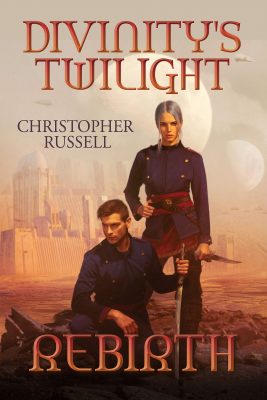
Divinity’s Twilight: Rebirth by Christopher Russell is the opening of a High Fantasy epic about the rise and fall of vast empires.
The story grows from unfinished business between three brothers gifted with magic and power but chose different paths to achieve safety and security for themselves and the people who followed them.
These different paths culminated in a battle where the fate of their world is balanced precariously on a knife’s edge. Darmatus and Rabban are engaged in a war to the death with their oldest brother Sarcon. Sarcon believes the road to that safety lies in power alone, that the only way to be secure is to crush all his enemies, no matter how heinous the deeds required.
Darmatus believes that knowledge and education are the way, while Rabban advocates for engineering and artistry. But all are powerful in war as well as in peace. In the end, Darmatus and Rabban prevail, or so it seems.
But that is only the prologue to this grand saga.
This ancient battle was a projection of memory crystals. Nearly 700 years have passed since then. Sarcon, Darmatus, and Rabban are long dead, but their empires founded by their followers continue on, each espousing the brothers’ philosophies.
Sarcon is at the pinnacle of military might, while Rabban’s engineering prowess has kept their empire dogging at Sarcon’s heels. Darmatia holds the balance of power in their mercantile empire and serves as the breadbasket for all three.
But this tenuous balance will not last long; history is about to repeat itself. Sarcon is threatening war yet again, and Darmatia seems to be on the verge of throwing in their military lot with Rabban to keep Sarcon from swallowing them both whole. The action – and there is plenty of it! – follows the adventures of one very mixed group of Darmatian military cadets who may just hold the key to peace in their ill-prepared hands.
The world of Divinity’s Twilight: Rebirth is an epic, complex, and well-crafted story.
Key characters represent each of the empires, enough to give the reader an understanding of the critical differences between the three kingdoms. The story has a vast cast overall, and keeping track of all the individuals can be challenging for some.
This story moves through multiple casts; the opening prologue has one set of characters long gone by the time the story shifts to its current time frame. Yet another set pushes the story forward until we reach that group of cadets who carry the meat of the narrative. Once the tale gets to Matteo, Vallen, and their cohort, readers won’t be able to set the book down.
The scope and setting of this series opener may invoke fond memories of the Star Wars saga for many readers.
Divinity’ Twilight weaves its tale in operatic (space operatic) fashion, where mighty empires and plucky underdogs clash. In a universe of both space ships and high magic, a place where a chosen hero – or heroine – must rise from obscurity to save their world from an evil that reaches beyond death itself.
Any reader of epic fantasy, fantastic tales of politics run amuck, or epic space battles will find a lot to love in Divinity’s Twilight: Rebirth.
As a developmental editor, I help writers in many ways, including layering in sensory data to make their stories more immersive.
I’m always gleaning information and trying to understand how the brain and nervous system work. I’m learning that it’s easy to use the latest neuroscience research and you can too.
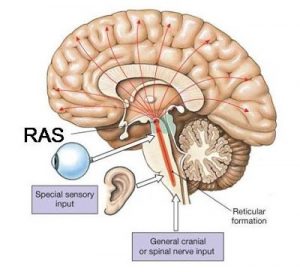
The brain works hard to protect humans from risk. Risk assessment happens via thereticular activating system, a gatekeeper between your conscious and unconscious mind. It filters through all the information coming in from your sensory organs including possible dangers, then reacts.
RAS is the GATEKEEPER between our conscious and unconscious.
Our brain is inundated with millions of messages whenever we’re awake. Without the RAS we’d be overloaded with stimulus, our heads noisy and cluttered, always on the alert, never able to focus. When messages slip past the reticular activating system, they become conscious thoughts, emotions, or both. So again, the RAS works to keep us safe and sane in a sometimes dangerous world.
What I love about studying the brain is how possible it is to change our thoughts, the way we see the world, and ultimately our brains.Because we can train and reset our brains. Another reason to learn about the reticular activating system is that it can help us focus when we most need to focus.
The RAS can filter out the white noise of your life while you write away.
Editor’s Note: An example of RAS is how parents can filter out the extremely loud noise of a plane taking off, but can hear if their baby is stirring. Or how a student can study in a loud cafeteria, but is disturbed by pages being rustled or someone tapping their fingers or clicking a pen in the next carrell while in the library.
But the RAS has many tasks. It manages what information {stimulus} you receive, arousal, and motivation. As you can imagine, is a huge job, but the brain has so many responsibilities such as regulating the body and creating memories. The RAS is located in the brain stem, the most primitive part of our brain. It is responsible for fight-or-flight responses, our wakefulness, and our ability to focus. It shapes how we perceive our world, dangers and all.
Learning about the RAS means writers can tap into its powers.
RAS can help us focus, remember, and achieve goals. One simple trick is to focus on what you want to achieve, not what youcannotdo, or what is clouding your attention. Stop worrying about the extra five pounds you’ve gained, or gray hairs and wrinkles, and how your neighbor doesn’t mow his lawn. Stop telling yourself your latest chapter or draft sucks.
The RAS listens to our signals and prioritizes the ones that are most important. If you focus on negative thoughts, the RAS will deliver more reasons to worry and fret. So, feed your RAS signals that are most helpful to your writing goals. Spend time mulling over your stories instead of fretting about them. Imagine that your characters are hanging out with you. Search for the good in your work and life and the RAS will notice. And you’ll be creating new neural pathways.
So, let me repeat this easy hack if you don’t already employ it:
Take mental snapshots throughout your days. But don’t focus on sights only–weave in all your senses. Last night I could hear the wind in the trees and smell wood smoke which has natural cozy associations which further imprinted the moment in my memory.
Let me give you a quick example.
Charles Frazier’sCold Mountain–one of the most immersive novels I’ve ever read–has two main characters separated by war. New to the Cold Mountain region, Ada, a minister’s daughter and genteel lady, is struggling to survive the Civil War after her father dies. Trouble is, she has no practical survival skills and is slowly starving, but too proud to ask for help. This is when another young woman, Ruby, comes into her life and teaches her the exhausting array of skills and tasks needed to keep them fed and warm. After Ruby’s arrival, gone are Ada’s mornings of sleeping in. Here’s a small segment of Ada adjusting to Ruby’s new regime:
So Ada would walk down to the kitchen in her robe and sit in the chair in the warm stove corner and wrap her hands around a cup of coffee. Through the window the day would be starting to take shape, grey and loose in its features. Even on days that would eventually proved to be clear, Ada could seldom make out even the palings of the fence around the kitchen garden through the fog. At some point Ruby would blow out the yellow light of the lamp and the kitchen would go dim and then the light from outside would rise and fill the room. It seemed a thing of such wonder to Ada, who had not witnessed many dawns.Cold Mountain, Charles Frazier
The Swangers notice Ada is struggling to maintain the farm so they send Ruby Thewes to help out. Cold Mountain by Charles Frazier
There are only a few simple details here, yet the sense of dawn arriving is powerful, isn’t it? And it’s Frazier demonstrating the beginning of Ada’s character arc.
Think in pictures, vignettes, and scenesso you can re-create them on the page.
Strive to always capture meaningful moments. This is why it helps to stop time whenever possible by focusing your attention and deliberately storing images. Train yourself to become a visual thinker. If you’re ‘not a visual type’, then study how other people do it from advertisers to public speakers.
Pay attention to your dreams and write them down if possible. Take notes on books you read, films you watch and hikes you take.
Here is a scene from my RAS moment last winter:
Foggy, drizzly weather here in the Pacific Northwest. Last night I stepped out onto my porch to see if the moon was visible. The current moon phase is a waxing crescent. Low clouds had moved in obscuring the moon and stars, the air was cold enough to be bracing, and snow was falling in the higher evaluations. Walking into a coldish reality is such an easy jolt to the senses.
I came back indoors and sat for a minute replaying the night scene I’d just witnessed. Deliberately storing it away.
Do you do this too? Small habits and tweaks can be so useful to writers.
If you stop to focus on things that are important to you, it sharpens your perceptions and teaches your brain what you value.
And work at giving your RAS a jolt, like stepping out into a cold night or dancing in warm summer rain showers. Play music to either soothe or energize while you write. Recently I suggested here that like me, you visit a library or bookstore, go to the shelf where your future books will be housed, and imagine your titles there. It’s a simple trick to cue your reticular activating system.
Vivid, clear intentions communicate to your conscious mind which in turn speaks to your RAS and subconscious. In turn, they help you achieve goals because they expect the goals to happen.
Keep writing, keep dreaming, have heart. – Jessica
Jessica Page Morrell
Jessica Morrell is a top-tier developmental editor and a contributor to Chanticleer Reviews Media and to the Writer’s Digest magazine. She teaches Master Writing Craft Classes along with sessions at the Chanticleer Authors Conference that is held annually along with teaching at Chanticleer writing workshops that are held throughout the year.
Be sure to click on her name above to visit her website that has a wealth of writing craft advice.
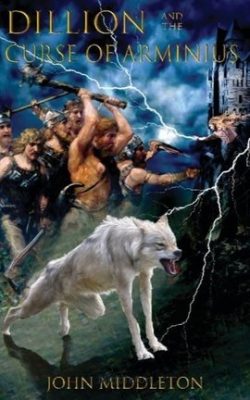
Hang your disbelief by the door, pull up a chair, and prepare to step back in time to a period of unrest that would forever change the world In Dillion and the Curse of Arminius by John Middleton.
British and European legends set the stage for ancient warriors with a clarion call to re-awaken to battle—and only the innocents can intervene.
In 1936, the children of the privileged le Close family pursue their interests and enjoy their lives at their patriarchal home, gifted to the original Baron le Close by King James centuries ago. Since Oakholm Abbey lay on the border of England and Wales, everyone looked to the Baron to protect the surrounding farmlands from Welsh raiders. They would slip down from the wilds of the Welsh hills and valleys just beyond the old monastic estate and do their damage on the population.
By virtue of their lineage, the youngest generation of the le Close family, Gilbert and Emelia, have certain special abilities. Gilbert is attuned to the animal kingdom—and it to him—and wanders fearlessly into deep forests on the Welsh borderlands where he discovers magical places. These places exude an aura of intense spirituality, bringing Druids and secret ceremonies to mind. On the other hand, Emelia is percipient, although she is only just learning how to understand the meaning of her experiences.
Unbeknownst to Gilbert and Emelia, trouble brews across the channel.
They will soon become integral in saving both the lives of their good friends, Axel and Rebecca, German refugees now living in Amsterdam, and in helping good conquer evil in their part of the world.
Meanwhile, at Schloss Wewelsburg, a centuries old castle in south-western Germany, Heinrich Himmler, the commander of Hitler’s SS, has turned to the occult to realize a dream. He believes in the supernatural and wants to contact and enlist the aid of the fabled Cherusci warriors who conquered the Romans centuries ago to assist in Germany’s attempt to rule Europe.
Himmler connects with a revenant whose ancestor was second in command to Arminius, the chieftain of the fierce Cherusci tribe that freed the Germanic people of Roman rule.
What happens next, when the bucolic world of life at Oakmont Abbey collides with the occult, is the stuff of legends.
Gilbert and Amelia will discover their connections to their ancestral history, and are called upon to fulfill their predestined roles as guardians of a sacred place. They will be sorely tested, and must call upon everything in their beings to survive, to secure the survival of their friends, and to save their way of life.
In Dillion and the Curse of Arminius, author John Middleton has created a work of fantasy fiction with a plot that will appeal to pre and early teen readers. Much of the writing is lyrical with vivid imagery, creating a mystical mood—set up with a complex storyline and sophisticated language.
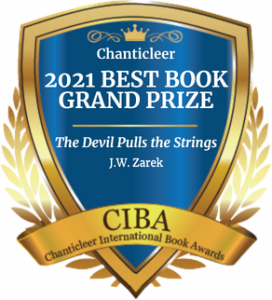
We are deeply honored and excited to continue to announce the 2021 Winners of the Chanticleer International Book Awards (The CIBAs) with our third and final of three official postings.
CIBA Grand Prize Ribbons!
The winners were recognized at the CIBA ceremonies held on June 25th, 2022 in-person and by ZOOM webinars at the luxurious Hotel Bellwether, Bellingham, Wash.
The CIBA announcements were made LIVE with Chanticleerians participating and interacting from around the globe and North America.
Raising our glasses to cheer the CIBA Winners!
We want to thank all of the CIBA judges who read each and every entry and then comment, rate, and rank within each of the 25 CIBA Divisions. Without your labors of love for books, the Chanticleer International Book Awards would not exist. THANK YOU!
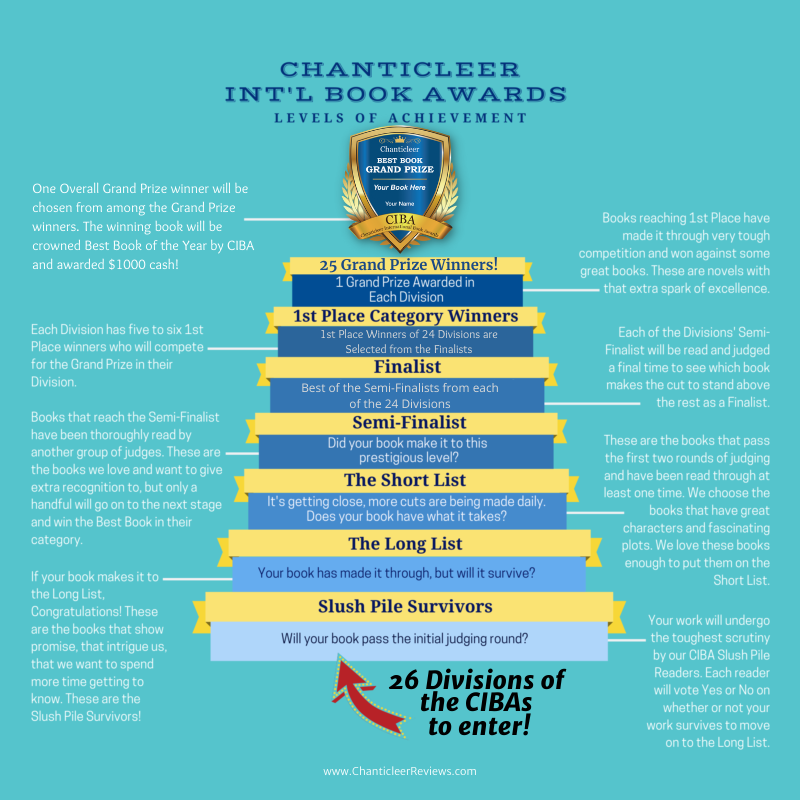
We want to thank all of the authors and publishers who participated in the 2021 Chanticleer International Book Awards (the CIBAs). Each year, we find the quality of the entries and the competitiveness of the division competitions increasing exponentially. We added a new level to the judging rounds in 2019—the premier Level of FINALIST per each CIBA Division. The CIBA judges wanted to add the Finalist Level of Achievement as a way to recognize and validate the entries that had outstanding merit but were not selected for the very few First Place Award positions within each genre division.
This post will recognize the First Place and Grand Prize Winners for the
Seven Non-Fiction Divisions:
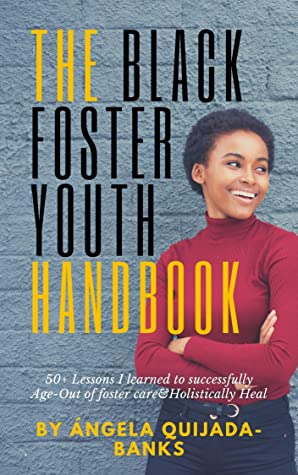
Journey, Hearten, Harvey Chute, Mind and Spirit, I & I, Military & Frontline and Nellie Bly
along with the FIRST Winners for the
Short Story, and Book Series Awards,
and concluding with the
OVERALL 2021 GRAND PRIZE WINNER
for the 2021 Chanticleer International Book Awards
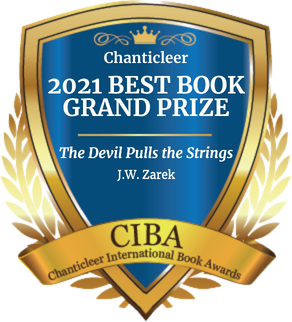
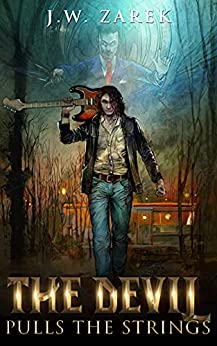
J.W. Zarek will also be awarded $1,000 USD in recognition of her 2021 BEST BOOK of the YEAR – Chanticleer International Book Awards – Sponsored by Chanticleer Reviews & Media.
A Chanticleer Review ofThe Devil Pulls the Stringswill be featured in the in the Chanticleer Reviews OnWord Magazine (print and epub) along with other promotional and marketing opportunities along with an interview with the author, J.W. Zarek.
Thank you J.W. Zarek for participating in the 2021 Chanticleer International Book Awards. We look forward to receiving future work in our CIBAs.
CONGRATULATIONS J.W. Zarek!
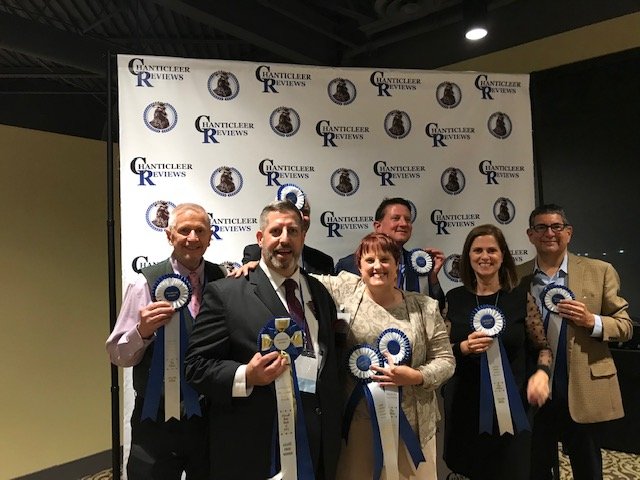
Six Grand Prize Winners with J.W. Zarek, the 2021 Overall Grand Prize Winner!
From all of us at Chanticleer International Book Awards and Chanticleer Reviews.
Looking for your Division? Check out our previous posts:
Be sure to register early for the 11th Chanticleer Authors Conference that will start on April 23rd, 2023 with the 2022 CIBA banquet and ceremony scheduled to take place on Saturday, April 25th, 2023 at the luxurious Hotel Bellwether in Bellingham, Wash.
Be well. Stay Healthy. Take Care!
An email will go out to all 2021 CIBA award winners prior to October 30, 2022, with instructions, links, and more information about the awards packages. We appreciate your patience. As stated many times before “One does not need to be present at the CIBA ceremony and banquet to win. But it sure is a lot more fun!”
As always, please contact us at Chanticleer@ChantiReviews.com with any questions, concerns, or suggestions!






 Kiffer is the founder of Chanticleer Book Reviews and International Writing Competitions, LLC. She is also a partner in SillanPaceBrown Publishing + Production LLC, which specializes in curating books with the potential to become fully actualized intellectual properties.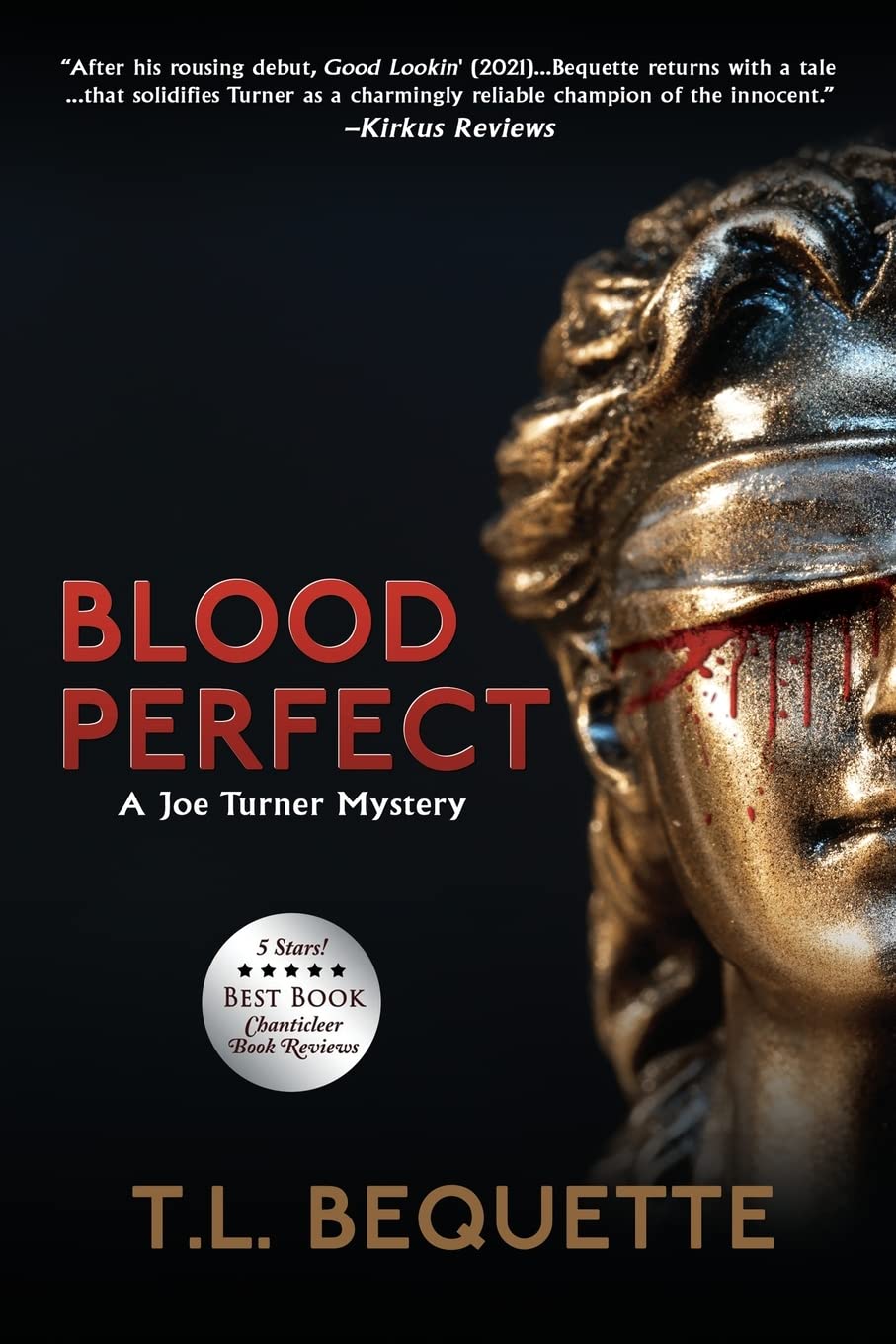

 Franklin Posner gives readers an adventurous dark urban fantasy filled to the brim with vampires, werewolves, black-eyed kids, and even Sasquatches in his novel Suburban Vampire Ragnarok.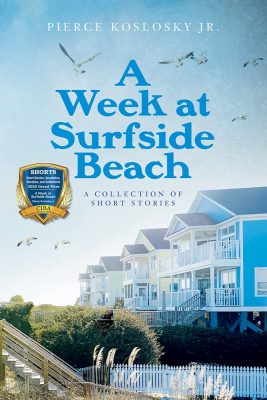

 In
In 
 Divinity’s Twilight: Rebirth

 Hang your disbelief by the door, pull up a chair, and prepare to step back in time to a period of unrest that would forever change the world In