
Author: Barbara Bamberger Scott

  • The SUBURBAN MICRO-FARM: Modern Solutions for Busy People by Amy Stross – Fruit Gardening, Sustainable Gardening, Garden Design, Gardening & Horticulture Reference

    The SUBURBAN MICRO-FARM: Modern Solutions for Busy People by Amy Stross – Fruit Gardening, Sustainable Gardening, Garden Design, Gardening & Horticulture Reference

    Author, educator, and urban farmer Amy Stross offers a comprehensive look at how to repurpose a small yard in the city for basic sustenance and so much more.

    Award-winning writer Stross has composed a thoroughly practical guide to everything a reader would need to know to do what she did: transform a yard into a farm. Acknowledging that the ground surrounding a town dwelling is hardly what one thinks of when one thinks farmland, Stross draws from her personal experience to show precisely how the transformation can take shape. Her colorfully illustrated manual gives the basics for managing an ample garden space, or micro-farm, almost down to the minute (in fact, seven minutes twice a day).

    Stross was caught between jobs and challenged to make the best use of time and space. Growing the kinds of foods her family liked to eat on a tenth of an acre, preparing and preserving them and, at times offering produce for sale became her grand quest. She shares the wisdom she gained as she gradually moved from beginner to experienced farmhand, to teacher of others. She tells readers what, why, and how to grow sustainable crops from the depths of the soil on up.

    One bias Stross invites us to overcome is that gardens are ugly and should be hidden. She blasted that notion by using the “parking strip” – that piece of land between the sidewalk and the street – for cherry trees, providing not only the beauty of the spring blooms but, after a few years, an abundance of cherries for jams and preserves. She makes useful suggestions about how to explain one’s project to perhaps skeptical or critical neighbors. She recounts our American history of Victory Gardens as a success story supporting the home garden venture. If we can, why should we not provide a good portion of our edibles by our own labor? Later, the author became involved in community gardening, learning from, and helping others in a socially responsible setting.

    Stross’s book combines memoir and good humor with an encyclopedic knowledge of the subject. She starts with soil with composting readily available substances like coffee grounds and eggshells, then covers annual plantings and planning with a micro-farm calendar. Instead of seeing hills, rocks, and other barriers as problems, Stross shows how these can be utilized in the overall strategy of garden planning. Stross goes on to recommend specific plants for specific purposes such as hedgerows, shady areas, and saleable products like cut flowers and homemade soaps. Following her example, readers can become writers, teachers, and sharers of the vast body of information she presents. The Suburban Micro-Farm projects Stross’s personal win-win-win-win: readers will learn, learners will do, doers will share, and all will be the better for it.

    The Suburban Micro-Farm: Modern Solutions for Busy People won First Place in the 2018 CIBAs for Instruction and Insight.


     

  • The SECRET of the MOON by Anthony Allaway – Metaphysical Sci-Fi, Fantasy, Myths & Legends

    The SECRET of the MOON by Anthony Allaway – Metaphysical Sci-Fi, Fantasy, Myths & Legends

    In a world once nearly obliterated by war, mankind has been put under the control of powerful religious forces. However, not all humans are convinced of the beneficence of their rulers. A young man named Axel is destined to combat the evil that pervades his realm.

    Axel is an introspective young man, partner to Val, his beautiful true love, with whom he shares many secrets from childhood. He questions the meaning of life, the mysteries of the cosmos, even the works of God. His nemesis Lucinder is the offspring of a mother raped and savagely beaten by his priest father, leaving him with no feelings of love or compassion, only hatred underpinned by a deep cynicism.  Now known as the Serpent Priest, Lucinder and his goddess-like lover Shira hold thousands in thrall, promulgating rigid religious doctrine. When Axel learns that Lucinder is planning a global upheaval, he knows he must act before Lucinder has a chance to exact his wrath.

    First, Axel urges his little band of loyal companions to retreat by entering the Enchanted Forest.

    The forest is seen as a mysterious, dangerous place, but Axel reveals that he spent time in the forest as a child and that there are forces of good within its shadows. From a Buddha-like human figure and heavenly visions, Axel will learn why he has been chosen and what sacrifices he will make in an epic battle against evil.

    In this engaging debut fantasy, Anthony Allaway writes with an undeniable flair for the genre with tropes reminiscent of Tolkien and C. S. Lewis.

    He uses Biblical lore, European mythology, and ancient folklore in his story, though all are clothed in illusion and metaphor. One example is the fruit tree that stands in the middle of the Enchanted Forest, the tree from which Axel and Val eat the fruit. As a consequence of taking and eating the fruit, the children are banished from the Temples of Avalon, where the monks reside. But from the fruit, in Allaway’s mystical depiction, Axel is given revelations about the powerful secret of the moon.

    The author has created vibrant characters: innocent children; nefarious priests; memorable females like the generous-hearted Grace and the nasty-minded Shira; and angelic beings who seem a cross between the pure spoken of in religious literature and the all-seeing but humanly flawed celestial overseers described in Greek mythology.

    The blend of heady philosophy and an action-packed plot forms a colorful, page-turner-of-a novel.  Allaway’s story is the stuff dreams are born out of, easily envisioned in cinematic images that will appeal to all imaginative readers.

    Chanticleer Book Reviews 4 star silver foil book sticker

  • ELEPHANTS IN MY ROOM by Christie Nicholls – Dark Humor, Love, Sex & Marriage Humor, Actor & Entertainer Biographies

    ELEPHANTS IN MY ROOM by Christie Nicholls – Dark Humor, Love, Sex & Marriage Humor, Actor & Entertainer Biographies

    A bitingly funny collection of life-stories from Christie Nicholls – stand-up comedian, actor, and writer – made all the more piquant by her repeated insistence that she has no short-term memory. Fortunately for us, her long-term reminiscences more than make up the deficit.

    Nicholls has divided the book into four parts. In the first, “A Broad Abroad,” she recalls her experiences of traveling to far-flung places, beginning with a summer in Belém, Brazil as a child. She and her brother, for some reason nicknamed Beluga, slept in hammocks and played in a swimming pool, but much of her cherished time involved a German Shepherd named Ferdinand, from whom she learned dog talk. Raucous family bowling in Bologna, Italy, is contrasted with attendance at a staid English wedding. At a later period, Nicholls and her mother went to Sweden, where the budding comic tried her hand at stand-up in newly acquired Swedish, leading to an amusing mix-up of jargon.

    “Odd Jobs” highlights employment, from babysitting to trying to sell magazines by phone and getting the ax for her admirable refusal to inveigle a woman who was going blind to buy a subscription. Nicholls’ recollections of those “Dearly Departed” includes lessons learned from a singularly inspiring music teacher, and time spent with her grandparents – with the pain of watching them slowly “disappear” from failing health and dementia.

    In “Boys to Man,” she confesses a few of her more outstanding, and hilarious, meet-ups with the opposite sex, revealing her youthful whims and desires. The final episode, and the book’s closing, is a comedy of errors that gradually reveals itself as a well-crafted salute to her partner and their quirky manner of demonstrating mutual respect.

    Nicholls is a charming yarn spinner, revealing much about herself in this lively aggregation, and not all of it merely for laughs. She expresses her self-doubts and her struggles with schooling and recalls the year she did not win a prize from her music teacher. The experience of not being acknowledged for her effort spurred her to try even harder next time. Nicholls admits her many flaws in a characteristic satirical manner, almost certainly dramatized for comic effect. But poignant moments arise frequently. After feeling frustrated in her early relationship with her grandfather Poppop, who could be, and often was, sarcastic and bombastic, she took up his cause. She protected him when he became wheelchair-bound, rewarded by his beaming smiles.

    Anyone familiar with the author’s significant talents will be happy to learn that she can write as well. Indeed, those getting to know her through this debut writing romp will want to see her show, follow her on social media, stalk her at the grocery store… well, we discourage stalking. What you will come away with is a genuine respect and admiration for Nicholls, a smart modern comedian, who brings her audience joy and quite possibly makes the world a brighter place to reside.


  • DAVID and AVSHALOM: Life and Death in the Forest of Angels by Bernard Mann – Ancient History, Augmented Historical Accounts, Jewish Literature and Fiction

    DAVID and AVSHALOM: Life and Death in the Forest of Angels by Bernard Mann – Ancient History, Augmented Historical Accounts, Jewish Literature and Fiction

    Debut novelist Bernard Mann has diligently researched a wide-ranging saga centered on the life, loves, songs, and struggles of King David, a central figure in the Old Testament and author of the Book of Psalms.

    The tale begins at a crucial stage of David’s life as he is escaping the wrath of King Saul. Once a father-figure to the former shepherd boy, Saul’s view of David sours when the majority of his subjects begin to revere David over him. David flees with a small band of loyal stalwarts. He is still a fast friend to Saul’s son and likely successor, Jonathan, and is married to Saul’s daughter Maacah. Moreover, he still holds fast to his faith in God and continues to compose poems and songs in praise of Him. When both Saul and Jonathan perish in battle, David takes up the struggle, amasses an army, receives the crown, and seizes the city of Jerusalem, making it the seat of Israelite power.

    The title, David and Avshalom, is reflective of the King’s sin of infidelity and murder. David lusts after his general’s wife. He sends the soldier to the front line of battle with a cryptic deadly message so he can take Batsheva as his lover and wife. David loses two precious sons, one of them his beloved Avshalom (often spelled “Absalom”) whom he had hoped to crown as his successor.

    The details of King David’s life, as told in the Bible, are generally accepted. Mann includes augmented material in this lengthy portrait of one of history’s most significant players, whose actions in the restoration of the city of Jerusalem impact the region today. Portions of psalms (poetry/songs) speckle the narrative, put in place as the inspiration to critical junctures in the King’s life, such as the death of Samuel or the conquest of Goliath.

    One aspect of David’s personality that Mann stresses is his respect for women. Calling together numerous scribes to begin recording his people’s history, David is introduced to the works of Judith and includes them and the writings of other women in the endeavor. Here is a king who contradicts the standard practices of the day and honors his daughters equally with his sons.

    An international architecture expert, Mann pieced David’s exploits together by drawing on several books of the Bible – Samuel I and II, Joshua, Kings I, Chronicles I, and Psalms. He describes his book as “presented in fictional fabric” while assuring the reader of its scholarly sources and attributions. He has included some lesser-known facts about his main character – alliances, weaponry, and, again, the belief in the equality of women. Mann proclaims, “… David…was cast by the Lord in a different mold than that of any other man.”

    The result? Mann delivers smart text, worthy of study, as well as a lively plot capable of engaging thoughtful readers. His prose is rich and his imagination equally so, as he brings King David back to life in a fresh way sure to invite attention and appreciation.

    David and Avshalom:  Life and Death in the Forest of Angels won First Place in the 2018 CIBAs, Chaucer Awards for Early Historical Fiction.


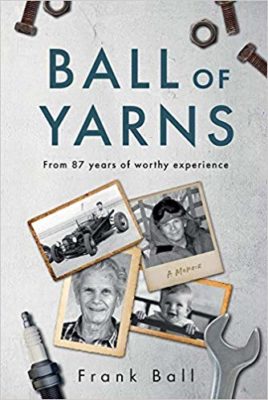
  • BALL of YARNS – From 87 Years of Worthy Experience by Franklin Ball – Memoir, Americana, Heartwarming Stories

    BALL of YARNS – From 87 Years of Worthy Experience by Franklin Ball – Memoir, Americana, Heartwarming Stories

    Author Frank Ball delivers an engaging, poignant account, contrasting idyllic times growing up and the remote, icy climes of his later years in his memoir, Ball of Yarns – From 87 Years of Worthy Experience.

    Born in 1931, Ball was raised in rural California. Often left on his own, the result was a series of escapades with the first object of his affections – vehicles of any kind. An early solo experiment with his father’s sedan gave him the heady feeling of “wheels unguided by human hands.” A next adventure involved rebuilding, with his brother, a neglected Chevy Roadster that Ball proudly drove to school in the sixth grade. Yet another, more terrifying event occurred when he and a friend decided it would be fun to take a farm tractor up into the mountains on a snowy day; the descent was “reminiscent of a scene from the Keystone Cops.”

    In high school, he and his pals visited an inactive bomb-testing site and exploded “dud” ordnance for kicks, and he later drove a racecar and worked as a pitman for that sport. Ball served in the military during World War II, stateside, getting technical education leading to a career in electronics, in which he excelled. After retirement, he and his wife Josie pursued more exploits together, living for long stints in Antarctica, she as a cook and he as an all-round mechanical whiz. It provided an atmosphere of camaraderie where the person nearest to a disaster had to deal with it immediately or risk the whole camp’s population freezing to death.

    Ball tells his life saga in engagingly short, chronological episodes, most only a page or two. He has provided a few photographs to underpin his often-amusing narrative. His writing style shows a particularly strong ability to put the reader into the frame. This is especially the case with his story of going into the salvage business with a friend. Using shallow-water diving gear, they discovered a submerged vessel near the San Diego Bay. Pirating bits of it, mostly brass propellers, they were observed, and a story made the local newspapers since the vessel was, in fact, an abandoned US Navy submarine. Equally enthralling are the many aspects revealed about his working in frigid conditions, repairing everything from aircraft fuel pumps to urinals and figuring out for his own amusement how long it takes a cup of hot coffee to freeze when setting out in the subzero cold. And even in his eighties, he is still repairing and driving vintage cars.

    Ball’s well-organized reminiscences will charm anyone with a love of vehicles, machines, youthful high jinx, and general mischief. His compelling American story speaks to timeless values of passion, family, ingenuity, determination, and legacy. 


    **Ball of Yarns by Frank Ball releases on January 14, 2020. To get your copy, please click on Kobo or Amazon.

  • A HOME on the SOUTH FORK – An Early History of ACME – A Northwest Washington Community by Margaret A. Hellyer – Pacific Northwest History, Narrative Non-Fiction, Small Town Histories

    A HOME on the SOUTH FORK – An Early History of ACME – A Northwest Washington Community by Margaret A. Hellyer – Pacific Northwest History, Narrative Non-Fiction, Small Town Histories

    For untold millennia, the region that would come to be known as Whatcom was occupied by the indigenous conglomerate of tribes known as the Salish, who were peaceful and civilized. The Nooksack, who are a part of the Coast Salish, spent their time fishing, building canoes, weaving, and farming. In the 1850s, that began to change as the native peoples had to learn to co-exist with a new incursion of settlers—hardy people from the Eastern states and as far away as Europe.

    They came to the region with the lure of inexpensive land ownership that had been made possible by the Homestead Act. A few had drifted in earlier when false rumors of gold were sounded, those early explorations revealing arable land and an abundance of natural resources.

    Early homesteaders found the resources both sustaining and at times, daunting. For example, the trees themselves were so enormous that felling them was perilous, and logjams were frequent, cutting off the river’s flow. The winters were harsh and the summers, bug-infested. But families like the Galbraiths (the author’s ancestors) were hardy and determined. By the early 1900s, a thriving town had been established.

    Readers who think of the early 20th century as ancient times will be surprised by Hellyer’s lively account of how an organized and industrious outpost developed out of a nearly uninhabited wilderness. Not long after the first settlers arrived, cabins and then houses soon bloomed into handsome estates, some of which still stand today in Acme and elsewhere. Along with the settlers came schools and school districts. Roads changed from dirt trails to cement highways, while railroads transported logs and shingles out and new visitors in. Modern conveniences such as a town water system, churches, electricity, and the postal service arrived to make life easier. Readers will be amused by the telephones, with party lines that allowed everyone in the community to know everyone else’s business.

    People of Acme had to travel to a dentist, and, for a while, the town had a doctor who dealt with a variety of contagious diseases, delivered babies, and reattached severed fingers. At one time, citizens also had access to a local pharmacy to help with their aches and pains. Acme’s General Merchandise store sold everything from dry goods to salt meats, run by the Zobrist family, original settlers of the South Fork region. Recreation for the fully established town included hiking trips, concerts, and dances open to “woodmen and the general public.”

    Hellyer was born in Whatcom County and has remained, pursuing a career in graphic design while enjoying a personal interest in photography and writing about local history. Her family photos and recollections are a small but significant part of this story. Illustrated with black and white images on nearly every page, Hellyer’s historical account of the settling of the South Fork will enthrall both a regional audience and those curious about American pioneering in the Great Pacific Northwest.


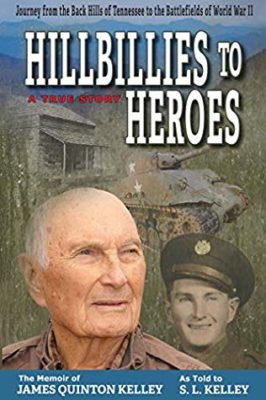
  • HILLBILLIES to HEROES: Journey from the Back Hills of Tennessee to the Battlefields of World War II – The Memoir of James Quinton Kelley by S.L. Kelley – World War II Biography, American Heroes, World War II History

    HILLBILLIES to HEROES: Journey from the Back Hills of Tennessee to the Battlefields of World War II – The Memoir of James Quinton Kelley by S.L. Kelley – World War II Biography, American Heroes, World War II History

    World War II veteran Quinton Kelley recounted his life story to an avid biographer – his daughter, S. L. Kelley, a documentarian and award-winning video producer.

    Kelley’s tale begins in Coker Creek, Tennessee, where he was raised on an 80-acre farm, in a log cabin that he described as rough, but “brightened” with flowers. Taught to be honest and hardworking by his parents, he grew up with kerosene lamps for light, a fireplace for warmth and a wood stove for cooking. His recollections are colorful, with language that recalls his roots.

    As a boy, he wore shoes only to church or to town and attended a church that doubled as a one-room schoolhouse. Everyone in the region knew someone who made moonshine, “a scruffy bunch,” Kelley called them; the local country store had bullet holes in the walls from fights between that bunch and the storekeeper. In his teens, he began work away from the farm, first for a local gold prospector, then for the TVA. Then in 1940 he heard about World War II and knew he’d be drafted.

    The second part of the book shows Kelley leaving Coker Creek for Camp Beale, California, where he became the company carpenter. Assigned to an armored division, the former farm boy showed his worth as the only member of his group who did not need the training to drive a tank. He met fellow recruits from all over America, and despite the manly joshing and rough language among them, the boys in his platoon once generously gave him money to get home when his sister was dangerously ill.

    He drove into combat, first in France, then in Germany, as part of an initiative that ultimately saw the end of Hitler’s Third Reich. Kelley (who passed away before the publication of his memoir) did not glorify himself in recounting his war exploits, but vividly described what it’s like to sit in a tank, looking at the action through a tiny window, always in danger of being killed while trapped inside the metal box. There’s not much room, he opined, for mistakes in battle.

    In his Tennessee argot, he states that combat “made me a bit jubrous.” Still a homeboy at heart, courting a girl by mail, Kelley noted that French and German people were good farmers, though still using horses, and very orderly in their houses and fields. Camped near Berchtesgaden after victory, he refused to go see Hitler’s former hangout: “I didn’t want to waste a minute on that sorry ol’ scudder.” Once back in the US, marriage to his sweetheart soon followed.

    Two books in one, this substantial memoir can be read equally avidly by nostalgic southern and mountain folk as a wide-ranging recreation of simpler times, or by anyone who is drawn to tales of war – both the battles and the long days and hours waiting and watching for the next conflict – as seen up close and personal. Using her writer’s instinct and flair, S.L. Kelley has done a remarkable job of combining her father’s spoken words, his accent, and slant, with those of fellow combatants, and others. Her book would make a splendid gift for old-timers, and a wholesome educational read for younger generations who would do well to remember and revere the sacrifices of America’s soldiers, and a heartfelt recollection that those who make history can be kindhearted and good!

    Kiffer’s favorite quote from this book: “…it took all of our personal sacrifices to go from war to peace.”  Quinton Kelley

  • HOW DACHSHUNDS CAME to BE: A Tall Tale About a Short Long Dog by Kizzie Jones – Children’s Books, Mythology & Folk Tale, Children’s Dog Books

    HOW DACHSHUNDS CAME to BE: A Tall Tale About a Short Long Dog by Kizzie Jones – Children’s Books, Mythology & Folk Tale, Children’s Dog Books

    Author Kizzie Jones creates a beautiful origin story about how the lovable dog species – the Dachshund – came to be with the help of illustrator Scott Ward.

    In an enchanted time and place, a little girl walks every day along a beautiful beach, delighting in the sea stars, anemones, mussels, and barnacles that are revealed when the tides sweep out. She combs the beach for treasured “friends” of shells and sand dollars. A pod of humpback whales visits the beach twice yearly, and the little girl thrills to see the whales and their newborn calves. But the little girl is lonely and more than anything, wishes for an animal friend to take home with her.

    Kizzie Jones loves dachshunds (she has three) and lives near the Salish Sea, where Orcas and Humpback whales and other sea life frolic and play. This familiar setting provides a rich environment for her charming stories to take root. How Dachshunds Came to Be: A Tall Tale About a Short Long Dog, is Kizzie Jones’ first book, and like the other books in her series, A Tall Tale About a Dachshund and a Pelican: How a Friendship Came to Be, and her very latest book in the series,  A Tall Tale  About Dachshunds in Costumes: How MORE Dogs Came to Beartist Scott Ward’s illustrations perfectly match the mood of Jones’ narrative – bright, fresh, almost etheric colors of sea, sand, and the whimsical renderings of the little girl and those who love and surround her. Each page number is highlighted on the back of a dachshund, and the three dogs that rush to befriend the little girl are simply adorable. This sweet collaboration makes a perfect “read-to” for parents and grandparents of toddlers and an engagingly accessible tale for older children to delve into on their own.

    Shortly after the little girl leaves the beach for home, the whales decide to find a companion for her. This friend would need to be a warm-blooded mammal – able to breathe fresh air. Each creature has ideas about the ideal companion. A barnacle suggests giving it a long nose; seals advise a “long sleek body” just right for cuddling; anemones think it needs soft wavy whiskers and eyebrows. The octopus naturally suggests 8 limbs. Still, the group settles on four, with padding on the ends of their legs – suitable for walking on land.

    By the time the little girl awakens and returns to the beach, she finds not one but three new friends – black, brown-red, and golden dachshunds. They run to her, ready for cuddles and loves.


  • GENERAL in COMMAND – The Life of Major General John B. Anderson by Michael M. Van Ness – Military History, WWII Biographies, Military & Spy Biographies

    GENERAL in COMMAND – The Life of Major General John B. Anderson by Michael M. Van Ness – Military History, WWII Biographies, Military & Spy Biographies

    Michael M. Van Ness, the grandson of “the general in command,” has created a remarkable biography chronicling the adventures of a farm boy who rose high rank in the US military and served with distinction in two world wars as a combatant, officer, and sage observer.
    Born in 1891, John Benjamin Anderson must have had considerable intelligence as well as patriotism and grit, since he was accepted at West Point Military Academy at age 19, an honor conferred on only 130 applicants per year—and finished in the top third of his class. He would soon serve under General Pershing in the Mexican War, giving him the experience of combat and coincidentally, his first ride in an automobile. That deployment earned him inclusion in Pershing’s ranks in World War I. It was then his diaries began, and though he protested humorously that “I hate to write,” these personal recollections give readers an up-close picture of the devastation of warfare.

    Anderson also describes, in straightforward prose, the grim conditions of foot soldiers in that terrible war—in muddy water up to their waists in the trenches, and always carrying two gas masks. The war gave him a chance for advancement through the ranks, and admiration for his fellow fighters, including the “bulldog tenacity of the British.”

    His welcome home included giving a speech to the locals along with the realization that the military would be his lifetime profession, as the family had died or scattered. He studied to attain the rank of major and then lieutenant colonel, married happily, worked in Washington, DC, and had an assignment with the CCC (Civilian Conservation Corps) during the Great Depression.

    In 1942, as a new war was rumbling once more in Europe, he took charge of training an infantry division. In 1944, he met with Winston Churchill; in fact, at one time he escorted Winston Churchill and Field Marshal Montgomery over the Rhine River. General William Simpson was a dear friend of Anderson’s and the pair maintained contact for years. He wrote letters to his wife, daughter, and mother-in-law; his homey descriptions included seeing a cart drawn by a dog, and noting foreign celebrations of Christmas. His XVI corps served in the Rhineland campaign, and he personally oversaw the liberation of the Dutch city of Roermond, where his name is revered to this day.

    After the war, Anderson retired but often attended reunions with his military cohort and continued to receive civilian recognition. However, unlike many others, including his friend Simpson, he did not receive a post-war promotion. A rise to lieutenant general would fairly reflect his actual role in World War II, so Van Ness and others continue to petition for this honor—a third star—to be bestowed posthumously, as it is undoubtedly merited.

    Van Ness served in the Navy in a medical capacity and shares a deep understanding of his outstanding forebear in this well-organized life story, which offers a thorough, thoughtful exploration of the many issues that arose during his grandfather’s wartime service. General in Command – The Life of Major General John B. Anderson will resound those who have served their country, either at home or abroad, their families, and with military history buffs. Highly recommended.


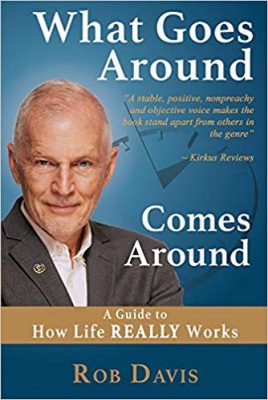
  • WHAT GOES AROUND COMES AROUND – A Guide to How Life REALLY Works by Rob Davis – Philanthropy & Charity, Motivational Management & Leadership, Business Motivation & Self-Improvement

    WHAT GOES AROUND COMES AROUND – A Guide to How Life REALLY Works by Rob Davis – Philanthropy & Charity, Motivational Management & Leadership, Business Motivation & Self-Improvement

    Combining personal vignettes with sage advice, Rob Davis demonstrates how the saying, What Goes Around Comes Around, connects to other sources of wisdom, indeed to our everyday lives. As an adult involved in business, family, and sports, he came to recognize how true the saying is.

    As a child, he often heard the expression, “As you sow, so shall you reap.” As an adult, he saw in numerous situations, including the experiences of friends, business partners, and in his own life, how the results we reap do come from the actions we sow.

    It was some time until he realized that “sow” referred to the planting of seeds and had nothing to do with needles and thread. Also, that “reap” referred to how successful or disappointing the resulting harvest would be.

    One example referred to the Ponzi scheme run by Bernie Madoff, the notorious financier who had built what appeared to be a thriving business until being exposed as a fraud who stole $millions, even from widows, orphans, and charities. Madoff is now in prison, most likely for the rest of his life.

    Suppose Davis suggests, that early on, Madoff had called together those involved, and “fessed up?” While the consequences would have been painful, they would not likely have been anything as disastrous as the total ruin he and his family ended up experiencing.

    The lesson here is that the longer one lets the deception continue, the more bottomless the pit they dig for themselves when the light finally catches up to them.

    Much of the book’s theme rests on the significance of choice. When it appears that we have no other option in a given situation, the right choice probably seems like the most challenging thing to do. Here Davis cautions us to set our sights on the high road to avoid losing the chance for the most positive possible outcome.

    Of course, not all choices are wrong, and not all comebacks are bad. A friend and running buddy described by Davis wrecked his car after having had a few too many drinks at a party. His driver’s license was suspended for three months, along with the requirement to attend weekly classes. Despite the problematic consequences, his friend turned this self-created slip into an example for his children, by accepting the full measure of his punishment and making the best of it.

    Some of Davis’ stories are his own, such as the time he was kicking himself for not living up to his commitment to helping a friend who had organized a charitable fund-raising event. The result led to his creation of a new organization supported by alternative, investment industry people for the prevention and treatment of child abuse.

    His book concludes with positive “Thoughts to Live By,” such as – I Choose HappinessI Cooperate for the Greatest GoodI Take the High Road, and I Expect to Be Happy.

    His philosophy, as expressed here, makes effective use of humor, humility, and a hefty helping of logic! Drawing insight from personal parables, Davis has constructed a manual of straightforward and sensible life skills designed for those who genuinely want “what goes around” to yield the best outcomes!